Posted on 07/19/2022 3:23:18 AM PDT by Cronos
Sunday of the 16th week in ordinary time
St. George's Chaldean Catholic church, Mosul, Iraq Readings at MassLiturgical Colour: Green
Have pity on us one more timeWith shepherd’s crook, O Lord, lead your people to pasture, the flock that is your heritage, living confined in a forest with meadow land all around. Let them pasture in Bashan and Gilead as in the days of old. As in the days when you came out of Egypt grant us to see wonders. What god can compare with you: taking fault away, pardoning crime, not cherishing anger for ever but delighting in showing mercy? Once more have pity on us, tread down our faults, to the bottom of the sea throw all our sins. Grant Jacob your faithfulness, and Abraham your mercy, as you swore to our fathers from the days of long ago.
Let us see, O Lord, your mercy. O Lord, you once favoured your land and revived the fortunes of Jacob, you forgave the guilt of your people and covered all their sins. You averted all your rage, you calmed the heat of your anger. Let us see, O Lord, your mercy. Revive us now, God, our helper! Put an end to your grievance against us. Will you be angry with us for ever, will your anger never cease? Let us see, O Lord, your mercy. Will you not restore again our life that your people may rejoice in you? Let us see, O Lord, your mercy and give us your saving help. Let us see, O Lord, your mercy.
Alleluia, alleluia! Whenever anyone obeys what Christ has said, God’s love comes to perfection in him. Alleluia!
Alleluia, alleluia! If anyone loves me he will keep my word, and my Father will love him, and we shall come to him. Alleluia!
My mother and my brothers are anyone who does the will of my Father in heavenJesus was speaking to the crowds when his mother and his brothers appeared; they were standing outside and were anxious to have a word with him. But to the man who told him this Jesus replied, ‘Who is my mother? Who are my brothers?’ And stretching out his hand towards his disciples he said, ‘Here are my mother and my brothers. Anyone who does the will of my Father in heaven, he is my brother and sister and mother.’ The readings on this page are from the Jerusalem Bible, which is used at Mass in most of the English-speaking world. The New American Bible readings, which are used at Mass in the United States, are available in the Universalis apps, programs and downloads. You can also view this page with the Gospel in Greek and English. |
catholic, prayer, ordinarytime, mt12
Please FReepmail me/annalex to get on/off the Alleluia Ping List.

46. While he yet talked to the people, behold, his mother and his brethren stood without, desiring to speak with him.
47. Then one said unto him, Behold, thy mother and thy brethren stand without, desiring to speak with thee.
48. But he answered and said unto him that told him, Who is my mother? and who are my brethren?
49. And he stretched forth his hand toward his disciples, and said, Behold my mother and my brethren!
50. For whosoever shall do the will of my Father which is in heaven, the same is my brother, and sister, and mother.
HILARY. Because He had spoken all the aforesaid things in the power of His Father’s majesty, therefore the Evangelist proceeds to tell what answer He made to one that told Him that His mother and His brethren waited for Him without; While he yet spake unto the people, his mother and his brethren stood without desiring to see him.
AUGUSTINE. (De Cons. Ev. ii. 40.) We are to understand without doubt that this happened close upon the foregoing; for he begins to tell it with the words, And while he yet spake. What can that yet mean but that it was at the very time He spake the foregoing things? Mark also follows up that which He had said concerning blasphemy against the Holy Ghost, by saying, And there came his mother and his brethren. (Mark 3:31) Luke has not observed the order of action here, but has placed this earlier as he happened to recollect it.
JEROME. (cont. Helvid. 14, et seq.) From this is taken one of Helvidius’s propositions, on the ground that mention is made in the Gospel of the brethren of the Lord. How, says he, are they called brethren of the Lord, if they were not his brethren? But now it should be known that in divine Scripture men are said to be brethren in four different ways, by nature, by nation, by kindred, and by affection. By nature, as Esau and Jacob. By nation, as all Jews are called brethren, as in Deuteronomy, Thou shalt not set over thee a foreigner who is not thy brother. (Deut. 17:15) They are called brethren by kindred who are of one family, as in Genesis, Abraham said unto Lot, Let there not be strife between thee and me, for we are brethren. (Gen. 13:8) Also men are called brethren by affection, which is of two kinds, special and general. Special, as all Christians are called brethren, as the Saviour says, Go tell my brethren. General, inasmuch as all men are born of one father, we are bound together by a tie of consanguinity, as in that, Say unto them that hate you, Ye are our brethren. (Is. 66:5 sec. LXX.) I ask then, after which manner these are called the Lord’s brethren in the Gospel? According to nature? But Scripture saith not, neither calling them sons of Mary nor of Joseph. By nation? But it is absurd that some few out of all the Jews should be called brethren, seeing that all the Jews who were there might have thus been called brethren. By affection, either of a human sort, or of the Spirit? If that be true, yet how were they more His brethren than the Apostles, whom He instructed in the inmost mysteries. Or if because they were men, and all men are brethren, it was foolish to say of them in particular, Behold, thy brethren seek thee. It only remains then that they should be His brethren by kindred, not by affection, not by privilege of nation, not by nature.
JEROME. (in loc.) But some suspect the brethren of the Lord to be sons of Joseph by another wife, following the idle fancies of apocryphal writers, who have coined a certain woman called E sea. But we understand by the brethren of the Lord, not the sons of Joseph, but cousins of the Saviour, sons of a sister of Mary, an aunt of Our Lord, who is said to be the mother of James the Less, and Joseph, and Jude, whom in another place of the Gospel we find called the brethren of the Lord. (Mark 6:3) And that cousins are called brethren, appears from every part of Scripture.
CHRYSOSTOM. (Hom. xliv.) But mart the loftiness of His brethrena; when they should have come in and heartened with the crowd, or if they would not this, to have waited the end of His speech, and then to have approached Him—they on the contrary call Him out to them, and do this before the multitude, therein shewing their superabundant love of honour, and also, that with all authority they lay their commands upon Christ. This the Evangelist covertly hints when he says, While he yet spake; as much as to say, Was there no other time? But what did they seek to say? Was it aught of the dogmas of truth? then should they have brought it forth before all, that all might profit thereby. But if of other things that concerned themselves alone, they should not have called Him in such haste, whence it is plain that they did this out of vain glory.
AUGUSTINE. (De Nat. et Grat. 36.) But whatever may be decided concerning these brethren, yet concerning the holy Virgin Mary, (for the honour of Christ,) when sin in her is in question, I would not have it brought into doubt. For from this only we might know that more abundant grace was conferred upon her that she should overcome sin on all sides, because she merited to conceive and bring forth Him Who it is clear had no sin. It follows; Then said one unto him, Behold, thy mother and thy brethren stand without seeking thee.
JEROME. He that delivers this message, seems to me not to do it casually and without meaning, but as setting a snare for Him, whether He would prefer flesh and blood to the spiritual work; and thus the Lord refused to go out, not because He disowned His mother and His brethren, but that He might confound him that had laid this snare for Him.
CHRYSOSTOM. For He said not, Go and say unto her, She is not My mother, but continues His discourse to him that had brought Him word; as it follows; But he answered and said unto him that told him, Who is my mother? and who are my brethren?
HILARY. And He cannot be held to have thought meanly of His mother, seeing that in His passion He evinced the most extreme carefulness for her.
CHRYSOSTOM. But had He desired to disown His mother, He would have done it at the time when the Jews cast His birth in His teeth.
JEROME. He did not then, as Marcion and Manichæus say, disown His mother, so as to be thought to be born of a phantasm, but He preferred His Apostles to His kindred, that we also in a comparison of our affections should set the spirit before the flesh.
AMBROSE. (in Luc. 8:21.) Nor does He overthrow the duty of filial submission, which is conveyed in the command, Honour thy father and thy mother, (Ex. 20:12.) but shews that He owes more to the mysteries and relationship of His Father, than of His mother; as it follows, And stretching out his hand to his disciples, he said, Behold my mother and my brethren.
GREGORY. (Hom. in Ev. iii. 2.) The Lord deigned to call faithful disciples His brethren, saying, Go, tell my brethren. Since then a man may be made a brother of the Lord by coming to the faith, it should be enquired how one may become also His mother. Be it known by us then, that he that by believing is made brother or sister of Christ, becomes His mother by preaching; for in pouring Him into the heart of the hearer, he may be said to beget the Lord; and he is made the Lord’s mother, when by his word love of the Lord is begotten in the mind of his neighbour.
CHRYSOSTOM. And besides what has been said, He taught also somewhat more, namely, that we should not neglect virtue relying on any kindred. For if it profited His mother nothing that she was such, if she had not had virtue, who is there that shall be saved by his kindred? For there is one only nobility, to do the will of God, and therefore it follows, Whoso shall do the will of my Father which is in heaven, the same is my brother, and sister, and mother. Many women have blessed that holy Virgin and her womb, and have desired to be made such mothers. What is it then that hinders? Behold, He hath set before you a broad way, and not women only, but men likewise, may become the mother of God.
JEROME. Let us also expound in another way. The Saviour is speaking to the multitude—that is, He teaches the Gentiles the inward mysteries; His mother and His brethren, that is the synagogue and the Jewish people, stand without.
HILARY. Although they had like the rest power to come in, yet they abstain from all approach to Him, for he came unto his own, and his own received him not. (John 1:11.)
GREGORY. (ubi sup.) Thus also His mother is declared to stand without, as though she was not acknowledged, because the synagogue is therefore not acknowledged by its Author, because it held to the observance of the Law, and having lost the spiritual discernment thereof, kept itself without to guard the letter.
JEROME. And when they shall have asked and enquired, and sent a messenger, they shall receive for answer, that their will is free, and that they can enter in, if they will believe.


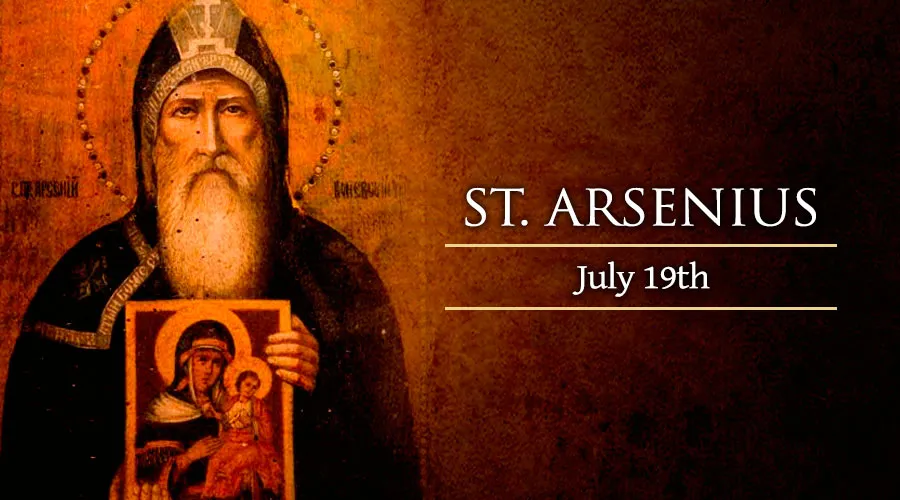
Confessor and hermit on the Nile. Arsenius, who was born in Rome in 354, was the tutor of the children of Emperors Theodosius I the Great, Arcadius, and Honorius. At that time, Arsenius was a Roman deacon recommended for the office by Pope St. Damasus. lie served at Theodosius' court in Constantinople for about ten years and then became a monk in Alexandria, Egypt. Inheriting a fortune from a relative, Arsenius studied with St. John the Dwarf and became a hermit in the desert of Egypt. In 434, he left Skete and went to the rock of Troe, near Memphis, Egypt, and to the island of Canopus near Alexandria. He died at Troe. Arsenius is sometimes called "the Roman" or "the Deacon."
Saint Arsenius the Deacon, sometimes known as Arsenius of Scetis and Turah, Arsenius the Roman or Arsenius the Great, was a Roman imperial tutor who became an anchorite in Egypt, one of the most highly regarded of the Desert Fathers, whose teachings were greatly influential on the development of asceticism and the contemplative life.
His contemporaries so admired him as to surname him "the Great". His feast day is celebrated on May 8 in the Eastern Orthodox church,[1] in the Roman Catholic Church,[2] and on 13 Pashons in the Coptic Orthodox Church.
-----------------------------------------------------------------------
He was born in 350 AD, in Rome to a Christian, Roman senatorial family. After his parents died, his sister Afrositty was admitted to a community of virgins, and he gave all their riches to the poor, and lived an ascetic life. Arsenius became famous for his righteousness and wisdom.
There is considerable debate regarding the accuracy of several points in Arsenius's life. Arsenius is said to have been made a deacon by Pope Damasus I who recommended him to Byzantine Emperor Theodosius I the Great, who had requested the Emperor Gratian and Pope Damasus around 383 to find him in the West a tutor for his sons (future emperors Arcadius and Honorius). Arsenius was chosen on the basis of being a man well read in Greek literature. He reached Constantinople in 383, and continued as tutor in the imperial family for eleven years, during the last three of which he also had charge of his original pupil Arcadius's brother, Honorius. Coming one day to see his sons at their studies, Theodosius found them sitting while Arsenius talked to them standing. This he would not tolerate, and caused the teacher to sit and the pupils to stand. On his arrival at court Arsenius had been given a splendid establishment, and probably because the Emperor so desired, he lived in great pomp. While living in the Emperor's palace, God gave him grace in the sight of everyone, and they all loved him. He lived a lavish life in the palace, but all the time felt a growing inclination to renounce the world. One day he was praying, and said, “O God teach me how to be saved.” And God's voice came to him through the Gospel, "For what is a man profited, if he shall gain the whole world, and lose his own soul?" (Matthew 16:26). He left Constantinople and came by sea to Alexandria and fled into the wilderness. When he first presented himself to Saint Macarius the Great, the father of the monks of Scetis, he recommended him to the care of Saint John the Dwarf to try him. Sometime around the year 400 he joined the desert monks at Scetes, Egypt, and asked to be admitted among the solitaries who dwelt there. Saint John the Dwarf, to whose cell he was conducted, though previously warned of the quality of his visitor, took no notice of him and left him standing by himself while he invited the rest to sit down at table. When the repast was half finished he threw down some bread before him, bidding him with an air of indifference eat if he would. Arsenius meekly picked up the bread and ate, sitting on the ground. Satisfied with this proof of humility, St. John kept him under his direction. The new solitary was from the first most exemplary yet unwittingly retained certain of his old habits, such as sitting cross-legged or laying one foot over the other. Noticing this, the abbot requested someone to imitate Arsenius's posture at the next gathering of the brethren, and upon his doing so, forthwith rebuked him publicly. Arsenius took the hint and corrected himself. In 434 he was forced to leave due to raids on the monasteries and hermitages there by the Mazices (tribesmen from Libya). He relocated to Troe (near Memphis), and also spent some time on the island of Canopus (off Alexandria). He spent the next fifteen years wandering the desert wilderness before returning to Troe to die c. 445 at the age of around 95.
During the fifty-five years of his solitary life he was always the most meanly clad of all, thus punishing himself for his former seeming vanity in the world. In like manner, to atone for having used perfumes at court, he never changed the water in which he moistened the palm leaves of which he made mats, but only poured in fresh water upon it as it wasted, thus letting it become stenchy in the extreme. Even while engaged in manual labour he never relaxed in his application to prayer. At all times copious tears of devotion fell from his eyes. But what distinguished him most was his disinclination to all that might interrupt his union with God. When, after long search, his place of retreat was discovered, he not only refused to return to court and act as adviser to his former pupil, now Roman Emperor, Arcadius, but he would not even be his almoner to the poor and the monasteries of the neighbourhood. He invariably denied himself to visitors, no matter what their rank and condition and left to his disciples the care of entertaining them. A biography of Arsenius was written by Theodore the Studite.
Saint Arsenius was a man who was very quiet and often silent, as evidenced by an adage of his: "Many times I spoke, and as a result felt sorry, but I never regretted my silence."
Two of his writings are still extant: a guideline for monastic life titled διδασκαλία και παραινεσις (Instruction and Advice), and a commentary on the Gospel of Luke titled εις τον πειρασθεν νομικος (On the Temptation of the Law). Apart from this, many sayings attributed to Arsenius are contained in the Apophthegmata Patrum.
Monastery of St. Arsenius in Wadi El Natrun in Egypt
By Lumen roma - Own work, CC BY 3.0, https://commons.wikimedia.org/w/index.php?curid=4233112
Ad Majorem Dei Gloriam (To the Greater Glory of God)
From: Micah 7:14-15, 18-20
Prayer for Jerusalem
--------------------
[14] Shepherd thy people with thy staff, the flock of thy inheritance, who dwell alone in a forest in the midst of a garden land; let them feed in Báshan and Gilead as in the days of old. [15] As in the days when you came out of the land of Egypt I will show them marvellous things.
Hymn to the Lord
----------------
[18] Who is a God like thee, pardoning iniquity and passing over transgression for the remnant of his inheritance? He does not retain his anger for ever because he delights in steadfast love. [19] He will again have compassion upon us, he will tread our iniquities under foot. Thou wilt cast all our sins into the depths of the sea. [20] Thou wilt show faithfulness to Jacob and steadfast love to Abraham, as thou hast sworn to our fathers from the days of old.
***********************************************************************
Commentary:
7:14-17. These verses also deal with hope in the future restoration, but it is now expressed in the form of a prayer to the Lord. He is asked for a return to the way things were in the early days of the chosen people--a repetition of wondrous works that will astound the Gentiles (vv. 16-17) and convince them of the power of the Lord (v. 16). The prayer also desires the Lord to be the only shepherd of his people (v. 14; cf. 5:3), who now occupy the whole of Palestine again, a land that is most fertile. Bashan and Gilead, on the eastern banks and highlands of the Jordan, were areas renowned for rich pasture-land.
7:18-20. The last three verses of the book, in a liturgical tone, celebrate the Lord’s steadfast love. Witnessing the works of the Lord (his pardoning of sins, and putting them out of his mind: vv. 18-19; his faithfulness to his promises, no matter what: v. 20), all that the believer can do is be grateful and live in awe: “Who is a God like thee?” (v. 18). Many of the terms used in this short hymn (remnant, inheritance, faithfulness, etc.) have come up earlier in the book and are being rehearsed again here. But we can appreciate their importance more if we remember the way Micah is echoed in the Benedictus of Zechariah in the New Testament. That hymn sums up very well the hope in the Messiah harbored by generation upon generation of the people of God, and when we reread it, it will help to revive our own hope in the definitive (second) coming of the Lord: “Blessed be the Lord God of Israel, for he has visited and redeemed his people, and has raised up a horn of salvation for us in the house of his servant David, as he spoke by the mouth of his holy prophets from of old” (Lk 1:68-70).
The True Kinsmen of Jesus
-------------------------
[46] While He (Jesus) was still speaking to the people, behold, His mother and His brethren stood outside, asking to speak to Him.* [48] But He replied to the man who told Him, "Who is My mother, and who are My brethren?" [49] And stretching out His hand toward His disciples, He said, "Here are My mother and My brethren! [50] For whoever does the will of My Father in Heaven is My brother, and sister and mother."
(*Other ancient authorities insert verse 47, "Some one told Him, `Your mother and Your brothers are standing outside, asking to speak to You.'")
***********************************************************************
Commentary:
46-47. "Brethren": ancient Hebrew, Aramaic and other languages had no special words for different degrees of relationship, such as are found in more modern languages. In general, all those belonging to the same family, clan and even tribe were "brethren".
In the particular case we have here, we should bear in mind that Jesus had different kinds of relatives, in two groups--some on His mother's side, others on St. Joseph's. Matthew 13:55-56 mentions, as living in Nazareth, James, Joseph, Simon and Judas ("His brethren") and elsewhere there is reference to Jesus' "sisters" (cf. Matthew 6:3). But in Matthew 27:56 we are told that James and Joseph were sons of a Mary distinct from the Blessed Virgin, and that Simon and Judas were not brothers of James and Joseph, but seemingly children of a brother of St. Joseph.
Jesus, on the other hand, was known to everyone as "the son of Mary" (Mark 6:3) or "the carpenter's son" (Matthew 13:55).
The Church has always maintained as absolutely certain that Jesus had no brothers or sisters in the full meaning of the term: it is a dogma that Mary was ever-Virgin (cf. note on Matthew 1:25).
48-50. Jesus obviously loved His Mother and St. Joseph. He uses this episode to teach us that in His Kingdom human ties do not take precedence. In Luke 8:19 the same teaching is to be found. Jesus regards the person who does the will of His Heavenly Father as a member of His own family. Therefore, even though it means going against natural family feelings, a person should do just that when needs be in order to perform the mission the Father has entrusted to him (cf. Luke 2:49).
We can say that Jesus loved Mary more because of the bonds between them created by grace than because He was her son by natural generation: Mary's divine motherhood is the source of all our Lady's other prerogatives; but this very motherhood is, in its turn, the first and greatest of the graces with which Mary was endowed.
The True Kinsmen of Jesus
-------------------------
[46] While He (Jesus) was still speaking to the people, behold, His mother and His brethren stood outside, asking to speak to Him.* [48] But He replied to the man who told Him, "Who is My mother, and who are My brethren?" [49] And stretching out His hand toward His disciples, He said, "Here are My mother and My brethren! [50] For whoever does the will of My Father in Heaven is My brother, and sister and mother."
(*Other ancient authorities insert verse 47, "Some one told Him, `Your mother and Your brothers are standing outside, asking to speak to You.'")
***********************************************************************
Commentary:
46-47. "Brethren": ancient Hebrew, Aramaic and other languages had no special words for different degrees of relationship, such as are found in more modern languages. In general, all those belonging to the same family, clan and even tribe were "brethren".
In the particular case we have here, we should bear in mind that Jesus had different kinds of relatives, in two groups--some on His mother's side, others on St. Joseph's. Matthew 13:55-56 mentions, as living in Nazareth, James, Joseph, Simon and Judas ("His brethren") and elsewhere there is reference to Jesus' "sisters" (cf. Matthew 6:3). But in Matthew 27:56 we are told that James and Joseph were sons of a Mary distinct from the Blessed Virgin, and that Simon and Judas were not brothers of James and Joseph, but seemingly children of a brother of St. Joseph.
Jesus, on the other hand, was known to everyone as "the son of Mary" (Mark 6:3) or "the carpenter's son" (Matthew 13:55).
The Church has always maintained as absolutely certain that Jesus had no brothers or sisters in the full meaning of the term: it is a dogma that Mary was ever-Virgin (cf. note on Matthew 1:25).
48-50. Jesus obviously loved His Mother and St. Joseph. He uses this episode to teach us that in His Kingdom human ties do not take precedence. In Luke 8:19 the same teaching is to be found. Jesus regards the person who does the will of His Heavenly Father as a member of His own family. Therefore, even though it means going against natural family feelings, a person should do just that when needs be in order to perform the mission the Father has entrusted to him (cf. Luke 2:49).
We can say that Jesus loved Mary more because of the bonds between them created by grace than because He was her son by natural generation: Mary's divine motherhood is the source of all our Lady's other prerogatives; but this very motherhood is, in its turn, the first and greatest of the graces with which Mary was endowed.
| Matthew | |||
| English: Douay-Rheims | Latin: Vulgata Clementina | Greek NT: Byzantine/Majority Text (2000) | |
| Matthew 12 | |||
| 46. | As he was yet speaking to the multitudes, behold his mother and his brethren stood without, seeking to speak to him. | Adhuc eo loquente ad turbas, ecce mater ejus et fratres stabant foras, quærentes loqui ei. | ετι δε αυτου λαλουντος τοις οχλοις ιδου η μητηρ και οι αδελφοι αυτου ειστηκεισαν εξω ζητουντες αυτω λαλησαι |
| 47. | And one said unto him: Behold thy mother and thy brethren stand without, seeking thee. | Dixit autem ei quidam : Ecce mater tua, et fratres tui foris stant quærentes te. | ειπεν δε τις αυτω ιδου η μητηρ σου και οι αδελφοι σου εξω εστηκασιν ζητουντες σοι λαλησαι |
| 48. | But he answering him that told him, said: Who is my mother, and who are my brethren? | At ipse respondens dicenti sibi, ait : Quæ est mater mea, et qui sunt fratres mei ? | ο δε αποκριθεις ειπεν τω ειποντι αυτω τις εστιν η μητηρ μου και τινες εισιν οι αδελφοι μου |
| 49. | And stretching forth his hand towards his disciples, he said: Behold my mother and my brethren. | Et extendens manum in discipulos suos, dixit : Ecce mater mea, et fratres mei. | και εκτεινας την χειρα αυτου επι τους μαθητας αυτου ειπεν ιδου η μητηρ μου και οι αδελφοι μου |
| 50. | For whosoever shall do the will of my Father, that is in heaven, he is my brother, and sister, and mother. | Quicumque enim fecerit voluntatem Patris mei, qui in cælis est, ipse meus frater, et soror, et mater est. | οστις γαρ αν ποιηση το θελημα του πατρος μου του εν ουρανοις αυτος μου αδελφος και αδελφη και μητηρ εστιν |

The represented saints are John the Baptist, Peter, Dominic, and Mary Magdalen.
Disclaimer: Opinions posted on Free Republic are those of the individual posters and do not necessarily represent the opinion of Free Republic or its management. All materials posted herein are protected by copyright law and the exemption for fair use of copyrighted works.