Free Republic
Browse · Search
Religion
Topics · Post Article

Skip to comments.

Catholic Caucus: Daily Mass Readings 17-July-2022;
Universalis/Jerusalem Bible ^ | 17th July 2022

Posted on 07/16/2022 10:33:35 PM PDT by Cronos

July 17th 2022

Sunday of the 16th week in ordinary time


Our Lady of the Rosary, Boise, Idaho

Readings at Mass

Liturgical Colour: Green


First reading

Genesis 18:1-10 ©

'Next year your wife Sarah will have a son'

The Lord appeared to Abraham at the Oak of Mamre while he was sitting by the entrance of the tent during the hottest part of the day. He looked up, and there he saw three men standing near him. As soon as he saw them he ran from the entrance of the tent to meet them, and bowed to the ground. ‘My lord,’ he said ‘I beg you, if I find favour with you, kindly do not pass your servant by. A little water shall be brought; you shall wash your feet and lie down under the tree. Let me fetch a little bread and you shall refresh yourselves before going further. That is why you have come in your servant’s direction.’ They replied, ‘Do as you say.’
  Abraham hastened to the tent to find Sarah.’ ‘Hurry,’ he said ‘knead three bushels of flour and make loaves.’ Then running to the cattle Abraham took a fine and tender calf and gave it to the servant, who hurried to prepare it. Then taking cream, milk and the calf he had prepared, he laid all before them, and they ate while he remained standing near them under the tree.
  ‘Where is your wife Sarah?’ they asked him. ‘She is in the tent’ he replied. Then his guest said, ‘I shall visit you again next year without fail, and your wife will then have a son.’

Responsorial Psalm
Psalm 14(15):2-5 ©
The just will live in the presence of the Lord.
Lord, who shall dwell on your holy mountain?
He who walks without fault;
he who acts with justice
and speaks the truth from his heart;
he who does not slander with his tongue.
The just will live in the presence of the Lord.
He who does no wrong to his brother,
who casts no slur on his neighbour,
who holds the godless in disdain,
but honours those who fear the Lord.
The just will live in the presence of the Lord.
He who keeps his pledge, come what may;
who takes no interest on a loan
and accepts no bribes against the innocent.
Such a man will stand firm for ever.
The just will live in the presence of the Lord.

Second reading
Colossians 1:24-28 ©

A mystery hidden for generations has been revealed to God's saints

It makes me happy to suffer for you, as I am suffering now, and in my own body to do what I can to make up all that has still to be undergone by Christ for the sake of his body, the Church. I became the servant of the Church when God made me responsible for delivering God’s message to you, the message which was a mystery hidden for generations and centuries and has now been revealed to his saints. It was God’s purpose to reveal it to them and to show all the rich glory of this mystery to pagans. The mystery is Christ among you, your hope of glory: this is the Christ we proclaim, this is the wisdom in which we thoroughly train everyone and instruct everyone, to make them all perfect in Christ.

Gospel Acclamationcf.Ac16:14
Alleluia, alleluia!
Open our heart, O Lord,
to accept the words of your Son.
Alleluia!
Or:cf.Lk8:15
Alleluia, alleluia!
Blessed are those who,
with a noble and generous heart,
take the word of God to themselves
and yield a harvest through their perseverance.
Alleluia!

GospelLuke 10:38-42 ©

Martha works; Mary listens

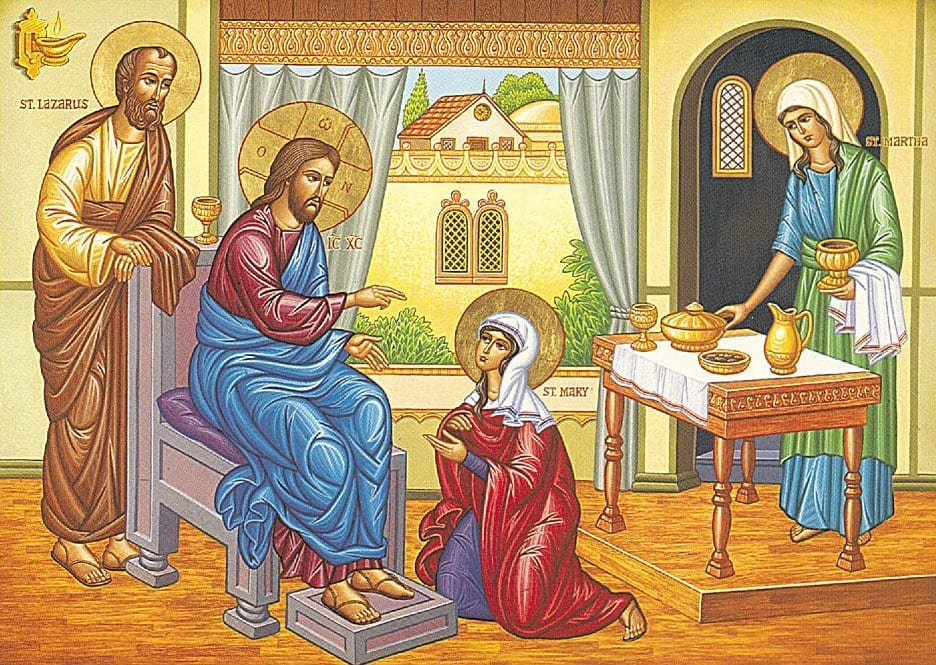
Jesus came to a village, and a woman named Martha welcomed him into her house. She had a sister called Mary, who sat down at the Lord’s feet and listened to him speaking. Now Martha who was distracted with all the serving said, ‘Lord, do you not care that my sister is leaving me to do the serving all by myself? Please tell her to help me.’ But the Lord answered: ‘Martha, Martha,’ he said ‘you worry and fret about so many things, and yet few are needed, indeed only one. It is Mary who has chosen the better part; it is not to be taken from her.’

The readings on this page are from the Jerusalem Bible, which is used at Mass in most of the English-speaking world. The New American Bible readings, which are used at Mass in the United States, are available in the Universalis apps, programs and downloads.

You can also view this page with the Gospel in Greek and English.


TOPICS: Catholic; General Discusssion; Prayer; Worship
KEYWORDS: catholic; lk10; ordinarytime; prayer
For your reading, reflection, faith-sharing, comments, questions, discussion.

1 posted on 07/16/2022 10:33:35 PM PDT by Cronos
[ Post Reply | Private Reply | View Replies]

To: Cronos

catholic, prayer, ordinarytime, lk10


2 posted on 07/16/2022 10:33:43 PM PDT by Cronos
[ Post Reply | Private Reply | To 1 | View Replies]

To: nickcarraway; NYer; ELS; Pyro7480; livius; ArrogantBustard; Catholicguy; RobbyS; marshmallow; ...
Alleluia Ping

Please FReepmail me/annalex to get on/off the Alleluia Ping List.


3 posted on 07/16/2022 10:34:06 PM PDT by Cronos
[ Post Reply | Private Reply | To 2 | View Replies]

To: Cronos

Catena Aurea by St. Thomas Aguinas

10:38–42

38. Now it came to pass, as they went, that he entered into a certain village: and a certain woman named Martha received him into her house.

39. And she had a sister called Mary, which also sat at Jesus’ feet, and heard his word.

40. But Martha was cumbered about much serving, and came to him, and said, Lord, dost thou not care that my sister hath left me to serve alone? bid her therefore that she help me.

41. And Jesus answered and said unto her, Martha, Martha, thou art careful and troubled about many things:

42. But one thing is needful: and Mary hath chosen that good part, which shall not be taken away from her.

BEDE. The love of God and our neighbour, which was contained above in words and parables, is here set forth in very deed and reality; for it is said, Now it came to pass, as they went, that he entered into a certain village.

ORIGEN. The name of which village Luke indeed here omits, but John mentions, calling it Bethany. (John 11.)

AUGUSTINE. (Ser. 103.) But the Lord, who came to his own, and his own received him not, (John 1:12.) was received as a guest, for it follows, And a certain woman named Martha received him into her house, &c. as strangers are accustomed to be received. But still a servant received her Lord, the sick her Saviour, the creature her Creator. But if any should say, “O blessed are they who have been thought worthy to receive Christ into their houses,” grieve not thou, for He says, For inasmuch as ye have done it to the least of my brethren, ye have done it unto me. (Matt. 25:40.) But taking the form of a servant, He wished therein to be fed by servants, by reason of His condescension, not His condition. He had a body in which He was hungry and thirsty, but when He was hungry in the desert, Angels ministered to Him. (Matt. 4:11.) In wishing therefore to be fed, He came Himself to the feeder. Martha then, setting about and preparing to feed our Lord, was occupied in serving; but Mary her sister chose rather to be fed by the Lord, for it follows, And she had a sister called Mary, which also sat at Jesus’ feet, and heard his word.

CHRYSOSTOM. It is not said of Mary simply that she sat near Jesus, but at His feet, to shew her diligence, stedfastness, and zeal, in hearing, and the great reverence which she had for our Lord.

AUGUSTINE. (ubi sup.) Now as was her humility in sitting at His feet, so much the more did she receive from Him. For the waters pour down to the lowest part of the valley, but flow away from the rising of the hill.

BASIL. (Const. Mon. c. 1.) Now every work and word of our Saviour is a rule of piety and virtue. For to this end did He put on our body, that as much as we can we might imitate His conversation.

CYRIL OF ALEXANDRIA. By His own example then He teaches His disciples how they ought to behave in the houses of those who receive them, namely, when they come to a house, they should not remain idle, but rather fill the minds of those who receive them with sacred and divine teaching. But let those who make ready the house, go to meet their guests gladly and earnestly, for two reasons. First, indeed, they will be edified by the teaching of those whom they receive; next also they will receive the reward of charity. And hence it follows here, But Martha was cumbered about much serving, &c.

AUGUSTINE. (ubi sup.) Martha was well engaged in ministering to the bodily wants or wishes of our Lord, as of one who was mortal, but He who was clothed in mortal flesh; in the beginning was the Word. Behold then what Mary heard, The Word was made flesh. Behold then Him to whom Martha ministered. The one was labouring, the other at rest. But yet Martha, when much troubled in her occupation and business of serving, interrupted our Lord, and complained of her sister. For it follows, And said, Lord, dost thou not care that my sister hath left me to serve alone? For Mary was absorbed in the sweetness of our Lord’s words; Martha was preparing a feast for our Lord, in whose feast Mary was now rejoicing. While then she was listening with delight to those sweet words, and was feeding on them with the deepest affection, our Lord was interrupted by her sister. What must we suppose was her alarm, lest the Lord should say to her, “Rise, and help thy sister?” Our Lord therefore, who was not at a loss, for He had shewn He was the Lord, answered as follows, And Jesus answered and said unto her, Martha, Martha. The repetition of the name is a mark of love, or perhaps of drawing the attention, that she should listen more earnestly. When twice called, she hears, Thou art troubled about many things, that is, thou art busied about many things. For man wishes to meet with something when he is serving, and can not; and thus between seeking what is wanting and preparing what is at hand, the mind is distracted. For if Martha had been sufficient of herself, she would not have required the aid of her sister. There are many, there are diverse things, which are carnal, temporal, but one is preferred to many. For one is not from many, but many from one. Hence it follows, But one thing is needful. Mary wished to be occupied about one, according to that, It is good for me to cling close unto the Lord. (Ps. 73:28.) The Father, the Son, the Holy Spirit, are one. To this one he does not bring us, unless we being many have one heart. (Acts 4:32.)

CYRIL OF ALEXANDRIA. Or else, when certain brethren have received God, they will not be anxious about much service, nor ask for those things which are not in their hands, and are beyond their needs. For every where and in every thing that which is superfluous is burdensome. For it begets weariness in those who are wishing to bestow it, while the guests feel that they are the cause of trouble.

BASIL. (in reg. fus. int. 19.) It is foolish also to take food for the support of the body, and thereby in return to hurt the body, and to hinder it in the performance of the divine command. If then a poor man come, let him receive a model and example of moderation in food, and let us not prepare our own tables for their sakes, who wish to live luxuriously. For the life of the Christian is uniform, ever tending to one object, namely, the glory of God. But the life of those who are without is manifold and vacillating, changed about at will. And how in truth canst thou, when thou settest thy table before thy brother with profusion of meats, and for the pleasure of feasting sake, accuse him of luxury, and revile him as a glutton, censuring his indulgence in that which thou thyself affordest him? Our Lord did not commend Martha when busied about much serving.

AUGUSTINE. (Serm. 104.) What then? Must we think that blame was cast upon the service of Martha, who was engaged in the cares of hospitality, and rejoiced in having so great a guest? If this be true, let men give up ministering to the needy; in a word, let them be at leisure, intent only upon getting wholesome knowledge, taking no care what stranger is in the village in want of bread; let works of mercy be unheeded, knowledge only be cultivated.

THEOPHYLACT. Our Lord does not then forbid hospitality, but the troubling about many things, that is to say, hurry and anxiety. And mark the wisdom of our Lord, in that at first He said nothing to Martha, but when she sought to tear away her sister from hearing, then the Lord took occasion to reprove her. For hospitality is ever honoured as long as it keeps us to necessary things. But when it begins to hinder us from attending to what is of more importance, then it is plain that the hearing of the divine word is the more honourable.

AUGUSTINE. (Serm. 104.) Our Lord then does not blame the actions, but distinguishes between the duties. For it follows, Mary hath chosen that good part, &c. Not thine a bad one, but hers a better. Why a better? because it shall not be taken away from her. From thee the necessary burden of business shall one time be taken away. For when thou comest into that country, thou wilt find no stranger to receive with hospitality. But for thy good it shall be taken away, that what is better may be given thee. Trouble shall be taken away, that rest may be given. Thou art yet at sea; she is in port. For the sweetness of truth is eternal, yet in this life it is increased, and in the next it will be made perfect, never to be taken away.

AMBROSE. May you then like Mary be influenced by the desire of wisdom. For this is the greater, this the more perfect work. Nor let the care of ministering to others turn thy mind from the knowledge of the heavenly word, nor reprove or think indolent those whom thou seest seeking after wisdom.

AUGUSTINE. (de Qu. Evang. l. ii. q. 30.) Now mystically, by Martha’s receiving our Lord into her house is represented the Church which now receives the Lord into her heart. Mary her sister, who sat at Jesus’ feet and heard His word, signifies the same Church, but in a future life, where ceasing from labour, and the ministering to her wants, she shall delight in Wisdom alone. But by her complaining that her sister did not help her, occasion is given for that sentence of our Lord, in which he shews that Church to be anxious and troubled about much service, when there is but one thing needful, which is yet attained through the merits of her service; but He says that Mary hath chosen the good part, for through the one the other is reached, which shall not be taken away.

GREGORY. (6. Mor. c. 18.) Or by Mary who sat and heard our Lord’s words, is signified the contemplative life; by Martha engaged in more outward services, the active life. Now Martha’s care is not blamed, but Mary is praised, for great are the rewards of an active life, but those of a contemplative are far better. Hence Mary’s part it is said will never be taken away from her, for the works of an active life pass away with the body, but the joys of the contemplative life the rather begin to increase from the end.





Copyright ©1999-2018 e-Catholic2000.com
4 posted on 07/16/2022 10:35:00 PM PDT by Cronos
[ Post Reply | Private Reply | To 3 | View Replies]

To: Cronos

5 posted on 07/16/2022 10:38:07 PM PDT by Cronos
[ Post Reply | Private Reply | To 4 | View Replies]

To: Cronos
NAVARRE BIBLE COMMENTARY (RSV)

Ad Majorem Dei Gloriam (To the Greater Glory of God)

From: Genesis 18:1-10a

The Apparition of God at Mamre
------------------------------
[1] And the Lord appeared to him (Abraham) by the oaks of Mamre, as he sat at the door of his tent in the heat of the day. [2] He lifted up his eyes and looked, and behold, three men stood in front of him. When he saw them, he ran from the tent door to meet them and bowed himself to the earth, [3] and said, "My lord, if I have found favor in your sight, do not pass by your servant. [4] Let a little water be brought, and wash your feet, and rest yourselves under the tree, [5] while I fetch a morsel of bread, that you may refresh yourselves, and after that you may pass on--since you have come to your servant." So they said, "Do as you have said." [6] And Abraham hastened into the tent to Sarah, and said, "Make ready quickly three measures of fine meal, knead it, and make cakes. [7] And Abraham ran to the herd, and took a calf, tender and good and gave it to the servant, who hastened to prepare it. [8] Then he took curds, and milk, and the calf which he had prepared, and set it before them; and he stood by them under the tree while they ate.

Isaac's Birth is Promised
-------------------------
[9] They said to him, "Where is Sarah your wife?" And he said, "She is in the tent." [10a] The Lord said, "I will surely return to you in the spring, and Sarah your wife shall have a son…"

************************************************************
Commentary:

18:1-19:38. These two episodes—God's appearance to Abraham at Mamre and the destruction of Sodom—form a single account. Once again we can see the sort of relationship that obtains between God and Abraham; this time, what is emphasized is not just the promise of a son for Sarah, but also the patriarch's intercession on behalf of Sodom and Gomorrah. This intercession saves Lot and his family (cf. 19:29). Thus, Abraham is already a blessing for all the descendants of Lot. This narrative is quite colorful, and includes some curious little details--making it one of the most popular passages in the story of the patriarchs.

18:1-15. This new appearance of God to Abraham is somewhat mysterious: the three men stand for God. When Abraham speaks to them, sometimes he addresses them in the singular (as if there were one person there: cf. v. 3), and sometimes in the plural (as if there were three: cf. v. 4). That is why some Fathers interpreted this appearance as an early announcement of the mystery of the Holy Trinity; others, following Jewish tradition (cf. Heb 13:2) take these personages to be angels. The sacred text says that one of the three men (Yahweh, apparently) stays with Abraham (cf. v. 22), while the other two, who are referred to as angels, go to Sodom (cf. 19:1). Although the early chapters of Genesis do not expressly talk about the creation of angels, that creation can be read into the word "heavens" in Gen 1:1: "at the beginning of time, God created out of nothing both types of creatures, spiritual and corporeal, that is, angelic and earthly," says Lateran Council IV ("De Fide Catolica"). In Holy Scripture angels are mentioned as being servants and messengers of God, and, despite the way they are sometimes described, such as in this passage, they should be understood as being purely spiritual, personal and immortal creatures, endowed with intelligence and will. "Angels have been present since creation (cf. Job 38:7, where the angels are called 'sons of God') and throughout the history of salvation, announcing this salvation from afar or near and serving the accomplishment of the divine plan: they closed the earthly paradise (cf. Gen 3:24); protected Lot (cf. Gen 19); saved Hagar and her child (cf. Gen 21:17); stayed Abraham's hand (cf. Gen 22.11); communicated the law by their ministry (cf. Acts 7:53); led the people of God (cf. Ex 23:20-23); announced births (cf. Judg 13) and callings (cf. Judg 6:11-24; Is 6:6); and assisted the prophets (cf. 1 Kings 19:5), just to cite a few examples. Finally, the angel Gabriel announced the birth of the Precursor and that of Jesus himself (cf. Lk 1:11-26)" ("Catechism of the Catholic Church", 332).

In the general context of Genesis, this episode points up the new situation created by the Covenant. God speaks to Abraham directly, as he spoke to Adam before he committed sin. Abraham, for his part, receives God through his hospitality, and God again promises that Sarah will have a son (now specifying when the child will be born). "Because Abraham believed in God and walked in his presence and in covenant with him (cf. Gen 15:6; 17:1-2), the patriarch is ready to welcome a mysterious Guest into his tent. Abraham's remarkable hospitality at Mamre foreshadows the annunciation of the true Son of the promise (cf. Gen 18:1-15; Lk 1:26-38). After that, once God has confided his plan, Abraham's heart is attuned to his Lord's compassion for men and he dares to intercede for them with bold confidence (cf. Gen 18:16-33)" (ibid., 2571).

18:6. The measure mentioned here, a "seah" (pl. "seim") is a measure of dry grain (cf. 1 Sam 25:18; 2 Kings 7:1, 16, 18) which was probably a third of an ephah, that is, about seven liters or two gallons

6 posted on 07/17/2022 6:01:44 AM PDT by fidelis (Behold, the Cross of the Lord! Begone, all evil powers! The Lion of the tribe of Judah rules!)
[ Post Reply | Private Reply | To 5 | View Replies]

To: fidelis
From: Colossians 1:24—2:3

St. Paul's Response to His Calling
----------------------------------
[24] Now I (Paul) rejoice in my sufferings for your sake, and in my flesh I complete what is lacking in Christ's afflictions for the sake of His body, that is, the Church, [25] of which I became a minister according to the divine office which was given to me for you, to make the word of God fully known, [26] the mystery hidden for ages and generations but now made manifest to His saints. [27] To them God chose to make known how great among the Gentiles are the riches of the glory of this mystery, which is Christ in you, the hope of glory. [28] Him we proclaim, warning every man and teaching every man in all wisdom, that we may present every man mature in Christ.

****************************************
Commentary:

24. Jesus Christ our Lord perfectly accomplished the work the Father gave Him to do (cf. John 17:4); as He said Himself when He was about to die, "It is finished", it is accomplished (John 19:30).

From the point onwards objective redemption is an accomplished fact. All men have been saved by the redemptive death of Christ. However, St. Paul says that he completes in his flesh "what is lacking in Christ's afflictions"; what does he mean by this? The most common explanation of this statement is summarized by St. Alphonsus as follows: "Can it be that Christ's passion alone was insufficient to save us? It left nothing more to be done, it was entirely sufficient to save all men. However, for the merits of the Passion to be applied to us, according to St. Thomas ("Summa Theologiae", III, q. 49, a. 3), we need to cooperate (subjective redemption) by patiently bearing the trials God sends us, so as to become like our Head, Christ" (St. Alphonsus, "Thoughts on the Passion", 10).

St. Paul is applying this truth to himself. Jesus Christ worked and strove in all kinds of ways to communicate His message of salvation, and then He accomplished the redemption by dying on the Cross. The Apostle is mindful of the Master's teaching and so he follows in His footsteps (cf. 1 Peter 2:21), takes up his cross (cf. Matthew 10:38) and continues the task of bringing Christ's teaching to all men.

Faith in the fact that we are sharing in the sufferings of Christ, St. John Paul II says, gives a person "the certainty that in the spiritual dimension of the work of Redemption he is serving, like Christ, the salvation of his brothers and sisters. Therefore he is carrying out an irreplaceable service. In the Body of Christ, which is ceaselessly born of the Cross of the Redeemer, it is precisely suffering permeated by the spirit of Christ's sacrifice that is the irreplaceable mediator and author of the good things which are indispensable for the world's salvation. It is suffering, more than anything else, which clears the way for the grace which transforms human souls. Suffering, more than anything else, makes present in the history of humanity the force of the Redemption" ("Salvifici Doloris", 27).

26-27. The "mystery", now revealed, is God's eternal plan to give salvation to men, both Jews and Gentiles, making all without distinction co-heirs of glory and members of a single body which is the Church (cf. Ephesians 3:6), through faith in Jesus Christ (cf. Romans 16:25-26).

In Christ, who has brought salvation to Gentile and Jew, the "mystery" is fully revealed. His presence in Christians of Gentile origin is in fact a very clear manifestation of the supernatural fruitfulness of the "mystery" and an additional ground for Christians' hope. Thanks to this presence people who do not form part of Israel are enable to attain salvation. Previously subject to the power of darkness and slaves of sin (verses 13-14), they have now died to sin through Baptism (cf. Romans 6:2-3) and Christ, through grace, dwells in their hearts (on the salvific "mystery", cf. notes on Ephesians 1:13-14 and Ephesians 1:9, and "Introduction to the Letters of St. Paul" in "The Navarre Bible: Romans and Galatians", pages 32-33).

In His infinite love Christ lives in us through faith and grace, through prayer and the Sacraments. Also, "He is present when the Church prays and sings, for He has promised `where two or three are gathered in My Name, there am I in the midst of them' (Matthew 18:20)" (Vatican II, "Sacrosanctum Concilium", 7).

"Christ stays in His Church, its Sacraments, its liturgy, its preaching--in all that it does. In a special way Christ stays with us in the daily offering of the Blessed Eucharist…The presence of Christ in the host is the guarantee, the source and the culmination of His presence in the world.

"Christ is alive in Christians". Our faith teaches that man, in the state of grace, is divinized--filled with God. We are men and women, not angels. We are flesh and blood, people with sentiments and passions, with sorrows and joys. And this divinization affects everything human; it is a sort of foretaste of the final resurrection" (St. Josemaria Escriva, "Christ Is Passing By", 102-103).

28: "In all wisdom": St. Paul is exhorting and teaching each and every one, communicating wisdom, the true teaching of Jesus Christ. The text clearly shows St. Paul's conviction that he is a faithful transmitter of teachings revealed by God. Possessed of such wisdom he is confident that he can lead his disciples to Christian perfection.

7 posted on 07/17/2022 6:02:23 AM PDT by fidelis (Behold, the Cross of the Lord! Begone, all evil powers! The Lion of the tribe of Judah rules!)
[ Post Reply | Private Reply | To 6 | View Replies]

To: fidelis
From: Luke 10:38-42

Martha and Mary Welcome Our Lord
--------------------------------
[38] Now as they went on their way, He (Jesus) entered a village; and a woman named Martha received Him into her house. [39] And she had a sister called Mary, who sat at the Lord's feet and listened to His teaching. [40] But Martha was distracted with much serving; and she went to Him and said, "Lord, do You not care that my sister has left me to serve alone? Tell her then to help me." [41] But the Lord answered her, "Martha, Martha, you are anxious and troubled about many things; [42] one thing is needful. Mary has chosen the good position, which shall not be taken away from her."

*******************************************
Commentary:

38-42. Our Lord was heading for Jerusalem (Luke 9:51) and His journey took Him through Bethany, the village where Lazarus, Martha and Mary lived--a family for whom He had a special affection, as we see in other passages of the Gospel (cf. John 11:1-14; 12:1-9).

St. Augustine comments on this scene as follows: "Martha, who was arranging and preparing the Lord's meal, was busy doing many things, whereas Mary preferred to find her meal in what the Lord was saying. In a way she deserted her sister, who was very busy, and sat herself down at Jesus' feet and just listened to His words. She was faithfully obeying what the Psalm said: `Be still and know that I am God' (Psalm 46:10). Martha was getting annoyed, Mary was feasting; the former coping with many things, the latter concentrating on one. Both occupations were good" ("Sermon", 103).

Martha has come to be, as it were, the symbol of the active life, and Mary that of the contemplative life. However, for most Christians, called as they are to sanctify themselves in the middle of the world, action and contemplation cannot be regarded as two opposite ways of practicing the Christian faith: an active life forgetful of union with God is useless and barren; but an apparent life of prayer which shows no concern for apostolate and the sanctification of ordinary things also fails to please God. The key lies in being able to combine these two lives, without either harming the other. Close union between action and contemplation can be achieved in very different ways, depending on the specific vocation each person is given by God.

Far from being an obstacle, work should be a means and an occasion for a close relationship with our Lord, which is the most important thing in our life.

Following this teaching of the Lord, the ordinary Christian should strive to attain an integrated life--an intense life of piety and external activity, orientated towards God, practiced out of love for Him and with an upright intention, which expresses itself in apostolate, in everyday work, in doing the duties of one's state in life. "You must understand now more clearly that God is calling you to serve Him in and from the ordinary, material and secular activities of human life. He waits for us every day, in the laboratory, in the operating room, in the army barracks, in the university chair, in the factory, in the workshop, in the fields, in the home and in all the immense panorama of work. Understand this well: there is something holy, something divine, hidden in the most ordinary situations, and it is up to each of you to discover it…There is no other way. Either we learn to find our Lord in ordinary, everyday life, or else we shall never find Him. That is why I can tell you that our age needs to give back to matter and to the most trivial occurrences and situations their noble and original meaning. It needs to restore them to the service of the Kingdom of God, to spiritualize them, turning them into a means and an occasion for a continuous meeting with Jesus Christ" (St. Josemaria Escriva, "Conversations", 114).

Source: Daily Word for Reflection—Navarre Bible Commentary

8 posted on 07/17/2022 6:02:46 AM PDT by fidelis (Behold, the Cross of the Lord! Begone, all evil powers! The Lion of the tribe of Judah rules!)
[ Post Reply | Private Reply | To 7 | View Replies]

To: fidelis
Click here to go to the thread for the Sacred Page meditations on the Scripture readings for this Sunday's Mass.
9 posted on 07/17/2022 6:08:03 AM PDT by fidelis (Behold, the Cross of the Lord! Begone, all evil powers! The Lion of the tribe of Judah rules!)
[ Post Reply | Private Reply | To 8 | View Replies]

To: fidelis
This week’s Sunday Scripture Study for Catholics downloadable resource for personal, small group, or family reflection:

Sunday Scripture Study for Catholics - 16th Sunday of Ordinary Time, Year C

(Main SSSC page found here)

10 posted on 07/17/2022 6:08:30 AM PDT by fidelis (Behold, the Cross of the Lord! Begone, all evil powers! The Lion of the tribe of Judah rules!)
[ Post Reply | Private Reply | To 9 | View Replies]

To: fidelis


Christ in the House of Martha and Mary

Johannes Vermeer (1632–1675)

160 × 142 cm (63 × 55.9 in)
National Gallery of Scotland

11 posted on 07/17/2022 10:16:11 AM PDT by annalex (fear them not)
[ Post Reply | Private Reply | To 10 | View Replies]

To: annalex

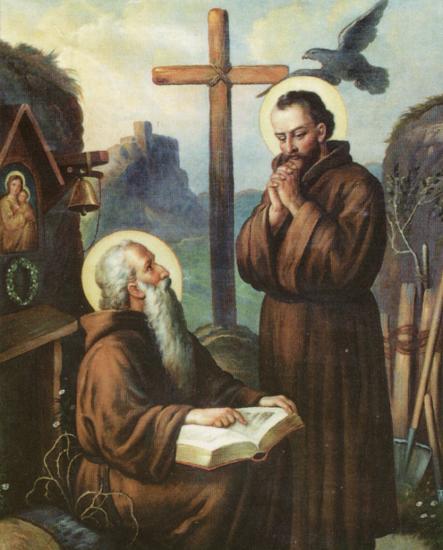
Saints Andrew Svorad and Benedict Skalka

St. Andrew Svorad was born around the year 980. Tradition has it that he lived his youth as a monk in a small village in what is now southern Poland. He with many other monks fled the Polish Crown lands of King Boleslav Chrabry when the King banned the use of the Old Slavonic (Byzantine) Liturgy. Svorad came to Slovakia and settled in the monastery of St. Hyppolytus in Zobor near Nitra. He was accepted by Abbot Philip, received the monastic name of Andrew, and lived for a while in the monastery. He was given permission to establish a hermitage in the Skalka forest on the Vah River near Trencin. Here alone in the wilderness of the forest he lived a life of prayer and penance and became known for his holiness of life.

Benedict Vaganus (of the Vah basin), also a monk of Zobor abbey, became a hermit and retired to a cave in the Skalka forest as Andrew’s disciple. Andrew died about 1034 and Benedict returned his body to Zobor for burial. About three years latter Benedict suffered martyrdom at the hands of bandits seeking the secrets of his miraculous powers received from God for his holiness of life. His body was thrown into the Vah River. Searching for Benedict for over a year monks from Zobor miraculously found his incorrupt body in the river.

Devotion to the holy monks spread rapidly through out central Europe from Slovakia to the Kingdoms of Poland, Bohemia, Croatia and Hungary. On July 10, 1083 Pope Gregory VII proclaimed them saints of the Church. Their bodies were carried in solemn procession to the cathedral of St. Emmeram in Nitra were they are entombed to this day. King Geza proclaimed Andrew a patron of Hungary.


standrewabbey.org

Patronage of St. Benedict Skalka: Sailors of the Váh River, Diocese of Nitra, Diocese of Tarnów, St. Andrew Abbey in Cleveland, Ss. Andrew & Benedict in Detroit

12 posted on 07/17/2022 10:22:40 AM PDT by annalex (fear them not)
[ Post Reply | Private Reply | To 11 | View Replies]

To: annalex


St. Benedict of Skalka (right) and St. Andrew Zorard

13 posted on 07/17/2022 10:25:07 AM PDT by annalex (fear them not)
[ Post Reply | Private Reply | To 12 | View Replies]

Disclaimer: Opinions posted on Free Republic are those of the individual posters and do not necessarily represent the opinion of Free Republic or its management. All materials posted herein are protected by copyright law and the exemption for fair use of copyrighted works.

Free Republic
Browse · Search
Religion
Topics · Post Article

FreeRepublic, LLC, PO BOX 9771, FRESNO, CA 93794
FreeRepublic.com is powered by software copyright 2000-2008 John Robinson