Memorial of St. Benedict, abbott
Main Altar at the benedictine abbey at Montecassino Readings at MassLiturgical Colour: White
|
Posted on 07/10/2022 11:48:56 PM PDT by Cronos
Memorial of St. Benedict, abbott
Main Altar at the benedictine abbey at Montecassino Readings at MassLiturgical Colour: White
|
catholic, prayer, ordinarytime, mt10
Please FReepmail me/annalex to get on/off the Alleluia Ping List.

34. Think not that I am come to send peace on earth: I came not to send peace, but a sword.
35. For I am come to set a man at variance against his father, and the daughter against her. mother, and the daughter in law against her mother in law.
36. And a man’s foes shall be they of his own household.
JEROME. He had before said, What I say to you in darkness, that speak ye in the light; He now tells them what will follow upon that preaching, saying, Think not that I am come to send peace upon earth; I am not come to send peace, but a sword.
GLOSS. (interlin.) Or connect it with what has gone before, As the fear of death ought not to draw you away, so neither ought carnal affection.
CHRYSOSTOM. (Hom. xxxv.) How then did He enjoin them, that when they should entor any house they should say, Peace be to this house, as also the Angels sung, Glory to God in the highest, on earth peace to men. (Luke 2:14.) That is the most perfect peace when that which is diseased is lopped off, when that which introduces strife is taken away, for so only is it possible that heaven should be joined to earth. For so does the physician save the rest of the body, namely by cutting off that which cannot be healed. So it came to pass at the tower of Babel; a happy discord broke up their bad union. So also Paul divided those who were conspired together against him. For concord is not in all cases good; for there is honour among thieves. And this combat is not of His setting before them, but of the plots of the world.
JEROME. For in the matter of belief in Christ, the whole world was divided against itself; each house had its believers and its unbelievers; and therefore was this holy war sent, that an unholy peace might be broken through.
CHRYSOSTOM. This He said as it were comforting His disciples, as much as to say, Be not troubled as though these things fell upon you unexpectedly; for, for this cause I came that I might send war upon the earth—nay He says not ‘war,’ but what is yet harder, a sword. For He sought by sharpness of speech so to rouse their attention, that they should not fall off in time of trial and difficulty, or say that He had told them smooth things, and had hid the difficulties. For it is better to meet with softness in deeds than in words; and therefore He stayed not in words, but shewing them the nature of their warfare, He taught them that it was more perilous than a civil war; saying, I am come to set a man against his father, and daughter against her mother, and daughter-in-law against her mother-in-law. So this warfare will be between not acquaintances merely, but the nearest and dearest kindred; and this shews Christ’s very great power; that His disciples after having heard this, yet undertook the mission, and brought over others. Yet was it not Christ who made this division, but the evil nature of the parties; when He says that it is He that does it, He speaks according to the manner of Scripture. As it is written, God hath given them eyes that they should not see. (Is. 6:10.) Here is also a great proof that the Old Testament is like the New. For among the Jews a man was to put his neighbour to death if he found him making a calf, or sacrificing to Baalphegor; so here to shew that it was the same God who ordained both that and these precepts, He reminds them of the prophecy, A man’s foes are they of his household. For this same thing happened among the Jews; there were Prophets, and false Prophets; there the multitude was divided, and houses were set against themselves; there some believed one part, and some another.
JEROME. These are almost the words of the Prophet Micah. (Mic. 7:6.) We should always take note when a passage is cited out of the Old Testament, whether the sense only, or the very words are given.
HILARY. Mystically; A sword is the sharpest of all weapons, and thence it is the emblem of the right of authority, the impartiality of justice, the correction of offenders. The word of God, we may remember, is likened to a sword; (Eph. 6:17. Heb. 4:12.) so here the sword that is sent upon the earth is His preaching poured into the heart of man. The five inhabiting one house, whom He divides three against two, and two against three, we may explain thus; The three are the three parts of man, the body, the soul, and the will; for as the soul is bestowed in the body, so the will has power of using both in any way it chooses; and thence when a law is given it is given to the will. But this is only found in those who were first formed by God. By the sin and unbelief of the first parent, all the generations of men since have had sin for the father of their body, and unbelief for the mother of their soul. And as each man has his will within him, there are thus five in one house. When then we are renewed in the laver of baptism, by virtue of the word we are set apart from our original guilt, and severed, as it were, by the sword of God, from the lusts of this our father and mother, and thus there is great discord made in one house; the new man finding his foes within, he seeks with joy to live in newness of spirit; they which are derived from the old stock, lust to remain in their old pleasures.
AUGUSTINE. (Quæst. in Matt. q. 3.) Otherwise; I am come to set a man against his father; for he renounces the Devil, who was his son; the daughter against her mother, that is, the people of God against the city of the world, that is, the wicked society of mankind, which is spoken of in Scripture under the names of Babylon, Egypt, Sodom, and other names. The daughter-in-law against her mother-in-law, that is, the Church against the Synagogue, which according to the flesh, brought forth Christ the spouse of the Church. They are severed by the sword of the Spirit, which is the word of God. And a man’s foes are they of his household, those, that is, with whom he before lived as intimates.
RABANUS. For no other mutual rights can be preserved between those who are at war in their creeds.
GLOSS. (interlin.) Otherwise; He means, I am not come among men to strengthen their carnal affections, but to cut them off with the sword of the Spirit; whence it is rightly added, And a man’s foes are they of his household.
GREGORY. (Mor. iii. 8.) For the subtle enemy when he sees himself driven out of the hearts of the good, seeks out those who most love them, and speaking by the mouth of those who are dearest, endeavours while the heart is penetrated by love, that the sword of conviction may pierce to the inmost bulwarks of virtue.
10:37–39
37. He that loveth father or mother more than me is not worthy of me: and he that loveth son or daughter more than me is not worthy of me.
38. And he that taketh not his cross, and followeth after me, is not worthy of me.
39. He that findeth his life shall lose it: and he that loseth his life for my sake shall find it.
JEROME. Because of what He had said, I am not come to send peace but a sword, &c. that none might suppose that family affection was banished from His religion, He now adds, He that loves father or mother more than me is not worthy of me. So in the Song of Songs we read, Order love in me. (c. 2:4.) For this order is needed in every affection; after God love thy father, thy mother, and thy children; but if a necessity should occur that the love of parents and children comes into competition with the love of God, and where both cannot be preserved, remember that hatred of our kindred becomes then love to God. He forbids not to love parent or child, but adds emphatically, more than me.
HILARY. For they who have esteemed domestic affection of relations higher than God, are unworthy to inherit good things to come.
CHRYSOSTOM. Yet when Paul bids us obey our parents in all things, we are not to marvel; for we are only to obey in such things as are not hurtful to our piety to God. It is holy to render them every other honour, but when they demand more than is due, we ought not to yield. This is likewise agreeable to the Old Testament; in it the Lord commands that all who worshipped idols, should not only be held in abhorrence, but should be stoned. And in Deuteronomy it is said, He who saith to his father and his mother, I know you not; and to his brethren, Ye are strangers; he hath kept thy saying. (Deut. 33:9.)
GLOSS. (non occ.) It seems to happen in many cases that the parents love the children more than the children love the parents; therefore having taught that His love is to be preferred to the love of parents, as in an ascending scale, He next teaches that it is to be preferred to the love of children, saying, And whoso loveth son or daughter more than me is not worthy of me.
RABANUS. He is unworthy of the divine communion who prefers the carnal affection of kindred to the spiritual love of God.
CHRYSOSTOM. Then that those to whom the love of God is preferred should not be offended thereat, He leads them to a higher doctrine. Nothing is nearer to a man than his soul, and yet He enjoins that this should not only be hated, but that a man should be ready to deliver it up to death, and blood; not to death only, but to a violent and most disgraceful death, namely, the death of the cross; therefore it follows, And whoso taketh not up his cross and followeth me, is not worthy of me. He had as yet said nothing to them respecting his own sufferings, but instructs them in the meanwhile in these things, that they may the more readily receive His words concerning His passion.
HILARY. Or; They that are Christ’s have crucified the body with its vices and lusts. (Gal. 5:24.) And he is unworthy of Christ who does not take up His cross, in which we suffer with Him, die with Him, are buried and rise again with Him, and follow his Lord, purposing to live in newness of spirit in this sacrament of the faith.
GREGORY. (Hom. in Ev. xxxii. 3.) The cross is so called from 1torment; and there are two ways in which we bear the Lord’s cross; either when we afflict the flesh by abstinence; or when in compassion for our neighbour we make his afflictions our own. But it should be known that there are some who make a shew of abstinence not for God, but for ostentation; and some there are who shew compassion to their neighbour, not spiritually but carnally, not that they may encourage him in virtue, but rather countenancing him in faults. These indeed seem to bear their cross, but do not follow the Lord; therefore He adds, And followeth me
CHRYSOSTOM. Because these commands seemed burdensome, He proceeds to shew their great use and benefit, saying, He that findeth his life shall lose it. As much as to say, Not only do these things that I have inculcated do no harm, but they are of great advantage to a man; and the contrary thereof shall do him great hurt—and this is His manner every where. He uses those things which men’s affections are set upon as a means of bringing them to their duty. Thus: Why are you loath to contemn your life? Because you love it? For that very reason contemn it, and you will do it the highest service.
REMIGIUS. The life in this place is not to be understood as the substance, (the soul,) but as this present state of being; and the sense is, He who findeth his life, i. e. this present life, he who so loves this light, its joys and pleasures, as to desire that he may always find them; he shall lose that which he wishes always to keep, and prepare his soul for eternal damnation.
RABANUS. Otherwise; He who seeks an immortal life, does not hesitate to lose his life, that is, to offer it to death. But either sense suits equally well with that which follows, And whoso shall lose his life for my sake shall find it.
REMIGIUS. That is, he who in confession of My name in time of persecution despises this temporal world, its joys, and pleasures, shall find eternal salvation for his soul.
HILARY. Thus the gain of life brings death, the loss of life brings salvation; for by the sacrifice of this short life we gain the reward of immortality.
10:40–42
40. He that receiveth you receiveth me, and he that receiveth me receiveth him that sent me.
41. He that receiveth a prophet in the name of a prophet shall receive a prophet’s reward; and he that receiveth a righteous man in the name of a righteous man shall receive a righteous man’s reward.
42. And whosoever shall give to drink unto one of these little ones a cup of cold water only in the name of a disciple, verily I say unto you, he shall in no wise lose his reward.
JEROME. The Lord when He sends forth His disciples to preach, teaches them that dangers are not to be feared, that natural affection is to be postponed to religion—gold He had above taken from them, brass He had shaken out of their purses—hard then surely the condition of the preachers! Whence their living? Whence their food and necessaries? Therefore He tempers the rigour of His precepts by the following promises, that in entertaining the Apostles each believer may consider that he entertains the Lord.
CHRYSOSTOM. Enough had been said above to persuade those who should have to entertain the Apostles. For who would not with all willingness take in to his house men who were so courageous, that they despised all dangers that others might be saved? Above He had threatened punishment to those who should not receive them, He now promises reward to such as should receive them. And first He holds out to those who should entertain them the honour, that in so doing they were entertaining Christ, and even the Father; He who receiveth me, receiveth him that sent me. What honour to be compared to this of receiving the Father and the Son?
HILARY. These words shew that He has a Mediator’s office, and since He came from God, when He is received by us, through Him God is transfused into us; and by this disposition of grace to have received the Apostles is no other than to have received God; for Christ dwells in them, and God in Christ.
CHRYSOSTOM. A further reward also He promises, saying, He who receiveth a prophet in the name of a prophet, shall receive a prophet’s reward. He said not merely, Whoso receiveth a prophet, or a righteous man, but in the name of a prophet, and in the name of a righteous man; that is, not for any greatness in this life, or other temporal account, but because he is a prophet, or a righteous man.
JEROME. Otherwise; To this His exhortation to the disciple to entertain his teacher, there might a secret objection arise among the faithful; then shall we have to support the false prophets, or Judas the traitor. To this end it is that the Lord instructs them in these words, that it is not the person but the office that they should look to; and that the entertainer loses not his reward, though he whom he entertains be unworthy.
CHRYSOSTOM. A prophet’s reward, and a righteous man’s reward, are such rewards as it is fitting he should have who entertains a prophet, or a righteous man: or, such a reward as a prophet or righteous man should have.
GREGORY. (Hom. in Ev. xx. 12.) He says not, a reward from a prophet, or righteous man, but the reward of a prophet or righteous man. For the prophet is perhaps a righteous man, and the less he possesses in this world, the greater confidence has he in speaking in behalf of righteousness. He who hath of this world’s goods, in supporting such a man, makes himself a free partaker in his righteousness, and shall receive the reward of righteousness together with him whom he has aided by supporting him. He is full of the spirit of prophecy, but he lacks bodily sustenance, and if the body be not supported, it is certain that the voice will fail. Whoso then gives a prophet food, gives him strength for speaking, therefore together with the prophet he shall receive the prophet’s reward, when he shews before the face of God what bounty he shewed him.
JEROME. Mystically; He who receives a prophet as a prophet, and understands him speaking of things to come, he shall receive reward of that prophet. The Jews therefore, who understand the prophets carnally, do not receive the prophet’s reward.
REMIGIUS. Some understand by the prophet here, the Lord Jesus Christ, of whom Moses says, A Prophet shall the Lord your God raise up unto you; (Deut. 18:18.) and the same also by the righteous man, because he is beyond comparison righteous. He then who shall receive a prophet or righteous man in the name of the prophet or righteous man, i. e. of Christ, shall receive reward from Him for love of whom he received Him.
JEROME. That none should say, I am poor and therefore cannot be hospitable, He takes away even this plea by the instance of a cup of cold water, given with good will. He says cold water, because in hot, poverty and lack of fuel might be pleaded. And whosoever shall give to drink to one of the least of these a cup of cold water only in the name of a disciple, verily I say unto you, he shall not lose his reward.
REMIGIUS. The least of these, that is, not a prophet, or a righteous man, but one of these least.
GLOSS. (non occ.) Note, that God looks more to the pious mind of the giver, than to the abundance of the thing given.
GLOSS. (ord.) Or, the least are they who have nothing at all in this world, and shall be judges with Christ.
HILARY. Or; Seeing beforehand that there would be many who would only glory in the name of Apostleship, but in their whole life and walk would be unworthy of it, He does not therefore deprive of its reward that service which might be rendered to them in belief of their religious life. For though they were the very least, that is, the greatest of sinners, yet even small offices of mercy shewn them, such as are denoted by the cup of cold water, should not be shewn in vain. For the honour is not done to a man that is a sinner, but to his title of disciple.
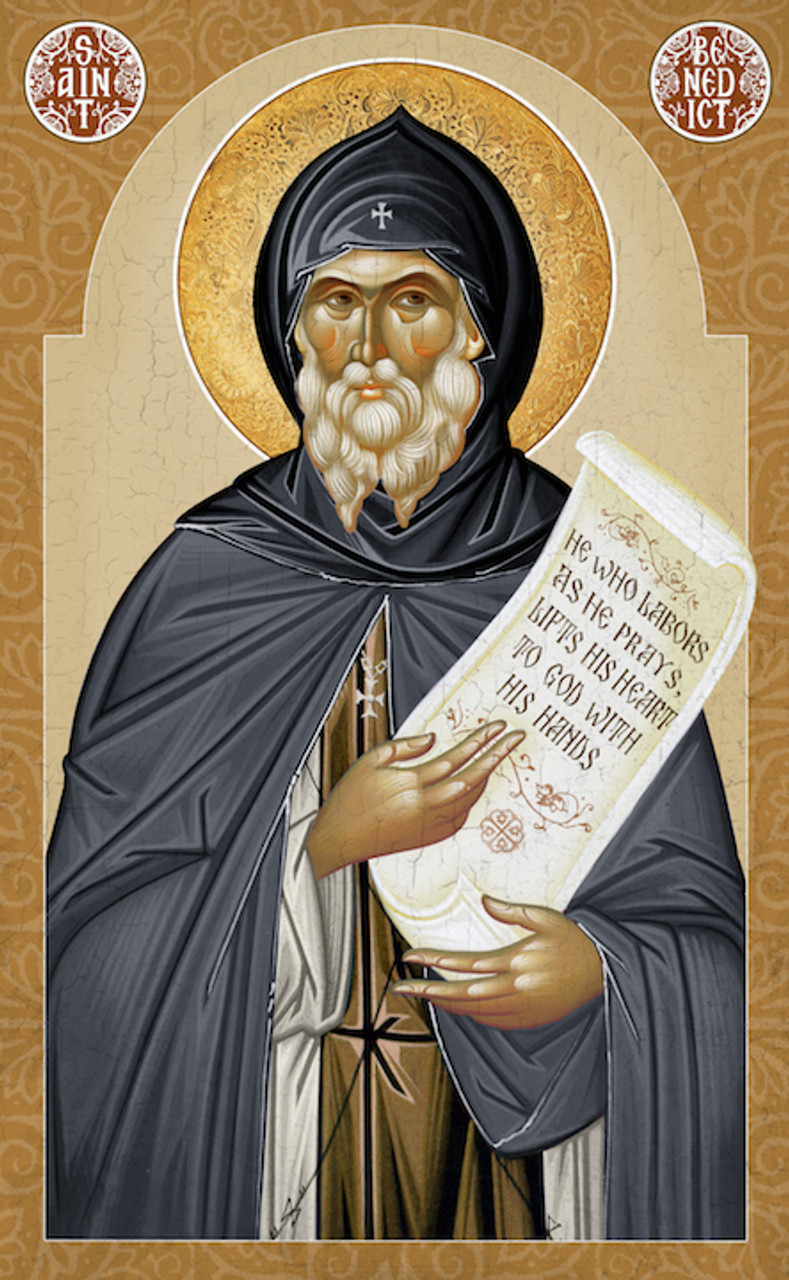
St. Benedict is believed to have been born around 480, as the son to a Roman noble of Norcia and the twin to his sister, Scholastica.
In the fifth century, the young Benedict was sent to Rome to finish his education with a nurse/housekeeper. The subject that dominated a young man's study then was rhetoric -- the art of persuasive speaking. A successful speaker was not one who had the best argument or conveyed the truth, but one who used rhythm, eloquence, and technique to convince. The power of the voice without foundation in the heart was the goal of the student's education. And that philosophy was reflected in the lives of the students as well. They had everything -- education, wealth, youth -- and they spent all of it in the pursuit of pleasure, not truth. Benedict watched in horror as vice unraveled the lives and ethics of his companions.
Afraid for his soul, Benedict fled Rome, gave up his inheritance and lived in a small village with his nurse. When God called him beyond this quiet life to an even deeper solitude, he went to the mountains of Subiaco. Although becoming a hermit was not his purpose in leaving, there he lived as a hermit under the direction of another hermit, Romanus.
One day, during his time living in a cave above a lake as a hermit, the Devil presented Benedict's imagination with a beautiful, tempting woman. Benedict resisted by rolling his body into a thorn bush until it was covered in scrapes. It is said through these body wounds, he cured the wounds of his soul.
After years of prayer, word of his holiness brought nearby monks to ask for his leadership. He warned them he would be too strict for them, but they insisted -- then tried to poison him when his warning proved true. The story goes, the monks attempted to poison Benedict's drink, but when he prayed a blessing over the cup - it shattered.
So Benedict was on his own again -- but not for long. The next set of followers were more sincere and he set up twelve monasteries in Subiaco where monks lived in separate communities of twelve.
He left these monasteries abruptly when the envious attacks of another hermit made it impossible to continue the spiritual leadership he had taken.
But it was in Monte Cassino he founded the monastery that became the roots of the Church's monastic system. Instead of founding small separate communities he gathered his disciples into one whole community. His own sister, Saint Scholastica, settled nearby to live a religious life.
After almost 1,500 years of monastic tradition his direction seems obvious to us. However, Benedict was an innovator. No one had ever set up communities like his before or directed them with a rule. What is part of history to us now was a bold, risky step into the future.
Benedict had the holiness and the ability to take this step. His beliefs and instructions on religious life were collected in what is now known as the Rule of Saint Benedict -- still directing religious life after 15 centuries.
In this tiny but powerful Rule, Benedict put what he had learned about the power of speaking and oratorical rhythms at the service of the Gospel. He did not drop out of school because he did not understand the subject! Scholars have told us that his Rule reflects an understanding of and skill with the rhetorical rules of the time. Despite his experience at school, he understood rhetoric was as much a tool as a hammer was. A hammer could be used to build a house or hit someone over the head. Rhetoric could be used to promote vice ... or promote God. Benedict did not shun rhetoric because it had been used to seduce people to vice; he reformed it.
Ad Majorem Dei Gloriam (To the Greater Glory of God)
From: Isaiah 1:10-20
Religion Without Soul
---------------------
[10] Hear the word of the LORD, you rulers of Sodom! Give ear to the teaching of our God, you people of Gomorrah! [11] “What to me is the multitude of your sacrifices? says the Lord; I have had enough of burnt offerings of rams and the fat of fed beasts; I do not delight in the blood of bulls, or of lambs, or of he-goats.
[12] “When you come to appear before me, who requires of you this trampling of my courts? [13] Bring no more vain offerings; incense is an abomination to me. New moon and sabbath and the calling of assemblies – I cannot endure iniquity and solemn assembly. [14] Your new moons and your appointed feasts my soul hates; [15] When you spread forth your hands, I will hide my eyes from you; even though you make many prayers, I will not listen; your hands are full of blood.
Call to Conversion
------------------
[16] Wash yourselves; make yourselves clean; remove the evil of your doings from before my eyes; cease to do evil, [17] learn to do good; seek justice, correct oppression; defend the fatherless, plead for the widow.
***********************************************************************
Commentary:
1:2-39:8. The first part of the book of Isaiah is usually described as “First Isaiah”. It includes prophetic passages that have as their background the threat posed by the Assyrians to Judah and Jerusalem during the second half of the eighth century BC. At the start and conclusion of this part, Jerusalem is referred to as a “besieged city” and as “overthrown by aliens” (l:7-8; 36:1ff).
The sacred text links the people of Judah’s distress and uneasiness with the fact that they have distanced themselves from God; they live without reference to him, forgetful of all he has done for them. The future looks bleak, for there is no sign of their heeding the prophet’s call to conversion. However, there is still some cause for hope, for a remnant of Israel has kept faith with God, and from it a new, reformed people will emerge. In various ways a contrast is drawn between those (like King Ahaz: cf. 7:1-17) who clearly do not put their trust in God, relying only on human prudence to deal with the situation, and others (like King Hezekiah: 36:1-38:22) who have recourse to the Lord and make every effort to remedy things; they are confident that God will come to their aid and deliver them from danger.
The first part of the book contains prophetic passages that differ in style and origin. The oldest of them reflect the fear caused by the sheer might of Assyria, which is depicted as a rod or staff wielded by the Lord in his anger (cf. 10:5). All nations in the region felt threatened by Assyria, whose armies reached the very gates of Jerusalem when Sennacherib besieged the city. (That siege marks the end of this part of the book.)
These words of prophecy fall into six sections. The first deals with the threat hanging over Israel and Judah (1:2-12:6); and the second contains oracles to do with foreign nations (13:1-23:18). The third, which in away contains the theological basis of all the teaching found in First Isaiah, and which is known as the “Apocalypse of Isaiah”, deals with the sentence passed on the nations by the Lord (he is supreme, and nothing escapes his justice); still, the light of salvation is always on the horizon (24:1-27:13). Then we hear more about the misfortunes that threaten Jerusalem on account of its sins -- and further reason to hope that all is not lost (28:1-33:24). After returning to the theme of divine judgment and rallying the people to hope in salvation, in a section known as the “little Apocalypse” (34:1-35:10), First Isaiah ends with a narrative section dealing with the havoc caused in Judah by Sennacherib’s forces, although, for a while at least, a small remnant is spared -- those who take refuge in Jerusalem alongside Hezekiah the king (36:1-39:8).
1:2-12:6. Isaiah’s ministry as a prophet must have begun in the years prior to the war, when the kingdoms of Syria and Ephraim (Israel), with Egypt’s encouragement, joined forces and took to the field in campaigns aimed at stemming the advance of the Assyrians. The kings of Syria and Israel tried to persuade Ahaz of Judah to join their alliance. Ahaz refused to get involved and, instead, sought to ingratiate himself with Assyria in order to save his country. In 734 BC Assyria overran Syria, most of Israel and the Lebanon, the Philistine coast and the Transjordan, and in the years that followed it consolidated its grip on the region. After the fall of Samaria (722 BC), much of the population of Israel was deported and replaced by foreigners.
The kingdom of Judah was not invaded, but it was forced to pay heavy tribute and became a state dependent on Assyria. At the cost of many concessions, an uneasy peace prevailed. Religious life and the rule of law deteriorated. This was the background to the earliest of the oracles contained in these twelve chapters. The section begins with a general denunciation of the forsaking of the Lord; no specific events are mentioned. It is a time of crisis, with Judah laid waste and Jerusalem under siege (1:2-20); clearly there is need for a call to conversion, to atone for sins and infidelities (1:21-31). After a few verses that strike a note of hope (in time, Jerusalem will be raised on high), there follow oracles that describe how the people have been laid low on account of their pride (2:6-22). However, amid all the uncleanness, a seed of beauty remains, offering hopes of rebirth (3:1-4:6). One could say that the core of the whole section is the “Song of the vineyard” (5:1-7), a lovely allegory about the care that the Lord lavishes on his people, and about their failure to appreciate it.
After this we begin to find references to specific times in what is called the “Book of lmmanuel” (7:1-12:6), which begins with an account of the calling of Isaiah, whom the Lord has commissioned to explain the meaning of what is happening and to show that there are grounds for hope (6:1-13). In line with this, the prophet approaches Ahaz to encourage him to trust in the Lord (7:1-17) in the face of threatened invasion (7:18-25). Assyria is about to close in on Israel and Judah (8:1-22), but there is still hope of deliverance (8:23-9:6). Punishment does await Israel and Judah (9:7-10:4), but Assyria will not escape it either (10:5-19). Meanwhile, the “remnant” of Israel will grow in its appreciation of the Lord and will find peace (10:20-11:9). The section ends with a song of joy and praise to the Lord for saving and renewing his people (11:10-12:6).
1:2-31. The first oracles are couched in the language of a lawsuit (rib). This is a style of writing often found in the prophetical literature of Israel. which shares similar modes of expression with other writings of the ancient Middle East (see the note on Is 1:10-20). However, other people resort to that legal style when they seek to justify the punishment inflicted on a vassal by an aggrieved overlord, whereas when prophetical texts denounce a fault it is in order to evince an immediate change of heart. The Lord takes no pleasure in punishing people; he very much wants to forgive transgressors and reestablish friendship with them.
The passage begins by calling on heaven and earth to see how wickedly the people have acted, and by accusing them of forsaking the Lord (vv. 2-3). It then inveighs against those who have turned away from the Lord and show no inclination to react, even though misfortune has overtaken them (vv. 4-9), and it denounces the hypocrisy of a people that goes through the motions of religious worship without having the right dispositions (vv. 10-15). A call to conversion follows (vv. 16-17). The Lord is ready to argue his point against his people, to reward them if they mend their ways or punish them if they persist in their sins (vv. 18-20). They are in a bad way, such is their sinfulness (vv. 21-23). Their punishment will be very harsh; so they should respond now and be faithful, as they were in earlier times (vv. 24-31).
This oracle brings in all the main theological themes found in the history of the chosen people of the Old Testament -- their divine election; God’s offer of a Covenant; the people’s transgression of the Covenant; God’s punishment for their infidelity. Even so, it shows that theirs is a merciful God, ever ready to forgive offences; he never turns his back on those whom he has loved.
1:10-20. These verses, too, in some ways form a literary unit in line with the “lawsuit” ("rib") style often found in prophetical literature: the charge sheet (vv. 10-15) is set against a list of good works, given here in the form of an exhortation (vv. 16-17), and then comes to the sentence at the end, seen here in the attitude of the judge, who is God (vv. 18-20).
Harsh words (v. 10) are used: the people of Judah are identified with those of Sodom and Gomorrah, the epitome of sin and rejection of God. The transgressions of which they are accused are against acts of worship (vv. 11-15), listed one after the other--sacrifices, incense offerings, festivals, entreaties. The accusation is not against acts of worship in themselves, for these are laid down in the book of Leviticus and therefore are right and proper. What the prophet is inveighing against is religious formalism and the dichotomy between performance and intention, as.can be seen from the verses that follow. What God desires is sincerity of heart, virtue, protection for the weak--in other words, proper treatment of others. In laying down the law here, the Lord shows his readiness to forgive, while still holding out the threat of punishment (vv. 18-20).
Some passages of the section are read in the Liturgy during Lent (Tuesday of the Second Week) to help people check whether they have given God the worship due to him, and as a call to a sincere change of heart. Christian writers have used this passage from Isaiah (and other texts from the Scriptures) to explain that true religion and compassion begin in a person’s heart and then express themselves in actions. For example, one of the apostolic Fathers writes: “Inspired by the Holy Spirit, the ministers of God’s grace will speak of penance. And the Lord of all things himself spoke of penance, and swore an oath: I do not desire the death of the wicked man, but that he should change his ways; and he adds: "Cease to do evil, learn to do good; [...] though your sins are like scarlet, they shall be as white as snow, though they are red like crimson, they shall become like wool." The Lord desires that all whom he loves would repent, and he affirms it by his all-powerful will. Let us be obedient, then, to his glorious plan, and, by imploring his mercy and kindness, let us return to his goodness and be converted, leaving aside all our vain works, the disputes and jealousies that lead to death” (St Clement of Rome, "Ad Corinthios", 8, 1-9, 1).
1-17. “Learn to do good”: in order to lead the sort of lives that God wants, we need to be properly schooled. St Basil comments: “Since moral understanding is neither self-evident nor clear to all, we must learn to do good deeds through our study of sound doctrine” ("Enarratio in Isaiam", 1, 40). As well as calling for sound doctrine, holiness of life requires the practice of virtue, day after day, consistently, in whatever circumstances we find ourselves. The “human virtues are [...] the foundation for the supernatural ones. These in turn provide us with constant encouragement to behave in a noble way. But it is not sufficient merely to want to have these virtues: we must learn bow to practise them. "Discite benefacere" (Is 1:17), learn to do good. We need to make a habit of exercising each virtue, by actually being sincere, truthful, balanced, calm, and patient--for love is proved by deeds and we cannot love God only by word, but ‘with deeds and in truth’ (1 Jn 3:18)” (St Josemaria Escriva, "Friends of God", 91).
Jesus' Instructions to the Apostles (Continuation)
--------------------------------------------------
(Jesus said to His disciples) [34] "Do not think that I have come to bring peace on earth; I have not come to bring peace, but a sword. [35] For I have come to set a man against his father, and a daughter against her mother, and a daughter-in-law against her mother-in-law; [36] and a man's foes will be those of his own household. [37] He who loves father or mother more than Me is not worthy of Me; and he who loves son or daughter more than Me is not worthy of Me; [38] and he who does not take his cross and follow Me is not worthy of Me. [39] He who finds his life will lose it, and he who loses his life for My sake will find it.
[40] He who receives you receives Me, and he who receives Me receives Him who sent Me. [41] He who receives a prophet because he is a prophet shall receive a prophet's reward, and he who receives a righteous man because he is a righteous man shall receive a righteous man's reward. [42] And whoever gives to one of these little ones even a cup of cold water because he is a disciple, truly, I say to you, he shall not lose his reward."
The Mission of John the Baptist. Jesus' Reply
----------------------------------------------
[1] And when Jesus had finished instructing His twelve disciples, He went on from there to teach and preach in their cities.
***********************************************************************
Commentary:
34-37. Our Lord has not come to bring a false and earthly peace—the sort of tranquility the self-seeking person yearns for; He wants us to struggle against our own passions and against sin and its effects. The sword He equips us with for this struggle is, in the words of Scripture, "the sword of the Spirit which is the word of God" (Ephesians 6:17), "lively and active, sharper than any two-edged sword, piercing to the division of soul and spirit, of joints and marrow, and discerning the thoughts and intentions of the heart" (Hebrews 4:12).
The word of God in fact leads to these divisions mentioned here. It can lead, even within families, to those who embrace the faith being regarded as enemies by relatives who resist the word of truth. This is why our Lord goes on (verse 37) to say that nothing should come between Him and His disciple--not even father, mother, son or daughter: any and every obstacle (cf. Matthew 5:29-30) must be avoided.
Obviously these words of Jesus do not set up any opposition between the first and fourth commandments (love for God above all things and love for one's parents): He is simply indicating the order of priorities. We should love God with all our strength (cf. Matthew 22:37), and make a serious effort to be saints; and we should also love and respect—in theory and in practice--the parents God has given us; they have generously cooperated with the creative power of God in bringing us into the world and there is so much that we owe them. But love for our parents should not come before love of God; usually there is no reason why these two loves should clash, but if that should happen, we should be quite clear in our mind and in heart about what Jesus says here. He has in fact given us an example to follow on this point: "How is it that you sought Me? Did you not know that I must be in My Father's house?" (Luke 2:49)--His reply when, as a youth, Mary and Joseph found Him in the Temple of Jerusalem after a long search. This event in our Lord's life is a guideline for every Christian--parent or child. Children should learn from it that their affection for their parents should never come before their love for God, particularly when our Creator asks us to follow Him in a way which implies special self-giving on our part; parents should take the lesson that their children belong to God in the first place, and therefore He has a right to do with them what He wishes, even if this involves sacrifice, even heroic sacrifice. This teaching of our Lord asks us to be generous and to let God have His way. In fact, however, God never lets Himself be outdone in generosity. Jesus has promised a hundredfold gain, even in this life, and later on eternal life (cf. Matthew 19:29), to those who readily respond to His will.
38-39. The teaching contained in the preceding verses is summed up in these two succinct sentences. Following Christ, doing what He asks, means risking this present life to gain eternal life.
"People who are constantly concerned with themselves, who act above all for their own satisfaction, endanger their eternal salvation and cannot avoid being unhappy even in this life. Only if a person forgets himself and gives himself to God and to others, in marriage as well as in any other aspect of life, can he be happy on this earth, with a happiness that is a preparation for, and a foretaste of, the joy of Heaven" ([St] J. Escriva, "Christ Is Passing By", 24). Clearly, Christian life is based on self-denial: there is no Christianity without the Cross.
40. To encourage the Apostles and to persuade others to receive them, our Lord affirms that there is an intimate solidarity, or even a kind of identity, between Himself and His disciples. God in Christ, Christ in the Apostles: this is the bridge between Heaven and earth. (cf. 1 Corinthians 3:21-23).
41-42. A prophet's mission is not essentially one of announcing future events; his main role is that of communicating the word of God (cf. Jeremiah 11:2; Isaiah 1:2). The righteous man, the just man, is he who obeys the Law of God and follows His paths (cf. Genesis 6:9; Isaiah 3:10). Here Jesus tells us that everyone who humbly listens to and welcomes prophets and righteous men, recognizing God in them, will receive the reward of a prophet and a righteous man. The very fact of generously receiving God's friends will gain one the reward that they obtain. Similarly, if we should see God in the least of His disciples (verse 42), even if they do not seem very important, they are important, because they are envoys of God and of His Son. That is why he who gives them a glass of cold water--an alms, or any small service--will receive a reward, for he has shown generosity to our Lord Himself (cf. Matthew 25:40).
1. In chapters 11 and 12 the Gospel records the obduracy of the Jewish leaders toward Jesus, despite hearing His teaching (chapter 5-7) and seeing the miracles which bear witness to the divine nature of His person and His doctrine (chapters 8 and 9).
| Matthew | |||
| English: Douay-Rheims | Latin: Vulgata Clementina | Greek NT: Byzantine/Majority Text (2000) | |
| Matthew 10 | |||
| 34. | Do not think that I came to send peace upon earth: I came not to send peace, but the sword. | Nolite arbitrari quia pacem venerim mittere in terram : non veni pacem mittere, sed gladium : | μη νομισητε οτι ηλθον βαλειν ειρηνην επι την γην ουκ ηλθον βαλειν ειρηνην αλλα μαχαιραν |
| 35. | For I came to set a man at variance against his father, and the daughter against her mother, and the daughter in law against her mother in law. | veni enim separare hominem adversus patrem suum, et filiam adversus matrem suam, et nurum adversus socrum suam : | ηλθον γαρ διχασαι ανθρωπον κατα του πατρος αυτου και θυγατερα κατα της μητρος αυτης και νυμφην κατα της πενθερας αυτης |
| 36. | And as a man's enemies shall be they of his own household. | et inimici hominis, domestici ejus. | και εχθροι του ανθρωπου οι οικειακοι αυτου |
| 37. | He that loveth father or mother more than me, is not worthy of me; and he that loveth son or daughter more than me, is not worthy of me. | Qui amat patrem aut matrem plus quam me, non est me dignus : et qui amat filium aut filiam super me, non est me dignus. | ο φιλων πατερα η μητερα υπερ εμε ουκ εστιν μου αξιος και ο φιλων υιον η θυγατερα υπερ εμε ουκ εστιν μου αξιος |
| 38. | And he that taketh not up his cross, and followeth me, is not worthy of me. | Et qui non accipit crucem suam, et sequitur me, non est me dignus. | και ος ου λαμβανει τον σταυρον αυτου και ακολουθει οπισω μου ουκ εστιν μου αξιος |
| 39. | He that findeth his life, shall lose it: and he that shall lose his life for me, shall find it. | Qui invenit animam suam, perdet illam : et qui perdiderit animan suam propter me, inveniet eam. | ο ευρων την ψυχην αυτου απολεσει αυτην και ο απολεσας την ψυχην αυτου ενεκεν εμου ευρησει αυτην |
| 40. | He that receiveth you, receiveth me: and he that receiveth me, receiveth him that sent me. | Qui recipit vos, me recipit : et qui me recipit, recipit eum qui me misit. | ο δεχομενος υμας εμε δεχεται και ο εμε δεχομενος δεχεται τον αποστειλαντα με |
| 41. | He that receiveth a prophet in the name of a prophet, shall receive the reward of a prophet: and he that receiveth a just man in the name of a just man, shall receive the reward of a just man. | Qui recipit prophetam in nomine prophetæ, mercedem prophetæ accipiet : et qui recipit justum in nomine justi, mercedem justi accipiet. | ο δεχομενος προφητην εις ονομα προφητου μισθον προφητου ληψεται και ο δεχομενος δικαιον εις ονομα δικαιου μισθον δικαιου ληψεται |
| 42. | And whosoever shall give to drink to one of these little ones a cup of cold water only in the name of a disciple, amen I say to you, he shall not lose his reward. | Et quicumque potum dederit uni ex minimis istis calicem aquæ frigidæ tantum in nomine discipuli : amen dico vobis, non perdet mercedem suam. | και ος εαν ποτιση ενα των μικρων τουτων ποτηριον ψυχρου μονον εις ονομα μαθητου αμην λεγω υμιν ου μη απολεση τον μισθον αυτου |
| Matthew 11 | |||
| 1. | AND it came to pass, when Jesus had made an end of commanding his twelve disciples, he passed from thence, to teach and preach in their cities. | Et factum est, cum consummasset Jesus, præcipiens duodecim discipulis suis, transiit inde ut doceret, et prædicaret in civitatibus eorum. | και εγενετο οτε ετελεσεν ο ιησους διατασσων τοις δωδεκα μαθηταις αυτου μετεβη εκειθεν του διδασκειν και κηρυσσειν εν ταις πολεσιν αυτων |

19:27–30
27. Then answered Peter and said unto him, Behold, we have forsaken all, and followed thee; what shall we have therefore?
28. And Jesus said unto them, Verily I say unto you, That ye which have followed me, in the regeneration when the Son of man shall sit in the throne of his glory, ye also shall sit upon twelve thrones, judging the twelve tribes of Israel.
29. And every one that hath forsaken houses, or brethren, or sisters, or father, or mother, or wife, or children, or lands, for my name’s sake, shall receive an hundred fold, and shall inherit everlasting life.
30. But many that are first shall be last; and the last shall be first.
ORIGEN. Peter had heard the word of Christ when He said, If thou wilt be perfect, go and sell all that thou hast. Then he observed that the young man had departed sorrowful, and considered the difficulty of riches entering into the kingdom of heaven; and thereupon he put this question confidently as one who had achieved no easy matter. For though what he with his brother had left behind them were but little things, yet were they not esteemed as little with God, who considered that out of the fulness of their love they had so forsaken those least things, as they would have forsaken the greatest things if they had had them. So Peter, thinking rather of his will than of the intrinsic value of the sacrifice, asked Him confidently, Behold, we have left all.
CHRYSOSTOM. (Hom. lxiv.) What was this all, O blessed Peter? The reeds, your net, and boat. But this he says, not to call to mind his own magnanimity, but in order to propose the case of the multitude of poor. A poor man might have said, If I have nought, I cannot become perfect. Peter therefore puts this question that you, poor man, may learn that you are in nothing behind. For he had already received the kingdom of heaven, and therefore secure of what was already there, he now asks for the whole world. And see how carefully he frames his question after Christ’s requirements: Christ required two things of a rich man, to give what he had to the poor, and to follow Him; wherefore he adds, and have followed thee.
ORIGEN. It may be said, In all things which the Father revealed to Peter that the Son was, righteousness, sanctification, and the like, in all we have followed Thee. Therefore as a victorious athlete, he now asks what are the prizes of his contest.
JEROME. Because to forsake is not enough, he adds that which makes perfection, and have followed thee. We have done what thou commandedst us, what reward wilt thou then give us? What shall we have?
JEROME. He said not only, Ye who have left all, for this did the philosopher Cratesh, and many other who have despised riches, but added, and have followed me, which is peculiar to the Apostles and believers.
HILARY. The disciples had followed Christ in the regeneration, that is, in the laver of baptism, in the sanctification of faith, for this is that regeneration which the Apostles followed, and which the Law could not bestow.
JEROME. Or it may be constructed thus, Ye which have followed me, shall in the regeneration sit, &c.; that is, when the dead shall rise from corruption incorrupt, you also shall sit on thrones of judges, condemning the twelve tribes of Israel, for that they would not believe when you believed.
AUGUSTINE. (de Civ. Dei, xx. 5.) Thus our flesh will be regenerated by incorruption, as our soul also shall be regenerated by faith.
PSEUDO-CHRYSOSTOM. For it would come to pass, that in the day of judgment the Jews would allege, Lord, we knew Thee not to be the Son of God when Thou wast in the flesh. For who can discern a treasure buried in the ground, or the sun when obscured by a cloud? The disciples therefore will then answer, We also were men, and peasants, obscure among the multitude, but you priests and scribes; but in us a right will became as it were a lamp of our ignorance, but your evil will became to you a blinding of your science.
CHRYSOSTOM. He therefore said not the Gentiles and the whole world, but, the tribes of Israel, because the Apostles and the Jews had been brought up under the same laws and customs. So that when the Jews should plead that they could not believe in Christ, because they were hindered by their Law, the disciples will be brought forward, who had the same Law. But some one may say, What great thing is this, when both the Ninevites and the Queen of the South will have the same? He had before and will again promise them the highest rewards; and even now He tacitly conveys something of the same. For of those others He had only said, that they shall sit, and shall condemn this generation; but He now says to the disciples, When the Son of Man shall sit, ye also shall sit. It is clear then that they shall reign with Him, and shall share in that glory; for it is such honour and glory unspeakable that He intends by the thrones. How is this promise fulfilled? Shall Judas sit among them? By no means. For the law was thus ordained of the Lord by Jeremiah the Prophet, I will speak it upon my people, and upon the kingdom, that I may build, and plant it. Bui if it do evil in my sight, then will I repent we of the good which I said I would do to them; (Jer. 18:9.) as much as to say, If they make themselves unworthy of the promise, I will no more perform that I promised. But Judas shewed himself unworthy of the preeminence; wherefore when He gave this promise to His disciples, He did not promise it absolutely, for He said not, Ye shall sit, but, Ye which, have followed me shall sit; at once excluding Judas, and admitting such as should be in after time; for neither was the promise confined to them only, nor yet did it include Judas who had already shewn himself undeserving.
HILARY. Their following Christ in thus exalting the Apostles to twelve thrones to judge the twelve tribes of Israel, associated them in the glory of the twelve Patriarchs.
AUGUSTINE. (ubi sup.) From this passage we learn that Jesus will judge with His disciples; whence He says in another place to the Jews, Therefore shall they be your judges. (Mat. 12:27.) And whereas He says they shall sit upon twelve thrones, we need not think that twelve persons only shall judge with Him. For by the number twelve is signified the whole number of those that shall judge; and that because the number seven which generally represents completeness contains the two numbers four and three, which multiplied together make twelve. For if it were not so, as Matthias was elected into the place of the traitor Judas, the Apostle Paul who laboured more than they all should not have place to sit to judge; but he shews that he with the rest of the saints pertains to the number of judges, when he says, Know ye not that we shall judge Angels? (1 Cor. 6:3.)
AUGUSTINE. (Serm. 351. 8.) In the number of judges therefore are included all that have left their all and followed the Lord;
GREGORY. (Mor. x. 31.) For whosoever, urged by the spur of divine lore, shall forsake what he possesses here, shall without doubt gain there the eminence of judicial authority; and shall appear as judge with the Judge, for that he now in consideration of the judgment chastens himself by a voluntary poverty.
AUGUSTINE. (de Civ. Dei, xx. 5.) The same holds good, by reason of this number twelve, of those that are to be judged. For when it is said, Judging the twelve tribes, yet is not the tribe of Levi, which is the thirteenth, to be exempt from being judged by them; nor shall they judge this nation alone, and not also other nations.
PSEUDO-CHRYSOSTOM. Or, by that, In the regeneration, Christ designs the period of Christianity that should be after His ascension, in which men were regenerated by baptism; and that is the time in which Christ sate on the throne of His glory. And hereby you may see that He spake not of the time of the judgment to come, but of the calling of the Gentiles, in that He said not, When the Son of Man shall come sitting upon the throne of his majesty; but only, In the regeneration when he shall sit, which was from the time that the Gentiles began to believe on Christ; according to that, God shall reign over the heathen; God sitteth upon his holy throne. (Ps. 47:8.) From that time also the Apostles have sat upon twelve thrones, that is, over all Christians; for every Christian who receives the word of Peter, becomes Peter’s throne, and so of the rest of the Apostles. On these thrones then the Apostles sit, parcelled into twelve divisions, after the variety of minds and hearts, known to God only. For as the Jewish nation was split into twelve tribes, so is the whole Christian people divided into twelve, so as that some souls are numbered with the tribe of Reuben, and so of the rest, according to their several qualities. For all have not all graces alike, one is excellent in this, another in that. And so the Apostles will judge the twelve tribes of Israel, that is, all the Jews, by this, that the Gentiles received the Apostles’ word. The whole body of Christians are indeed twelve thrones for the Apostles, but one throne for Christ. For all excellencies are but one throne for Christ, for He alone is equally perfect in all virtues. But of the Apostles each one is more perfect in some one particuar excellence, as Peter in faith; so Peter tests upon his faith, John on his innocence, and so of the rest. And that Christ spake of reward to be given to the Apostles in this world, is shewn by what follows, And every one that hath forsaken houses, or brethren, or sisters, &c. For if these shall receive an hundred fold in this life, without doubt to the Apostles also was promised a reward in this present life.
CHRYSOSTOM. Or; He holds out rewards in the future life to the Apostles, because they were already looking above, and desired nothing of things present; but to others. He promises things present.
ORIGEN. Or otherwise; Whosoever shall leave all and follow Christ, he also shall receive those things that were promised to Peter. But if he has not left all, but only those things in special here enumerated, he shall receive manifold, and shall possess eternal life.
JEROME. There are that take occasion from this passage to bring forward the thousand years after the resurrection, and say that then we shall have a hundred fold of the things we have given up, and moreover life eternal. But though the promise be in other things worthy, in the matter of wives it seems to have somewhat shameful, if he who has forsaken one wife for the Lord’s sake, shall receive a hundred in the world to come. The meaning is therefore, that he that has forsaken earnal things for the Saviour’s sake, shall receive spiritual things, which in a comparison of value are as a hundred to a small number.
ORIGEN. And in this world, because for his brethren after the flesh he shall find many brethren in the faith; for parents, all the Bishops and Presbyters; for sons, all that have the age of sons. The Angels also are brethren, and all they are sisters that have offered themselves chaste virgins to Christ, as well they that still continue on earth, as they that now live in heaven. The houses and lands manifold more suppose in the repose of Paradise, and the city of God. And besides all these things they shall possess eternal life.
AUGUSTINE. (De Civ. Dei, xx. 7.) That He says, An hundred fold, is explained by the Apostle, when he says, As having nothing, and yet possessing all things. (2 Cor. 6:10.) For a hundred is sometimes put for the whole universe.
JEROME. And that, And every one that hath forsaken brethren, agrees with that He had said before, I am come to set a man at variance with his father. (Mat. 10:35.) For they who for the faith of Christ and the preaching of the Gospel shall despise all the ties, the riches, and pleasures of this world, they shall receive an hundred fold, and shall possess eternal life.
CHRYSOSTOM. But when He says, He that has forsaken wife, it is not to be taken of actual severing of the marriage tie, but that we should hold the ties of the faith dearer than any other. And here is, I think, a covert allusion to times of persecution; for because there should be many who would draw away their sons to heathenism, when that should happen, they should be held neither as fathers, nor husbands.
RABANUS. But because many with what zeal they take up the pursuit of virtue, do not with the same complete it; but either grow cool, or fall away rapidly; it follows, But many that are first shall be last, and the last first.
ORIGEN. By this He exhorts those that come late to the heavenly word, to haste to ascend to perfection before many whom they see to have grown old in the faith. This sense may also overthrow those that boast to have been educated in Christianity by Christian parents, especially if those parents have filled the Episcopal see, or the office of Priests or Deacons in the Church; and hinder them from desponding who have entertained the Christian doctrines more newly. It has also another meaning, the first, are the Israelites, who become last because of their unbelief; and the Gentiles who were last become first. He is careful to say, Many; for not all who are first shall be last, nor all last first. For before this have many of mankind, who by nature are the last, been made by an angelic life above the Angels; and some Angels who were first have been made last through their sin.
REMIGIUS. It may also be referred in particular to the rich man, who seemed to be first, by his fulfilment of the precepts of the Law, but was made last by his preferring his worldly substance to God. The holy Apostles seemed to be last, but by leaving all they were made first by the grace of humility. There are many who having entered upon good works, fall therefrom, and from having been first, become last.
Catena Aurea Matthew 19
Disclaimer: Opinions posted on Free Republic are those of the individual posters and do not necessarily represent the opinion of Free Republic or its management. All materials posted herein are protected by copyright law and the exemption for fair use of copyrighted works.
