Free Republic
Browse · Search
Religion
Topics · Post Article

Skip to comments.

Catholic Caucus: Daily Mass Readings 13-March-2022; 2nd Sunday of Lent
Universalis/Jerusalem Bible | 13 March 2022 | God inspired

Posted on 03/13/2022 4:01:12 AM PDT by Cronos

March 13th 2022

2nd Sunday of Lent


St. Joseph Cathedral, Sioux Falls, South Dakota

Readings at Mass

Liturgical Colour: violet


First reading
Genesis 15:5-12,17-18 ©

God enters into a Covenant with Abraham, the man of faith

Taking Abram outside, the Lord said, ‘Look up to heaven and count the stars if you can.’ ‘Such will be your descendants,’ he told him. Abram put his faith in the Lord, who counted this as making him justified.
  ‘I am the Lord’ he said to him ‘who brought you out of Ur of the Chaldaeans to make you heir to this land.’ ‘My Lord,’ Abram replied ‘how am I to know that I shall inherit it?’ He said to him, ‘Get me a three-year-old heifer, a three-year-old goat, a three-year-old ram, a turtledove and a young pigeon.’ He brought him all these, cut them in half and put half on one side and half facing it on the other; but the birds he did not cut in half. Birds of prey came down on the carcases but Abram drove them off.
  Now as the sun was setting Abram fell into a deep sleep, and terror seized him. When the sun had set and darkness had fallen, there appeared a smoking furnace and a firebrand that went between the halves. That day the Lord made a Covenant with Abram in these terms:
‘To your descendants I give this land,
from the wadi of Egypt to the Great River.’

Responsorial Psalm
Psalm 26(27):1,7-9,13-14 ©
The Lord is my light and my help.
The Lord is my light and my help;
  whom shall I fear?
The Lord is the stronghold of my life;
  before whom shall I shrink?
The Lord is my light and my help.
O Lord, hear my voice when I call;
  have mercy and answer.
Of you my heart has spoken:
  ‘Seek his face.’
The Lord is my light and my help.
It is your face, O Lord, that I seek;
  hide not your face.
Dismiss not your servant in anger;
  you have been my help.
The Lord is my light and my help.
I am sure I shall see the Lord’s goodness
  in the land of the living.
Hope in him, hold firm and take heart.
  Hope in the Lord!
The Lord is my light and my help.

Second reading
Philippians 3:17-4:1 ©

Our homeland is in heaven, and from heaven comes Christ to transfigure us

My brothers, be united in following my rule of life. Take as your models everybody who is already doing this and study them as you used to study us. I have told you often, and I repeat it today with tears, there are many who are behaving as the enemies of the cross of Christ. They are destined to be lost. They make foods into their god and they are proudest of something they ought to think shameful; the things they think important are earthly things. For us, our homeland is in heaven, and from heaven comes the saviour we are waiting for, the Lord Jesus Christ, and he will transfigure these wretched bodies of ours into copies of his glorious body. He will do that by the same power with which he can subdue the whole universe.
  So then, my brothers and dear friends, do not give way but remain faithful in the Lord. I miss you very much, dear friends; you are my joy and my crown.

Gospel AcclamationMt17:5
Glory and praise to you, O Christ!
From the bright cloud the Father’s voice was heard:
‘This is my Son, the Beloved. Listen to him.’
Glory and praise to you, O Christ!

GospelLuke 9:28-36 ©

Jesus is transfigured before them

Jesus took with him Peter and John and James and went up the mountain to pray. As he prayed, the aspect of his face was changed and his clothing became brilliant as lightning. Suddenly there were two men there talking to him; they were Moses and Elijah appearing in glory, and they were speaking of his passing which he was to accomplish in Jerusalem. Peter and his companions were heavy with sleep, but they kept awake and saw his glory and the two men standing with him. As these were leaving him, Peter said to Jesus, ‘Master, it is wonderful for us to be here; so let us make three tents, one for you, one for Moses and one for Elijah.’ – He did not know what he was saying. As he spoke, a cloud came and covered them with shadow; and when they went into the cloud the disciples were afraid. And a voice came from the cloud saying, ‘This is my Son, the Chosen One. Listen to him.’ And after the voice had spoken, Jesus was found alone. The disciples kept silence and, at that time, told no one what they had seen.

The readings on this page are from the Jerusalem Bible, which is used at Mass in most of the English-speaking world. The New American Bible readings, which are used at Mass in the United States, are available in the Universalis apps, programs and downloads.

You can also view this page with the Gospel in Greek and English.


TOPICS: Catholic; General Discusssion; Prayer; Worship
KEYWORDS: catholic; lent; lk9; prayer
For your reading, reflection, faith-sharing, comments, questions, discussion.

1 posted on 03/13/2022 4:01:12 AM PDT by Cronos
[ Post Reply | Private Reply | View Replies]

To: Cronos

catholic, lent, prayer, lk9


2 posted on 03/13/2022 4:01:20 AM PDT by Cronos ( One cannot desire freedom from the Cross, especially when one is especially chosen for the cross)
[ Post Reply | Private Reply | To 1 | View Replies]

To: nickcarraway; NYer; ELS; Pyro7480; livius; ArrogantBustard; Catholicguy; RobbyS; marshmallow; ...
Alleluia Ping

Please FReepmail me/annalex to get on/off the Alleluia Ping List.

Feel free to add your content, so long as it conforms with the rules of the Catholic Caucus. For example, post your prayers, thoughts, art that you like.

3 posted on 03/13/2022 4:01:39 AM PDT by Cronos ( One cannot desire freedom from the Cross, especially when one is especially chosen for the cross)
[ Post Reply | Private Reply | To 2 | View Replies]

To: Cronos

Catena Aurea by St. Thomas Aguinas

9:28–31

28. And it came to pass about an eight days after these sayings, he took Peter and John and James, and went up into a mountain to pray.

29. And as he prayed, the fashion of his countenance was altered, and his raiment was white and glistering.

30. And, behold, there talked with him two men, which were Moses and Elias:

31. Who appeared in glory, and spake of his decease which he should accomplish at Jerusalem.

EUSEBIUS. Our Lord, when He made known to His disciples the great mystery of His second coming, that it might not seem that they were to believe in His words only, proceeds to works, manifesting to them, through the eyes of their faith, the image of His kingdom; as it follows, And it came to pass about an eight days after these sayings, he took Peter and John and James, and went up into a mountain to pray.

DAMASCENE. (Orat. de Trans fig. §. 8.) Matthew and Mark indeed say that the transfiguration took place on the sixth day after the promise made to the disciples, but Luke on the eighth. But there is no disagreement in these testimonies, but they who make the number six, taking off a day at each end, that is, the first and the last, the day on which He makes the promise, and that on which He fulfilled it, have reckoned only the intervening ones, but He who makes the number eight, has counted in each of the two days above mentioned. But why were not all called, but only some, to behold the sight? There was only one indeed who was unworthy to see the divinity, namely Judas, according to the word of Isaiah, Let the wicked be taken away, that he should not behold the glory of God. (Isai. 26:10 LXX.) If then he alone had been sent away, he might have, as it were from envy, been provoked to greater wickedness. Henceforward He takes away from the traitor every pretext for his treachery, seeing that He left below the rest of the company of the Apostles. But He took with Him three, that in the mouths of two or three witnesses every word should be established. He took Peter, indeed, because He wished to shew him that the witness he had borne to Him was confirmed by the witness of the Father, and that he was as it were to preside over the whole Church. He took with Him James, who was to be the first of all the disciples to die for Christ; but He took John as the clearest singer of the sacred doctrine, that having seen the glory of the Son, which submits not to time, he might sound forth, In the beginning was the Word. (John 1:1.)

AMBROSE. Or, Peter went up, who received the keys of the kingdom of heaven; John, to whom was committed our Lord’s mother; James, who first suffered martyrdom. (Acts 12:1.)

THEOPHYLACT. Or, He takes these with Him as men who were able to conceal this thing, and reveal it to no one else. But going up into a mountain to pray, He teaches us to pray solitary, and going up, into stooping to earthly things.

DAMASCENE. (ut sup. 10.) Servants however pray in one way; our Lord prayed in another. For the prayer of the servant is offered up by the lifting up of the mind to God, but the holy mind of Christ, (who was hypostatically [ὑπόστασιν] united to God,) prayed, that He might lead us by the hand to the ascent, whereby we mount up in prayer to God, and teach us that He is not opposed to God, but reverences the Father as His beginning; (ὡς ἀρχὴν ἑαυτὸν) nay, even tempting the tyrant, who sought from Him whether He were God, (which the power of His miracles declared,) He concealed as it were under the bait a hook; that he who had deceived man with the hope of divinity might fitly himself be caught with the clothing of humanity. Prayer is the revelation of Divine glory; as it follows, And as he prayed, the fashion of his countenance was altered.

CYRIL OF ALEXANDRIA. Not as though His body changed its human form, but a certain glistening glory overspread it.

DAMASCENE. (ut sup. 13.) Now the devil, seeing His face shining in prayer, recollected Moses, whose face was glorified. But Moses indeed was arrayed with a glory, which came from without; our Lord, with that which proceeded from the inherent brightness of Divine glory. (Exod. 34:29.) For since in the hypostatical union there is one and the same glory of the Word and the flesh, He is transfigured not as receiving what He was not, but manifesting to His disciples, what He was. Hence, according to Matthew, it is said, that He was transfigured before them, and that His face shone as the sun; (Mat. 17:2.) for what the sun is in things of sense, God is in spiritual things. And as the sun, which is the fountain of light, cannot be easily seen, but its light is perceived from that which reaches the earth; so the countenance of Christ shines more intensely, like the sun, but His raiment is white as snow; as it follows, And his raiment was white and glistering; that is, lighted up by its participation of the divine light. And a little afterwards, But while these things were so, that it might be shewn there was but one Lord of the new and old covenant, and the mouths of heretics might be shut, and men might believe on the resurrection, and He also, who was transfigured, be believed to be the Lord of the living and the dead, Moses and Elias, as servants, stand by their Lord in His glory; hence it follows, And behold there talked with him two men. For it became men, seeing the glory and confidence of their fellow servants, to admire indeed the merciful condescension of the Lord, but to emulate those who had laboured before them, and looking to the pleasantness of future blessings, to be the more strengthened for conflicts. For he who has known the reward of his labours, will the more easily endure them.

CHRYSOSTOM. (Hom. 56. in Matt.) Or else this took place because the multitude said He was Elias or Jeremias, to shew the distinction between our Lord and His servants. And to make it plain that He was not an enemy of God, and transgressor of the law, He shewed these two standing by Him; (for else, Moses the lawgiver, and Elias who was zealous for the glory of God, had not stood by Him,) but also to give testimony to the virtues of the men. For each had ofttimes exposed Himself to death in keeping the divine commands. He wishes also His disciples to imitate them in the government of the people, that they might be indeed meek like Moses, and zealous like Elias. He introduces them also to set forth the glory of His cross, to console Peter and the others who feared His Passion. Hence it follows, And spake of his decease, which he should accomplish at Jerusalem.

CYRIL OF ALEXANDRIA. The mystery, namely, of His incarnation, also the life-giving Passion accomplished on the sacred cross.

AMBROSE. Now in a mystical manner, after the words above said, is exhibited the transfiguration of Christ, since he who hears the words of Christ, and believes, shall see the glory of His resurrection. For, on the eighth day the resurrection took place. Hence also several Psalms are written, ‘for the eighth,’ (pro octava.) or perhaps it was that He might make manifest what He had said, that he who for the word of God shall lose his own life, shall save it, seeing that He will make good His promises at the resurrection.

BEDE. For as He rose from the dead after the seventh day of the Sabbath, during which He lay in the tomb, we also after the six ages of this world, and the seventh of the rest of souls, which meanwhile is passed in another life, shall rise again as it were in the eighth age.

AMBROSE. But Matthew and Mark have related that He took them with Him after six days, of which we may say after 6000 years, (for a thousand years in the Lord’s sight are as one day;) but more than 6000 years are reckoned. We had rather then take the six days symbolically, that in six days the works of the world were completed, that by the time we may understand the works, by the works the world. And so the times of the world being finished, the resurrection to come is declared; or because, He who has ascended above the world, and has passed beyond the moments of this life, is waiting, seated as it were on a high place, for the everlasting fruit of the resurrection.

BEDE. Hence He ascends the mountain to pray and be transfigured, to shew that those who expect the fruit of the resurrection, and desire to see the King in His glory, ought to have the dwelling place of their hearts on high, and be ever on their knees in prayer.

AMBROSE. I should think that in the three who are taken up into the mountain, was contained in a mystery the human race, because from the three sons of Noah sprung the whole race of man; I did not perceive that they were chosen out. Three then are chosen to ascend the mountain, because none can see the glory of the resurrection, but they who have preserved the mystery of the Trinity with inviolable purity of faith.

BEDE. Now the transfigured Saviour shews the glory of His own coming, or our resurrection; who as He then appeared to His Apostles shall in like manner appear to all the elect. But the raiment of the Lord is taken for the band of His Saints, which in truth when our Lord was upon earth seemed to be despised, but when He sought the mount, shines with a new whiteness; for now are we the sons of God; and it does not yet appear what we shall be. But we know that, when he shall appear, we shall be like him. (1 John 3:2.)

AMBROSE. Or else, according to your capacity is the word either lessened or increased to you, and unless you ascend the summit of a higher wisdom, you behold not what glory there is in the word of God. Now the garments of the Word, are the discourses of the Scriptures, and certain clothings of the Divine mind; and as His raiment shone white, so in the eyes of your understanding, the sense of the divine words becomes clear. Hence after Moses, Elias; that is, the Law and the Prophets in the Word. For neither can the Law exist without the Word, nor the Prophet, unless he prophesied of the Son of God.

9:32–36

32. But Peter and they that were with him were heavy with sleep: and when they were awake, they saw his glory, and the two men that stood with him.

33. And it came to pass, as they departed from him, Peter said unto Jesus, Master, it is good for us to be here: and let us make three tabernacles; one for thee, and one for Moses, and one for Elias: not knowing what he said.

34. While he thus spake, there came a cloud, and overshadowed them: and they feared as they entered into the cloud.

35. And there came a voice out of the cloud, saying, This is my beloved Son: hear him.

36. And when the voice was past, Jesus was found alone. And they kept it close, and told no man in those days any of those things which they had seen.

THEOPHYLACT. While Christ is engaged in prayer, Peter is heavy with sleep, for he was weak, and did what was natural to man; as it is said, But Peter and they that were with him were heavy with sleep. But when they awake, they behold His glory, and the two men with Him; as it follows, And when they were awake, they saw his glory, and the two men, that stood with him.

CHRYSOSTOM. (Hom. 56. in Matt.) Or, by the word sleep, he means that strange maze that fell upon them by reason of the vision. For it was not night time, but the exceeding brightness of the light weighed down their weak eyes.

AMBROSE. For the incomprehensible brightness of the Divine nature oppresses our bodily senses. For if the sight of the body is unable to contain the sun’s ray when opposite to the eyes which behold it, how can the corruption of our fleshly members endure the glory of God? And perhaps they were oppressed with sleep, that after their rest they might behold the sight of the resurrection. Therefore when they were awake they saw His glory. For no one, except he is watching, sees the glory of Christ. Peter was delighted, and as the allurements of this world enticed him not, was carried away by the glory of the resurrection. Hence it follows, And it came to pass as they departed, &c.

CYRIL OF ALEXANDRIA. For perhaps holy Peter imagined that the kingdom of heaven was at hand, and therefore it seemed good to him to abide on the mount.

DAMASCENE. (Orat. de Trans. fig.) It were not good for thee, Peter, that Christ should abide there, for if He had remained, the promise made to thee would never receive its accomplishment. For neither wouldest thou have obtained the keys of the kingdom, nor the tyranny of death been abolished. Seek not bliss before its time, as Adam did to be made a God. The time shall come when thou shalt enjoy the sight without ceasing, and dwell together with Him who is light and life.

AMBROSE. But Peter distinguished not only by earnest feeling, but also by devout deeds, wishing like a zealous workman to build three tabernacles, offers the service of their united labour; for it follows, Let us make three tabernacles, one for thee, &c.

DAMASCENE. (ubi sup.) But the Lord ordained thee not the builder of tabernacles, but of the universal Church. Thy words have been brought to pass by thy disciples, by thy sheep, in building a tabernacle, not only for Christ, but also for His servants. But Peter said not this deliberately, but through the inspiration of the Spirit revealing things to come, as it follows, not knowing what he said.

CYRIL OF ALEXANDRIA. He knew not what he said, for neither was the time come for the end of the world, or for the Saints’ enjoyment of their promised hope. And when the dispensation was now commencing, how was it fitting that Christ should abandon His love of the world, Who was willing to suffer for it?

DAMASCENE. (ubi sup.) It behoved Him also not to confine the fruit of His incarnation to the service of those only who were on the mount, but to extend it to all believers, which was to be accomplished by His cross and passion.

TITUS BOSTRENSIS. (non occ.) Peter also was ignorant what he said, seeing that it was not proper to make three tabernacles for the three. For the servants are not received with their Lord, the creature is not placed beside the Creator.

AMBROSE. Nor does the condition of man in this corruptible body allow of making a tabernacle to God, whether in the soul or in the body, or in any other place; and although he knew not what he said, yet a service was offered which not by any deliberate forwardness, but its premature devotion, receives in abundance the fruits of piety. For his ignorance was part of his condition, his offer of devotion.

CHRYSOSTOM. (ubi sup.) Or else Peter heard that it was necessary Christ must die, and on the third day rise again, but he saw around him a very remote and solitary place; he supposed therefore that the place had some great protection. For this reason he said, It is good for us to be here. (Exod. 24:15, 2 Kings 1:12.) Moses, too was present, who entered into the cloud. Elias, who on the mount brought down fire from heaven. The Evangelist then, to indicate the confusion of mind in which he utters this, added, Not knowing what he said.

AUGUSTINE. (de Con. Ev. l. ii. c. 56.) Now in what Luke here says of Moses and Elias, And it came to pass as they departed from him, Peter said unto Jesus, Master, it is good for us to be here, he must not be thought contrary to Matthew and Mark, who have so connected Peter’s suggestion of this, as if Moses and Elias were still speaking with our Lord. For they did not expressly state that Peter said it then, but rather were silent about what Luke added, that as they departed, Peter suggested this to our Lord.

THEOPHYLACT. But while Peter spake, our Lord builds a tabernacle not made with hands, and enters into it with the Prophets. Hence it is added, While he thus spake there came a cloud and overshadowed them, to shew that He was not inferior to the Father. For as in the Old Testament it was said, the Lord dwelt in the cloud, so now also a cloud received our Lord, not a dark cloud, but bright and shining.

BASIL. (in Esai. c. 4. 5.) For the obscurity of the Law had passed away; for as smoke is caused by the fire, so the cloud by light; but because a cloud is the sign of calmness, the rest of the future state is signified by the covering of a cloud.

AMBROSE. For it is the overshadowing of the divine Spirit which does not darken, but reveals secret things to the hearts of men.

ORIGEN. (in Matt. tom. 12.) Now His disciples being unable to bear this, fell down, humbled under the mighty hand of God, greatly afraid since they knew what was said to Moses, No man shall see my face, and lice. Hence it follows, And they feared as they entered into the cloud.

AMBROSE. Now observe, that the cloud was not black from the darkness of condensed air, and such as to overcast the sky with a horrible gloom, but a shining cloud, from which we were not moistened with rain, but as the voice of Almighty God came forth the dew of faith was shed upon the hearts of men. For it follows, And there came a voice out of the cloud, saying, This is my beloved Son: hear ye him. Elias was not His Son. Moses was not. But this is the Son whom you see alone.

CYRIL OF ALEXANDRIA. (in Thes. lib. 12. c. 14.) How then should men suppose Him who is really the Son to be made or created, when God the Father thundered from above, This is my beloved Son! as if He said, Not one of My sons, but He who is truly and by nature My Son, according to whose example the others are adopted, He ordered them then to obey Him, when He added, Hear ye him. And to obey Him more than Moses and Elias, for Christ is the end of the Law and the Prophets. Hence the Evangelist adds significantly, And when the voice was past, Jesus was found alone.

THEOPHYLACT. Lest in truth any one should suppose that these words, This is my beloved Son, were uttered about Moses or Elias.

AMBROSE. They then departed, when our Lord’s manifestation had begun. There are three seen at the beginning, one at the end; for faith being made perfect, they are one. Therefore are they also received into the body of Christ, because we also shall be one in Christ Jesus; or perhaps, because the Law and the Prophets came out from the Word.

THEOPHYLACT. Now those things which began from the Word, end in the Word. For by this he implies that up to a certain time the Law and the Prophets appear, as here Moses and Elias; but afterwards, at their departure, Jesus is alone. For now abideth the Gospel, legal things having passed away.

BEDE. And mark, that as when our Lord was baptized in Jordan, so also when He was glorified on the Mount, the mystery of the whole Trinity is declared; for His glory which we confess at baptism, we shall see at the resurrection. Nor in vain does the Holy Spirit appear here in the cloud, there in the form of a dove, seeing that he who now preserves with a simple heart the faith which he receives, shall then in the light of open vision look upon those things which he believed.

ORIGEN. (ubi sup.) Now Jesus wishes not those things which relate to His glory to be spoken of before His passion. Hence it follows, And they kept it close. For men would have been offended, especially the multitude, if they saw Him crucified Who had been so glorified.

DAMASCENE. (ubi sup.) This also our Lord commands, since He knew His disciples to be imperfect, seeing that they had not yet received the full measure of the Spirit, lest the hearts of others who had not seen should be prostrated by sorrow, and lest the traitor should be stirred up to a frantic hatred.





Copyright ©1999-2018 e-Catholic2000.com


4 posted on 03/13/2022 4:02:44 AM PDT by Cronos ( One cannot desire freedom from the Cross, especially when one is especially chosen for the cross)
[ Post Reply | Private Reply | To 3 | View Replies]

To: Cronos
NAVARRE BIBLE COMMENTARY (RSV)

Ad Majorem Dei Gloriam (To the Greater Glory of God)

From: Genesis 15:5-12, 17-18

God's Covenant with Abram
-------------------------
[5] And he brought him outside and said, "Look toward heaven, and number the stars, if you are able to number them." Then he said to him, "So shall your descendants be." [6] And he believed the Lord; and he reckoned it to him as righteousness.

[7] And he said to him, "I am the Lord who brought you from Ur of the Chaldeans, to give you this land to possess." [8] But he said, "0 Lord God, how am I to know that I shall possess it?" [9] He said to him, "Bring me a heifer three years old, a she-goat three years old, a ram three years old, a turtledove, and a young pigeon." [10] And he brought him all these, cut them in two, and laid each half over against the other; but he did not cut the birds in two. [11] And when birds of prey came down upon the carcasses, Abram drove them away.

[12] As the sun was going down, a deep sleep fell on Abram; and lo, a dread and great darkness fell upon him.

[17] When the sun had gone down and it was dark, behold, a smoking firepot and a flaming torch passed between these pieces. [18] 0n that day the Lord made a covenant with Abram, saying, "To your descendants I give this land, from the river of Egypt to the great river, the river Euphrates."

***********************************************************************
Commentary:

15:1-21. God rewards Abraham for his generosity towards Mechizedek and for his renouncing of the riches offered him by the king of Sodom. He appears to him in a vision and promises his help, many descendants and the land of Canaan. Here all that is required of Abraham is that he believe in the promise that God himself, through a rite of covenant, undertakes to fulfill. This passage emphasizes the gravity of God's promise and speaks of the faithfulness of God, who will keep his word.

15:2-3. Abraham does not understand how God can keep the promise he made to him in Haran (cf. chap. 12). The fact that he has no children is a severe test of his faith; and anything else God may give him means little by comparison. This is the first time Abraham speaks to God, and their conversation shows the deep intimacy between them. He makes his concerns known to God: because Lot has left him and Abraham has no son of his own, he needs to appoint an heir who will take over leadership of the clan in return for serving Abraham in his lifetime. This is the first friendly dialogue the Bible records between God and a man since the dialogue God had with Adam in paradise (cf. 3:9-12). It is a conversation between friends and the first example, therefore, of a prayer of friendship and filiation, for to pray is to speak to God.

"Of Damascus": this is the translation most frequently given for a word which is very unclear (the original text is unrecoverably corrupt). It does not seem to mean that Eliezer was a native of Damascus, for he was a slave or servant born in Abraham's house (v. 3); therefore, it must be some other sort of title whose meaning escapes us.

15:4-6. Once more Abraham is asked to make an act of faith in the word of God, and he does so. This pleases God and is reckoned righteous. This makes Abraham the father of all those who believe in God and his saving word.

In the light of this passage St Paul sees Abraham as the model of how a person becomes righteous in God's eyes--through faith in his word, the definitive word being the announcement that God saves us through the death and resurrection of Jesus. In this way, Abraham not only becomes the father of the Jewish people according to the flesh, but also the father of those who without being Jews have become members of the new people of God through faith in Jesus: "We say that faith was reckoned to Abraham as righteousness. How then was it reckoned to him? Was it before or after he was circumcised? It was not after, but before he was circumcised. He received circumcision as a sign or seal of the righteousness which he had by faith while he was still uncircumcised. The purpose was to make him the father of all who believe without being circumcised and who thus have righteousness reckoned to them, and likewise the father of the circumcised who are not merely circumcised but also follow the example of the faith which our father Abraham had before he was circumcised" (Rom 4:9-12).

Abraham's faith revealed itself in his obedience to God when he left his homeland (cf. 12:4), and later on when he was ready to sacrifice his son (cf 22:1-4). This is the aspect of Abraham's obedience which is given special emphasis in the Letter of St James, inviting Christians to prove the genuineness of their faith with obedience to God and good works: "Was not Abraham our father justified by works, when he offered his son Isaac upon the altar? You see that faith was active along with his works, and faith was completed by works, and scripture was fulfilled which says, 'Abraham believed God, and it was reckoned to him as righteousness'; and he was called the friend of God" (Jas 2:21-23).

15:7-21. The strength of God's resolve to give the land of Canaan is vividly demonstrated by his ordaining a rite of covenant to externalize the commitment undertaken by both parties. According to this ancient rite (cf. Jer 34:18), the action of the two parties--"passing between" the pieces of the victims-indicated a readiness to be similarly cut in pieces if one were guilty of breaking the pact. The text makes the point that God (represented by the flaming torch: cf Ex 3:2; 13:21; 19:18) "passes between" the bloody limbs of the victims, to ratify his promise.

This is how the book of Genesis portrays the people of Israel's right to the land of Canaan and explains how the land came to belong to it only in recent times, after the Exodus. During the ceremony Abraham is given advance information about the afflictions the people will suffer before the promise is fulfilled. An explanation is also given as to why God will take the land away from the Canaanites (here described as Amorites): their evil-doing will have gone too far. God emerges here as the Lord of the earth and of nations. On the sojourn of the people of Israel in Egypt, cf. the note on 37:2-50:25.

5 posted on 03/13/2022 6:31:27 AM PDT by fidelis (Ecce Crucem Domi/i><p>! Fugite partes adversae! Vicit Leo de tribu Juda, Radix David! Alleluia! )
[ Post Reply | Private Reply | To 4 | View Replies]

To: fidelis
From: Philippians 3:17-4:1

Citizens of Heaven
------------------
[17] Brethren, join in imitating me, and mark those who so live as you have an example in us. [18] For many, of whom I have often told you and now tell you even with tears, live as enemies of the cross of Christ. [19] Their end is destruction, their god is the belly, and they glory in their shame, with minds set on earthly things. [20] But our commonwealth is in heaven, and from it we await a Savior, the Lord Jesus Christ, [21] who will change our lowly body to be like his glorious body, by the power which enables him even to subject all things to himself.

Exhortation to Perseverance and Joy
-----------------------------------
[1] Therefore, my brethren, whom I love and long for, my joy and crown, stand firm thus in the Lord, my beloved.

***********************************************************************
Commentary:

17. The Apostle's teaching goes further than to list a series of truths and rules for moral behavior: he backs this up with his own life in the service of the Gospel, and, through it, all men; this is what makes his preaching arresting and convincing.

There is no better teaching than the teacher's own example," St John Chrysostom exclaims, commenting on this passage; "by taking this course the teacher is sure of getting his disciple to follow him. Speak wisely, instruct as eloquently as you can ..., but your example will make a greater impression, will be more decisive.... When your actions are in line with your words, nobody will be able to find fault with you" ("Hom. on Phil, ad loc.").

This, then, is the standard Christians should aim at. It will help those they come in contact with to learn how to be hard-working, noble, loyal and sincere people, or at least to tend in that direction.

One can see from this verse, as from many other passages in his letters, that St Paul refers to himself now as "me", now as "us". In the second case he is probably also referring to his co-workers; these they should also imitate, for like him they are imitators of Christ (cf. 1 Cor 4:17). it is quite likely that he is thinking particularly of Timothy, whose name he put alongside his own at the head of this letter--and whom he praised in glorious terms in the previous chapter (cf. Phil 2:19, 22).

Imitation of the saints is a very good way to equip oneself to serve others. "Most earnestly, then, we exhort you", Pius XII says, "be very solicitous for the salvation of those whom Providence has entrusted to your apostolic labors, maintaining throughout the closest union with our divine Redeemer, by whose strength we can do all things (cf. Phil 4:13). It is our ardent desire, beloved sons, that you may emulate those saintly men of old who, by the immensity of their achievement, bore witness to the power of divine grace. Would that each of you could on the evidence of the faithful attribute to himself in humble sincerity the words of the Apostle: 'I will most gladly spend and be spent for your souls' (2 Cor 12:15)" ("Menti Nostrae", 31).

18-19. St Paul points to the bad example given by those (cf. v. 2) who, by upholding false doctrines or abusing their Christian freedom, lead a life steeped in vice; they let themselves be controlled by their sensual appetites and they set their hearts on things which enslave them, which should rather make them blush. They are enemies of Christ's cross.

"They glory in their own shame": they take pride in behavior which is shameful. This may also be an allusion to circumcision, for Judaizers were proud of a mark which decency keeps covered.

20-21. "It is nature, flawed by sin, that begets all the citizens of the earthly city, whereas it is grace alone which frees nature from sin, which begets citizens of the heavenly city" ("De Civitate Dei", 15, 2). Christians are "citizens of heaven" and therefore are called to live a life that is joyful and full of hope, as befits children of God.

The effort to live in a manner worthy of members of the commonwealth of heaven is aided by hope in the second coming of our Lord Jesus Christ in glory. The Parousia, as well as the passion and death of Christ and his subsequent resurrection, are constant themes in the Apostle's preaching. Reflection on these mysteries helps us to have hope and gives us encouragement in our everyday struggle.

Christ's resurrection is the cause of our resurrection, for "Christ has been raised from the dead, the first fruits of those who have fallen asleep. For as by a man came death, by a man has come also the resurrection of the dead" (1 Cor 15:20-21). An essential prerequisite for attaining resurrection in glory is the effort to identify with Christ, in both joy and suffering, in both life and death. "If we have died with him, we shall also live with him; if we endure, we shall also reign with him" (2 Tim 2:12). Christ is the Lord of all creation; his authority extends over the entire universe (cf. Col 1:15-20). If we make the effort that fidelity requires, he will take our body, which is weak and subject to illness, death and decay, and transform it into a glorious body.

6 posted on 03/13/2022 6:32:16 AM PDT by fidelis (Ecce Crucem Domi/i><p>! Fugite partes adversae! Vicit Leo de tribu Juda, Radix David! Alleluia! )
[ Post Reply | Private Reply | To 5 | View Replies]

To: fidelis
From: Luke 9:28b-36

The Transfiguration
-------------------
[28b] He (Jesus) took with Him Peter and John and James, and went up on the mountain to pray. [29] And as He was praying, the appearance of His countenance was altered, and His raiment became dazzling white. [30] And behold, two men talked with Him, Moses and Elijah, [31] who appeared in glory and spoke of His departure which He was to accomplish at Jerusalem. [32] Now Peter and those who were with Him were heavy with sleep but kept awake, and they saw His glory and the two men who stood with Him. [33] And as the men were parting from Him, Peter said to Jesus, "Master, it is well that we are here; let us make three booths, one for You and one for Moses and one for Elijah"--not knowing what He said. [34] As he said this, a cloud came and overshadowed them; and they were afraid as they entered the cloud. [35] And a voice came out of the cloud, saying, "This is My Son, My Chosen; listen to Him!" [36] And when the voice had spoken, Jesus was found alone. And they kept silence and told no one in those days anything of what they had seen.

***********************************************************************
Commentary:

28-36. By His transfiguration Jesus strengthens His disciples' faith, revealing a trace of the glory His body will have after the Resurrection. He wants them to realize that His passion will not be the end but rather the route He will take to reach His glorification. "For a person to go straight along the road, he must have some knowledge of the end--just as an archer will not shoot an arrow straight unless he first sees the target [...]. This is particularly necessary if the road is hard and rough, the going heavy, and the end delightful" (St. Thomas Aquinas, "Summa Theologiae", III, q. 45, a. 1).

Through the miracle of the Transfiguration Jesus shows one of the qualities of glorified bodies--brightness, "by which the bodies of the saints shall shine like the sun, according to the words of our Lord recorded in the Gospel of St. Matthew: `The righteous will shine like the sun in the Kingdom of their Father' (Matthew 13:43). To remove the possibility of doubt on the subject, He exemplifies this in His transfiguration. This quality the Apostle (St. Paul) sometimes calls glory, sometimes brightness: `He will change our lowly body to be like His glorious body' (Philippians 3:21); and again, `It is sown in dishonor, it is raised in glory' (1 Corinthians 15:43). Of this glory the Israelites beheld some image in the desert, when the face of Moses, after he had enjoyed the presence and conversation of God, shone with such luster that they could not look on it (Exodus 34:29; 2 Corinthians 3:7). This brightness is a sort of radii acne reflected by the body from the supreme happiness of the soul. It is a participation in that bliss which the soul enjoys [...]. This quality is not common to all in the same degree. All the bodies of the saints will be equally impassible; but the brightness of all will not be the same, for, according to the Apostle, `There is one glory of the sun, and another of the moon, and another glory of the stars; for star differs from star in glory. So it is with the resurrection of the dead' (1 Corinthians 15:4f)" ("St. Pius V Catechism", I, 12, 13). See also the notes on Matthew 17:1-13; 17:5; 17:10-13; and Mark 9:2-10; 9:7.

-----------------------------------------------------

Notes on Matthew 17:1-13; 17:5; 17:10-13: 2-10. We contemplate in awe this manifestation of the glory of the Son of God to three of His disciples. Ever since the Incarnation, the divinity of our Lord has usually been hidden behind His humanity. But Christ wishes to show, to these favorite disciples, who will later be pillars of the Church, the splendor of His divine glory, in order to encourage them to follow the difficult way that lies ahead, fixing their gaze on the happy goal which is awaiting them at the end. This is why, as St. Thomas comments (cf. "Summa Theologia", III, q. 45, a. 1), it was appropriate for Him to give them an insight into His glory. The fact that the Transfiguration comes immediately after the first announcement of His passion, and His prophetic words about how His followers would also have to carry His cross, shows us that "through many tribulations we must enter the kingdom of God" (Acts 14:22).

What happened at the Transfiguration? To understand this miraculous event in Christ's life, we must remember that in order to redeem us by His passion and death our Lord freely renounced divine glory and became man, assuming flesh which was capable of suffering and which was not glorious, becoming like us in every way except sin (cf. Hebrew 4:15). In the Transfiguration, Jesus Christ willed that the glory which was His as God and which His soul had from the moment of the Incarnation, should miraculously become present in His body. "We should learn from Jesus' attitude in these trials. During His life on earth He did not even want the glory that belong to Him. Though He had the right to be treated as God, He took the form of a servant, a slave (cf. Philippians 2:6)" (St J. Escriva, "Christ Is Passing By", 62). Bearing in mind WHO became man (the divinity of the person and the glory of His soul), it was appropriate for His body to be glorious; given the PURPOSE of His Incarnation, it was not appropriate, usually, for His glory to be evident. Christ shows His glory in the Transfiguration in order to move us to desire the divine glory which will be given us so that, having this hope, we too can understand "that the sufferings of this present time are not worth comparing with the glory that is to be revealed to us" (Romans 8:18).

2. According to Deuteronomy (19:15), to bear witness to anything the evidence of two or three much concur. Perhaps this is why Jesus wanted three Apostles to be present. It should be pointed out that these three Apostles were specially loved by Him; they were with Him also at the raising of the daughter of Jairus (Mark 5:37) and will also be closest to Him during His agony at Gethsemane (Mark 14:33). Cf. note on Matthew 17:1-13.

7. This is how St. Thomas Aquinas explains the meaning of the Transfiguration: "Just as in Baptism, where the mystery of the first regeneration was proclaimed, the operation of the whole Trinity was made manifest, because the Son Incarnate was there, the Holy Spirit appeared under the form of a dove, and the Father made Himself known in the voice; so also in the Transfiguration, which is the sign of the second regeneration [the Resurrection], the whole Trinity appears—the Father in the voice, the Son in the man, the Holy Spirit in the bright cloud; for just as in Baptism He confers innocence, as signified by the simplicity of the dove, so in the Resurrection will He give His elect the clarity of glory and the refreshment from every form of evil, as signified by the bright cloud" ("Summa Theologiae", III, q. 45, 1.4 ad 2). For, really, the Transfiguration was in some way an anticipation not only of Christ's glorification but also of ours. As St. Paul says, "it is the same Spirit Himself bearing witness with our spirit that we are children of God, and if children, then heirs, heirs of God and fellow heirs with Christ, provided we suffer with Him in order that we may also be glorified with Him" (Romans 8:16-17).

10. That the dead would rise was already revealed in the Old Testament (cf. Daniel 12:2-3; 2 Maccabees 7:9; 12:43) and was believed by pious Jews (cf. John 11:23-25). However, they were unable to understand the profound truth of the death and Resurrection of the Lord: they expected a glorious and triumphant Messiah, despite the prophecy that He would suffer and die (cf. Isaiah 53). Hence the Apostles' oblique approach; they too do not dare to directly question our Lord about His Resurrection.

11-13. The scribes and Pharisees interpret the messianic prophecy in Malachi (3:1-2) as meaning that Elijah will appear in person, dramatically, to be followed by the all-triumphant Messiah, with no shadow of pain or humiliation. Jesus tells them that Elijah has indeed come, in the person of John the Baptist (Matthew 17:13) and has prepared the way of the Messiah, a way of pain and suffering.

Verse 12 is a question which Jesus puts to His disciples, but they should really have asked it themselves, had they realized that Christ's Resurrection presupposed the Messiah's suffering and death. Since they fail to ask it, Jesus does, to teach them that He like Elijah (that is, John the Baptist) must experience suffering before entering His glory.

Notes on Mark 9:2-10; 9:7: 2-10. We contemplate in awe this manifestation of the glory of the Son of God to three of His disciples. Ever since the Incarnation, the divinity of our Lord has usually been hidden behind His humanity. But Christ wishes to show, to these favorite disciples, who will later be pillars of the Church, the splendor of His divine glory, in order to encourage them to follow the difficult way that lies ahead, fixing their gaze on the happy goal which is awaiting them at the end. This is why, as St. Thomas comments (cf. "Summa Theologia", III, q. 45, a. 1), it was appropriate for Him to give them an insight into His glory. The fact that the Transfiguration comes immediately after the first announcement of His passion, and His prophetic words about how His followers would also have to carry His cross, shows us that "through many tribulations we must enter the kingdom of God" (Acts 14:22).

What happened at the Transfiguration? To understand this miraculous event in Christ's life, we must remember that in order to redeem us by His passion and death our Lord freely renounced divine glory and became man, assuming flesh which was capable of suffering and which was not glorious, becoming like us in every way except sin (cf. Hebrew 4:15). In the Transfiguration, Jesus Christ willed that the glory which was His as God and which His soul had from the moment of the Incarnation, should miraculously become present in His body. "We should learn from Jesus' attitude in these trials. During His life on earth He did not even want the glory that belong to Him. Though He had the right to be treated as God, He took the form of a servant, a slave (cf. Philippians 2:6)" (St J. Escriva, "Christ Is Passing By", 62). Bearing in mind WHO became man (the divinity of the person and the glory of His soul), it was appropriate for His body to be glorious; given the PURPOSE of His Incarnation, it was not appropriate, usually, for His glory to be evident. Christ shows His glory in the Transfiguration in order to move us to desire the divine glory which will be given us so that, having this hope, we too can understand "that the sufferings of this present time are not worth comparing with the glory that is to be revealed to us" (Romans 8:18).

2. According to Deuteronomy (19:15), to bear witness to anything the evidence of two or three much concur. Perhaps this is why Jesus wanted three Apostles to be present. It should be pointed out that these three Apostles were specially loved by Him; they were with Him also at the raising of the daughter of Jairus (Mark 5:37) and will also be closest to Him during His agony at Gethsemane (Mark 14:33). Cf. note on Matthew 17:1-13.

7. This is how St. Thomas Aquinas explains the meaning of the Transfiguration: "Just as in Baptism, where the mystery of the first regeneration was proclaimed, the operation of the whole Trinity was made manifest, because the Son Incarnate was there, the Holy Spirit appeared under the form of a dove, and the Father made Himself known in the voice; so also in the Transfiguration, which is the sign of the second regeneration [the Resurrection], the whole Trinity appears—the Father in the voice, the Son in the man, the Holy Spirit in the bright cloud; for just as in Baptism He confers innocence, as signified by the simplicity of the dove, so in the Resurrection will He give His elect the clarity of glory and the refreshment from every form of evil, as signified by the bright cloud" ("Summa Theologiae", III, q. 45, 1.4 ad 2). For, really, the Transfiguration was in some way an anticipation not only of Christ's glorification but also of ours. As St. Paul says, "it is the same Spirit Himself bearing witness with our spirit that we are children of God, and if children, then heirs, heirs of God and fellow heirs with Christ, provided we suffer with Him in order that we may also be glorified with Him" (Romans 8:16-17).
----------------------------------------------------------------------------

31. "And spoke of His departure": that is, His departure from this world, in other words, His death. It can also be understood as meaning our Lord's Ascension.

35. "Listen to Him!": everything God wishes to say to mankind He has said through Christ, now that the fullness of time has come (cf. Hebrews 1:1). "Therefore," St. John of the Cross explains, "if any now should question God or desire a vision or revelation, not only would he be acting foolishly but he would be committing an offense against God, by not fixing his gaze on Christ with no desire for any new thing. For God could reply to him in this way: `If I have spoken all things to you in My Word, which is My Son, and I have no greater word, what answer can I give you now, or what can I reveal to you that is greater than this? Fix your eyes on Him alone, for in Him I have spoken and revealed to you all things, and in Him you will find even more than what you ask for and desire [...]. Hear Him, for I have no more faith to reveal, nor have I any more things to declare'" ("Ascent of Mount Carmel", Book 2, Chapter 22, 5).

Source: Daily Word for Reflection—Navarre Bible Commentary

7 posted on 03/13/2022 6:32:44 AM PDT by fidelis (Ecce Crucem Domi/i><p>! Fugite partes adversae! Vicit Leo de tribu Juda, Radix David! Alleluia! )
[ Post Reply | Private Reply | To 6 | View Replies]

To: fidelis
Click here to go to the thread for the Sacred Page mediations on the Scripture readings for this Sunday's Mass.
8 posted on 03/13/2022 6:35:07 AM PDT by fidelis (Ecce Crucem Domi/i><p>! Fugite partes adversae! Vicit Leo de tribu Juda, Radix David! Alleluia! )
[ Post Reply | Private Reply | To 7 | View Replies]

To: fidelis
Luke
 English: Douay-RheimsLatin: Vulgata ClementinaGreek NT: Byzantine/Majority Text (2000)
 Luke 9
28And it came to pass about eight days after these words, that he took Peter, and James, and John, and went up into a mountain to pray. Factum est autem post hæc verba fere dies octo, et assumpsit Petrum, et Jacobum, et Joannem, et ascendit in montem ut oraret.εγενετο δε μετα τους λογους τουτους ωσει ημεραι οκτω και παραλαβων πετρον και ιωαννην και ιακωβον ανεβη εις το ορος προσευξασθαι
29And whilst he prayed, the shape of his countenance was altered, and his raiment became white and glittering. Et facta est, dum oraret, species vultus ejus altera : et vestitus ejus albus et refulgens.και εγενετο εν τω προσευχεσθαι αυτον το ειδος του προσωπου αυτου ετερον και ο ιματισμος αυτου λευκος εξαστραπτων
30And behold two men were talking with him. And they were Moses and Elias, Et ecce duo viri loquebantur cum illo. Erant autem Moyses et Elias,και ιδου ανδρες δυο συνελαλουν αυτω οιτινες ησαν μωσης και ηλιας
31Appearing in majesty. And they spoke of his decease that he should accomplish in Jerusalem. visi in majestate : et dicebant excessum ejus, quem completurus erat in Jerusalem.οι οφθεντες εν δοξη ελεγον την εξοδον αυτου ην εμελλεν πληρουν εν ιερουσαλημ
32But Peter and they that were with him were heavy with sleep. And waking, they saw his glory, and the two men that stood with him. Petrus vero, et qui cum illo erant, gravati erant somno. Et evigilantes viderunt majestatem ejus, et duos viros qui stabant cum illo.ο δε πετρος και οι συν αυτω ησαν βεβαρημενοι υπνω διαγρηγορησαντες δε ειδον την δοξαν αυτου και τους δυο ανδρας τους συνεστωτας αυτω
33And it came to pass, that as they were departing from him, Peter saith to Jesus: Master, it is good for us to be here; and let us make three tabernacles, one for thee, and one for Moses, and one for Elias; not knowing what he said. Et factum est cum discederent ab illo, ait Petrus ad Jesum : Præceptor, bonum est nos hic esse : et faciamus tria tabernacula, unum tibi, et unum Moysi, et unum Eliæ : nesciens quid diceret.και εγενετο εν τω διαχωριζεσθαι αυτους απ αυτου ειπεν πετρος προς τον ιησουν επιστατα καλον εστιν ημας ωδε ειναι και ποιησωμεν σκηνας τρεις μιαν σοι και μιαν μωσει και μιαν ηλια μη ειδως ο λεγει
34And as he spoke these things, there came a cloud, and overshadowed them; and they were afraid, when they entered into the cloud. Hæc autem illo loquente, facta est nubes, et obumbravit eos : et timuerunt, intrantibus illis in nubem.ταυτα δε αυτου λεγοντος εγενετο νεφελη και επεσκιασεν αυτους εφοβηθησαν δε εν τω εκεινους εισελθειν εις την νεφελην
35And a voice came out of the cloud, saying: This is my beloved Son; hear him. Et vox facta est de nube, dicens : Hic est Filius meus dilectus, ipsum audite.και φωνη εγενετο εκ της νεφελης λεγουσα ουτος εστιν ο υιος μου ο αγαπητος αυτου ακουετε
36And whilst the voice was uttered, Jesus was found alone. And they held their peace, and told no man in those days any of these things which they had seen. Et dum fieret vox, inventus est Jesus solus. Et ipsi tacuerunt, et nemini dixerunt in illis diebus quidquam ex his quæ viderant.και εν τω γενεσθαι την φωνην ευρεθη ο ιησους μονος και αυτοι εσιγησαν και ουδενι απηγγειλαν εν εκειναις ταις ημεραις ουδεν ων εωρακασιν

9 posted on 03/13/2022 8:47:21 AM PDT by annalex (fear them not)
[ Post Reply | Private Reply | To 8 | View Replies]

To: annalex


Transfiguration

Duccio di Buoninsegna

1308-11
Tempera on wood, 48 x 50,5 cm
National Gallery, London

10 posted on 03/13/2022 8:53:04 AM PDT by annalex (fear them not)
[ Post Reply | Private Reply | To 9 | View Replies]

To: annalex

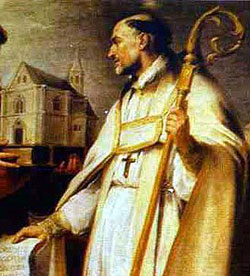
St. Leander of Seville

Without St. Leander’s faithfulness, Spain would not have such a rich Catholic history. For his work opposing heresy, the Church in Spain recognizes him as a doctor of the faith.

St. Leander came from a royal family in Cartagena, Spain, and his three siblings are all honored as saints (including his brother, St. Isidore of Seville). He grew up in the 6th century and was known for his eloquence and charismatic personality, even as a youth. At an early age, he entered the monastery for several years of intense study and prayer.

Leander became known for his holiness, and was old enough when the bishop of Seville died that he was unanimously chosen to replace him. His task was clear—the Arian heresy was widespread at the time (the belief that Jesus was not fully human), and Leander set out to preach the truth. His prayer and eloquent arguments won many over to orthodoxy.

He became friends with St. Gregory the Great before that man became pope, and the two exchanged letters and supported one another.

Political divisions in Spain aligned with doctrinal differences, and Leander was exiled for opposing Arianism. He continued his fight, however, writing three books while he was away.

Leander was eventually restored, and had the opportunity to instruct successors to the throne, which helped to convert the whole nation.

He had a great appreciation for the importance of prayer in the Christian life. Several councils were held under his leadership, and he helped reform the liturgy in Spain at the time.

St. Leander died in 596, and his image is used here with permission from Catholic.org.

St. Leander of Seville, you restored true faith to Spain--pray for us!


faith.nd.edu
11 posted on 03/13/2022 8:59:27 AM PDT by annalex (fear them not)
[ Post Reply | Private Reply | To 10 | View Replies]

Disclaimer: Opinions posted on Free Republic are those of the individual posters and do not necessarily represent the opinion of Free Republic or its management. All materials posted herein are protected by copyright law and the exemption for fair use of copyrighted works.

Free Republic
Browse · Search
Religion
Topics · Post Article

FreeRepublic, LLC, PO BOX 9771, FRESNO, CA 93794
FreeRepublic.com is powered by software copyright 2000-2008 John Robinson