Posted on 03/06/2022 4:10:00 AM PST by Cronos
First Sunday of Lent
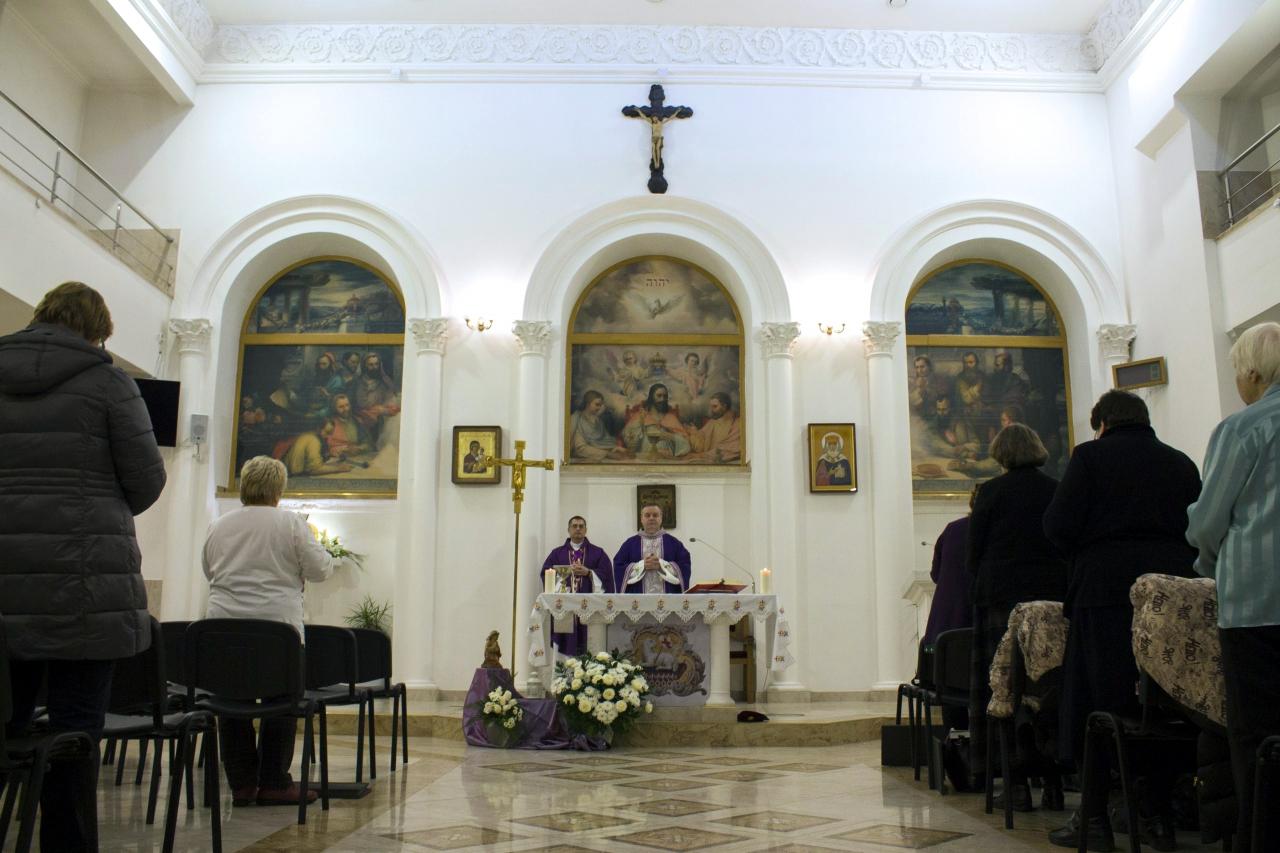
Catholic church of St. Olga of Russia, Moscow, Russia / Католическая церковь святой Ольги
Readings at MassLiturgical Colour: Green
The creed of the Chosen PeopleMoses said to the people: ‘The priest shall take the pannier from your hand and lay it before the altar of the Lord your God. Then, in the sight of the Lord your God, you must make this pronouncement: ‘“My father was a wandering Aramaean. He went down into Egypt to find refuge there, few in numbers; but there he became a nation, great, mighty, and strong. The Egyptians ill-treated us, they gave us no peace and inflicted harsh slavery on us. But we called on the Lord, the God of our fathers. The Lord heard our voice and saw our misery, our toil and our oppression; and the Lord brought us out of Egypt with mighty hand and outstretched arm, with great terror, and with signs and wonders. He brought us here and gave us this land, a land where milk and honey flow. Here then I bring the first-fruits of the produce of the soil that you, the Lord, have given me.” ‘You must then lay them before the Lord your God, and bow down in the sight of the Lord your God.’
Be with me, O Lord, in my distress. He who dwells in the shelter of the Most High and abides in the shade of the Almighty says to the Lord: ‘My refuge, my stronghold, my God in whom I trust!’ Be with me, O Lord, in my distress. Upon you no evil shall fall, no plague approach where you dwell. For you has he commanded his angels, to keep you in all your ways. Be with me, O Lord, in my distress. They shall bear you upon their hands lest you strike your foot against a stone. On the lion and the viper you will tread and trample the young lion and the dragon. Be with me, O Lord, in my distress. His love he set on me, so I will rescue him; protect him for he knows my name. When he calls I shall answer: ‘I am with you,’ I will save him in distress and give him glory. Be with me, O Lord, in my distress.
The creed of the ChristianScripture says: The word (that is the faith we proclaim) is very near to you, it is on your lips and in your heart. If your lips confess that Jesus is Lord and if you believe in your heart that God raised him from the dead, then you will be saved. By believing from the heart you are made righteous; by confessing with your lips you are saved. When scripture says: those who believe in him will have no cause for shame, it makes no distinction between Jew and Greek: all belong to the same Lord who is rich enough, however many ask his help, for everyone who calls on the name of the Lord will be saved.
Praise to you, O Christ, king of eternal glory! Man does not live on bread alone, but on every word that comes from the mouth of God. Praise to you, O Christ, king of eternal glory!
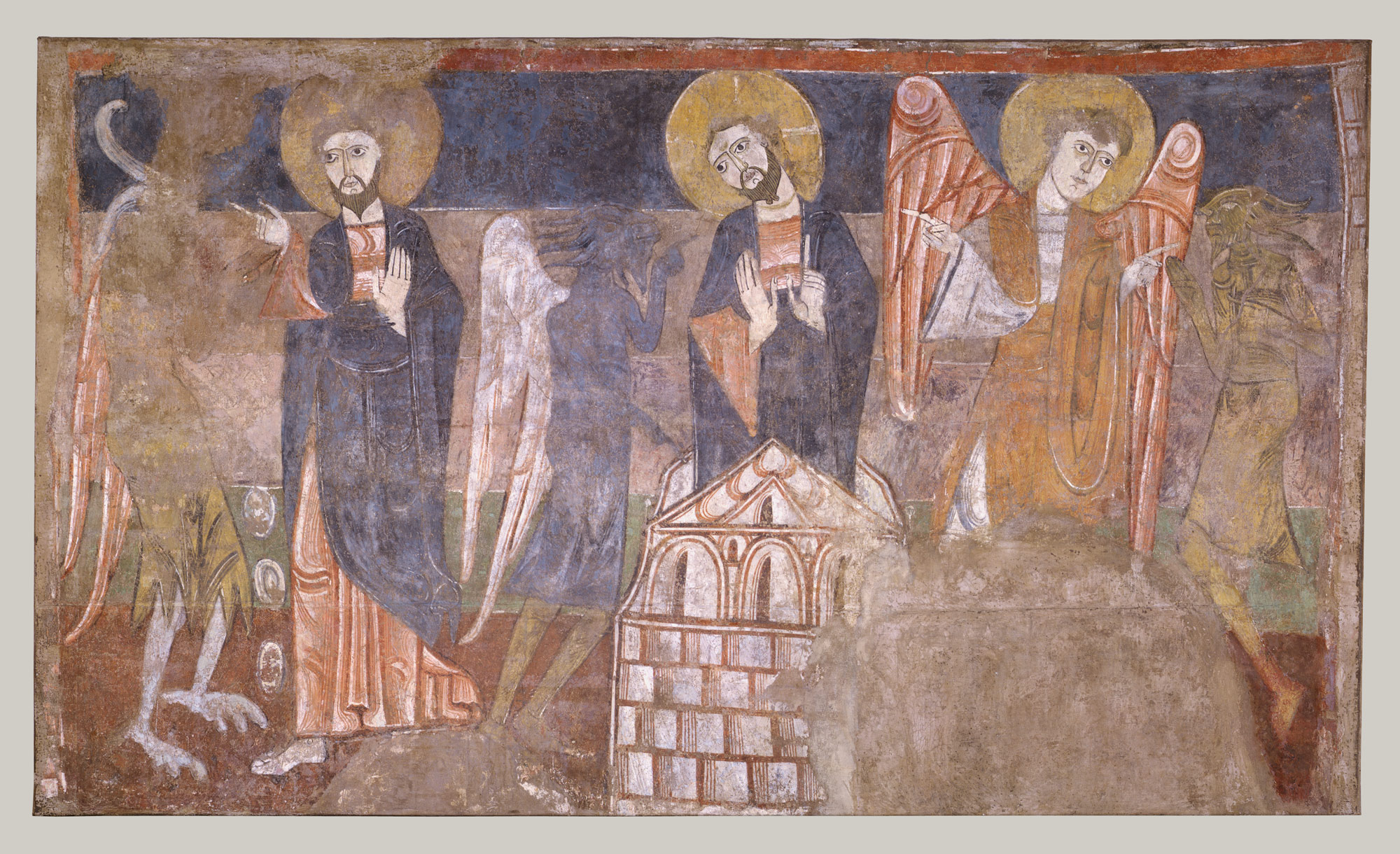
The temptation in the wildernessFilled with the Holy Spirit, Jesus left the Jordan and was led by the Spirit through the wilderness, being tempted there by the devil for forty days. During that time he ate nothing and at the end he was hungry. Then the devil said to him, ‘If you are the Son of God, tell this stone to turn into a loaf.’ But Jesus replied, ‘Scripture says: Man does not live on bread alone.’ Then leading him to a height, the devil showed him in a moment of time all the kingdoms of the world and said to him, ‘I will give you all this power and the glory of these kingdoms, for it has been committed to me and I give it to anyone I choose. Worship me, then, and it shall all be yours.’ But Jesus answered him, ‘Scripture says: You must worship the Lord your God, and serve him alone.’ Then he led him to Jerusalem and made him stand on the parapet of the Temple. ‘If you are the Son of God,’ he said to him ‘throw yourself down from here, for scripture says: He will put his angels in charge of you to guard you, and again: They will hold you up on their hands in case you hurt your foot against a stone.’ But Jesus answered him, ‘It has been said: You must not put the Lord your God to the test.’ Having exhausted all these ways of tempting him, the devil left him, to return at the appointed time. The readings on this page are from the Jerusalem Bible, which is used at Mass in most of the English-speaking world. The New American Bible readings, which are used at Mass in the United States, are available in the Universalis apps, programs and downloads. You can also view this page with the Gospel in Greek and English. |
catholic; lent; lk4; prayer
Please FReepmail me/annalex to get on/off the Alleluia Ping List.
Feel free to add your content, so long as it conforms with the rules of the Catholic Caucus. For example, post your prayers, thoughts, art that you like.

1. And Jesus being full of the Holy Ghost returned from Jordan, and was led by the Spirit into the wilderness,
2. Being forty days tempted of the devil. And in those days he did eat nothing: and when they were ended, he afterward hungered.
3. And the devil said unto him, If thou be the Son of God, command this stone that it be made bread.
4. And Jesus answered him, saying, It is written, That man shall not live by bread alone, but by every word of God.
THEOPHYLACT. Christ is tempted after His baptism, shewing us that after we are baptized, temptations await us. Hence it is said, But Jesus being full of the Holy Spirit, &c.
CYRIL OF ALEXANDRIA. God said in times past, My Spirit shall not always abide in men, for that they are flesh. (Gen. 6:3. Vulg.) But now that we have been enriched with the gift of regeneration by water and the Spirit, we are become partakers of the Divine nature by participation of the Holy Spirit. But the first-born among many brethren first received the Spirit, who Himself also is the giver of the Spirit, that we through Him might also receive the grace of the Holy Spirit.
ORIGEN. When therefore you read that Jesus was full of the Holy Spirit, and it is written in the Acts concerning the Apostles, that they were filled with the Holy Spirit, you must not suppose that the Apostles were equal to the Saviour. For as if you should say, These vessels are full of wine or oil, you would not thereby affirm them to be equally full, so Jesus and Paul were full of the Holy Spirit, but Paul’s vessel was far less than that of Jesus, and yet each was filled according to its own measure. Having then received baptism, the Saviour, being full of the Holy Spirit, which came upon Him from heaven in the form of a dove, was led by the Spirit, because, as many as are led by the Spirit, they are the sons of God, (Rom. 8:14.) but He was above all, especially the Son of God.
BEDE. That there might be no doubt by what Spirit He was led, while the other Evangelists say, into the wilderness, Luke has purposely added, And he was led by the Spirit into the wilderness for forty days. That no unclean spirit should be thought to have prevailed against Him, who being full of the Holy Spirit did whatever He wished.
GREEK EXPOSITOR. (Severus.) But if we order our lives according to our own will, how was He led about unwillingly? Those words then, He was led by the Spirit, have some meaning of this kind: He led of His own accord that kind of life, that He might present an opportunity to the tempter.
BASIL. For not by word provoking the enemy, but by His actions rousing him, He seeks the wilderness. For the devil delights in the wilderness, he is not wont to go into the cities, the harmony of the citizens troubles him.
AMBROSE. He was led therefore into the wilderness, to the intent that He might provoke the devil, for if the one had not contended, the other it seems had not conquered. In a mystery, it was to deliver that Adam from exile who was cast out of Paradise into the wilderness. By way of example, it was to shew us that the devil envies us, whenever we strive after better things; and that then we must use caution, lest the weakness of our minds should lose us the grace of the mystery. Hence it follows: And he was tempted of the devil.
CYRIL OF ALEXANDRIA. Behold, He is among the wrestlers, who as God awards the prizes. He is among the crowned, who crowns the heads of the saints.
GREGORY. (3. Mor. sup. Job 2.) Our enemy was however unable to shake the purpose of the Mediator between God and men. For He condescended to be tempted outwardly, yet so that His soul inwardly, resting in its divinity, remained unshaken.
ORIGEN. But Jesus is tempted by the devil forty days, and what the temptations were we know not. They were perhaps omitted, as being greater than could be committed to writing.
BASIL. Or, the Lord remained for forty days untempted, for the devil knew that He fasted, yet hungered not, and dared not therefore approach Him. Hence it follows: And he eat nothing in those days. He fasted indeed, to shew that He who would gird Himself for struggles against temptation must be temperate and sober.
AMBROSE. There are three things which united together conduce to the salvation of man; The Sacrament, The Wilderness, Fasting. No one who has not rightly contended receives a crown, but no one is admitted to the contest of virtue, except first being washed from the stains of all his sins, he is consecrated with the gift of heavenly grace.
GREGORY NAZIANZEN. (Orat. 40.) He fasted in truth forty days, eating nothing. (For He was God.) But we regulate our fasting according to our strength, although the zeal of some persuades them to fast beyond what they are able.
BASIL. (ex Const. Mon.) But we must not however so use the flesh, that through want of food our strength should waste away, nor that by excess of mortification our understandings wax dull and heavy. Our Lord therefore, once performed this work, but during this whole succeeding time He governed His body with due order, and so in like manner did Moses and Elias.
CHRYSOSTOM. (Hom. 13. in Matt.) But very wisely, He exceeded not their number of days, lest indeed He should be thought to have come in appearance only, and not to have really received the flesh, or lest the flesh should seem to be something beyond human nature.
AMBROSE. But mark the mystical number of days. For you remember that for forty days the waters of the deep were poured forth, and by sanctifying a fast of that number of days, He brings before us the returning mercies of a calmer sky. By a fast of so many days also, Moses earned for himself the understanding of the law. Our fathers being for so many years settled in the wilderness, obtained the food of Angels.
AUGUSTINE. (de Con. Ev. lib. ii. c. 4.) Now that number is a sacrament of our time and labour, in which under Christ’s discipline we contend against the devil, for it signifies our temporal life. For the seasons of the year run in courses of four, but forty contains four tens. Again, those ten are completed by the number one successively advancing up to four. This plainly shews that the fast of forty days, i. e. the humiliation of the soul, the Law and the Prophets have consecrated by Moses and Elias, the Gospel by the fast of our Lord Himself.
BASIL. (ubi sup.) But because not to suffer hunger is above the nature of man, our Lord took upon Himself the feeling of hunger, and submitted Himself as it pleased Him to human nature, both to do and to suffer those things which were His own. Hence it follows: And those days being ended, he was a hungered. Not forced to that necessity which overpowers nature, but as if provoking the devil to the conflict. For the devil, knowing that wherever hunger is there is weakness, sets about to tempt Him, and as the deviser or inventer of temptations, Christ permitting him tries to persuade Him to satisfy His appetite with the stones. As it follows; But the devil said unto him, If thou art the Son of God, command these stones that they be made bread.
AMBROSE. There are three especial weapons which we are taught the devil is wont to arm himself with, that he may wound the soul of man. One is of the appetite, another of boasting, the third ambition. He began with that wherewith he had already conquered, namely, Adam. Let us then beware of the appetite, let us beware of luxury, for it is a weapon of the devil. But what mean his words, If thou art the Son of God, unless he had known that the Son would come, but supposed Him not to have come from the weakness of His body. He first endeavours to find Him out, then to tempt Him. He professes to trust Him as God, then tries to deceive Him as man.
ORIGEN. When a father is asked by his son for bread, he does not give him a stone for bread, but the devil like a crafty and deceitful foe gives stones for bread.
BASIL. (ubi sup.) He tried to persuade Christ to satisfy His appetite with stones, i. e. to shift his desire from the natural food to that which was beyond nature or unnatural.
ORIGEN. I suppose also that even now at this very time the devil shews a stone to men that he may tempt them to speak, saying to them, Command this stone to be made bread. If thou seest the heretics devouring their lying doctrines as if they were bread, know that their teaching is a stone which the devil shews them.
BASIL. (ubi sup.) But Christ while He vanquishes temptation, banishes not hunger from our nature, as though that were the cause of evils, (which is rather the preservative of life, but confining nature within its proper bounds, shews of what kind its nourishment is, as follows; And Jesus answered him, saying, It is written, Man shall not live by bread alone.
THEOPHYLACT. As if He said, Not by bread alone is human nature sustained, but the word of God is sufficient to support the whole nature of man. Such was the food of the Israelites when they gathered manna during the space of forty years, and when they delighted in the taking of quails. (Exod. 16:15, Numb. 11:32) By the Divine counsel Elias had the crows to entertain him; (1 Kings 17:6) Elisha fed his companions on the herbs of the field. (2 Kings 4:44.)
CYRIL OF ALEXANDRIA. Or, our earthly body is nourished by earthly food, but the reasonable soul is strengthened by the Divine Word, to the right ordering of the spirit.
GREGORY NAZIANZEN. (Poem. Mor. x. 624.) For the body nourishes not our immaterial nature.
GREGORY OF NYSSA. (in Eccles. Hom. 5.) Virtue then is not sustained by bread, nor by flesh does the soul keep itself in health and vigour, but by other banquets than these is the heavenly life fostered, and increased. The nourishment of the good man is chastity, his bread, wisdom, his herbs, justice, his drink, freedom from passion, his delight, (εὐφροσύνη quasi ex εὐφρόνειν) to be rightly wise.
AMBROSE. You see then what kind of arms He uses to defend man against the assaults of spiritual wickedness, and the allurements of the appetite. He does not exert His power as God, (for how had that profited me,) but as man He summons to Himself a common aid, that while intent upon the food of divine reading He may neglect the hunger of the body, and gain the nourishment of the word. For he who seeks after the word cannot feel the want of earthly bread; for divine things doubtless make up for the loss of human. At the same time by saying, Man lives not by bread alone, He shews that man was tempted, that is, our flesh which He assumed, not His own divinity.
4:5–8
5. And the devil, taking him up into a high mountain, shewed unto him all the kingdoms of the world in a moment of time.
6. And the devil said unto him, All this power will I give thee, and the glory of them: for that is delivered unto me; and to whomsoever I will I give it.
7. If thou therefore wilt worship me, all shall be thine.
8. And Jesus answered and said unto him, Get thee behind me, Satan: for it is written, Thou shalt worship the Lord thy God, and him only shalt thou serve.
THEOPHYLACT. The enemy had first assailed Christ by the temptation of the appetite, as also he did Adam. He next tempts Him with the desire of gain or covetousness, shewing Him all the kingdoms of the world. Hence it follows, And the devil taking him up.
GREGORY. (Hom. 6. in Ev.) What marvel that He permitted Himself to be led by the devil into the mountains, who even endured to be crucified in His own body?
THEOPHYLACT. But how did the devil shew Him all the kingdoms of the world? Some say that he presented them to Him in imagination, but I hold that he brought them before Him in visible form and appearance.
TITUS BOSTRENSIS. Or, the devil described the world in language, and as he thought brought it vividly before our Lord’s mind as though it were a certain house.
AMBROSE. Truly in a moment of time, the kingdoms of this world are described. For here it is not so much the rapid glance of sight which is signified as is declared the frailty of mortal power. For in a moment all this passes by, and oftentimes the glory of this world has vanished before it has arrived. It follows, And he said unto him, I will give thee all this power.
TITUS BOSTRENSIS. (non occ.) He lied in two respects. For he neither had to give, nor could he give that which he had not; he gains possession of nothing, but is an enemy reduced to fight.
AMBROSE. For it is elsewhere said, that all power is from God. (Rom. 13:1.) Therefore from God’s hands comes the disposal of power, the lust of power is from the evil one; power is not itself evil, but he who evilly uses it. What then; is it good to exercise power, to desire honour? Good if it is bestowed upon us, not if it is seized. We must distinguish however in this good itself. There is one good use of the world, another of perfect virtue. It is good to seek God; it is a good thing that the desire of becoming acquainted with God should be hindered by no worldly business. But if he who seeks God, is from the weakness of the flesh, and the narrowness of his mind, often tempted, how much more is he exposed who seeks the world? We are taught then to despise ambition, because it is subject to the power of the devil. But honour abroad is followed by danger at home, and in order to rule others a man is first their servant, and prostrates himself in obedience that he may be rewarded with honours, and the higher he aspires the lower he bends with feigned humility; whence he adds, If thou will fall down and worship me.
CYRIL OF ALEXANDRIA. And dost thou, whose lot is the unquenchable fire, promise to the Lord of all that which is His own? Didst thou think to have Him for thy worshipper, from dread of whom the whole creation trembles?
ORIGEN. Or, to view the whole in another light. Two kings are earnestly contending for a kingdom; The king of sin who reigneth over sinners, that is, the devil; The king of righteousness who ruleth the righteous, that is, Christ. The devil, knowing that Christ had come to take away his kingdom, shews Him all the kingdoms of the world; not the kingdoms of the Persians and of the Medes, but his own kingdom whereby he reigned in the world, whereby some are under the dominion of fornication, others of covetousness. And he shews Him them in a moment of time, that is, in the present course of time, which is but a moment in comparison of eternity. For the Saviour needed not to be shewn for any longer time the affairs of this world, but as soon as He turned His eyes to look, He beheld sins reigning, and men made slaves to vice. The devil therefore says unto Him, Camest Thou to contend with me for dominion? Worship me, and behold I give Thee the kingdom I hold. Now the Lord would indeed reign, but being Righteousness itself, would reign without sin; and would have all nations subject to Him, that they might obey the truth, but would not so reign over others as that He Himself should be subject to the devil. Hence it follows, And Jesus answering said unto him, It is written, Thou shalt worship the Lord thy God.
BEDE. The devil saying to our Saviour, If thou wilt fall down and worship me, receives answer that he himself ought rather to worship Christ as his Lord and God.
CYRIL OF ALEXANDRIA. (in Thes. 32.) But how comes it that the Son (if as the heretics say a created being) is worshipped? What charge can be brought against those who served the creature and not the Creator, if the Son (according to them a created being) we are to worship as God?
ORIGEN. Or else, All these, he says, I would have subject to me, that they might worship the Lord God, and serve Him alone. But dost thou wish sin to begin from Me, which I came hither to destroy?
CYRIL OF ALEXANDRIA. This command touched him to the quick; for before Christ’s coming he was every where worshipped. But the law of God casting him down from his usurped dominion, establishes the worship of Him alone who is really God.
BEDE. But some one may ask how this injunction agrees with the word of the Apostle, which says, Beloved, serve one another. (Gal. 5:13.) In the Greek, δουλεία signifies a common service, (i. e. given either to God or man,) according to which we are bid to serve one another; but λατρεία is the service due to the worship of the Deity, with which we are bid to serve God alone.
4:9–13
9. And he brought him to Jerusalem, and set him on a pinnacle of the temple, and said unto him, If thou be the Son of God, cast thyself down from hence:
10. For it is written, He shall give his angels charge over thee, to keep thee:
11. And in their hands they shall bear thee up, lest at any time thou dash thy foot against a stone.
12. And Jesus answering said unto him, It is said, Thou shalt not tempt the Lord thy God.
13. And when the devil had ended all the temptation, he departed from him for a season.
AMBROSE. The next weapon he uses is that of boasting, which always causes the offender to fall down; for they who love to boast of the glory of their virtue descend from the stand and vantage ground of their good deeds. Hence it is said, And he led him to Jerusalem.
ORIGEN. He followed evidently as a wrestler, gladly setting out to meet the temptation, and saying, as it were, Lead me where you will, and you will find me the stronger in every thing.
AMBROSE. It is the fate of boasting, that while a man thinks he is climbing higher, he is by his pretension to lofty deeds brought low. Hence it follows, And he said unto him, If thou art the Son of God, throw thyself down.
ATHANASIUS. (non occ.) The devil entered not into a contest with God, (for he durst not, and therefore said, If thou art the Son of God,) but he contended with man whom once he had power to deceive.
AMBROSE. That is truly the devil’s language, which seeks to cast down the soul of man from the high ground of its good deeds, while he shews at the same time both his weakness and malice, for he can injure no one that does not first cast himself down. For he who forsaking heavenly things pursues earthly, rushes as it were wilfully down the self-sought precipice of a falling life. As soon then as the devil perceived his dart blunted, he who had subdued all men to his own power, began to think he had to deal with more than man. But Satan transforms himself into an angel of light, and often from the Holy Scriptures weaves his mesh for the faithful: hence it follows, It is written, He shall give, &c.
ORIGEN. Whence knowest thou, Satan, that those things are written? Hast thou read the Prophets, or the oracles of God? Thou hast read them indeed, but not that thyself mightest be the better for the reading, but that from the mere letter thou mightest slay them who are friends to the letter. (2 Cor. 3:6.) Thou knowest that if thou wert to speak from His other books, thou wouldest not deceive.
AMBROSE. Let not the heretic entrap thee by bringing examples from the Scriptures. The devil makes use of the testimony of the Scriptures not to teach but to deceive.
ORIGEN. But mark how wily he is even in this testimony. For he would fain throw a slur upon the glory of the Saviour, as though He needed the assistance of angels, and would stumble were He not supported by their hands. But this was said not of Christ, but of the saints generally; He needs not the aid of angels, Who is greater than angels. But let this teach thee, Satan, that the angels would stumble did not God sustain them; and thou stumblest, because thou refusest to believe in Jesus Christ the Son of God. But why art thou silent as to what follows, Thou shalt walk upon the asp and the basilisk, (Ps. 91:13.) except that thou art the basilisk, thou art the dragon and the lion?
AMBROSE. But the Lord, to prevent the thought that those things which had been prophesied of Him were fulfilled according to the devil’s will, and not by the authority of His own divine power, again so foils his cunning, that he who had alleged the testimony of Scripture, should by Scripture himself be overthrown. Hence it follows, And Jesus answering said, It is said, Thou shalt not tempt the Lord thy God.
CHRYSOSTOM. For it is of the devil to cast one’s self into dangers, and try whether God will rescue us.
CYRIL OF ALEXANDRIA. God gives not help to those who tempt Him, but to those who believe on Him. Christ therefore did not shew His miracles to them that tempted Him, but said to them, An evil generation seeketh a sign, and no sign shall be given to them. (Mat. 12:39.)
CHRYSOSTOM. But mark how the Lord, instead of being troubled, condescends to dispute from the Scriptures with the wicked one, that thou, as far as thou art able, mightest become like Christ. The devil knew the arms of Christ, beneath which he sunk. Christ took him captive by meekness, He overcame him by humility. Do thou also, when thou seest a man who has become a devil coming to meet thee, subdue him in like manner. Teach thy soul to conform its words to those of Christ. For as a Roman judge, who on the bench refuses to hear the reply of one who knows not how to speak as he does; so also Christ, except thou speakest after His manner, will neither hear thee nor protect thee.
GREGORY OF NYSSA. (ubi sup.) In lawful contests the battle is terminated either when the adversary surrenders of his own accord to the conqueror, or is defeated in three falls, according to the rules of the art of fighting. Hence it follows, And all the temptation being completed, &c.
AMBROSE. He would not have said that all the temptation was ended, had there not been in the three temptations which have been described the materials for every crime; for the causes of temptations are the causes of desire, namely, the delight of the flesh, the pomp of vain-glory, greediness of power.
ATHANASIUS. (non occ.) The enemy came to Him as man, but not finding in Him the marks of his ancient seed, he departed.
AMBROSE. You see then that the devil is not obstinate on the field, is wont to give way to true virtue; and if he ceases not to hate, he yet dreads to advance, for so he escapes a more frequent defeat. As soon then as he heard the name of God, he retired (it is said) for a season, for afterwards he comes not to tempt, but to fight openly.
THEOPHYLACT. Or, having tempted Him in the desert with pleasure, he retires from Him until the crucifixion, when he was about to tempt Him with sorrow.
MAXIMUS. (lib. ad. piet. ex. 12.) Or the devil had prompted Christ in the desert to prefer the things of the world to the love of God. The Lord commanded him to leave Him, (which itself was a mark of Divine love.) It was afterwards then enough to make Christ appear the false advocate of love to His neighbours, and therefore while He was teaching the paths of life, the devil stirred up the Gentiles and Pharisees to lay traps for Him that He might be brought to hate them. But the Lord, from the feeling of love which He had towards them, exhorted, reproved, ceased not to bestow mercy upon them.
AUGUSTINE. (de con. Ev. lib. ii. c. 6.) The whole of this narrative Matthew relates in a similar manner, but not in the same order. It is uncertain therefore which took place first, whether the kingdoms of the earth were first shewn unto Him, and He was afterwards taken up to the pinnacle of the temple; or whether this came first, and the other afterwards. It matters little however which, as long as it is clear that they all took place.
MAXIMUS. (ut sup.) But the reason why one Evangelist places this event first, and another that, is because vain-glory and covetousness give birth in turn to one another.
ORIGEN. But John, who had commenced his Gospel from God, saying, In the beginning was the Word, did not describe the temptation of the Lord, because God can not be tempted, of whom he wrote. But because in the Gospels of Matthew and Luke the human generations are given, and in Mark it is man who is tempted, therefore Matthew, Luke, and Mark have described the temptation of the Lord.
Ad Majorem Dei Gloriam (To the Greater Glory of God)
From: Deuteronomy 26:4-10
First Fruits
------------
(Moses spoke to the people saying,) [4] "Then the priest shall take the basket from your hand and set it down before the altar of the Lord your God.
[5] "And you shall make response before the Lord your God, 'A wandering Aramean was my father; and he went down into Egypt and sojourned there, few in number; and there he became a nation, great, mighty, and populous. [6] And the Egyptians treated us harshly, and afflicted, us, and laid upon us hard bondage. [7] Then we cried to the Lord the God of our fathers, and the Lord heard our voice, and saw our affliction, our toil, and. our oppression; [8] and the Lord brought us out of Egypt with a mighty hand and an outstretched arm, with great terror, with signs and wonders; [9] and he brought us into this place and gave us this land, a land flowing with milk and honey. [10] And behold, now I bring the first of the fruit of the ground, which thou, 0 Lord, hast given me.' And you shall set it down before the Lord your God, and worship before the Lord your God.
***********************************************************************
Commentary:
26:1-11. The Deuteronomic Code, which began by specifying that there should be only one sanctuary (cf. chap. 12), concludes by giving the prayers that were to be said in that sanctuary in connection with the offering of the first fruits.
The offering of the first fruits was an appropriate way for Israel to express gratitude for the great deeds done by God, the "magnalia Dei", the wonders he worked in liberating the people from bondage and establishing them in the promised land.
The prayer that is said on this occasion (vv. 5-9) is a kind of historical-religious Creed, a very important one, which takes in all the main features of Old Testament faith. It is a summary of the history of Israel, centered on its deliverance from Egypt and settlement in the promised land. These two saving actions form a paradigm: they are the hinges on which this "creed" (vv. 8-9) turns. Other Old Testament passages containing similar "professions of faith" are to be found in Deut 6:20-23; Josh 24:1-13; Neh 9:4ff; Jer 32:16-25 and Ps 136.
Jacob is portrayed as a key figure in the early history of the people of Israel; he personifies the patriarchal era. The reference to him not by name but as a "wandering Aramaean" (v. 5) underlines the contrast between the miserable circumstances of Israel earlier and settlement in the promised land. Jacob could be called an Aramaean because Abraham may have been connected with the.migrations of Aramaean tribes. Moreover, one must bear in mind the long years Jacob spent in north-eastern Mesopotamia, and his Aramaean wives (Gen 29-30). The prayer at the first-fruits offering heightens the contrast between the poverty of the homeless, landless Aramaean and the prosperity of the rich landowner enjoying his freedom in a land flowing with milk and honey.
Israel's Infidelity (Continuation)
----------------------------------
[8] But what does it [Moses' writing] say? The word is near you, on your lips and in your heart (that is, the word of faith which we preach); [9] because, if you confess with your lips that Jesus is Lord and believe in your heart that God raised him from the dead, you will be saved. [10] For man believes with his heart and so is justified, and he confesses with his lips and so is saved. [11] The scripture says, "No one who believes in him will be put to shame." [12] For there is no distinction between Jew and Greek; the same Lord is Lord of all and bestows his riches upon all who call upon him. [13] For, "everyone who calls upon the name of the Lord will be saved."
***********************************************************************
Commentary:
6-8. St Paul here quotes and applies some words from Deuteronomy: "This commandment," Moses tells the people of Israel, "which I command you this day is not too hard for you, neither is it far off. It is not in heaven, that you should say, 'Who will go up for us to heaven, and bring it to us, that we may hear it and do it? [...] Who will go over the sea for us, and bring it to us, that we may hear it and do it?' But the word is very near you; it is in your mouth and in your heart, so that you can do it" (Deut 30:11-14). The law which God handed to Moses, then, clearly revealed his will and made it much easier to fulfill. By the Incarnation, the Word of God became flesh and dwelt among us and showed us the way to God. For the Christian the life and teaching of the Word made flesh are divine precepts and commandments. Through his Incarnation Jesus Christ brought us grace and truth; by rising from the dead he conquered death; and by ascending into heaven and, with the Father, sending the Holy Spirit, he perfected his work of redemption.
9. At least from the third century B.C. we have documentary evidence that, out of respect, the Jews did not utter the name "Yahweh" but generally referred to God instead as "Lord". The first Christians, by giving Christ the title of "Lord", were making a profession of faith in the divinity of Jesus.
10. To make the act of faith, human free will must necessarily be involved as St Thomas explains when commenting on this passage: "He very rightly says that man believes with his heart. Because everything else to do with external worship of God, man can do it against his will, but he cannot believe if he does not want to believe. So, the mind of a believer is not obliged to adhere to the truth by rational necessity, as is the case with human knowledge: it is moved by the will" ("Commentary on Rom, ad loc.")
However, in order to live by faith, in addition to internal assent external profession of faith is required; man is made up of body and soul and therefore he tends by nature to express his inner convictions externally; when the honor of God or the good of one's neighbor requires it, one even has an obligation to profess one's faith externally. For example, in the case of persecution we are obliged to profess our faith, even at the risk of life, if, on being interrogated about our beliefs, our silence would lead people to suppose that we did not believe or that we did not hold our faith to be the true faith and our bad example would cause others to fall away from the faith. However, external profession is an obligation not only in extreme situations of that kind. In all situations--be they ordinary or exceptional--God will always help us to confess our faith boldly (cf. Mt 10:32-33; Lk 12:8).
Jesus Fasts and Is Tempted in the Wilderness
--------------------------------------------
[1] And Jesus, full of the Holy Spirit, returned from the Jordan and was led by the Spirit [2] for forty days in the wilderness, tempted by the devil. And He ate nothing in those days; and when they were ended, He was hungry. [3] The devil said to Him, "If You are the Son of God, command this stone to become bread." [4] And Jesus answered him, "It is written, `Man shall not live by bread alone.'" [5] And the devil took Him up, and showed Him all the kingdoms of the world in a moment of time, [6] and said to Him, "To You I will give all this authority and glory; for it has been delivered to me, and I give it to whom I will. [7] If you, then, will worship me, it shall all be yours." [8] And Jesus answered, "It is written, `You shall worship the Lord your God, and Him only shall you serve.'"
[9] And he took Him to Jerusalem, and set Him on the pinnacle of the temple, and said to Him, "If You are the Son of God, throw Yourself down from here; [10] for it is written, `He will give His angels charge of you, to guard you,' [11] and `On their hands they will bear you up, lest you strike your foot against a stone.'"
[12] And Jesus answered him, "It is said, `You shall not tempt the Lord your God.'" [13] And when the devil had ended every temptation, he departed from Him until an opportune time.
***********************************************************************
Commentary:
1-13. Here we see the devil interfere with Jesus' life for the first time. He does so very brazenly. Our Lord is about to begin His public ministry, so it is a particularly important point in His work of salvation.
"The whole episode is a mystery which man cannot hope to understand--God submitting to temptation, letting the Evil One have his way. But we can meditate upon it, asking our Lord to help us understand the teaching it contains" (St J. Escriva, "Christ Is Passing By", 61).
Christ, true God and true man, made Himself like us in everything except sin (cf. Philippians 2:7; Hebrews 2:7; 4:15) and voluntarily underwent temptation. "How fortunate we are," exclaims the Cure of Ars, "how lucky to have a God as a model. Are we poor? We have a God who is born in a stable, who lies in a manger. Are we despised? We have a God who led the way, who was crowned with thorns, dressed in a filthy red cloak and treated as a madman. Are we tormented by pain and suffering? Before our eyes we have a God covered with wounds, dying in unimaginable pain. Are we being persecuted? How can we dare complain when we have a God who is being put to death by executioners? Finally, are we being tempted by the demon? We have our lovable Redeemer; He was also tempted by the demon and was twice taken up by that hellish spirit: therefore, no matter what sufferings, pains or temptations we are experiencing, we always have, everywhere, our God leading the way for us and assuring us of victory as long as we genuinely desire it" ("Selected Sermons", First Sunday of Lent).
Jesus teaches us therefore that no one should regard himself as incorruptible and proof against temptation; He shows us how we should deal with temptation and exhorts us to have confidence in His mercy, since He Himself experienced temptation (cf. Hebrews 2:18).
For further explanation of this passage, see the notes on Matthew 4:3-11.
---------------------------------------------------------------------------------------------
Notes on Matthew 4:3-11
[1. Jesus, our Savior, allowed Himself to be tempted because He so chose; and He did so out of love for us and to instruct us. However, since He was perfect He could only be tempted externally. Catholic teaching tells us that there are three levels of temptation: 1) suggestion, that is, external temptation, which we can undergo without committing any sin; 2) temptation in which we take a certain delight, whether prolonged or not, even though we do not give clear consent; this level of temptation has now become internal and there is some sinfulness in it; 3) temptation to which we consent; this is always sinful, and since it affects the deepest part of the soul, it is definitely internal. By allowing Himself to be tempted, Jesus wanted to teach us how to fight and conquer our temptations. We will do this by having trust in God and prayer, with the help of God's grace and by having fortitude.
Jesus' temptations in the desert have a deep significance in salvation history. All the most important people throughout sacred history were tempted--Adam and Eve, Abraham, Moses, and the Chosen People themselves. Similarly with Jesus. By rejecting the temptations of the devil, our Lord atones for the falls of those who went before Him and those who come after Him. He is an example for us in all the temptations we were subsequently to have, and also for the battles between the Church and the power of the devil. Later Jesus teaches us in the "Our Father" to ask God to help us with His grace not to fall at the time of temptation. 2. Before beginning His work as Messiah, that is, before promulgating the New Law or New Testament, Jesus prepares Himself by prayer and fasting in the desert. Moses acted in the same way before proclaiming, in God's name, the Old Law on Mount Sinai (Exodus 34:28). Elijah, too, journeyed for forty days in the desert to fulfill the Law (1 Kings 19:5-8).
The Church follows Jesus' footsteps by prescribing the yearly Lenten fast. We should practice Lent each year with this spirit of piety. "It can be said that Christ introduced the tradition of forty days fast into the Church's liturgical year, because He Himself 'fasted forty days and forty nights' before beginning to teach. By this Lenten fast the Church is in a certain sense called every year to follow her Master and Lord if she wishes to preach His Gospel effectively" ([Pope] John Paul II, "General Audience", 28 February 1979). In the same way, Jesus' withdrawal into the desert invites us to prepare ourselves by prayer and penance before any important decision or action.
3. Jesus had fasted forty days and forty nights. Naturally He is very hungry and the devil makes use of this opportunity to tempt Him. Our Lord rejects the temptation and in doing so He uses a phrase from Deuteronomy (8:3). Although He could do this miracle, He prefers to continue to trust His Father since performing the miracle is not part of His plan of salvation. In return for this trust, angels come and minister to Him (Matthew 4:11).
Miracles in the Bible are extraordinary and wonderful deeds done by God to make His words or actions understood. They do not occur as isolated outpourings of God's power but rather as part of the work of Redemption. What the devil proposes in this temptation would be for Jesus' benefit only and therefore could not form part of the plan for Redemption. This suggests that the devil, in tempting Him in this way, wanted to check if Jesus is the "Son of God". For, although he seems to know about the voice from Heaven at Jesus' baptism, he cannot see how the Son of God could be hungry. By the way He deals with the temptation, Jesus teaches us that when we ask God for things we should not ask in the first place for what we can obtain by our own efforts. Neither should we ask for what is exclusively for our own convenience, but rather for what will help towards our holiness or that of others.
4. Jesus' reply is an act of trust in God's fatherly providence. God led Him into the desert to prepare Him for His messianic work, and now He will see to it that Jesus does not die. This point is underlined by the fact that Jesus' reply evokes Deuteronomy 8:3, where the sons of Israel are reminded how Yahweh fed them miraculously with manna in the desert. Therefore, in contrast to the Israelites who were impatient when faced with hunger in the desert, Jesus trustingly leaves His well-being to His Father's providence. The words of Deuteronomy 8:3, repeated here by Jesus, associate "bread" and "word" as having both come from the mouth of God: God speaks and gives His Law; God speaks and makes manna appear as food.
Also, manna is commonly used in the New Testament (see, for example, in 6:32-58) and throughout Tradition as a symbol of the Eucharist.
The Second Vatican Council points out another interesting aspect of Jesus' words when it proposes guidelines for international cooperation in economic matters: "In many instances there exists a pressing need to reassess economic structures, but caution must be exercised with regard to proposed solutions which may be untimely, especially those which offer material advantages while militating against man's spiritual nature and advancement. For 'man shall not live by bread alone, but by every word that proceeds from the mouth of God'" ("Gaudium Et Spes", 86).
5. Tradition suggests that this temptation occurred at the extreme southern corner of the temple wall. At this point, the wall was at its highest, since the ground beneath sloped away steeply to the Cedron River. Looking down from this point one could easily get a feeling of vertigo.
St. Gregory the Great ("In Evangelia Homiliae", 16) says that if we consider how our Lord allowed Himself to be treated during His passion, it is not surprising that He allowed the devil also to treat Him as he did.
6. "Holy Scripture is good, but heresies arise through its not being understood properly" (St. Augustine, "In Ioann. Evang., 18, 1). Catholics should be on their guard against arguments which, though they claim to be founded on Scripture, are nevertheless untrue. As we can see in this passage of the Gospel, the devil can also set himself up at times as an interpreter of Scripture, quoting it to suit himself. Therefore, any interpretation which is not in line with the teaching contained in the Tradition of the Church should be rejected.
The error proposed by a heresy normally consists in stressing certain passages to the exclusion of others, interpreting them at will, losing sight of the unity that exists in Scripture and the fact that the faith is all of a piece.
7. Jesus rejects the second temptation as He did the first; to do otherwise would have been to tempt God. In rejecting it, He uses a phrase from Deuteronomy (6:16): "You shall not put the Lord your God to the test". In this way He alludes to the passage in Exodus where the Israelites demand a miracle of Moses. The latter replies, "Why do you put the Lord to the proof?"
To tempt God is the complete opposite of having trust in Him. It means presumptuously putting ourselves in the way of unnecessary danger, expecting God to help us by an exceptional use of His power. We would also tempt Him if, by our unbelief and arrogance, we were to ask Him for signs or proof. The very first lesson from this passage of the Gospel is that if ever a person were to ask or demand extraordinary proofs or signs from God, he would clearly be tempting Him.
8-10. The third temptation is the most pseudo-messianic of the three: Jesus is urged to appropriate to Himself the role of an earthly messianic king of the type so widely expected at the time. Our Lord's vigorous reply, "Begone, Satan!" is an uncompromising rejection of an earthly messianism--an attempt to reduce His transcendent, God-given mission to a purely human and political use. By His attitude, Jesus, as it were, rectifies and makes amends for the worldly views of the people of Israel. And, for the same reason, it is a warning to the Church, God's true Israel, to remain faithful to its God-given mission of salvation in the world. The Church's pastors should be on the alert and not allow themselves to be deceived by this temptation of the devil.
"We should learn from Jesus' attitude in these trials. During His life on earth He did not even want the glory that belonged to Him. Though He had the right to be treated as God, He took the form of a servant, a slave (cf. Philippians 2:6-7). And so the Christian knows that all the glory is due to God and that he must not make use of the sublimity and greatness of the Gospel to further his own interests or human ambitions.
"We should learn from Jesus. His attitude in rejecting all human glory is in perfect balance with the greatness of His unique mission as the beloved Son of God who takes flesh to save men [...]. And the Christian, who, following Christ, has this attitude of complete adoration of the Father, also experiences our Lord's loving care: 'because he cleaves to Me in love, I will deliver him; I will protect him, because he knows My name' (Psalm 90:14)" (St J. Escriva, "Christ Is Passing By", 62).
11. If we struggle constantly, we will attain victory. And nobody is crowned without having first conquered: "Be faithful unto death, and I will give you the crown of life" (Revelation 2:10). By coming to minister to Jesus after He rejects the temptations, the angels teach us the interior joy given by God to the person who fights energetically against the temptations of the devil. God has given us also powerful defenders against such temptations--our guardian angels, on whose aid we should call.]
-----------------------------------------------------------------------------
13. Our Lord's temptations sum up every kind of temptation man can experience: "Scripture would not have said", St. Thomas comments, "that once all the temptation ended the devil departed from Him, unless the matter of all sins were included in the three temptations already related. For the causes of temptation are the causes of desires--namely, lust of the flesh, desire for glory, eagerness for power" ("Summa Theologiae", III, q. 41, a. 4 ad 4).
By conquering every kind of temptation, Jesus shows us how to deal with the snares of the devil. It was as a man that He was tempted and as a man that He resisted: "He did not act as God, bringing His power into play; if He had done so, how could we have availed of His example? Rather, as a man He made use of the resources which He has in common with us" (St. Ambrose, "Expositio Evangelii Sec. Lucam, in loc.").
He wanted to show us the methods to use to defeat the devil--prayer, fasting, watchfulness, not dialoguing with temptation, having the words of God's Scripture on our lips and putting our trust in the Lord.
"Until an opportune time", that is, until it is time for Jesus to undergo His passion. The devil often appears in the course of our Lord's public life (cf., for example, Mark 12:28), but it will be at the Passion--"this is your hour, and the power of darkness" (Luke 22:53)--that he will be most clearly seen in his role as tempter. Jesus will forewarn His disciples about this and once more assure them of victory (cf. John 12:31; 14:30). Through the passion, death and resurrection of Christ, the devil will be overpowered once and for all. And by virtue of Christ's victory we are enabled to overcome all temptations.
| Luke | |||
| English: Douay-Rheims | Latin: Vulgata Clementina | Greek NT: Byzantine/Majority Text (2000) | |
| Luke 4 | |||
| 1. | AND Jesus being full of the Holy Ghost, returned from the Jordan, and was led by the Spirit into the desert, | Jesus autem plenus Spiritu Sancto regressus est a Jordane : et agebatur a Spiritu in desertum | ιησους δε πνευματος αγιου πληρης υπεστρεψεν απο του ιορδανου και ηγετο εν τω πνευματι εις την ερημον |
| 2. | For the space of forty days; and was tempted by the devil. And he ate nothing in those days; and when they were ended, he was hungry. | diebus quadraginta, et tentabatur a diabolo. Et nihil manducavit in diebus illis : et consummatis illis esuriit. | ημερας τεσσαρακοντα πειραζομενος υπο του διαβολου και ουκ εφαγεν ουδεν εν ταις ημεραις εκειναις και συντελεσθεισων αυτων υστερον επεινασεν |
| 3. | And the devil said to him: If thou be the Son of God, say to this stone that it be made bread. | Dixit autem illi diabolus : Si Filius Dei es, dic lapidi huic ut panis fiat. | και ειπεν αυτω ο διαβολος ει υιος ει του θεου ειπε τω λιθω τουτω ινα γενηται αρτος |
| 4. | And Jesus answered him: It is written, that Man liveth not by bread alone, but by every word of God. | Et respondit ad illum Jesus : Scriptum est : Quia non in solo pane vivit homo, sed in omni verbo Dei. | και απεκριθη ιησους προς αυτον λεγων γεγραπται οτι ουκ επ αρτω μονω ζησεται [ο] ανθρωπος αλλ επι παντι ρηματι θεου |
| 5. | And the devil led him into a high mountain, and shewed him all the kingdoms of the world in a moment of time; | Et duxit illum diabolus in montem excelsum, et ostendit illi omnia regna orbis terræ in momento temporis, | και αναγαγων αυτον ο διαβολος εις ορος υψηλον εδειξεν αυτω πασας τας βασιλειας της οικουμενης εν στιγμη χρονου |
| 6. | And he said to him: To thee will I give all this power, and the glory of them; for to me they are delivered, and to whom I will, I give them. | et ait illi : Tibi dabo potestatem hanc universam, et gloriam illorum : quia mihi tradita sunt, et cui volo do illa. | και ειπεν αυτω ο διαβολος σοι δωσω την εξουσιαν ταυτην απασαν και την δοξαν αυτων οτι εμοι παραδεδοται και ω εαν θελω διδωμι αυτην |
| 7. | If thou therefore wilt adore before me, all shall be thine. | Tu ergo si adoraveris coram me, erunt tua omnia. | συ ουν εαν προσκυνησης ενωπιον εμου εσται σου πασα |
| 8. | And Jesus answering said to him: It is written: Thou shalt adore the Lord thy God, and him only shalt thou serve. | Et respondens Jesus, dixit illi : Scriptum est : Dominum Deum tuum adorabis, et illi soli servies. | και αποκριθεις αυτω ειπεν ο ιησους υπαγε οπισω μου σατανα γεγραπται προσκυνησεις κυριον τον θεον σου και αυτω μονω λατρευσεις |
| 9. | And he brought him to Jerusalem, and set him on a pinnacle of the temple, and he said to him: If thou be the Son of God, cast thyself from hence. | Et duxit illum in Jerusalem, et statuit eum super pinnam templi, et dixit illi : Si Filius Dei es, mitte te hinc deorsum. | και ηγαγεν αυτον εις ιερουσαλημ και εστησεν αυτον επι το πτερυγιον του ιερου και ειπεν αυτω ει υιος ει του θεου βαλε σεαυτον εντευθεν κατω |
| 10. | For it is written, that He hath given his angels charge over thee, that they keep thee. | Scriptum est enim quod angelis suis mandavit de te, ut conservent te : | γεγραπται γαρ οτι τοις αγγελοις αυτου εντελειται περι σου του διαφυλαξαι σε |
| 11. | And that in their hands they shall bear thee up, lest perhaps thou dash thy foot against a stone. | et quia in manibus tollent te, ne forte offendas ad lapidem pedem tuum. | και επι χειρων αρουσιν σε μηποτε προσκοψης προς λιθον τον ποδα σου |
| 12. | And Jesus answering, said to him: It is said: Thou shalt not tempt the Lord thy God. | Et respondens Jesus, ait illi : Dictum est : Non tentabis Dominum Deum tuum. | και αποκριθεις ειπεν αυτω ο ιησους οτι ειρηται ουκ εκπειρασεις κυριον τον θεον σου |
| 13. | And all the temptation being ended, the devil departed from him for a time. | Et consummata omni tentatione, diabolus recessit ab illo, usque ad tempus. | και συντελεσας παντα πειρασμον ο διαβολος απεστη απ αυτου αχρι καιρου |

This statement sounds very suspicious, and makes one conclude that Balther was compelled to rely on verbal tradition for the information recorded in his work. Not a single ancient author mentions Fridolin, the life has no proper historical chronological arrangement, and the enumeration of so many wonders and visions awakens distrust. Consequently, most modern historians justly reject the life as unauthentic, and as having no historical foundation for the facts recorded, while the older historians believed that it contained a germ of truth. In the early Middle Ages, there was certainly some connection between Säckingen and Poitiers, from which the former monastery received its relics, and this fact may have made the author connect Fridolin with the veneration of St. Hilarius of Poitiers, and the churches erected in his honour. The only portion of the life that can be regarded as historically tenable, is that Fridolin was an Irish missionary, who preached the Christian religion in Gaul, and founded a monastery on the island of Säckingen in the Rhine. Concerning the date of these occurrences, we have no exact information. The monastery, however, was of great importance in the ninth century, since the earliest extant document concerning it states that on 10 February, 878, Charles the Fat presented to his wife Richardis the Monasteries of Säckingen, of St. Felix and of Regula in Zurich.
Sources
Vita Fridolini, auctore Balthero monacho, in the following works: COLGAN, Acta Sanct. Hiberniæ (Louvain, 1645), I, 481 sq.; MONE, Quellensammlung der badischen Landesgeschichte (Karlsruhe, 1845), I; ed. KRUSCH in Mon. Hist., Script. Rer. Merowing., III, 351-69; Acta SS., March, I, 433-441. POTTHAST, Bibliotheca historica medii ævi (Berlin, 1896), II, 1322-23; Bibliotheca hagiographica latina, ed. BOLLANDISTS, I, 478; WATTENBACH, Deutschlands Geschichtsquellen, I (7th ed., Berlin, 1904) 155; HEFELE, Geschichte der Einführung des Christenthums in Südwestl. Deutschland (Tübingen, 1837); LÜTOLF, Die Glaubensboten der Schweiz vor St. Gallus (Lucerne, 1871), 267 sqq.; LEO, Der hl. Fridolin (Freiburg im Br., 1886); HEER, St. Fridolin, der Apostel Alemanniens (Zürich, 1889); VON KNONAU, Nochmals die Frage St. Fridolin in Anzeiger für Schweizergesch. (1889), 377-81; SCHULTE, Beiträge zur Kritik der Vita Fridolini, Jahrbuch für Schweizergesch., XVIII (1893), 134-152.
Disclaimer: Opinions posted on Free Republic are those of the individual posters and do not necessarily represent the opinion of Free Republic or its management. All materials posted herein are protected by copyright law and the exemption for fair use of copyrighted works.