
Posted on 03/03/2022 4:27:01 PM PST by ebb tide
It is difficult to find a war in which the distinction between aggressor and aggressed is as clear-cut as in the present conflict in Ukraine. Yet it is precisely this distinction that is absent in the words and deeds of Pope Francis. His visit to the Russian ambassador to the Holy See on Friday February 25 was a glaring example of this. “During the visit, the pope wished to express his concern over the war in Ukraine,” blazened “L’Osservatore Romano” on the front page. Not one more line, no article to follow. Because only that and nothing else was what the pope wanted known about his contact with the Russia of Vladimir Putin and of Moscow patriarch Kirill.
Of course, Francis also spoke by telephone with Ukrainian president Volodymyr Zelensky and with the major archbishop of the Greek-Catholic Church, Sviatoslav Shevchuk. For Ash Wednesday he announced a day of prayer and fasting “for peace in Ukraine and in the whole world.” And both he and secretary of state Cardinal Pietro Parolin have repeatedly asked the adversaries to lay down their arms. But “pretending not to understand that if one calls for a ceasefire right in the middle of an invasion one is in reality coaxing the invaded people to surrender, asking them to accept the occupation of their country,” as noted in “Corriere della Sera” of February 27 by Angelo Panebianco, foremost of the Italian political scientists of the liberal school.
A completely different tune in the Churches of the Ukraine invaded by Russia. In his passionate messages to the faithful, transmitted every day from the basement of the Catholic cathedral of Kyiv, Archbishop Shevchuk prays for “the heroic soldiers of the border guard of Zmijiny Island in the Black Sea” killed for not having surrendered to the invader, for “the hero who at the cost of his life stopped the Russian army near Kherson by blowing himself up together with the bridge over the Dnieper river", in short, both “for all the innocent victims among civilians” and “for all those who fight in defense of the nation.”
But there is more. Not even the Ukrainian Orthodox Church subject to the Moscow patriarchate has approved the invasion, as the mother Church instead has done in Russia. Its primate, Onufry, metropolitan of Kyiv, has from the beginning invoked God’s blessing on “our soldiers who protect and defend our land and the people, the sovereignty and integrity of Ukraine.” And he has denounced the attacks on his priests and faithful and the devastation of Ukrainian Orthodox churches by Russian troops: entirely the opposite of what Putin asserted in his February 21 speech, in which he accused the Ukrainian authorities of persecuting the Orthodox faithful to Moscow and claimed to be their defender.
Not only that. On February 28 the synod of this same Church published a message of full solidarity with the Ukrainian people, with a direct appeal to Moscow patriarch Kirill to “call on the leadership of the Russian Federation,” meaning Putin, “to immediately stop hostilities that are already threatening to turn into a world war.” With no comment, to date, from the patriarchate of Moscow.
More predictable was the condemnation of the Russian invasion by the other Orthodox Church of Ukraine, independent of the Moscow patriarchate and by this latter proscribed and excluded from Eucharistic communion. Its metropolitan, Epiphanius, addressed on February 27, a Sunday, “the day on which we remember the Last Judgment,” a vibrant appeal to Moscow patriarch Kirill that “if he cannot speak out against the aggression, at least he may help bring back home the bodies of the Russian soldiers who in Ukraine have paid with their lives for the idea of ‘greater Russia’.”
“Greater Russia,” both political and religious, is in fact the idée mère of Moscow’s aggression against Ukraine. An idea that for Putin becomes a neoimperial plan, while for the patriarchate of Moscow it is a question of identity and primacy.
The Ukrainian Orthodox Church subject to Moscow’s jurisdiction has a third of the faithful and a good 40 percent of the parishes of the entire Russian patriarchate, about 12,000 out of 30,000. Losing them would be a tragedy for Moscow. And if to these 12 thousand parishes one then adds the thousands belonging to the other two Orthodox Churches currently in existence in Ukraine - the one with Epiphanius as its metropolitan and the smaller one that separated from Moscow in following the self-proclaimed Patriarch Filaret - Ukrainian Orthodoxy as a whole would become the second most populous branch of Orthodoxy in the world, capable of rivaling the patriarchate of Moscow, until today the undisputed leader by number of faithful.
A giveaway of the fear of this loss came in the homily that Patriarch Kirill delivered on Sunday February 27 in Moscow, entirely aimed at invoking the preservation of unity - also geographical and political - between Russian Orthodoxy and the Ukrainian Church subject to Moscow, “in protection of our common historic motherland against any external force that would wish to destroy this unity.”
The fact is that Russia’s aggression against Ukraine does not help cement this unity. Quite the contrary. In recent days, a survey by the Russian research center “Razumkov” found that two thirds of the faithful of the Ukrainian Orthodox Church subject to the Moscow patriarchate condemn the invasion and that the esteem for their primate Onufry - he too critical, as has been seen - is much higher than that for Patriarch Kirill, whose popularity has plummeted.
But then there are also the nearly five million Greek-Catholic Ukrainians, a living community, with a history populated by martyrs, enlivened by a sincere ecumenical spirit with their Orthodox fellow countrymen and by a strong spirit of autonomy from Russia. It is the Church that would be most in danger if Ukraine were to fall under the yoke of Moscow, yet has been incredibly mistreated by Rome since Francis became pope.
At the end of 2014, Russia’s first attack on Ukraine, the armed occupation of its eastern border in Donbas and the annexation of Crimea, found the Holy See on the sidelines, as if indifferent, except for Francis’s regretful words on “fratricidal violence" that put everyone on an equal footing. And this in spite of the fact that the Vatican nuncio to Ukraine at the time, Thomas E. Gullickson, was sending increasingly alarming reports on the tragedies of the occupation. What mattered most to Francis was meeting with Moscow patriarch Kirill, bound with a double thread to Putin and a staunch adversary of the Greek Catholics of Ukraine, whom he dismisses - with the contemptuous term of “Uniates” - as papist false imitators of one true Orthodox Christian faith.
In February of 2016 Francis and Kirill met in Havana using the secular protocol of heads of state, in the transit area of the airport, without any moment of prayer, without a blessing. Only a private conversation and the signing of a joint declaration completely biased toward Moscow’s side and immediately taken by the Ukrainian Greek-Catholics, by the archbishop of Kyiv himself, and even by the new nuncio Claudio Gugerotti as a “betrayal” and “indirect support for Russian aggression against Ukraine.”
Two years later, in 2018, when a new Orthodox Church was about to be born in Ukraine, independent of the patriarchate of Moscow and viewed as a plague by this but favorably by the Greek-Catholics, once again Francis chose to be more on the side of Kirill and - receiving at the Vatican a delegation of the Russian patriarchate chaired by its powerful foreign minister, Metropolitan Hilarion of Volokolamsk - he launched into a harangue against the Greek-Catholic “Uniates,” whom he ordered “not to interfere in internal affairs of the Russian Orthodox Church.” The complete text of the pope’s remarks, which were supposed to remain confidential, was finally made public after the patriarchate of Moscow, approvingly, brought forward the passages most in its favor.
Today the entire Orthodox world is in a dramatic crisis precisely on account of what is happening in Ukraine, where the new Church independent of Moscow has received the canonical recognition of the ecumenical patriarchate of Constantinople, of the Churches of Greece and Cyprus, and of the patriarchate of Alexandria and all Africa. But precisely for this reason Moscow has broken off Eucharistic communion with all these Churches.
In this schism that divides Orthodoxy, the patriarchate of Moscow is even working to submit Africa to its own jurisdiction, removing it from the patriarchate of Alexandria. It is therefore unthinkable that it would passively accept the loss of Ukraine, which is just what it sees happening.
In a book-length interview on the history of Christianity in Ukraine, the Greek-Catholic archbishop Shevchuk dreams of the rebirth in his country of a single patriarchate of all Christians, Orthodox and Catholic. The dream is not historically groundless, far from it. But what reigns in Rome is uncertainty, if not bewilderment, to the point that one does not even dare to speak the names of those carrying out armed attack on Ukraine, political and religious.
.
Once again, "confidential", like Bergoglio's betrayal of the Catholics in China with his "confidential" agreement with his fellow red dictator, Xi Jinping.
Ping
He’s a communist first and foremost
Pope Joke has been lost for some time. Destroying The Church from within.
It’s interesting. Most of Bergoglio’s usual globalist allies like the EU and Soros oppose Putin’s move on Ukraine. Yet like the Marxist comandantes of Cuba and Venezuela, Bergoglio’s affinity for Putin is intact. Esther Ballestrino de Careaga certainly recruited a loyal operative.
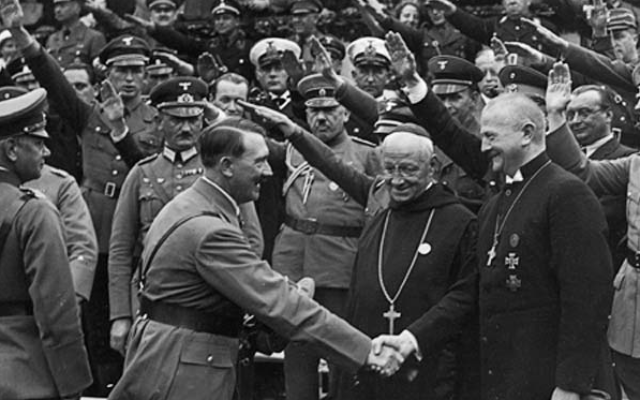
The Pope is a hypocrite, a moron and a communist. God will not be smiling when the Dope goes horizontal subterranean.
He’s on the exact path he desires. He lost his ‘way’ long ago.
Good Lord: I am not fan of Pope Francis, call me the Pope John Paul II cohort of the loyal opposition. But in this case, jus what the heck can the Catholic Pope do with Putin, who identifies as a Russian Orthodox under the Jurisdiction of the Moscow Patriarch who is not in communion with Rome.
The far West of Ukraine in Lviv has the Ukrainian Byzantine Catholic Church, which is in communion with Rome but they are not anywhere near in numbers as the Orthodox in Ukraine, which are split in all types of directions.
Francis lost his way a long time ago.
It’s Fabian socialists versus the Communists competing for global power now. Now that they have practically defeated any other competition, they turn on each other.
Well, the man has had no shortage of opinions on issues like the U.S. border wall, and no hesitation in making known his disdain for “populist” right-wing politicians like Donald Trump and Victor Orban. Yet Putin can bring down the wrath of hell on a neighboring country that wasn’t attacking Russia... and Bergoglio is strangely silent.
Tangential argument, debating those policy issues, many of which I supported that Trump did, is a not even a drop in the bucket of telling a leader like Putin to stop a war.
I don’t think Francis is for War. As I said, I am not a fan of his, but for Free republic, which has a large anti-Catholic theological contingent, one of which is the role of the Pope (not talking about respectful differences in theology), for some folks here to think the Pope of the Catholic Church can tell Putin, a Russian Orthodox/ex KGB official to stop a war, is nonsense.
Where is the Moscow Patriarch?
Well, I’m Catholic, but I recognize that Bergoglio is a “political pope.” In fact, that was the title of a good book about the man (”The Political Pope: How Pope Francis Is Delighting the Left and Abandoning Conservatives” by George Neumayr). Bergoglio is a player in international affairs, and hasn’t been bashful about opining on climate policy, migrants, covid-19 vaccines, etc. Now, suddenly, the cat has got his tongue. Can he stop Putin? Never said that he could, but he could add his voice to those denouncing Putin’s war of aggression.
To say, well, where is Moscow patriarch Kirill on all this is frankly absurd as the Russian Orthodox Church in Russia has always been a state-run church. That was true under the czars, the Bolsheviks and now Putin and his oligarchs. Few in the world know Kirill’s name, and even fewer would expect the Russian state church to buck the Russian state. It’d like expecting the Church of England to denounce the Windsor family.
Correct, Krill, the MP sees Putin engaging in a War to protect Russia. There is also the notion that when The US State department in 2019 recognized a separate Ukrainian Orthodox Patriarch, which I think the Ecumenical Patriarch recognize, you know have what is tantamount to a schism as Krill the MP does not recognize the separate Ukrainian Orthodox Church that is not under the jurisdiction of MP. There is an article at the American Conservative written by Rod Dreher, former Protestant, turned Catholic, turned Eastern Orthodox citing some former Intel guy that this was seen as an attempt by the USA to bring Ukraine to the West.
I am not saying what Dreher said is true. Personally, I think Dreher has to dug himself to justify his move to Eastern Orthodoxy that He can’t objectively see that Krill, the MP, is like Putin, a former KGB agent and thus the Russian Orthodox Church is nothing but a tool for Russian expansion.
So how does the Pope in Rome have sway over Putin when the Moscow Patriarch has given him theological cover. On this one I am waiting, In Lviv, the Ukrainian Byzantine Catholic Church has its Mother Church. That is in Western Ukraine which as of now has not been attacked. So in private the Ukrainian Byzantine Major Archbishop Shevchuck has asked the Pope to be vary careful as any statement by the Pope could be used as propaganda by Russia to say the Catholic Church is allying with NATO and the USA, which could result in Lviv being attacked like the Eastern Ukraine areas and that gets you very close to the Polish Border.
“So how does the Pope in Rome have sway over Putin”
I’m not saying that he has sway. I’m just noting that Bergoglio typically has an opinion on everything and he’s not bashful about sharing said opinion with the world. Moreover, his opinions are usually closely aligned with those of elite leaders of the international globalist left such as George Soros or Barack Obama or Bill Gates. It’s uncharacteristic of him to not shoot his mouth off concerning some big issue of the day like he’s doing now.
Perhaps, as you suggest, he’s avoiding anti-Putin remarks as a way of preventing a backlash against Ukraine’s Christians not aligned with Kirill. That would certainly be a worthy and reasonable strategy.
I’m just not quite convinced that that’s the real reason.
That is all true, but in every conflict that has happened, he has never come out against one leader or the other, he has simply said come to some peace agreement.
Disclaimer: Opinions posted on Free Republic are those of the individual posters and do not necessarily represent the opinion of Free Republic or its management. All materials posted herein are protected by copyright law and the exemption for fair use of copyrighted works.