Posted on 02/06/2022 1:11:46 AM PST by Cronos
|
| First reading |
|---|
| Isaiah 6:1-2,3-8 © |
| Responsorial Psalm |
|---|
| Psalm 137(138):1-5,7-8 © |
| Second reading |
|---|
| 1 Corinthians 15:1-11 © |
| Gospel Acclamation | Jn15:15 |
|---|
| Or: | Mt4:19 |
|---|
| Gospel | Luke 5:1-11 © |
|---|
The readings on this page are from the Jerusalem Bible, which is used at Mass in most of the English-speaking world. The New American Bible readings, which are used at Mass in the United States, are available in the Universalis apps, programs and downloads.
You can also view this page with the Gospel in Greek and English.
catholic, prayer, ordinarytime, lk5
Please FReepmail me/annalex to get on/off the Alleluia Ping List.
Feel free to add your content, so long as it conforms with the rules of the Catholic Caucus. For example, post your prayers, thoughts, art that you like.

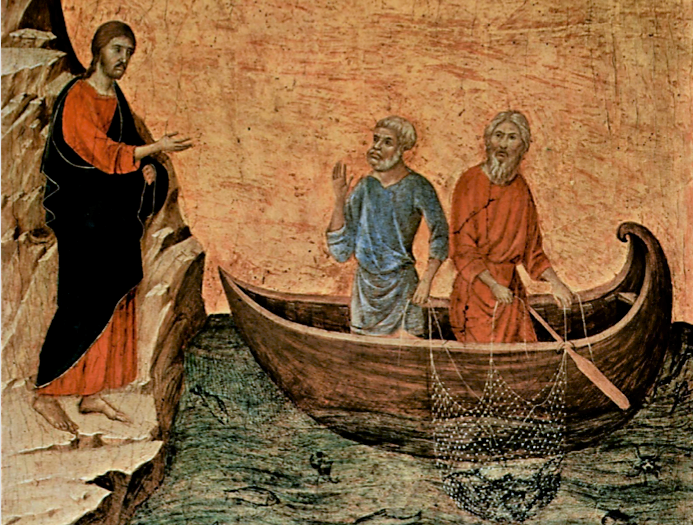
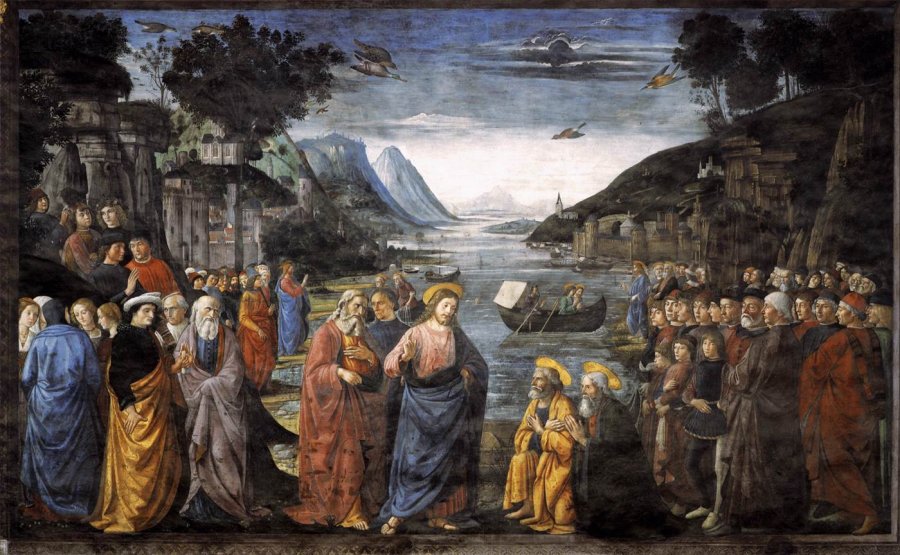
1. And it came to pass, that, as the people pressed upon him to hear the word of God, he stood by the lake of Gennesaret,
2. And saw two ships standing by the lake: but the fishermen were gone out of them, and were washing their nets.
3. And he entered into one of the ships, which was Simon’s, and prayed him that he would thrust out a little from the land. And he sat down, and taught the people out of the ship.
AMBROSE. When the Lord had performed many and various kinds of cures, the multitude began to heed neither time nor place in their desire to be healed. The evening came, they followed; a lake is before them, they still press on; as it is said, And it came to pass, as the people pressed upon him.
CHRYSOSTOM. (Hom. 25. in Matt.) For they clung to Him with love and admiration, and longed to keep Him with them. For who would depart while He performed such miracles? who would not be content to see only His face, and the mouth that uttered such things? Nor as performing miracles only was He an object of admiration, but His whole appearance was overflowing with grace. Therefore when He speaks, they listen to Him in silence, interrupting not the chain of His discourse; for it is said, that they might hear the word of God, &c. It follows, And he stood near the lake of Gennesaret.
BEDE. The lake of Gennesaret is said to be the same as the sea of Galilee or the sea of Tiberias; but it is called the sea of Galilee from the adjacent province, the sea of Tiberias from a neighbouring city. Gennesaret however, is the name given it from the nature of the lake itself, (which is thought from its crossing waves to raise a breeze upon itself,) being the Greek expression for “making a breeze to itself.” (quasi a γιννάω et ἀὴρ.) For the water is not steady like that of a lake, but constantly agitated by the breezes blowing over it. It is sweet to the taste, and wholesome to drink. In the Hebrew tongue, any extent of water, whether it be sweet or salt, is called a sea.
THEOPHYLACT. But the Lord seeks to avoid glory the more it followed Him, and therefore separating Himself from the multitude, He entered into a ship, as it is said, And he saw two ships standing near the lake: but the fishermen were gone out of them, and were washing their nets.
CHRYSOSTOM. This was a sign of leisure, but according to Matthew He finds them mending their nets. For so great was their poverty, that they patched up their old nets, not being able to buy new ones. But our Lord was very desirous to collect the multitudes, that none might remain behind, but they might all behold Him face to face; He therefore enters into a ship, as it is said, And he entered into a ship, which was Simon’s, and prayed him.
THEOPHYLACT. Behold the gentleness of Christ; He asks Peter; and the willingness of Peter, who was obedient in all things.
CHRYSOSTOM. After having performed many miracles, He again commences His teaching, and being on the sea, He fishes for those who were on the shore. Hence it follows, And he sat down and taught the people out of the ship.
GREGORY NAZIANZEN. (Orat. 37.) Condescending to all, in order that He might draw forth a fish from the deep, i. e. man swimming in the everchanging scenes and bitter storms of this life.
BEDE. Now mystically, the two ships represent circumcision and uncircumcision. The Lord sees these, because in each people He knows who are His, and by seeing, i. e. by a merciful visitation, He brings them nearer the tranquillity of the life to come. The fishermen are the doctors of the Church, because by the net of faith they catch us, and bring us as it were ashore to the land of the living. But these nets are at one time spread out for catching fish, at another washed and folded up. For every time is not fitted for teaching, but at one time the teacher must speak with the tongue, and at another time we must discipline ourselves. The ship of Simon is the primitive Church, of which St. Paul says, He that wrought effectually in Peter to the Apostleship of circumcision. (Gal. 2:8.) The ship is well called one, for in the multitude of believers there was one heart and one soul. (Acts 4:32.)
AUGUSTINE. (de Quæst. Ev. 1. 2. c. 2.) From which ship He taught the multitude, for by the authority of the Church He teaches the Gentiles. But the Lord entering the ship, and asking Peter to put off a little from the land, signifies that we must be moderate in our words to the multitude, that they may be neither taught earthly things, nor from earthly things rush into the depths of the sacraments. Or, the Gospel must first be preached to the neighbouring countries of the Gentiles, that (as He afterwards says, Launch out into the deep,) He might command it to be preached afterwards to the more distant nations.
5:4–7
4. Now when he had left speaking, he said unto Simon, Launch out into the deep, and let down your nets for a draught.
5. And Simon answering said unto him, Master, we have toiled all the night, and have taken nothing: nevertheless at thy word I will let down the net.
6. And when they had this done, they inclosed a great multitude of fishes: and their net brake.
7. And they beckoned unto their partners, which were in the other ship, that they should come and help them. And they came, and filled both the ships, so that they began to sink.
CYRIL OF ALEXANDRIA. Having sufficiently taught the people, He returns again to His mighty works, and by the employment of fishing fishes for His disciples. Hence it follows, When he had left off speaking, he said unto Simon, Launch out into the deep, and let down your nets for a draught.
CHRYSOSTOM. (Hom. 6. in Matt.) For in His condescension to men, He called the wise men by a star, the fishermen by their art of fishing.
THEOPHYLACT. Peter did not refuse to comply, as it follows, And Simon answering said unto him, Master, we have toiled all night and have taken nothing. He did not go on to say, “I will not hearken to thee, nor expose myself to additional labour,” but rather adds, Nevertheless, at thy word I will let down the net. But our Lord, since he had taught the people out of the ship, left not the master of the ship without reward, but conferred on him a double kindness, giving him first a multitude of fishes, and next making him His disciple: as it follows, And when they had done this, they inclosed a great multitude of fishes. They took so many fishes that they could not pull them out, but sought the assistance of their companions; as it follows, But their net brake, and they beckoned to their partners who were in the other ship to come, &c. Peter summons them by a sign, being unable to speak from astonishment at the draught of fishes. We next hear of their assistance, And they came and filled both the ships.
AUGUSTINE. (de Con. Ev. lib. 4. c. 6.) John seems indeed to speak of a similar miracle, but this is very different from the one he mentions. That took place after our Lord’s resurrection at the lake of Tiberias, and not only the time, but the miracle itself is very different. For in the latter the nets being let down on the right side took one hundred and fifty-three fishes, and these of large size, which it was necessary for the Evangelist to mention, because though so large the nets were not broken, and this would seem to have reference to the event which Luke relates, when from the multitude of the fishes the nets were broken.
AMBROSE. Now in a mystery, the ship of Peter, according to Matthew, is beaten about by the waves, (Matt. 8:24.) according to Luke, is filled with fishes, in order that you might understand the Church at first wavering, at last abounding. The ship is not shaken which holds Peter; that is which holds Judas. In each was Peter; but he who trusts in his own merits is disquieted by another’s. Let us beware then of a traitor, lest through one we should many of us be tossed about. Trouble is found there where faith is weak, safety here where love is perfect. Lastly, though to others it is commanded, Let down your nets, to Peter alone it is said, Launch out into the deep, i. e. into deep researches. What is so deep, as the knowledge of the Son of God! But what are the nets of the Apostles which are ordered to be let down, but the interweaving of words and certain folds, as it were, of speech, and intricacies of argument, which never let those escape whom they have once caught. And rightly are nets the Apostolical instruments for fishing, which kill not the fish that are caught, but keep them safe, and bring up those that are tossing about in the waves from the depths below to the regions above. But he says, Master, we have toiled the whole night and have caught nothing; for this is not the work of human eloquence but the gift of divine calling. But they who had before caught nothing, at the word of the Lord inclosed a great multitude of fishes.
CYRIL OF ALEXANDRIA. Now this was a figure of the future. For they will not labour in vain who let down the net of evangelical doctrine, but will gather together the shoals of the Gentiles.
AUGUSTINE. (ut sup.) Now the circumstance of the nets breaking, and the ships being filled with the multitude of fishes so that they began to sink, signifies that there will be in the Church so great a multitude of carnal men, that unity will be broken up, and it will be split into heresies and schisms.
BEDE. The net is broken, but the fish escape not, for the Lord preserves His own amid the violence of persecutors.
AMBROSE. But the other ship is Judæa, out of which James and John are chosen. These then came from the synagogue to the ship of Peter in the Church, that they might fill both ships. For at the name of Jesus every knee shall bow, whether Jew or Greek.
BEDE. Or the other ship is the Church of the Gentiles, which itself also (one ship being not sufficient) is filled with chosen fishes. For the Lord knows who are His, and with Him the number of His elect is sure. And when He finds not in Judæa so many believers as He knows are destined to eternal life, He seeks as it were another ship to receive His fishes, and fills the hearts of the Gentiles also with the grace of faith. And well when the net brake did they call to their assistance the ship of their companions, since the traitor Judas, Simon Magus, Ananias and Sapphira, and many of the disciples, went back. And then Barnabas and Paul were separated for the Apostleship of the Gentiles.
AMBROSE. We may understand also by the other ship another Church, since from one Church several are derived.
CYRIL OF ALEXANDRIA. But Peter beckons to his companions to help them. For many follow the labours of the Apostles, and first those who brought out the writings of the Gospels, next to whom are the other heads and shepherds of the Gospel, and those skilled in the teaching of the truth.
BEDE. But the filling of these ships goes on until the end of the world. But the fact that the ships, when filled, begin to sink, i. e. become weighed low down in the water; (for they are not sunk, but are in great danger,) the Apostle explains when he says, In the last days perilous times shall come; men shall be lovers of their own selves, &c. (2 Tim. 3:1, 2.) For the sinking of the ships is when men, by vicious habits, fall back into that world from which they have been elected by faith.
5:8–11
8. When Simon Peter saw it, he fell down at Jesus’ knees, saying, Depart from me; for I am a sinful man, O Lord.
9. For he was astonished, and all that were with him, at the draught of the fishes which they had taken:
10. And so was also James, and John, the sons of Zebedee, which were partners with Simon. And Jesus said unto Simon, Fear not; from henceforth thou shalt catch men.
11. And when they had brought their ships to land, they forsook all, and followed him.
BEDE. Peter was astonished at the divine gift, and the more he feared, the less did he now presume; as it is said, When Simon Peter saw it, he fell down at Jesus’ knees, saying, Depart from me; for I am a sinful man, O Lord.
CYRIL OF ALEXANDRIA. For calling back to his consciousness the crimes he had committed, he is alarmed and trembles, and as being unclean, he believes it impossible he can receive Him who is clean, for he had learnt from the law to distinguish between what is defiled and holy.
GREGORY OF NYSSA. When Christ commanded to let down the nets, the multitude of the fishes taken was just as great as the Lord of the sea and land willed. For the voice of the Word is the voice of power, at whose bidding at the beginning of the world light and the other creatures came forth. At these things Peter wonders, for he was astonished, and all that were with him, &c.
AUGUSTINE. (de con. Ev. lib. ii. 17.) He does not mention Andrew by name, who however is thought to have been in that ship, according to the accounts of Matthew and Mark. It follows, And Jesus said unto Simon, Fear not.
AMBROSE. Say thou also, Depart from me, for I am a sinful man, O Lord, that God may answer, Fear not. Confess thy sin, and the Lord will pardon thee. See how good the Lord is, who gives so much to men, that they have the power of making alive. As it follows, From henceforth thou shalt catch men.
BEDE. This especially belongs to Peter himself, for the Lord explains to him what this taking of fish means; that in fact as now he takes fishes by the net, so hereafter he will catch men by words. And the whole order of this event shews what is daily going on in the Church, of which Peter is the type.
CHRYSOSTOM. (Hom. 14. in Matt.) But mark their faith and obedience. For though they were eagerly engaged in the employment of fishing, yet when they heard the command of Jesus, they delayed not, but forsook all and followed Him. Such is the obedience which Christ demands of us; we must not forego it, even though some great necessity urges us. Hence it follows, And having brought their ships to land.
AUGUSTINE. (ubi sup.) Matthew and Mark here briefly state the matter, and how it was done. Luke explains it more at large. There seems however to be this difference, that he makes our Lord to have said to Peter only, From henceforth thou shalt catch men, whereas they related it as having been spoken to both the others. But surely it might have been said at first to Peter, when he marvelled at the immense draught of fishes, as Luke suggests, and afterwards to both, as the other two have related it. Or we must understand the event to have taken place as Luke relates, and that the others were not then called by the Lord, but only it was foretold to Peter that he should catch men, not that he should no more be employed in fishing; and hence there is room for supposing that they returned to their fishing, so that afterwards that might happen which Matthew and Mark speak, of. For then the ships were not brought to land, as if with the intention of returning, but they followed Him as calling or commanding them to come. (Matt. 4:20, Mark 1:18.) But if according to John, Peter and Andrew followed Him close by Jordan, how do the other Evangelists say that He found them fishing in Galilee, and called them to the discipleship? Except we understand that they did not see the Lord near Jordan so as to join Him inseparably, but knew only who He was, and marvelling at Him returned to their own.
AMBROSE. But mystically, those whom Peter takes by his word, he claims not as his own booty or his own gift. Depart, he says, from me, O Lord. Fear not then also to ascribe what is thy own to the Lord, for what was His He has given to us.
AUGUSTINE. (de Quæst. Ev. lib. ii. c. 2.) Or, Peter speaks in the character of the Church full of carnal men, Depart from me, for I am a sinful man. As if the Church, crowded with carnal men, and almost sunk by their vices, throws off from it, as it were, the rule in spiritual things, wherein the character of Christ chiefly shines forth. For not with the tongue do men tell the good servants of God that they should depart from them, but with the utterance of their deeds and actions they persuade them to go away, that they may not be governed by the good. And yet all the more anxiously do they hasten to pay honours to them, just as Peter testified his respect by falling at the feet of our Lord, but his conduct in saying, Depart from me.
BEDE. But the Lord allays the fears of carnal men, that no one trembling at the consciousness of his guilt, or astonished at the innocence of others, might be afraid to undertake the journey of holiness.
AUGUSTINE. (ubi sup.) But the Lord did not depart from them, shewing thereby that good and spiritual men, when they are troubled by the wickedness of the many, ought not to wish to abandon their ecclesiastical duties, that they might live as it were a more secure and tranquil life. But the bringing their ships to land, and forsaking all to follow Jesus, may represent the end of time, when those who have clung to Christ shall altogether depart from the storms of this world.
I’ve watched tons of ww2 documentaries,
The imperial soldiers refusal to surrender for the most part, but some did.
It dawned on me one day after looking into the faces of those that did surrender in those combat films of the day.
It started as a question in my mind.
What would it have been like to have been a sincere follower of Christ as a Catholic in ww2 Japan’s military ?
I think the Japanese who did surrender were Christian catholics, the looks of greif mixed with relief and even gratefullness that their tribulations were finally over.
Just my .02.
Ad Majorem Dei Gloriam (To the Greater Glory of God)
From: Isaiah 6:1-8
The Lord calls Isaiah
------------------------------
[1] In the year that King Uzziah died I saw the Lord sitting upon a throne, high and lifted up; and his train filled the temple. [2a] Above him stood the seraphim. [3] And one called to another and said:
"Holy, holy, holy is the Lord of hosts;
the whole earth is full of his glory."
[4] And the foundations of the thresholds shook at the voice of him who called, and the house was filled with smoke. [5] And I said: "Woe is me! For I am lost; for I am a man of unclean lips, and I dwell in the midst of a people of unclean lips; for my eyes have seen the King, the Lord of hosts!"
[6] Then flew one of the seraphim to me, having in his hand a burning coal which he had taken with tongs from the altar. [7] And he touched my mouth, and said: "Behold, this has touched your lips; your guilt is taken away, and your sin forgiven." [8] And I heard the voice of the Lord saying, "Whom shall I send, and who will go for us?" Then I said, "Here am I! Send me."
**********************************
Commentary:
6:1-13. As an introduction to what is called the "Book of Immanuel" (7:1-12:6) we get this account of how the Lord called Isaiah to be a prophet, sending him to his people at the time of the Syrian-Ephraimite coalition to explain to them what is going on and how they should act.
The account begins with a theophany (vv. 1-4), which is one of the key points in this book's message. God manifests himself seated in the manner of eastern kings, surrounded by his angelic court (the "seraphim"), who extol the holiness of the Lord: he clearly is Lord of all. In this vision, God is depicted as the thrice holy (v. 3), the highest form of superlative available in Hebrew. Being holy implies standing apart -- standing above everything else. God stands far above all other beings and he is their creator. In Hebrew "holy includes the idea of "sacred". It means that God has none of the limitations and imperfections that created beings have.
The holiness and majesty of God fill Isaiah with a sense of his own uncleanness and that of his people (v. 5). Typically, visions of God in biblical history induce feelings of fear in the seer; we even see this in the angel's announcement to Mary (cf. Lk 1:30): "Do not be afraid, Mary, for you have found favour with God."
"Faced with God's fascinating and mysterious presence, man discovers his own insignificance. Before the burning bush, Moses takes off his sandals and veils his face (cf. Ex 3:5-6) in the presence of God's holiness. Before the glory of the thrice-holy God, Isaiah cries out: 'Woe is me! I am lost; for I am a man of unclean lips' (Is 6:5). Before the divine signs wrought by Jesus, Peter exclaims: 'Depart from me, for I am a sinful man, O Lord' (Lk 5:8). But because God is holy, he can forgive the man who realizes that he is a sinner before him: 'I will not execute my fierce anger . . . for I am God and not man, the Holy One in your midst (Hos 11:9)'" (Catechism of the Catholic Church, 208).
Isaiah is cleansed and consoled as soon as he humbly acknowledges his unworthiness and insignificance before God (vv. 6-7). His instinctive sense of fear is immediately replaced by a generous and trusting response on the prophet's part: he is ready to do what God wants (v. 8). "In their 'one to one' encounters with God the prophets draw light and strength for their mission. Their prayer is not flight from this unfaithful world, but rather attentiveness to the Word of God. At times their prayer is an argument or a complaint, but it is always an intercession that awaits and prepares for the intervention of the Saviour God, the Lord of history (cf. Amos 7:2, 5; Is 6:5, 8, 11; Jer 1:6; 15:15-18; 20:7-18)" (Catechism of the Catholic Church, 2584).
Finally, the Lord entrusts him with his mission. The message he is to deliver is hard-hitting and full of paradoxes (vv. 9-10). The task given him is not, as one might at first think, to render the people incapable of hearing and understanding the word of God that could move their hearts. It is, rather, to tell them that if they fail to listen to the word of God, their hearts will be blinded: they will not be able to see things right and, because of that, the sinner will feel no need to take stock of his position and be converted. The Synoptic Gospels interpret Jesus' preaching as a fulfillment of what is said here in vv. 9-10 (Mt 13:13-15; Mk 4:11-12). The Gospel of St John sees these same words as anticipating what will happen to those who reject Jesus' message: "Therefore they could not believe. For Isaiah again said, 'He has blinded their eyes and hardened their heart, lest they should see with their eyes and perceive with their heart, and turn for me to heal them.' Isaiah said this because he saw his glory and spoke of him" (Jn 12:27-41). And St Paul also uses vv. 9-10 to reproach the Jews of Rome for rejecting the Good News of salvation in Christ which he is proclaiming to them (cf. Acts 28:23-28).
The people's hardness of heart will merit severe punishment; cities and houses will he laid waste, but all will not be lost: a holy seed will remain and from it the tree will grow back again (v. 11-13). These verses carry a message for people in all ages. Isaiah approaches God in all humility, showing him every reverence, and at the same time he puts his trust in God. For his part, the Lord cleanses his chosen ones and sends them out to help in his work of salvation. Origen, who commented on this passage a number of times, points out: "May burning coals he brought from the altar of heaven to burn my lips. If the burning coals of the Lord touch my lips, they will he purified; and when they are purified and cleansed of all sin, […] my mouth will he opened to the Word of God and I will not utter another impure word [...]. The seraphim who was sent to purify the prophet's lips did not purify the lips of the people […]; therefore, they continued to live in sin, and now they deny the Lord Jesus Christ and curse him from their unclean mouths. For my part, I pray that the seraphim will come to cleanse my lips (Homiliae in Isaiam, 1, 4). All we need is the same humble docility that Isaiah had: "Having received the grace God, he did not want it to be a gift granted to him to no avail, without being put to work in everything that needed to be done. Seeing the seraphim and the Lord of hosts seated on high, on his throne of glory, he said: 'Woe me ...'. By speaking thus and making himself 'unworthy', he received the help of God because He took in account his humility" (ibid., 6:2). And St John Chrysostom, commenting on Isaiah's response to God, says that the prophet shows readiness to carry out his mission to the people because "since the saints are friends of God, they, too, love all men dearly" (In Isaiam, 6, 5).
Christ's Resurrection and His Appearances
-----------------------------------------
[1] Now I would remind you, brethren, in what terms I preached to you the gospel, which you received, in which you stand, [2] by which you are saved, if you hold it fast--unless you believed in vain.
[3] For I delivered to you as of first importance what I also received, that Christ died for our sins in accordance with the scriptures, [4] that he was buried, that he was raised on the third day in accordance with the scriptures, [5] and that he appeared to Cephas, then to the twelve. [6] Then he appeared to more than five hundred brethren at one time, most of whom are still alive, though some have fallen asleep. [7] Then he appeared to James, then to all the apostles. [8] Last of all, as to one untimely born, he appeared also to me. [9] For I am the least of the apostles, unfit to be called an apostle, because I persecuted the church of God. [10] But by the grace of God I am what I am, and his grace toward me was not in vain. On the contrary, I worked harder than any of them, though it was not I, but the grace of God which is with me. [11] Whether then it was I or they, so we preach and so you believed.
***********************************************************************
Commentary:
1-58. Some of the Corinthian Christians were objecting to the doctrine of the resurrection of the dead, because this was a belief with which Greeks were unfamiliar, even those Greeks who held that the soul was immortal. Given the great importance of this doctrine, St Paul replies at length, pointing first to the historical fact of Christ's resurrection (vv. 1-11) and how it necessarily connects up with the resurrection of the dead in general (vv. 12-34). He then goes on to discuss what form this resurrection will take (vv. 35-58). This epistle, which began with an exposition on Jesus Christ crucified, the power and wisdom of God (cf. 1:18-2:5), ends with a development of doctrine on the resurrection of Christ and the consequent resurrection of the members of his mystical body.
To understand what St Paul is saying it is useful to bear in mind that here he is referring only to the glorious resurrection of the just. Elsewhere in Sacred Scripture it is clearly stated that all men will rise from the dead (cf., e.g., Jn 5:28-29; Acts 24:15).
1-11. The resurrection of Jesus Christ is one of the essential doctrines of the Catholic faith, explicitly stated in the first creeds or symbols of the faith. It is in fact the supreme argument in favor of the divinity of Jesus and his divine mission: our Lord proclaimed it many times (cf., e.g., Mt 16:21-28; 17:22-27; 20:17-19), and by rising from the dead he provided the sign which he had promised those who did not believe him (cf. Mt 12:38-40).
This point is so important that the primary role of the Apostles is to bear witness to Christ's resurrection (cf. Acts 1:22; 2:32; 3:15; etc.); the proclamation of the resurrection of the Lord is the very core of apostolic catechesis (cf., e.g., the discourses of St Peter and St Paul reported in the Acts of the Apostles).
3-8. On the verbs "deliver" and "receive" see the note on 1 Cor 11:23-26. St Paul reminds the Corinthians of certain basic points in his preaching--that Jesus Christ died for our sins; "that he was buried, that he was raised on the third day in accordance with the scriptures" (a statement which has passed directly into the Creed) and was seen by many people.
It should be pointed out that the Greek verb translated as "appeared" refers to being seen by the eye. This is relevant to studying the nature of the appearances of the risen Jesus: St Paul is speaking of true, ocular, sight; there seems to be no way this can be identified with imagination or intellectual vision.
The appearances of the risen Christ are a direct proof of the historical fact of his resurrection. This argument gains special force when one remembers that at the time this letter was written many people who had seen the risen Lord were still alive (v. 6). Some of the appearances referred to by St Paul are also mentioned in the Gospels and in Acts--that to Peter (cf. Lk 24:34), those to the Apostles (cf., e.g., Lk 24:36-49; Jn 20:19-29), that to St Paul himself (cf. Acts 9:1-6); others--that to James and to the five hundred brethren—are mentioned only here.
The importance of this passage is enhanced by the fact that it is the earliest documentary record earlier than the Gospels--of our Lord's resurrection, which had taken place scarcely twenty years earlier.
4. "Was buried": in recounting the death of Christ, all four evangelists expressly mention that his body was buried (cf. Mt 27:57-61 and par.). St Paul also confirms the fact in this letter, written very soon after the time, thereby confirming a tradition which had come down from the beginning (v. 3). The fact that Christ's body was buried eliminates any doubt about his death, and underlines the miracle of the Resurrection: Jesus Christ rose by his own power, rejoining his soul with his body, and leaving the tomb with the same human body (not merely the appearance of a body) as died and was buried, although now that body was glorified and had certain special properties (cf. note on 15:42-44). The Resurrection, therefore, is an objective, physical event, witnessed to by the empty tomb (cf. Mt 28:1ff and par) and by Christ's appearances.
"He was raised on the third day": Jesus died and was buried on the evening of Good Friday; his body lay in the tomb the entire sabbath, and rose on the Sunday. It is correct to say that he rose on the third day after his death, even though it was not a full seventy-two hours later.
"According to the scriptures": St Paul may be referring to certain passages of the Old Testament which--"after" the event--were seen to foreshadow the Resurrection--for example, the episode of Jonah (chaps.1-2), which Jesus in fact applied to himself (cf. Mt 12:39-40; cf. also Hos 6:1-2 and Ps 16:9-10).
9-10. St Paul's humility, which leads him to think that his past faults render him unworthy of the grace of the apostolate, is precisely what gives God's grace scope to work in him. "Admit outright that you are a servant whose duty it is to perform very many services. Do not pride yourself on being called a son of God: let us recognize grace, yet be mindful of our nature; do not be proud of having rendered good service, of having done what you were supposed to do. The sun fulfills its function; the moon obeys, the angels carry out their charge. The Lord's chosen instrument for the Gentiles says, 'I am unfit to be called an apostle, because I persecuted the church of God' (1 Cor 15:9) [...]. Neither should we seek to be praised on our own account" (St Ambrose, "Expositio Evangelii sec. Lucam", VIII, 32).
However, the grace of God is not enough on its own. As in St Paul's case, man's cooperation is needed, because God has chosen to rely on our free response to grace: "God, who created you without you, will not save you without you" (St Augustine, "Sermon" 169, 13). And, commenting on St Paul's words--"Not I, but the grace of God which is with me"-- Augustine points out, "that is, not just me, but God with me; and therefore not the grace of God alone, nor myself alone, but the grace of God and myself" ("De Gratia Et Libero Arbitrio", V, l2).
The Miraculous Catch of Fish and the Calling of the First Disciples
-------------------------------------------------------------------
[1] While the people pressed upon Him (Jesus) to hear the word of God, He was standing by the Lake of Gennesaret. [2] And He saw two boats by the lake, but the fishermen had gone out of them and were washing their nets. [3] Getting into one of the boats, which was Simon's, He asked him to put out a little from the land. And He sat down and taught the people from the boat. [4] And when He had ceased speaking, He said to Simon, "Put out into the deep and let down your nets for a catch." [5] And Simon answered, "Master, we toiled all night and took nothing! But at your word I will let down the nets." [6] And when they had done this, they enclosed a great shoal of fish; and as their nets were breaking, [7] they beckoned to their partners in the other boat to come and help them. And they came and filled both the boats, so that they began to sink. [8] But when Simon Peter saw it, he fell down at Jesus' knees, saying, "Depart from me, for I am a sinful man, O Lord." [9] For he was astonished, and all that were with Him, at the catch of fish which they had taken; [10] And so also were James and John, sons of Zebedee, who were partners with Simon. And Jesus said to Simon, "Do not be afraid; henceforth you will be catching men." [11] And when they had brought their boats to land, they left everything and followed Him.
***********************************************************************
Commentary:
1. "Just as they do today! Can't you see? They want to hear God's message, even though outwardly they may not show it. Some perhaps have forgotten Christ's teachings. Others, through no fault of their own, have never known them and they think that religion is something odd. But of this we can be sure, that in every man's life there comes a time sooner or later when his soul draws the line. He has had enough of the usual explanations. The lies of the false prophets no longer satisfy. Even though they may not admit it at the time, such people are longing to quench their thirst with the teachings of our Lord" (St J. Escriva, "Friends of God", 260).
3. The Fathers saw in Simon's boat a symbol of the pilgrim Church on earth. "This is the boat which according to St. Matthew was in danger of sinking and according to St. Luke was filled with fish. Here we can see the difficult beginnings of the Church and its later fruitfulness" (St. Ambrose, "Expositio Evangelii sec. Lucam, in loc."). Christ gets into the boat in order to teach the crowds--and from the barque of Peter, the Church, He continues to teach the whole world.
Each of us can also see himself as this boat Christ uses for preaching. Externally no change is evident: "What has changed? There is a change inside our soul, now that Christ has come aboard, as He went aboard Peter's boat. Its horizon has been expanded. It feels a greater ambition to serve and an irrepressible desire to tell all creation about the "magnalia Dei" (Acts 2:11), the marvellous doings of our Lord, if only we let Him work" ([St] J. Escriva, "Friends of God", 265).
4. "When He had finished His catechizing, He told Simon: `Put out into the deep, and lower your nets for a catch.' Christ is the master of this boat. He it is who prepares the fishing. It is for this that He has come into the world, to do all He can so that His brothers may find the way to glory and to the love of the Father" ("Friends of God", 260). To carry this task out, our Lord charges all of them to cast their nets, but it is only Peter He tells to put out into the deep.
This whole passage refers in some way to the life of the Church. In the Church the bishop of Rome, Peter's successor, "is the vicar of Jesus Christ because he represents Him on earth and acts for Him in the government of the Church" ("St. Pius X Catechism", 195). Christ is also addressing each one of us, urging us to be daring in apostolate: `"Duc in altum. Put out into deep water!' Throw aside the pessimism that makes a coward of you. `Et laxate retia vestra in capturam. And pay out you nets for a catch.' Don't you see that you, like Peter, can say: `In nomine tuo, laxabo rete': Jesus, if You say so, I will search for souls?" (St J. Escriva, "The Way", 792).
"If you were to fall into the temptation of wondering, `Who's telling me to embark on this?', we would have reply, `Christ Himself is telling you, is begging you.' `The harvest is plentiful enough, but the laborers are few. You must ask the Lord to whom the harvest belongs to send laborers out for the harvesting' (Matthew 9:37-38). Don't take the easy way out. Don't say, `I'm no good at this sort of thing; there are others who can do it; it isn't my line.' No, for this sort of thing, there is no one else: if you could get away with that argument, so could everyone else. Christ's plea is addressed to each and every Christian. No one can consider himself exempt, for whatever reason--age, health or occupation. There are no excuses whatsoever. Either we carry out a fruitful apostolate, or our faith will prove barren" ("Friends of God", 272).
5. When Christ gives him these instructions, Peter states the difficulties involved. "A reasonable enough reply. The night hours were the normal time for fishing, and this time the catch had yielded nothing. What was the point of fishing by day? But Peter has faith: `But at Your word I will let down the nets.' He decides to act on Christ's suggestion. He undertakes the work relying entirely on the word of our Lord" ("Friends of God", 261).
8. Peter does not want Christ to leave him; aware of his sins, he declares his unworthiness to be near Christ. This reminds us of the attitude of the centurion who confesses his unworthiness to receive Jesus into his house (Matthew 8:8). The Church requires her children to repeat these exact words of the centurion before receiving the Blessed Eucharist. She also teaches us to show due external reverence to the Blessed Sacrament when going to Communion: by falling down on his knees Peter also shows that internal adoration of God should be also be expressed externally.
11. Perfection is not simply a matter of leaving all things but of doing so in order to follow Christ--which is what the Apostles did: they gave up everything in order to be available to do what God's calling involved.
We should develop this attitude of availability, for "Jesus isn't satisfied `going halves': He wants the lot" (St J. Escriva, "The Way", 155).
If we don't give ourselves generously we will find it very difficult to follow Jesus: "Detach yourself from people and things until you are stripped of them. For, says Pope St. Gregory, the devil has nothing of his own in this world, and naked he comes to battle. If you go clothed to fight him, you will soon be pulled to the ground: for he will have something to catch you by" ("The Way", 149).
| Luke | |||
| English: Douay-Rheims | Latin: Vulgata Clementina | Greek NT: Byzantine/Majority Text (2000) | |
| Luke 5 | |||
| 1. | AND it came to pass, that when the multitudes pressed upon him to hear the word of God, he stood by the lake of Genesareth, | Factum est autem, cum turbæ irruerunt in eum ut audirent verbum Dei, et ipse stabat secus stagnum Genesareth. | εγενετο δε εν τω τον οχλον επικεισθαι αυτω του ακουειν τον λογον του θεου και αυτος ην εστως παρα την λιμνην γεννησαρετ |
| 2. | And saw two ships standing by the lake: but the fishermen were gone out of them, and were washing their nets. | Et vidit duas naves stantes secus stagnum : piscatores autem descenderant, et lavabant retia. | και ειδεν δυο πλοια εστωτα παρα την λιμνην οι δε αλιεις αποβαντες απ αυτων απεπλυναν τα δικτυα |
| 3. | And going into one of the ships that was Simon's, he desired him to draw back a little from the land. And sitting he taught the multitudes out of the ship. | Ascendens autem in unam navim, quæ erat Simonis, rogavit eum a terra reducere pusillum. Et sedens docebat de navicula turbas. | εμβας δε εις εν των πλοιων ο ην του σιμωνος ηρωτησεν αυτον απο της γης επαναγαγειν ολιγον και καθισας εδιδασκεν εκ του πλοιου τους οχλους |
| 4. | Now when he had ceased to speak, he said to Simon: Launch out into the deep, and let down your nets for a draught. | Ut cessavit autem loqui, dixit ad Simonem : Duc in altum, et laxate retia vestra in capturam. | ως δε επαυσατο λαλων ειπεν προς τον σιμωνα επαναγαγε εις το βαθος και χαλασατε τα δικτυα υμων εις αγραν |
| 5. | And Simon answering said to him: Master, we have labored all the night, and have taken nothing: but at thy word I will let down the net. | Et respondens Simon, dixit illi : Præceptor, per totam noctem laborantes nihil cepimus : in verbo autem tuo laxabo rete. | και αποκριθεις ο σιμων ειπεν αυτω επιστατα δι ολης της νυκτος κοπιασαντες ουδεν ελαβομεν επι δε τω ρηματι σου χαλασω το δικτυον |
| 6. | And when they had done this, they enclosed a very great multitude of fishes, and their net broke. | Et cum hoc fecissent, concluserunt piscium multitudinem copiosam : rumpebatur autem rete eorum. | και τουτο ποιησαντες συνεκλεισαν πληθος ιχθυων πολυ διερρηγνυτο δε το δικτυον αυτων |
| 7. | And they beckoned to their partners that were in the other ship, that they should come and help them. And they came, and filled both the ships, so that they were almost sinking. | Et annuerunt sociis, qui erant in alia navi, ut venirent, et adjuvarent eos. Et venerunt, et impleverunt ambas naviculas, ita ut pene mergerentur. | και κατενευσαν τοις μετοχοις τοις εν τω ετερω πλοιω του ελθοντας συλλαβεσθαι αυτοις και ηλθον και επλησαν αμφοτερα τα πλοια ωστε βυθιζεσθαι αυτα |
| 8. | Which when Simon Peter saw, he fell down at Jesus' knees, saying: Depart from me, for I am a sinful man, O Lord. | Quod cum vidisset Simon Petrus, procidit ad genua Jesu, dicens : Exi a me, quia homo peccator sum, Domine. | ιδων δε σιμων πετρος προσεπεσεν τοις γονασιν ιησου λεγων εξελθε απ εμου οτι ανηρ αμαρτωλος ειμι κυριε |
| 9. | For he was wholly astonished, and all that were with him, at the draught of the fishes which they had taken. | Stupor enim circumdederat eum, et omnes qui cum illo erant, in captura piscium, quam ceperant : | θαμβος γαρ περιεσχεν αυτον και παντας τους συν αυτω επι τη αγρα των ιχθυων η συνελαβον |
| 10. | And so were also James and John the sons of Zebedee, who were Simon's partners. And Jesus saith to Simon: Fear not: from henceforth thou shalt catch men. | similiter autem Jacobum et Joannem, filios Zebedæi, qui erunt socii Simonis. Et ait ad Simonem Jesus : Noli timere : ex hoc jam homines eris capiens. | ομοιως δε και ιακωβον και ιωαννην υιους ζεβεδαιου οι ησαν κοινωνοι τω σιμωνι και ειπεν προς τον σιμωνα ο ιησους μη φοβου απο του νυν ανθρωπους εση ζωγρων |
| 11. | And having brought their ships to land, leaving all things, they followed him. | Et subductis ad terram navibus, relictis omnibus, secuti sunt eum. | και καταγαγοντες τα πλοια επι την γην αφεντες απαντα ηκολουθησαν αυτω |

(5 FEBRUARY 1597)
Christian faith was first introduced into Japan in the sixteenth century by Jesuit and later by Franciscan missionaries. By the end of that century, there were probably about 300,000 baptized believers in Japan.
Unfortunately, this promising beginning met reverses, brought about by rivalries between different groups of missionaries and political intrigues by the Spanish and Portuguese governments, along with power politics among factions in the Japanese government itself. The result was a suppression of Christians.
The first victims were six Franciscan friars and twenty of their converts, who were executed at Nagasaki on 5 February 1597. (They were tied to crosses, the crosses were raised to an upright position, and they were then quickly stabbed to death by a soldier with a javelin.) After a short interval of relative tolerance, many other Christians were arrested, imprisoned for life, or tortured and killed; and the Church was totally driven underground by 1630. However, when Japan was re-opened to Western contacts 250 years later, it was found that a community of Japanese Christians had survived underground, without clergy, without Scriptures, with only very sketchy instructions in the doctrines of the faith, but with a firm commitment to Jesus as Lord. (I remind you that 250 years is a long time -- 250 years ago Americans were loyal subjects of King George II. The preceding statement is valid only until 2010.)
by James Kiefer
February 5,1997 marks the 400th anniversary of the first Christian martyrs in Japan. The Japanese martyrs became Christians as a result of the witness of Roman Catholic missionaries who first arrived in Japan with the Portugese in 1543. The Jesuit priest Francis Xavier, whose mission work between 1549-1551 from Kyushu to Kyoto, laid the foundation for the future Christian church in Japan. In 1563, Omura Sumitada became the first daimyo baptized by a Jesuit priest. The first church was built in Kyoto in 1576. According to Martin Repp of the NCC Center for the Study of Japanese Religions, "between 1579 and 1582 the early missionary work was revised under Father Alessandro Valignano, one of the few who understood that Christianity had to loose its European flavor in order to become acceptable to the Japanese" (Martin Repp, "Introduction" Japanese Religions, Vol. 19 No. 1&2, Jan. 1994, p.1).
Because of unrest among his subjects attributed to Christians, Shogun Hideyoshi issued in 1587 the first decree banishing the propoagation of the Christian faith. After a century of civil war, he feared unrest that might lead to peasant revolts. He stated that the religions of Shinto and Buddhism were the only religions of Japan. Nevertheless, for ten years Christian missionaries enjoyed toleration in a restricted way. After the arrival of Spanish priests of the Franciscan and Dominican orders in the beginning of the 1590's, rivalry and quarrel arose among the Christian missionaries. The conflict was also between different European nationals. In 1596 the "San Filipe" incident dealt a serious blow to the Christian mission. The Spanish ship "San Filipe" ran aground and its cargo containing a lot of ammunition was confiscated. The ship's pilot was said to have told during interrogation that Spanish colonial expansion was normally proceeded by missionaries preparing the way for military conquest. This argument was taken up very quickly by the Japanese rulers.
In 1597 Jesuits and Franciscans were taken prisoner in the capital (the Jesuits were released soon due to their connection with the court) and twenty-six Christians, Japanese and foreigners, were executed in Nagasaki, becoming the first martyrs in Japan. The Rev. Sigfrid Schneider describes an incident from the martyrdom on February 5, 1597," On the way up the hill a nobleman tempted the youngest boy, Louis Ibaragi, who was only twelve years old to renounce his faith, He would not yield but eagerly asked: 'Where is my cross?' When they pointed out the smallest one to him he immediately embraced it and held on to it as a child clings to his toy." (Sigfried Schneider, Ofm, The 26 Martyrs of Japan, Chuo Press, 1980, p. 16)
In spite of local persecutions, the Roman Catholic mission continued to expand. Finally, in 1614, Shogun Ieyasu issued the edict of persecution and ensured its implementation: churches were destroyed, foreign missionaries were expelled, and Japanese Christians tortured and killed. From this time on Christians went into hiding and were known as Kakure Kirishitan (Hidden Christians). In 1637/38 the "Shimabara Rebellion," a peasant uprising in Kyushu under Christian leadership, was put down. In reaction to the turmoil caused by this last attempt at survival, the government closed the country to Roman Catholic traders as well as Christian missionaries. The contact with the West was henceforth strictly controlled. As an annual procedure, fumi-e (stepping on a metal image of Christ or Mary) was performed and Japanese had to publically confess that they had nothing to do with Christianity. In spite of the most cruel persecution, some Christians managed to survive and worshipped Christ in secret or under the guise of other religious rituals or tea ceremonies. Persecution of Christians continued until 1854 when Japan was opened by Commodore Perry.
by Jeff Powell, from Koinonia, the Newsletter of the Tokyo Union Church

Disclaimer: Opinions posted on Free Republic are those of the individual posters and do not necessarily represent the opinion of Free Republic or its management. All materials posted herein are protected by copyright law and the exemption for fair use of copyrighted works.