Posted on 12/28/2021 7:42:51 PM PST by ebb tide
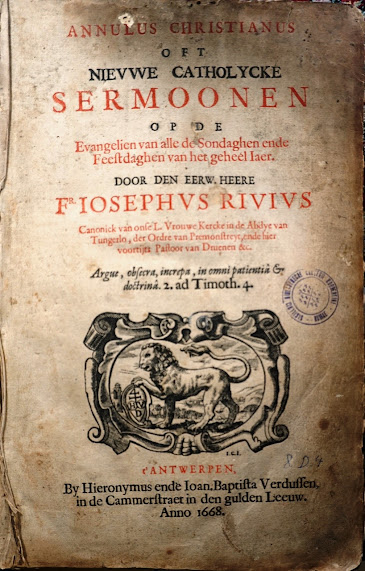
In keeping with recent developments in the ongoing attack on the Traditional Latin Mass and its adherents, it seems fitting to mention a new book just released by the admirable Arouca Press: The Christian Year, volume 1: Sermons for Advent, Christmas, & Epiphany, by Joseph Rivius, O.Praem., in a translation by Fr. Martin Roestenburg, O.Praem.
The ancient Jews wrote the name of God, Jehovah, with four letters. So great was their reverence for the Holy Name that they did not even dare pronounce it. The High Priest wore on his forehead a golden headband on which was engraved the Holy Name. Only he was allowed to utter the Name, and then only at certain times and hours of the day. If this was so for the ancients, then what great reverence and honour should we Christians bestow on the Holy Name of Jesus? Saint Paul the Apostle says that at the name of Jesus every knee should bow, in Heaven and on earth and under the earth. Your name, O Jesus! is both holy and terrifying; it stirs up in our hearts both love and fear. It is a Name full of honour and reverence. It is a Name invented by the Blessed Trinity, announced by an angel and given to Joseph and Mary. It is a Name of salvation and grace. There is no Name higher than this blessed Name by which man can obtain salvation. In your Name, O Jesus! did the wondrous exchange occur between humanity and divinity, by which we were saved. In your Name, O Jesus! are contained wisdom and power, goodness, love and all the other divine properties [...]And yet, notwithstanding the sweetness of this holy, blessed Name, the Reformed Brethren, like birds of prey circling dead, stinking corpses, cannot abide the sweetness of the Name of Jesus, for they find pleasure in the stench of error and the filth of sin. Woe to these pathetic people who say evil is good, and good is evil! How they labour to cure their ailing bodies! They are not in the least concerned for their immortal souls, even though a powerful and effective medicine can easily be found. For as Saint Bernard tells us, calling to mind the Name of Jesus softens the impetuosity of anger, it quenches the fire of concupiscence, it conquers pride and overcomes the thirst of avarice.
O gentle Jesus! How many false witnesses later rose up against you? The Jews unjustly condemned you, but more than a thousand times have the heretics tried to overcome you with false testimonials. The heretic Arius claimed you were not God but only a man; Nestorius claimed you were made up of two separate persons; Eutyches said that you only had one single nature; Manes said you did not have a real body. All these were false witnesses whose testimonials did not match.In the end, two more false witnesses have arisen, namely, Calvin and Luther, the former a Frenchman, the latter a High-German. Both have poured out terrible blasphemies against you. One says you are not truly present in the Most Holy Sacrament of the Altar, but only figuratively. The other says you are truly present, but together with the bread. In their belief they give false witness to your own words and they claim this Most Holy Sacrament to be a superstition, an impiety, sorcery and idolatry. These are without a doubt horrendous blasphemies.
So then, after Our Saviour had asked Cleophas what had happened during these past days in the city of Jerusalem, Cleophas began telling Him the story “about Jesus of Nazareth, who was a man powerful in word and deed. We had hoped that He was the one who was going to redeem Israel and all of us from the Romans, just as Moses redeemed our forefathers from slavery in Egypt. But it is now the third day since these things took place, and yet we have seen nothing happening and we are starting to lose hope.” O you foolish disciples! The time has not yet come, nor yet has the hour passed, so take courage.In a way, these two disciples resembled those other two strange pilgrims, Luther and Calvin, who, while walking away from the Jerusalem of the Catholic Church towards the Emmaus of Wittenberg and Geneva, so often said among themselves, “we had hoped, we had hoped.” What had they hoped for? They had hoped that after they had fought with the Pope of Rome, who is the Vicar of Christ on earth, about their accursed teachings on the Holy Sacrament of the Altar, and other Catholic doctrines, they would subjugate the entire Catholic Church. But this hope quickly dissipated after the Church rose up against them.In the second year of his apostasy, Luther boasted that if he were to have still two or three years of life left in him, he would be able to destroy the entire papacy. Alas! This proved to be a proud, presumptuous hope seeing that he was not able to accomplish much to that end during the twenty-four years he persisted in his wickedness. “O fools, and slow of heart to believe!” What foolishness for these Reformed Apostles! Do they really want to bash their heads against the rock upon which the holy Catholic Church is built? They will do so in vain, and must heed Our Saviour’s promise, “the gates of hell shall not prevail against it” (Mt 16:18).
Now then, just as a man goes through a door or a gate to enter into a house, so too does a person go through sin, heresies, and bad people to reach hell and the kingdom of the devil. What do you think? Did not the tyrants and persecutors in the early Catholic Church serve as an open door through which thousands of people, some because of fear, others because of money, goods, status and honour, have been dragged to idolatry and superstition? And in our own times, have not Calvin and Luther been wide-open gates through whose teachings thousands of souls, even to this day, have fallen into the eternal abyss? Finally, are not public sinners wide-open gates through whom others can be influenced by their sins and wickedness, thereby also risking eternal damnation?Our Saviour reinforced and strengthened His holy Catholic Church against all of this, when He said to the Apostle Peter, “and the gates of hell shall not prevail against it” (Mt 16:18). “O Apostle Peter! I shall build upon you such a strong and steadfast Church that neither the tyrants with their followers, nor the heretics with their errors, nor the sinners with their sins, will be able to overcome or subdue her,” writes Saint Cyril. After the Lord’s promise, the Apostolic Church of Peter remained untainted from any seductions and trickery of the heretics; it is true that at times she appeared to be oppressed and trampled upon because of tyranny, persecution, and battles with the heretics. Nonetheless, she has always remained ostensibly triumphant and unconquerable, as when she flies to Heaven with thirty, even forty thousand martyrs who had received their martyrs’ crowns.Therefore, we must not be down-cast, Catholic Listeners, we must not be filled with a sense of dread foreboding and doubts about her power and steadfastness, when in our days she is still persecuted and oppressed; even less should we give ear to our Reformed Brethren when they arrogantly say, “See how our religion is the pure religion, for as we extend our boundaries we can daily count on victory.” On no account should we ever doubt the truth of Our Saviour’s words, “The gates of hell shall not prevail against it.” The barque of Saint Peter the Apostle might have to endure storms, and can be shaken and tossed about, but it shall never sink. “For the word of the Lord shall endure forever.”If it were the case that the True Faith could be measured by setting boundaries, then the heathen ancient Romans would have had the best religion, for their dominion extended almost throughout the entire world, and in these days the Turks must have the best religion, seeing that they possess more land and sand than the whole of Christendom. Nevertheless, not only did Our Saviour make the promise to Saint Peter the Apostle that the gates of hell, or the power of the devil, shall not prevail against His Church, but furthermore, “I will give to you the keys of the Kingdom of Heaven” (Mt 16:19). Peter thus received the keys of Heaven, he was made Prince of the Catholic Church, and he was given authority to govern and rule over her, and the power to forgive sins or to bind them [...] And in Saint John’s Gospel we read, “Whose sins you shall forgive, they are forgiven them; and whose sins you shall retain, they are retained” (Jn 20:23).People therefore can no longer make excuses or plead innocence for not being able to reach Heaven. For in order to obtain forgiveness of our sins He did not send us to the angels or to some other pure creatures which had never sinned, and who, in their purity and innocence can reproach us, but instead He sent us to Peter the Apostle, and to His servants and the priests, who, being sinners themselves, can take pity on other sinners, yet who were given divine authority and the power of God to forgive sins.
|
| Frontispiece of the 1668 edition |
So then, if the officials do not give sound advice, and if priests live without fear of the Lord, it is no wonder that the entire community can become immoderate and coarse [...] These are the kinds of things that made Christ our Saviour weep bitter tears, even though in His omnipotence He had already foreseen them.
The clergy should therefore take note not to hoard the income Almighty God has provided for them, nor to store up treasures, but they should generously distribute what they earn to the poor.... Therefore, the clergy should learn from this that the Church’s income is the price of the Son of God’s Precious Blood, and consequently it should not be locked away in chests but liberally distributed to the poor and needy through acts of charity and mercy.
Catholic Listeners, we should not be downcast during this time of the divine wedding, but we must open our eyes to the rising Sun of Righteousness. I can imagine some people thinking to themselves, “may God grant me a deep humility so that I might love Him! May God grant me perfect purity, so that I may receive Him with cleanliness of heart! Perhaps I will hear my Guardian Angel say to me, ‘Hail soul, full of grace, the Lord is with you.’ Oh, what a great honour this would be for me! Perhaps God might kiss me with a kiss from His mouth; what sweetness this would give my soul! Perhaps He might take my soul as His bride; how happy I would be.”Whatever one wishes is permitted; whatever one desires can come about. For does not the Divine Bridegroom love our souls? Listen, we were all once lost and damned for all eternity through the sin of our first father Adam, and we were redeemed. We were infected with the leprosy of sin, and He washed us clean in His Precious Blood and healed us through His death. We came into the world naked and poor, yet, more than merely life, He gives us health and strength, food and sustenance, and anything else for our daily needs and desires. These are the physical benefits He gives us for our bodies.Furthermore, whenever we receive the Most Blessed Sacrament of the Altar with a pure soul and conscience, He descends into our mouths and bodies, giving us, as it were, a kiss from His divine mouth. Finally, He sends into our hearts many holy warnings and divine inspirations, with which He seeks out our hearts as His Bride, His ambassadors, and His envoys. What else is there for us to do, Catholic Listeners, than to submit to Him and hand over our souls with humble wills and pure hearts, saying together with the Blessed Virgin Mary: “Behold the handmaid of the Lord, let it be done to me according to your word!” Let this, then, be our response, so that, enjoying an overabundance of divine grace in this world, we may attain heavenly glory in the life to come.

Ping
Needs a longer, more descriptive title.
And despite your 3000+ polemic by the deluded railing Rivius, the plain fact remains that distinctive Catholic teachings are not manifest in the only wholly inspired substantive authoritative record of what the NT church believed (which is Scripture, in particular Acts through Revelation, which best shows how the NT church understood the gospels).
"he had no time for the Protestant “wolves” who were lurking nearby to destroy the traditional Faith " Which is not that of Scripture, but one which teaches that, 'the one duty of the multitude is to allow themselves to be led, and, like a docile flock, to follow the Pastors," "to suffer themselves to be guided and led in all things that touch upon faith or morals by the Holy Church of God through its Supreme Pastor the Roman Pontiff," "of submitting with docility to their judgment," with "no discussions regarding what he orders or demands, or up to what point obedience must go, and in what things he is to be obeyed... not only in person, but with letters and other public documents ;" and 'not limit the field in which he might and must exercise his authority, " for "obedience must not limit itself to matters which touch the faith: its sphere is much more vast: it extends to all matters which the episcopal power embraces," and not set up "some kind of opposition between one Pontiff and another. Those who, faced with two differing directives, reject the present one to hold to the past, are not giving proof of obedience to the authority which has the right and duty to guide them," "Nor must it be thought that what is expounded in Encyclical Letters does not of itself demand consent." (Sources http://www.freerepublic.com/focus/religion/3578348/posts?page=14#14)
"Priests had been forced out of their parishes, and the torture and execution of the nineteen priests and religious rounded up and hanged at the town of Den Briel"
One need not wonder where they go that idea from:
• Canons of the Ecumenical Fourth Lateran Council (canon 3), 1215:
Along with this is that of Rome requiring civil rulers to engaged in other means of punishment and compulsion under her claimed power of "coercive jurisdiction," such as, Pope Innocent IV, Ad extirpanda,1252:
(29) The head of state or ruler must...The head of state or ruler must......The head of state or ruler must... The head of state or ruler must... The head of state or ruler must...
More.
For the use of physical force itself was sanctioned, including in slaying. Thus we have condemned as error, "That heretics be burned is against the will of the Spirit." (Exsurge Domine, Bull of Pope Leo X issued June 15, 1520 http://www.papalencyclicals.net/leo10/l10exdom.htm) "Catholics who have girded themselves with the cross for the extermination [or expulsion] of the heretics, shall enjoy the indulgences and privileges granted to those who go in defense of the Holy Land." Punishment itself by physical means was historically affirmed as being a right of the RCC: "The Church has the right,..to admonish or warn its members, ecclesiastical or lay, who have not conformed to its laws and also, if needful to punish them by physical means, that is, coercive jurisdiction." - Catholic encyclopedia, Jurisdiction (http://www.newadvent.org/cathen/08567a.htm) Pope Pius IX, The Syllabus (of Errors): "[It is error to believe that] The (Catholic) Church has not the power of using force, nor has she any temporal power, direct or indirect." Section V, Errors Concerning the Church and Her Rights, #24. (http://www.ewtn.com/library/papaldoc/p9syll.htm) While technically the Catholic church itself may have never executed heretics, yet she knew what Catholic governments would do and used coercive physical means to indict persons and sanctioned and enabled execution through her excommunication.
And the devil was in the details her left out in his railing against the needed Reformers.
Cardinal Bellarmine:
"Some years before the rise of the Lutheran and Calvinistic heresy, according to the testimony of those who were then alive, there was almost an entire abandonment of equity in ecclesiastical judgments; in morals, no discipline; in sacred literature, no erudition; in divine things, no reverence; religion was almost extinct. (Concio XXVIII. Opp. Vi. 296- Colon 1617, in “A History of the Articles of Religion,” by Charles Hardwick, Cp. 1, p. 10,)
• The Avignon Papacy (1309-76) relocated the throne to France and was followed by the Western Schism (1378-1417), with three rival popes excommunicating each other and their sees. Referring to the schism of the 14th and 15th centuries,
•Cardinal Ratzinger observed,
"For nearly half a century, the Church was split into two or three obediences that excommunicated one another, so that every Catholic lived under excommunication by one pope or another, and, in the last analysis, no one could say with certainty which of the contenders had right on his side. The Church no longer offered certainty of salvation; she had become questionable in her whole objective form--the true Church, the true pledge of salvation, had to be sought outside the institution.“
"It is against this background of a profoundly shaken ecclesial consciousness that we are to understand that Luther, in the conflict between his search for salvation and the tradition of the Church, ultimately came to experience the Church, not as the guarantor, but as the adversary of salvation. (Joseph Cardinal Ratzinger, head of the Sacred Congregation of the Doctrine of the Faith for the Church of Rome, “Principles of Catholic Theology,” trans. by Sister Mary Frances McCarthy, S.N.D. (San Francisco: Ignatius, 1989) p.196).
Catholic historian Paul Johnson additionally described the existing social situation among the clergy during this period leading up to the Refomation:
“Probably as many as half the men in orders had ‘wives’ and families. Behind all the New Learning and the theological debates, clerical celibacy was, in its own way, the biggest single issue at the Reformation. It was a great social problem and, other factors being equal, it tended to tip the balance in favour of reform. As a rule, the only hope for a child of a priest was to go into the Church himself, thus unwillingly or with no great enthusiasm, taking vows which he might subsequently regret: the evil tended to perpetuate itself.” (History of Christianity, pgs 269-270)
• Maurice W. Sheehan: In this lecture I want to talk about the causes of the Reformation. This is a rather standard approach to the Reformation because it is admitted by all that the Reformation did not just happen or come like a bolt from the blue...Part of the tragedy of the Reformation is that the Church before 1517 was unable to reform itself or to set in motion events or changes that would have led to a reform in the Church that would have satisfied its members and really affected change....
It is possible to go back deep into the Middle Ages when enumerating or toting up the causes of the Reformation. I would like to start simply with the fourteenth century....
The first thing to note is that in the fourteenth century there was a period of approximately seventy years, from 1309 to 1377, when the pope was not living or residing in Rome...In the midst of the pope living outside of the Italian peninsula, outside of Rome, there occurred one of those events in European history that mark an age forever, and that was the infamous Black Death...Not too long after the Black Death there occurred something that was far worse than the popes living in Avignon... they proceeded to elect a counter-pope in 1378 to the pope who was then living in Rome. This counter-pope was French. He went back to Avignon. The man already resident now in Rome stayed in Rome, and Christendom now had the spectacle of not one pope living where he shouldn't have been, but of two popes each claiming to be the rightful pope, one living in Avignon, the other in Rome.
To...Boniface IX, goes the unenviable distinction of probably having begun the papal sale of offices...
And if we go to the clergy, to what we can call the lower clergy or the ordinary priests, we can say that one vice that many of them had was immorality. Many of them had women that they kept in their rectories by whom they had children, so they had families to support. — Maurice W. Sheehan, O.F.M. Cap., Lecture 2: Prelude-Causes, Attempts at Reform to 1537; International Catholic University http://home.comcast.net/~icuweb/c01802.htm
Dickens: In the summer of 1536, Pope Paul III appointed Cardinals Contarini and Cafara and a commission to study church Reform. The report of this commission, the Consilium de emendanda ecclesiae, was completed in March 1537. The final paragraphs deal with the corruptions of Renaissance Rome itself: “the swarm of sordid and ignorant priests in the city, the harlots who are followed around by clerics and by the noble members of the cardinals’ households …” (G. Dickens, “The Counter Reformation,” pp. 100)
So after the "last apostle" died, whenever there was a question they would they would investigate the "only wholly inspired substantive authoritative record of what the NT church believed" and then try to "restore" it? And that's how it worked until 313? Then they suddenly stopped and started listening to "the church?"
It's amazing the things one can believe with the right preconceptions.
Do you believe Jesus is Messiah?
It's amazing the things one can come up with under the wrong preconceptions. While there was no NT on how the NT church understood the word of God until later in the 1st century, and yet men such as the apostles could speak and write as wholly inspired of God, it remains that there was appeal to a wholly inspired substantive authoritative record of what the prophets of God believed, and thus what they were to believe also. For the establishment of an authoritative body of Scripture preceded the church, and which was built upon its prophetic, doctrinal epistemological foundation. And thus the appeal to it in establishing teaching by the church.
Therefore the principal of appeal to wholly inspired substantive Scripture as the sure substantive standard remains, regardless of your protestation and the gradual declension of the church in favor of amorphous unwritten tradition with its accretion of traditions of men.
Jesus said unto him, It is written again, Thou shalt not tempt the Lord thy God. (Matthew 4:7)
Jesus answered and said unto them, Ye do err, not knowing the scriptures, nor the power of God. (Matthew 22:29)
For had ye believed Moses, ye would have believed me: for he wrote of me. But if ye believe not his writings, how shall ye believe my words? (John 5:46-47)
And beginning at Moses and all the prophets, he expounded unto them in all the scriptures the things concerning himself. (Luke 24:27)
And Paul, as his manner was, went in unto them, and three sabbath days reasoned with them out of the scriptures, (Acts 17:2)
For he [Apollos] mightily convinced the Jews, and that publickly, shewing by the scriptures that Jesus was Christ. (Acts 18:28)
And when they had appointed him a day, there came many to him into his lodging; to whom he expounded and testified the kingdom of God, persuading them concerning Jesus, both out of the law of Moses, and out of the prophets, from morning till evening. (Acts 28:23) CF.
Mat. 1:22; 2:5,15,17,18; 3:3; 4:4,6,7,10,14,15; 5:17,18,33,38,43; 8:4,17; 9:13; 11:10; 12:3,5,17-21,40,41; 13:14,15,35; 14:3,4,7-9;19:4,5,17-19; 21:4,5,13,16,42; 22:24,29,31,32,37,39,43,44; 23:35;24:15; 26:24,31,54,56; 27:9,10,35; Mark 1:2,44; 7:3,10; 9:12,13; 10:4,5; 11:17; 12:10,19,24,26 13:14; 14:21,47,49; 15:28; Lk. 2:22,23.24; 3:4,5,6; 4:4,6-8,10,12,16,17,18,20,25-27; 5:14; 7:27; 8:10; 10:26,27; 16:29,31; 18:20,31; 19:46; 20:17,18, 28,37,42,43; 22:37; 23:30; 24:25.27,32,44,45,46; Jn. 1:45; 2:17,22; 3:14; 5:39,45-47; 6:31,45; 7:19,22,23,38,42,51,52; 8:5,17; 9:26; 10:34,35; 12:14,15,38-41; 15:25; 17:12; 19:24,28,36,37; 20:9,31; 21:24; Acts 1:20; 2:16-21,25-28,34,35; 3:22,23,25; 4:11,25,26; 7:3,7,27,28,32,33,37,40,42,43,49,50,53; 8:28,30,32,33; 10:43;13:15,27,29,33,39; 15:5,15-17,21; 17:2,11; 18:13.24,28; 21:20,24; 22:12; 23:3,5; 24:14; 26:22; 28:23,26,27; Rom 1:2,17; 2:10-21,31; 4:3,7,17,18,23,24; 5:13; 7:1-3,7,12,14,16; 8:4,36; 9:4,9,12,13,15,17,25-29,33; 10:11,15,19; 11:2-4,8,9,26,27; 12:19,20; 13:8-10; 14:11; 15:3,4,9-12,21; 16:16,26,27; 1Cor. 1:19,31; 2:9; 3:19,20; 4:6; 6:16; 7:39; 9:9,10; 10:7,11,26,28; 14:21,34; 15:3,4,32,45,54,55; 2Cor. 1:13; 2:3,4; 3:7,15; 4:13; 6:2;16; 7:12; 8:15; 9:9; 10:17; 13:1; Gal. 3:6,8,10-13; 4:22,27,30; 5:14; Eph. 3:3,4; (cf. 2Pt. 3:16); Eph. 4:8; 5:31; 6:2,3; (cf. Dt. 5:16); Col. 4:16; 1Thes. 5:27; 1Tim. 5:18; 2Tim. 3:14,16,17; Heb. 1:5,7-13; 2:5-8,12,13; 3:7-11,15; 4:3,4,7; 5:5,6; 6:14; 7:17,21,28; 8:5,8-13; 9:20; 10:5-916,17,28,30,37; 11:18; 12:5,6,12,26,29; 13:5,6,22; James 2:8,23; 4:5; 1Pet. 1:16,24,25; 2:6,7,22; 3:10-12; 5:5,12; 2Pet. 1:20,21; 2:22; 3:1,15,16; 1Jn. 1:4; 2:1,7,8,12,13,21; 5:13; Rev. 1:3,11,19; 2:1,8,12,18; 3:1,7,12,14; 14:13; 19:9; 21:5; 22:6,7;10,18,19 (Note: while the Bible reveals that there is revelation which is not written down, (2Cor. 12:4; Rv. 10:4)
Premonstratensian, byname White Canon, or Norbertine, member of Order of the Canons Regular of Prémontré,
abbreviation O. Praem., a Roman Catholic religious order founded in 1120 by St. Norbert of Xanten, who, with 13 companions, established a monastery at Prémontré, Fr. The order combines the contemplative with the active religious life and in the 12th century provided a link between the strictly contemplative life of the monks of the preceding ages and the more active life of the friars of the 13th century. The Premonstratensians followed the monastic rule of life of St. Augustine, but their supplementary statutes, which were greatly influenced by Cistercian ideals in both the manner of life and the government of the order, made their life one of great austerity. The order was approved by Rome in 1126 and quickly spread over western Europe. Later, after its austerity had been relaxed, reforms were undertaken and a number of more or less independent congregations were created. The order was nearly destroyed by the French Revolution.
Its modern centre of strength is in Belgium, where there are several restored medieval abbeys. The members are engaged in the solemn public celebration of the liturgy and in the apostolate (religious activity) of preaching, pastoral work, mission work, and education. Their habit, or religious dress, is all white. Their abbot general resides in Rome.
"The State has the right,..to admonish or warn its citizens, who have not conformed to its laws by receiving the prescribed medicines.
And also, if needful to punish them by physical means, that is, coercive jurisdiction."
Yup
Ah yes, yet another thread involving Catholics trying to justify the unrepentant sins of their chosen religion by fingerpointing.
I’d take the resident FRomans more seriously if they weren’t bloody hypocrites all the time.
However, it is rather hypocritical for us to refuse vaccination under the premise of danger to health when we overeat and unhealthily so and become obese, seeing that condition is estimated to be behind 280,000 deaths in America each year , and this, along with hypertension and diabetes (which tend to be related to obesity) are the leading comorbidities in Covid-assigned deaths.
while allowing abortion to kill more that covid ever will!
Indeed. But while a Covid death can be classified as such based upon rather liberal presumption, the taking of human life is classified as such based upon such strict criteria as (by some) even location.
Meanwhile, since as the CDC reports, "in 2019, the abortion ratio was 195 abortions per 1,000 live births (excludes spontaneous miscarriages, which is estimated to be around an average of 15%) then (excluding spontaneous miscarriages) the pregnancy fatality rate (PFR) is 19.5%
In comparison in terms of safety,
As of Nov. 18 (as well as at the original time of this writing on 12/10/21), the Case Fatality Rate (CFR) — which is the percentage of Covid-19 deaths in the U.S. out of the total number of cases — is 1.6%, and which includes all people of all ages and conditions. Based on statistics from between the beginning of January 2020 and December 8, 2021,the CFR for those aged 0-17 calculates (Y is what % of X) to 0.01% (644 deaths out of 6,310,536 cases); and for those aged 18-29 the CFR is 0.05% (4,700 deaths out of 8,667,566 cases); for ages 30-39 it is 0.21% (13,882 deaths out of 6,697,096 cases); for ages 40-49 it is 0.58% (33,706 deaths out of 5,832,777 cases); for ages 50-64 it is 1.88% (145,247 deaths out of 7,717,656 cases); but for the ages of 65-74 it jumps to 6.21% (178,912 deaths out of 2,880,341 cases); and for the combined ages of 75 and all those who are older then it leaps to 18.43% (411,177 deaths out of 2,231,117 cases). Sources: Statista; CDC on 12/10/21.
Therefore based upon statistics on those aged 0-64 who were tested as being infected with Covid and found or judged as having died from it, then the CFR is 0.56% (198,179 deaths out of 35,225,631 cases, or 1 out of 180). In contrast, for those ages 65 and up the CFR rises to 11.54% (590,089 deaths out of 5,111,458 cases, combined). For comparison, the odds of dying in a motor vehicle accident are 1 in 107 (0.93%) and your chances of getting into a motor vehicle accident are one in 366 (0.27%) for every 1,000 miles driven. And thus despite headlines of exceptions, for the young (and fit and healthy) the odds of dying from Covid-19 are very minimal.
Unless you are quarantined in the womb.
Disclaimer: Opinions posted on Free Republic are those of the individual posters and do not necessarily represent the opinion of Free Republic or its management. All materials posted herein are protected by copyright law and the exemption for fair use of copyrighted works.
No comments: