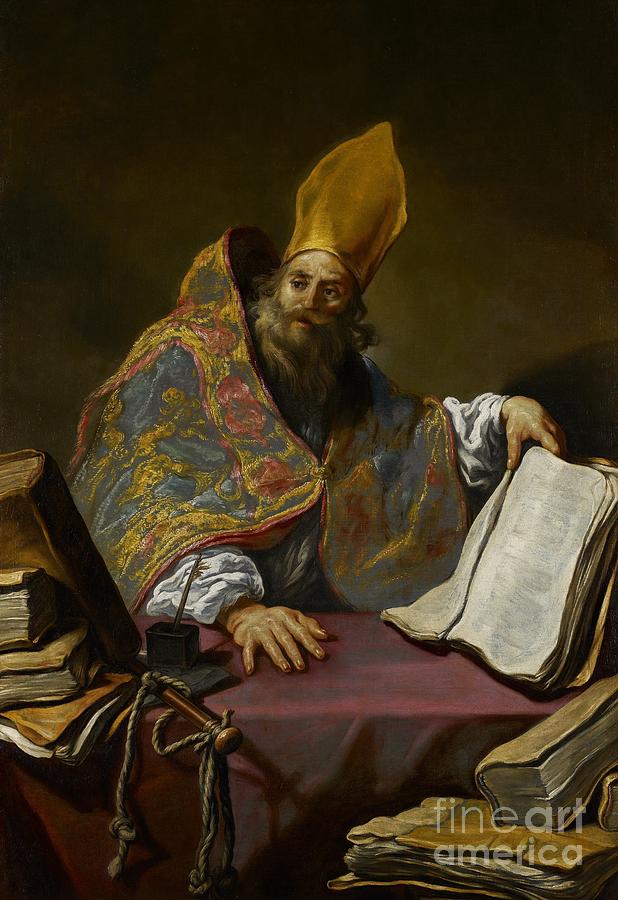
Catena Aurea by St. Thomas Aguinas
10:11–13
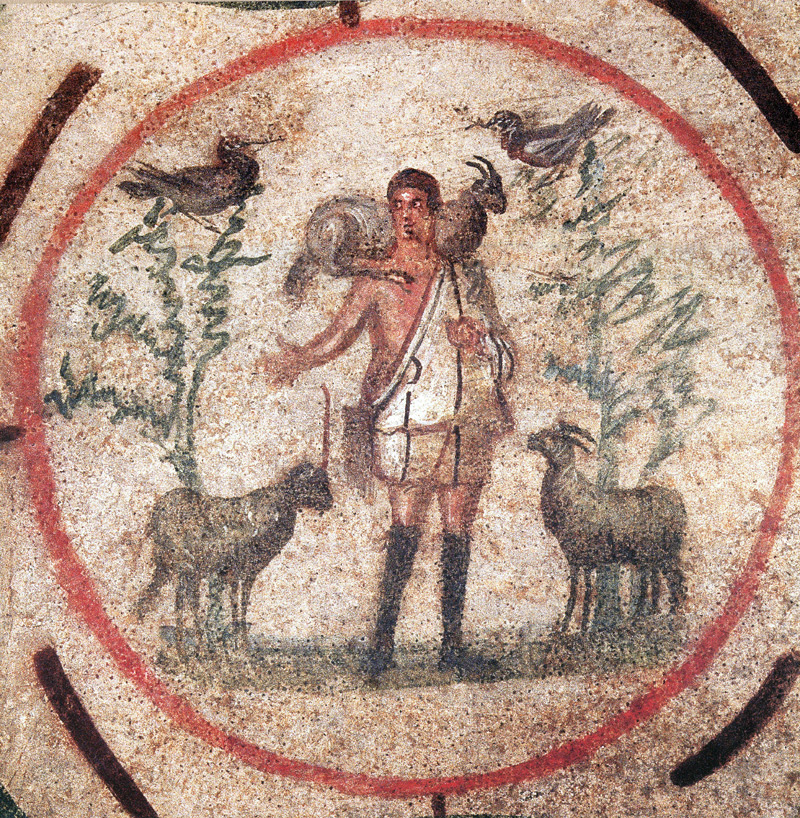
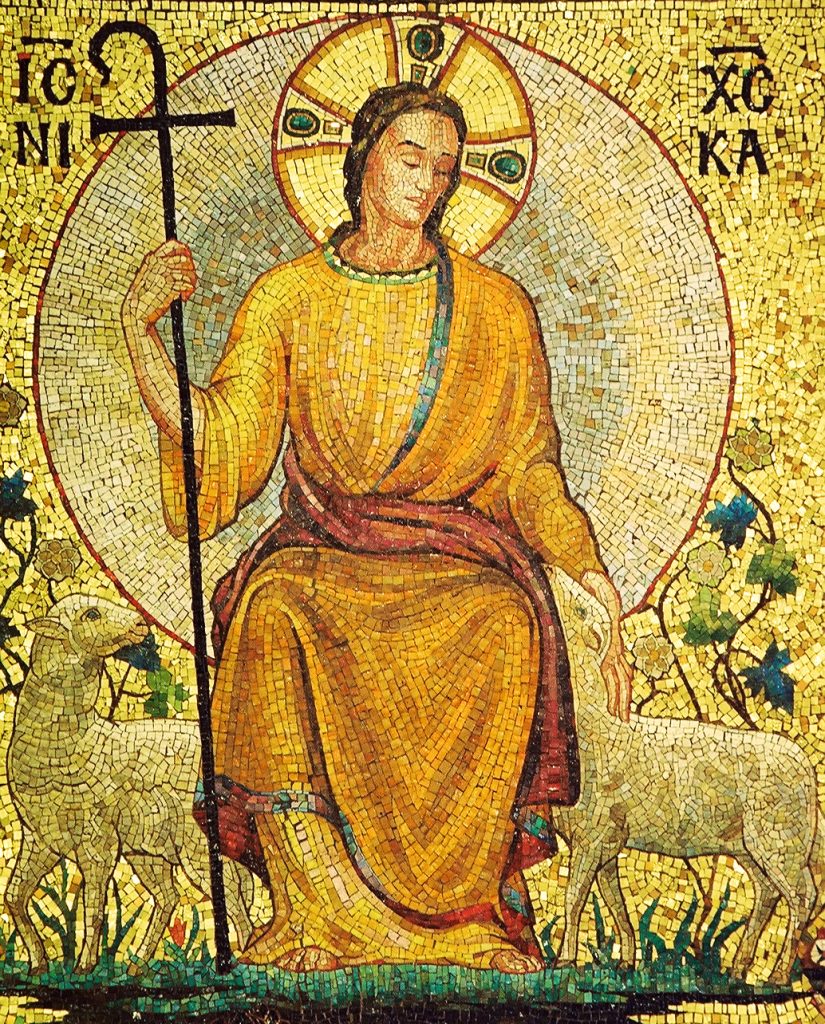
11. I am the good shepherd: the good shepherd giveth his life for the sheep.
12. But he that is an hireling, and not the shepherd, whose own the sheep are not, seeth the wolf coming, and leaveth the sheep, and fleeth: and the wolf catcheth them, and scattereth the sheep.
13. The hireling fleeth, because he is an hireling, and careth not for the sheep.
AUGUSTINE. (Tr. xlvi. 1) Our Lord has acquainted us with two things which were obscure before; first, that He is the Door; and now again, that He is the Shepherd: I am the good Shepherd. (c. xlvii. 1, 3). Above He said that the shepherd entered by the door. If He is the Door, how doth He enter by Himself? Just as He knows the Father by Himself, and we by Him; so He enters into the fold by Himself, and we by Him. We enter by the door, because we preach Christ; Christ preaches Himself. A light shews both other things, and itself too. (Tr. xlvi. 5). There is but one Shepherd. For though the rulers of the Church, those who are her sons, and not hirelings, are shepherds, they are all members of that one Shepherd. (Tr. xlvii. 3). His office of Shepherd He hath permitted His members to bear. Peter is a shepherd, and all the other Apostles: all good Bishops are shepherds. But none of us calleth himself the door. He could not have added good, if there were not bad shepherds as well. They are thieves and robbers; or at least mercenaries.
GREGORY. (Hom. xiv. in Evang.) And He adds what that goodness (forma bonitatis) is, for our imitation: The good Shepherd giveth His life for the sheep. He did what He bade, He set the example of what He commanded: He laid down His life for the sheep, that He might convert His body and blood in our Sacrament, and feed with His flesh the sheep He had redeemed. A path is shewn us wherein to walk, despising death; a stamp is applied to us, and we must submit to the impression. Our first duty is to spend our outward possessions upon the sheep; our last, if it be necessary, is to sacrifice our life for the same sheep. Whoso doth not give his substance to the sheep, how can he lay down his life for them?
AUGUSTINE. (Tr. xlvii) Christ was not the only one who did this. And yet if they who did it are members of Him, one and the same Christ did it always. He was able to do it without them; they were not without Him.
AUGUSTINE. (de Verb. Dom. Serm. 1) All these however were good shepherds, not because they shed their blood, but because they did it for the sheep. For they shed it not in pride, but in love. Should any among the heretics suffer trouble in consequence of their errors and iniquities, they forthwith boast of their martyrdom; that they may be the better able to steal under so fair a cloak: for they are in reality wolves. But not all who give their bodies to be burned, are to be thought to shed their blood for the sheep; rather against the sheep; for the Apostle saith, Though I give my body to be burned, and have not charity, it profiteth me nothing. (1 Cor. 13:3) And how hath he even the smallest charity, who does not love connexion (convictus) with Christians? to command which, our Lord did not mention many shepherds, but one, I am the good Shepherd.
CHRYSOSTOM. (Hom. lx. 5) Our Lord shews here that He did not undergo His passion unwillingly; but for the salvation of the world. He then gives the difference between the shepherd and the hireling: But he that is an hireling, and not the shepherd, whose own the sheep are not, seeth the wolf coming, and leaveth the sheep, and fleeth.
GREGORY. (Hom. in Evang. xiv.) Some there are who love earthly possessions more than the sheep, and do not deserve the name of a shepherd. He who feeds the Lord’s flock for the sake of temporal hire, and not for love, is an hireling, not a shepherd. An hireling is he who holds the place of shepherd, but seeketh not the gain of souls, who panteth after the good things of earth, and rejoices in the pride of station.
AUGUSTINE. (de Verb. Dom. Serm. xlix) He seeketh therefore in the Church, not God, but something else. If he sought God he would be chaste; for the soul hath but one lawful husband, God. Whoever seeketh from God any thing beside God, seeketh unchastely.
GREGORY. (Hom. in Evang. xiv.) But whether a man be a shepherd or an hireling, cannot be told for certain, except in a time of trial. In tranquil times, the hireling generally stands watch like the shepherd. But when the wolf comes, then every one shews with what spirit he stood watch over the flock.
AUGUSTINE. (de Verb. Dom. Serm. xlix.) The wolf is the devil, and they that follow him; according to’ Matthew, Which come to you in sheeps’ clothing, but inwardly they are ravening wolves. (Matt. 7:15)
AUGUSTINE. (Tr. xlvi. 8) Lo, the wolf hath seized a sheep by the throat, the devil hath enticed a man into adultery. The sinner must be excommunicated. But if he is excommunicated, he will be an enemy, he will plot, he will do as much harm as he can. Wherefore thou art silent, thou dost not censure, thou hast seen the wolf coming, and fled. Thy body has stood, thy mind has fled. For as joy is relaxation, sorrow contraction, desire a reaching forward of the mind; so fear is the flight of the mind.
GREGORY. (Hom. in Evang. xiv.) The wolf too cometh upon the sheep, whenever any spoiler and unjust person oppresses the humble believers. And he who seems to be shepherd, but leaves the sheep and flees, is he who dares not to resist his violence, from fear of danger to himself. He flees not by changing place, but by withholding consolation from his flock. The hireling is inflamed with no zeal against this injustice. He only looks to outward comforts, and overlooks the internal suffering of his flock. The hireling fleeth, because he is an hireling, and careth not for the sheep. The only reason that the hireling fleeth, is because he is an hireling; as if to say, He cannot stand at the approach of danger, who doth not love the sheep that he is set over, but seeketh earthly gain. Such an one dares not face danger, for fear he should lose what he so much loves.
AUGUSTINE. (Tr. xlvi. 7) But if the Apostles were shepherds, not hirelings, why did they flee in persecution? And why did our Lord say, When they persecute you in this city, flee ye into another? (Mat. 10:23) Let us knock, then will come one, who will explain.
AUGUSTINE. (ad Honor. Ep. clxxx.) A servant of Christ, and minister of His Word and Sacraments, may flee from city to city, when he is specially aimed at by the persecutors, apart from his brethren; so that his flight does not leave the Church destitute. But when all, i. e. Bishops, Clerics, and Laics, are in danger in common, let not those who need assistance be deserted by those who should give it. Let all flee together if they can, to some place of security; but, if any are obliged to stay, let them not be forsaken by those who are bound to minister to their spiritual wants. Then, under pressing persecution, may Christ’s ministers flee from the place where they are, when none of Christ’s people remain to be ministered to, or when that ministry may be fulfilled by others who have not the same cause for flight. But when the people stay, and the ministers flee, and the ministry ceases, what is this but a damnable flight of hirelings, who care not for the sheep?
AUGUSTINE. (Tr. xlvi. 1) On the good side are the door, the porter, the shepherd, and the sheep; on the bad, the thieves, the robbers, the hirelings, the wolf.
AUGUSTINE. (de Verb. Dom. s. xlix) We must love the shepherd, beware of the wolf, tolerate the hireling. For the hireling is useful so long as he sees not the wolf, the thief, and the robber. When he sees them, he flees.
AUGUSTINE. (Tr. xlvi. 5) Indeed he would not be an hireling, did he not receive wages from the hirer. (c. 6). Sons wait patiently for the eternal inheritance of their father; the hireling looks eagerly for the temporal wages from his hirer; and yet the tongues of both speak abroad the glory of Christ. The hireling hurteth, in that he doeth wrong, not in that he speaketh right: the grape bunch hangeth amid thorns; pluck the grape, avoid the thorn. Many that seek temporal advantages in the Church, preach Christ, and through them Christ’s voice is heard; and the sheep follow not the hireling, but the voice of the Shepherd heard through the hireling.
10:14–21
14. I am the good shepherd, and know my sheep, and am known of mine.
15. As the Father knoweth me, even so know I the Father: and I lay down my life for the sheep.
16. And other sheep I have, which are not of this fold: them also I must bring, and they shall hear my voice; and there shall be one fold, and one shepherd.
17. Therefore doth my Father love me, because I lay down my life, that I might take it again.
18. No man taketh it from me, but I lay it down of myself. I have power to lay it down, and I have power to take it again. This commandment have I received of my Father.
CHRYSOSTOM. (Hom. lx. 1) Two evil persons have been mentioned, one that kills, and robs the sheep, another that doth not hinder: the one standing for those movers of seditions; the other for the rulers of the Jews, who did not take care of the sheep committed to them. Christ distinguishes Himself from both; from the one who came to do hurt by saying, I am come that they might have life; from those who overlook the rapine of the wolves, by saying that He giveth His life for the sheep. Wherefore He saith again, as He said before, I am the good Shepherd. And as He had said above that the sheep heard the voice of the Shepherd and followed Him, that no one might have occasion to ask, What sayest Thou then of those that believe not? He adds, And I know My sheep, and am known of Mine. (Rom. 11:12) As Paul too saith, God hath not cast away His people, whom He foreknew.
GREGORY. (Hom. in Evang. xiv.) As if He said, I love My sheep, and they love and follow Me. For he who loves not the truth, is as yet very far from knowing it.
THEOPHYLACT. Hence the difference of the hireling and the Shepherd. The hireling does not know his sheep, because he sees them so little. The Shepherd knows His sheep, because He is so attractive to them.
CHRYSOSTOM. (Hom. lx. 1) Then that thou mayest not attribute to the Shepherd and the sheep the same measure of knowledge, He adds, As the Father knoweth Me, even so know I the Father: i. e. I know Him as certainly as He knoweth Me. This then is a case of like knowledge, the other is not; as He saith, No man knoweth who the Son is, but the Father. (Luke 10:23)
GREGORY. (Hom. in Evang. xiv.) And I lay down My life for My sheep. As if to say, This is why I know My Father, and am known by the Father, because I lay down My life for My sheep; i. e. by My love for My sheep, I shew how much I love My Father.
CHRYSOSTOM. (Hom. lx. 1) He gives it too as a proof of His authority. In the same way the Apostle maintains his own commission in opposition to the false Apostles, by enumerating his dangers and sufferings.
THEOPHYLACT. For the deceivers did not expose their lives for the sheep, but, like hirelings, deserted their followers. Our Lord, on the other hand, protected His disciples: Let these go their way. (infr. 18:8)
GREGORY. (Hom. xiv.) But as He came to redeem not only the Jews, but the Gentiles, He adds, And other sheep I have, which are not of this fold.
AUGUSTINE. (de Verb. Dom. s. 1) The sheep hitherto spoken of are those of the stock of Israel according to the flesh. But there were others of the stock of Israel, according to faith, Gentiles, who were as yet out of the fold; predestinated, but not yet gathered together. They are not of this fold, because they are not of the race of Israel, but they will be of this fold: Them also I must bring.
CHRYSOSTOM. (Hom. lx. 2) What wonder that these should hear My voice, and follow Me, when others are waiting to do the same. Both these flocks are dispersed, and without shepherds; for it follows, And they shall hear My voice. And then He foretells their future union: And there shall be one fold and one Shepherd.
GREGORY. (Hom. Evang. xiv.) Of two flocks He maketh one fold, uniting the Jews and Gentiles in His faith.
THEOPHYLACT. For there is one sign of baptism for all, and one Shepherd, even the Word of God. Let the Manichean mark; there is but one fold and one Shepherd set forth both in the Old and New Testaments.
AUGUSTINE. (Tr. xlvii. 4) What does He mean then when He says, I am not sent but unto the lost sheep of the house of Israel? Only, that whereas He manifested Himself personally to the Jews, He did not go Himself to the Gentiles, but sent others.
CHRYSOSTOM. (Hom. lx) The word must here (I must bring) does not signify necessity, but only that the thing would take place. Therefore doth My Father love Me, because I lay down My life, that I might take it again. They had called Him an alien from His Father.
AUGUSTINE. (Tr. xlvii. 7) i. e. Because I die, to rise again. There is great force in, I lay down. Let not the Jews, He says, boast; rage they may, but if I should not choose to lay down My life, what will they do by raging?
THEOPHYLACT. The Father does not bestow His love on the Son as a reward for the death He suffered in our behalf; but He loves Him, as beholding in the Begotten His own essence, whence proceeded such love for mankind.
CHRYSOSTOM. (Hom. lx. 2) Or He says, in condescension to our weakness, Though there were nothing else which made Me love you, this would, that ye are so loved by My Father, that, by dying for you, I shall win His love. Not that He was not loved by the Father before, or that we are the cause of such love. For the same purpose He shews that He does not come to His Passion unwillingly: No man taketh it from Me, but I lay it down of Myself.
AUGUSTINE. (iv. de Trin. c. xiii.) Wherein He shewed that His natural death was not the consequence of sin in Him, but of His own simple will, which was the why, the when, and the how: I have power to lay it down.
CHRYSOSTOM. (Hom. lx. 2) As they had often plotted to kill Him, He tells them their efforts will be useless, unless He is willing. I have such power over My own life, that no one can take it from Me, against My will. This is not true of men. We have not the power of laying down our own lives, except we put ourselves to death. Our Lord alone has this power. And this being true, it is true also that He can take it again when He pleases: And I have power to take it again: which words declare beyond a doubt a resurrection. That they might not think His death a sign that God had forsaken Him, He adds, This commandment have I received from My Father; i. e. to lay down My life, and take it again. By which we must not understand that He first waited to hear this commandment, and had to learn His work; He only shows that that work which He voluntarily undertook, was not against the Father’s will.
THEOPHYLACT. He only means His perfect agreement with His Father.
ALCUIN. For the Word doth not receive a command by word, but containeth in Himself all the Father’s commandments. When the Son is said to receive what He possesseth of Himself, His power is not lessened, but only His generation declared. The Father gave the Son every thing in begetting Him. He begat Him perfect.
THEOPHYLACT. After declaring Himself the Master of His own life and death, which was a lofty assumption, He makes a more humble confession; thus wonderfully uniting both characters; shewing that He was neither inferior to or a slave of the Father on the one hand, nor an antagonist on the other; but of the same power and will.
AUGUSTINE. (Tr. xlvii) How doth our Lord lay down His own life? Christ is the Word, and man, i. e. in soul and body. Doth the Word lay down His life, and take it again; or doth the human soul, or doth the flesh? If it was the Word of God that laid down His soul1 and took it again, that soul was at one time separated from the Word. But, though death separated the soul and body, death could not separate the Word and the soul. It is still more absurd to say that the soul laid down itself; if it could not be separated from the Word, how could it be from itself? The flesh therefore layeth down its life and taketh it again, not by its own power, but by the power of the Word which dwelleth in it. This refutes the Apollinarians, who say that Christ had not a human, rational soul.
Catena Aurea John 10
ST AMBROSE, BISHOP CONFESSOR, DOCTOR OF THE CHURCH(A.D. 397)Feast: December 7
[From his works, and his short life written at the request of St. Austin, by Paulinus, who was his deacon and secretary at the time of his death, and was afterwards promoted to the priesthood. See also the Church historians of that age, and the histories of his life compiled by Hermant, Tillemont, Rivet, Hist. Litter. de la France, t. i. part 2, p. 325; Vagliano, Sommario de Gliarcivescovi di Milano; and du Frische and Nic. Ie Nourri, the two Maurist Benedictin editors of his works, in 1686, at the end of the second and last volume. See also Archiepiscoporum Mediolanensium Series Critico-Chronologica, Auctore Jos. Saxio. Bibl. Ambrosianae praefecto. Anno 1756.]
An invincible courage and constancy in resisting evil is a necessary ingredient of virtue, especially in the episcopal character. Gentleness, meekness, humility, and obedience, make the servant of God ready to yield and conform himself to everyone in things indifferent; but in those of duty he is inflexible, not with willfulness or obstinacy, but with modesty, yet invincible firmness. Of this virtue St. Ambrose, in the judgment of the learned Hermant, was the most admirable model among all the great pastors of God's church since the Apostles. His father, whose name was also Ambrose, was prefect of the praetorium in Gaul, by which office not only France, but also a considerable part of Italy and Germany, the five Roman provinces in Britain, eight in Spain, and Mauritania Tingitana, in Africa, were under his jurisdiction. He was blessed with three children: Marcellina, the eldest, who received the religious veil from the hands of Pope Liberius, Satyrus, and our saint, who bore his father's name. It is clear, from Paulinus, that he was born in the city where his father resided and kept his court in Gaul, but whether this was Arles, Lyons, or Triers, modern authors are not agreed in their conjectures. The saint's birth happened about the year 340. Whilst the child lay asleep in one of the courts of his father's palace, a swarm of bees flew about his cradle and some of them crept in and out of his mouth, which was open; at last they mounted up into the air so high that they quite vanished out of sight. This was esteemed a presage of future greatness and eloquence The like is said to have happened to Plato. The father of St. Ambrose dying whilst he was yet an infant, his mother left Gaul and returned to Rome, her own country. She took special care of the education of her children, and Ambrose profited much by her instructions, and by the domestic examples which she, his sister, and other holy virgins that were with them, set him. He learned the Greek language, became a good poet and orator, and went with his brother Satyrus from Rome to Milan, which was then the seat of the praetorium, or supreme court of judicature. His writings are, to this day, a standing proof how vigorously he applied himself to human literature. Having finished his studies he was taken notice of, and his friendship was courted by the first men of the empire, particularly by Anicius Probus and Symmachus, two persons of great learning and abilities, though the latter was an idolater. The first was made by Valentinian in 368, praetorian prefect of Italy, and in his court St. Ambrose pleaded causes with so much reputation that Probus made choice of him to be his assessor. Afterwards he made him Governor of Liguria and Aemilia, that is, of all that country which comprehends at this day the archbishoprics with the suffragan dioceses of Milan, Turin, Genoa, Ravenna, and Bologna. Probus, who was a magistrate of great worth and integrity, said to him at parting. "Go thy way, and govern more like a bishop than a judge." The young governor, by his watchfulness, probity, and mildness, endeavoured to comply with this advice, which was most conformable to his natural goodness and inclinations. Auxentius, an Arian, and a violent and subtle persecutor of the Catholics, who, upon the banishment of St. Dionysius, had usurped the see of Milan and held it tyrannically for almost twenty years, died in 374. The city was distracted by furious parties and tumults about the election of a new bishop-some of the clergy and people demanding an Arian, others a Catholic for their pastor. To prevent an open sedition, St. Ambrose thought it the duty of his office to go to the church in which the assembly was held; there he made an oration to the people with much discretion and mildness, exhorting them to proceed in their choice with the spirit of peace and without tumult. While he was yet speaking, a child cried out, "Ambrose Bishop." This the whole assembly took up, and both Catholics and Arians unanimously proclaimed him Bishop of Milan. This unexpected choice surprised him; he presently withdrew, and made use of all the artifices he could to shun this charge. He ascended the bench of justice, and affecting to seem cruel and unworthy of the priesthood, caused certain criminals to be brought before him and put to the torture. The people, perceiving all the stratagems he made use of to be effected, continued still in their choice. Whereupon he stole out of the city by night with a design to retire to Pavia; but, missing his way, he wandered up and down all night and found himself next morning at the gates of Milan. His flight being known, a guard was set upon him, and a relation of all that had passed was sent to the emperor, whose consent was necessary that an officer in his service should be chosen bishop. Ambrose wrote also to him on his own behalf, that he might be excused from that office. Valentinian, who was then at Triers, answered the clergy and people, that it gave him the greatest pleasure that he had chosen governors and judges who were fit for the episcopal office; and at the same time he sent an order to the vicar, or lieutenant of Italy, to see that the election took place. In the meantime Ambrose once more made his escape and hid himself in the house of Leontius, one of those senators who had the title of Clarissimi; but the vicar of Italy having published a severe order against anyone who should conceal him or who, knowing where he was, should not discover him, Leontius by an innocent kind of treachery declared where he was. Ambrose finding it in vain to resist any longer, yielded himself up; but insisted that the canons forbade anyone who was only a catechumen to be promoted to the priesthood. He was answered, that such ecclesiastical canons may be dispensed with on extraordinary occasions. Ambrose therefore was first baptized, and after due preparation, received the episcopal consecration on the 7th of December in 374, not in 375, as some have wrote; for Valentinian I died on the 10th of November in 375. St. Ambrose was about thirty-four years old when he was ordained bishop.
He was no sooner placed in the episcopal chair but, considering that he was no longer a man of this world and resolving to break all ties which could hold him to it, he gave to the church and the poor all the gold and silver of which he was possessed. His lands and estates he gave also to the church, reserving only an income for the use of his sister Marcellina during her life. The care of his family and temporalities he committed to his brother Satyrus that, being disengaged from all temporal concerns, ho might give himself up wholly to his ministry and prayer. So perfectly did he renounce the world, and his mind dwelt so much above it, that temptations to riches and honours never had any weight with him. Soon after his ordination he wrote to the Emperor Valentinian severe complaints against some of the imperial judges and magistrates. To which the emperor replied, "I was long since acquainted with your freedom of speech, which did not hinder me from consenting to your ordination. Continue to apply to our sins the remedies prescribed by the divine law." St. Basil also wrote to him to congratulate with him, or rather with the church, upon his promotion, and to exhort him vigorously to oppose the Arians and to fight a good fight.[1] St. Ambrose first applied himself to study the scriptures and to read ecclesiastical writers, particularly Origen and St. Basil. In his studies he put himself under the conduct and instruction of Simplicianus, a learned and pious Roman priest whom he loved as a friend, honoured as a father, and reverenced as a master. This Simplicianus succeeded him in the archbishopric of Milan, and is honoured among the saints on the 16th of August. Whilst St. Ambrose studied he neglected not from the beginning assiduously to instruct his people. He purged the diocese of Milan of the leaven of the Arian heresy with such wonderful success that, in the year 385, there remained not one citizen of Milan infected with it except a few Goths and some persons belonging to the imperial family, as he assures us.[2] His instructions were enforced by an admirable innocence and purity of manners, prayer, rigorous abstinence, and a fast which he kept almost every day; for he never dined except on Sundays, the feasts of certain famous martyrs, and all Saturdays, on which it was the custom at Milan never to fast; but when he was at Rome he fasted on Saturdays. To avoid the danger of intemperance he excused himself from going to banquets or great tables, and entertained others at his own with great frugality. He spent a considerable part both of the day and of the night in devout prayer; and every day offered the holy sacrifice of the altar for his people.[3] He devoted himself entirely to the service of his flock, and of every state and condition in it; one laborious employment serving for relaxation from another, he allowed himself no moments for amusement. He relieved the poor, comforted the afflicted, and hearkened to all men with meekness and charity, so that all his people loved and admired him. It-was an inviolable rule with him never to have any hand in making matches, never to persuade anyone to serve in the army, and never to recommend persons to places at court. He had a soul exquisitely tender and compassionate, and he often employed his interest to save the lives of condemned persons. He wept with those that wept, and he rejoiced with those that rejoiced. His charity was as extensive as the necessities of human nature, and he styled the poor his stewards and treasurers, in whose hands he deposited his revenues. It was his constant care and practice to do good for evil, and to requite affronts and injuries by offices of kindness. His chamber was for the greatest part of the day filled with persons who came to consult him, and to ask his private advice. St. Austin, when he came to visit him, always found him so overwhelmed with such business, or so intent in the few moments he was able to steal to himself, that he often went into his chamber and, after some stay, came out again without being perceived by the holy bishop whom, out of mere pity, he durst not interrupt.
Our holy bishop, in his discourses, frequently enlarged very much on the praises of the holy state and virtue of virginity. By his exhortations many virgins who came from Bologna, Placentia, and even Mauritania, served God in this state under his direction. He had been bishop only two years when, at the request of his sister Marcellina, he committed to writing what he had delivered from the pulpit in commendation of that holy state.[4] This he executed in his three books, On Virgins, or On Virginity, written in the year 377 and penned with singular elegance, for which they are justly admired by St. Jerome and St. Austin, though the sincere piety which the language everywhere breathes, deserves chiefly the reader's attention. He enlarges on the excellency of virginity, and shows the spiritual advantages of that state. In the third book he prescribes the principal duties of those who have embraced it, ordering them to be abstemious, to shun visits, and apply themselves to spiritual exercises and reflection, to pray often in the day, and to repeat the Lord's Prayer and the Psalms in bed before they sleep, and when they awake; and to recite every morning the creed as the seal of our faith. He adds that they ought to weep and to shun excessive mirth, particularly dancing, on which he mentions the fatal consequences of the dancing of Herodias's daughter. St. Ambrose mentions[5] that there were twenty virgins at Bologna, and that they laboured with their own hands, not only that they might gain a subsistence, but that they might also have wherewithal to bestow in charity. St. Marcellina, who received the veil from Pope Liberius in the Church of St. Peter at Rome, on Christmas Day,[6] did not live in a society of virgins, but with her relations in Rome. Many other consecrated virgins did the same at that time; but they had a part of the church to themselves, separated from the rest by boards; and on the walls were written sentences of the scripture for their instruction.[7] St. Ambrose wrote his treatise, Of Widows, soon after the former work, to exhort them to perpetual chastity. This was soon followed by that On Virginity, which he compiled to give us, from the holy scriptures, a high idea of that virtue; but he adds a most necessary caution, that the veil is not to be given rashly to young virgins, especially such as are of a light unconstant behaviour. "Some complain," says he, "that mankind will shortly fail if so many are consecrated virgins. I desire to know who ever wanted a wife and could not find one? The killing of an adulterer, the pursuing or waging war against a ravisher, are the consequences of marriage. The number of people is greatest where virginity is most esteemed. Inquire how many virgins are consecrated every year at Alexandria, all over the East, and in Africa, where there are more virgins than there are men in this country." May not the French and Austrian Netherlands, full of numerous monasteries, yet covered with populous cities, be at present esteemed a proof of this remark? The populousness of China, where great numbers of newborn infants are daily exposed to perish, is a dreadful proof that the voluntary virginity of some in these remote ages of the world is no prejudice. Wars and the sea, not the number of virgins, are the destroyers of the human race, as St. Ambrose observes; though the state of virginity is not to be rashly engaged in, and marriage is not only holy, but the general state of mankind in the world. St. Ambrose's book, entitled The Institution of a Virgin, contains a confutation of Bonosus, who renewed the error of Helvidius, denying the perpetual virginity of the Holy Mother of God. The saint adds the instructions he had given to Ambrosia, one of the twenty virgins at Bologna who served God under his direction: he shows that retirement, silence, humility, and prayer are the principal duties of a Christian virgin. Towards the end the ceremonies of the solemn profession of a virgin are described. She presented herself at the foot of the altar, where she made her profession before the people; the bishop preached to her and gave her the veil which distinguished her from other virgins; but her hair was not cut, as was done in the initiation of clergymen and monks. In the close the author invites Jesus Christ to come on the day of these spiritual nuptials to receive his handmaid, who consecrates herself to him by a public profession, after having long before dedicated herself to him in spirit and in her heart.
Gratian, by the death of Valens, became master of the eastern empire; but, seeing it attacked on all sides by triumphant barbarians, sent thither Theodosius, a general of great probity and velour who, with his father, a virtuous general of the same name, had triumphed over the barbarians in Britain and Africa; but the father, out of mere jealousy, being unjustly put to death by Valens, the son had led from that time a retired life in Spain. Theodosius vanquished the Goths, pacified the whole empire, and made excellent regulations in all the provinces under his command, insomuch that, on the 16th of January 379, Gratian gave him the purple and crown at Sirmich in presence of their two armies, and declared him his colleague and Emperor of the East, giving him Thrace and all that Valens had possessed, and also the eastern part of Illyricum of which Thessalonica was then the capital. The Goths had extended their ravages from Thrace into Illyricum and as far as the Alps. St. Ambrose, not content to lay out all the money he could raise in redeeming the captives, employed for that use the gold vessels belonging to the church, which he caused to be broken and melted down; but such only as were not yet consecrated, reserving those which were for a more pressing necessity.[8] The Arians reproached him upon this account; to whom he answered, that he thought it much more expedient to save the souls of men than gold: for not only the lives of the captives and the honour of the women were preserved, but the children were rescued from being educated in idolatry. "I find," said he, "that the blood of Jesus Christ poured out in the gold plate, hath not only shone therein, but hath also impressed upon it the virtue of redemption." Many Arians who, upon that occasion fled from Illyricum into Italy, were converted to the faith by the care of St. Ambrose, who was indefatigable in every branch of his pastoral charge. Every Lent he bestowed so much pains and labour in instructing the catechumens that, when he died, five bishops could hardly go through with that which he used himself to perform.[9]
In 379 St. Ambrose lost his brother Satyrus, to whom he had committed the care of all his temporal affairs. Satyrus, attempting to go to Africa to recover some money due to his brother, was shipwrecked; and, not being baptized, desired some that were there to give him the holy mysteries, that is, the blessed eucharist, to carry with him; for the faithful carried it on long voyages that they might not die deprived of it. As none but those who were baptized were allowed even to have a sight of it, Satyrus begged them to wrap it in an orarium, which was a kind of long handkerchief at that time worn by the Romans about their necks. This he wrapped about him and threw himself into the sea, without seeking a plank to support him; yet by swimming he was the first who came to land. It seems to have been in the isle of Sardinia. Satyrus, being then a catechumen, addressed himself to the bishop of the place in order to be immediately baptized; but first asked him whether he was in communion with the Catholic bishops, that is, with the Church of Rome, says St. Ambrose; and finding that he took part in the schism of Lucifer, he chose rather to venture again upon the sea than to receive baptism from a schismatic. When he arrived in a Catholic country he was baptized, the grace of which sacrament he never forfeited, as his brother affirms. Satyrus died soon after his return to Milan, in the arms of St. Ambrose and St. Marcellina, and left his wealth to be disposed of by them without making a will. They thought he had only made them stewards of it, and gave it all to the poor.
The funeral of Satyrus was performed with great solemnity, at which St. Ambrose made an oration, which is extant, from which these particulars are taken.[10] The seventh day after, they returned to the grave to repeat the solemn obsequies, as was usual; and St. Ambrose made there another discourse, in which he expatiated on the happiness of death and the belief of the resurrection; on which account it is often called, A Discourse on the Resurrection. The church commemorates St. Satyrus on the 17th of September.
In 381 St. Ambrose held a council at Milan, against the heresy of Apollinaris; and assisted at another at Aquileia, in which he procured the deposition of two Arian bishops named Palladius and Secundianus. In a journey which he made to Sirmich, he compassed the election of a Catholic bishop to occupy that see, notwithstanding the intrigues of the Empress Justina in favour of an Arian candidate. In 382 our saint assisted at a council which Pope Damasus held at Rome in order to apply a remedy to the divisions which reigned in the oriental church about the see of Antioch. Paulinus relates, that whilst he continued there, a certain woman that kept a public bath and lay bedrid of a palsy, caused herself to be conveyed in a chair to the place where the holy bishop said mass, and importuned him to intercede with heaven for her; and while he was praying and laying his hands upon her, she caught hold of his garments and, kissing them, found her strength return and rose up and walked.
The Emperor Gratian was chaste, temperate, mild, beneficent, and a zealous Catholic; and St. Ambrose obtained of him, among other wholesome laws, one by which, to prevent surprises in condemning accused persons, it was enacted that no one should be executed sooner than thirty days after sentence. He prevailed with the same prince to remove the altar of victory out of the senate-house, which-Julian the Apostate had restored. Yet this emperor gave too much of his time to hunting, shooting of beasts In a park, casting the javelin, and other such corporal exercises, making an employment of a recreation, in which idleness his governors and ministers entertained him, that they might remain masters of affairs. Hence he did not sufficiently attend to business and look into the conduct of his officers; and Macedonius, prefect of the pratorium, was a man openly addicted to bribery. Complaints which were raised, alienated the affections of many; and Maximus, an accomplished general who commanded the troops in Britain (where Theodosius had formerly been his colleague, who was then become Emperor of the East), assumed the purple and passed with his army into Gaul. Gratian left Triers upon his approach and near Lyons a battle was fought, which continued five days, till Gratian, perceiving part of his army deserting him, fled with three hundred horse. Andragathius, general of Maximus's horse, contrived the following, stratagem: He was carried in a close horse-litter, and it was given out that it was the empress who was coming to her husband. Gratian passed the Rhone to meet her; but when he came near, the general leaped out of the litter and stabbed him. This happened on the 25th of August in 383. Gratian lamented with his expiring breath that his father Ambrose was not with him. Maximus after this ranged at pleasure, treated those of Gratian's party with great severity, and threatened to cross the Alps and attack Valentinian II, Gratian's half-brother, who resided at Milan with his mother Justina. To prevent this danger the empress dispatched St. Ambrose upon an embassy to Maximus. The saint, by the gravity of his person, the authority of his office, his humble address, and eloquent insinuations, stopped the usurper in his march, and at length concluded with him a treaty, by which Maximus was to enjoy Gaul, Britain, and Spain, and Valentinian Italy with the rest of the West. St. Ambrose passed the winter with Maximus at Triers in 384; and had the courage constantly to refuse to communicate with a tyrant who was stained with the blood of his master, and to exhort him to do penance. In these times of confusion the Gentiles at Rome attempted to restore the abolished rites of their superstition. At their head appeared Quintus Aurelius Symmachus, a senator of great eminence, an admirable scholar, statesman, and orator at that time prefect of Rome. In autumn, in the year 384, this man presented a request to Valentinian, in the name of the senate, begging that the altar of victory might be re-established in the senate-house, and the salaries restored to the priests and vestal virgins; to which he ascribed the victories and prosperity of ancient Rome. A like petition had been before presented to Gratian in 382, but was disavowed by the Christian senators (who were the greater number), and rejected by that prince. St. Ambrose, having privately received notice of Symmachus's petition, wrote against it two beautiful apologies or letters to Valentinian, in which even his eloquence seems superior to that of the pagan, who was esteemed the greatest orator of his age. In the first he desired that a copy of Symmachus's petition should be communicated to him, remonstrating at the same time to the emperor, that as all the subjects of the Roman empire ought to submit to him, so he was obliged to obey the only true God, and to defend the religion of Christ; that he could never concur to idolatry; and the church or bishops would never receive oblations from him who had given ornaments to the temples of idols; his gifts cannot be presented on the altar of Jesus Christ who hath made an altar for false gods, &c.[11] In the second the saint confuted all that was alleged in the petition.[12] These apologies being read in the council in presence of the emperor, he answered the Gentiles, that he loved Rome as his mother, but obeyed God as the author of his salvation.
The Empress Justina, though an Arian, durst not openly espouse the interest of her sect during the lives of her husband, Valentinian I, and of Gratian. But the peace which St. Ambrose had procured between Maximus and her son gave her an opportunity to persecute the Catholics, especially the holy bishop-for she ungratefully forgot the obligations which she and her son had to him. When Easter was near at hand, in 385, she sent to him certain ministers of state to demand of him the Portian basilica, now called St. Victor's, without the city, for the use of the Arians, for herself, her son, and many officers of the court. The saint replied that he could never give up the temple of God. By other messengers of the first rank she afterwards demanded the new basilica; then again insisted on having at least the former; but the bishop was inflexible. Certain deans, or officers of the court, were sent to take possession of the Portian basilica, by hanging up in it imperial escutcheons. The citizens, enraged at this violence, seized in the street an Arian priest called Castulus. St. Ambrose being informed of this whilst he was at the altar, wept bitterly, prayed that God would suffer no blood to be shed, and sent out certain priests and deacons who delivered the Arian priest. The court, to punish the citizens for this commotion, taxed them two hundred pounds weight in gold. They answered that they were willing to pay as much more, provided they might be allowed to retain the true faith. Certain counts and tribunes came to summon St. Ambrose to deliver up the basilica, saying the emperor claimed it as his right. The bishop answered, "Should he require what is my own, as my land or my money, I would not refuse him, though all that I possess belongs to the poor; but the emperor has no right to that which belongs to God. If you require my estate, you may take it; if my body, I readily give it up; have you a mind to load me with irons, or to put me to death, I am content. I shall not fly to the protection of the people, nor cling to the altars: I choose rather to be sacrificed for the sake of the altars."[13] St. Ambrose continued all that day in the old basilica; but at night went home to his house, that if they designed to seize him, they might readily find him. The next morning, which was Wednesday, he went out before day to the old basilica, which was immediately surrounded with soldiers. A troop of soldiers was sent to seize on the new church; but St. Ambrose sent certain priests thither to officiate, and they threatened the soldiers with excommunication if they offered any violence; and they came into the church and prayed peaceably, being Catholics. In the evening St. Ambrose preached on patience. After the sermon a secretary arrived from the court, who, calling the bishop aside, made him severe reproaches, and told him that he set himself up for a tyrant. The bishop replied, "Maximus, who complains that by my embassy I stopped him from marching into Italy, says not that I am the tyrant over Valentinian. Bishops never set themselves up for tyrants, but have often suffered much from tyrants." The Catholics spent all that day in sorrow; and the basilica being surrounded with soldiers, St. Ambrose could not return home to his own house; but passed the night in reading psalms with his brethren in the little basilica of the church, or in some oratory in the outer buildings. The next day, which was Maundy Thursday, St. Ambrose prayed and preached to the people, till news was brought him that the emperor had withdrawn the soldiers from the basilica, and had restored to the merchants and citizens the mulct which he had imposed upon them: upon which all joined in joy and thanksgiving. St. Ambrose gave an account of these transactions to his sister Marcellina, who was then at Rome, and had earnestly begged it of him. At the conclusion of this relation, he adds that he foresees greater commotions. After this he says, "The eunuch Calligonus, high chamberlain, said to me, 'Thou despisest Valentinian whilst I am yet living; I will cut off thy head.' To which I replied, 'May God permit me so to suffer; then I shall suffer as a bishop, and you will act a part becoming a eunuch or a courtier. I beseech God that all the enemies of the church may cease persecuting her, and level all their shafts at me, to quench their thirst with my blood.'"[14] Soon after Calligonus was convicted of a heinous crime and beheaded.
The empress was still more exasperated against St. Ambrose by the resistance of the people; and persuaded her son to make a law for authorizing the religious assemblies of the Arians, which was published on the 3rd of January 386.[15] The true author of this law was Mercurinus, whom the Arians made Bishop of Milan for those of their sect, and who took the name of Auxentius II. In consequence of this law, which forbade anyone under pain of death to oppose the religious assemblies of Arians, no one could so much as advise or present a petition against a church being yielded up to them without incurring the danger of being proscribed or put to death.[16] The empress, therefore, in the following Lent, in 386, again demanded of St. Ambrose the Portian basilica. The holy prelate answered, "Naboth would not give up the inheritance of his ancestors, and shall I give up that of Jesus Christ? God forbid that I should abandon that of my fathers, of St. Dionysius, who died in exile for the defence of the faith; of St. Eustorgius, the confessor; of St. Miroclus, and of all the other holy bishops, my predecessors." Dalmatius, a tribune and notary, came to St. Ambrose from the emperor with an order that he should choose his judges at court, as Auxentius had done on his side, that his and Auxentius's cause might be tried before them and the emperor; which if he refused to do, he was forthwith to retire and yield up his see to Auxentius. The saint took the advice of his clergy and of some Catholic bishops, who were then at Milan; then wrote his answer to the emperor, wherein, amongst other things, he says, "Who can deny that, in causes of faith, the bishops judge Christian emperors? so far are they from being judged by them. Would you have me choose lay judges, that if they maintain the true faith, they may be banished or put to death? Would you have me expose them either to a prevarication or to torments? Ambrose is not of that consequence for the priesthood to be debased and dishonoured for his sake. The life of one man is not to be compared with the dignity of all the bishops. If a conference is to be held about the faith, it belongs to the bishops to hold it, as was done under Constantine, who left them the liberty of being judges." After sending this remonstrance to the emperor, signed by his own hand, St. Ambrose retired into the church, where he was for some time guarded by the people, who stood within doors night and day lest he should be carried away by violence; and the church was soon surrounded by soldiers sent from court, who suffered people to go in, but no one to come out. St. Ambrose being thus shut up with the people, preached often to them. One of those sermons, which he made on Palm Sunday, is extant, under this title: "On not delivering up the Basilicas." In it he says, "Are you afraid that I would forsake you, to secure my own life? But you might have observed by my answer, that I could not possibly forsake the church, because I fear the Lord of the whole world more than the emperor; that if they carry me by force from the church, they may draw away my body, but they can never separate my mind from it: that if he proceeds against me as a prince, I will suffer as a bishop. Why then are you troubled? I shall never quit you voluntarily; but I can never resist or oppose violence. I can sigh and lament: I can weep and groan. But tears are my only arms against swords, soldiers, and Goths. Bishops have no other defence. I cannot, I ought not to resist any other ways. But as to flying away and forsaking my church, that I will never do. The respect which I have for the emperor does not make me yield cowardly: I offer myself willingly to torments, and fear not the mischiefs they threaten me with...." The saint spoke with an astonishing intrepidity of the sword, fire, or banishment, detected boldly the impiety of Auxentius, and other Arian persecutors, and called their new law a flying sword sent over the empire to kill some by corporal death, others in their souls by the guilt of sacrilege What he mentioned of the chariot is explained by Paulinus, who relates that one Euthymius had placed a chariot at a house near the church, that he might take away St. Ambrose with greater ease and carry him into banishment. But a year after he was himself put into the same chariot, and carried from that very house into banishment; under which misfortune St. Ambrose furnished him with money and other necessaries for his journey This historian mentions several other stratagems laid during this time to take or kill the servant of God, and says that one came with a sword to the chamber of St. Ambrose in order to murder him; but that, lifting up his hand with the naked sword, his arm remained extended in the air motionless, till he confessed that Justina had sent him upon that errand, and upon his repentance he recovered the use of the arm. When St. Ambrose had remained several days in the church and adjacent buildings within its inclosure, with the people who kept the doors shut, and guarded the passes, the guards were removed and he returned to his house.
St. Ambrose mentions[17] that the Arians reproached him with leading the people into error by singing hymns; and he allows that by hymns he taught them to testify their faith in the Trinity. To comfort his people under this persecution he encouraged them to assiduity in singing the hymns and anthems which he composed. Psalms were always sung throughout the whole church; but St. Ambrose seems first to have established at Milan the custom which he learned from the oriental churches, of singing psalms alternately by two choirs,[18] which spread from Milan to all the churches of the west. God gave a visible consolation to this saint and his afflicted flock in the very heat of the persecution by the discovery of the relics of SS. Gervasius and Protasius, of which he gives an account in a letter to his sister.[19] These relics were laid in the Faustinian basilica, and the next morning were translated into the Ambrosian basilica; during which translation a blind man named Severus, a butcher by trade, was cured by touching the bier on which the relics lay with a handkerchief, and then applying it to his eyes. He had been blind several years, was known to the whole city, and the miracle was performed before a prodigious number of people; and is testified also by St. Austin,[20] who was then at Milan, in three several parts of his works, and by Paulinus in the life of St. Ambrose. Our saint made two sermons on the occasion of this translation, in which he speaks of this and other miracles wrought by the holy relics, by which he assures us that many possessed persons were delivered and many sick healed. St. Austin[21] and Paulinus say, that an end was put to the persecution of St. Ambrose by the discovery of these relics in 386. The Arians indeed at court pretended that St. Ambrose had suborned men to feign themselves possessed; which calumny he confutes in the second of these sermons by the notoriety and evidence of the facts, which was such as to put the Arians to silence, and to oblige the empress to let St. Ambrose remain in peace. Dr. Middleton revives the slanders of the Arians, pretending these miracles to be juggle and imposture. But Dr. Cave[22] mentions the miraculous cure of Severus, and the many other miracles wrought by those relics, and by the towels and handkerchiefs laid upon the bodies as incontestable, attested by St. Ambrose in sermons preached upon the spot before the relics. This learned Protestant critic adds, "The truth of which miracles is abundantly justified by St. Ambrose, St. Austin, and Paulinus, who were all then upon the place; and indeed they were notoriously evident to the whole city, and twice the subject of St. Ambrose's sermons. I make no doubt but God suffered these to confront the Arian impieties, and to give the highest attestation to the Catholic cause, so mightily at this time opposed, traduced, and persecuted." Maximus, who had been then acknowledged emperor both by Valentinian and Theodosius in solemn treaties, wrote to Valentinian, exhorting him not to persecute the Catholic Church, as Sozomen and Theodoret testify. "All Italy," said he, "Africa, Gaul, Aquitain, and Spain; and, in short, Rome, which holds the first rank in religion, as well as in empire, maintain this faith."
In the year 387 news daily came to Milan of the preparations Maximus was making to invade Italy. Ambition is restless and insatiable. Maximus thought Britain, Gaul, and Spain, which he possessed in peace and without danger of being molested, as nothing, so long as he was not master of Italy: and the astonishing success of his usurpation made him only enlarge his views further, and think more due to him. Valentinian and his weak mother were in no condition to oppose him, and in this distress they had again recourse to St. Ambrose, whom they besought to stand in the gap and venture on a second embassy to stop the march of a prosperous usurper. The good bishop, burying the memory both of public and private injuries, readily undertook the journey, and arriving at Triers, the next day went to court. Maximus refused to admit him to an audience but in public consistory, though the contrary was a customary privilege both of bishops and of all imperial ambassadors. St. Ambrose made a remonstrance upon this account, but chose rather to recede from his dignity, than not execute his commission. He therefore was introduced into the consistory, where Maximus was seated on a throne, who rose up to give him a kiss, according to the custom of saluting bishops and great men in those times. But Ambrose stood still among the counsellors, though they persuaded him to go near the throne, and the emperor called him. Maximus reproached him with having deceived him in his former embassy, by preventing him from entering Italy at a time when nothing could have opposed him. St. Ambrose said he was come to justify himself, though it was glorious to have saved the life of an orphan prince: but that he could not have opposed the march of his legions, or shut up the Alps with his body, and that he had not deceived him in anything; only when Maximus insisted that Valentinian should come to him, he had pleaded that it was not reasonable that a child should cross the Alps in the depth of winter. He added that Valentinian had sent Maximus's brother, whom he saw there present, safe to him, when he could have sacrificed him to his passion, when the news of the bloody assassination of his brother Gratian was brought to him; but he conquered his resentment, and scorned to pay like for like. The bishop reproved Maximus for the murder of Gratian, and of many great men whom he had put to death for no other crime than their fidelity to their natural prince; for which he admonished him to do penance. He also entreated him to give up the body of Gratian to Valentinian, a brother dead for his own brother whom he had received alive and unhurt; the ashes of an emperor only that he might not be deprived of the honour of a burial. The tyrant answered that he would consider of it; but he was extremely incensed at St. Ambrose, because he constantly refused to communicate either with the tyrant or with any of his bishops; these were the Ithacians, who desired the death of the Priscillianist heretics. When he was inflexible on this point he was ordered forthwith to depart. Seeing Hyginus, an aged bishop, sent at the same time into banishment, he interceded that he might be furnished with necessary provisions, and not sent without a garment to cover him or a bed to lie on. But St. Ambrose could not be heard, and was himself thrust out of doors. He therefore returned to Milan and wrote to Valentinian an account of his unsuccessful embassy, advising him to be cautious how he treated with Maximus, a concealed enemy, who pretended peace, but intended war.[23] The event showed the truth of this conjecture. For Valentinian sent Domninus, a favourite courtier, to succeed St. Ambrose in this embassy. Maximus entertained him with all the obliging caresses and demonstrations of honour, amused him with assurances and, as an instance of his friendship toward Valentinian, sent back with him a considerable part of his army, as he gave out, to assist the emperor against the barbarians who were then falling upon Pannonia. But these soldiers, coming to the Alps, seized all the narrow passages; which was no sooner done, but Maximus followed after with his whole army and marched without the least opposition into Italy, where he took up his quarters at Aquileia.
The news of this unexpected surprise carried terror into every place. Valentinian and his mother, in the utmost consternation, took ship and fled to Thessalonica, whence they sent to the Emperor Theodosius, to beg his speedy assistance before all was lost. That great prince had been employed in quelling the barbarians on different sides and settling the peace of the church and state in the East, which had hindered him from revenging the death of Gratian. Upon receiving the message of the fugitive young emperor, he left Constantinople and went to Thessalonica where, in the most tender and paternal manner, he comforted the distressed remains of the family of the great Valentinian I. He represented to the young prince that by favouring the Arian impiety and persecuting the Catholic Church, he had provoked heaven; and he effaced out of his mind all the impressions of heresy; for it was a fundamental maxim with Theodosius to undertake no enterprise without first doing everything by which he might engage God on his side. Theodosius being then a widower, and meeting at Thessalonica the Princess Galla, sister to Valentinian II, to give him a pledge of his friendship, married her, and in spring 388 declared war against Maximus, and dismissed the ambassador the tyrant had sent to court his favour. It was his chief care to procure the blessing of God upon his army. Setting out from Thessalonica he caused excellent regulations for the discipline and moderation of his troops in their march to be made and observed, insomuch that no city or province was aggrieved by their passage. With incredible velour and prudence he entirely defeated Maximus upon the banks of the Save, near Siscia, now Peisseg, in Pannonia, and soon after that tyrant's brother, Marcellin, upon the Drave, though their armies were superior in numbers to his own. Thence he dispatched Arbogastes, general of the barbarians in his army, into Gaul to seize that country, and marched himself to Aquileia, where Maximus had shut himself up. His own soldiers, seeing it impossible to escape, stripped him of his imperial robes and delivered him into the hands of Theodosius, who reproached him for his perfidiousness with more compassion than anger, and was inclined to spare his life; but at last suffered him to be beheaded on the 20th of July 388, after he had reigned almost five years.
Theodosius proceeded to Milan, where he stayed from the 10th of October to the latter end of May. At Calinicus, in Mesopotamia, certain Christians who had been insulted by the Jews in a religious procession, pulled down their synagogue. Theodosius, who had been informed of the affair by the Count of the East, ordered the bishop and other Christians, who had demolished the synagogue, to rebuild it, and to be rigorously punished. The Oriental bishops wrote to St. Ambrose, entreating him to obtain a mitigation of this sentence. St. Ambrose solicited him first by a strong letter,[24] and afterwards by a discourse which he made him in the church; and did not go up to the altar to say mass till he had procured his promise of a pardon.[25] The deputies of the senate came to compliment the emperor at Milan, and petitioned that the altar of victory, which Maximus had allowed to be restored, might be preserved in the senate-house. Theodosius seemed inclined, upon motives of state, to grant their request; but St. Ambrose easily engaged him to reject it. This emperor, after having passed all the winter and part of the spring at Milan, went to Rome, where in June he received the honour of a triumph. He made his entrance in a chariot drawn by elephants, which the King of Persia had lately sent him. The magnificence of this pomp was incredible,[26] yet nothing in it seemed to be regarded but the conqueror, for whom it was made, and the greatest ornament of this triumph was the modesty of him that triumphed. Theodosius returned to Milan on the 1st of September and restored the whole western empire to Valentinian, in whose mind, by repeated instructions, he imprinted so deeply the Catholic faith that the young prince put himself entirely under the discipline of St. Ambrose and honoured him as his father to his death. His mother Justina was dead before the end of the war. The heresiarch Jovinian having been condemned by Pope Siricius at Rome, retired to Milan; but was there rejected by Theodosius, and anathematized by St. Ambrose in a council which he held in 390.
This council was yet sitting when the news of a dreadful massacre committed at Thessalonica was brought to Milan.[27] Botheric, who was general of the forces in Illyricum and resided at Thessalonica, caused a charioteer who belonged to the circus to be put in prison for having seduced a young servant in his family, and refused to release him on a certain festival on which his appearance in the circus was demanded for the public diversion. The people not being able to obtain his liberty, grew enraged, and proceeded to so violent a sedition that some officers were stoned to death and their bodies dragged along the streets, and Botheric himself was slain. Upon this news Theodosius, who was naturally hasty, was transported with passion; but was mitigated by St. Ambrose and some other bishops, and promised to pardon the delinquents. Ruffinus, who became afterwards a firebrand in the state and was master of the offices, and other courtiers and ministers persuaded him that the insolence of the people was grown to the highest pitch merely by impunity, and must be restrained by an example of severity. It was therefore resolved that a warrant should be sent to the commander in Illyricum to let loose the soldiers against the city till about seven thousand persons should be put to death, This inhuman commission was executed with the utmost cruelty "whilst the people were assembled in the circus, soldiers surrounding and rushing in upon them. The slaughter continued for three hours, and seven thousand men were massacred without distinguishing the innocent from the guilty. Such was the brutality of the soldiers that a faithful slave, who offered to die for his master, was murdered by them. It is also related that a certain father seeing his two sons ready to be butchered, by his tears moved the murderers to compassion so far, that they promised to spare the life of one of them, whom they left to his choice; but whilst the distracted father ran first to one, then to another, not being able to abandon either of them, they growing impatient of delay massacred them both. The horror with which the news of this tragical scene filled the breast of St. Ambrose and his colleagues is not to be expressed; but our saint thought it best to give the emperor a little time to reflect and enter into himself. The emperor was not then at Milan; but was to return in two or three days. St. Ambrose, that he might not see him too soon, left the town and wrote him a very tender strong letter, which is extant, exhorting him to penance, and declaring that he neither could nor would receive lids offering, or celebrate the divine mysteries before him, till that obligation was satisfied; for how much soever he loved and respected him, he gave preference to God; and he loved his majesty, not to his prejudice, but to his salvation.[28] Soon after the bishop came to town, and the emperor, according to his custom, went to church. But St. Ambrose went out and met him at the church-porch, and forbidding him any further entrance said, "It seems, sir, that you do not yet rightly apprehend the enormity of the massacre lately committed. Let not the splendour of your purple robes hinder you from being acquainted with the infirmities of that body which they cover. You are of the same mould with those subjects which you govern; and there is one common Lord and Emperor of the world. With what eyes will you behold his temple? With what feet will you tread his sanctuary? How will you lift up to him in prayer those hands which are still stained with blood unjustly spilt? Depart, therefore, and attempt not by a second offence to aggravate your former crime; but quietly take the yoke upon you which the Lord has appointed for you. It is sharp, but it is medicinal and conducive to your health." The prince offered something by way of extenuation and said that David had sinned. The holy bishop replied, "Him whom you have followed in sinning, follow also in his repentance." Theodosius submitted, accepted the penance which the church prescribed, and retired to his palace where he passed eight months in mourning, without ever going into the church, and clad with penitential or mourning weeds. After this term, the feast of Christmas being come, he remained still shut up in his palace shedding many tears. Ruffinus, the master of the offices and prefect or comptroller of his household or palace, who was not baptized before the year 391, asked him the reason of his grief, and told him he had only punished criminals and had no cause to fall into depression of mind; for piety required not so cruel an affliction. Thus this courtier, after having induced his master to commit a crime, attempted by his flatteries to weaken his repentance. But the emperor, redoubling his tears and sighs, said to him, "Ruffinus, thou cost but make sport and mock me. Thou little knowest the anguish and trouble I feel. I weep and bewail my miserable condition. The Church of God is open to beggars and slaves; but the church doors, and consequently the gates of heaven too, are shut against me. For our Lord has peremptorily declared, 'Whatever you shall bind on earth, shall be bound in heaven." Ruffinus said, "If you please, I will run to the bishop and will use so many arguments with him, that I will persuade him to absolve you." The emperor answered; "It will not be in your power to do ill. I know the justice of the sentence he has passed, and he is an Inflexible man where the laws of religion are concerned and will never, out of respect to the imperial dignity, do anything against the law of God." He added, that it was better to finish his penance than vainly demand the favour of an overhasty absolution. Ruffinus insisted upon it that he should prevail. Whereupon the emperor said, "Go quickly then." And, flattering himself with the hopes that Ruffinus had given him, he followed him soon after. St. Ambrose no sooner saw the comptroller coming towards him, but he abruptly broke out and said, "Ruffinus, you carry your assurances and boldness beyond all bounds. You were the advises and author of this massacre. How can you then intercede for another? You have laid aside all shame, and neither blush nor tremble at the remembrance of so great a crime and an assault made upon the image of God." Ruffinus fell to entreaties and besought the bishop with all possible earnestness, adding that the emperor would be there by and by "If so," said the bishop, "I tell you plainly I shall forbid him to enter the church-porch. And if he think good to turn his power into force and tyranny, here I am most ready to undergo any death and to present my throat to the sword." Ruffinus, seeing the resolution of the bishop, dispatched a messenger to the emperor to inform him of what had passed and to advise him to stay at home. The prince received the information in the midst of the high street, but said, "I will go, and receive the affront and rebuke which I deserve." When he came to the inclosure of the holy place he did hot go into the church; but went to the bishop, who was sitting in the auditory, and besought him to give him absolution. St. Ambrose stood up and said, "What! do you come here to trample upon the holy laws of God?" " I respect them," said the emperor, "I will not enter the sacred porch contrary to the rules: but I beseech you to free me from these bonds; and not shut against me the door which the Lord hath opened to all penitents." The bishop said "What penance have you done, after having been guilty of such a crime?" "It is your part," said the emperor, "to inform me what I ought to do; to prescribe the remedies and apply the plaster: and it is mine to submit and to comply with the prescriptions."[29] St. Ambrose ordered him to place himself amongst the public penitents in the church. Sozomen assures us, that the emperor made a public confession of his sin: and St. Ambrose, in his funeral oration, describes how he knelt at the church door and lay long prostrate in the tank of the penitents, repeating with David, "My soul hath cleaved to the pavement: O Lord, restore my life, according to thy word."[30] He remained in this posture beating his breast from time to time, to ring his hair arid, with tears running down his cheeks, begged pardon of God, lamenting his sin in the sight of all the people, who were so touched at it as to weep along with him, and to pray a long while. St. Ambrose enjoined him, before he gave him absolution, to draw up a law to cancel all decrees that are made in haste or passion, and to command a respite of thirty days before execution of all warrants or sentences which regard life or the forfeiture of estates, that it may be discovered if any surprise or passion had any part in it. This law the emperor forthwith commanded to be drawn up and signed it with his own hand, promising always to observe it. Such a law in part had been made by Gratian eight years before, with which this of Theodosius is now joined in one.[31] Theodosius, after his absolution, passed no day to his death on which he did not bewail afresh this offence into which he was drawn by surprise and through the instigation of others, as St. Ambrose remarks.
Theodoret mentions another example of humility and religion which this great emperor showed whilst he was at Milan, which some moderns placed before and others after his penance.[32] It happened on a great festival that, having brought his offering to the altar, he remained within the rails of the sanctuary, that is, within the chancel or choir, St. Ambrose asked him if he wanted anything, The emperor said he stayed to assist at the holy mysteries and to communicate. The bishop sent his archdeacon to him with this message: "My lord, it is lawful for none but the sacred ministers to remain within the sanctuary. Be pleased therefore to go out, and continue standing with the rest. The purple robe makes princes, but not priests." Theodosius answered that he stayed not with a design of doing anything against the church, or out of any affectation to distinguish himself from all the rest; but that he thought the custom was the same at Milan as at Constantinople, where his place was in the sanctuary; and, after having thanked the archbishop for being so kind as to inform him of his duty, he went out of the rails and took his place among the laity. At his return to Constantinople; on the first great holiday that he went to the great church, he went out of the sanctuary after he had made his offering. The Archbishop Nectarius sent to desire him to come back and resume the place designed for him. The pious emperor answered, with a sigh, "Alas! how hard is it for me to learn the difference between the priesthood and the empire! I am encompassed with flatterers, and have found but one man that has set me right and told me the truth. I know but one true bishop in the world; this is Ambrose." From that time he kept without the rails or chancel, a little above the people, in which he was imitated by succeeding emperors. Theodosius, after staying almost three years in the West, left Valentinian in peaceable possession of that empire, and would carry home no other recompense of his labours and victories than the glory of having restored that prince, and afforded so many nations a disinterested protection. In his return into the East all the people came out to meet him with extraordinary joy, and his reception in every city on the road was a kind of triumph, especially at Constantinople, where he arrived on the 9th of November 391; and he appeared more glorious by the marks of love which he received of his subjects than by the victories he had gained over his enemies.
The young Valentinian followed in everything the advice and instructions of St. Ambrose, honouring and loving him with as much ardour as his mother had formerly persecuted him with fury. Never was prince more ready to correct his faults. When he was told that he was too fond of the sports of the circus, he renounced those diversions except on indispensable occasions. When some said that his passion for hunting diverted his mind from business, he presently ordered all the wild beasts he kept in a park to be killed. It was said by some that he advanced the hour of his meal too early, out of intemperance: he made use of this advice, and became so abstemious that he fasted very often and ate but little, even in the magnificent entertainments which he provided for his courtiers. He eased his subjects of many burdens and taxes, and never imposed any new ones, saying the people were already too much oppressed. Yet Count Arbogastes, general of his forces, came to an open breach with him. This man was a Frank by birth, but had been brought up from his youth in the Roman army and was a pagan. By the great power to which he arrived, he assumed so much as to command Valentinian and dispose of all things at pleasure. The emperor at length resolved no longer to brook his imperious behaviour and bear with his insolence. In 392, when they were both together in Gaul, busy in securing the country against the Germans, their misintelligence was carried to the highest pitch. But at length a seeming peace was concluded. The emperor pressed St. Ambrose to come to him at Vienne, in Gaul, to be a witness to their reconciliation, and he was desirous to be baptized by him, being then in the twentieth year of his age. In his impatience to see him and receive the holy sacrament of regeneration, he used often to say, "Shall I be so happy as to see my father?" He never had that happiness, being strangled by Arbogastes whilst he was diverting himself in the garden of his palace, on the banks of the Rhone, at Vienne, on the 15th of May 392. St. Ambrose, who was advanced on his journey as far as the Alps, upon hearing this tragical news, returned to Milan, watering all his steps with his tears. Valentinian's corpse was buried with Gratian's at Milan, and St. Ambrose pronounced his funeral oration, in which he largely proves that his desire of baptism supplied the want of it, and promises always to remember him in his sacrifices and prayers. Arbogastes placed the imperial diadem on the head of Eugenius, a rhetorician by profession, a man of parts and learning, who had long been in his service, and from an ignoble condition had been raised to high undeserved honours. This man was a nominal Christian, but unsettled in religious principles; for he flattered the heathens and placed great confidence in divinations and auguries. They hastened their march into Italy and courted St. Ambrose by very obliging letters; but before they arrived at Milan the holy bishop had retired to Bologna, where he assisted at the translation of the relics of SS. Vitalis and Agricola. Thence he went to Florence, where he consecrated a church, called afterwards the Ambrosian basilica, like another at Milan which was mentioned above. At Florence St. Ambrose lived in the house of the most considerable among the citizens, named Decentius, whose infant child happened to die. The mother laid him upon the bed of St. Ambrose while he was abroad. The saint, being returned, laid himself upon the child in imitation of Eliseus, and by his prayers restored him to life, as Paulinus assures us. Theodosius refused all terms proposed to him by Eugenius's ambassadors, and raised a powerful army to march against the traitors. He prepared himself for war by fasts, prayers, and frequent visiting of churches;[33] and he sent to implore the prayers of St. John of Egypt. That holy hermit, who had formerly foretold him the defeat of Maximus, sent him an assurance that this enterprise against Eugenius would be more difficult than the former against Maximus had been, yet that he should obtain a complete victory, but should die shortly after.[34] Theodosius, before he set out, among many actions of heroic and public charity, justice, devotion, and piety, by a rescript inserted in the Roman law pardoned all injuries in word or action that had ever been committed against his person.
His army was assembled under Timasius, who commanded the Roman legions; Stilicho, a Vandal prince who had married Serena, the emperor's niece; Gainas, general of the Goths, &c. Theodosius joined them in Thrace, marched through Pannonia and Illyricum and forced the passes of the Alps, which Arbogastes had so fenced and guarded as to look upon as not only impregnable, but even inaccessible. Yet Arbogastes was not dismayed, and drew up his army in battalia in the spacious plains of Aquileia, at the foot of the Alps. In the first engagement Arbogastes gained the day; and in a second the army of Theodosius was upon the point of being broken and dispersed when, by a fervent prayer, he conjured God to defend the cause of his own divine honour.[35] Soon after there arose from the Alps an impetuous wins, which put the squadrons of the enemy into strange disorder, drove back their darts and arrows, and beat clouds of dust upon their faces, which deprived many of the use of their sight and almost of their respiration,[36] which gave Theodosius a complete victory. Theodoret[37] tells us that the prince, before this second battle, shut himself up one highs in a church to pray and, falling asleep, saw in a vision two men on white horses, who promised him that they would assist him. The one was St. Philip the apostle, the other St. John the Evangelist. Evagtius and his companions taking leave of St. John in Thebais, that holy man, giving them his blessing, said, "Go in peace, my cleat children, and know that they hear this day in Alexandria that Theodosius has defeated the tyrant Eugenius. But this prince will not fang enjoy the advantage of his victory, and God will ere long withdraw him out of this world."[38] Eugenius, who was seated on a hill neat the field of battle, was taken and brought to Theodosius, who reproached him with his crimes and credulity in the promises of heathenish diviners, and commanded him to be beheaded on the 6th of September in 394. Arbogastes, after wandering two days in the mountains, became his own executioner, thrusting two swords, one after another, through his body. Theodosius pardoned all the test of their party, and never was any prince more moderate in his victory. He knew how to pardon, scarce how to punish; and he seemed to forget that he had enemies as soon as he had overcome. Being informed that the children of Eugenius and Flavian (general of his Roman forces) had taken sanctuary in the churches of Aquileia, he sent a tribune with an order to save their lives. He took care to have them educated in the Christian religion, left possessions for them, and used them as if they had been of his own family. As this victory was rather God's than his own, his first care was that a solemn thanksgiving should be rendered to him throughout his whole empire. He wrote particularly to St. Ambrose on that subject. This holy archbishop had returned to Milan as soon as Eugenius was departed thence; and upon receiving his letter with the news of his victory he offered the holy sacrifice in thanksgiving, and sent one of his deacons to him with letters in which, after having expressed his joy for the prosperity of his arms, he represented to him that he ought to give God the whole glory thereof, that piety had contributed mare to it than valour, and that his victory was incomplete unless he pardoned those who were involved in the misfortune rather than in the crimes of the tyrant, to which mercy he strongly exhorted him.[39] This he besought in particular in favour of those who had taken refuge in the churches; which the saint doubted not of obtaining from a prince in whose behalf God had wrought prodigies, as he had formerly done in favour of Moses, Josue, Samuel, and David.[40] A little while after, St. Ambrose went to Aquileia to wait upon the emperor. Their interview was full of joy and tenderness. The archbishop prostrated himself before this prince whom piety and the visible protection of Gad had rendered mote venerable than his victories and crowns, and prayed that God would bestow on him all the blessings of heaven as he had loaded him with all the prosperity of the earth. The emperor, on his side, cast himself at the feet of the archbishop, imputing to his prayers the favours which he had received from God, and entreating him to pray for his salvation, as he had done for his success. Then they entertained themselves about the means of restoring religion.
Theodosius soon followed St. Ambrose to Milan, who was gone the day before; but the prince refrained some time from the holy communion because he had been stained with blood, though shed in a just and necessary war. In the meantime he studied by compunction to purify his soul, and was assaulted by a mortal dropsy which the fatigues of his expedition and the severity of winter had brought on him. He sent for his children to Milan, and would receive them in the church On the day on which he received the communion the first time after his wars. He gave his two sons excellent instructions how to govern well, then turning to St. Ambrose he said, "These are the truths which you have taught me, and which I myself have experienced. It is your part to make them descend in my family, and to instruct, according to your custom, these young emperors whom I leave to you." The archbishop answered that he hoped God would give to the children a teachable heart and easy temper, which he had given the father. He granted and confirmed by law a general amnesty and pardon to all rebels who were returned to their duty, by which they were re-established in their estates and dignities. He discharged the people of the augmentations of tribute, desiring that his subjects might enjoy the advantage of a victory to which they had contributed by their prayers and labours. Nothing could be more pathetic than his last exhortations to those senators who still remained idolaters, that they would embrace the faith of Christ, in which he declared it to have been his greatest desire to make all his subjects faithful servants of Jesus Christ. He gave much of his time to his devotions and to pious conversation with St. Ambrose, in whose arms he expired on the 17th of January, in the year 395, of his age the fiftieth. St. Ambrose preached his funeral sermon on the fortieth day after his death, and his body was conveyed to Constantinople, and everywhere received with honours which rather resembled triumphs than funeral solemnities.
In the year 393 St. Ambrose discovered the bodies of the holy martyrs Nazarius and Celus in a garden near Milan, and translated them into the basilica of the apostles, near the Roman gate. Their blood was gathered up with plaster and linen; and this was distributed to others as a precious relic.[41] A person possessed with a devil was delivered by St. Ambrose at these relics, before which the devil tormented him till the saint bade him hold kits peace. One who had counterfeited grants for the office of a tribune, the saint delivered to Satan; and even before the bishop had done speaking, the unclean spirit seized on him and began to tear him: "At which," saith the secretary Paulinus, "we were all much terrified." He adds, "We saw in those days many dispossessed at his command, and by the laying on of his hands." He also mentions sick persons who were cured by his prayers. The reputation of St. Ambrose reached the most distant countries.
A little before our saint's death, Fritigil, Queen of the Marcomanni, having heard of the fame of his sanctity from a certain Christian that came from Italy, was moved by it to believe in Jesus Christ, and sent ambassadors to him with presents for the Church of Milan, entreating St. Ambrose to instruct her by writing in what she was to believe. He sent her an excellent letter in form of a catechism, which is now lost. The queen having received it, persuaded the king to submit himself and his people to the Romans, and went herself to Milan; but to her great affliction did not find St. Ambrose alive.
Our holy bishop made the administration of the sacrament of penance a chief part of his pastoral care. Paulinus writes thus of him: "Whenever any person confessed their sins to him in order to receive penance, he shed such an abundance of tears as to make the penitent also to weep. The sins which were confessed to him he never disclosed to anyone, only interceded with God."[42] In his writings he explains in a great detail all the parts and duties of penance. Speaking of the obligation of confessing sins, he says: "If thou wilt be justified, confess thy crime: for an humble confession loosens the bonds of sins."[43] Against the Novatian heresy St. Ambrose wrote his two books of Penance. In the first, he shows that absolution is to be given to penitents for all sins, however grievous. But, towards the end, observes that their penitence must be condign and sincere. "If anyone," says he, "be guilty of secret sins, and does penance for them very heartily, in obedience to the commands of Jesus Christ, how shall he receive the reward unless he be restored to the communion of the church? I would have the guilty hope for the pardon of his sins; yet he should beg it with tears, sighs, and the lamentations of all the people. I would have him pray for absolution; and when it is twice or thrice delayed, let him believe that this delay proceeds from the want of importunity in his prayers. Let him redouble his weeping; let him render himself more worthy of pity; and then let him return, let him throw himself at the feet of the faithful, let him embrace them, kiss them, bathe them with his tears; and let him not forsake them, that so our Lord may say to him, 'Many sins are forgiven him because he loved much.'" In the second book, after answering some objections of the Novatians, he shows that penance is false and fruitless without a total change of heart and manners, in which its very essence consists. "There are others," says he, "who may be immediately restored to communion. These do not so much desire to be loosed as to bind the priest; for they do not unburden their own conscience, but burden that of the priest, who is commanded not to give holy things to dogs, that is, not easily to admit impure souls to communion. I have found more persons who have preserved the innocence of their baptism than who have done penance as they should do after they have lost it. They must renounce the world and allow less time for sleep than nature requires; they must break their sleep with groaning and sighing, and employ part of that time in prayers; they must live in such a manner as to be dead to the use of this life; let such men deny themselves and change themselves wholly," &c. St. Ambrose exhorts the faithful to very frequent communion, because the holy eucharist is our spiritual bread and daily nourishment, not a poison. In his book, On the Mysteries, composed in 387, he instructs the new baptized, expounding the ceremonies of baptism and confirmation, and the sacrament of the holy eucharist, which he does in the clearest terms. That this book On the Mysteries is the undoubted work of our holy doctor is manifest, not only from the unanimous consent of authors, but also from the first part of this book itself. After having explained the ancient types of the eucharist, as the sacrifice of Melchisedech, the manna, and the water flowing out of the rock, he adds: "You will say, perhaps, I see something else: how can I be sure that I receive the body of Christ? Prove that it is not what hath been formed by nature, but what the benediction hath consecrated, and that the benediction is more powerful than nature, because it changes even nature itself." He urges the incarnation, which mystery he compares to that of the eucharist. "A virgin," says he, "brought forth. This is contrary to the order of nature. The body which we consecrate came forth of a virgin: why do you seek for the order of nature in the body of Jesus Christ, since Jesus Christ was born of a virgin against the order of nature. Jesus Christ had real flesh which was fastened to the cross and laid in the sepulchre. So the eucharist is the true sacrament of this flesh. Christ himself assures us of it. 'This is,' says he, 'my body.'" The saint recommends to the new believers to keep the mysteries secret. St. Austin, who was baptized by St. Ambrose in 387, must have been present at these discourses which St. Ambrose then made to the neophytes. St. Ambrose was particularly careful in the choice of his clergy. This appears from several instances which the saint himself relates. One of his friends he would never be prevailed upon to admit among the clergy, on account of some levity in his carriage. Another, who was one of the clergy, he forbade ever to walk before him on a like account; for he was persuaded that such faults proceed from an irregularity of the mind.[44] He forbids the clergy to intermeddle with business or traffic, wishing them to be contented with their small patrimony, or, if they have none, with their salaries.[45] In order to regulate the manners of the clergy, that they might be the light of the world, he composed, in 386, three books On the Offices of the Ministers; in which, however, he often descends to general precepts of morality adapted to Christians of all denominations.
One of St. Ambrose's last actions was the ordination of St. Honoratus, Bishop of Vercelli. A few days before he fell sick he foretold his death, but said he should live till Easter, Before he took his bed he continued his usual studies, and expounded the forty-third psalm. Whilst he dictated this exposition, Paulinus, who wag his amanuensis, looking up, saw a flame in the form of a small shield covering his head, and by degrees creeping into his mouth; upon which his face became white as snow, though soon after it returned to its usual complexion. "I was so affrighted thereat," says Paulinus, "that I remained without motion, and could not write what he dictated till the vision was over. He was then repeating a passage of scripture which I well remember, and on that day he left off both writing and reading, so that he could not finish the psalm." We have this exposition of St. Ambrose upon the forty-third psalm, which ends at the twenty-fifth verse, and nothing is said upon the two last. He must have been already sick; for Paulinus assures us that when he was well he never spared the pains of writing his books with his own hand. After having ordained a bishop of Pavia, he was taken so ill that he kept his bed a long time. Upon this news, Count Stilicho, the guardian and prime minister of Honorius who governed the western empire, was much troubled and said publicly, "The day that this "great man dies, destruction hangs over Italy." And therefore sending for as many of the nobility and magistrate of the city as he knew had the greatest interest and sway with the bishop, he persuaded them to go to him, and by all means prevail with him to beg of God a longer life. They went and, standing about his bed, with tears entreated him to intercede with heaven for his own life for the sake of others; to whom he answered, "I have not so behaved myself among you that I should be ashamed to live longer; nor am I afraid to die, because we have a good master." He lay in a gallery, at the end whereof were four deacons discoursing together who might succeed him. They spoke so low that they could hardly heat each other. Yet, when they named Simplician, the bishop, though at a distance, cried out three times, "He is old, but good;" At which they were so surprised that they hastened out of the place. As St. Ambrose was playing in the same place, he beheld Jesus Christ coming toward him with a smiling countenance. This he told Bassianus, Bishop of Lodi, who was praying with him, and from him Paulinus learned it. The saint died a few days after. The day on which he expired, he lay with his hands extended in form of a cross for several hours, moving his lips in constant prayer, though it could not be understood what he said. St. Honoratus, Bishop of Vetcelli, was there, and, being gone into an upper chamber to take a little rest, heard a voice crying three times to him, "Arise, and make haste; for he is going to depart." He went down and gave him the body of our Lord, which the saint had no sooner swallowed but he gave up the ghost.[46] St. Ambrose died about midnight before Holy Saturday, the 4th of April, in 397; he was about fifty-seven years old, and had been bishop twenty-two years and four months.[47] The common suffrage of all antiquity has ranked him among the four great doctors of the Latin church.[48] His feast is kept on the 7th of December, the day on which he was ordained bishop; and he is honoured on the same not only in the western calendars, but also in those of the Oriental church. The body of St. Ambrose reposes in a vault under the high altar in the Ambrosian basilica at Milan; it was first interred near the relics of SS. Gervasius and Protasius. God was pleased to honour him by manifesting that through his intercession he protected the state against the idolaters. Radagaisus, a king of the Goths, a pagan, threatened the destruction of Christianity and the ruin of the Roman empire, which he invaded with an army, it is said, of two hundred thousand, others say four hundred thousand, men, about the year 405. Tillemont gives the following relation:[49] "Radagaisus besieged Florence. This city was reduced to the utmost straits when St. Ambrose, who had once retired thither (and who had now been dead nine years), appeared to a person of the house where he had lodged, and promised him that the city should be delivered from the enemy the next day. The man told it to the inhabitants, who took courage and resumed the hopes which they had quite lost; and on the next day came Stilicho with his army. Paulinus, who relates this, learned it from a lady who lived at Florence." Though the forces of the Emperor Honorius were too weak to oppose this torrent, at their approach Radagaisus was struck with a sudden panic and fled, and his scattered troops were taken and sold like droves of cattle.
St. Ambrose joined together in the conduct of his life a wonderful generosity and inflexibility, where the divine law was concerned, with all possible prudence and moderation; yet in all his actions tempered the boldness and authority of a bishop with an air of sweetness and charity. By this he gained all hearts, and his inflexible severity in points of duty appeared amiable and mild, whilst everyone saw that it proceeded wholly from the most tender charity. St. Austin tells us that in his first interview, when he was a stranger to St. Ambrose and enslaved to the world and his passions, he was won by him because he saw in him a good eye and a kind countenance, the index of his benevolent heart. "I saw a man affectionate and kind to me," says he. When a friend shows by his words and behaviour that he has sincerely and only our interest at heart, this opens all the avenues of our mind, and strengthens and enforces his admonitions, so that they never fail to make deep impressions. They who speak affectionately and from their hearts speak powerfully to the hearts of others. This is the property of true charity, the most essential qualification of a minister of Christ, who is dead to the world and himself, and seeks no interest but that of Christ and his neighbour in the salvation of souls.
Endnotes
1 St. BasilEp. 55.
2 St. Ambr. Ep. 20, n. 18.
3 Ep. 20, n. 15.
4 St. Ambr. lib. i. de Virgin.
5 Lib. i. de Virgin. c. 10, and lib. i. de Instit. Virgin. c. I.
6 St. Ambr. lib. iii. do Virgin. c, I.
7 L. ad Virg. laps, c. 6.
8 St. Ambr. Offic. lib. ii. c. 15, n. 70, et c. 38.
9 Paulin. vit. Ambros. n. 38.
10 St. Ambr. de Excessu. Fr. Satyri.
11 St. Ambr. Ep 17.
12 Ep. 18.
13 Rufin. Hist. lib. xi. c. 15. St. Ambrose, Ep. 20, ad Soror Mabill. Itin, Ital. p, 17.
14 St. Aug. lib. vi. cap. Julian, c. 14, n. 41.
15 L. ult. Cod. Theod. de Fide Cathol.
16 St. Ambr. Ep. 2I, ad Valen.
17 Serm. de Basil, non trad. n. 34. Paulin. vit. n. 3.
18 St. Isid. Offic. lib. i. c. 7. St. Aug. Conf. lib. ix. c. 7.
19 Ep.[2].
20 St. Ambr. Ep. 22, St. Aug. Conf. lib. ix. c. 7, et I, and lib. xxii. de Civ. c. 8, n. 2; also Serm. 286 (ol. 39, de div.), c. 8, n. 2. See on SS. Gervasius and Protasius, June 19.
21 St. Aug. Conf. lib. ix. c. 7.
22 Cave's Life of St. Ambrose, sect. 4, p. 400. See Petri Puricelli Historica Dissertatio de SS. Gervasio et Protasio, in fol. Mediolani, 1658.
23 St. Amb. Ep. 24.
24 St. Ambr. Ep. 40. 25 Paulin. in Vit. St. Ambros.
26 See Claudian Consul. Honor. Sozom. lib. vii. c. 14. Pacatus in Panegyr.
27 Theodoret, lib. v. c. 17; St. Aug. de Civ. Dei. lib. v. c. 29: St. Ambr. Ep. 15; Paulin, &c.
28 St. Ambr. Ep. 51.
29 Theodoret Hist. lib. v. c. 18.
30 Ps. cviii.
31 Lib. xiii.. Cod. Theod. de poen..
32 Theodoret. Hist. lib. v. c. 18; Sozom.. lib. vii. c. 24.
33 Sozom. lib. vii. c. 22.
34 Evagr. Vit. Patr. c. I; Theodoret. Hist. lib. v. c. 24.
35 Rufin. lib. ii. c. 33.
36 Claudian, in Paneg. Consul. Honor. Oros. lib. vii. c. 35; St. Aug. lib. xxvi. de Civ. Dei. Rufin. Socr. Sozom. Theodoret.
37 Theodor. lib. v. c. 24.
38 Evagr. lib. i. c. I; Pallad. in Lausiac. c. 4.
39 St. Ambr. Ep. 61.
40 Ep. 62.
41 Paulin. in vit. Ambros. n. 32 St. Aug. Ep. 3I, et Ep. 7, alias Ep. 46; St. Pautin. Natal. 9; St. Gaudent, Serm. I[7], p. 90; Bibl. Patri Ennod. Carm. 18.
42 Paulin. n. 39.
43 St. Ambr. lib. ii. de Poenit. c. 6, n. 40.
44 St. Ambr. lib. i.; Offic. c. 18, n. 72.
45 St. Ambr. lib. i. c. 36, n. 184.
46 Paulin n. 47.
47 See Pagi ad an. 397.
48 These four doctors are St. Jerome, St. Ambrose, St. Augustine, and St. Gregory the Great.
49 Tillemont, Hist. des Emp. t. v. p. 540.
(Taken from Vol. III of "The Lives or the Fathers, Martyrs and Other Principal Saints" by the Rev. Alban Butler.)
ewtn.com