Free Republic
Browse · Search
Religion
Topics · Post Article

Skip to comments.

Catholic Caucus: Daily Mass Readings 22-Nov-2021; Memorial of Bl. Baldji Oghlou Ohannes, Armenian murdered by Islamic Turks
Universalis/Jerusalem Bible ^ | 22 November 2021 | God inspired

Posted on 11/22/2021 1:14:38 AM PST by Cronos

November 21st, 2021

Memorial of Blessed Baldji Oghlou Ohannes


Christians Catholic Church, Khuzestan province, Iran

Readings at Mass

Liturgical Colour: White


Readings for the feria

Readings for the memorial

These are the readings for the feria


First reading
Daniel 1:1-6,8-20 ©

Daniel and his companions are trained to be the king's servants in Babylon

In the third year of the reign of Jehoiakim king of Judah, Nebuchadnezzar king of Babylon marched on Jerusalem and besieged it. The Lord delivered Jehoiakim king of Judah into his hands, with some of the furnishings of the Temple of God. He took them away to the land of Shinar, and stored the sacred vessels in the treasury of his own gods.
  The king ordered Ashpenaz, his chief eunuch, to select from the Israelites a certain number of boys of either royal or noble descent; they had to be without any physical defect, of good appearance, trained in every kind of wisdom, well-informed, quick at learning, suitable for service in the palace of the king. Ashpenaz himself was to teach them the language and literature of the Chaldaeans. The king assigned them a daily allowance of food and wine from his own royal table. They were to receive an education lasting for three years, after which they were expected to be fit for the king’s society. Among them were Daniel, Hananiah, Mishael and Azariah, who were Judaeans. Daniel, who was most anxious not to defile himself with the food and wine from the royal table, begged the chief eunuch to spare him this defilement; and by the grace of God Daniel met goodwill and sympathy on the part of the chief eunuch. But he warned Daniel, ‘I am afraid of my lord the king: he has assigned you food and drink, and if he sees you looking thinner in the face than the other boys of your age, my head will be in danger with the king because of you.’ At this Daniel turned to the guard whom the chief eunuch had assigned to Daniel, Hananiah, Mishael and Azariah. He said, ‘Please allow your servants a ten days’ trial, during which we are given only vegetables to eat and water to drink. You can then compare our looks with those of the boys who eat the king’s food; go by what you see, and treat your servants accordingly.’ The man agreed to do what they asked and put them on ten days’ trial. When the ten days were over they looked and were in better health than any of the boys who had eaten their allowance from the royal table; so the guard withdrew their allowance of food and the wine they were to drink, and gave them vegetables. And God favoured these four boys with knowledge and intelligence in everything connected with literature, and in wisdom; while Daniel had the gift of interpreting every kind of vision and dream. When the period stipulated by the king for the boys’ training was over, the chief eunuch presented them to Nebuchadnezzar. The king conversed with them, and among all the boys found none to equal Daniel, Hananiah, Mishael and Azariah. So they became members of the king’s court, and on whatever point of wisdom or information he might question them, he found them ten times better than all the magicians and enchanters in his entire kingdom.

Responsorial PsalmDaniel 3:52-56 ©
To you glory and praise for evermore.
You are blest, Lord God of our fathers.
To you glory and praise for evermore.
Blest your glorious holy name.
To you glory and praise for evermore.
You are blest in the temple of your glory.
To you glory and praise for evermore.
You are blest on the throne of your kingdom.
To you glory and praise for evermore.
You are blest who gaze into the depths.
To you glory and praise for evermore.
You are blest in the firmament of heaven.
To you glory and praise for evermore.

Gospel AcclamationRv2:10
Alleluia, alleluia!
Even if you have to die, says the Lord,
keep faithful, and I will give you
the crown of life.
Alleluia!
Or:Mt24:42,44
Alleluia, alleluia!
Stay awake and stand ready,
because you do not know the hour
when the Son of Man is coming.
Alleluia!

GospelLuke 21:1-4 ©

The widow's mite

As Jesus looked up, he saw rich people putting their offerings into the treasury; then he happened to notice a poverty-stricken widow putting in two small coins, and he said, ‘I tell you truly, this poor widow has put in more than any of them; for these have all contributed money they had over, but she from the little she had has put in all she had to live on.’

Continue

These are the readings for the memorial


First reading
Hosea 2:16,17,21-22 ©

I will betroth you to myself for ever

The Lord says this:
I am going to lead her out into the wilderness
and speak to her heart.
There she will respond to me as she did when she was young,
as she did when she came out of the land of Egypt.
I will betroth you to myself for ever,
betroth you with integrity and justice,
with tenderness and love;
I will betroth you to myself with faithfulness,
and you will come to know the Lord.

Responsorial Psalm
Psalm 44(45):11-12,14-17 ©
Listen, O daughter, give ear to my words.
or
The bridegroom is here! Go out and meet Christ the Lord.
Listen, O daughter, give ear to my words:
  forget your own people and your father’s house.
So will the king desire your beauty:
  He is your lord, pay homage to him.
Listen, O daughter, give ear to my words.
or
The bridegroom is here! Go out and meet Christ the Lord.
The daughter of the king is clothed with splendour,
  her robes embroidered with pearls set in gold.
She is led to the king with her maiden companions.
Listen, O daughter, give ear to my words.
or
The bridegroom is here! Go out and meet Christ the Lord.
They are escorted amid gladness and joy;
  they pass within the palace of the king.
Sons shall be yours in place of your fathers:
  you will make them princes over all the earth.
Listen, O daughter, give ear to my words.
or
The bridegroom is here! Go out and meet Christ the Lord.

Gospel Acclamation
Alleluia, alleluia!
This is the wise virgin whom the Lord found watching;
she went in to the wedding feast with him when he came.
Alleluia!

GospelMatthew 25:1-13 ©

The wise and foolish virgins

Jesus told this parable to his disciples: ‘The kingdom of heaven will be like this: Ten bridesmaids took their lamps and went to meet the bridegroom. Five of them were foolish and five were sensible: the foolish ones did take their lamps, but they brought no oil, whereas the sensible ones took flasks of oil as well as their lamps. The bridegroom was late, and they all grew drowsy and fell asleep. But at midnight there was a cry, “The bridegroom is here! Go out and meet him.” At this, all those bridesmaids woke up and trimmed their lamps, and the foolish ones said to the sensible ones, “Give us some of your oil: our lamps are going out.” But they replied, “There may not be enough for us and for you; you had better go to those who sell it and buy some for yourselves.” They had gone off to buy it when the bridegroom arrived. Those who were ready went in with him to the wedding hall and the door was closed. The other bridesmaids arrived later. “Lord, Lord,” they said “open the door for us.” But he replied, “I tell you solemnly, I do not know you.” So stay awake, because you do not know either the day or the hour.’

The readings on this page are from the Jerusalem Bible, which is used at Mass in most of the English-speaking world. The New American Bible readings, which are used at Mass in the United States, are available in the Universalis apps, programs and downloads.
You can also view this page with the Gospel in Greek and English.


TOPICS: Catholic; General Discusssion; Prayer; Worship
KEYWORDS: catholic; lk21; ordinarytime; prayer
For your reading, reflection, faith-sharing, comments, questions, discussion.

1 posted on 11/22/2021 1:14:38 AM PST by Cronos
[ Post Reply | Private Reply | View Replies]

catholic,prayer,ordinarytime,lk21


2 posted on 11/22/2021 1:14:46 AM PST by Cronos ( One cannot desire freedom from the Cross, especially when one is especially chosen for the cross)
[ Post Reply | Private Reply | To 1 | View Replies]

To: nickcarraway; NYer; ELS; Pyro7480; livius; ArrogantBustard; Catholicguy; RobbyS; marshmallow; ...
Alleluia Ping

Please FReepmail me/annalex to get on/off the Alleluia Ping List.

Feel free to add your content, so long as it conforms with the rules of the Catholic Caucus. For example, post your prayers, thoughts, art that you like.

3 posted on 11/22/2021 1:15:13 AM PST by Cronos ( One cannot desire freedom from the Cross, especially when one is especially chosen for the cross)
[ Post Reply | Private Reply | To 2 | View Replies]

To: Cronos

Catena Aurea by St. Thomas Aguinas

21:1–4

1. And he looked up, and saw the rich men casting their gifts into the treasury.

2. And he saw also a certain poor widow casting in thither two mites.

3. And he said, Of a truth I say unto you, that this poor widow hath cast in more than they all:

4. For all these have of their abundance cast in unto the offerings of God: but she of her penury hath cast in all the living that she had.

GLOSS. (non occ.) Our Lord having rebuked the covetousness of the Scribes who devoured widows’ houses, commends the almsgiving of a widow; as it is said, And he looked up, and saw the rich men casting into the treasury, & c.

BEDE. In the Greek language, φυλάξαι signifies to keep, and gaza in Persian means riches, hence gazophylacium is used for the name of the place in which money is kept. Now there was a chest with an opening at the top placed near the altar, on the right hand of those entering the house of God, into which the Priests cast all the money, which was given for the Lord’s temple. But our Lord as He overthrows those who trade in His house, so also He remarks those who bring gifts, giving praise to the deserving, but condemning the bad. Hence it follows, And he saw also a certain poor widow casting in thither two mites.

CYRIL OF ALEXANDRIA. She offered two oboli, which with the sweat of her brow she had earned for her daily living, or what she daily begs for at the hands of others she gives to God, shewing that her poverty is fruitful to her. Therefore does she surpass the others, and by a just award receives a crown from God; as it follows, Of a truth I say unto you, that this poor widow hath cast in more, &c.

BEDE. For whatever we offer with an honest heart is well pleasing to God, who hath respect unto the heart, not the substance, nor does He weigh the amount of that which is given in sacrifice, but of that from which it is taken; as it follows, For all these have cast in of their abundance, but she all that she had.

CHRYSOSTOM. (Hom. 1. in Ep. ad Heb., Hom. 28.) For God regarded not the scantiness of the offering, but the overflowing of the affection. Almsgiving is not the bestowing a few things out of many, but it is that of the widow emptying, herself of her whole substance. But if you cannot offer as much as the widow, at least give all that remains over.

BEDE. Now mystically, the rich men who cast their gifts into the treasury signify the Jews puffed up with the righteousness of the law; the poor widow, the simplicity of the Church which is called poor, because it has either cast away the spirit of pride, or its sins, as if they were worldly riches. But the Church is a widow, because her Husband endured death for her. She cast two mites into the treasury, because in God’s sight, in whose keeping are all the offerings of our works, she presents her gifts, whether of love to God and her neighbour, or of faith and prayer. And these excel all the works of the proud Jews, for they of their abundance cast into the offerings of God, in that they presume on their righteousness, but the Church casts in all her living, for every thing that hath life she believes to be the gift of God.

THEOPHYLACT. Or the widow may be taken to mean any soul bereft as it were of her first husband, the ancient law, and not worthy to be united to the Word of God. Who brings to God instead of a dowry faith and a good conscience, and so seems to offer more than those who are rich in words, and abound in the moral virtues of the Gentiles.


Copyright ©1999-2018 e-Catholic2000.com


4 posted on 11/22/2021 1:16:05 AM PST by Cronos ( One cannot desire freedom from the Cross, especially when one is especially chosen for the cross)
[ Post Reply | Private Reply | To 3 | View Replies]

The Catholic church in Khuzestan Province, Ahvaz, District 1, استان خوزستان، اهواز،، Shahid Moslem, Iran serves the tiny number of Christians in Khuzestan. Let us remember them in our prayers

5 posted on 11/22/2021 1:18:42 AM PST by Cronos ( One cannot desire freedom from the Cross, especially when one is especially chosen for the cross)
[ Post Reply | Private Reply | To 4 | View Replies]

To: Cronos
Luke
 English: Douay-RheimsLatin: Vulgata ClementinaGreek NT: Byzantine/Majority Text (2000)
 Luke 21
1AND looking on, he saw the rich men cast their gifts into the treasury. Respiciens autem, vidit eos qui mittebant munera sua in gazophylacium, divites.αναβλεψας δε ειδεν τους βαλλοντας τα δωρα αυτων εις το γαζοφυλακιον πλουσιους
2And he saw also a certain poor widow casting in two brass mites. Vidit autem et quamdam viduam pauperculam mittentem æra minuta duo.ειδεν δε τινα και χηραν πενιχραν βαλλουσαν εκει δυο λεπτα
3And he said: Verily I say to you, that this poor widow hath cast in more than they all: Et dixit : Vere dico vobis, quia vidua hæc pauper plus quam omnes misit.και ειπεν αληθως λεγω υμιν οτι η χηρα η πτωχη αυτη πλειον παντων εβαλεν
4For all these have of their abundance cast into the offerings of God: but she of her want, hath cast in all the living that she had. Nam omnes hi ex abundanti sibi miserunt in munera Dei : hæc autem ex eo quod deest illi, omnem victum suum quem habuit, misit.απαντες γαρ ουτοι εκ του περισσευοντος αυτοις εβαλον εις τα δωρα του θεου αυτη δε εκ του υστερηματος αυτης απαντα τον βιον ον ειχεν εβαλεν

6 posted on 11/22/2021 4:34:55 AM PST by annalex (fear them not)
[ Post Reply | Private Reply | To 4 | View Replies]

To: annalex


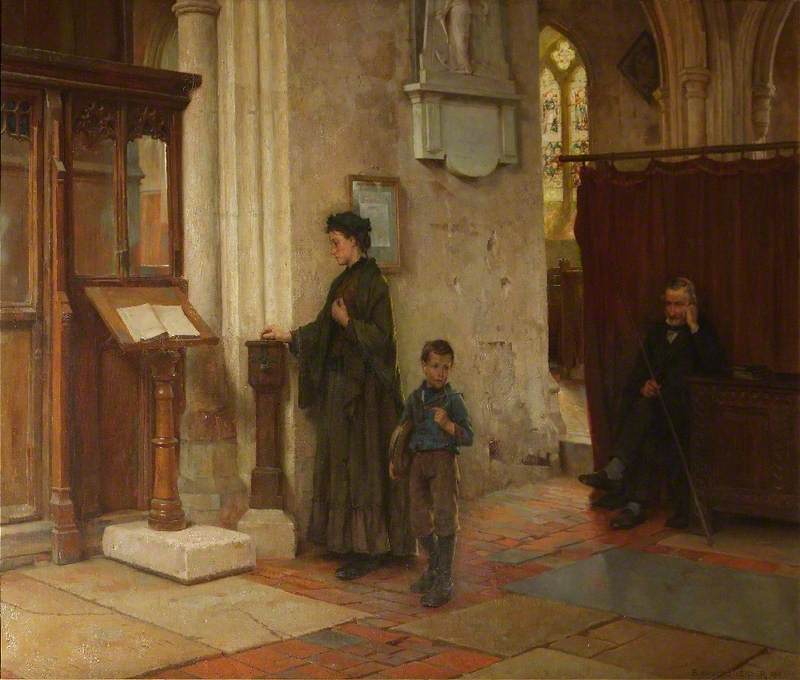
The Widow's Mite

W. T. Blandford-Fletcher (1858-1936)

Worcester City Art Gallery & Museum
Worcester, England

7 posted on 11/22/2021 4:37:15 AM PST by annalex (fear them not)
[ Post Reply | Private Reply | To 6 | View Replies]

To: annalex
Matthew
 English: Douay-RheimsLatin: Vulgata ClementinaGreek NT: Byzantine/Majority Text (2000)
 Matthew 25
1THEN shall the kingdom of heaven be like to ten virgins, who taking their lamps went out to meet the bridegroom and the bride. Tunc simile erit regnum cælorum decem virginibus : quæ accipientes lampades suas exierunt obviam sponso et sponsæ.τοτε ομοιωθησεται η βασιλεια των ουρανων δεκα παρθενοις αιτινες λαβουσαι τας λαμπαδας αυτων εξηλθον εις απαντησιν του νυμφιου
2And five of them were foolish, and five wise. Quinque autem ex eis erant fatuæ, et quinque prudentes :πεντε δε ησαν εξ αυτων φρονιμοι και αι πεντε μωραι
3But the five foolish, having taken their lamps, did not take oil with them: sed quinque fatuæ, acceptis lampadibus, non sumpserunt oleum secum :αιτινες μωραι λαβουσαι τας λαμπαδας αυτων ουκ ελαβον μεθ εαυτων ελαιον
4But the wise took oil in their vessels with the lamps. prudentes vero acceperunt oleum in vasis suis cum lampadibus.αι δε φρονιμοι ελαβον ελαιον εν τοις αγγειοις αυτων μετα των λαμπαδων αυτων
5And the bridegroom tarrying, they all slumbered and slept. Moram autem faciente sponso, dormitaverunt omnes et dormierunt.χρονιζοντος δε του νυμφιου ενυσταξαν πασαι και εκαθευδον
6And at midnight there was a cry made: Behold the bridegroom cometh, go ye forth to meet him. Media autem nocte clamor factus est : Ecce sponsus venit, exite obviam ei.μεσης δε νυκτος κραυγη γεγονεν ιδου ο νυμφιος ερχεται εξερχεσθε εις απαντησιν αυτου
7Then all those virgins arose and trimmed their lamps. Tunc surrexerunt omnes virgines illæ, et ornaverunt lampades suas.τοτε ηγερθησαν πασαι αι παρθενοι εκειναι και εκοσμησαν τας λαμπαδας αυτων
8And the foolish said to the wise: Give us of your oil, for our lamps are gone out. Fatuæ autem sapientibus dixerunt : Date nobis de oleo vestro, quia lampades nostræ extinguuntur.αι δε μωραι ταις φρονιμοις ειπον δοτε ημιν εκ του ελαιου υμων οτι αι λαμπαδες ημων σβεννυνται
9The wise answered, saying: Lest perhaps there be not enough for us and for you, go ye rather to them that sell, and buy for yourselves. Responderunt prudentes, dicentes : Ne forte non sufficiat nobis, et vobis, ite potius ad vendentes, et emite vobis.απεκριθησαν δε αι φρονιμοι λεγουσαι μηποτε ουκ αρκεση ημιν και υμιν πορευεσθε δε μαλλον προς τους πωλουντας και αγορασατε εαυταις
10Now whilst they went to buy, the bridegroom came: and they that were ready, went in with him to the marriage, and the door was shut. Dum autem irent emere, venit sponsus : et quæ paratæ erant, intraverunt cum eo ad nuptias, et clausa est janua.απερχομενων δε αυτων αγορασαι ηλθεν ο νυμφιος και αι ετοιμοι εισηλθον μετ αυτου εις τους γαμους και εκλεισθη η θυρα
11But at last come also the other virgins, saying: Lord, Lord, open to us. Novissime vero veniunt et reliquæ virgines, dicentes : Domine, domine, aperi nobis.υστερον δε ερχονται και αι λοιπαι παρθενοι λεγουσαι κυριε κυριε ανοιξον ημιν
12But he answering said: Amen I say to you, I know you not. At ille respondens, ait : Amen dico vobis, nescio vos.ο δε αποκριθεις ειπεν αμην λεγω υμιν ουκ οιδα υμας
13Watch ye therefore, because you know not the day nor the hour. Vigilate itaque, quia nescitis diem, neque horam.γρηγορειτε ουν οτι ουκ οιδατε την ημεραν ουδε την ωραν εν η ο υιος του ανθρωπου ερχεται

8 posted on 11/22/2021 4:39:39 AM PST by annalex (fear them not)
[ Post Reply | Private Reply | To 7 | View Replies]

To: annalex

Catena Aurea by St. Thomas Aguinas

25:1–13

1. Then shall the kingdom of heaven be likened unto ten virgins, which took their lamps, and went forth to meet the bridegroom.

2. And five of them were wise, and five were foolish.

3. They that were foolish took their lamps, and took no oil with them:

4. But the wise took oil in their vessels with their lamps.

5. While the bridegroom tarried, they all slumbered and slept.

6. And at midnight there was a cry made, Behold, the bridegroom cometh; go ye out to meet him.

7. Then all those virgins arose, and trimmed their lamps.

8. And the foolish said unto the wise, Give us of your oil; for our lamps are gone out.

9. But the wise answered saying, Not so; lest there be not enough for us and you: but go ye rather to them that sell, and buy for yourselves.

10. And while they went to buy, the bridegroom came; and they that were ready went in with him to the marriage: and the door was shut.

11. Afterward came also the other virgins, saying, Lord, Lord, open to us.

12. But he answered and said, Verily I say unto you, I know you not.

13. Watch therefore, for ye know neither the day nor the hour wherein the Son of man cometh.

CHRYSOSTOM. (Hom. lxxviii.) In the foregoing parable the Lord set forth the punishment of the man who beat, and was drunk, and wasted his Lord’s goods; in this He declares his punishment who profits not, and does not prepare for himself abundantly the things of which he has need; for the foolish virgins had oil, but not enough.

HILARY. Then, because all this discourse is concerning the great day of the Lord, concerning which He had been speaking before.

GREGORY. (Hom. in Ev. xii. 1.) By the kingdom of heaven is meant the present Church, as in that, The Son of Man shall send forth his angels, and they shall gather out of his kingdom all things that offend. (Matt. 13:41.)

JEROME. This parable of the ten foolish and the ten wise virgins, some interpret literally of virgins, of whom there are according to the Apostle some who are virgins both in body and in thought, (1 Cor. 7.) others who have preserved indeed their bodies virgin, but have not the other deeds of virgins, or have only been preserved by the guardianship of parents, but have wedded in their hearts. But from what has gone before, I think the meaning to be different, and that the parable has reference not to virgins only, but to the whole human race.

GREGORY. (ubi sup.) For in each of the five senses of the body `there is a double instrument, and the number five doubled makes ten. And because the company of the faithful is gathered out of both sexes, the Holy Church is described as being like to ten virgins, where as bad are mixed with good, and reprobate with elect, it is like a mixture of wise and foolish virgins.

CHRYSOSTOM. And He employs the character virgins in this parable to shew, that though virginity be a great thing, yet if it be not accompanied by works of mercy, it shall be cast out with the adulterers.

ORIGEN. Or, The understandings of all who have received the word of God are virgins. For such is the word of God, that of its purity it imparts to all, who by its teaching have departed from the worship of idols, and have through Christ drawn near to the worship of God; Which took their lamps, and went forth to meet the bridegroom and the bridea. They take their lamps, i. e. their natural faculties, and go forth out of the world and its errors, and go to meet the Saviour, who is ever ready to come to enter with them that are worthy to His blessed bride the Church.

HILARY. Or, The bridegroom and the bride represent our Lord God in the body, for the flesh is the bride of the spirit. The lamps are the light of bright souls which shine forth in the sacrament of baptismb.

AUGUSTINE. (Lib. 83 Quæst. q. 59.) Or, The lamps which they carry in their hands are their works, of which it was said above, Let your works shine before men. (Mat. 5:16.)

ORIGEN. They that believe rightly, and live righteously, are likened to the five wise; they that profess the faith of Jesus, but prepare themselves not by good works to salvation, are likened to the five foolish.

JEROME. For there are five senses which hasten towards heavenly things, and seek after things above. Of sight, hearing, and touch, it is specially said, That which we have heard, which we have seen with our eyes, and our hands have handled. (1 John 1:1.) Of taste, Taste and see that the Lord is good. (Ps. 34:8.) Of smell, Because of the savour of thy good ointments. (Sol. Song, 1:3.) There are also other five senses which gape after earthly husks.

AUGUSTINE. (ubi sup.) Or, by the five virgins, is denoted a five-fold continence from the allurements of the flesh; for our appetite must be held from gratification of the eyes, ears, smell, taste, and touch. And as this continence may be done before God, to please Him in inward joy of the conscience, or before men only to gain applause of men, five are called wise, and five foolish. Both are virgins, because both these men exercise continence, though from different motives.

ORIGEN. And because the virtues are so linked together, that he who has one has all, so all the senses so follow one another, that all must be wise, or all foolish.

HILARY. Or, The five wise and five foolish are an absolute distinction between believers and unbelievers.

GREGORY. (ubi sup.) It is to be observed, that all have lamps, but all have not oil.

HILARY. The oil is the fruit of good works, the vessels are the human bodies in whose inward parts the treasure of a good conscience is to be laid up.

JEROME. The virgins that have oil are they who, besides their faith, have the ornament of good works; they that have not oil, are they that seem to confess with like faith, but neglect the works of virtue.

AUGUSTINE. (ubi sup.) Or, The oil denotes joy, according to that, God hath anointed thee with the oil of gladness. (Ps. 45:7.) He then whose joy springs not from this that he is inwardly pleasing to God, has no oil with him; for they have no gladness in their continent lives, save in the praises of men. But the wise took oil with their lamps, that is, the gladness of good works, in their vessels, that is, they stored it in their heart and conscience, as the Apostle speaks, Let every man prove himself, and then shall he have rejoicing in himself, and not in another. (Gal. 6:4.)

CHRYSOSTOM. Or, The oil denotes charity, alms, and every aid rendered to the needy; the lamps denote the gifts of virginity; and He calls them foolish, because after having gone through the greater toil, they lost all for the sake of a less; for it is greater labour to overcome the desires of the flesh than of money.

ORIGEN. Or, The oil is the word of teaching, with which the vessels of souls are filled; for what gives so great content as moral discourse, which is called the oil of light. The wise took with them of this oil, as much as would suffice, though the Word should tarry long, and be slack to come to their consummation. The foolish took lamps, alight indeed at the first, but not supplied with so much oil as should suffice even to the end, being careless respecting the provision of doctrine which comforts faith, and enlightens the lamp of good deeds.

AUGUSTINE. (ubi sup.) For there die of both kinds of men in this interval of time before the resurrection of the dead, and the Lord’s coming shall be.

GREGORY. (ubi sup.) To sleep is to die, to slumber before sleep is to faint from salvation before death, because, by the burden of sickness we come to the sleep of death.

JEROME. Or, They slumbered, i. e. they were dead. And then follows, And slept, because they were to be afterwards wakened. While the bridegroom tarried, shews that no little time intervened between the Lord’s first and second coming.

ORIGEN. Or, Whilst the bridegroom tarried, and the Word comes not speedily to the consummation of this life, the senses suffer, slumbering and moving in the night of the world; and sleep, as energizing feebly, and with no quick sense. Yet did those wise virgins not quit their lamps, nor despair of hoarding their oil.

JEROME. The Jews have a tradition that Christ will come at midnight, in like manner as in that visitation of Egypt, when the Paschal feast is celebrated, and the destroyer comes, and the Lord passes over our dwellings, and the door posts of each man’s countenance are hallowed by the blood of the Lamb. Hence, I suppose, has continued among us that apostolic tradition, that on the vigil of Easterc the people should not be dismissed before midnight, in expectation of Christ’s coming; but when that hour has past over, they may celebrate the feast in security; whence also the Psalmist says, At midnight did I rise to praise thee. (Ps. 119:62.)

AUGUSTINE. (ubi sup.) Or, At midnight, that is, when none knew or looked for it.

JEROME. Suddenly thus, as on a stormy night, and when all think themselves secure, at the hour when sleep is the deepest, the coming of Christ shall be proclaimed by the shout of Angels, and the trumpets of the Powers that go before Him. This is meant when it says, Lo, the bridegroom cometh, go ye out to meet him.

HILARY. At the trumpet signal they go forth to meet the bridegroom alone, for then shall the two be one, that is, the flesh and God, when the lowliness of the flesh shall be transformed into spiritual glory.

AUGUSTINE. (ubi sup.) Or, that the virgins go forth to meet the bridegroom alone, I think is to be understood that the virgins themselves constitute her who is called the bride; as we speak of the Christians flocking to the Church as children running to their mother, and yet this same mother consists only of the children who are gathered together. For now the Church is betrothed, and is to be led forth as a virgin to the marriage, which takes place then when all her mortal part having past away, she may be held in an eternal union.

ORIGEN. Or, At midnight, that is, at the time of their most abandoned carelessness, there was a great cry, of the Angels, I suppose, desiring to arouse all men, those ministering spirits crying within in the senses of all that sleep, Behold, the bridegroom cometh, go ye out to meet him. All heard this summons, and arose, but all were not able to trim their lamps fitly. The lamps of the senses are trimmed by evangelical and right use of them; and they that use their senses amiss have their lamps untrimmed.

GREGORY. (ubi sup.) Or, All the virgins arose, that is, both elect and reprobate are roused from the sleep of death; they trimmed their lamps, that is, they reckon up to themselves their works for which they look to receive eternal blessedness.

AUGUSTINE. (ubi sup.) They trimmed their lamps, that is, prepared to give an account of their deeds.

HILARY. Or, the trimming their lamps is the return of their souls into their bodies, and their light is the consciousness of good works that shines forth, which is contained in the vessels of the body.

GREGORY. (ubi sup.) The lamps of the foolish virgins go out, because the works which appeared outwardly to men to be bright, are dimmed within at the coming of the Judge. That they then beg oil of the wise virgins, what is it but that at the coming of the Judge, when they find themselves empty within, they seek for witness from without? As though deceived by their own self-confidence, they say to their neighbours, Whereas ye see us rejected as living without works, do ye witness to our works that ye have seen.

AUGUSTINE. (ubi sup.) From habit, the mind seeks that which uses to give it pleasure. And these now seek from men, who see not the heart, witness to God, who sees the heart. But their lamps go out, because those, whose good works rest upon the testimony of others, when that is withdrawn, sink into nothing.

JEROME. Or, These virgins who complain that their lamps are gone out, shew that they are partially alight, yet have they not an unfailing light, nor enduring works. Whoso then has a virgin soul, and is a lover of chastity, ought not to rest content with such virtues as quickly fade, and are withered away when the heat comes upon them, but should follow after perfect virtues, that he may have an enduring light.

CHRYSOSTOM. Or otherwise; These virgins were foolish, not only because they departed hence, lacking store of mercy, but because they deemed to receive it from those of whom they importunately begged it. For though nothing could be more merciful than those wise virgins, who for this very mercifulness were approved, yet would they not grant the prayer of the foolish virgins. But the wise answered, saying, Not so, lest there be not enough for us and you; hence we lean that none of us shall be able in that day to stand forth as patron1 of those who are betrayed by their own works, not because he will not, but because he cannot.

JEROME. For these wise virgins do not answer thus out of covetousness, but out of fear. Wherefore, each man shall receive the recompense of his own works, and the virtues of one cannot atone for the vices of another in the day of judgment. The wise admonish them not to go to meet the bridegroom without oil, Go ye rather to them that sell, and buy for yourselves.

HILARY. They that sell are the poor, who, needing the alms of the faithful, made them that recompense which they desire, selling in return for the relief afforded to their wants, a consciousness of good works. This is the abundant fuel of an undying light which may be bought and stored up for the fruits of mercy.

CHRYSOSTOM. You see then how great merchants the poor are to us; but the poor are not there, but here, and therefore we must store up oil here, that we may have it to use there when occasion shall require.

JEROME. And this oil is sold, and at a high cost, nor is it to be got without much toil; so that we understand it not of alms only, but of all virtues and counsels of the teachers.

ORIGEN. Otherwise; Notwithstanding they were foolish, they yet understood that they must have light to go and meet the bridegroom, that all the lights of their senses might be burning. This also they discerned, that because they had little of the spiritual oil, their lamps would burn dim as darkness drew on. But the wise send the foolish to those that sell, seeing that they had not stored up so much oil, that is, word of doctrine, as would suffice both for themselves to live by, and to teach others, Go ye rather to them that sell, i. e. to the doctors, and buy, i. e. take of them; the price is perseverance, the love of learning, industry, and toil of all who are willing to learn.

AUGUSTINE. (ubi sup.) Or we may suppose it not meant as advice what they should do, but as an indirect allusion to their fault. For flatterers sell oil, who by praising things false, and things unknown, lead souls astray, recommending to them, as foolish, empty joys, and receiving in return some temporal benefit. Go ye rather to them that sell, and buy for yourselves, i. e. Let us now see what they can profit you who have used to sell you their praise. Lest there be not enough for us and you, because no man is profited in God’s sight by the testimony of others, because God sees the heart, and each man is scarce able to give testimony concerning his own conscience.

JEROME. But because the season for buying was now past, and the day of judgment was coming on, so that there was no room for penitence, they must not now lay up new works, but give an account of the old.

HILARY. The marriage is the putting on of immortality, and the joining together corruption and incorruption in a new union,

CHRYSOSTOM. That, While they went to buy, shews that even, if we should become merciful after death, it will avail us nothing to escape punishment, as it was no profit to the rich man, that he became merciful and careful about those who belonged to him.

ORIGEN. Or, He says, While they went to buy, because there are men to be found who have neglected to learn any thing useful, till when, in the very end of their life, when they set themselves to learn, they are overtaken by death.

AUGUSTINE. (ubi sup.) Or otherwise; While they went to buy, that is, while they turned themselves to things without, and sought to find pleasure in things they had been accustomed to, because they knew not inward joys, came He that judges; and they that were ready, i. e. they whose conscience bore witness to them before God, went in with him to the wedding, i. e. to where the pure soul is united prolific to the pure and perfect word of God.

JEROME. After the day of judgment, there is no more opportunity for good works, or for righteousness, and therefore it follows, And the door was shut.

AUGUSTINE. (ubi sup.) When they have been taken in who have been changed into angelic being (1 Cor. 15:51), all entrance into the kingdom of heaven is closed; after the judgment, there is no more place for prayers or merit.

HILARY. Yet though the season of repentance is now past, the foolish virgins come and beg that entrance may be granted to them.

JEROME. Their worthy confession calling Him, Lord, Lord, is a mark of faith. But what avails it to confess with the mouth Him whom you deny with your works?

GLOSS. (ap. Anselm.) Grief at their exclusion extorts from them a repetition of this title of Lord; they call not Him Father, whose mercy they despised in their lifetime.

AUGUSTINE. (ubi sup.) It is not said that they bought any oil, and therefore we must suppose that all their delight in the praise of men being gone, they return in distress and affliction to implore God. But His severity, after judgment, is as great as His mercy was unspeakable before. But He answered and said, Verily I say unto you, I know you not; by that rule, namely, that the art of God, that is, His wisdom, does not admit that those should enter into His joy who have sought to do in any thing according to His commandments, not as before God, but that they may please men.

JEROME. For the Lord knoweth them that are his, (2 Tim. 2:19.) and he that knoweth not shall not be known, and though they be virgins in purity of body, or in confession of the true faith, yet forasmuch as they have no oil, they are unknown by the bridegroom. When He adds, Watch therefore, because ye know not the day nor the hour, He means that all that has been said points to this, namely, that seeing we know not the day of judgment, we should be careful in providing the light of good works.

AUGUSTINE. (ubi sup.) For indeed we know the day and the hour neither of that future time when the Bridegroom will come, nor of our own falling asleep each of us; if then we be prepared for this latter, we shall also be prepared when that voice shall sound, which shall arouse us all.

AUGUSTINE. (Ep. 199. 45.) There have not been wanting those who would refer these ten virgins to that coming of Christ, which takes place now in the Church; but this is not to be hastily held out, lest any thing should occur contradictory of it.


Catena Aurea Matthew 25

9 posted on 11/22/2021 4:41:10 AM PST by annalex (fear them not)
[ Post Reply | Private Reply | To 8 | View Replies]

To: annalex


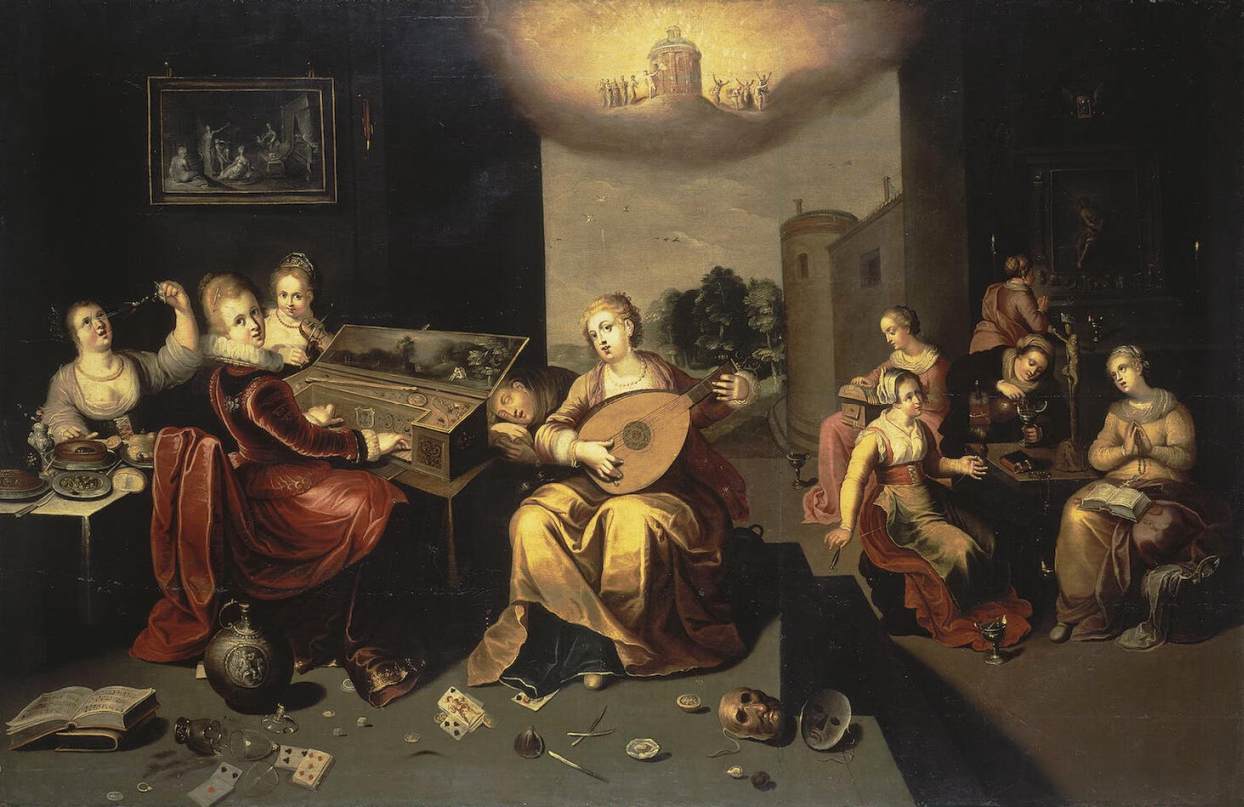
Parable of the Wise and Foolish Virgins

Hieronymus Francken II

c. 1616
Oil on canvas, 111 x 172 cm
The Hermitage, St. Petersburg

10 posted on 11/22/2021 4:41:51 AM PST by annalex (fear them not)
[ Post Reply | Private Reply | To 9 | View Replies]

To: annalex

Martyrs of Armenia

A group of eight Franciscans martyred in the region of Mujuk-Dersi, Armenia (modern Turkey) by invading Islamic Turks who tortured them, demanded they convert, and murdered them when they did not. They were Died

22 November 1895 in Mujuk-Dersi, Armenia (in modern Turkey)

Venerated

12 July 1982 by Pope John Paul II (decree of martyrdom)

Beatified

3 October 1982 by Pope John Paul II


catholicsaints.info
11 posted on 11/22/2021 4:49:38 AM PST by annalex (fear them not)
[ Post Reply | Private Reply | To 10 | View Replies]

To: annalex

12 posted on 11/22/2021 4:50:54 AM PST by annalex (fear them not)
[ Post Reply | Private Reply | To 11 | View Replies]

To: annalex
NAVARRE BIBLE COMMENTARY (RSV)

Ad Majorem Dei Gloriam (To the Greater Glory of God)

From: Daniel 1:1-6, 8-20

Arrival at the Court
--------------------
[1] In the third year of the reign of Jehoiakim king of Judah, Nebuchadnezzar king of Babylon came to Jerusalem and besieged it. [2] And the Lord gave Jehoiakim king of Judah into his hand, with some of the vessels of the house of God; and he brought them to the land of Shinar, to the house of his god, and placed the vessels in the treasury of his god. [3] Then the king commanded Ashpenaz, his chief eunuch, to bring some of the people of Israel, both of the royal family and of the nobility, [4] youths without blemish, handsome and skillful in all wisdom, endowed with knowledge, understanding learning, and competent to serve in the king’s palace, and to teach them the letters and language of the Chaldeans. [5] The king assigned them a daily portion of the rich food which the king ate, and of the wine which he drank. They were to be educated for three years, and at the end of that time they were to stand before the king. [6] Among these were Daniel, Hananiah, Misha-el, and Azariah of the tribe of Judah.

Royal Fare--God’s Servants Tested
---------------------------------
[8] But Daniel resolved that he would not defile himself with the king’s rich food, or with the wine which he drank; therefore he asked the chief of the eunuchs to allow him not to defile himself. [9] And God gave Daniel favor and compassion in the sight of the chief of the eunuchs; [10] and the chief of the eunuchs said to Daniel, “I fear lest my lord the king, who appointed your food and your drink, should see that you were in poorer condition than the youths who are of your own age. So you would endanger my head with the king.” [11] Then Daniel said to the steward whom the chief of the eunuchs had appointed over Daniel, Hananiah, Misha-el, and Azariah; [12] ”Test your servants for ten days; let us be given vegetables to eat and water to drink. [13] Then let our appearance and the appearance of the youths who eat the king’s rich food be observed by you, and according to what you see deal with your servants.” [14] So he hearkened to them in this matter, and tested them for ten days. [15] At the end of ten days it was seen that they were better in appearance and fatter in flesh than all the youths who ate the king’s rich food. [16] So the steward took away their rich food and the wine they were to drink, and gave them vegetables.

The Wisdom of the Three Young Men
---------------------------------
[17] As for these four youths, God gave them learning and skill in all letters and wisdom; and Daniel had understanding in all visions and dreams. [18] At the end of the time, when the king had commanded that they should be brought in, the chief of the eunuchs brought them in before Nebuchadnezzar. [19] And the king spoke with them, and among them all none was found like Daniel, Hananiah, Misha-el, and Azariah, therefore they stood before the king [20] And in every matter of wisdom and understanding concerning which the king inquired of them, he found them ten times better than all the magicians and enchanters that were in all his kingdom.

***********************************************************************
Commentary:

1:1-6:29. These chapters deal with Daniel at the court of the kings of Babylon--Nebuchadnezzar (1:1-4:37), Belshazzar (chap. 5) and Darius the Mede (chap. 6). These three reigns, arranged in a line as if they really followed one another cover the entire period from the start of the Babylonian captivity to the arrival of Cyrus of Persia, who allowed the Jews to return to their homeland (cf. 1:21). The main themes running through these chapters are: 1) divine protection afforded Daniel and his companions; 2) the help that these young Jews render the kings; 3) their faithfulness to the Lord despite trials and ordeals; 4) the acknowledgment of the God of Israel by these pagan kings. In the overall context of the book, these first six chapters introduce the God of Israel and Daniel, who will later receive a revelation about the end of the world. They also provide the Jews of the Diaspora with a model of how a Jew in a pagan society ought to live. For that reason, the Church will read them with interest because she lives in the midst of the world and “realizes that she is truly linked with mankind and its history by the deepest of bonds” (Vatican II, "Gaudium Et Spes", 1).

1:1-4:37 Nebuchadnezzar was the king who was responsible for the deportation of the Jews, and the most famous of the Babylonian kings. That may explain why he gets so much space in the book: Daniel interprets two dreams for him (2:1-49; 4:1-37), and the king three times acknowledges the God of Israel (2:46-49; 4:1-3; 4:37). Each episode in these chapters is an independent unit, and they all combine to show the qualities that Daniel and these other Jews had: they were accomplished people, successful in life; at the same time they stayed true to God, even when their religion was put to the test.

1:1-21. This chapter acts as an introduction to the whole book. It tells us who Daniel was and how he and his companions became members of Nebuchadnezzar’s household. The dates given at the start and finish of the chapter (vv. 1, 21) show that Daniel was connected with the whole period of the exile.

1:1-7. The third year of the reign of Jehoiakim was 606 BC, but the siege and sack of Jemsalem by Nebuchadnezzar took place in 597. The sacred writer is content to use vague references like this; and it may well be that he is advancing the date of the deportation because that is more in line with seventy years--the length of the exile according to Jeremiah 25:11. The Hebrew word translated as “eunuch” (v. 3) is "saris", which could refer to any palace officials or guards, not necessarily eunuchs. The country of Shinar is Babylonia, which is how the Greek version translates the name. It was quite common in the ancient East for a victorious king to appoint state officials from among the noblemen of subject peoples; Jewish officials, for example, could be very useful in dealings with Jewish communities.

1:8-16. The sacred writer extends Jewish regulations about food (cf. 1 Mac 1:62) to wine, to show that keeping to the Jewish law was much better for the youths than eating the king’s fare would have been. Besides, to eat and drink at the royal table would have involved eating and drinking things offered to the gods; it would have been a form of communing with pagan gods. As those young men saw it, being good Jews was not incompatible with the performance of duties for which they were trained. Similarly, “to remind a Christian that his life is meaningless unless he obeys God’s will does not mean separating him from other men” (St Josemaria Escrivá, "Christ Is Passing By", 21).

God can afford protection by making use of people’s good dispositions; here he causes the chief eunuch to be well-disposed to the Jewish youths (v. 9). Thus, “though often unconscious collaborators with God’s will, men can also enter deliberately into the divine plan by their actions, their prayers and their sufferings” ("Catechism of the Catholic Church", 307).

1:17-21. Athough Daniel and his companions are given a very good Chaldean education, their wisdom comes from God, not from that training (v. 17) It includes the understanding of all things human and, in Daniel’s case, the ability to interpret dreams and visions. The king will soon see for himself that Daniel and the Jews have greater wisdom than others, but he does not yet know where it comes from (he will, later: cf. 2:47). But the Jewish or Christian reader of the book does know what the source of this true wisdom is: "God's truth is his wisdom which commands the whole created order and governs the world (cf. Wis 13:1-9). God who alone made heaven and earth (cf. Ps 115:15), can alone impart true knowledge of every created thing in relation to himself” ("Catechism of the Catholic Church", 216).

Summing up the career of these Jewish youths in Babylon, and aware that their wisdom came from the Word of God, St Hippolytus of Rome comments: “It was the Word who gave them wisdom and made them faithful witnesses [to him] in Babylon, so that through them what was worshipped in Babylon would be scorned. Nebuchadnezzar was defeated by three young men whose faith was tested in the fires of the furnace, the holy woman Susanna was delivered from the jaws of death and the terrible depth of ancient evil was laid bare. These were the victories won by four young men in Babylon; they were beloved of God and nurtured the fear of the Lord in their hearts” ("Commentarium In Danielem", 1, 11).

13 posted on 11/22/2021 6:25:53 AM PST by fidelis (Ecce Crucem Domini! Fugite partes adversae! Vicit Leo de tribu Juda, Radix David! Alleluia! )
[ Post Reply | Private Reply | To 12 | View Replies]

To: fidelis
From: Luke 21:1-4

The Widow's Mite
----------------
[1] He (Jesus) looked up and saw the rich putting their gifts into the treasury; [2] and He saw a poor widow put in two copper coins. [3] And He said, "Truly I tell you, this poor widow has put in more than all of them; [4] for they all contributed out of their abundance, but she out of her poverty put in all the living she had."

***********************************************************************
Commentary:

1-4. Our Lord, surrounded by His disciples, watches people putting offerings into the treasury. This was a place in the women's courtyard, where there were various collection boxes for the offerings of the faithful. Just then, something happens whose significance Jesus wants His disciples to notice: a poor widow puts in two small coins, of very little value. He describes this as the greatest offering of all, praising the generosity of giving alms for this purpose, particularly that of those people who give part of what they need. Our Lord is moved by this tiny offering because in her case it implies a big sacrifice. "The Lord does not look", St. John Chrysostom comments, "at the amount offered but at the affection with which it is offered" ("Hom. on Heb", 1). Generosity is of the essence of almsgiving. This woman teaches us that we can move God's heart if we give Him all we can, which will always amount to very little even if we give our very lives. "How little a life is to offer to God!" (St Josemaria Escriva, "The Way", 42).

Source: Daily Word for Reflection—Navarre Bible Commentary

14 posted on 11/22/2021 6:26:22 AM PST by fidelis (Ecce Crucem Domini! Fugite partes adversae! Vicit Leo de tribu Juda, Radix David! Alleluia! )
[ Post Reply | Private Reply | To 13 | View Replies]

Disclaimer: Opinions posted on Free Republic are those of the individual posters and do not necessarily represent the opinion of Free Republic or its management. All materials posted herein are protected by copyright law and the exemption for fair use of copyrighted works.

Free Republic
Browse · Search
Religion
Topics · Post Article

FreeRepublic, LLC, PO BOX 9771, FRESNO, CA 93794
FreeRepublic.com is powered by software copyright 2000-2008 John Robinson