Posted on 10/30/2021 2:29:52 AM PDT by Cronos
Our Lady of the Shoals, Tuscumbia, Alabama
Readings at MassLiturgical Colour: Green
The Jews have not fallen for everLet me put a question: is it possible that God has rejected his people? Of course not. I, an Israelite, descended from Abraham through the tribe of Benjamin, could never agree that God had rejected his people, the people he chose specially long ago. Do you remember what scripture says of Elijah – how he complained to God about Israel’s behaviour? Let me put another question then: have the Jews fallen for ever, or have they just stumbled? Obviously they have not fallen for ever: their fall, though, has saved the pagans in a way the Jews may now well emulate. Think of the extent to which the world, the pagan world, has benefited from their fall and defection – then think how much more it will benefit from the conversion of them all. There is a hidden reason for all this, brothers, of which I do not want you to be ignorant, in case you think you know more than you do. One section of Israel has become blind, but this will last only until the whole pagan world has entered, and then after this the rest of Israel will be saved as well. As scripture says: The liberator will come from Zion, he will banish godlessness from Jacob. And this is the covenant I will make with them when I take their sins away. The Jews are enemies of God only with regard to the Good News, and enemies only for your sake; but as the chosen people, they are still loved by God, loved for the sake of their ancestors. God never takes back his gifts or revokes his choice.
The Lord will not abandon his people. Happy the man whom you teach, O Lord, whom you train by means of your law; to him you give peace in evil days. The Lord will not abandon his people. The Lord will not abandon his people nor forsake those who are his own; for judgement shall again be just and all true hearts shall uphold it. The Lord will not abandon his people. If the Lord were not to help me, I would soon go down into the silence. When I think: ‘I have lost my foothold’; your mercy, Lord, holds me up. The Lord will not abandon his people.
Alleluia, alleluia! Let the message of Christ, in all its richness, find a home with you; through him give thanks to God the Father. Alleluia!
Alleluia, alleluia! Shoulder my yoke and learn from me, says the Lord, for I am gentle and humble in heart. Alleluia!
Everyone who exalts himself shall be humbledNow on a sabbath day Jesus had gone for a meal to the house of one of the leading Pharisees; and they watched him closely. He then told the guests a parable, because he had noticed how they picked the places of honour. He said this, ‘When someone invites you to a wedding feast, do not take your seat in the place of honour. A more distinguished person than you may have been invited, and the person who invited you both may come and say, “Give up your place to this man.” And then, to your embarrassment, you would have to go and take the lowest place. No; when you are a guest, make your way to the lowest place and sit there, so that, when your host comes, he may say, “My friend, move up higher.” In that way, everyone with you at the table will see you honoured. For everyone who exalts himself will be humbled, and the man who humbles himself will be exalted.’ The readings on this page are from the Jerusalem Bible, which is used at Mass in most of the English-speaking world. The New American Bible readings, which are used at Mass in the United States, are available in the Universalis apps, programs and downloads. |
catholic,prayer,ordinarytime,lk14
Please FReepmail me/annalex to get on/off the Alleluia Ping List.
Feel free to add your content, so long as it conforms with the rules of the Catholic Caucus. For example, post your prayers, thoughts, art that you like

1. And it came to pass, as he went into the house of one of the chief Pharisees to eat bread on the sabbath day, that they watched him.
2. And, behold, there was a certain man before him which had the dropsy.
3. And Jesus answering spake unto the Lawyers and Pharisees, saying, Is it lawful to heal on the sabbath day?
4. And they held their peace. And he took him, and healed him, and let him go;
5. And answered them, saying, Which of you shall have an ass or an ox fallen into a pit, and will not straightway pull him out on the sabbath day?
6. And they could not answer him again to these things.
CYRIL OF ALEXANDRIA. Although our Lord knew the malice of the Pharisees, yet He became their guest, that He might benefit by His words and miracles those who were present. Whence it follows, And it came to pass, as he went into the house of one of the chief Pharisees to eat bread on the sabbath day, that they watched him; to see whether He would despise the observance of the law, or do any thing that was forbidden on the sabbath day. When then the man with the dropsy came into the midst of them, He rebukes by a question the insolence of the Pharisees, who wished to detect Him; as it is said, And, behold, there was a certain man before him which had the dropsy. And Jesus answering, &c.
BEDE. When it is said that Jesus answered, there is a reference to the words which went before, And they watched him. For the Lord knew the thoughts of men.
THEOPHYLACT. But by His question He exposes their folly. For while God blessed the sabbath, (Gen. 2:1.) they forbade to do good on the sabbath; but the day which does not admit the works of the good is accursed.
BEDE. But they who were asked, are rightly silent, for they perceived that whatever they said, would be against themselves. For if it is lawful to heal on the sabbath day, why did they watch the Saviour whether He would heal? If it is not lawful, why do they take care of their cattle on the sabbath? Hence it follows, But they held their peace.
CYRIL OF ALEXANDRIA. Disregarding then the snares of the Jews, He cures the dropsical, who from fear of the Pharisees did not ask to be healed on account of the sabbath, but only stood up, that when Jesus beheld him, He might have compassion on him and heal him. And the Lord knowing this, asked not whether he wished to be made whole, but forthwith healed him. Whence it follows; And he took him, and healed him, and let him go. Wherein our Lord took no thought not to offend the Pharisees, but only that He might benefit him who needed healing. For it becomes us, when a great good is the result, not to care if fools take offence.
CYRIL OF ALEXANDRIA. But seeing the Pharisees awkwardly silent, Christ baffles their determined impudence by some important considerations. As it follows; And he answered and said unto them, Which of you shall have an ass or an ox fallen into a pit, and will not straightway pull him out on the sabbath day?
THEOPHYLACT. As though He said, If the law forbids to have mercy on the sabbath-day, have no care of thy son when in danger on the sabbath-day. But why speak I of a son, when thou dost not even neglect an ox if thou seest it in danger?
BEDE. By these words He so refutes His watchers, the Pharisees, as to condemn them also of covetousness, who in the deliverance of animals consult their own desire of wealth. How much more then ought Christ to deliver a man, who is much better than cattle!
AUGUSTINE. (de Quæst. Evan. lib. 2. cap. 29.) Now He has aptly compared the dropsical man to an animal which has fallen into a ditch, (for he is troubled by water,) as He compared that woman, whom He spoke of as bound, and whom He Himself loosed, to a beast which is let loose to be led to water.
BEDE. By a suitable example then He settles the question, shewing that they violate the sabbath by a work of covetousness, who contend that he does so by a work of charity. Hence it follows, And they could not answer him again to these things. Mystically, the dropsical man is compared to him who is weighed down by an overflowing stream of carnal pleasures. For the disease of dropsy derives the name from a watery humour.
AUGUSTINE. (ubi sup.) Or we rightly compare the dropsical man to a covetous rich man. For as the former, the more he increases in unnatural moisture the greater his thirst; so also the other, the more abundant his riches, which he does not employ well, the more ardently he desires them.
GREGORY. (14 Mor. c. 6.) Rightly then is the dropsical man healed in the Pharisees’ presence, for by the bodily infirmity of the one, is expressed the mental disease of the other.
BEDE. In this example also He well refers to the ox and the ass; so as to represent either the wise and the foolish, or both nations; that is, the Jew oppressed by the burden of the law, the Gentile not subject to reason. For the Lord rescues from the pit of concupiscence all who are sunk therein.
14:7–11
7. And he put forth a parable to those which were bidden, when he marked how they chose out the chief rooms; saying unto them,
8. When thou art bidden of any man to a wedding, sit not down in the highest room; lest a more honourable man than thou be bidden of him;
9. And he that bade thee and him come and say to thee, Give this man place; and thou begin with shame to take the lowest room.
10. But when thou art bidden, go and sit down in the lowest room; that when he that bade thee cometh, he may say unto thee, Friend, go up higher: then shalt thou have worship in the presence of them that sit at meat with thee.
11. For whosoever exalteth himself shall be abased; and he that humbleth himself shall be exalted.
AMBROSE. First the dropsical man is cured, in whom the abundant discharges of the flesh crushed down the powers of the soul, quenched the ardour of the Spirit. Next, humility is taught, when at the nuptial feast the desire of the highest place is forbidden. As it is said, And he spake, Sit not down in the highest room.
CYRIL OF ALEXANDRIA. For to rush forward hastily to honours which are not fitting for us, indicates rashness and casts a slur upon our actions. Hence it follows, lest a more honourable man than thou be invited, &c.
CHRYSOSTOM. (non occ.) And so the seeker of honour obtained not that which he coveted, but suffered a defeat, and busying himself how he might be loaded with honours, is treated with dishonour. And because nothing is of so much worth as modesty, He leads His hearer to the opposite of this seeking; not only forbidding him to seek the highest place, but bidding him search for the lowest. As it follows; But when thou art bidden, go and sit down in the lowest room.
CYRIL OF ALEXANDRIA. For if a man wishes not to be set before others, he obtains this honour according to the divine word. As it follows; That when he that bade thee cometh, he may say unto thee, Friend, go up higher. In these words He does not harshly chide, but gently admonishes; for a word of advice is enough for the wise. And thus for their humility men are crowned with honours; as it follows, Then shall thou have worship.
BASIL. (in reg. fus. ad inter. 12.) To take then the lowest place at a feast, according to our Lord’s command, is becoming to every man, but again to rush contentiously after this is to be condemned as a breach of order and cause of tumult; and a strife raised about it, will place you on a level with those who dispute concerning the highest place. Wherefore, as our Lord here says, it becomes him who makes the feast to arrange the order of sitting down. Thus in patience and love should we mutually bear ourselves, following all things decently according to order, not for external appearance or public display; nor should we seem to study or affect humility by violent contradiction, but rather gain it by condescension or by patience. For resistance or opposition is a far stronger token of pride than taking the first seat at meat, when we obtain it by authority.
THEOPHYLACT. Now let no one deem the above precepts of Christ to be trifling, and unworthy of the sublimity and grandeur of the Word of God. For you would not call him a merciful physician who professed to heal the gout, but refused to cure a scar on the finger or a tooth-ache. Besides, how can that passion of vainglory appear slight, which moved or agitated those who sought the first seats. It became then the Master of humility to cut off every branch of the bad root. But observe this also, that when the supper was ready, and the wretched guests were contending for precedency before the eyes of the Saviour, there was a fit occasion for advice.
CYRIL OF ALEXANDRIA. Having shewn therefore from so slight an example the degradation of the ambitious and the exaltation of the humbleminded, He adds a great thing to a little, pronouncing a general sentence, as it follows, For every one who exalts himself shall be abased, and he that humbleth himself shall be exalted. This is spoken according to the divine judgment, not after human experience, in which they who desire after glory obtain it, while others who humble themselves remain inglorious.
THEOPHYLACT. Moreover, he is not to be respected in the end, nor by all men, who thrusts himself into honours; but while by some he is honoured, by others he is disparaged, and sometimes even by the very men who outwardly honour him.
BEDE. But as the Evangelist calls this admonition a parable, we must briefly examine what is its mystical meaning. Whosoever being bidden has come to the marriage feast of Christ’s Church, being united to the members of the Church by faith, let him not exalt himself as higher than others by boasting of his merits. For he will have to give place to one more honourable who is bidden afterwards, seeing that he is overtaken by the activity of those who followed him, and with shame he occupies the lowest place, now that knowing better things of the others he brings low whatever high thoughts he once had of his own works. But a man sits in the lowest place according to that verse, The greater thou art, humble thyself in all things. (Eccles. 3:18.) But the Lord when He cometh, whomsoever He shall find humble, blessing him with the name of friend, He will command him to go up higher. For whoever humbleth himself as a little child, he is the greatest in the kingdom of heaven. But it is well said, Then shalt thou have glory, that thou mayest not begin to seek now what is kept for thee in the end. It may also be understood, even in this life, for daily does God come to His marriage feast, despising the proud; and often giving to the humble such great gifts of His Spirit, that the assembly of those who sit at meat, i. e. the faithful, glorify them in wonder. But in the general conclusion which is added, it is plainly declared that the preceding discourse of our Lord must be understood typically. For not every one who exalts himself before men is abased; nor is he who humbleth himself in their sight, exalted by them. But whoever exalteth himself because of his merits, the Lord shall bring low, and him who humbleth himself on account of his mercies, shall He exalt.

Ad Majorem Dei Gloriam (To the Greater Glory of God)
From: Romans 11:1-2a, 11-12, 25-29
The New Chosen People
---------------------
[1] I ask, then, has God rejected his people? By no means! I myself am an Israelite, a descendant of Abraham, a member of the tribe of Benjamin. [2a] God has not rejected his people whom he foreknew. Do you not know what the scripture says of Elijah, how he pleads with God against Israel?
[11] So I ask, have they stumbled so as to fall? By no means! But through their trespass salvation has come to the Gentiles, so as to make Israel jealous. [12] No if their trespass means riches for the world, and if their failure means riches for the Gentiles, how much more will their inclusion mean!
The Conversion of the Jews
---------------------------------------
[25] Lest you be wise in our own conceits, I want you to understand this mystery, brethren: a hardening has come upon part of Israel, until the full number of the Gentiles come in, [26] and so all Israel will be saved; as it is written, "The Deliverer will come upon Zion, he will banish ungodliness from Jacob"; [27] "and this will be my covenant with them when I take away their sins." [28] As regards the gospel they are enemies of God, for your sake; but as regards election they are beloved for the sake of their forefathers. [29] For the gifts and the call of God are irrevocable.
***********************************************************************
Commentary:
2-5. When Israel fell into idolatry, God raised up the prophet Elijah, who confronted the king with the sins of the people, who were worshipping idols and listening to false prophets (cf. 1 Kings 19:9-18). The king, instead of listening to Elijah, persecuted him; he had to flee to Mount Horeb. There he complained to God about Israel, and God in reply told him that he would punish them: the sons of Israel would die by the sword, but not all of them. God would preserve seven thousand of them, who had remained faithful to him. St Paul recalls this episode as an example of God intervening in Salvation History through men he has specially chosen. Even in times when sinfulness was rampant the Lord kept certain individuals faithful; these acted as his instruments to revive and extend people's grasp of true teaching and love of his laws, and to render due worship to the Creator: for example, he chose Noah and his family when the world was full of wickedness (Gen 6:5-8), and Abraham, when men had forgotten the true God (Josh 24:2ft), and he did the same when the people of Israel fell into idolatry.
The Prophets describe those who stay faithful to Yahweh as "the remnant of Israel", or words to that effect (cf. Jer 3:14; Ezek 9:8; Amos 3:12; Is 4:2-3; Mic 4:7; Zeph 2:7, 9), and prophesy that this "remnant" will be found, first, among those deported to Babylonia, later among the repatriated exiles and, finally, after the exile, among the servants of God, after the still unfaithful people are decimated and purified.
25-32. We all yearn for the fulfillment of these words--threatening yet consoling—which Christ addressed to the scribes and Pharisees: "For I tell you, you will not see me again, until you say 'Blessed is he who comes in the name of the Lord"' (Mt 23:39). "Together with the prophets and the Apostle, the Church awaits the day, known to God alone, when all peoples will call on God with one voice and 'serve him with one accord' (Zeph 3:9)" (Vatican II, "Nostra Aetate", 4). The conversion of the Jews is a secret--a mystery, the text says (v. 25)--hidden in the future, which will come about when the Incarnation of the Word achieves its ultimate purpose.
This conversion will follow on that of the Gentiles, which will be as it were a prelude to it. Jesus has foretold that "Jerusalem will be trodden down by the Gentiles, until the times of the Gentiles are fulfilled" (Lk 21:24; cf. note on same), which in some way suggests that the Jews will be converted at the end of time.
However, when the Church in its preaching touches on the main signs of the end of the world, it only refers to the proclamation of the Gospel throughout the world, to apostasy and to the Antichrist, but it has nothing to say about the conversion of the Jews (cf. "St Pius V Catechism", I, 8, 7). What the Church does do, and what we should do, is to pray the Lord to listen to its prayers "that the people you first made your own may arrive at the fullness of redemption" ("Roman Missal", Good Friday Liturgy, Prayer of the Faithful).
"The same thing is happening, St Paul explains, now that the Gospel is being preached. The people of Israel in general are not accepting it and are not becoming part of the Church; only a small number of Jews have believed, and these are the "remnant.' of Israel, chosen by God so that in them the promises might be kept. The conversion of Paul himself is an example and an earnest of this return of the people of Israel to their God, in line with the invitation that Hosea addressed to them: "Return, O Israel, to the Lord your God, for you have stumbled because of your iniquity" (Hos 14:2).
Throughout the history of the Church lapses of this type have occurred, with a consequent breakdown in morality. Whenever this happens, those Christians who stay true to the faith may, like Elijah, feel inclined to despair; but they should react with a realistic and vigilant optimism and not indulge in useless lamentation. In the presence of God, they should reflect on the fact that God actually wants to use them and their holy lives to turn the situation around: "A secret, an open secret: these world crises are sanctity crises. God wants a handful of men 'of his own' in every human activity. And then...'"pax Christi in regno Christi"--the peace of Christ in the kingdom of Christ"(St J. Escriva, The Way, 301).
29. God never goes back on anything he promises; therefore he continues to call the Jews to enter the chosen people. He does not take account of their disobedience or their sins: he will love them with an everlasting love, as he promised the patriarchs and in line with the merits accruing to them for their fidelity (cf. Rom 9:4-5). It is this very immutability of God's love that makes it possible for "all Israel" (v. 26) to be saved. God's calling, which is eternal, cannot cease; but we for our part can reject his call. The immutability of God's plan is reassuring to us: it means that even if we abandon him at any point, we can always return to our earlier fidelity: he is still there, waiting for us.
A Lesson About Humility
-----------------------
[1] One Sabbath when He (Jesus) went to dine at the house of a ruler who belonged to the Pharisees, they were watching Him.
[7] Now He told a parable to those who were invited, when He marked how they chose the places of honor, saying to them, [8] "When you are invited by any one to a marriage feast, do not sit down in a place of honor, lest a more eminent man than you be invited by him; [9] and he who invited you both will come and say to you, `Give place to this man' and then you will begin with shame to take the lowest place. [10] But when you are invited, go and sit in the lowest place, so that when your host comes he may say to you, `Friend, go up higher'; then you will be honored in the presence of all who sit at t able with you. [11] For every one who exalts himself will be humbled, and he who humbles himself will be exalted.
***********************************************************************
Commentary:
11. Humility is necessary for salvation that Jesus takes every opportunity to stress its importance. Here He uses the attitudes of people at banquet to remind us again that it is God who assigns the places at the Heavenly banquet. "Together with humility, the realization of the greatness of man's dignity--and of the overwhelming fact that, by grace, we are made children of God--forms a single attitude. It is not our own efforts that save us and gives us life; it is the grace of God. This is a truth which must never be forgotten" (St J. Escriva, "Christ Is Passing By", 133).
| Luke | |||
| English: Douay-Rheims | Latin: Vulgata Clementina | Greek NT: Byzantine/Majority Text (2000) | |
| Luke 14 | |||
| 1. | AND it came to pass, when Jesus went into the house of one of the chief of the Pharisees, on the sabbath day, to eat bread, that they watched him. | Et factum est cum intraret Jesus in domum cujusdam principis pharisæorum sabbato manducare panem, et ipsi observabant eum. | και εγενετο εν τω ελθειν αυτον εις οικον τινος των αρχοντων των φαρισαιων σαββατω φαγειν αρτον και αυτοι ησαν παρατηρουμενοι αυτον |
| [...] | |||
| 7. | And he spoke a parable also to them that were invited, marking how they chose the first seats at the table, saying to them: | Dicebat autem et ad invitatos parabolam, intendens quomodo primos accubitus eligerent, dicens ad illos : | ελεγεν δε προς τους κεκλημενους παραβολην επεχων πως τας πρωτοκλισιας εξελεγοντο λεγων προς αυτους |
| 8. | When thou art invited to a wedding, sit not down in the first place, lest perhaps one more honourable than thou be invited by him: | Cum invitatus fueris ad nuptias, non discumbas in primo loco, ne forte honoratior te sit invitatus ab illo. | οταν κληθης υπο τινος εις γαμους μη κατακλιθης εις την πρωτοκλισιαν μηποτε εντιμοτερος σου η κεκλημενος υπ αυτου |
| 9. | And he that invited thee and him, come and say to thee, Give this man place: and then thou begin with shame to take the lowest place. | Et veniens is, qui te et illum vocavit, dicat tibi : Da huic locum : et tunc incipias cum rubore novissimum locum tenere. | και ελθων ο σε και αυτον καλεσας ερει σοι δος τουτω τοπον και τοτε αρξη μετ αισχυνης τον εσχατον τοπον κατεχειν |
| 10. | But when thou art invited, go, sit down in the lowest place; that when he who invited thee, cometh, he may say to thee: Friend, go up higher. Then shalt thou have glory before them that sit at table with thee. | Sed cum vocatus fueris, vade, recumbe in novissimo loco : ut, cum venerit qui te invitavit, dicat tibi : Amice, ascende superius. Tunc erit tibi gloria coram simul discumbentibus : | αλλ οταν κληθης πορευθεις αναπεσε εις τον εσχατον τοπον ινα οταν ελθη ο κεκληκως σε ειπη σοι φιλε προσαναβηθι ανωτερον τοτε εσται σοι δοξα ενωπιον των συνανακειμενων σοι |
| 11. | Because every one that exalteth himself, shall be humbled; and he that humbleth himself, shall be exalted. | quia omnis, qui se exaltat, humiliabitur : et qui se humiliat, exaltabitur. | οτι πας ο υψων εαυτον ταπεινωθησεται και ο ταπεινων εαυτον υψωθησεται |

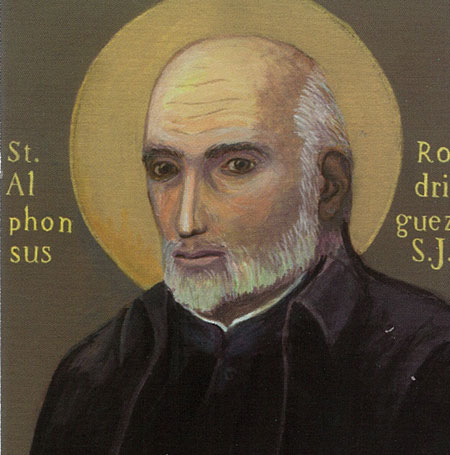
Alphonsus Rodriguez (Alfonso Rodriguez, 1533-1617) gained enduring fame for the extraordinary holiness that shone out of the very ordinariness of his work as the Jesuit doorkeeper of a school. He was born in Segovia, Spain, the second son of a successful wool and cloth merchant whose comfortable household provided hospitality to Father Peter Faber, one of St. Ignatius' first companions, when that Jesuit came to Segovia to preach. Faber helped the young boy prepare for his first communion, but Rodriguez's path to the Society of Jesus was slow and indirect.
When he was 12, his father sent him to the new Jesuit college at Alcalá, but studies abruptly ended when his father died. Alphonsus helped his mother run the family business and eventually took over its management altogether. At age 27 he married Maria Suárez with whom he had three children, but family life ended when all four died. Then heavy taxes drained the life from his business which eventually fell apart. The young widower viewed himself as a failure.
In his distress he turned to the Jesuits, recently arrived in Segovia, for spiritual direction. Through the inconsolable death of his wife and family, God led Rodriguez to an extraordinarily intimate relationship with himself. The widower spent sad and lonely years in prayer, seeking to do God's will. He wanted to give himself to God as a Jesuit and offered himself as a candidate for priesthood, but his advanced age of 35, poor health and limited education made him unsuitable in the eyes of the Jesuits who interviewed him for entrance. In 1568 he moved to Valencia, where his spiritual father had been transferred, and spent two years seeking the education necessary to become a priest. He was willing to become a Jesuit brother if priesthood was out of the question, but the fathers who examined him in Valencia came to the same negative conclusion as before. The provincial, however, recognized his holiness and gave him permission to enter the Society of Jesus.
On Jan. 31, 1571, at 37 years of age, Rodriguez entered the Jesuit novitiate but was sent only six months later to the college of Montesión in Palma on the island of Majorca, off the Spanish coast. There the new brother would finish his novitiate and become famous for his humble job of door-keeper and his friendship with another Jesuit saint, Peter Claver, apostle to the slaves recently arrived in Colombia.
In 1579 Rodriguez became the college's door-keeper, whose duties involved receiving visitors, searching for Jesuits or students whom someone sought, delivering messages, running errands, distributing alms to the needy, and–most importantly—consoling the troubled whom had no one else to turn to. It was repetitious and monotonous work, demanding much humility, but Rodriguez imagined everyone who knocked at the door to be the Lord himself and greeted everyone with the same smile he would have given God. Students felt the presence and influence of Brother Alphonsus and came to him for advice, encouragement and prayers.
He was 72 when Peter Claver came to the college, aflame with a desire to do something for God but uncertain how to do so. The two became friends and often discussed prayer and holiness as they walked around the school grounds. The older mentor encouraged the student to go to the South American missions.
The Jesuit doorkeeper was always appreciated for his kindness and holiness but only after his death did his memoirs and spiritual notes reveal the quality and depth of his prayer life. The humble brother had been favored by God with remarkable mystical graces, ecstasies and visions of our Lord, our Lady and the saints. Originally Collected and edited by: Tom Rochford, SJ

Disclaimer: Opinions posted on Free Republic are those of the individual posters and do not necessarily represent the opinion of Free Republic or its management. All materials posted herein are protected by copyright law and the exemption for fair use of copyrighted works.