 Cathedral of Saint Jean-Baptiste de Lyons, Lyons, France
Readings at MassLiturgical Colour: White
|
Posted on 10/01/2021 10:26:14 PM PDT by Cronos
Cathedral of Saint Jean-Baptiste de Lyons, Lyons, France
Readings at MassLiturgical Colour: White
|
catholic,prayer,ordinarytime,mt18
Please FReepmail me/annalex to get on/off the Alleluia Ping List.

1. At the same time came the disciples unto Jesus, saying, Who is the greatest in the kingdom of heaven?
2. And Jesus called a little child unto him, and set him in the midst of them,
3. And said, Verily I say unto you, Except ye be converted, and become as little children, ye shall not enter into the kingdom of heaven.
4. Whosoever therefore shall humble himself as this little child, the same is greatest in the kingdom of heaven.
5. And whoso shall receive one such little child in my name receiveth me.
6. But whoso shall offend one of these little ones which believe in me, it were better for him that a millstone were hanged about his neck, and that he were drowned in the depth of the sea.
JEROME. The disciples seeing one piece of money paid both for Peter and the Lord, conceived from this equality of ransom that Peter was preferred before all the rest of the Apostles.
CHRYSOSTOM. Thus they suffered a human passion, which the Evangelist denotes by saying, At the same time come the disciples to Jesus, saying, Who, we pray thee, is the greatest in the kingdom of heaven? Ashamed to shew the feeling which was working within, they do not say openly, Why have you honoured Peter above us? but they ask in general, Who is the greatest? When in the transfiguration they saw three distinguished, namely, Peter, James, and John, they had no such feeling, but now that one is singled out for especial honour, then they are grieved. But do you remember, first, that it was nothing in this world that they sought; and, secondly, that they afterwards laid aside this feeling? Even their failings are above us, whose enquiry is not, Who is the greatest in the kingdom of heaven? but, Who is greatest in the kingdom of the world?
ORIGEN. Herein we ought to be imitators of the disciples, that when any question of doubt arises among us, and we find not how to settle it, We should with one consent go to Jesus, Who is able to enlighten the hearts of men to the explication of every perplexity. We shall also consult some of the doctors, who are thought most eminent in the Churches. But in that they asked this question, the disciples knew that there was not an equality among the saints in the kingdom of heaven; what they yet sought to learn was, how they were so, and lived as greater and less. Or, from what the Lord had said above, they knew Who was the best and who was great; but out of many great, who was the greatest, this Was not clear to them.
JEROME. Jesus seeing their thoughts would heal their ambitious strivings, by arousing an emulation in lowliness; whence it follows, And Jesus calling a little child, set him in the midst of them.
CHRYSOSTOM. He chose, I suppose, quite an infant, devoid of any of the passions.
JEROME. One whose tender age should express to them the innocence which they should have. But truly He set Himself in the midst of them, a little one who had come not to be ministered unto, but to minister; (Mat. 20:28.) that He might be a pattern of holiness. Others interpret the little one of the Holy Spirit, whom He set in the hearts of His disciples, to change their pride into humility. (Vid. Origen. in loc.) And he said. Verily I say unto you, Except ye be converted, and become as little children, ye shall not enter into the kingdom of heaven. He does not enjoin on the Apostles the age, but the innocence of infants, which they have by virtue of their years, but to which these might attain by striving; that they should be children in malice, not in understanding. As though He had said, As this child, whom I set before you as a pattern, is not obstinate in anger, when injured does not bear it in mind, has no emotion at the sight of a fair woman, does not think one thing while he speaks another; so ye, unless ye have the like innocence and purity of mind, shall not be able to enter into the kingdom of heaven.
HILARY. He calls infants all who believe through the hearing of faith; for such follow their father, love their mother, know not to will that which is evil, do not bear hate, or speak lies, trust what is told them, and believe what they hear to be true. But the letter is thus interpreted.
GLOSS. (interlin.) Except ye be converted from this ambition and jealousy in which you are at present, and become all of you as innocent and humble in disposition as you are weak, in your years, ye shall not enter into the kingdom of heaven; and since there is none other road to enter in, whoso shall humble himself as this little child, the same is greatest in the kingdom of heaven; for by how much a man is humble now, by so much shall he be exalted in the kingdom of heaven.
REMIGIUS. In the understanding of grace, or in ecclesiastical dignity, or at least in everlasting blessedness.
JEROME. Or otherwise; Whoso shall humble himself as this little child, that is, whoso shall humble himself after My example, he shall enter into the kingdom of heaven. It follows, And whoso receiveth one such little one in my name, receiveth me.
CHRYSOSTOM. Not only if ye become such yourselves, but also if for My sake you shall pay honour to other such, ye receive reward; and as the return for the honour you pay them, I entail upon you the kingdom. He puts indeed what is far greater, Receiveth me.
JEROME. For whoever is such that he imitates Christ’s humility and innocence, Christ is received by him; and by way of caution, that the Apostles should not think, when such are come to them, that it is to themselves that the honour is paid, He adds, that they are to be received not for their own desert, but in honour of their Master.
CHRYSOSTOM. And to make this word the rather received. He subjoins a penalty in what follows, Whoso offendeth one of these little ones, & c. as though he had said, As those who for My sake honour one of these, have their reward, so they who dishonour shall undergo the extreme punishment. And marvel not that He calls an evil word an offence, for many of feeble spirit are offended by only being despised,
JEROME. Observe that he who is offended is a little one, for the greater hearts do not take offences. And though it may be a general declaration against all who scandalize any, yet from the connection of the discourse it may be said specially to the Apostles; for in asking who should be greatest in the kingdom of heaven, they seemed to be contending for preeminence among themselves; and if they had persisted in this fault, they might have scandalized those whom they called to the faith, seeing the Apostles contending among themselves for the preference.
ORIGEN. But how can he who has been converted, and become as a little child, be yet liable to be scandalized? This may be thus explained. Every one who believes on the Son of God, and walks after evangelic acts, is converted and walks as a little child; but he who is not converted that he may become as a child, it is impossible that he should enter into the kingdom of heaven. But in every congregation of believers, there are some only newly converted that they may become as little children, but not yet made such; these are the little ones in Christ, and these are they that receive offence.
JEROME. When it is said, It is better for him that a mill-stone be hanged about his neck, He speaks according to the custom of the province; for among the Jews this was the punishment of the greater criminals, to drown them by a stone tied to them. It is better for him, because it is far better to receive a brief punishment for a fault, than to be reserved for eternal torments.
CHRYSOSTOM. To correspond with the foregoing, He should have said here, Receiveth not Me, which were bitterer than any punishment; but because they were dull, and the before-named punishment did not move them, by a familiar instance He shews that punishment awaited them; for He therefore says, it were better for him, because another more grievous punishment awaits him.
HILARY. Mystically; The work of the mill is a toil of blindness, for the beasts having their eyes closed are driven round in a circle, and under the type of an ass we often find the Gentiles figured, who are held in the ignorance of blind labour; while the Jews have the path of knowledge set before them in the Law, who if they offend Christ’s Apostles it were better for them, that having their necks made fast to a mill-stone, they should be drowned in the sea, that is, kept under labour and in the depths of ignorance, as the Gentiles; for it were better for them that they should have never known Christ, than not to have received the Lord of the Prophets.
GREGORY. (Mor. vi. 37.) Otherwise; What is denoted by the sea, but the world, and what by the mill-stone, but earthly action? which, when it binds the neck in the yoke of vain desires, sends it to a dull round of toil. There arc some who leave earthly action, and bond themselves to aims of contemplation beyond the reach of intellect, laying aside humility, and so not only throw themselves into error, but also cast many weak ones out of the bosom of truth. Whoso then offends one of the least of mine, it were better for him that a mill-stone be tied about his neck, and he be cast into the sea; that is, it were better for a perverted heart to be entirely occupied with worldly business, than to be at leisure for contemplative studies to the hurt of many.
AUGUSTINE. (Quæst. Ev. i. 24) Otherwise; Whoso offendeth one of these little ones, that is so humble as He would have his disciples to be, by not obeying, or by opposing, (as the Apostle says of Alexander,) it were better for him, that a millstone should be hanged about his neck, and he be drowned in the depths of the sea, (2 Tim. 4:15.) that is, it were better for him that desire of the things of the world, to which the blind and foolish are tied down, should sink him by its load to destruction.
18:7–9
7. Woe unto the world because of offences! for it must needs be that offences come; but woe to that man by whom the offence cometh.
8. Wherefore if thy hand or thy foot offend thee, cut them off, and cast them from thee: it is better for thee to enter into life halt or maimed, rather than having two hands or two feet to be cast into everlasting fire.
9. And if thine eye offend thee, pluck it out, and cast it from thee: it is better for thee to enter into life with one eye, rather than having two eyes to be east into hell fire.
GLOSS. (non occ.) The Lord had said, that it is better for him who gives offence, that a mill-stone be hanged about his neck, of which He now subjoins the reason, Woe unto the world from offences! i. e. because of offences.
ORIGEN. This we may understand not of the material elements of the world; but here the men who are in the world, are called the worlda. But Christ’s disciples are not of this world, whence there cannot be woe to them from offences; for though there be many offences, they do not touch him who is not of this world. But if he be yet of this world in loving the world, and the things in it, as many offences will seize him as those by which he was encompassed in the world. It follows, For it must needs be that offences come.
CHRYSOSTOM. (Hom. lix.) This does not subvert the liberty of the will, or impose a necessity of any act, but foreshews what must come to pass. Offences are hindrances in the right way. But Christ’s prophecy does not bring in the offences, for it is not done because He foretold it, but He foretold it because it was certainly to come to pass. But some one will say, If all men are recovered, and if there be none to bring the offences, will not His speech be convicted of falsehood? By no means; for seeing that men were incurable, He therefore said, It must needs he that offences come; that is, they surely will come; which He never would have said, if all men might be amended.
GLOSS. (interlin. 1 Cor. 11:19.) Or they must needs come because they are necessary, that is, useful, that by this mean they that are approved may be made manifest.
CHRYSOSTOM. For offences rouse men, and make them more attentive; and he who falls by them speedily rises again, and is more careful.
HILARY. Or; The lowliness of His passion is the scandal of the world, which refused to receive the Lord of eternal glory under the disgrace of the Cross. And what more dangerous for the world than to have rejected Christ? And He says that offences must needs come, forasmuch as in the sacrament of restoring to us eternal life, all lowliness of suffering was to be fulfilled in Him.
ORIGEN. Or; The scandals that are to come are the Angels of Satan. But do not look that these offences should shew themselves in a substantial or natural shape, for in some the freedom of the will has been the origin of offence, not liking to undergo toil for virtue’s sake. But there cannot be real good, without the opposition of evil. It must needs be then that offences come, as it must needs be that we encounter the evil assaults of spiritual powers; whose hatred is the more stirred up, as Christ’s word invading men drives out the evil influences from them. And they seek instruments by whom the offences may the rather work; and to such instruments is more woe; for him who gives, it shall be worse than for him who takes, the offence, as it follows, But woe unto that man by whom the offence cometh.
JEROME. As much as to say, Woe to that man through whose fault it comes to pass, that offences must needs be in the world. And under this general declaration, Judas is particularly condemned, who had made ready his soul for the act of betrayal.
HILARY. Or; By the man is denoted the Jewish people, as the introducers of all this offence that is about Christ’s passion; for they brought upon the world all the danger of denying Christ in His passion, of whom the Law and the Prophets had preached that He should suffer.
CHRYSOSTOM. But that you may learn that there is no absolute necessity for offences, hear what follows, If thy hand or thy foot offend thee, & c. This is not said of the limbs of the body, but of friends whom we esteem as limbs necessary to us; for nothing is so hurtful as evil communications.
RABANUS. Scandal (offence) is a Greek word, which we may call a stumbling-block, or a fall, or hitting of the foot. He then scandalizes his brother, who by word or deed amiss gives him occasion of falling.
JEROME. So all affection, our whole kindred, are severed from us; lest under cover of duty any believer should be exposed to offence. If, He says, he be united to thee as close as is thy hand, or foot, or eye, and is useful to thee, anxious and quick to discern, and yet causes thee offence, and is by the unmeetness of his behaviour drawing thee into hell; it is better for thee that thou lack his kindred, and his profitableness to thee, than that whilst thou seekest to gain thy kindred or friends, thou shouldest have cause of fallings. For every believer knows what is doing him harm, what troubles and tempts him, for it is better to lead a solitary life, than to lose eternal life, in order to have the things necessary for this present life.
ORIGEN. Or, The priests may with good reason be called the eyes of the Church, since they are considered her watchmen, but the deacons and the rest her hands, for by them spiritual deeds are wrought; the people are the feet of the body, the Church; and all these it behoves not to spare, if they become an offence to the Church. Or, by the offending hand is understood an act of the mind; a motion of the mind is the offending foot, and a vision of the mind is the sinning eye, which we ought to cut off if they give offence, for thus the acts of the limbs are often put in Scripture for the limbs themselves.
18:10–14
10. Take heed that ye despise not one of these little ones; for I say unto you, That in heaven their angels do always behold the face of my Father which is in heaven.
11. For the Son of man is come to save that which was lost.
12. How think ye? if a man have an hundred sheep, and one of them be gone astray, doth he not leave the ninety and nine, and goeth into the mountains, and seeketh that which is gone astray?
13. And if so be that he find it, verily I say unto you, he rejoiceth more of that sheep, than of the ninety and nine which went not astray.
14. Even so it is not the will of your Father which is in heaven, that one of these little ones should perish.
JEROME. The Lord had said, under the type of hand, foot, and eye, that all kin and connection which could afford scandal must be cut off. The harshness of this declaration He accordingly tempers with the following precept, saying, Take heed that ye despise not one of these little ones; i. e. As far as you may avoid despising them, but next to your own salvation seek also to heal them. But if ye see that they hold to their sins, it is better that ye be saved, than that ye perish in much company.
CHRYSOSTOM. Or otherwise; As to shun the evil, so to honour the good, has great recompense. Above then He had bid them to cut off the friendships of those that gave offence, here He teaches them to shew honour and service to the saints.
GLOSS. (ap. Anselm.) Or otherwise; Because so great evils come of brethren being scandalized, Take heed that ye despise not one of these little ones.
ORIGEN. The little ones are those that are but lately born in Christ, or those who abide without advance, as though lately born. But Christ judged it needless to give command concerning not despising the more perfect believers, but concerning the little ones, as He had said above, If any man shall offend one of these little ones. A man may perhaps say that a little one here means a perfect Christian, according to that He says elsewhere, Whoso is least among you, he shall be great. (Luke 9:48.)
CHRYSOSTOM. Or because the perfect are esteemed of many as little ones, as poor, namely, and despicable.
ORIGEN. But this exposition does not seem to agree with that which was said, If any one scandalizes one of these little ones; for the perfect man is not scandalized, nor does he perish. But he who thinks this the true exposition, says, that the mind of a righteous man is variable, and is sometimes offended, but not easily.
GLOSS. (ap. Anselm.) Therefore are they not to be despised for that they are so dear to God, that Angels are deputed to be their guardians; For I say unto you, that in heaven their Angels do always behold the face of my Father which is in heaven.
ORIGEN. Some will have it that an Angel is given as an attendant minister from the time when in the laver of regeneration the infant is born in Christ; for, say they, it is incredible that a holy Angel watches over those who are unbelieving and in error, but in his time of unbelief and sin man is under the Angels of Satan. Others will have it, that those who are foreknown of God, have straightway from their very birth a guardian Angel.
JEROME. High dignity of souls, that each from its birth has an Angel set in charge over it!
CHRYSOSTOM. Here He is speaking not of any Angels, but of the higher sort; for when He says, Behold the face of my Father, He shews that their presence before God is free and open, and their honour great.
GREGORY. (Hom. in Ev. 34. 12) But Dionysius says, that it is from the ranks of the lesser Angels that these are sent to perform this ministry, either visibly or invisibly, for that those higher ranks have not the employment of an outward ministry.
GREGORY. (Mor. ii. 3.) And therefore the Angels always behold the face of the Father, and yet they come to us, for by a spiritual presence they come forth to us, and yet by internal contemplation keep themselves there whence they come forth; for they come not so forth from the divine vision, as to hinder the joys of inward contemplation.
HILARY. The Angels offer daily to God the prayers of those that are to be saved by Christ; it is therefore perilous to despise him whose desires and requests are conveyed to the eternal and invisible God, by the service and ministry of Angels.
AUGUSTINE. (de Civ. Dei, xxii. 29.) Or; They are called our Angels who are indeed the Angels of God. they are Gods because they have not forsaken Him; they are ours because they have begun to have us for their fellow-citizens. As they now behold God, so shall we also behold Him face to face, of which vision John speaks, We shall see him as he is. (1 John 3:2.) For by the face of God is to be understood the manifestation of Himself, not a member or feature of the body, such as we call by that name.
CHRYSOSTOM. He gives yet another reason weightier than the foregoing, why the little ones are not to be despised, For the Son of Man is come to save that which was lost.
REMIGIUS. As much as to say, Despise not little ones, for I also for men condescended to become man. By that which was lost, understand the human race; for all the elements have kept their place, but man was lost, because he has broken his ordained place.
CHRYSOSTOM. And to this reasoning He adds a parable, in which He sets forth the Father as seeking the salvation of men, and saying, What think you, If a man have a hundred sheep.
GREGORY. (Hom. in Ev. xxxiv. 3.) This refers to the Creator of man Himself; for a hundred is a perfect number, and He had a hundred sheep when He created the substance of Angels and men.
HILARY. But by the one sheep is to be understood one man, and under this one man is comprehended the whole human race. He that seeks man is Christ, and the ninety and nine are the host of the heavenly glory which He left.
GREGORY. (ubi sup.) The Evangelist says they were left on the mountains, to signify that the sheep which were not lost abode on high.
BEDE. (ap. Anselm.) The Lord found the sheep when He restored man, and over that sheep that is found there is more joy in heaven than over the ninety and nine, because there is a greater matter for thanksgiving to God in the restoration of man than in the creation of the Angels. Wonderfully are the Angels made, but more wonderfully man restored.
RABANUS. Note, that nine wants only one to make it ten, and ninety and nine the same to be a hundred. Thus members which want one only to be perfect, may be larger or smaller, but yet the unit remaining invariable, when it is added makes the rest perfect. And that the number of sheep might be made up perfect in heaven, lost man was sought on earth.
JEROME. Others think that by the ninety and nine sheep are understood the number of the righteous, and by the one sheep the sinners, according to that said in another place, I am not come to call the righteous but sinners to repentance. (Matt. 9:13.)
GREGORY. (ubi sup.) We must consider whence it is that the Lord declares that He has joy rather over the converted sinners, than over the righteous that stand. Because these last are often slothful and slack to practise the greater good works, as being very secure within themselves, for that they have committed none of the heavier sins. While on the other hand those who have their wicked deeds to remember, do often through the compunction of sorrow glow with the more heat in their love of God, and when they think how they have strayed from Him, they replace their former losses by gains following. So the general in a battle loves best that soldier who turns in his flight and courageously presses the enemy, than him who never turned his back, yet never did any valorous deed. Yet there be some righteous over whom is joy so great, that no penitent can be preferred before them, those, who though not conscious to themselves of sins, yet reject things lawful, and humble themselves in all things. How great is the joy when the righteous mourns, and humbles himself, if there be joy when the unrighteous condemns himself wherein he has done amiss?
BEDE. (ap. Anselm.)f; Or, By the ninety-nine sheep, which He left on the mountains, are signified the proud to whom a unit is still wanting for perfection. When then He has found the sinner, He rejoices over him, that is, He makes his own to rejoice over him, rather than over the false righteous.
JEROME. What follows, Even so it is not the will, &c. is to be referred to what was said above, Take heed that ye despise not one of these little ones; and so He shews that this parable was set forth to enforce that same saying. Also in saying, It is not the will of my Father which is in heaven that one of these little ones should perish, He shews that so oft as one of these little ones does perish, it is not by the Father’s will that it perishes.
Ad Majorem Dei Gloriam (To the Greater Glory of God)
From: Baruch 4:5-12, 27-29
Song of exhortation and consolation for the exiles
-----------------------------------------------------------------------
[5] Take courage, my people,
O memorial of Israel!
[6] It was not for destruction
that you were sold to the nations,
but you were handed over to your enemies
because you angered God.
[7] For you provoked him who made you,
by sacrificing to demons and not to God.
[8] You forgot the everlasting God, who brought you up,
and you grieved Jerusalem, who reared you.
Jerusalem makes lamentation to the cities round about
-------------------------------------------------------------------------------
[9] For she saw the wrath that came upon you from God,
and she said:
“Hearken, you neighbours of Zion,
God has brought great sorrow upon me;
[10]for I have seen the captivity of my sons and daughters,
which the Everlasting brought upon them.
[11]With joy I nurtured them,
but I sent them away with weeping and sorrow.
[12]Let no one rejoice over me, a widow
and bereaved of many;
I was left desolate because of the sins of my children,
because they turned away from the law of God.
Jerusalem calls on her children to be converted and to have hope
---------------------------------------------------------------------------------------------
[27]”Take courage, my children, and cry to God,
for you will be remembered by him who brought this upon you.
[28]For just as you purposed to go astray from God,
return with tenfold zeal to seek him.
[29]For he who brought these calamities upon you
will bring you everlasting joy with your salvation.”
*************************************************
Commentary:
4:5-5:9. This brings us to the fourth section of the book. Themes of lamentation, hope, conversion and consolation alternate here. The narrative concerns Jerusalem, who shares her sorrow with her children scattered among the nations, acknowledges her inability to help them, and confesses that her only hope is the Lord God of Israel. It begins (4:5-8) with words of consolation and encouragement. Then Jerusalem makes a lamentation to the cities of Judah (4:9-16) and to her own children, exhorting them to conversion (4:17-29). This is followed by a song of rejoicing (4:30-37) and an optimistic summing up of the whole book (5:1-9).
4:5-8. The chosen people will be punished for their unfaithfulness, but still there are grounds for hope: a remnant, a “memorial” (v. 5), will remain loyal and will return from exile. This goes to show that the punishment meted out by God does not imply the destruction of the people; it is meant as a corrective, and marks the start of a new people. The theme of the “remnant of Israel” appears often in the prophets (cf. Amos 5:15; Mic 4:7; Is 4:2-6; 10:20-21; Jer 3:14; 5:18; Ezek 14:22; etc.) and is a reminder that everything that happens is guided by the hand of God.
4:9-16. Now it is Jerusalem who speaks. She is depicted as a widow and mother who sees that her children have been led off into captivity: “Jerusalem is called a widow because she has been deprived of the divine care that was once given to her” (Theodoret of Cyprus, Interpretation in Baruch, 4, 12). It is a lament for those who have gone, leaving her alone – an echo of the poetry of the book of Lamentations.
4:17-29. But the punishment imposed by God will not last forever; there is good reason to hope, based on the compassion and goodness of the Everlasting One; he will deliver them (v. 22). The return of the exiles is announced, and the joy of the holy city – in tones reminiscent of the last part of the book of Isaiah (cf. Is 60:1-4; 63:7-9; 66:10-11) and some of Jeremiah’s oracles (cf. Jer 30:18-22). The passage is both a song of consolation and an exhortation to turn to the Lord.
The "Little Ones" and the Kingdom. The Lost Sheep
--------------------------------------------------
[1] At that time, the disciples came to Jesus, saying, "Who is the greatest in the Kingdom of Heaven?" [2] And calling to Him a child, He put him in the midst of them, [3] and said, "Truly, I say to you, unless you turn and become like children, you will never enter the Kingdom of Heaven. [4] Whoever humbles himself like this child, he is the greatest in the Kingdom of Heaven. [5] "Whoever receives one such child in My name receives Me.
[10] "See that you do not despise one of these little ones; for I tell you that in Heaven their angels always behold the face of My Father who is in Heaven.
***********************************************************************
Commentary:
1-35. The teachings of Jesus recorded in chapter 18 of St. Matthew are often called the "discourse on the Church" or "ecclesiastical discourse" because they are a series of instructions on the way in which His Church is to be administered.
The first passage (Matthew 18:1-5), addressed to leaders, that is, the future hierarchy of the Church, warns them against natural tendencies to pride and ambition: even though they have positions of government, they must act with humility. In verses 6-10 Jesus emphasizes the fatherly care which pastors of the Church should have for the "little ones"--a term which covers everyone in need of special care for whatever reason (because they are recent converts, or are not well grounded in Church teaching, or are not yet adults, etc.)…God takes special care of the weak and will punish those who harm them.
Our Lord shows similar concern for those who are experiencing spiritual difficulties. Every effort, even an heroic effort, must be made to seek out the "lost sheep" (verses 12-14). If the Church in general and each Christian in particular should be concerned to spread the Gospel, all the more reason for them to try and see that those who already embraced the faith do not go astray...
Thus, the whole of Chapter 18, the "discourse of the Church", is a survey of the future history of the Church during its earthly stage, and a series of practical rules for conduct for Christians--a kind of complement to the Sermon on the Mount, (Chapters 5-7), which is a "magna carta" for the new Kingdom established by Christ.
1-6. Clearly the disciples still suffer from human ambition: they want to occupy key positions when Jesus comes to establish the Kingdom on earth (cf. Acts 1:6). To correct their pride, our Lord shows them a child and tells them that if they want to enter the Kingdom of Heaven, they must decide to be like children: children are incapable of hating anyone and are totally innocent of vice, particularly of pride, the worst vice of all. They are simple and full of trust.
Humility is one of the main pillars of the Christian life. "If you ask me", St. Augustine says, "what is the essential thing in the religion and discipline of Jesus Christ, I shall reply: first humility, second humility and third humility" (Letter 118).
3-4. Applying these words to our Lord's virtues, Fray Luis de Granada makes the point that humility is superior to virginity: "If you cannot imitate the virginity of the humble, then imitate the humility of the virgin. Virginity is praiseworthy, but humility is more necessary. The former is recommended to us, the latter is an obligation for us; to the former we are invited, to the latter we are obliged [...]. And so we see that the former is celebrated as voluntary sacrifice, the latter required as an obligatory sacrifice. Lastly, you can be saved without virginity, but not without humility" (Summa De La Vida Cristiana, Book 3, Part 2, Chapter 10).
5. Receiving a child in Jesus' name is the same as receiving Jesus Himself. Because children reflect the innocence, purity, simplicity and tenderness of our Lord, "In children and in the sick a soul in love sees Him" (St J. Escriva, The Way, 419).
10. Jesus warns that giving scandal to little children is a very serious matter, for they have angels who guard them, who will plead a case before God against those who led them to commit sin.
In this context He speaks of children having guardian angels. However, everyone, adult or child, has a guardian angel. "By God's providence angels have been entrusted with the office of guarding the human race and of accompanying every human being so as to preserve him from any serious dangers [...]. Our Heavenly Father has placed over each of us an angel under whose protection and vigilance we are" (St. Pius V Catechism, IV, 9, 4).
This means that we should have a trusting relationship with our guardian angel. "Have confidence in your guardian Angel. Treat him as a lifelong friend--that is what he is--and he will render you a thousand services in the ordinary affairs of each day" (St J. Escriva, The Way, 562).
| Matthew | |||
| English: Douay-Rheims | Latin: Vulgata Clementina | Greek NT: Byzantine/Majority Text (2000) | |
| Matthew 18 | |||
| 1. | AT that hour the disciples came to Jesus, saying: Who thinkest thou is the greater in the kingdom of heaven? | In illa hora accesserunt discipuli ad Jesum, dicentes : Quis, putas, major est in regno cælorum ? | εν εκεινη τη ωρα προσηλθον οι μαθηται τω ιησου λεγοντες τις αρα μειζων εστιν εν τη βασιλεια των ουρανων |
| 2. | And Jesus calling unto him a little child, set him in the midst of them, | Et advocans Jesus parvulum, statuit eum in medio eorum, | και προσκαλεσαμενος ο ιησους παιδιον εστησεν αυτο εν μεσω αυτων |
| 3. | And said: Amen I say to you, unless you be converted, and become as little children, you shall not enter into the kingdom of heaven. | et dixit : Amen dico vobis, nisi conversi fueritis, et efficiamini sicut parvuli, non intrabitis in regnum cælorum. | και ειπεν αμην λεγω υμιν εαν μη στραφητε και γενησθε ως τα παιδια ου μη εισελθητε εις την βασιλειαν των ουρανων |
| 4. | Whosoever therefore shall humble himself as this little child, he is the greater in the kingdom of heaven. | Quicumque ergo humiliaverit se sicut parvulus iste, hic est major in regno cælorum. | οστις ουν ταπεινωσει εαυτον ως το παιδιον τουτο ουτος εστιν ο μειζων εν τη βασιλεια των ουρανων |
| 5. | And he that shall receive one such little child in my name, receiveth me. | Et qui susceperit unum parvulum talem in nomine meo, me suscipit : | και ος εαν δεξηται παιδιον τοιουτον εν επι τω ονοματι μου εμε δεχεται |
| [...] | |||
| 10. | See that you despise not one of these little ones: for I say to you, that their angels in heaven always see the face of my Father who is in heaven. | Videte ne contemnatis unum ex his pusillis : dico enim vobis, quia angeli eorum in cælis semper vident faciem Patris mei, qui in cælis est. | ορατε μη καταφρονησητε ενος των μικρων τουτων λεγω γαρ υμιν οτι οι αγγελοι αυτων εν ουρανοις δια παντος βλεπουσιν το προσωπον του πατρος μου του εν ουρανοις |
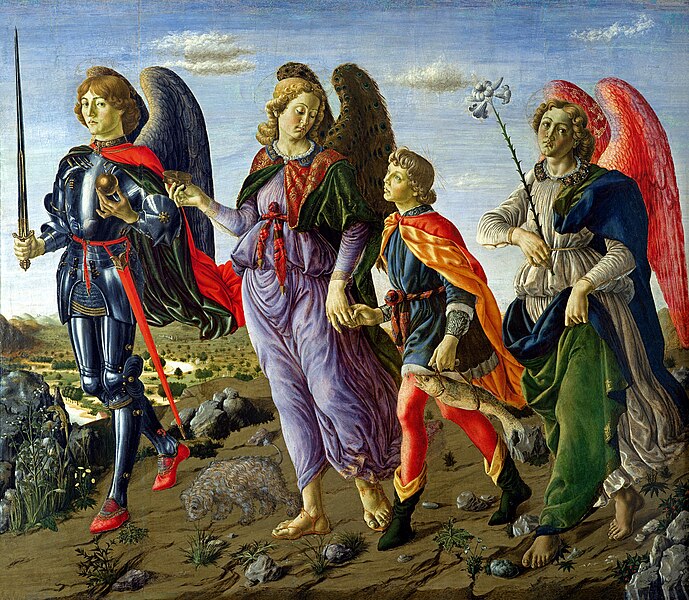
Perhaps no aspect of Catholic piety is as comforting to parents as the belief that an angel protects their little ones from dangers real and imagined. Yet guardian angels are not only for children. Their role is to represent individuals before God, to watch over them always, to aid their prayer, and to present their souls to God at death.
The concept of an angel assigned to guide and nurture each human being is a development of Catholic doctrine and piety based on Scripture but not directly drawn from it. Jesus’ words in Matthew 18:10 best support the belief: “See that you do not despise one of these little ones, for I say to you that their angels in heaven always look upon the face of my heavenly Father.”
Devotion to the angels began to develop with the birth of the monastic tradition. Saint Benedict gave it impetus and Saint Bernard of Clairvaux, the great 12th-century reformer, was such an eloquent spokesman for the guardian angels that angelic devotion assumed its current form in his day.
A feast in honor of the guardian angels was first observed in the 16th century. In 1615, Pope Paul V added it to the Roman calendar.
Reflection
Devotion to the angels is, at base, an expression of faith in God’s enduring love and providential care extended to each person day in and day out.

Disclaimer: Opinions posted on Free Republic are those of the individual posters and do not necessarily represent the opinion of Free Republic or its management. All materials posted herein are protected by copyright law and the exemption for fair use of copyrighted works.
