Posted on 09/01/2021 2:23:01 AM PDT by Cronos
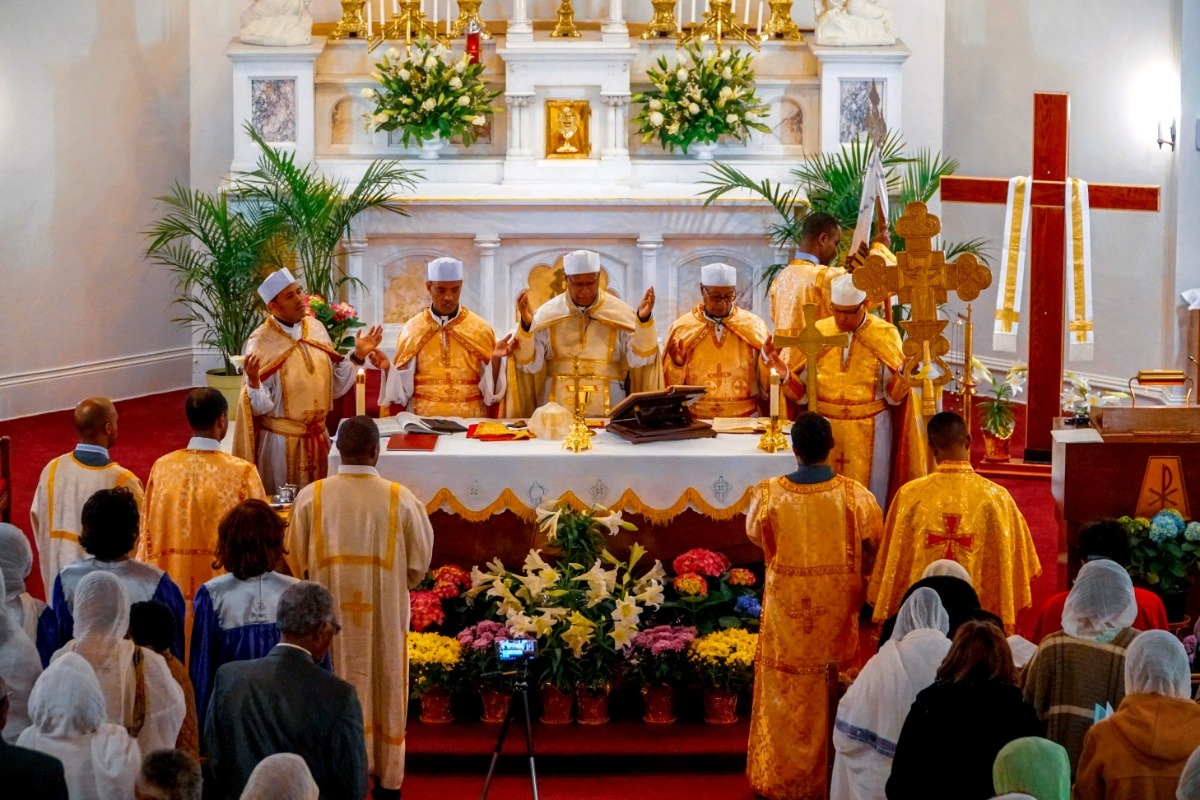
Memorial of Bl. Michael Ghebre of Ethiopia![]() Kidane Mehret Catholic Church, Eritrea
Readings at MassLiturgical Colour: Green
The message of the truth has reached you and is spreading all over the worldFrom Paul, appointed by God to be an apostle of Christ Jesus, and from our brother Timothy to the saints in Colossae, our faithful brothers in Christ: Grace and peace to you from God our Father. We have never failed to remember you in our prayers and to give thanks for you to God, the Father of our Lord Jesus Christ, ever since we heard about your faith in Christ Jesus and the love that you show towards all the saints because of the hope which is stored up for you in heaven. It is only recently that you heard of this, when it was announced in the message of the truth. The Good News which has reached you is spreading all over the world and producing the same results as it has among you ever since the day when you heard about God’s grace and understood what this really is. Epaphras, who taught you, is one of our closest fellow workers and a faithful deputy for us as Christ’s servant, and it was he who told us all about your love in the Spirit.
I trust in the goodness of God for ever and ever. I am like a growing olive tree in the house of God. I trust in the goodness of God for ever and ever. I trust in the goodness of God for ever and ever. I will thank you for evermore; for this is your doing. I will proclaim that your name is good, in the presence of your friends. I trust in the goodness of God for ever and ever.
Alleluia, alleluia! The word of the Lord remains for ever: What is this word? It is the Good News that has been brought to you. Alleluia!
Alleluia, alleluia! The Lord has sent me to bring the good news to the poor, to proclaim liberty to captives. Alleluia!
He would not allow them to speak because they knew he was the ChristLeaving the synagogue, Jesus went to Simon’s house. Now Simon’s mother-in-law was suffering from a high fever and they asked him to do something for her. Leaning over her he rebuked the fever and it left her. And she immediately got up and began to wait on them. At sunset all those who had friends suffering from diseases of one kind or another brought them to him, and laying his hands on each he cured them. Devils too came out of many people, howling, ‘You are the Son of God.’ But he rebuked them and would not allow them to speak because they knew that he was the Christ. When daylight came he left the house and made his way to a lonely place. The crowds went to look for him, and when they had caught up with him they wanted to prevent him leaving them, but he answered, ‘I must proclaim the Good News of the kingdom of God to the other towns too, because that is what I was sent to do.’ And he continued his preaching in the synagogues of Judaea. The readings on this page are from the Jerusalem Bible, which is used at Mass in most of the English-speaking world. The New American Bible readings, which are used at Mass in the United States, are available in the Universalis apps, programs and downloads. |
catholic,prayer,ordinarytime,lk4

38. And he arose out of the synagogue, and entered into Simon’s house. And Simon’s wife’s mother was taken with a great fever: and they besought him for her.
39. And he stood over her, and rebuked the fever: and it left her: and immediately she arose and ministered unto them.
AMBROSE. Luke having first introduced a man delivered from an evil spirit, goes on to relate the healing of a woman. For our Lord had come to heal each sex, and he ought first to be healed who was first created. Hence it is said, And he arose out of the synagogue, and entered into Simon’s house.
CHRYSOSTOM. (Hom. 27. in Matt.) For He honoured His disciples by dwelling among them, and so making them the more zealous.
CYRIL OF ALEXANDRIA. Now see how Christ abides in the house of a poor man, suffering poverty of His own will for our sakes, that we might learn to visit the poor, and despise not the destitute and needy. It follows: And Simon’s wife’s mother was taken with a great fever: and they besought him for her.
BEDE. At one time at the request of others, at another of his own accord, our Saviour cures the sick, shewing that He is far aloof from the passions of sinners, and ever grants the prayer of the faithful, and what they in themselves little understand He either makes intelligible, or forgives their not understanding it. As, Who understands his errors? Lord, cleanse me from my secret faults. (Ps. 19:12.)
CHRYSOSTOM. (ut sup.) Because Matthew is silent on the point of asking Him, he does not differ from Luke, or it matters not, for one Gospel had brevity in view, the other accurate research. It follows: And he stood over her, &c.
ORIGEN. Here Luke speaks figuratively, as of a command given to a sensible being, saying, that the fever was commanded, and neglected not the work of Him who commanded it. Hence it follows: And she arose, and ministered unto them.
CHRYSOSTOM. (ut sup.) For since the disease was curable, He shewed His power by the manner of the cure, doing what art could never do. For after the allaying of the fever, the patient needs much time ere he be restored to his former health, but at this time all took place at once.
AMBROSE. But if we weigh these things with deeper thoughts, we shall consider the health of the mind as well as the body; that the mind which was assailed by the wiles of the devil may be released first. Eve was not a hungered before the serpent beguiled her, and therefore against the author of evil himself ought the medicine of salvation first to operate. Perhaps also in that woman as in a type our flesh languished under the various fevers of crimes, nor should I say that the fever of love was less than that of bodily heat.
BEDE. For if we say that a man released from the devil represents morally the mind cleansed from unclean thoughts, consequently a woman vexed by fever, but cured at our Lord’s command, represents the flesh controlled by the rules of continence in the fury of its own lust.
CYRIL OF ALEXANDRIA. Let us therefore receive Jesus. For when He has visited us, we carry Him in our heart and mind; He will then extinguish the flames of our unlicensed pleasures, and will make us whole, so that we minister unto Him, that is, do things well-pleasing to Him.
4:40–41
40. Now when the sun was setting, all they that had any sick with divers diseases brought them unto him; and he laid his hands on every one of them, and healed them.
41. And devils also came out of many, crying out, and saying, Thou art Christ the Son of God. And he rebuking them suffered them not to speak: for they knew that he was Christ.
THEOPHYLACT. We must observe the zeal of the multitude, who after the sun had set bring their sick unto Him, not deterred by the lateness of the day; as it is said, Now when the sun was setting, they brought their sick.
ORIGEN. It was ordered about sun-set, that is, when the day was gone, that they should bring them out, either because during the day they were employed about other things, or because they thought that it was not lawful to heal on the sabbath. But He healed them, as it follows, But he laid his hands upon every one of them.
CYRIL OF ALEXANDRIA. But although as God He was able to drive away diseases by His word, He nevertheless touches them, shewing that His flesh was powerful to apply remedies, since it was the flesh of God; for as fire, when applied to a brazen vessel, imprints on it the effect of its own heat, so the omnipotent Word of God, when He united to Himself in real assumption a living virgin temple, endued with understanding, implanted in it a participation of His own power. May He also touch us, nay rather may we touch Him, that He may deliver us from the infirmities of our souls as well as the assaults of the evil spirit and pride! For it follows, And devils also came out.
BEDE. The devils confess the Son of God, and as it is afterwards said, they knew him to be Christ; for when the devil saw Him distressed by fasting, he perceived Him to be truly man, but when he prevailed not in his trial he doubted whether or not He were the Son of God, but now by the power of Christ’s miracles he either perceived or suspected Him to be the Son of God. He did not then persuade the Jews to crucify Him because he thought Him not to be Christ or the Son of God, but because he did not foresee that by this death he himself would be condemned. Of this mystery hidden from the world the Apostle says, that none of the princes of this world knew, for if they had known they would never have crucified the Lord of Glory. (1 Cor. 2:8.)
CHRYSOSTOM. But in what follows, And he rebuking them suffered them not to speak, mark the humility of Christ, who would not let the unclean spirits make Him manifest. For it was not fit that they should usurp the glory of the Apostolical office, nor did it become the mysteries of Christ to be made public by impure tongues.
THEOPHYLACT. Because, “praise is not seemly in the mouth of a sinner.” Or, because He did not wish to inflame the envy of the Jews by being praised of all.
BEDE. But the Apostles themselves are commanded to be silent concerning Him, lest by proclaiming His divine Majesty, the dispensation of His Passion should be delayed.
4:42–44
42. And when it was day, he departed and went into a desert place: and the people sought him, and came unto him, and stayed him, that he should not depart from them.
43. And he said unto them, I must preach the kingdom of God to other cities also: for therefore am I sent.
44. And he preached in the synagogues of Galilee.
CHRYSOSTOM. When he had bestowed sufficient favour upon the people by miracles, it was necessary for Him to depart. For miracles are always thought greater when the worker is gone, since they themselves are then the more heeded, and have in their turn a voice; as it is said, But when it was day, he departed, and went.
GREEK EXPOSITOR. (Victor Antiochenus.) He went also into the desert, as Mark says, and prayed; not that he needed prayer, but as an example to us of good works.
CHRYSOSTOM. (Hom. 25. in Matt.) The Pharisees indeed, seeing how that the miracles themselves published His fame, were offended at His power. But the people hearing His words, assented and followed; as it is said, And the multitudes sought him, not indeed any of the chief priests, or scribes, but all those who had not been blackened with the dark stain of malice, and preserved their consciences unhurt.
GREEK EXPOSITOR. (ut sup.) Now when Mark says that the Apostles came to him, saying, All seek thee, but Luke, that the people came, there is no difference between them, for the people came to Him following in the footsteps of the Apostles. But the Lord rejoiced in being held back, yet bid them let Him go, that others also might partake of His teaching, as the time of His presence would not last long; as it follows, And he said unto them, I must preach the kingdom of God to other cities also, &c. Mark says, Unto this I came, shewing the loftiness of His divine nature, and His voluntary emptying Himself of it. But Luke says, Unto this am I sent, shewing His incarnation, and calling also the decree of the Father, a sending Him forth; and one simply says, To preach, the other added, the kingdom of God, which is Christ Himself.
CHRYSOSTOM. (Hom. 48. in Matt.) Observe also, that He might, by abiding in the same place, have drawn all men over to Himself. He did not however do so, giving us an example to go about and seek those who are perishing, as the shepherd his lost sheep, and as the physician the sick. For by recovering one soul, we may be able to blot out a thousand sins. Hence also it follows, And he was preaching in the synagogues of Galilee. He frequently indeed went to the synagogues, to shew them that He was no deceiver. For if He were constantly to dwell in the desolate places, they would spread abroad that He was concealing Himself.
BEDE. But if the sun-setting mystically expresses the death of our Lord, the returning day denotes His resurrection, (the light of which being made manifest, He is sought for by the multitudes of believers, and being found in the desert of the Gentiles He is held back by them, lest He should depart;) especially as this took place on the first day of the week, on which day the Resurrection was celebrated.
38. And he arose out of the synagogue, and entered into Simon’s house. And Simon’s wife’s mother was taken with a great fever: and they besought him for her.
39. And he stood over her, and rebuked the fever: and it left her: and immediately she arose and ministered unto them.
AMBROSE. Luke having first introduced a man delivered from an evil spirit, goes on to relate the healing of a woman. For our Lord had come to heal each sex, and he ought first to be healed who was first created. Hence it is said, And he arose out of the synagogue, and entered into Simon’s house.
CHRYSOSTOM. (Hom. 27. in Matt.) For He honoured His disciples by dwelling among them, and so making them the more zealous.
CYRIL OF ALEXANDRIA. Now see how Christ abides in the house of a poor man, suffering poverty of His own will for our sakes, that we might learn to visit the poor, and despise not the destitute and needy. It follows: And Simon’s wife’s mother was taken with a great fever: and they besought him for her.
BEDE. At one time at the request of others, at another of his own accord, our Saviour cures the sick, shewing that He is far aloof from the passions of sinners, and ever grants the prayer of the faithful, and what they in themselves little understand He either makes intelligible, or forgives their not understanding it. As, Who understands his errors? Lord, cleanse me from my secret faults. (Ps. 19:12.)
CHRYSOSTOM. (ut sup.) Because Matthew is silent on the point of asking Him, he does not differ from Luke, or it matters not, for one Gospel had brevity in view, the other accurate research. It follows: And he stood over her, &c.
ORIGEN. Here Luke speaks figuratively, as of a command given to a sensible being, saying, that the fever was commanded, and neglected not the work of Him who commanded it. Hence it follows: And she arose, and ministered unto them.
CHRYSOSTOM. (ut sup.) For since the disease was curable, He shewed His power by the manner of the cure, doing what art could never do. For after the allaying of the fever, the patient needs much time ere he be restored to his former health, but at this time all took place at once.
AMBROSE. But if we weigh these things with deeper thoughts, we shall consider the health of the mind as well as the body; that the mind which was assailed by the wiles of the devil may be released first. Eve was not a hungered before the serpent beguiled her, and therefore against the author of evil himself ought the medicine of salvation first to operate. Perhaps also in that woman as in a type our flesh languished under the various fevers of crimes, nor should I say that the fever of love was less than that of bodily heat.
BEDE. For if we say that a man released from the devil represents morally the mind cleansed from unclean thoughts, consequently a woman vexed by fever, but cured at our Lord’s command, represents the flesh controlled by the rules of continence in the fury of its own lust.
CYRIL OF ALEXANDRIA. Let us therefore receive Jesus. For when He has visited us, we carry Him in our heart and mind; He will then extinguish the flames of our unlicensed pleasures, and will make us whole, so that we minister unto Him, that is, do things well-pleasing to Him.
4:40–41
40. Now when the sun was setting, all they that had any sick with divers diseases brought them unto him; and he laid his hands on every one of them, and healed them.
41. And devils also came out of many, crying out, and saying, Thou art Christ the Son of God. And he rebuking them suffered them not to speak: for they knew that he was Christ.
THEOPHYLACT. We must observe the zeal of the multitude, who after the sun had set bring their sick unto Him, not deterred by the lateness of the day; as it is said, Now when the sun was setting, they brought their sick.
ORIGEN. It was ordered about sun-set, that is, when the day was gone, that they should bring them out, either because during the day they were employed about other things, or because they thought that it was not lawful to heal on the sabbath. But He healed them, as it follows, But he laid his hands upon every one of them.
CYRIL OF ALEXANDRIA. But although as God He was able to drive away diseases by His word, He nevertheless touches them, shewing that His flesh was powerful to apply remedies, since it was the flesh of God; for as fire, when applied to a brazen vessel, imprints on it the effect of its own heat, so the omnipotent Word of God, when He united to Himself in real assumption a living virgin temple, endued with understanding, implanted in it a participation of His own power. May He also touch us, nay rather may we touch Him, that He may deliver us from the infirmities of our souls as well as the assaults of the evil spirit and pride! For it follows, And devils also came out.
BEDE. The devils confess the Son of God, and as it is afterwards said, they knew him to be Christ; for when the devil saw Him distressed by fasting, he perceived Him to be truly man, but when he prevailed not in his trial he doubted whether or not He were the Son of God, but now by the power of Christ’s miracles he either perceived or suspected Him to be the Son of God. He did not then persuade the Jews to crucify Him because he thought Him not to be Christ or the Son of God, but because he did not foresee that by this death he himself would be condemned. Of this mystery hidden from the world the Apostle says, that none of the princes of this world knew, for if they had known they would never have crucified the Lord of Glory. (1 Cor. 2:8.)
CHRYSOSTOM. But in what follows, And he rebuking them suffered them not to speak, mark the humility of Christ, who would not let the unclean spirits make Him manifest. For it was not fit that they should usurp the glory of the Apostolical office, nor did it become the mysteries of Christ to be made public by impure tongues.
THEOPHYLACT. Because, “praise is not seemly in the mouth of a sinner.” Or, because He did not wish to inflame the envy of the Jews by being praised of all.
BEDE. But the Apostles themselves are commanded to be silent concerning Him, lest by proclaiming His divine Majesty, the dispensation of His Passion should be delayed.
4:42–44
42. And when it was day, he departed and went into a desert place: and the people sought him, and came unto him, and stayed him, that he should not depart from them.
43. And he said unto them, I must preach the kingdom of God to other cities also: for therefore am I sent.
44. And he preached in the synagogues of Galilee.
CHRYSOSTOM. When he had bestowed sufficient favour upon the people by miracles, it was necessary for Him to depart. For miracles are always thought greater when the worker is gone, since they themselves are then the more heeded, and have in their turn a voice; as it is said, But when it was day, he departed, and went.
GREEK EXPOSITOR. (Victor Antiochenus.) He went also into the desert, as Mark says, and prayed; not that he needed prayer, but as an example to us of good works.
CHRYSOSTOM. (Hom. 25. in Matt.) The Pharisees indeed, seeing how that the miracles themselves published His fame, were offended at His power. But the people hearing His words, assented and followed; as it is said, And the multitudes sought him, not indeed any of the chief priests, or scribes, but all those who had not been blackened with the dark stain of malice, and preserved their consciences unhurt.
GREEK EXPOSITOR. (ut sup.) Now when Mark says that the Apostles came to him, saying, All seek thee, but Luke, that the people came, there is no difference between them, for the people came to Him following in the footsteps of the Apostles. But the Lord rejoiced in being held back, yet bid them let Him go, that others also might partake of His teaching, as the time of His presence would not last long; as it follows, And he said unto them, I must preach the kingdom of God to other cities also, &c. Mark says, Unto this I came, shewing the loftiness of His divine nature, and His voluntary emptying Himself of it. But Luke says, Unto this am I sent, shewing His incarnation, and calling also the decree of the Father, a sending Him forth; and one simply says, To preach, the other added, the kingdom of God, which is Christ Himself.
CHRYSOSTOM. (Hom. 48. in Matt.) Observe also, that He might, by abiding in the same place, have drawn all men over to Himself. He did not however do so, giving us an example to go about and seek those who are perishing, as the shepherd his lost sheep, and as the physician the sick. For by recovering one soul, we may be able to blot out a thousand sins. Hence also it follows, And he was preaching in the synagogues of Galilee. He frequently indeed went to the synagogues, to shew them that He was no deceiver. For if He were constantly to dwell in the desolate places, they would spread abroad that He was concealing Himself.
BEDE. But if the sun-setting mystically expresses the death of our Lord, the returning day denotes His resurrection, (the light of which being made manifest, He is sought for by the multitudes of believers, and being found in the desert of the Gentiles He is held back by them, lest He should depart;) especially as this took place on the first day of the week, on which day the Resurrection was celebrated.

Please FReepmail me/annalex to get on/off the Alleluia Ping List.
| Luke | |||
| English: Douay-Rheims | Latin: Vulgata Clementina | Greek NT: Byzantine/Majority Text (2000) | |
| Luke 4 | |||
| 38. | And Jesus rising up out of the synagogue, went into Simon's house. And Simon's wife's mother was taken with a great fever, and they besought him for her. | Surgens autem Jesus de synagoga, introivit in domum Simonis. Socrus autem Simonis tenebatur magnis febribus : et rogaverunt illum pro ea. | αναστας δε εκ της συναγωγης εισηλθεν εις την οικιαν σιμωνος πενθερα δε του σιμωνος ην συνεχομενη πυρετω μεγαλω και ηρωτησαν αυτον περι αυτης |
| 39. | And standing over her, he commanded the fever, and it left her. And immediately rising, she ministered to them. | Et stans super illam imperavit febri : et dimisit illam. Et continuo surgens, ministrabat illis. | και επιστας επανω αυτης επετιμησεν τω πυρετω και αφηκεν αυτην παραχρημα δε αναστασα διηκονει αυτοις |
| 40. | And when the sun was down, all they that had any sick with divers diseases, brought them to him. But he laying his hands on every one of them, healed them. | Cum autem sol occidisset, omnes qui habebant infirmos variis languoribus, ducebant illos ad eum. At ille singulis manus imponens, curabat eos. | δυνοντος δε του ηλιου παντες οσοι ειχον ασθενουντας νοσοις ποικιλαις ηγαγον αυτους προς αυτον ο δε ενι εκαστω αυτων τας χειρας επιθεις εθεραπευσεν αυτους |
| 41. | And devils went out from many, crying out and saying: Thou art the Son of God. And rebuking them he suffered them not to speak, for they knew that he was Christ. | Exibant autem dæmonia a multis clamantia, et dicentia : Quia tu es Filius Dei : et increpans non sinebat ea loqui : quia sciebant ipsum esse Christum. | εξηρχετο δε και δαιμονια απο πολλων κραζοντα και λεγοντα οτι συ ει ο χριστος ο υιος του θεου και επιτιμων ουκ εια αυτα λαλειν οτι ηδεισαν τον χριστον αυτον ειναι |
| 42. | And when it was day, going out he went into a desert place, and the multitudes sought him, and came unto him: and they stayed him that he should not depart from them. | Facta autem die egressus ibat in desertum locum, et turbæ requirebant eum, et venerunt usque ad ipsum : et detinebant illum ne discederet ab eis. | γενομενης δε ημερας εξελθων επορευθη εις ερημον τοπον και οι οχλοι επεζητουν αυτον και ηλθον εως αυτου και κατειχον αυτον του μη πορευεσθαι απ αυτων |
| 43. | To whom he said: To other cities also I must preach the kingdom of God: for therefore am I sent. | Quibus ille ait : Quia et aliis civitatibus oportet me evangelizare regnum Dei : quia ideo missus sum. | ο δε ειπεν προς αυτους οτι και ταις ετεραις πολεσιν ευαγγελισασθαι με δει την βασιλειαν του θεου οτι εις τουτο απεσταλμαι |
| 44. | And he was preaching in the synagogues of Galilee. | Et erat prædicans in synagogis Galilææ. | και ην κηρυσσων εν ταις συναγωγαις της γαλιλαιας |

Ghebre-Michael differs in three ways from the other canonised and beatified members of our Congregation: First, he was African, not European; second, he was not a born Catholic, but an adult convert; and third, he was not actually a confrere.
He was a disciple of Justin de Jacobis for many years, and eventually decided, with Justin’s consent, to become a Vincentian. A date was fixed for him to begin his internal seminary but when the fixed day arrived he was under arrest, and he died before he could carry out his intention. In a letter to the Superior General, Jean-Baptiste Etienne, Justin explained all this but said that he called Ghebre-Michael a Vincentian “because in his heart he already belonged to the Congregation”.
In a certain sense, too, he was not, strictly speaking, a martyr. He was not actually put to death for the faith. He died as a result of the long harsh treatment he had received.
The prefix Ghebre means “the servant of” and is always followed by the name of a saint; this combination is a very common form of name in Ethiopia and Eritrea. “Ghebre” cannot be separated from “Michael” and used as if it were a first name.
Ghebre-Michael was born about 1790. At an early age he lost one eye in an accident, and in his culture that rendered him unfit for most types of work. He received some education and then entered a monastery, where he showed himself to be a gifted student. He was not, however, preparing for ordination to the priesthood as most Ethiopian monks were not priests. His great interest was the history of monasticism. He saw, from his own experience, that there had been a great lowering of standards in Ethiopian monasteries, and he wished to do further research into the reasons for this, and his superiors commissioned him to do so. This gave him the authority to travel around the country visiting various monasteries and studying their practices and doing research in the manuscripts in their libraries. In each monastery which he visited he formed a small group of monks who had the same outlook as himself and he instructed them, and when he left to continue his travels they remained as a nucleus of monastic reform. As his research progressed he gradually came to see that the real problem behind the deterioration of monastic standards was the poor theological formation of the monks.
This realisation led him to the conclusion that the answer to the theological problems would not be found in Ethiopia, and he decided that he would have to go to Jerusalem to continue his research. He intended to make this journey alone, because no one else was going for the same purpose as himself. But just at the time he was thinking about this an unexpected thing happened.
In Ethiopia in those days there was always only one Orthodox bishop, appointed by the Coptic Patriarch of Alexandria. The position was vacant in 1840-41 and a delegation was being formed to go to Alexandria and request the Patriarch to give them a new bishop. The delegation intended to visit Jerusalem and because of that Ghebre-Michael joined the group.
A most extraordinary thing about this delegation is that Justin was invited to be part of it, which indicates the esteem in which he was held by that time. He was reluctant to accept, since the purpose of the journey was to bring back a new Orthodox bishop. He compromised by agreeing to go if the delegation agreed to visit Rome on the way back; he thought that this might lead to a lessening of the opposition which the Orthodox Ethiopians had to the Catholic Church. This condition was agreed to. The delegation arrived in Alexandria and to their annoyance and amazement they were given a most unsuitable new bishop, who had been educated by Protestants. He would cause Justin and the Catholics a huge amount of trouble and be responsible for the death of Ghebre-Michael. After Alexandria the group went to Rome, and then to Jerusalem on their way back to Ethiopia.
Some years ago, when I was doing some research in the archives of the archdiocese of Dublin on something completely different I came across a letter referring to the arrival of this delegation in Rome. The letter was written to the Archbishop of Dublin by the rector of the Irish College in Rome,
Paul Cullen, who would himself later become Cardinal Archbishop of Dublin,in a letter dated 19 August 1841 contain the following paragraph:
The reference to four or five young men staying on in Rome to study for the priesthood is interesting, and is not in Salvatore Pane’s thousand page biography of Justin when he deals with the delegation’s stay in Rome. It would seem to have happened because the young men had been impressed with what they saw of Justin during the long journey. I do not think that he had planned things to turn out in this way. Also, Cullen is not correct in thinking that the purpose of the delegation was to make their submission, and that of their prince, to the Holy See. Obviously some breakdown in communication had occurred if the Roman authorities thought that that was the purpose of the visit.
It was on this journey that Ghebre-Michael first came into contact with Justin. His initial reaction was the typical Orthodox one of suspicion and mistrust, simply because he was a Catholic priest. However, as he lived in his company day after day on the journey he gradually came to admire Justin for his obvious holiness, his prayer and his way of dealing with people and situations.
In his search for theological truth Ghebre-Michael had found that many Orthodox monks and priests became his opponents or even enemies. Because of this Justin advised him to separate himself from the main group for the return journey, and to travel home by a different route, alone. He took this advice. This was in mid-1843. His great dream had been to convert the new bishop to his own way of thinking about theological truth, and in that way lead the whole country back to the truth. After a meeting with the new bishop he saw clearly that this vision was not going to be realised. The bishop did not share his desire for theological truth, and as well as this he had a personal political agenda. The bishop saw that this monk was going to be a very dangerous opponent of his plans, and on one occasion some of the bishop’s followers tried to poison Ghebre-Michael. This plan failed because the monk had known that this would be a possibility and so he always had the antidote to the usual poison used on such occasions.
Since his meeting with the bishop was a total failure, as regards his vision of a wholesale return of the country to theological truth, Ghebre-Michael decided to seek another interview with Justin. Remember, the monk’s vision of truth was the original truth of the Orthodox Church, not that of the Catholic Church. The two men met in September 1843. The delegation had returned to the Red Sea port of Massawa in April 1842, and Justin was back in his own area in May. This means that it was more than a year after their return that Ghebre-Michael sought out Justin for a meeting. The main point of the meeting was that the monk told Justin that he had made up his mind to become a Catholic. At this time, September 1843, thirty-seven Ethiopians had been received into the Catholic Church, with ten more under instruction.
Justin and the monk had many discussions over a period of about six months, and they visited many monasteries together to study ancient manuscripts. Eventually, in February 1844 Justin received Ghebre-Michael into the Catholic Church. This led to about six other monks asking to be received as well.
At this time, 1844, five years after his arrival, Justin did not have any permanent central residence, and he decided to establish one. He selected the village of Guala, and sent Ghebre-Michael and two other converts there to assess its suitability as a Catholic headquarters. The local people gave them a good welcome and in December 1844 they were able to acquire some land and build a residence. They arranged religion classes for the local people, with Ghebre-Michael being the contact man for monks and priests who wished to discuss religious matters or to become Catholics. The people also handed over the village church to them.
In the following years there was some persecution of Catholics, instigated by the new Orthodox bishop, and at one stage Ghebre-Michael was imprisoned for a few months.
In 1850, six years after Ghebre-Michael’s reception into the Church, Justin raised with him something he had been considering for quite a while, namely that the monk give some thought to the question of his becoming a priest. As I mentioned earlier, most Ethiopian monks were not priests. As the suggestion came from Justin, Ghebre-Michael agreed with it. He was ordained a Catholic priest by Justin on 1 January 1851.
Almost since his arrival in Ethiopia Justin had had doubts about the validity of sacraments administered by Ethiopian Orthodox priests. In fact, he was even doubtful about the validity of the ordination rite for diaconate and priesthood. He gave this matter a lot of thought and prayer, and also studied as much as he could the sources of Ethiopian sacramental theology. Later still he began to have doubts about the validity of Ethiopian baptism. In the specific case of Ghebre-Michael he had doubts about the validity of his baptism. If his baptism had not been valid, then neither had his ordination as it would have been conferred on an unbaptised man. He explained his doubts to Ghebre-Michael, who saw their significance. As a result of these reflections, Justin baptised and ordained Ghebre-Michael conditionally. “Conditionally” when referring to the administration of sacraments means they are administered with the condition “If you are not already baptised…, etc”. This conditional baptism and ordination took place early in 1854.
In July of that year Justin, Ghebre-Michael and four other converts were arrested and imprisoned, Justin being kept separate from the others. The Ethiopians had their legs thrust through a hole in a log and kept there with wooden wedges. The prisoners were able to communicate with each other by writing. The purpose of this imprisonment and torture was to persuade the converts to renounce Catholicism. The Orthodox bishop was particularly anxious to get rid of Justin, and he had him sent into exile. On the last stage of the journey to the coast there was a change of soldiers guarding Justin. The new guards were Moslems and, unlike the previous guards, were able to read the letter which the bishop had written in Arabic. In the letter the bishop asked that Justin be killed. When the guards read this they released him. Justin went back, and resumed contact by letter with the other prisoners. Towards the end of 1854 the bishop made another fierce effort by torture to get the prisoners to apostatise, but was not successful.
A new emperor of Ethiopia was crowned in February 1855, and part of his policy was religious uniformity all over Ethiopia. This new ruler also tortured Ghebre-Michael in an attempt to get him to apostatise, but without success. The emperor kept him in chains and brought him along wherever he went. In May 1855 the British Consul visited the new emperor, and the emperor decided to put the monk on trial in the presence of the consul. Once again he refused to apostatise, and the court decided that he should be executed by being shot. The British Consul asked for his life to be spared, and the emperor agreed. However, he was still kept in chains and brought along with the emperor’s army. As a result of all the harsh treatment he died on 28 August 1855. He was buried where he died, at the side of the road under a cedar tree, but the exact spot has never been identified since
Some years later Justin sent a drawing of Ghebre-Michael to Jean-Baptiste Etienne, the Superior General. In the accompanying letter he wrote:
I beg you to accept the picture which I have the honour to send you. It catches the likeness of the subject so exactly that when you take into account the lack of skill in the matter of drawing on the part of the Abyssinian priest who did it you have to admit that it is really an extraordinary picture. To this picture of the Abyssinian martyr Ghebre-Michael I have added an inscription in Latin in which I refer to him as a Vincentian seminarist. In fact he was only a postulant because the time of his vocation could be counted only from the moment when he would have begun his intern seminary; by the date which had been arranged he was already in prison; however, in his heart he already belonged to the Congregation.
Ghebre-Michael was beatified as a martyr in 1926.
Justin himself had five more years to live after Ghebre-Michael’s death. In May 1855, some months before that event, he had had to go into enforced exile at Moncullo on the Red Sea coast. This town was on the mainland, opposite the island of Massawa which was the main point of entry to Ethiopia and a stopping place for many ships trading in that area. Justin had had the idea of building a Catholic church in Moncullo to cater for Christians who might come to the port. The area was under Turkish rule and a French Vincentian was negotiator with the government. Permission was given to build the church.
The following information in Italian is found on the the site of the Postulator General of the Congregation of the Mission http://www.vincenziani.com/santi.htm We would welcome a translation. Please contact freundj@gmail.com
Nato in un villaggio del Goggiam, in Etiopia, e dotato di acuta intelligenza, si adoperò nella ricerca della verità e la trovò in tutta la sua pienezza con l'aiuto di S. Giustino de Jacobis, il quale lo accolse nella comunione della Chiesa Cattolica. Perseguitato, resistette con fede salda e dallo stesso De Jacobis fu ordinato sacerdote il 1° gennaio 1851. Soggetto a nuove persecuzioni, morì il 13 luglio 1855, a circa settant'anni di età. Fu beatificato il 3 ottobre 1926. La sua memoria liturgica si celebra il 30 agosto. Leggi qui un suo più articolato profilo biografico.

The Navarre Bible Commentary will be posted later today as I am on the road and away from my computer. Sorry for the inconvenience.
Ad Majorem Dei Gloriam (To the Greater Glory of God)
From: Colossians 1:1-8
Greeting
--------
[1] Paul, an apostle of Christ Jesus by the will of God, and Timothy our brother, [2] To the saints and faithful brethren in Christ at Colossae: Grace to you and peace from God our Father.
Thanksgiving for the Colossians' Response to the Gospel
-------------------------------------------------------
[3] We always thank God, the Father of our Lord Jesus Christ, when we pray for you, because we have read of your faith in Christ Jesus and of the love which you have for all the saints, [5] because of the hope laid up for you in heaven. Of this you have heard before in the word of the truth, the gospel [6] which has come to you, as indeed in the whole world it is bearing fruit and growing--so among yourselves, from the day you heard and understood the grace of God in truth, [7] as you learned it from Epaphras our beloved fellow servant. He is a faithful minister of Christ on our behalf [8] and has made known to us your love in the Spirit.
***********************************************************************
Commentary:
1-2. The city of Colossae, as has already been mentioned in the Introduction, lay in the valley of the Lycus river, in Phrygia, a region in the west central part of Anatolia (modern Turkey).
Timothy--whose mother was Jewish and whose father was Greek—was already a Christian when St Paul met him in Lystra (cf. Acts 16: 1-2). He readily agreed to go with Paul and Tom that point onwards he was one of the Apostle's most faithful co-workers. Sometimes we see him accompanying Paul (cf. Acts 20:4), and at other times Paul is sending him off on a special mission (cf. Acts 19:22). When St Paul is writing to the Colossians from his Roman prison, Timothy is by his side and joins him in sending greetings.
Later on, the Apostle will entrust Timothy with the overseeing of the church of Ephesus, and in that capacity he will send him two letters, which form part of the canon of the New Testament.
On the greeting "grace and peace", see the note on Eph 1:2.
3-16. Epaphras, who was probably born in Colossae, must have come to know St Paul during his stay in Ephesus and been convened after receiving instruction from the Apostle. After being baptized he preached the Gospel to his fellow-citizens. The combination of grace and his own effort make his preaching very effective. However, due to certain false apostles of a Judaizing tendency, errors of a pre-Gnostic and syncretist type began to gain ground among the Colossians, to the detriment of their faith (cf. p. 152 above).
St Paul writes the epistle after receiving a report from Epaphras on the Church in Colossae (v. 9). Although the news Epaphras brought was on the whole good (vv. 3-5), the Apostle feels that the false doctrines being spread among the Colossians are a danger to their faith: the faith that they hold, which they learned from Epaphras, a loyal minister of Jesus Christ, is the true one.
3-5. St Paul expresses his gratitude to God for all the graces and benefits he has given the Colossians and for the way they have responded to them. He picks out the three theological virtues--faith, charity, and hope and emphasizes the importance of hope as a support for faith and fraternal love. In this regard, St J. Escriva says in a homily, "I have seen many souls with such hope in God that they are aflame with love, with a fire that makes the heart beat strong and keeps it safe from discouragement and dejection, even though along the way they may suffer and at times suffer greatly" (Friends of God, 205).
7. "On our behalf" (cf. RSV note): many important manuscripts read this as "on your behalf", but "on our behalf" parallels the "for us" of the New Vulgate, meaning that Epaphras is a minister of Christ who faithfully substitutes for Paul in his apostolic work among the Colossians.
8. "Your love in the Spirit": this may refer either to the theological virtue of charity or to the love which the faithful, under the influence of the Holy Spirit, have for the Apostle.
The Cure of Peter's Mother-In-Law
---------------------------------
[38] And He (Jesus) arose and left the synagogue, and entered Simon's house. Now Simon's mother-in-law was ill with a high fever, and they besought Him for her. [39] And He stood over her and rebuked the fever, and it left her; and immediately she rose and served them.
Other Cures
-----------
[40] Now when the sun was setting, all those who had any that were sick with various diseases brought them to Him; and He laid His hands on every one of them and healed them. [41] And demons also came out of many, crying, "You are the Son of God!" But He rebuked them, and would not allow them to speak, because they knew that He was the Christ.
Jesus Preaches in Other Cities in Judea
---------------------------------------
[42] And when it was day He departed and went into a lonely place. And the people sought Him and came to Him, and would have kept Him from leaving them; [43] but He said to them, "I must preach the Good News of the Kingdom of God to the other cities also; for I was sent for this purpose." [44] And He was preaching in the synagogues of Judea.
***********************************************************************
Commentary:
38-39. In the public life of Jesus we find many touching episodes (cf. for example Luke 19:1; John 2:1) which show the high regard He had for everyday family life.
Here we can clearly see the effectiveness of prayer on behalf of other people: "No sooner did they pray to the Savior", St. Jerome says, "than He immediately healed the sick; from this we learn that He also listens to the prayers of the faithful for help against sinful passions" (Expositio In Evangelium Sec. Lucam, in loc.).
St. John Chrysostom refers to this total, instantaneous cure: "Since this was a curable type of illness He displayed His power through the way He brought healing, doing what medicine could not do. Even after being cured of fever, patients need time to recover their former strength, but here the cure was instantaneous" (Hom. on St. Matthew, 27).
The Fathers saw in this lady's fever a symbol of concupiscence: "Peter's mother-in-law's fever represents our flesh affected by various illnesses and concupiscences; our fever is passion, our fever is lust, our fever is anger--vices which, although they affect the body, perturb the soul, the mind and the feelings" (St. Ambrose, Expositio Evangelii Sec. Lucam, in loc.).
On the practical consequences of this St. Cyril says: "Let us receive Jesus Christ, because when He visits us and we take Him into our minds and hearts, even our worst passions are extinguished and we are kept safe to serve Him, that is, to do what pleases Him" (Hom. 28 In Mattheum).
43. Our Lord again stresses one of the reasons why He has come into the world. St. Thomas, when discussing the purpose of the Eucharist, says that Christ "came into the world, first, to make the truth known, as He Himself says: `for this I was born, and for this I have come into the world, to bear witness to the truth' (John 18:37). Hence it was not fitting that He should hide Himself by leading a solitary life, but rather that He should appear openly and preach in public. For this reason He tells those who wanted to detain Him, `I must preach the Good News of the Kingdom of God to the other cities also; for I was sent for this purpose.' Secondly, He came in order to free men from sin; as the Apostle says, `Christ Jesus came into the world to save sinners' (1 Timothy 1:15). This is why Chrysostom says, `Although Christ might, while staying in the same place, have drawn all men to Himself to hear His preaching, He did not do so--in order to give us the example to go out and seek the lost sheep, as the shepherd does, or as the doctor does, who visits the sick person.' Thirdly, He came so that `we might obtain access to God' (Romans 5:2)" (Summa Theologiae, III, q. 40, a. 1, c.).
Disclaimer: Opinions posted on Free Republic are those of the individual posters and do not necessarily represent the opinion of Free Republic or its management. All materials posted herein are protected by copyright law and the exemption for fair use of copyrighted works.