Posted on 08/09/2021 2:24:03 AM PDT by Cronos
Memorial of St. Teresa Benedicta of the Cross![]() Sint Pieterskirk, Leuven, Belgium
Readings at MassLiturgical Colour: Green
The Lord your God is God of gods and Lord of lordsMoses said to the people: ‘Now, Israel, what does the Lord your God ask of you? Only this: to fear the Lord your God, to follow all his ways, to love him, to serve the Lord your God with all your heart and all your soul, to keep the commandments and laws of the Lord that for your good I lay down for you today. ‘To the Lord your God belong indeed heaven and the heaven of heavens, the earth and all it contains; yet it was on your fathers that the Lord set his heart for love of them, and after them of all the nations chose their descendants, you yourselves, up to the present day. Circumcise your heart then and be obstinate no longer; for the Lord your God is God of gods and Lord of lords, the great God, triumphant and terrible, never partial, never to be bribed. It is he who sees justice done for the orphan and the widow, who loves the stranger and gives him food and clothing. Love the stranger then, for you were strangers in the land of Egypt. It is the Lord your God you must fear and serve; you must cling to him; in his name take your oaths. He it is you must praise, he is your God: for you he has done these great and terrible things you have seen with your own eyes; and though your fathers numbered only seventy when they went down to Egypt, the Lord your God has made you as many as the stars of heaven.’
O praise the Lord, Jerusalem! or Alleluia! O praise the Lord, Jerusalem! Zion, praise your God! He has strengthened the bars of your gates he has blessed the children within you. O praise the Lord, Jerusalem! or Alleluia! He established peace on your borders, he feeds you with finest wheat. He sends out his word to the earth and swiftly runs his command. O praise the Lord, Jerusalem! or Alleluia! He makes his word known to Jacob, to Israel his laws and decrees. He has not dealt thus with other nations; he has not taught them his decrees. O praise the Lord, Jerusalem! or Alleluia!
Alleluia, alleluia! O praise the Lord, Jerusalem! He sends out his word to the earth. Alleluia!
Alleluia, alleluia! Through the Good News God called us to share the glory of our Lord Jesus Christ. Alleluia!
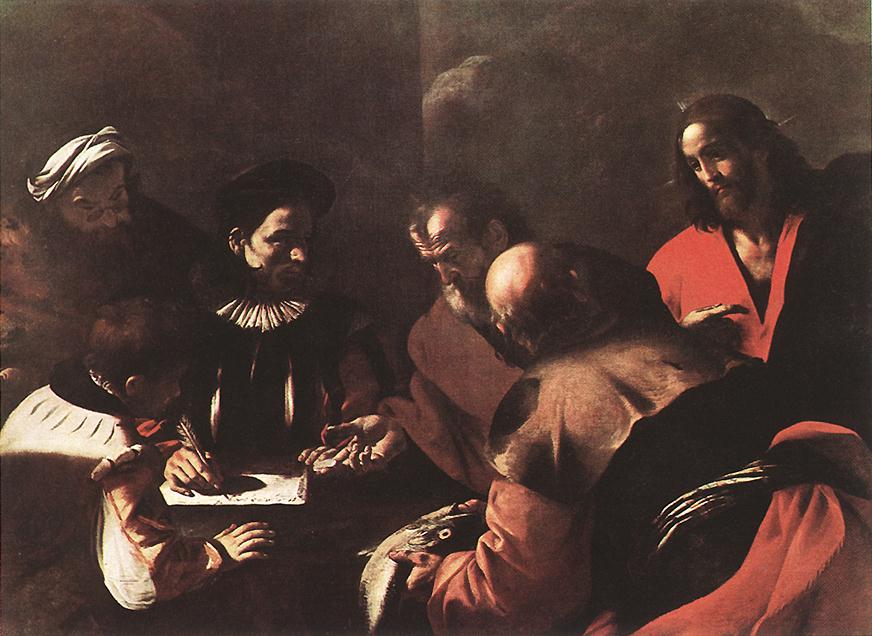
'They will put the Son of Man to death'One day when they were together in Galilee, Jesus said to his disciples, ‘The Son of Man is going to be handed over into the power of men; they will put him to death, and on the third day he will be raised to life again.’ And a great sadness came over them. When they reached Capernaum, the collectors of the half-shekel came to Peter and said, ‘Does your master not pay the half-shekel?’ ‘Oh yes’ he replied, and went into the house. But before he could speak, Jesus said, ‘Simon, what is your opinion? From whom do the kings of the earth take toll or tribute? From their sons or from foreigners?’ And when he replied, ‘From foreigners’, Jesus said, ‘Well then, the sons are exempt. However, so as not to offend these people, go to the lake and cast a hook; take the first fish that bites, open its mouth and there you will find a shekel; take it and give it to them for me and for you.’ The readings on this page are from the Jerusalem Bible, which is used at Mass in most of the English-speaking world. The New American Bible readings, which are used at Mass in the United States, are available in the Universalis apps, programs and downloads. |
catholic,prayer,ordinarytime,mt17

22. And while they abode in Galilee, Jesus said unto them, The Son of man shall be betrayed into the hands of men.
23. And they shall kill him, and the third day he shall he raised again. And they were exceeding sorry.
REMIGIUS. The Lord often foretold to His disciples the mysteries of His passion, in order that when they come to pass, they might be the lighter to them from having been known beforehand.
ORIGEN. This seems to be so like a warning He had given above, that a man might easily say that the Lord now repeated what He had said before; yet is it not so; He had not before said that He must be betrayed, but we hear now not only that He must be betrayed, but that He must be betrayed into the hands of men. The Son of Man indeed was delivered up by God the Father according to the Apostle (Rom. 8:32.), but different powers gave him up into the hands of men.
JEROME. Thus does He ever mix the joyful and the grievous; if it grieves them that He is to be put to death, they ought to be gladdened when they hear, And shall rise again the third day.
CHRYSOSTOM. For this is no long time that He speaks of continuing in death, when He says that He shall rise again on the third day.
ORIGEN. By this announcement of the Lord the disciples were made very sorrowful, not attending to that He said, And shall rise again the third day, nor considering what He must be to whom the space of three days was enough to destroy death.
JEROME. That they were thus made exceeding sorrowful, came not of their lack of faith; but out of their love of their Master they could not endure to hear of any hurt or indignity for Him.
17:24–27
24. And when they were come to Capernaum, they that received tribute money came to Peter, and said, Doth not your master pay tribute?
25. He saith, Yes. And when he was come into the house, Jesus prevented him, saying, What thinkest thou, Simon? of whom do the kings of the earth take custom or tribute? of their own children, or of strangers?
26. Peter saith unto him, Of strangers. Jesus saith unto him, Then are the children free.
27. Notwithstanding, lest we should offend them, go thou to the sea, and cast an hook, and take up the fish that first cometh up; and when thou hast opened his mouth, thou shalt find a piece of money: that take, and give unto them for me and thee.
GLOSS. (non occ.) The disciples were exceeding sorrowful when they heard of the Lord’s passion, and therefore that none might ascribe His suffering to compulsion, and not to a voluntary Submission, he adds an incident which instances Christ’s power, and is submission; And when they were come to Capernaum, there came to Peter those who received the didrachma, and said unto him, Doth not your Master pay the didrachma?
HILARY. The Lord is called upon to pay the didrachma, (that is, two denarii,) for this the Law had enjoined upon all Israel for the redemption of their body and soul, and the use of those that served in the temple.
CHRYSOSTOM. For when God slew the firstborn of Egypt, He then accepted the tribe of Levi for them. (Numb. 3:44.) But because the numbers of this tribe were less than the number of firstborn among the Jews, it was ordained that redemption money should be paid for the number that came short; and thence sprang the custom of paying this tax. Because then Christ was a firstborn son, and Peter seemed to be the first among the disciples, they came to him. And as it seems to me this was not demanded in every district, they come to Christ in Capernaum, because that was considered His native place.
JEROME. Or otherwise; From the time of Augustus Cæsar Judæa was made tributary, and all the inhabitants were registered, as Joseph with Mary his kinswoman gave in His name at Bethlehem. Again, because the Lord was brought up at Nazareth, which is a town of Galilee subject to Capernaum, it is there that the tribute is asked of Him; but for that His miracles were so great, those who collected it did not dare to ask Himself, but make up to the disciple.
CHRYSOSTOM. And him they address not with boldness, but courteously; for they do not arraign, but ask a question, Doth not your Master pay the didrachma?
JEROME. Or, They enquire with malicious purpose whether He pays tribute, or resists Caesar’s will.
CHRYSOSTOM. What then does Peter say? He saith, Yea. To these then he said that He did pay, but to Christ he said not so, blushing perhaps to speak of such matters.
GLOSS. (ap. Anselm.) Otherwise; Peter answered, Yea; meaning, yea, He does not pay. And Peter sought to acquaint the Lord that the Herodians had demanded tribute, but the Lord prevented him; as it follows, And when he had entered into the house, Jesus prevented him, saying, Of whom do the kings of the earth receive custom or tribute, (i. e. head-money,) of their children, or of strangers?
JEROME. Before any hint from Peter, the Lord puts the question to him, that His disciples might not be offended at the demand of tribute, when they, see that He knows even those things that are done in His absence. It follows, But he said, From strangers; Jesus said unto him, Then are the children free.
ORIGEN. This speech has a twofold meaning. First, that the children of the kings of the earth are free with the kings of the earth; but strangers, foreigners in the land, are not free, because of those that oppress them, as the Egyptians did the children of Israel. The second sense is; forasmuch as there be some who are strangers to the sons of the kings of the earth, and are yet sons of God, therefore it is they that abide in the words of Jesus; these are free, for they have known the truth, and the truth has set them free from the service of sin; but the sons of the kings of the earth are not free; for whoso doth sin, he is the servant of sin. (John 8:34.)
JEROME. But our Lord was the son of the king, both according to the flesh, and according to the Spirit; whether as sprung of the seed of David, or as the Word of the Almighty Father; therefore as the king’s son He owed no tribute.
AUGUSTINE. (Quæst. Ev. i. 23.) For, saith He, in every kingdom the children are free, that is, not under tax. Much more therefore should they be free in any earthly kingdom, who are children of that very kingdom under which are all the kingdoms of the earth.
CHRYSOSTOM. But this instance were brought to no purpose if He were not a son. But some one may say, He is son indeed, but not an own son. But then He were a stranger; and so this instance would not apply; for He speaks only of own sons, distinct from whom He calls them strangers who are actually born of parents. Mark how here also Christ certifies that relationship which was revealed to Peter from God, Thou art Christ, the Son of the living God.
JEROME. Howsoever free then He was, yet seeing He had taken to Him lowliness of the flesh, He ought to fulfil all righteousness; whence it follows, But that they should not be offended, go to the sea.
ORIGEN. We may hence gather as a consequence of this, that when any come with justice demanding our earthly goods, it is the kings of the earth that send them, to claim of us what is their own; and by His own example the Lord forbids any offence to be given even to these, whether that they should sin no more, or that they should be saved. For the Son of God, who did no servile work, yet as having the form of a slave, which He took on Him for man’s sake, gave custom and tribute.
JEROME. I am at a loss what first to admire in this passage; whether the foreknowledge, or the mighty power of the Saviour. His foreknowledge, in that He knew that a fish had a stater in its mouth, and that that fish should be the first taken; His mighty power, if the stater were created in the fish’s mouth at His word, and if by His command that which was to happen was ordered. Christ then, for His eminent love, endured the cross, and paid tribute; how wretched we who are called by the name of Christ, though we do nothing worthy of so great dignity, yet in respect of His majesty, pay no tribute, but are exempt from tax as the King’s sons. But even in its literal import it edifies the hearer to learn, that so great was the Lord’s poverty, that He had not whence to pay the tribute for Himself and His Apostle. Should any object that Judas bore money in a bag, we shall answer, Jesus held it a fraud to divert that which was the poor’s to His own use, and left us an example therein.
CHRYSOSTOM. Or He does not direct it to be paid out of that they had at hand, that He might shew that He was Lord also of the sea and the fish.
GLOSS. (non occ.) Or because Jesus had not any image of Cæsar, (for the prince of this world had nothing in Him,) therefore He furnished an image of Cæsar, not out of their own stock, but out of the sea. But He takes not the stater into His own possession, that there should never be found an image of Cæsar upon the Image of the invisible God.
CHRYSOSTOM. Observe also the wisdom of Christ; He neither refuses the tribute, nor merely commands that it be paid, but first proves that He is of right exempt, and then bids to give the money; the money was paid to avoid offence to the collectors; the vindication of His exemption was to avoid the offence to the disciples. Indeed in another place He disregards the offence of the Pharisees, in disputing of meats; teaching us herein to know the seasons in which we must attend to, and those in which we must slight the thoughts of, those who are like to be scandalized.
GREGORY. (in Ezech. 7. 4.) For we must cast about how, as far as we may without sin, to avoid giving scandal to our neighbours. But if offence is taken from truth, it is better that offence should come, though truth be forsaken.
CHRYSOSTOM. As you wonder at Christ’s power, so admire Peter’s faith, who was obedient in no easy matter. In reward of his faith he was joined with his Lord in the payment. An abundant honour! Thou shall find a stater, that take and give unto them for thee and for me.
GLOSS. (ap. Anselm.) For by custom every several man paid a didrachma for himself; now a stater is equal to two didrachmas.
ORIGEN. Mystically; In the field of comfort, (for so is Capernaum expounded,) He comforts each one of His disciples, and pronounces him to be a son and free, and gives him the power of taking the first fish, that after His ascension Peter may have comfort over that which he has caught.
HILARY. When Peter is instructed to take the first fish, it is shewn therein that he shall catch more than one. The blessed first martyr Stephen was the first that came up, having in his mouth a stater, which contained the didrachma of the new preaching, divided as two denarii, for he preached as he beheld in his passion the glory of God, and Christ the Lord.
JEROME. Or; That fish which was first taken is the first Adam, who is set free by the second Adam; and that which is found in his mouth, that is, in his confession, is given for Peter and for the Lord.
ORIGEN. And when you see any miser rebuked by some Peter who takes the speech of his money out of his mouth, you may say that he is risen out of the sea of covetousness to the hook of reason, and is caught and saved by some Peter, who has taught him the truth, that he should change his stater for the image of God, that is for the oracles of God.
JEROME. And beautifully is this very stater given for the tribute; but it is divided; for Peter as for a sinner a ransom is to be paid, but the Lord had not sin. Yet herein is shewn the likeness of their flesh, when the Lord and His servants are redeemed with the same price.
Please FReepmail me/annalex to get on/off the Alleluia Ping List.
Feel free to add your content, so long as it conforms with the rules of the Catholic Caucus.

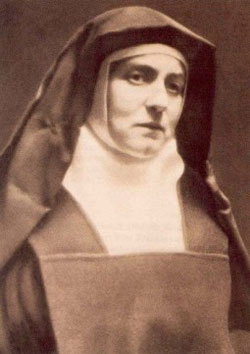
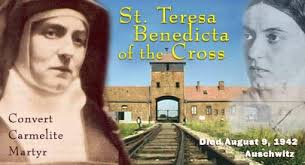
Saint Teresa Benedicta of the Cross (Edith Stein)Virgin and Martyr Edith Stein, born in 1891 in Breslau, Poland, was the youngest child of a large Jewish family.
She was an outstanding student and was well versed in philosophy with a particular interest in phenomenology. Eventually she became interested in the Catholic Faith, and in 1922, she was baptized at the Cathedral Church in Cologne, Germany. Eleven years later Edith entered the Cologne Carmel. Because of the ramifications of politics in Germany, Edith, whose name in religion was Teresa Benedicta of the Cross, was sent to the Carmel at Echt, Holland.
When the Nazis conquered Holland, Teresa was arrested, and, with her sister Rose, was sent to the concentration camp at Auschwitz. Teresa died in the gas chambers of Auschwitz in 1942

at the age of fifty-one. In 1987, she was beatified in the large outdoor soccer stadium in Cologne by Pope John Paul II. Out of the unspeakable human suffering caused by the Nazis in western Europe in the 1930's and 1940's, there blossomed the beautiful life of dedication, consecration, prayer, fasting, and penance of Saint Teresa. Even though her life was snuffed out by the satanic evil of genocide, her memory stands as a light undimmed in the midst of evil, darkness, and suffering. She was canonized on October 11, 1998.
| Matthew | |||
| English: Douay-Rheims | Latin: Vulgata Clementina | Greek NT: Byzantine/Majority Text (2000) | |
| Matthew 17 | |||
| 22. | 17:21 And when they abode together in Galilee, Jesus said to them: The Son of man shall be betrayed into the hands of men: | 17:21 Conversantibus autem eis in Galilæa, dixit illis Jesus : Filius hominis tradendus est in manus hominum : | αναστρεφομενων δε αυτων εν τη γαλιλαια ειπεν αυτοις ο ιησους μελλει ο υιος του ανθρωπου παραδιδοσθαι εις χειρας ανθρωπων |
| 23. | 17:22 And they shall kill him, and the third day he shall rise again. And they were troubled exceedingly. | 17:22 et occident eum, et tertia die resurget. Et contristati sunt vehementer. | και αποκτενουσιν αυτον και τη τριτη ημερα εγερθησεται και ελυπηθησαν σφοδρα |
| 24. | 17:23 And when they were come to Capharnaum, they that recieved the didrachmas, came to Peter and said to him: Doth not your master pay the didrachmas? | 17:23 Et cum venissent Capharnaum, accesserunt qui didrachma accipiebant ad Petrum, et dixerunt ei : Magister vester non solvit didrachma ? | ελθοντων δε αυτων εις καπερναουμ προσηλθον οι τα διδραχμα λαμβανοντες τω πετρω και ειπον ο διδασκαλος υμων ου τελει τα διδραχμα |
| 25. | 17:24 He said: Yes. And when he was come into the house, Jesus prevented him, saying: What is thy opinion, Simon? The kings of the earth, of whom do they receive tribute or custom? of their own children, or of strangers? | 17:24 Ait : Etiam. Et cum intrasset in domum, prævenit eum Jesus, dicens : Quid tibi videtur Simon ? reges terræ a quibus accipiunt tributum vel censum ? a filiis suis, an ab alienis ? | λεγει ναι και οτε εισηλθεν εις την οικιαν προεφθασεν αυτον ο ιησους λεγων τι σοι δοκει σιμων οι βασιλεις της γης απο τινων λαμβανουσιν τελη η κηνσον απο των υιων αυτων η απο των αλλοτριων |
| 26. | 17:25 And he said: Of strangers. Jesus said to him: Then the children are free. | 17:25 Et ille dixit : Ab alienis. Dixit illi Jesus : Ergo liberi sunt filii. | λεγει αυτω ο πετρος απο των αλλοτριων εφη αυτω ο ιησους αραγε ελευθεροι εισιν οι υιοι |
| 27. | 17:26 But that we may not scandalize them, go to the sea, and cast in a hook: and that fish which shall first come up, take: and when thou hast opened its mouth, thou shalt find a stater: take that, and give it to them for me and thee. | 17:26 Ut autem non scandalizemus eos, vade ad mare, et mitte hamum : et eum piscem, qui primus ascenderit, tolle : et aperto ore ejus, invenies staterem : illum sumens, da eis pro me et te. | ινα δε μη σκανδαλισωμεν αυτους πορευθεις εις την θαλασσαν βαλε αγκιστρον και τον αναβαινοντα πρωτον ιχθυν αρον και ανοιξας το στομα αυτου ευρησεις στατηρα εκεινον λαβων δος αυτοις αντι εμου και σου |

Ad Majorem Dei Gloriam (To the Greater Glory of God)
From: Deuteronomy 10:12-22
A Further Call to Faithfulness
------------------------------
(Moses said to the people,) [12] "And now, Israel, what does the LORD your God require of you, but to fear the LORD your God, to walk in all his ways, to love him, to serve the LORD your God with all your heart and with your soul, [13] and to keep the commandments and statutes of the LORD, which I command you this day for your good? [14] Behold, to the LORD your God belong heaven and the heaven of heavens, the earth with all that is in it; [15] yet the LORD set his heart in love upon your fathers and chose their descendants after them, you above all peoples, as at this day. [16] Circumcise therefore the foreskin of your heart, and be no longer stubborn. [17] For the LORD your God is God of gods and Lord of lords, the great, the mighty, and the terrible God, who is not partial and takes no bribe. [18] He executes justice for the fatherless and the widow, and loves the sojourner, giving him food and clothing. [19] Love the sojourner therefore; for you were sojourners in the land of Egypt. [20] You shall fear the LORD your God; you shall serve him and cleave to him, and by his name you shall swear. [21] He is your praise; he is your God, who has done for you these great and terrible things which your eyes have seen. [22] Your fathers went down to Egypt seventy persons; and now the LORD your God has made you as the stars of heaven for multitude.
*********************************************************************
Commentary:
10:12-16. With divine teaching skill, the sacred writer emphasizes the special love the Lord is showing Israel: the Lord of heaven and earth has "set his heart in love" on them (v. 15; cf. 7:7). It would be difficult to express more tenderly God's love for his people (cf. the note on 7:7-16).
An uncircumcised heart (v. 16) is a hard heart, insensitive to God's calls because it is closed in on itself. This is an image often used in both Old and New Testaments (cf. e.g., 30:6; Jer 4:4; Acts 7:51; Rom 2:29). Christian tradition sees circumcision of the heart as a figure of Baptism: "Now those whose hearts are circumcised live and are circumcised by the new Jordan, which is the baptism forgiveness of sins. [...] Jesus our Savior worked this circumcision a second time through circumcision of heart of all those who believe in Him and are cleansed in baptism. [...] Joshua, the son of Nun, led the people into the promised land; Jesus, our Savior, promised the land of life to all those who were ready to cross the true Jordan, who believed and who allowed the foreskin of their heart to be circumcised" (Aphraates, Demonstrationes, 11).
10:17-22. It is easy to appreciate the beauty and majesty of this passage; it is filled with profound respect for the greatness of God and with tenderness towards the needy. Deuteronomy makes many appeals (e.g., 14:29; 16:11, 14) on behalf of orphans, widows and strangers (vv. 18-19). This concern for the weak is a recurring theme in Holy Scripture (cf., e.g., Mal 3:5; Jas 1:26-27).
Second Prophecy of the Passion; the Temple Tax
----------------------------------------------
[22] As they were gathering in Galilee, Jesus said to them, "The Son of Man is to be delivered into the hands of men, [23] and they will kill Him, and He will be raised on the third day." And they were greatly distressed. [24] When they came to Capernaum, the collectors of the half-shekel tax went up to Peter and said, "Does not your Teacher pay the tax?" 25] He said, "Yes." And when he came home, Jesus spoke to him first, saying, "What do you think, Simon? From whom do kings of the earth take toll or tribute? From their sons or from others?" [26] And when he said, "From others," Jesus said to him, "Then the sons are free. [27] However, not to give offense to them, go to the sea and cast a hook, and take the first fish that comes up, and when you open its mouth you will find a shekel; take that and give to them for Me and for yourself."
***********************************************************************
Commentary:
24-27. "Half-shekel", or "didrachma": a coin equal in value to the annual contribution every Jew had to make for the upkeep of the temple--a day's wage of a laborer. The shekel or stater which our Lord refers to in verse 27 was a Greek coin worth two didrachmas.
Jesus uses things great and small to get His teaching across to His disciples. Peter, who is to be the rock on which He will found His Church (Matthew 16:18-19), He prepares by letting him see His dramatic Transfiguration (17:1-8); now He gives Peter another inkling of His divinity through an apparently unimportant miracle. We should take note of Jesus' teaching method: after His second announcement of His passion, His disciples are downhearted (Matthew 17:22-23); here He lifts Peter's spirits with this friendly little miracle.
26. This shows how conscientiously our Lord fulfilled His civic duties. Although the half-shekel tax had to do with religion, given the theocratic structure of Israel at the time, payment of this tax also constituted a civic obligation.
Disclaimer: Opinions posted on Free Republic are those of the individual posters and do not necessarily represent the opinion of Free Republic or its management. All materials posted herein are protected by copyright law and the exemption for fair use of copyrighted works.