Mgsr Charles Pope Ping
Please FReepmail me to get on/off the Msgr Charles Pope Ping List.
Posted on 08/06/2021 11:02:31 PM PDT by Cronos
The readings at daily Mass this week are from Exodus and say that Moses wore a veil to cover the afterglow of God radiating from his face.
In most traditional Catholic settings, we think of the veil as something a woman wears as a sign of traditional modesty. In this sense most of us consider it something good and positive.
In Exodus, however, the veil is presented in far more ambivalent terms:
As Moses came down from Mount Sinai with the two tablets of the commandments in his hands, he did not know that the skin of his face had become radiant while he conversed with the LORD. … the children of Israel … were afraid to come near him. … he put a veil over his face. Whenever Moses entered the presence of the LORD to converse with him, he removed the veil until he came out again. On coming out, he would tell the children of Israel all that had been commanded. Then the children of Israel would see that the skin of Moses’ face was radiant; so he would again put the veil over his face until he went in to converse with the LORD (Exodus 34).
The mere afterglow of God’s glory was something that the people of old could not tolerate, so Moses wore a veil that covered his face to shield them from it. Man, in his sinful state, is incapable of withstanding even the afterglow of God’s holiness.
The humility that they demonstrated is in many ways admirable. Unlike many people today, the ancients knew that God was utterly holy, and they were not. Many and varied were the rituals they carried out that recalled God’s holiness and man’s sinfulness.
An often repeated (but disputed) tradition is that the High Priest who went into the Holy of Holies once a year on the feast of Yom Kippur entered with much incense lest he catch a glimpse of the Holy One and be struck dead on account of his sins. It is also said that he wore bells sewn into his garment so that when he prayed, bowing and moving as he did so, those outside the veil knew that he was still alive. It is further said that he had a rope tied around his ankle so that if he were to be struck dead, he could be dragged out without others having to enter the inner sanctum and risk their own death in order to retrieve the body!
Whether this is true or not, it is clear that the ancient Jews understood that it was an awesome thing to be in the presence of the living and holy God, for who can look on the face of God and live? (cf Exodus 33:20)
How different this understanding is from that of us moderns, who manifest such a relaxed and comfortable posture in the presence of God in His holy Temple! Almost any sense of awe and holy fear has today been replaced by an extremely casual disposition, both in dress and in behavior. If the ancient Jewish practice was at one extreme, we are clearly at the other.
However, it would be a dubious position to hold that God expects Christians today the kind of fearsome reverence manifested in ancient Israel. Jesus came to grant us access to the Father through the forgiveness of our sins. Scripture says that as He died on the cross,
… Jesus cried out again with a loud voice and yielded up His spirit. And behold, the veil of the temple was torn in two from top to bottom; and the earth shook and the rocks were split (Matt 27:50-51).
Yes, the veil in the temple was torn in two from top to bottom. Extra-biblical traditions (e.g., Josephus) also hold that after the earthquake the large brass doors of the temple swung open and stayed that way.
Isaiah said, On this mountain he will destroy the veil that veils all peoples, the shroud that covers all nations (Is 25:7). This prophesy is fulfilled at the moment that Jesus dies on the cross on Mount Moriah (Golgotha) and the veil of the Temple is rent. On account of the cleansing blood of Jesus that reaches us in our baptism, we gain access again to the Father. Therefore, we have a perfect right (granted us by grace) to stand before the Father with hands uplifted to praise Him.
The veil is parted, torn asunder by Jesus. Thus, the veil that hid Moses’ face has a dual quality. While it does symbolize a great reverence, it also signifies a problem in need of resolution. We were made to know God, to be able to look on His face and live. Sin made us incapable of doing this, so the veil that Moses wore was one that ultimately needed to be taken away.
St. Paul speaks of us as looking on the face of the Lord with unveiled faces:
Setting forth the truth plainly, we commend ourselves to everyone’s conscience in the sight of God. And even if our gospel is veiled, it is only veiled to those who are perishing. The god of this age has blinded the minds of unbelievers, so that they cannot see the light of the gospel that displays the glory of Christ, who is the image of God. … For God, who said, “Let light shine out of darkness,” has made his light shine in our hearts to give us the light of the knowledge of God’s glory displayed in the face of Christ (2 Cor 4:2-6).
We are not like Moses, who would put a veil over his face to prevent the Israelites from seeing the end of what was passing away. But their minds were made dull, for to this day the same veil remains when the old covenant is read. It has not been removed, because only in Christ is it taken away. Even to this day when Moses is read, a veil covers their hearts. But whenever anyone turns to the Lord, the veil is taken away. … And we, who with unveiled faces contemplate the Lord’s glory, are being transformed into his image with ever-increasing glory, which comes from the Lord, who is the Spirit (2 Cor 3:13-18).
For some the veil remains; it is a veil that clouds their minds. It is not a veil of modesty or reverence; it is a veil of “unknowing,” which must be removed by the gift of faith.
In the Exodus account we have a kind of “veil in reverse.” As noted above, most of us think of the veil as something beautiful and reverent—and it is—but the veil of Moses spoke of the sins and sorrows of the people; it was a veil that needed to be removed.
That said, I think that we moderns must find our way back to a greater degree of reverence and awe before the presence of God. Even in the New Testament and after Jesus’ resurrection, there are stories of both St. John and St. Paul encountering the glory of the Lord Jesus manifested from Heaven. So awesome was this theophany that both of them were struck down. Paul, as yet unbaptized, was also blinded. John, though not blinded, fell to his face.
The removal of the veil of Moses is both necessary and prophesied. Cringing fear must give way to hopeful confidence and joy in the presence of the Lord. Especially in these proud times, when self-esteem is an inordinate focus, we must come to realize that we are in the presence of the Holy One of Israel.
As the ancient hymn from the Liturgy of St. James says, All mortal flesh must keep silence, and with fear and trembling stand, pondering nothing earthly minded, for with blessing in His, Christ our God to Earth descendeth, our full homage to demand.
The veil of Moses is removed, but the “veil” of reverence, whether physical or metaphorical, must remain.
Mgsr Charles Pope Ping
Please FReepmail me to get on/off the Msgr Charles Pope Ping List.
As Moses was in the presence of God for long periods of time, His face began to permanently shine. As He was away from God, the shine left.
The author would do well to read 2 corinthians 3:13, he missed the point of the vial completely.
Thanks - many take things out of context because it suits their thoughts - lots of misinformation gets passed around that way.
He quotes that verse in the article. Did you not get that far?
the veil was taken off while Moses face shone. It was put back on to hid his face before his face faded. The old was inferior to the new.
A FReeper actually reading the article before commenting? What are you thinking?
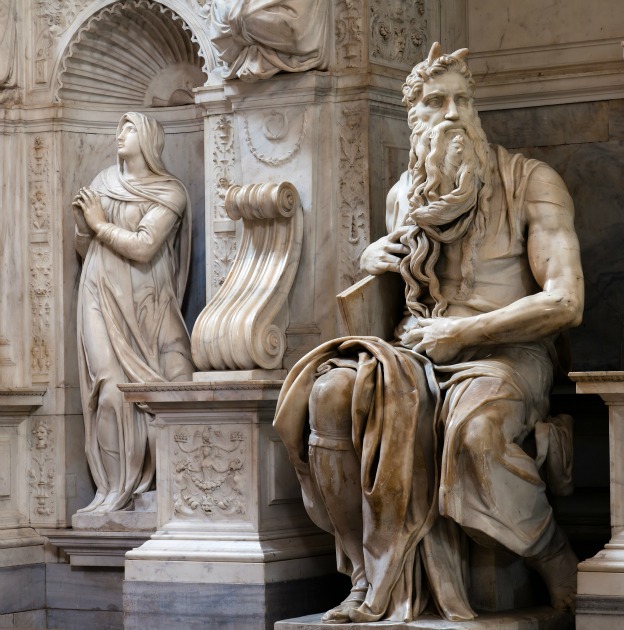
The “horns” on Moses’ statue by Michelangelo.
https://www.italymagazine.com/sites/default/files/story/moses-by-michelangelo.jpg
You mention the Mount of Transfiguration,
On the Father’s calendar, the world is approaching the day Moses came down the mount for the last time, Exodus 34. When his face shone bright.
Elijah had to cover his face on the mount, too.
It would be interesting if the Father placed the Mount of Transfiguration on the same day Moses came down the mount.
And Elijah, on the same day, years apart, had a similar experience.
A picture of a future day when Moses, Elijah and the three disciples with Christ were all on the same mount.
And maybe about 2,000 years later,there is a day where a small remnant goes up the mount to experience a transfiguration.
While the remaining disciples are on the ground fighting against demons.
And losing.
Moses, Elijah and Christ on different mounts in different times, yet on the same mount at the same time, in the time of Moses and the time of Elijah.
Maybe that’s a clue of when a Mount of Transfiguration in the future could occur.
But only 3 of 12 disciples experienced it..
Wouldn’t shock believers patterns repeat.
Passover is no longer just about Moses and physical bondage.
It’s about Christ, our Passover Lamb, and spiritual deliverance from bondage.
Exodus 34:29-35. The account of the events at Sinai ends with Moses in sharp focus, his face reflecting the glory of God.
"His face shone" (vv. 29,30, 35). The Hebrew word qaran, which means "to shine, to be radiant", is very similar to qeren, which means "horn". Hence St Jerome's translation in the Vulgate: "And his face turned with bright horns", which has had its influence on Christian tradition and art. Michelangelo, for example, gave his famous statue of Moses two bright lights, one on each side of his forehead. Anyway, the sacred author's point is that Moses was transformed due to the fact that he had been so near God. The veil covering his face emphasizes the transcendence of God: not only can the Israelites not see God; they cannot even look at the face of Moses, his closest intermediary.
St Paul refers to this episode in order to show the radical superiority of the New Covenant and the meaning of apostolic ministry, for with the coming of Christ all has been revealed and man has direct access to the Father (cf. 2 Cor 3:7-18).
2 Corinthians 3:12-18. In these verses St Paul continues to stress that the apostolic ministry is superior to that of Moses; he recalls the veil with which Moses covered his face after he had been speaking to Yahweh. The Apostle declares that this event was a symbol: the veil served Moses not only to hide the radiance of his f or of the Holy Spirit, in the New Testament, brings with it the freedom of the children of God obtained by Christ, who has freed us from sin and from the Old Law (cf. Rom 8: 1-17; Gal 4:21-31).
Christian freedom does not mean ignoring any bond or law; it means accepting God's commandments not in a servile way, out of fear of punishment, but rather as children who strive to do what pleases their Father God. St Augustine explains this as follows: "That person lives under the weight of the law who avoids sin out of fear of the punishment which the law threatens, rather than because of any liking for righteousness [...]. If you let yourselves be led by the Spirit, you will not be under the weight of the law; of that law which is considered to inspire fear and terror, and does not instill charity or a taste for goodness; charity which has been poured into our hearts, not by the letter of the law, but by the Holy Spirit, who has been given us. That is the law of freedom, not the law of slavery, for it is the law of charity, not that of fear" (De Natura Et Gratia, LVII, 67).
18. The teaching expounded in the previous verses leads to this final joyous declaration, in which St Paul sums up the Christian's spiritual itinerary. Just as Moses' face reflected the splendor of Yahweh after he had been speaking to him on Sinai, Christians in their lives reflect the splendor of Christ, whom they contemplate in faith: "The Christian who has been cleansed by the Holy Spirit in the sacrament of regeneration", St John Chrysostom comments, "is changed, as the Apostle puts it, into the likeness of Jesus Christ himself. Not only does he behold the glory of the Lord but he takes on some of the features of God's glory [...]. The soul who is regenerated by the Holy Spirit receives and radiates the splendor of the heavenly glory that has been given him" (Hom. on 2 Cor., 7).
Moreover, whereas the radiance of Moses was a passing thing, that of Christians steadily increases the more they become identified with Christ through docility to the influence of grace on their souls: "Docility, because it is the Holy Spirit who, with his inspirations, gives a supernatural tone to our thoughts, desires and actions. It is he who leads us to receive Christ's teaching and to assimilate it in a profound way. It is he who gives us the light by which we perceive our personal calling and the strength to carry out all that God expects of us. If we are docile to the Holy Spirit, the image of Christ will be formed more and more fully in us, and we will be brought closer every day to God the Father" (St. J. Escriva, Christ Is Passing By, 135).
It's my understanding that the first Tablets were received on Pentecost. Moses had his kerfuffle with the golden calf and went back up the mountain to get another set of tablets. After another 40 days or so would make it to the Fall Feasts. After 2 sets of Fasts for 40 days twice, that should make the time Moses came down the mountain with a glowing face about the time of Tabernacles. Just a guess.
Doing the math, it’s about 144 days after Passover that Moses comes down that last time.
Revelation 14 has the number 144,000 and Christ on a mount.
That’s an interesting connection if only to highlight the number 144 and the Mount Zion. And those first fruits followers of the Lamb.
A picture of 3 disciples on the mount with Christ? Seems plausible.
A remnant. A first fruit remnant. Not all.
It’s about the 11th day of the 6th month.
So, about 3 weeks until the 1st of 7th month.
The 11th of 6th month doesn’t seem interesting until one reads Deuteronomy 1:2 that mentions an 11 day journey from Horeb to Kadesh Barnea.
Mount Horeb connected to an 11 day journey.
The scriptures hint the Messiah was born and baptized on the same day.
40 days before the day He was presented in the temple as a babe, and when He began His ministry at about 30 (40 days after His birthday), which is the Day of Atonement.
So, a birth on the New Moon Day of the 6th month. Which would be 11 days before the day Moses comes down the mount for the last time.
Then 40 days and we get Anna the Prophetess fasting night and day on the day of Atonement.
Christ’s wilderness journey of 40 days would have included Moses and maybe even Elijah’s, last 11 days on the mount. And ended on the Day of Atonement, which is why Israel was taught to fast and afflict themselves on that day.
It represents the 40th day of the Messiah of Israel fasting for 40 days and nights.
A day that commemorates Him presented in the temple and when He began His ministry. A Holy Sabbath.
And it still is close enough to the Tabernacles feast.
Things line up.
One other interesting note. A discrepancy between Mathew Mark and Luke’s versions of the Transfiguration.
Mathew and Mark mention 6 days.
Luke mentions 8 days.
2 days later in Luke.
We are 2 days, or about 2,000 years, from the event recorded in Mathew Mark and Luke.
But only Luke’s version has a 2 day delay.
And an event where the disciples and Christ spent the night on the Mount and came down the next day. That wasn’t recorded like this in Mathew and Marks version. Only Luke’s version includes the following day when they came down and He healed the boy.
An obvious discrepancy and something His Word is giving as clues to ask,seek and knock with regards to it.
But just seeing it is exciting..
Your mention of Moses and the golden calf and the first tablets gave a thought.
It would have been about 102 days after Unleavened Bread when Moses came down.
1 captain and his 50,
1 captain and his 50
51+51=102
102 days consumed. A picture of Elijah and the 3 captains and their 50s (153).
That’s a day that commemorates the birth of the church.
Part of the time either affiliated with the 102 days consumed or the final captain and his 50 that are spared.
There is a lot that can be learned by wandering in the wilderness like Moses and Israel did.
For the New Covenant believers
Enjoyed your lesson on Hebrew!
Read later.
Did you even read the article? On line 33 the author writes
St. Paul speaks of us as looking on the face of the Lord with unveiled faces:Setting forth the truth plainly, we commend ourselves to everyone’s conscience in the sight of God. And even if our gospel is veiled, it is only veiled to those who are perishing. The god of this age has blinded the minds of unbelievers, so that they cannot see the light of the gospel that displays the glory of Christ, who is the image of God. … For God, who said, “Let light shine out of darkness,” has made his light shine in our hearts to give us the light of the knowledge of God’s glory displayed in the face of Christ (2 Cor 4:2-6).
We are not like Moses, who would put a veil over his face to prevent the Israelites from seeing the end of what was passing away. But their minds were made dull, for to this day the same veil remains when the old covenant is read. It has not been removed, because only in Christ is it taken away. Even to this day when Moses is read, a veil covers their hearts. But whenever anyone turns to the Lord, the veil is taken away. … And we, who with unveiled faces contemplate the Lord’s glory, are being transformed into his image with ever-increasing glory, which comes from the Lord, who is the Spirit (2 Cor 3:13-18).
Disclaimer: Opinions posted on Free Republic are those of the individual posters and do not necessarily represent the opinion of Free Republic or its management. All materials posted herein are protected by copyright law and the exemption for fair use of copyrighted works.