Posted on 07/20/2021 6:12:56 AM PDT by ebb tide
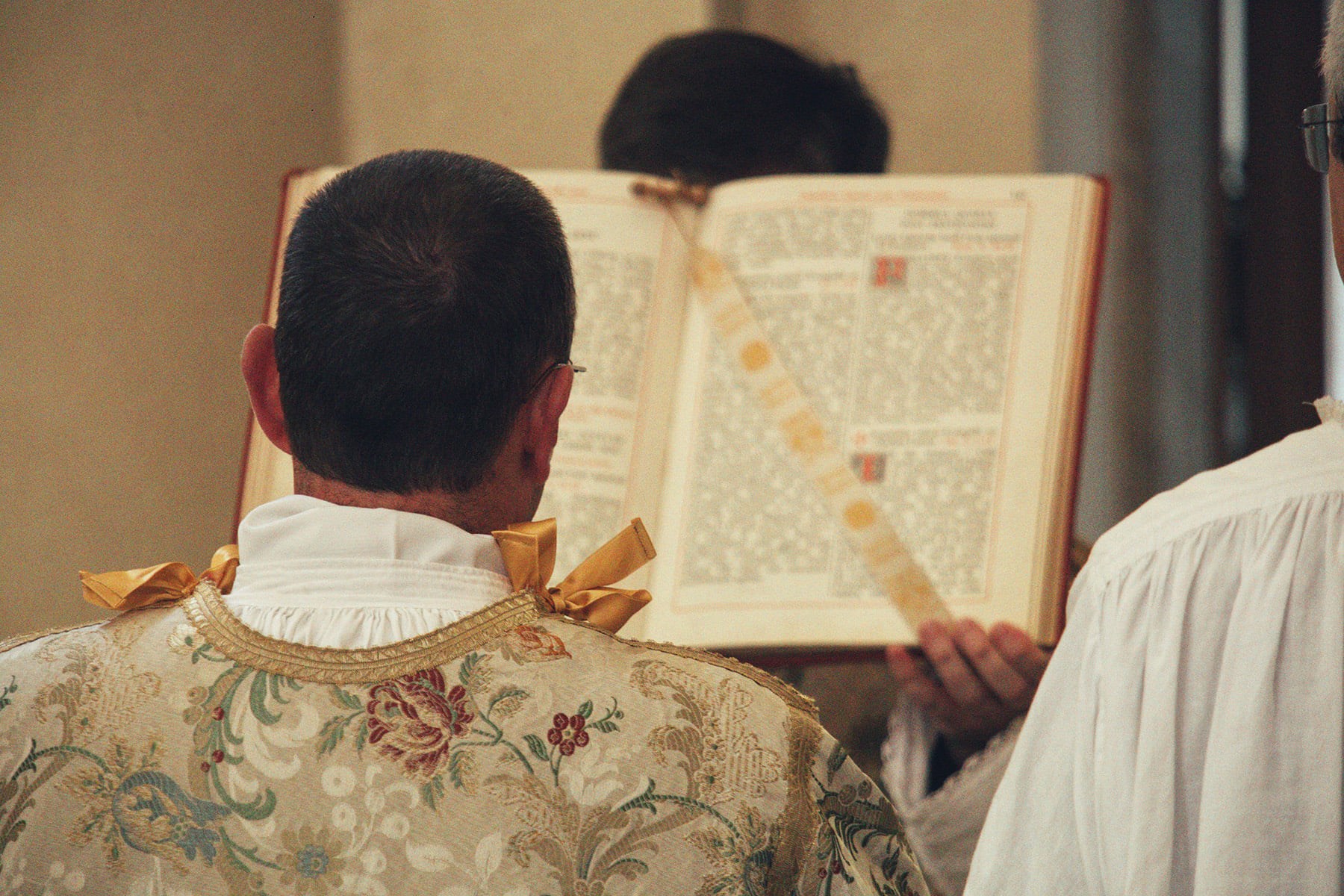
Among its many, many unjust prescriptions, Traditionis custodes says that the readings at the usus antiquior are now to be “proclaimed in the vernacular language, using translations of the Sacred Scripture approved for liturgical use by the respective Episcopal Conferences” (n. 3, § 3). Quite aside from what this actually means in practice (e.g., would chanting the lections in Latin, then reading them in the vernacular before the homily suffice?), it is clear that this demand has, like the rest of the document, been drafted by someone totally unfamiliar with the traditional Latin Mass.
For things are not as simple as just grabbing a Bible off the shelf, or getting a copy of the Novus Ordo lectionary, consulting its index and marking the relevant pages, which I suspect is what the Pope and those behind the motu proprio had in mind. This coming Sunday’s epistle reading (for the 9th Sunday after Pentecost), 1 Corinthians 10:6b-13, makes this very clear.
Brethren: (6b) We should not desire evil things as they did. (7) Do not be idolaters as some of them were; as it is written, “The people sat down to eat and drink and rose up to play.” (8) We must not indulge in sexual immorality as some of them did, and twenty-three thousand fell in a single day. (9) We must not put Christ to the test, as some of them did and were destroyed by serpents, (10) nor grumble, as some of them did and were destroyed by the Destroyer. (11) Now these things happened to them as an example, but they were written down for our instruction, on whom the end of the ages has come. (12) Therefore let anyone who thinks that he stands take heed lest he fall. (13) No temptation has overtaken you that is not common to man. God is faithful, and he will not let you be tempted beyond your ability, but with the temptation he will also provide the way of escape, that you may be able to endure it. [1]
Most of this reading does not occur in the post-Vatican II lectionary. The closest we get is 1 Corinthians 10:1-6, 10-12, read on the 3rd Sunday of Lent, in Year C – though it should be noted that, as the Year A readings for the 3rd, 4th and 5th Sundays of Lent can always be used ad libitum, there is no guarantee that this lection will ever be read in the Novus Ordo!
Here is that reading, with the omitted verses (which are all part of the traditional lectionary!) struck out, and in red text:
(1) I do not want you to be unaware, brethren, that our fathers were all under the cloud, and all passed through the sea, (2) and all were baptized into Moses in the cloud and in the sea, (3) and all ate the same spiritual food, (4) and all drank the same spiritual drink. For they drank from the spiritual Rock that followed them, and the Rock was Christ. (5) Nevertheless, with most of them God was not pleased, for they were overthrown in the wilderness. (6) Now these things took place as examples for us, that we might not desire evil as they did.(7) Do not be idolaters as some of them were; as it is written, “The people sat down to eat and drink and rose up to play.” (8) We must not indulge in sexual immorality as some of them did, and twenty-three thousand fell in a single day. (9) We must not put Christ to the test, as some of them did and were destroyed by serpents,(10)nor[We must not] grumble, as some of them did and were destroyed by the Destroyer. (11) Now these things happened to them as an example, but they were written down for our instruction, on whom the end of the ages has come. (12) Therefore let anyone who thinks that he stands take heed lest he fall.(13) No temptation has overtaken you that is not common to man. God is faithful, and he will not let you be tempted beyond your ability, but with the temptation he will also provide the way of escape, that you may be able to endure it.
I will let readers come to their own conclusions about why vv. 7-9 and 13 were omitted from the reformed lectionary. [2] The point here is that the post-Vatican II lectionary cannot be used to proclaim this coming Sunday’s epistle reading, as it does not exist in it!
Even for those readings that are in the Novus Ordo lectionary, such as this coming Sunday’s Gospel reading (Luke 19:41-47), it would be difficult to use the reformed books. In this instance, one would have to combine the Gospel readings for Thursday and Friday of Week 33 per annum (Luke 19:41-44, then 45-48), remembering to omit the incipit [3] for Friday’s reading as well as its last verse.
Neither is it possible to just read from the approved vernacular translation of the Bible – at least, not without difficulties. Adjustments need to be made for the incipits and other small changes made in the liturgy to the biblical text. For this coming Sunday, the epistle begins Fratres: Non simus concupiscentes malorum, whereas the Vulgate text begins Hæc autem in figura facta sunt nostri, ut non simus concupiscentes malorum. This means that the vernacular text needs adjusting from “Now these things took place as examples for us, that we might not desire evil as they did” to “Brethren: We should not desire evil things as they did” (ESV-CE) in order to make sense. Further complications in all of this are the many differences in both the Latin text and verse numbering of the Clementine and Neo Vulgates, particularly in books such as Tobit, Esther and Sirach (Ecclesiasticus). And then what about the celebration of sung Masses? Adaptation of the chant tones to the particular vernacular would be required, and this is long and difficult work—longer and more difficult depending on the vernacular language in question.
These sorts of thorny issues and details face bishops’ conferences who may wish to prepare a vernacular lectionary for the TLM (though I doubt many are interested in doing this). It is not possible to just ‘drop in’ one’s Bible translation of choice and call it a day. This section of the motu proprio is, like the rest of it, hastily and sloppily drafted, ignorant of the traditional Missal, and completely unjust: the faithful attached to the usus antiquior, wherever they live, were just expected on Friday 16th July to “immediately” have a vernacular lectionary ready to use, as if these books just fall out of the sky and do not need detailed and meticulous preparation.
Still, if it is currently impossible to accurately proclaim or chant the lections in the vernacular at the traditional Latin Mass due to the proper books not existing, then surely it need not be done. After all, no matter how much he might wish to, not even the Pope can demand the impossible!
NOTES
[1] I have here used the ESV-CE translation, which is the version due to replace the Jerusalem Bible at Novus Ordo Masses in England and Wales soon.
[2] 1 Corinthians 10:6-11 was assigned to Wednesday of Week 12 per annum in the Consilium’s draft lectionary sent out for consultation: see Schema 233 (De Missali, 39), July 1967, p. 237. 10:1-6 was assigned to the 3rd Sunday of Lent in Year B (ibid., p. 50). Verses 12-13 do not occur anywhere in this draft, and it seems obvious that some comments from the consultation caused vv. 7-9 to be deleted entirely, with vv. 10-12 then being added to the Lenten Sunday reading (which was also moved to Year C).
[3] It should be noted that the Praenotanda to the Ordo lectionum Missae actually allows the incipit to be omitted from its vernacular editions if the bishops’ conference so desires (see n. 124: Pro singulis linguis popularibus tales formulae mutari vel omitti possunt ex decreta Auctoritatum competentium), which just adds another practical problem with trying to use the reformed lectionary to proclaim the traditional readings in the vernacular!
[4] There happen to be only very minor differences between the Clementine Vulgate and Nova Vulgata texts of 1 Corinthians 10:1-13 (specifically in vv. 5a, 6a, 13b); v. 6a in the Nova Vulgata reads Haec autem figurae fuerunt nostrae, ut non simus concupiscentes malorum.
[5] Among the numerous good points made by Dr Peter Kwasniewski in “TLM Celebrants: Keep Doing the Readings in Latin — Add Vernacular as Appropriate”.
Ping
From a Southern Baptist’s point of view, we never understood the Catholic’s attraction to a latin Mass, outside of just plain adherence to tradition.
It always seemed to us that a Mass would be better understood in the vernacular. And if the Mass isn’t understood, then what’s the point?
It always seemed to us that a Mass would be better understood in the vernacular. And if the Mass isn’t understood, then what’s the point?
I think it is similar to Jewish children learning Hebrew and using hebrew in their service. Translations can obscure meanings. The 1962 Missal had side by side Latin and English translations.
For example:
John 1:1
1 ἐν ἀρχῇ ἦν ὁ λόγος, καὶ ὁ λόγος ἦν πρὸς τὸν θεόν, καὶ θεὸς ἦν ὁ λόγος.
λόγος and μῦθος are both translated into english with the same word: "word."
However they have different meanings:
μῦθος:
word, speech, conversation
tale, story, narrative
λόγος
That which is said: word, sentence, speech, story, debate, utterance.
That which is thought: reason, consideration, computation, reckoning.
An account, explanation, or narrative.
Quite aside from what this actually means in practice (e.g., would chanting the lections in Latin, then reading them in the vernacular before the homily suffice?) ...As one who served Mass both before and after the Missal of 1962, I can attest that the practice was just as the parenthetical suggests: the lections were first proclaimed in Latin, and after the gospel they were proclaimed from the pulpit in the vernacular, followed by a sermon (which is what we called them back in the day : )
I can further attest from personal experience that this was the practice both at the parishes in which the vernacular was English (in New York) and in which it was French (in New Hampshire).
Latin cannot change, meanings of words cannot change or be cancelled. A universal liturgical language meant one could go anywhere in the world and hear the same Mass. It undid the punishment of Babel. It is easy to follow as your missal has the Latin on one page and the vernacular on the opposite side. It can never be mistaken for anything but the worship of Almighty God, man does not dominate in any way. The three major religions all have a liturgical language which may or may not be the adherents primary language.
Vernacular French in New Hampshire?
Vernacular French in New Hampshire?Not just in New Hampshire, but in Nashua ("the Gateway City")), which is just north of the Massachusetts border and my hometown.
The French Canadians traveled south from Quebec all the way to Rhode Island, settling and working in the mill towns along the way. My mother and father were born in Hudson in 1919 and Nashua in 1921 respectively, and French was their first language -- my mother didn't learn English till she was nine-years-old! My maternal grandfather was born in Biddeford, Maine in 1883, and he could barely speak English till the day he died.
Fascinating. Thanks for clarifying.
Okay, I get that the message not being changed is important.
But it sounds like they are reading a vernacular version anyway. They just don’t hear it in the vernacular. Which introduces the same opportunity for change.
And unless all of the Catholic laypeople are proficient in Latin and can understand the spoken Latin, then it’s like watching a subtitled movie. I’m a lot more likely to tune out and quit reading the subtitles, than a movie where I can easily understand the language.
Just my opinion, should be yours and the Popes. lol
No, it doesn't. Read the black and do the red.

This Baptist doesn’t really understand it either but I have no problem with it. If some prefer to worship the Lord via the Latin Mass then more power to them. I’m happy they choose to gather together for worship, whatever language is used.
“The closest we get is 1 Corinthians 10:1-6, 10-12, read on the 3rd Sunday of Lent, in Year C – though it should be noted that, as the Year A readings for the 3rd, 4th and 5th Sundays of Lent can always be used ad libitum, there is no guarantee that this lection will ever be read in the Novus Ordo! “
And if you have a leap year it really buggers things up!
I am too.
But I do think it’s more important that they understand the mass than adhere to a tradition that impedes understanding.
Apparently some don’t think it does impede understanding, and that’s their call.
Much of the Latin Mass is said quietly and is solely addressed to the Holy Trinity. Recall, when this Mass developed over the centuries no sound systems existed save for the clever use of natural indoor acoustics. People are allowed to pray along in whatever manner the Holy Spirit moves them to, whether by reading along or meditating over particular passages, etc. The quietness is a marvel in this world of way too much noise, it is helpful in hearing the voice of God in your heart.
True, and people had tough, rural lives. Being in the cool, quiet and beautiful church was a great respite and consolation.
I think that’s only really an issue if the congregation is illiterate, since you can get the whole thing in a book very easily.
The usual practice in the US is for the readings to be sung in Latin in the customary place in the Mass, and then for them to be spoken in English (usually in the Douay-Rheims translation, but that is not required) at the beginning of the sermon.
Thanks for the clarification.
So the problem is that there is not a clear translation for the Old Mass?
But the Latin parts are repeated in the vernacular, so even someone who didn’t understand Latin wouldn’t be missing out.
And when do you use the Old Mass vs the New Mass? Is that prescribed or up to the parish?
So I grew up in Louisiana, home of America's illiterates in two languages. (English and French). Had a lot of Catholic Friends.
Disclaimer: Opinions posted on Free Republic are those of the individual posters and do not necessarily represent the opinion of Free Republic or its management. All materials posted herein are protected by copyright law and the exemption for fair use of copyrighted works.