Posted on 07/15/2021 1:43:50 AM PDT by Cronos
Memorial of St. Bonaventure![]() Sacred Heart Cathedral, New Delhi, India Readings at MassLiturgical Colour: White
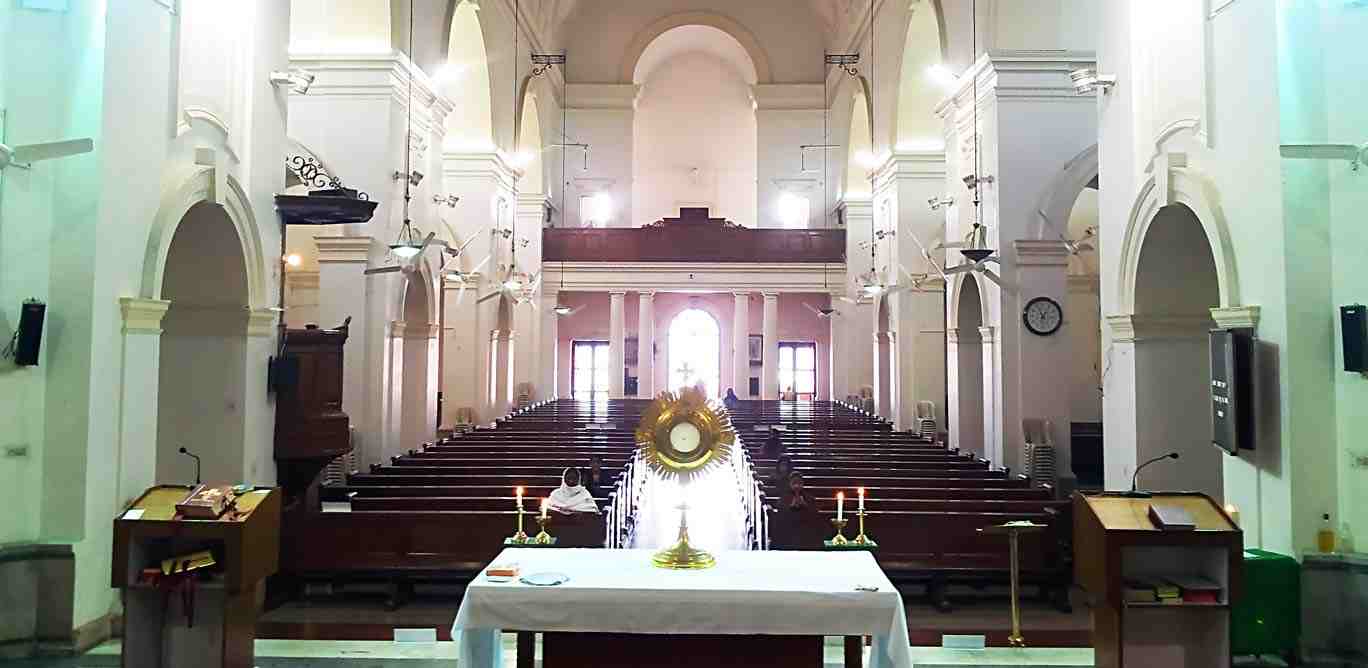
These are the readings for the feria
God reveals his name to MosesMoses, hearing the voice of God coming from the middle of the bush, said to him, ‘I am to go, then, to the sons of Israel and say to them, “The God of your fathers has sent me to you.” But if they ask me what his name is, what am I to tell them?’ And God said to Moses, ‘I Am who I Am. This’ he added ‘is what you must say to the sons of Israel: “I Am has sent me to you.”’ And God also said to Moses, ‘You are to say to the sons of Israel: “The Lord, the God of your fathers, the God of Abraham, the God of Isaac, and the God of Jacob, has sent me to you.” This is my name for all time; by this name I shall be invoked for all generations to come. ‘Go and gather the elders of Israel together and tell them, “The Lord, the God of your fathers, has appeared to me, the God of Abraham, of Isaac, and of Jacob; and he has said to me: I have visited you and seen all that the Egyptians are doing to you. And so I have resolved to bring you up out of Egypt where you are oppressed, into the land of the Canaanites, the Hittites, the Amorites, the Perizzites, the Hivites and the Jebusites, to a land where milk and honey flow.” They will listen to your words, and with the elders of Israel you are to go to the king of Egypt and say to him, “The Lord, the God of the Hebrews, has come to meet us. Give us leave, then, to make a three days’ journey into the wilderness to offer sacrifice to the Lord our God.” For myself, knowing that the king of Egypt will not let you go unless he is forced by a mighty hand, I shall show my power and strike Egypt with all the wonders I am going to work there. After this he will let you go.’
The Lord remembers his covenant for ever. or Alleluia! Give thanks to the Lord, tell his name, make known his deeds among the peoples. Remember the wonders he has done, his miracles, the judgements he spoke. The Lord remembers his covenant for ever. or Alleluia! He remembers his covenant for ever, his promise for a thousand generations, the covenant he made with Abraham, the oath he swore to Isaac. The Lord remembers his covenant for ever. or Alleluia! He gave his people increase; he made them stronger than their foes, whose hearts he turned to hate his people and to deal deceitfully with his servants. The Lord remembers his covenant for ever. or Alleluia! Then he sent Moses his servant and Aaron the man he had chosen. Through them he showed his marvels and his wonders in the country of Ham. The Lord remembers his covenant for ever. or Alleluia!
Alleluia, alleluia! My soul is waiting for the Lord, I count on his word. Alleluia!
Alleluia, alleluia! Come to me, all you who labour and are overburdened, and I will give you rest, says the Lord. Alleluia!
My yoke is easy and my burden lightJesus said, ‘Come to me, all you who labour and are overburdened, and I will give you rest. Shoulder my yoke and learn from me, for I am gentle and humble in heart, and you will find rest for your souls. Yes, my yoke is easy and my burden light.’ These are the readings for the memorial
May Christ live in your hearts through faithI pray, kneeling before the Father, from whom every family, whether spiritual or natural, takes its name: Out of his infinite glory, may he give you the power through his Spirit for your hidden self to grow strong, so that Christ may live in your hearts through faith, and then, planted in love and built on love, you will with all the saints have strength to grasp the breadth and the length, the height and the depth; until, knowing the love of Christ, which is beyond all knowledge, you are filled with the utter fullness of God.
Lord, teach me your statutes. How shall the young remain sinless? By obeying your word. I have sought you with all my heart; let me not stray from your commands. Lord, teach me your statutes. I treasure your promise in my heart lest I sin against you. Blessed are you, O Lord; teach me your statutes. Lord, teach me your statutes. With my tongue I have recounted the decrees of your lips. I rejoiced to do your will as though all riches were mine. Lord, teach me your statutes.
Alleluia, alleluia! You have only one Father, and he is in heaven; you have only one Teacher, the Christ. Alleluia!
The greatest among you must be your servantJesus said to his disciples, ‘You must not allow yourselves to be called Rabbi, since you have only one master, and you are all brothers. You must call no one on earth your father, since you have only one Father, and he is in heaven. Nor must you allow yourselves to be called teachers, for you have only one Teacher, the Christ. The greatest among you must be your servant. Anyone who exalts himself will be humbled, and anyone who humbles himself will exalted.’ The readings on this page are from the Jerusalem Bible, which is used at Mass in most of the English-speaking world. The New American Bible readings, which are used at Mass in the United States, are available in the Universalis apps, programs and downloads. |

catholic; mt11; ordinarytime; prayer;
Please FReepmail me/annalex to get on/off the Alleluia Ping List.
Feel free to add your content, so long as it conforms with the rules of the Catholic Caucus. For example, post your prayers, thoughts, art that you like

28. Come unto me, all ye that labour and are heavy laden, and I will give you rest.
29. Take my yoke upon you, and learn of me; for I am meek and lowly in heart: and ye shall find rest unto your souls.
30. For my yoke is easy, and my burden is light.
CHRYSOSTOM. By what He had said, He brought His disciples to have a desire towards Him, shewing them His unspeakable excellence; and now He invites them to Him, saying, Come unto me, all ye that labour and are heavy laden.
AUGUSTINE. (Serm. 69. 1.) Whence do we all thus labour, but that we are mortal men, bearing vessels of clay which cause us much difficulty. But if the vessels of flesh are straitened, the regions of love will be enlarged. To what end then does He say, Come unto me, all ye that labour, but that ye should not labour?
HILARY. He calls to Him those that were labouring under the hardships of the Law, and those who are burdened with the sins of this world.
JEROME. That the burden of sin is heavy the Prophet Zachariah bears witness, saying, that wickedness sitteth upon a talent of lead. (Zech. 5:7.) And the Psalmist fills it up, Thy iniquities are grown heavy upon me. (Ps. 38:4)
GREGORY. (Mor. xxx. 15.) For a cruel yoke and hard weight of servitude it is to be subject to the things of time, to be ambitious of the things of earth, to cling to falling things, to seek to stand in things that stand not, to desire things that pass away, but to be unwilling to pass away with them. For while all things fly away against our wish, those things which had first harassed the mind in desire of gaining them, now oppress it with fear of losing them.
CHRYSOSTOM. He said not, Come ye, this man and that man, but All whosoever are in trouble, in sorrow, or in sin, not that I may exact punishment of you, but that I may remit your sins. Come ye, not that I have need of your glory, but that I seek your salvation. And I will refresh you; not, I will save you, only; but that is much greater, I will refresh you, that is, I will set you in all quietness.
RABANUS. (non occ.) I will not only take from you your burden, but will satisfy you with inward refreshment.
REMIGIUS. Come, He says, not with the feet, but with the life, not in the body, but in faith. For that is a spiritual approach by which any man approaches God; and therefore it follows, Take my yoke upon you.
RABANUS. The yoke of Christ is Christ’s Gospel, which joins and yokes together Jews and Gentiles in the unity of the faith. This we are commanded to take upon us, that is, to have in honour; lest perchance setting it beneath us, that is wrongly despising it, we should trample upon it with the miry feet of unholiness; wherefore He adds, Learn of me.
AUGUSTINE. (Serm. 69. 1.) Not to create a world, or to do miracles in that world; but that I am meek and lowly in heart. Wouldest thou be great? Begin with the least. Wouldest thou build up a mighty fabric of greatness? First think of the foundation of humility; for the mightier building any seeks to raise, the deeper let him dig for his foundation. Whither is the summit of our building to rise? To the sight of God.
RABANUS. We must learn then from our Saviour to be meek in temper, and lowly in mind; let us hurt none, let us despise none, and the virtues which we have shewn in deed let us retain in our heart.
CHRYSOSTOM. And therefore in beginning the Divine Law He begins with humility, and sets before us a great reward, saying, And ye shall find rest for your souls. This is the highest reward, you shall not only be made useful to others, but shall make yourself to have peace; and He gives you the promise of it before it comes, but when it is come, you shall rejoice in perpetual rest. And that they might not be afraid because He had spoken of a burden, therefore He adds, For my yoke is pleasant, and my burden light.
HILARY. He holds forth the inducements of a pleasant yoke, and a light burden, that to them that believe He may afford the knowledge of that good which He alone knoweth in the Father.
GREGORY. (Mor. iv. 33.) What burden is it to put upon the neck of our mind that He bids us shun all desire that disturbs, and turn from the toilsome paths of this world?
HILARY. And what is more pleasant than that yoke, what lighter than that burden? To be made better, to abstain from wickedness, to choose the good, and refuse the evil, to love all men, to hate none, to gain eternal things, not to be taken with things present, to be unwilling to do that to another which yourself would be pained to suffer.
RABANUS. But how is Christ’s yoke pleasant, seeing it was said above, Narrow is the way which leadeth unto life? (Mat. 7:14.) That which is entered upon by a narrow entrance is in process of time made broad by the unspeakable sweetness of love.
AUGUSTINE. (Serm. 70. 1.) So then they who with unfearing neck have submitted to the yoke of the Lord endure such hardships and dangers, that they seem to be called not from labour to rest, but from rest to labour. But the Holy Spirit was there who, as the outward man decayed, renewed the inward man day by day, and giving a foretaste of spiritual rest in the rich pleasures of God in the hope of blessedness to come, smoothed all that seemed rough, lightened all that was heavy. Men suffer amputations and burnings, that at the price of sharper pain they may be delivered from torments less but more lasting, as boils or swellings. What storms and dangers will not merchants undergo that they may acquire perishing riches? Even those who love not riches endure the same hardships; but those that love them endure the same, but to them they are not hardships. For love makes right easy, and almost nought all things however dreadful and monstrous. How much more easily then does love do that for true happiness, which avarice does for misery as far as it can?
JEROME. And how is the Gospel lighter than the Law, seeing in the Law murder and adultery, but under the Gospel anger and concupiscence also, are punished? Because by the Law many things are commanded which the Apostle fully teaches us cannot be fulfilled; by the Law works are required, by the Gospel the will is sought for, which even if it goes not into act, yet does not lose its reward. The Gospel commands what we can do, as that we lust not; this is in our own power; the Law punishes not the will but the act, as adultery. Suppose a virgin to have been violated in time of persecution; as here was not the will she is held as a virgin under the Gospel; under the Law she is cast out as defiled.
| Matthew | |||
| English: Douay-Rheims | Latin: Vulgata Clementina | Greek NT: Byzantine/Majority Text (2000) | |
| Matthew 23 | |||
| 8. | But be not you called Rabbi. For one is your master; and all you are brethren. | Vos autem nolite vocari Rabbi : unus est enim magister vester, omnes autem vos fratres estis. | υμεις δε μη κληθητε ραββι εις γαρ εστιν υμων ο καθηγητης ο χριστος παντες δε υμεις αδελφοι εστε |
| 9. | And call none your father upon earth; for one is your father, who is in heaven. | Et patrem nolite vocare vobis super terram : unus est enim pater vester qui in cælis est. | και πατερα μη καλεσητε υμων επι της γης εις γαρ εστιν ο πατηρ υμων ο εν τοις ουρανοις |
| 10. | Neither be ye called masters; for one is you master, Christ. | Nec vocemini magistri : quia magister vester unus est, Christus. | μηδε κληθητε καθηγηται εις γαρ υμων εστιν ο καθηγητης ο χριστος |
| 11. | He that is the greatest among you shall be your servant. | Qui major est vestrum, erit minister vester. | ο δε μειζων υμων εσται υμων διακονος |
| 12. | And whosoever shall exalt himself shall be humbled: and he that shall humble himself shall be exalted. | Qui autem se exaltaverit, humiliabitur : et qui se humiliaverit, exaltabitur. | οστις δε υψωσει εαυτον ταπεινωθησεται και οστις ταπεινωσει εαυτον υψωθησεται |

Perhaps not a household name for most people, Saint Bonaventure, nevertheless, played an important role in both the medieval Church and the history of the Franciscan Order. A senior faculty member at the University of Paris, Saint Bonaventure certainly captured the hearts of his students through his academic skills and insights. But more importantly, he captured their hearts through his Franciscan love for Jesus and the Church. Like his model, Saint Francis, Jesus was the center of everything—his teaching, his administration, his writing, and his life. So much so, that he was given the title “Seraphic Doctor.”
Born in Bagnorea in 1221, Saint Bonaventure was baptized John, but received the name Bonaventure when he became a Franciscan at the age of 22. Little is known about his childhood, but we do know that his parents were Giovanni di Fidanza and Maria Ritell. It seems that his father was a physician and a man of means. While Saint Francis died about five years after the saint’s birth, he is credited with healing Bonaventure as a boy of a serious illness.
Saint Bonaventure’s teaching career came to a halt when the Friars elected him to serve as their General Minister. His 17 years of service were not easy as the Order was embroiled in conflicts over the interpretation of poverty. Some friars even ended up in heresy saying that Saint Francis and his community were inaugurating the era of the Holy Spirit which was to replace Jesus, the Church, and Scripture. But because he was a man of prayer and a good administrator, Saint Bonaventure managed to structure the Order through effective legislation. But more importantly, he offered the Friars an organized spirituality based on the vision and insights of Saint Francis. Always a Franciscan at heart and a mystical writer, Bonaventure managed to unite the pastoral, practical aspects of life with the doctrines of the Church. Thus, there is a noticeable warmth to his teachings and writings that make him very appealing.
Shortly before he ended his service as General Minister, Pope Gregory X created him a Cardinal and appointed him bishop of Albano. But a little over a year later, while participating in the Second Council of Lyon, Saint Bonaventure suddenly died on July 15, 1274. There is a theory that he was poisoned.
Saint Bonaventure left behind a structured and renewed Franciscan Order and a body of work all of which glorifies his major love—Jesus.
Reflection
Bonaventure so united holiness and theological knowledge that he rose to the heights of mysticism while remaining a very active preacher and teacher, one beloved by all who met him. To know him was to love him; to read him is still for us today to meet a true Franciscan and a gentleman.
Ad Majorem Dei Gloriam (To the Greater Glory of God)
From: Exodus 3:13-20
The Divine Name is Revealed
---------------------------
[3] Then Moses said to God, "If I come to the people of Israel and say to them, 'The God of your fathers has sent me to you,' and they ask me, 'What is his name?' what shall I say to them?" [4] God said to Moses, "I AM WHO I AM." And he said, "Say this to the people of Israel, 'I AM has sent me to you.'" [5] God said to Moses, "Say this to the people of Israel, 'The Lord, the God of your fathers, the God of Abraham, the God of Isaac, the God of Jacob, has sent me to you': this is my name forever and thus I am to be remembered throughout all generations.
The Mission of Moses
--------------------
[16] Go and gather the elders of Israel together, and say to them, 'The Lord the God of your fathers, the God of Abraham, of Isaac, and of Jacob, has appeared to me, saying, "I have observed you and what has been done to you in Egypt; [17] and I promise that I will bring you up out of the affliction of Egypt, to the land of the Canaanites, the Hittites, the Amorites, the Perizzites, the Hivites, and the Jebusites, a land flowing with milk and honey." [18] And they will hearken to your voice; and you and the elders of Israel shall go to the king of Egypt and say to him, 'The Lord, the God of the Hebrews, has met with us; and now, we pray you, let us go a three days' journey into the wilderness, that we may sacrifice to the Lord our God.' [19] I know that the king of Egypt will not let you go unless compelled by a mighty hand. [20] So I will stretch my hand and smite Egypt with all the wonders which I will do it; after that he will let you go."
***********************************************************************
Commentary:
3:13-15. Moses now raises another difficulty: he does not know the name of the God who is commissioning him. This gives rise to the revelation of the name "Yahweh" and the explanation of what it means--"I am who I am".
According to the tradition recorded in Genesis 4:26, a grandson of Adam, Enosh, was the first to call upon the name of the Lord (Yahweh). Thus, the biblical text is stating that a part of mankind knew the true God, whose name was revealed to Moses in this solemn way (Ex 35:15 and 6:2). The patriarchs invoked God under other names, to do with the divine attributes, such as the Almighty (El-Shaddai: Gen 17:1; Ex 6:2-3). Other proper names of God which appear in very ancient documents lead one to think that the name Yahweh had been known from along time back. The revelation of the divine name is important in salvation history because by that name God will be invoked over the course of the centuries.
All kinds of suggestions have been put forward as to the meaning of Yahweh; not all are mutually exclusive. Here are some of the main ones: a) God is giving an evasive answer here because he does not want those in ancient times, contaminated as they were by magic rites, to think that because they knew his name they would have power over the god. According to this theory, "I am who I am" would be equivalent to "I am whom you cannot know". "I am unnameable". This solution stresses the transcendence of God. b) What God is revealing is his nature--that he is subsistent being; in which case "I am who I am means I am he who exists per sibi, absolute be-ing. The divine name refers to what he is by essence; it refers to him whose essence it is to be. God is saying that he "is", and he is giving the name by which he is to be called. This explanation is often to be found in Christian interpretation. c) On the basis of the fact Yahweh is a causative form of the ancient Hebrew verb hwh (to be), God revealing himself as "he who causes to be", the creator, not so much in the fullest sense of the word (as creator of the universe) but above all the creator of the present situation--the one who gives the people its being and who always stays with it. Thus, calling upon Yahweh will always remind the good Israelite of his reason-for-being, as an individual and as a member of a chosen people.
None of these explanations is entirely satisfactory. "This divine name is mysterious just as God is mystery. It is at once a name revealed and something like the refusal of a name, and hence it better expresses God as what he is--infinitely above everything that we can understand or say: he is the 'hidden God' (Is 45:15), his name is ineffable, and he is the God who makes himself close to men (cf. Judg 1.3:18)" (Catechism of the Catholic Church, 206).
At a later time, around the 4th century BC, out of reverence for the name of Yahweh the use of the word was avoided; when it occurred in the sacred text it was read as Adonai, my Lord. In the Greek version it is translated as Kyrios and in the Latin as Dominus. "It is under this title that the divinity of Jesus will be acclaimed: 'Jesus is Lord'" (ibid., 209). The RSV always renders Yahweh as "the Lord". The medieval form Jehovah was the result of a misreading of the Hebrew text into which vowels were inserted by the Massoretes; it is simply a mistake and there is no justification for the use of "Jehovah" nowadays (cf. ibid., 446).
3:16-22. The Lord comes back again to the subject of Moses' mission; despite all the obstacles, it will be a success. "The elders of Israel" (v. 16), that is, the chiefs of clans, representing the whole community, will be happy to hear what Moses has to say. The words "I have observed you" (v. 16: literally, "I. have carried out an inspection among you") are significant because they indicate the key thing--God's is a friendly presence; but it is also a demanding presence which expects an account of the use we made of gifts received (cf. 32:34; Jer 9:24; Hos 4:14). The three days' journey (v.18) would not take them to Sinai but it was enough to get them away from Egypt. Later, three days will become a number symbolizing divine action. See the note on 6:10-13.
The pharaoh, unlike the elders, will refuse to let the people go-making it clearer that the Israelites will attain their freedom only if God comes to their rescue.
The "despoiling" of the Egyptians (v. 22) is by way of compensation for the years they have spent with nothing to show for it (cf. Gen 15:14; Wis 10:17) and also as a sort of booty of war (cf. Ex 11:2-3; 12:35-36): God comes out the victor in the struggle against the pharaoh, and he gives the sons of Israel a share in the booty. It may also be meant to signal festive joy: the Israelites are to dress up to celebrate the victory God has given them.
Jesus Thanks His Father (Continued)
-----------------------
[28] Come to Me, all who labor and are heavy laden, and I will give you rest. [29] Take My yoke upon you, and learn from Me; for I am gentle and lowly in heart, and you will find rest for your souls. [30] For My yoke is easy, and My burden is light."
***********************************************************************
Commentary:
28-30. Our Lord calls everyone to come to Him. We all find things difficult in one way or another. The history of souls bears out the truth of these words of Jesus. Only the Gospel can fully satisfy the thirst for truth and justice which sincere people feel. Only our Lord, our Master--and those to whom He passes on His power--can soothe the sinner by telling him, "Your sins are forgiven" (Matthew 9:2). In this connection Pope Paul VI teaches: "Jesus says now and always, `Come to Me, all who labor and are heavy laden, and I will give you rest.' His attitude towards us is one of invitation, knowledge and compassion; indeed, it is one of offering, promise, friendship, goodness, remedy of our ailments; He is our comforter; indeed, our nourishment, our bread, giving us energy and life" (Homily on Corpus Christi, 13 June 1974).
"Come to Me": the Master is addressing the crowds who are following Him, "harassed and helpless, like sheep without a shepherd" (Matthew 9:36). The Pharisees weighed them down with an endless series of petty regulations (cf. Acts 15:10), yet they brought no peace to their souls. Jesus tells these people, and us, about the kind of burden He imposes: "Any other burden oppresses and crushes you, but Christ's actually takes weight off you. Any other burden weighs down, but Christ's gives you wings. If you take a bird's wings away, you might seem to be taking weight off it, but the more weight you take off, the more you tie it down to the earth. There it is on the ground, and you wanted to relieve it of a weight; give it back the weight of its wings and you will see how it flies" (St. Augustine, Sermon 126).
"All you who go about tormented, afflicted and burdened with the burden of your cares and desires, go forth from them, come to Me and I will refresh you and you shall find for your souls the rest which your desires take from you" (St. John of the Cross, Ascent of Mount Carmel, Book 1, Chapter 7, 4).
Disclaimer: Opinions posted on Free Republic are those of the individual posters and do not necessarily represent the opinion of Free Republic or its management. All materials posted herein are protected by copyright law and the exemption for fair use of copyrighted works.