 Learn All About the Prophecies of Our Lady of Good Success About Our Times
Posted on 06/25/2021 6:47:29 PM PDT by ebb tide
Corpus Christi is the grand and solemn liturgical feast in praise of the Blessed Sacrament. Inspired by Saint Juliana of Mont Cornillon (1193–1258), it originated in the Middle Ages. Pope Urban IV approved it with the Bull Transiturus of September 8, 1264, and asked Saint Thomas Aquinas to compose its liturgical office.
Hence, we owe to Saint Thomas’s theological genius (he was also an inspired poet) the beautiful hymn Lauda Sion, that is part of the new feast’s Mass. In its verses, we find the beautiful expression “Ecce panis angelorum” (behold the Bread of angels), which came to be used frequently to designate Holy Communion. That is easy to understand because one can receive it only in the state of grace, which renders men similar to angels.
Pope Francis took advantage of the commemoration of the Feast of Corpus Christi on June 6 to change the meaning of the Sacrament of the Eucharist into one entirely contrary to the Church’s perennial teaching. Thus, changing the poetic but theologically safe formulation of Saint Thomas, he transforms the designation “Bread of Angels” into “Bread of sinners.”
As he had done on another occasion,1 at the Angelus on that feast day, Pope Francis presented Judas, the traitor, as an example of divine mercy. He said that, at the Holy Supper, Jesus knew of Judas’s betrayal. And “what does Jesus do? He reacts to the evil with a greater good. He responds to Judas’s ‘no’ with the ‘yes’ of mercy. He does not punish the sinner but rather gives His life for him.”2
Pope Francis adds, “When we receive the Eucharist, Jesus does the same with us: he knows us; he knows we are sinners; and he knows we make many mistakes, but he does not give up on joining his life to ours.”
Concluding his thought, he says that Jesus “knows that we need it, because the Eucharist is not the reward of saints, no, it is the Bread of sinners. This is why he exhorts us: ‘Do not be afraid! Take and eat.’”
The above words and the example of Judas when designating the Eucharist as “bread of sinners” make one wonder if Pope Francis suggests that the proper effect of Holy Communion is to forgive mortal sins, not just venial ones. That would run counter the Council of Trent: “Can. 5. If anyone says that the special fruit of the Most Holy Eucharist is the remission of sins, or that from it no other fruits are produced: let him be anathema.”3
Another error equally opposed to that Council and the Scriptures, and seemingly insinuated in Pope Francis’s words, is that being in the state of grace is not required to receive Holy Communion. However, quoting Saint Paul, the Council of Trent says:
[A]ssuredly, the more the holiness and divinity of this heavenly sacrament are understood by a Christian, the more diligently ought he to give heed that he approaches not to receive it but with great reverence and holiness, especially as we read in the Apostle those words full of terror: He that eat and drink unworthily, eat and drink judgment to himself (1 Cor. 11:29). Wherefore, he who would communicate ought to recall to mind the precept of the Apostle: Let a man prove himself.4
The moralists Antonio Lanza and Pietro Palazzini explain, “[by] divine right, all who are in mortal sin cannot licitly approach Communion.”5
These moral theologians summarize the effects of Eucharistic Communion as follows: “The specific effects of Holy Communion are: a) uniting us with Jesus Christ and His Mystical Body, the Church, in a more intimate way; b) increasing sanctifying grace in us; c) nurturing and fortify our spiritual life; d) weakening concupiscence; e) giving us a sign of eternal life. The effects will be all the more abundant the better are the dispositions [with which one receives It].”6
Holy Communion can indirectly erase a mortal sin when a person, unaware that he is in sin, receives Communion piously. In these cases, “theologians incline to the opinion, that in such exceptional cases the Holy Eucharist can restore the soul to the state of grace.”7
Given Pope Francis’s new designation of the Holy Eucharist as the “bread of sinners,” one understands better why, in his Apostolic Exhortation Amoris Laetitia, he opened in a footnote the possibility for people living in adultery to receive Holy Communion.8
In that Apostolic Exhortation, he says that a person can be in an “objective situation of sin” but still “living in God’s grace, can love and can also grow in the life of grace and charity, while receiving the Church’s help to this end.” In a note, he states, “In certain cases, this can include the help of the sacraments” because the Holy Eucharist “is not a prize for the perfect, but a powerful medicine and nourishment for the weak.”9
Learn All About the Prophecies of Our Lady of Good Success About Our TimesThe bishops of the Buenos Aires Pastoral Region made entirely clear what Amoris Laetitia said confusingly. They say that in certain cases when the first marriage cannot be the object of annulment, “Amoris Laetitia opens the possibility of access to the sacraments of Reconciliation and the Eucharist (see notes 336 & 351). In turn, these dispose the person to continue maturing and growing with the power of grace.”10
In his response to these bishops, Pope Francis praises their pronouncement and adds, “The writing is very good and makes fully explicit the meaning of chapter VIII of Amoris Laetitia. There are no other interpretations.”11
Pope Francis thus deems authentic the interpretation of the Argentine bishops, according to which married couples in adultery can receive sacramental absolution and Communion without abandoning their sinful situation. This is perfectly consistent with seeing the Holy Eucharist as the “bread of sinners.”
It is good to add that, according to the traditional doctrine sanctioned at the Council of Trent, a confession made without repentance and the firm purpose of abandoning sin is invalid and a profanation of the sacrament.12
On September 19, 2016, four cardinals of Holy Church—Carlo Caffarra, Joachim Meisner (both deceased), Raymond Burke, and Walter Brandmüller—addressed to Pope Francis a request for clarification in the form of dubia (doubts) on the new doctrines contained in Amoris Laetitia, especially on the Holy Eucharist and the Sacrament of Penance. They wrote:
It is asked whether, following the affirmations of Amoris Laetitia (300-305), it has now become possible to grant absolution in the sacrament of penance and thus to admit to Holy Communion a person who, while bound by a valid marital bond, lives together with a different person more uxorio without fulfilling the conditions provided for by Familiaris Consortio, 84, and subsequently reaffirmed by Reconciliatio et Paenitentia, 34, and Sacramentum Caritatis, 29. Can the expression “in certain cases” found in note 351 (305) of the exhortation Amoris Laetitia be applied to divorced persons who are in a new union and who continue to live more uxorio [as husband and wife]?13
To this day, almost five years later, Pope Francis has not responded to the dubia. His silence in this regard is now public and notorious throughout the Catholic world.
The following year, on July 16, 2017, a group of Catholic theologians and intellectuals published a document titled Correctio filialis de haeresibus propagatis. They showed the same concern as the cardinals. They wrote forcefully, “Several passages of Amoris Laetitia, in conjunction with acts, words, and omissions of Your Holiness, serve to propagate seven heretical propositions.”14
Is it not a blasphemy to call the Holy Eucharist “bread of sinners”? The sacraments bestow grace on those who receive them worthily. None of them can be given to an adult who is not in a condition to receive them. Even for Penance or Confession (currently called the Sacrament of Reconciliation), to produce its effects of restoring a sinner to the state of grace, he needs to seriously confess his sins with perfect or at least imperfect repentance (attrition) and a firm resolve to abandon sin.
According to Lanza-Palazzini, “Whoever consciously receives the Sacrament without the proper dispositions, commits a serious sin of sacrilege because it renders useless the rite that Christ instituted as an effective sign of grace.” They conclude: “The profanation of a very holy thing is a grave insult against the Divine Founder. Concretely, the state of grace is required to receive the Sacraments of the living;15 if that is missing, sacrilege is committed.”16
Objectively, in the external forum, it is quite evident that not only those who procure and those who perform an abortion are in a state of sin. The legislators or judges who turn pro-abortion measures into law are as well. They commit at least the sin of scandal by denying, in practice, a doctrine always taught by the Church and based on natural law.
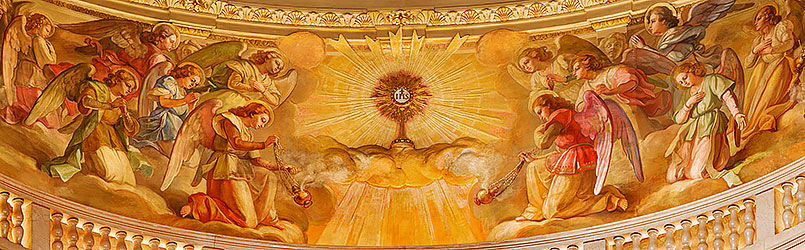
Angels’ Adoration of the Holy Eucharist, cupola fresco by Giuseppe Rollini (1889-1891) in the Basilica of Mary Help of Christians, Turin, Italy.
Photo Credit: © Renáta Sedmáková – stock.adobe.com
Pope Francis’s singular teaching that the Holy Eucharist, the “Bread of Angels,” is the “bread of sinners” has serious practical consequences. No one can deny that he is at least silent on this matter regarding the dubia. Furthermore, instead of supporting courageous bishops who take Catholic doctrine seriously and publicly state how allowing such politicians to receive Holy Communion is incompatible with Catholic doctrine, Pope Francis consistently favors concessive prelates.
Let us close with the verses of Saint Thomas Aquinas recited in the Sequence of the Mass of the Feast of Corpus Christi:
Behold the Bread of Angels,
For us pilgrims food, and token
Of the promise by Christ spoken,
Children’s meat, to dogs denied.
Shewn in Isaac’s dedication,
In the manna’s preparation:
In the Paschal immolation,
In old types pre-signified.
Jesu, shepherd of the sheep:
Thou thy flock in safety keep,
Living bread, thy life supply:
Strengthen us, or else we die,
Fill us with celestial grace.
Thou, who feeds us below:
Source of all we have or know:
Grant that with Thy Saints above,
Sitting at the feast of love,
We may see Thee face to face.
Amen. Alleluia.
Photo Credit (Top): © Antoine – stock.adobe.com
Ping
If the Eucharist is the bread of sinners according to the Poope,then he eats a loaf a day.
After reading this I had to listen to Panis Angelicus. One of the most beautiful hymns, especially in Latin.
Why are Novus Ordo parishes now celebrating the “Most Holy Body **and Blood** of Christ” instead of simply, Corpus Christi? Please correct me if I am wrong, but when one referred simply to “Corpus Christi”, aka “the Most Holy Sacrament”, one was never perceived as denigrating “the Precious Blood of Christ”, or relegating the same to second place among the two products of the Sacrament of the Altar. Is it not a confusing and unnecessary conflation?
Hagan lio! They have a compulsion to always be changing things.
I have always had a natural aversion to “change for change’s sake”.
There was always this sense I had that every time this happened, something good was being thrown away, either inadvisedly, or in certain cases in which malignity was suspected, deliberately. It might not be big, or obvious, but whatever it was, it was of value and was being wasted by being jettisoned in favor of whatever was replacing it (or by nothing, in the case of the change being a pure deletion).
It is true that one can go too far with this “bent”. Attachments can develop, some of them unhealthy. Some of the latter can serve to hold one back from appropriate character development. Attachments are also a known obstacle to spiritual growth.
Most people go with the flow.
Answering my own question about the “lumping together” of the Precious Blood and the Most Holy Sacrament for purposes of the Corpus Christi feast.
Please see the following from:
https://liturgicalnotes.blogspot.com/2021/07/the-precious-blood.html?m=1
Fr Hunwicke’s Mutual Enrichment
1 July 2021
THE PRECIOUS BLOOD
You may think the less well of me for this. But the Feast of the Precious Blood, today, July 1. does ... if anything ... more for me that the solemnity of the Sacred Heart, about three weeks ago. Particularly when we consider the Office Hymns in the Breviary.
Don Anselmo Lentini, who was entrusted with the revision of the Breviary hymns in the post-Conciliar maelstrom, thought the Sacred Heart hymns could not be saved. “fere omnibus invisi erant” he observed. So he introduced (among others) a hymn made up of stanzas from hymns (Aeterna and Te saeculorum) which a Fr Genovesi, a Jesuit, had composed for Christ the King. Unusually, there seems to have been a bit of a rebellion against the draft offered on this occasion by his coetus. When Liturgia Horarum emerged, two of those “invisi” hymns were found ... after all ... to have survived (Cor arca and Auctor beati saeculi). The centonisation based on the work of Fr Genovesi did not survive.
Dom Anselmo left the hymns for the Precious Blood untouched ... because the Powers that Be had decreed that the entire feast should be suppressed. OOPS: not suppressed but subsumed into Corpus Christi (to become Corpus et Sanguis Christi).
The throw-away cynicism of this ‘logic’ is as reprehensible as anything in the Novus Ordo Calendar.
Here is the opening stanza of the old Vespers Hymn, Festivis resonent, in Horatian Asclepiads, as translated in the fine old English Catholic Hymn Book of our Anglican Catholic days:
Now let our streets resound with vocal melody,
Now let each countenance shine clear with holy joy;
Raise high the torches bright, lighting our festal way,
As young and old in order go.
Savour the ironies that arise from continual clericalist meddling with the Liturgy. One year the Christian populace was liturgically encouraged to have spectacular public processions through the streets on a particular day; the very next year, the whole celebration had been cheerfully abolished.
Additional piquancy arises from the Magnificat Antiphon for this feast: “You will keep this day for a remembrance: and you will celebrate it as solemn unto the Lord in your generations, with a worship that will endure for ever [cultu sempiterno]”. I wonder how sempiternus that cultus was in Westminster Cathedral.
Things were not always quite as bad as this. Blessed Pius IX instituted the Feast, ordering it to be on the First Sunday of July. By the pontificate of S Pius X, it had become incorrect to have festivals permanently lodged on Sundays, thus (nearly) obliterating the Sunday Mass. Accordingly, the Feast was shifted to July 1. But ... get this ... it was still permitted to observe an External Solemnity on the Sunday ... as your handy St Lawrence Press Ordo will confirm.
In other words, under S Pius X some consideration was still entertained for popular habits of devotion. Liturgical steamrollers were still in their infancy.
But the twentieth century witnessed the high point of the glory of the wrecking-ball. At one moment, you could dedicate churches ... even Metropolitan Cathedrals ... to the Precious Blood; half a century later the celebration had disappeared from the Calendar. Now you see it, now you don’t. It’s positively Tommy Cooper. Or 1984.
Can anything be more expressive of an arrogant clericalism than the 1960s expectation that the plebs sancta Dei will instantly and obediently jump to whatever novel fashion ‘liturgical experts’ ... the ‘Grilloids’ of the time ... have decided has (overnight) become ‘correct’?
So why do I resent the disappearance from the ‘mainstream’ Church of the Feast of the Precious Bood? Because I dislike Clericalism. Because I valued the primacy the abolished Feast had given to Hebrews, an underrated NT book. Because the abolition swept away much of the theology of Sacrifice which we inherited from the Worship in the Temple of YHWH. And because the suppressed Lauds Hymn Salvete Christi vulnera preserved a great deal of the affection that the Medieval English, clerks and peasantry together, felt for the Devotion to the Five Wounds.
An affection that led to the genocide of the English South West in 1549.
Please see Post #8.
Disclaimer: Opinions posted on Free Republic are those of the individual posters and do not necessarily represent the opinion of Free Republic or its management. All materials posted herein are protected by copyright law and the exemption for fair use of copyrighted works.