Skip to comments.
Catholic Caucus: Daily Mass Readings 06-03-2021, Corpus Christi Solemnity
Universalis/Jerusalem Bible ^
Posted on 06/03/2021 5:43:17 AM PDT by annalex
June 3, 2021
Corpus Christi

Corpus Christi Church in Olesno (Rosenberg), Upper Silesia. Side altar Readings at MassLiturgical Colour: White.
| First reading | Exodus 24:3-8 © |
|---|
This is the blood of the Covenant that the Lord has made with youMoses went and told the people all the commands of the Lord and all the ordinances. In answer, all the people said with one voice, ‘We will observe all the commands that the Lord has decreed.’ Moses put all the commands of the Lord into writing, and early next morning he built an altar at the foot of the mountain, with twelve standing-stones for the twelve tribes of Israel. Then he directed certain young Israelites to offer holocausts and to immolate bullocks to the Lord as communion sacrifices. Half of the blood Moses took up and put into basins, the other half he cast on the altar. And taking the Book of the Covenant he read it to the listening people, and they said, ‘We will observe all that the Lord has decreed; we will obey.’ Then Moses took the blood and cast it towards the people. This’ he said ‘is the blood of the Covenant that the Lord has made with you, containing all these rules.’
| Responsorial Psalm |
|---|
| Psalm 115(116):12-13,15-18 © |
|---|
The cup of salvation I will raise; I will call on the Lord’s name. How can I repay the Lord for his goodness to me? The cup of salvation I will raise; I will call on the Lord’s name. The cup of salvation I will raise; I will call on the Lord’s name. O precious in the eyes of the Lord is the death of his faithful. Your servant, Lord, your servant am I; you have loosened my bonds. The cup of salvation I will raise; I will call on the Lord’s name. A thanksgiving sacrifice I make; I will call on the Lord’s name. My vows to the Lord I will fulfil before all his people. The cup of salvation I will raise; I will call on the Lord’s name.
| Second reading | Hebrews 9:11-15 © |
|---|
The blood of Christ can purify our inner selfNow Christ has come, as the high priest of all the blessings which were to come. He has passed through the greater, the more perfect tent, which is better than the one made by men’s hands because it is not of this created order; and he has entered the sanctuary once and for all, taking with him not the blood of goats and bull calves, but his own blood, having won an eternal redemption for us. The blood of goats and bulls and the ashes of a heifer are sprinkled on those who have incurred defilement and they restore the holiness of their outward lives; how much more effectively the blood of Christ, who offered himself as the perfect sacrifice to God through the eternal Spirit, can purify our inner self from dead actions so that we do our service to the living God. He brings a new covenant, as the mediator, only so that the people who were called to an eternal inheritance may actually receive what was promised: his death took place to cancel the sins that infringed the earlier covenant. Lauda, SionThe Sequence may be said or sung in full, or using the shorter form indicated by the asterisked verses. Sing forth, O Zion, sweetly sing The praises of thy Shepherd-King, In hymns and canticles divine; Dare all thou canst, thou hast no song Worthy his praises to prolong, So far surpassing powers like thine. Today no theme of common praise Forms the sweet burden of thy lays – The living, life-dispensing food – That food which at the sacred board Unto the brethren twelve our Lord His parting legacy bestowed. Then be the anthem clear and strong, Thy fullest note, thy sweetest song, The very music of the breast: For now shines forth the day sublime That brings remembrance of the time When Jesus first his table blessed. Within our new King’s banquet-hall They meet to keep the festival That closed the ancient paschal rite: The old is by the new replaced; The substance hath the shadow chased; And rising day dispels the night. Christ willed what he himself had done Should be renewed while time should run, In memory of his parting hour: Thus, tutored in his school divine, We consecrate the bread and wine; And lo – a Host of saving power. This faith to Christian men is given – Bread is made flesh by words from heaven: Into his blood the wine is turned: What though it baffles nature’s powers Of sense and sight? This faith of ours Proves more than nature e’er discerned. Concealed beneath the two-fold sign, Meet symbols of the gifts divine, There lie the mysteries adored: The living body is our food; Our drink the ever-precious blood; In each, one undivided Lord. Not he that eateth it divides The sacred food, which whole abides Unbroken still, nor knows decay; Be one, or be a thousand fed, They eat alike that living bread Which, still received, ne’er wastes away. The good, the guilty share therein, With sure increase of grace or sin, The ghostly life, or ghostly death: Death to the guilty; to the good Immortal life. See how one food Man’s joy or woe accomplisheth. We break the Sacrament, but bold And firm thy faith shall keep its hold, Deem not the whole doth more enfold Than in the fractured part resides Deem not that Christ doth broken lie, ’Tis but the sign that meets the eye, The hidden deep reality In all its fullness still abides. – – – – – – *Behold the bread of angels, sent For pilgrims in their banishment, The bread for God’s true children meant, That may not unto dogs be given: Oft in the olden types foreshowed; In Isaac on the altar bowed, And in the ancient paschal food, And in the manna sent from heaven. *Come then, good shepherd, bread divine, Still show to us thy mercy sign; Oh, feed us still, still keep us thine; So may we see thy glories shine In fields of immortality; *O thou, the wisest, mightiest, best, Our present food, our future rest, Come, make us each thy chosen guest, Co-heirs of thine, and comrades blest With saints whose dwelling is with thee. Amen. Alleluia.
Alleluia, alleluia! I am the living bread which has come down from heaven, says the Lord. Anyone who eats this bread will live for ever. Alleluia!
| Gospel |
|---|
| Mark 14:12-16,22-26 © |
|---|
This is my body; this is my bloodOn the first day of Unleavened Bread, when the Passover lamb was sacrificed, his disciples said to Jesus, ‘Where do you want us to go and make the preparations for you to eat the passover?’ So he sent two of his disciples, saying to them, ‘Go into the city and you will meet a man carrying a pitcher of water. Follow him, and say to the owner of the house which he enters, “The Master says: Where is my dining room in which I can eat the passover with my disciples?” He will show you a large upper room furnished with couches, all prepared. Make the preparations for us there.’ The disciples set out and went to the city and found everything as he had told them, and prepared the Passover. And as they were eating he took some bread, and when he had said the blessing he broke it and gave it to them. ‘Take it,’ he said ‘this is my body.’ Then he took a cup, and when he had returned thanks he gave it to them, and all drank from it, and he said to them, ‘This is my blood, the blood of the covenant, which is to be poured out for many. I tell you solemnly, I shall not drink any more wine until the day I drink the new wine in the kingdom of God.’ After psalms had been sung they left for the Mount of Olives. The readings on this page are from the Jerusalem Bible, which is used at Mass in most of the English-speaking world. The New American Bible readings, which are used at Mass in the United States, are available in the Universalis apps, programs and downloads.
You can also view this page with the Gospel in Greek and English. |
TOPICS: Catholic; General Discusssion; Prayer; Worship
KEYWORDS: catholic; mk14; ordinarytime; prayer
Navigation: use the links below to view more comments.
first 1-20, 21-25 next last
For your reading, reflection, faith-sharing, comments, questions, discussion.
1
posted on
06/03/2021 5:43:17 AM PDT
by
annalex
To: All
KEYWORDS: catholic; mk14; ordinarytime; prayer
2
posted on
06/03/2021 5:43:55 AM PDT
by
annalex
(fear them not)
To: All
KEYWORDS: catholic; mk14; ordinarytime; prayer
3
posted on
06/03/2021 5:43:55 AM PDT
by
annalex
(fear them not)
To: annalex
4
posted on
06/03/2021 5:44:20 AM PDT
by
annalex
(fear them not)
To: nickcarraway; NYer; ELS; Pyro7480; livius; ArrogantBustard; Catholicguy; RobbyS; marshmallow; ...
Alleluia Ping Please FReepmail me to get on/off the Alleluia Ping List.
5
posted on
06/03/2021 5:45:48 AM PDT
by
annalex
(fear them not)
To: nickcarraway; NYer; ELS; Pyro7480; livius; ArrogantBustard; Catholicguy; RobbyS; marshmallow; ...
Alleluia Ping Please FReepmail me to get on/off the Alleluia Ping List.
6
posted on
06/03/2021 5:45:48 AM PDT
by
annalex
(fear them not)
To: annalex
| Mark |
| | English: Douay-Rheims | Latin: Vulgata Clementina | Greek NT: Byzantine/Majority Text (2000) |
| | Mark 14
|
| 12. | Now on the first day of the unleavened bread, when they sacrificed the pasch, the disciples say to him: Whither wilt thou that we go, and prepare for thee to eat the pasch? | et primo die azymorum quando pascha immolabant dicunt ei discipuli quo vis eamus et paremus tibi ut manduces pascha | και τη πρωτη ημερα των αζυμων οτε το πασχα εθυον λεγουσιν αυτω οι μαθηται αυτου που θελεις απελθοντες ετοιμασωμεν ινα φαγης το πασχα |
| 13. | And he sendeth two of his disciples, and saith to them: Go ye into the city; and there shall meet you a man carrying a pitcher of water, follow him; | et mittit duos ex discipulis suis et dicit eis ite in civitatem et occurret vobis homo laguenam aquae baiulans sequimini eum | και αποστελλει δυο των μαθητων αυτου και λεγει αυτοις υπαγετε εις την πολιν και απαντησει υμιν ανθρωπος κεραμιον υδατος βασταζων ακολουθησατε αυτω |
| 14. | And whithersoever he shall go in, say to the master of the house, The master saith, Where is my refectory, where I may eat the pasch with my disciples? | et quocumque introierit dicite domino domus quia magister dicit ubi est refectio mea ubi pascha cum discipulis meis manducem | και οπου εαν εισελθη ειπατε τω οικοδεσποτη οτι ο διδασκαλος λεγει που εστιν το καταλυμα οπου το πασχα μετα των μαθητων μου φαγω |
| 15. | And he will shew you a large dining room furnished; and there prepare ye for us. | et ipse vobis demonstrabit cenaculum grande stratum et illic parate nobis | και αυτος υμιν δειξει ανωγεον μεγα εστρωμενον ετοιμον εκει ετοιμασατε ημιν |
| 16. | And his disciples went their way, and came into the city; and they found as he had told them, and they prepared the pasch. | et abierunt discipuli eius et venerunt in civitatem et invenerunt sicut dixerat illis et praeparaverunt pascha | και εξηλθον οι μαθηται αυτου και ηλθον εις την πολιν και ευρον καθως ειπεν αυτοις και ητοιμασαν το πασχα |
| [...] |
| 22. | And whilst they were eating, Jesus took bread; and blessing, broke, and gave to them, and said: Take ye. This is my body. | et manducantibus illis accepit Iesus panem et benedicens fregit et dedit eis et ait sumite hoc est corpus meum | και εσθιοντων αυτων λαβων ο ιησους αρτον ευλογησας εκλασεν και εδωκεν αυτοις και ειπεν λαβετε φαγετε τουτο εστιν το σωμα μου |
| 23. | And having taken the chalice, giving thanks, he gave it to them. And they all drank of it. | et accepto calice gratias agens dedit eis et biberunt ex illo omnes | και λαβων το ποτηριον ευχαριστησας εδωκεν αυτοις και επιον εξ αυτου παντες |
| 24. | And he said to them: This is my blood of the new testament, which shall be shed for many. | et ait illis hic est sanguis meus novi testamenti qui pro multis effunditur | και ειπεν αυτοις τουτο εστιν το αιμα μου το της καινης διαθηκης το περι πολλων εκχυνομενον |
| 25. | Amen I say to you, that I will drink no more of the fruit of the vine, until that day when I shall drink it new in the kingdom of God. | amen dico vobis quod iam non bibam de genimine vitis usque in diem illum cum illud bibam novum in regno Dei | αμην λεγω υμιν οτι ουκετι ου μη πιω εκ του γεννηματος της αμπελου εως της ημερας εκεινης οταν αυτο πινω καινον εν τη βασιλεια του θεου |
| 26. | And when they had said an hymn, they went forth to the mount of Olives. | et hymno dicto exierunt in montem Olivarum | και υμνησαντες εξηλθον εις το ορος των ελαιων |
7
posted on
06/03/2021 5:47:15 AM PDT
by
annalex
(fear them not)
To: annalex
Catena Aurea by St. Thomas Aguinas
14:12–16
12. And the first day of unleavened bread, when they killed the Passover, his disciples said unto him, Where wilt thou that we go and prepare that thou mayest eat the Passover?
13. And he sendeth forth two of his disciples, and saith unto them, Go ye into the city, and there shall meet you a man bearing a pitcher of water: follow him.
14. And wheresoever he shall go in, say ye to the goodman of the house, The Master saith, Where is the guestchamber, where I shall eat the Passover with my disciples?
15. And he will shew you a large upper room furnished and prepared: there make ready for us.
16. And his disciples went forth, and came into the city, and found as he had said unto them: and they made ready the Passover.
CHRYSOSTOM. (ubi sup.) Whilst Judas was plotting how to betray Him, the rest of the disciples were taking care of the preparation of the Passover: wherefore it is said, And the first day of unleavened bread, when they killed the Passover, his disciples said unto him, Where wilt thou that we go and prepare where thou mayest eat the Passover.
BEDE. (ubi sup.) He means by the first day of the Passover the fourteenth day of the first month, when they threw aside leaven, and were wont to sacrifice, that is, to kill the lamb at even. The Apostle explaining this says, Christ our Passover is sacrificed for us. (1 Cor. 5:7) For although He was crucified on the next day, that is, on the fifteenth moon, yet on the night when the lamb was offered up, He committed to His disciples the mysteries of His Body and Blood, which they were to celebrate, and was seized upon and bound by the Jews; thus He consecrated the beginning of His sacrifice, that is, of His Passion.
PSEUDO-JEROME. But the unleavened bread which was eaten with bitterness, that is with bitter herbs, is our redemption, and the bitterness is the Passion of our Lord.
THEOPHYLACT. From the words of the disciples, Where wilt thou that we go? it seems evident that Christ had no dwelling-place, and that the disciples had no houses of their own; for if so, they would have taken Him thither.
PSEUDO-JEROME. For they say, Where wilt thou that we go? to shew us that we should direct our steps according to the will of God. But the Lord points out with whom He would eat the Passover, and after His custom He sends two disciples, which we have explained above; wherefore it goes on, And he sendelh forth two of his disciples, and he saith unto them, Go ye into the city.
THEOPHYLACT. He sends two of His disciples, that is, Peter and John, as Luke says, to a man unknown to Him, implying by this that He might, if He had pleased, have avoided His Passion. For what could not He work in other men, who influenced the mind of a person unknown to Him, so that he received them? He also gives them a sign how they were to know the house, when He adds, And there shall meet you a man bearing a pitcher of water.
AUGUSTINE. (de Con. Evan. ii. 80) Mark says a pitcher, Luke a two-handled vessel; one points out the kind of vessel, the other the mode of carrying it; both however mean the same truth.
BEDE. (ubi sup.) And it is a proof of the presence of His divinity, that in speaking with His disciples, He knows what is to take place elsewhere; wherefore it follows, And his disciples went forth, and came into the city, and found as he had said unto them; and they made ready the Passover.
CHRYSOSTOM. (ubi sup.) Not our Passover, but in the meanwhile that of the Jews; but He did not only appoint ours, but Himself became our Passover. Why too did He eat it? Because He was made under the Law, to redeem them that were under the Law, (Gal. 4:4) and Himself give rest to the Law. And lest any one should say that He did away with it, because He could not fulfil its hard and difficult obedience, He first Himself fulfilled it, and then set it to rest.
PSEUDO-JEROME. And in a mystical sense the city is the Church, surrounded by the wall of faith, the man who meets them is the primitive people, the pitcher of water is the law of the letter.
BEDE. (ubi sup.) Or else, the water is the laver of grace, the pitcher points out the weakness of those who were to shew that grace to the world.
THEOPHYLACT. He who is baptized carries the pitcher of water, and he who bears baptism upon him comes to his rest, if he lives according to his reason; and he obtains rest, as being in the house. Wherefore it is added, Follow him.
PSEUDO-JEROME. That is, him who leads to the lofty place, where is the refreshment prepared by Christ. (John 21:15) The lord of the house is the Apostle Peter, to whom the Lord has entrusted His house, that there may be one faith under one Shepherd. The large upper-room is the wide-spread Church, in which the name of the Lord is spoken of, prepared by a variety of powers and tongues.
BEDE. (ubi sup.) Or else, the large upper-room is spiritually the Law, which comes forth from the narrowness of the letter, and in a lofty place, that is, in the lofty chamber of the soul, receives the Saviour. But it is designedly that the names both of the bearer of the water, and of the lord of the house, are omitted, to imply that power is given to all who wish to celebrate the true Passover, that is, to be embued with the sacraments of Christ, and to receive Him in the dwelling-place of their mind.
THEOPHYLACT. Or else, the lord of the house is the intellect, which points out the large upper room, that is, the loftiness of intelligences, and which, though it be high, yet has nothing of vain glory, or of pride, but is prepared and made level by humility. But there, that is, in such a mind Christ’s Passover is prepared by Peter and John, that is by action and contemplation.
14:17–21
17. And in the evening he cometh with the twelve.
18. And as they sat and did eat, Jesus said, Verily I say unto you, One of you which eateth with me shall betray me.
19. And they began to be sorrowful, and to say unto him one by one, Is it I? and another said, Is it I?
20. And he answered and said unto them, It is one of the twelve, that dippeth with me in the dish.
21. The Son of man indeed goeth, as it is written of him: but woe to that man by whom the Son of man is betrayed! good were it for that man if he had never been born.
BEDE. (ubi sup.) The Lord who had foretold His Passion, prophesied also of the traitor, in order to give him room for repentance, that understanding that his thoughts were known, he might repent. Wherefore it is said, And in the evening he cometh with the twelve. And as they sat and did eat, Jesus said, Verily I say unto you, One of you which eateth with me shall betray me.
CHRYSOSTOM. (ubi sup.) Where it is evident that He did not proclaim him openly to all, lest He should make him the more shameless; at the same time He did not altogether keep it silent, lest thinking that he was not discovered, he should boldly hasten to betray Him.
THEOPHYLACT. But how could they eat reclining, when the law ordered that standing and upright they should eat the Passover? It is probable that they had first fulfilled the legal Passover, and had reclined, when He began to give them His own Passover.
PSEUDO-JEROME. The evening of the day points out the evening of the world; for the last, who are the first to receive the penny of eternal life, come about the eleventh hour. All the disciples then are touched by the Lord; so that there is amongst them the harmony of the harp, all the well attuned strings answer with accordant tone; for it goes on: And they began to be sorrowful, and to say unto him one by one, Is it I? One of them however, unstrung, and steeped in the love of money, said, Is it I, Lord? as Matthew testifies.
THEOPHYLACT. But the other disciples began to be saddened on account of the word of the Lord; for although they were free from this passion, yet they trust Him who knows all hearts, rather than themselves. It goes on: And he answered and said unto them, It is one of the twelve, that dippeth with me in the dish.
BEDE. (ubi sup.) That is, Judas, who when the others were sad and held back their hands, puts forth his hand with his Master into the dish. And because He had before said, One of you shall betray me, and yet the traitor perseveres in his evil, He accuses him more openly, without however pointing out his name.
PSEUDO-JEROME. Again, He says, One out of the twelve, as it were separate from them, for the wolf carries away from the flock the sheep which he has taken, and the sheep which quits the fold lies open to the bite of the wolf. But Judas does not withdraw his foot from his traitorous design though once and again pointed at, wherefore his punishment is foretold, that the death denounced upon him might correct him, whom shame could not overcome; wherefore it goes on: The Son of man indeed goeth, as it is written of him.
THEOPHYLACT. The word here used, goeth, shews that the death of Christ was not forced but voluntary.
PSEUDO-JEROME. But because many do good, in the way that Judas did, without its profiting them, there follows: Woe to that man by whom the Son of man is betrayed! good were it for that man if he had never been born.
BEDE. (ubi sup.) Woe too to that man, to-day and for ever, who comes to the Lord’s table with an evil intent. For he, after the example of Judas, betrays the Lord, not indeed to Jewish sinners, but to his own sinning members. It goes on: Good were it for that man if he had never been born.
PSEUDO-JEROME. That is, hidden in his mother’s inmost womb, for it is better for a man not to exist than to exist for torments.
THEOPHYLACT. For as respects the end for which he was designed, it would have been better for him to have been born, if he had not been the betrayer, for God created him for good works; but after he had fallen into such dreadful wickedness, it would have been better for him never to have been born.
14:22–25
22. And as they did eat, Jesus took bread, and blessed, and brake it, and gave to them, and said, Take, eat: this is my body.
23. And he took the cup, and when he had given thanks, he gave it to them: and they all drank of it.
24. And he said unto them, This is my blood of the new testament, which is shed for many.
25. Verily I say unto you, I will drink no more of the fruit of the vine, until that day that I drink it new in the kingdom of God.
BEDE. (ubi sup.) When the rites of the old Passover were finished, He passed to the new, in order, that is, to substitute the Sacrament of His own Body and Blood, for the flesh and blood of the lamb. Wherefore there follows: And as they did eat, Jesus took bread; that is, in order to shew that He Himself is that person to whom the Lord swore, Thou art a Priest for ever after the order of Melchizedec. (Ps. 110:4) There follows: And blessed, and brake it.
THEOPHYLACT. That is, giving thanks, He brake it, which we also do, with the addition of some prayers.
BEDE. (ubi sup.) He Himself also breaks the bread, which He gives to His disciples, to shew that the breaking of His Body was to take place, not against His will, nor without His intervention; He also blessed it, because He with the Father and the Holy Spirit filled His human nature, which He took upon Him in order to suffer, with the grace of Divine power. He blessed bread and brake it, because He deigned to subject to death His manhood, which He had taken upon Him, in such a way as to shew that there was within it the power of Divine immortality, and to teach them that therefore He would the more quickly raise it from the dead. There follows: And gave to them, and said, Take, eat: this is my body.
THEOPHYLACT. That, namely, which I now give and which ye take. But the bread is not a mere figure of the Body of Christ, but is changed into the very Body of Christ. For the Lord said, The bread which I give you is my flesh. But the flesh of Christ is veiled from our eyes on account of our weakness, for bread and wine are things to which we are accustomed, if however we saw flesh and blood we could not bear to take them. For this reason the Lord bending Himself to our weakness keeps the forms of bread and wine, but changes the bread and wine into the reality of His Body and Blood.
CHRYSOSTOM. (ubi sup.) Even now also that Christ is close to us; He who prepared that table, Himself also consecrates it. For it is not man who makes the offerings to be the Body and Blood of Christ, but Christ who was crucified for us. The words are spoken by the mouth of the Priest, and are consecrated by the power and the grace of God. By this word which He spoke, This is my body, the offerings are consecrated; and as that word which says, Increase and multiply, and fill the earth, (Gen. 1:28) was sent forth but once, yet has its effect throughout all time, when nature does the work of generation; so also that voice was spoken once, yet gives confirmation to the sacrifice through all the tables of the Church even to this day, even to His advent.
PSEUDO-JEROME. But in a mystical sense, the Lord transfigures into bread His body, which is the present Church, which is received in faith, is blessed in its number, is broken in its sufferings, is given in its examples, is taken in its doctrines; and He forms His Blood (formans sanguinem suum ap. Pseudo-Hier.) in the chalice of water and wine mingled together, that by one we may be purged from our sins, by the other redeemed from their punishment. For by the blood of the lamb our houses are preserved from the smiting of the Angel, and our enemies perish in the waters of the Red sea, which are the sacraments of the Church of Christ. Wherefore it goes on: And he took the cup, and when he had given thanks, he gave it to them. For we are saved by the grace of the Lord, not by our own deserts.
GREGORY. (Mor. ii. 37) When His Passion was approaching, He is said to have taken bread and given thanks. He therefore gave thanks, who took upon Him the stripes of other men’s wickedness; He who did nothing worthy of smiting, humbly gives a blessing in His Passion, to shew us, what each should do when beaten for his own sins, since He Himself bore calmly the stripes due to the sin of others; furthermore to shew us, what we who are the subjects of the Father should do under correction, when He who is His equal gave thanks under the lash.
BEDE. (ubi sup.) The wine of the Lord’s cup is mixed with water, because we should remain in Christ and Christ in us. For on the testimony of John, the waters are the people, and it is not lawful for any one to offer either wine alone, or water alone, lest such an oblation should mean that the head may be severed from the members, and either that Christ could suffer without love for our redemption, and that we can be saved or be offered to the Father without His Passion. (Apoc. 17:15) It goes on: And they all drank of it.
PSEUDO-JEROME. Happy intoxication, saving fulness, which the more we drink gives the greater sobriety of mind!
THEOPHYLACT. Some say that Judas did not partake in these mysteries, but that he went out before the Lord gave the Sacrament. Some again say that He gave him also of that Sacrament.
CHRYSOSTOM. (ubi sup.) For Christ offered His blood to him who betrayed Him, that he might have remission of his sins, if he had chosen to cease to be wicked.
PSEUDO-JEROME. Judas therefore drinks and is not satisfied, nor can he quench the thirst of the everlasting fire, because he unworthily partakes of the mysteries of Christ. There are some in the Church whom the sacrifice does not cleanse, but their foolish thought draws them on to sin, for they have plunged themselves in the stinking slough of cruelty.
CHRYSOSTOM. (ubi sup.) Let there not be therefore a Judas at the table of the Lord; this sacrifice is spiritual food, for as bodily food, working on a belly filled with humours which are opposed to it, is hurtful, so this spiritual food if taken by one polluted with wickedness, rather brings him to perdition, not by its own nature, but through the fault of the recipient. Let therefore our mind be pure in all things, and our thought pure, for that sacrifice is pure. There follows: And he said unto them, This is my blood of the New Testament, which is shed for many.
BEDE. (ubi sup.) This refers to the different circumstances of the Old Testament, which was consecrated by the blood of calves and of goats; and the lawgiver said in sprinkling it, This is the blood of the Testament which God hath injoined unto you. (Heb. 9:20. vide Ex. 24:8) It goes on: Which is shed for many.
PSEUDO-JEROME. For it does not cleanse all. It goes on: Verily I say unto you, I will drink no more of the fruit of the vine, until that day that I drink it new in the kingdom of God.
THEOPHYLACT. As if He had said, I will not drink wine until the resurrection; for He calls His resurrection the kingdom, as He then reigned over death. But after His resurrection He ate and drank with His disciples, shewing that it was He Himself who had suffered. But He drank it new, that is, in a new and strange manner, for He had not a body subject to suffering, and requiring food, but immortal and incorruptible. We may also understand it in this way. The vine is the Lord Himself, by the offspring1 of the vine is meant mysteries, and the secret understanding, which He Himself begets2, who teaches man knowledge. But in the kingdom of God, that is, in the world to come, He will drink with His disciples mysteries and knowledge, teaching us new things, and revealing what He now hides.
BEDE. (ubi sup.) Or else, Isaiah testifies that the synagogue is called the vine or the vineyard of the Lord, saying, The vineyard of the Lord of hosts is the house of Israel. (Is. 5:7) The Lord therefore when about to go to His Passion, says, I will drink no more of the fruit of the vine, as if He had said openly, I will no longer delight in the carnal rites of the synagogue, in which also these rites of the Paschal Lamb have held the chief place. For the time of my resurrection shall come, that day shall come, when in the kingdom of heaven, that is, raised on high with the glory of immortal life, I will be filled with a new joy, together with you, for the salvation of the same people born again of the fountain of spiritual grace.
PSEUDO-JEROME. But we must consider that here the Lord changes the sacrifice without changing the time; so that we never celebrate the Cæna Domini before the fourteenth moon. He who celebrates the resurrection on the fourteenth moon, will celebrate the Cæna Domini on the eleventh moon, which was never done in either Old or New Testament.
14:26–31
26. And when they had sung an hymn, they went out into the mount of Olives.
27. And Jesus saith unto them, All ye shall be offended because of me this night: for it is written, I will smite the shepherd, and the sheep shall be scattered.
28. But after that I am risen, I will go before you into Galilee.
29. But Peter said unto him, Although all shall be offended, yet will not I.
30. And Jesus saith unto him, Verily I say unto thee, That this day, even in this night, before the cock crow twice, thou shalt deny me thrice.
31. But he spake the more vehemently, If I should die with thee, I will not deny thee in any wise. Likewise also said they all.
THEOPHYLACT. As they returned thanks, before they drank, so they return thanks after drinking; wherefore it is said, And when they had sung an hymn, they went out into the mount of Olives, to teach us to return thanks both before and after our food.
PSEUDO-JEROME. For by a hymn he means the praise of the Lord, as is said in the Psalms, The poor shall eat and be satisfied; they that seek after the Lord shall praise him. (Ps. 22:26, 29) And again, All such as be fat upon earth have eaten and worshipped.
THEOPHYLACT. He also shews by this that He was glad to die for us, because when about to be betrayed, He deigned to praise God. He also teaches us when we fall into troubles for the sake of the salvation of many, not to be sad, but to give thanks to God, who through our distress works the salvation of many.
BEDE. (ubi sup.) That hymn in the Gospel of John (John 17.) may also be meant, which the Lord sang, returning thanks to the Father, in which also He prayed, raising His eyes to heaven, for Himself and His disciples, and those who were to believe, through their word.
THEOPHYLACT. Again, He went out into a mountain, that they might come to Him in a lonely place, and take Him without tumult. For if they had come to Him, whilst He was abiding in the city, the multitude of the people would have been in an uproar, and then His enemies, who took occasion against Him, should seem to have slain Him justly, because He stirred up the people.
BEDE. (ubi sup.) Beautifully also does the Lord lead out His disciples, when they had tasted His Sacraments, into the mount of Olives, to shew typically that we ought through the reception of the Sacraments to rise up to higher gifts of virtue, and graces of the Holy Ghost, that we may be anointed in heart.
PSEUDO-JEROME. Jesus also is held captive on the mount of Olives, whence He ascended to heaven, that we may know, that we ascend into heaven from that place in which we watch and pray; there we are bound and do not tend back again to earth.
BEDE. (ubi sup.) But the Lord foretells to His disciples what is about to happen to them, that when they have gone through it, they may not despair of salvation, but work out their repentance, and be freed; wherefore there follows: And Jesus saith unto them, All ye shall be offended because of me this night.
PSEUDO-JEROME. All indeed fall, but all do not remain fallen. (Ps. 40:9. Vulg.) For shall not he who sleeps also rise up again? It is a carnal thing to fall, but devilish to remain lying when fallen.
THEOPHYLACT. The Lord allowed them to fall that they might not trust in themselves, and lest He should seem to have prophesied, what He had said, as an open accusation (κατηγορία ap. Theoph.) of them, He brings forward the witness of Zechariah the Prophet; wherefore it goes on: For it is written, I will smite the shepherd, and the sheep shall be scattered.
BEDE. (ubi sup.) This is written in different words in Zecharias, and in the person of the Prophet it is said to the Lord; Smite the shepherd, and the sheep shall be scattered. (Zech. 13:7)
PSEUDO-JEROME. For the Prophet prays for the Passion of the Lord, and the Father answers, I will smite the shepherd according to the prayers of those below. The Son is sent and smitten by the Father, that is, He is made incarnate and suffers.
THEOPHYLACT. But the Father says, I will smite the shepherd, because He permitted him to be smitten. He calls the disciples sheep, as being innocent and without guile. At last He consoles them, by saying, But after that I am risen I will go before you into Galilee.
PSEUDO-JEROME. In which the true resurrection is promised, that their hope may not be extinguished. There follows: But Peter said unto him, Although all shall be offended, yet will not I. Lo, a bird unfledged strives to raise itself on high; but the body weighs down the soul, so that the fear of the Lord is overcome by the fear of human death.
BEDE. (ubi sup.) Peter then promised in the ardour of his faith, and the Saviour as God knew what was to happen. Wherefore it goes on: And Jesus said unto him, Verily I say unto thee, that this day, even in this night, before the cock crow twice, thou shalt deny me thrice.
AUGUSTINE. (iii. 2. de Con. Evan) Though all the Evangelists say that the Lord foretold that Peter was to deny before the cock crew, Mark alone has related it more minutely, wherefore some from inattention suppose that he does not agree with the others. For the whole of Peter’s denial is threefold; if it had begun altogether after the cock crew, the other three Evangelists would seem to have spoken falsely, in saying, that before the cock crew, he would deny him thrice. Again, if he had finished the entire threefold denial before the cock began to crow, Mark would in the person of the Lord seem to have said needlessly, Before the cock crow twice, thou shall deny me thrice. But because that threefold denial began before the first cock-crowing, the other three did not notice when Peter was to finish it, but how great it was to be, that is, threefold, and when it was to begin, that is, before the cock crew, although the whole was conceived in his mind, even before the first cock crew; but Mark has related more plainly the interval between his words themselves.
THEOPHYLACT. We are to understand that it happened thus; Peter denied once, then the cock crew, but after he had made two more denials, then the cock crew for the second time.
PSEUDO-JEROME. Who is the cock, the harbinger of day, but the Holy Ghost? by whose voice in prophecy, and in the Apostles, we are roused from our threefold denial, to most bitter tears after our fall, for we have thought evil of God, spoken evil of our neighbours, and done evil to ourselves.
BEDE. (ubi sup.) The faith of the Apostle Peter, and his burning love for our Lord, is shewn in what follows. For it goes on: But he spake the more vehemently, If I should die with thee, I will not deny thee in any wise.
THEOPHYLACT. The other disciples also shewed a fearless zeal. For there follows, Likewise also said they all, but nevertheless they acted against the truth, which Christ had prophesied.Catena Aurea Mark 14
8
posted on
06/03/2021 5:52:06 AM PDT
by
annalex
(fear them not)
To: annalex
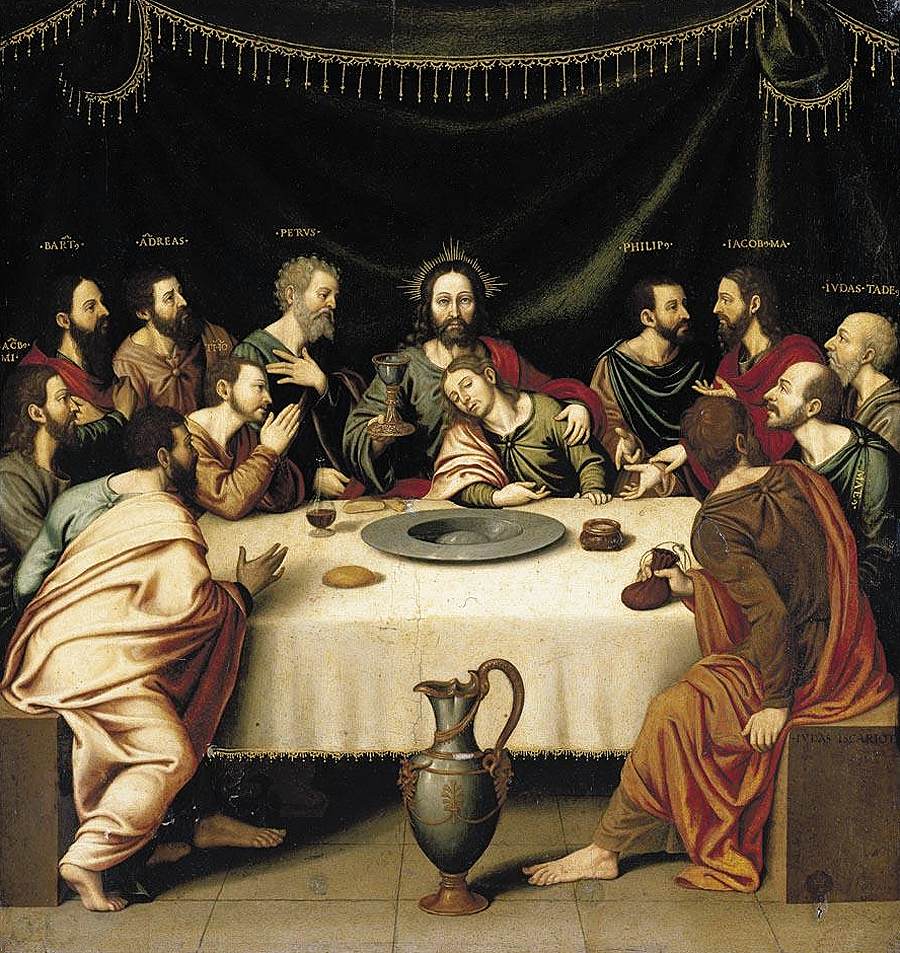
The Last Supper
Fray Nicolás Borrás
1570s
Oil on panel, 49 x 46 cm
Private collection
9
posted on
06/03/2021 5:52:48 AM PDT
by
annalex
(fear them not)
To: annalex
Corpus Christi – Corpus Domini – Dies Sanctissimi Corporis et Sanguinis Domini Iesu Christi – “The Day of the Most Holy Body and Blood of Jesus Christ the Lord” – these are the many names associated with this solemnity in the Roman Catholic, Anglican and Western Orthodox Churches. This Feast celebrates the Real Presence of the Body and Blood, Soul and Divinity of Christ. This same mystery is celebrated during Holy Week on Holy Thursday, when Christ gives his body and blood at the Last Supper, washes the feet of his disciples and institutes the priesthood. Corpus Christi is more festive in its liturgy – celebrating with joy in Christ’s continued presence that was celebrated in a more somber atmosphere on Holy Thursday.The process of the simple bread and wine being transformed into the Body and Blood of Christ is called Transubstantiation. The substance is changed – bread is no longer bread and wine is no longer wine – but the appearance remains.
St. Thomas Aquinas proposed the celebration of this feast and the joy of the Eucharistic presence of Christ. The Solemn Feast was established by Pope Urban IV in 1264. It is usually celebrated on the Thursday after Trinity Sunday, but in many diocese, has been moved to the following Sunday so that more of the faithful might participate in this celebration.
Celebrations include the celebration of Mass and a procession of the Blessed Sacrament and Benediction – the faithful are blessed with the Blessed Sacrament.
The Church is called the Body of Christ because of the intimate communion which Jesus shares with his disciples. He expresses this in the gospels by using the metaphor of a body in which He is the head. This image helps keep in focus both the unity and the diversity of the Church.
cicts.org
10
posted on
06/03/2021 5:58:32 AM PDT
by
annalex
(fear them not)
To: annalex
June 3rd is the feast of St. Charles Lwanga and Companions.
These great saints have been officially designated as martyrs for the Catholic faith.
Officially, St. Charles Lwanga is the patron of converts, torture victims, and the African Catholic Youth Action.
Unofficially, it would seem he’s a perfect patron of those striving for purity and resisting the myriad temptations and even downright celebrations of unchastity and sexual confusion. He was canonized by Pope Paul VI on October 18, 1964 in Uganda.
The Story of Sts. Charles Lwanga, Joseph Mkasa and Companions
Charles Lwanga was martyred on June 3, 1886, at the age of 26, along with 12 other Catholics and 11 Anglicans, for refusing to renounce their faith and to comply with the corrupt and unchaste demands of King Mwanga of Uganda.
King Mwanga was a violent ruler and pedophile with a predilection for the young boys and men who served him as pages and attendants. The Christians at Mwanga’s court tried to protect the pages from King Mwanga.
A young Catholic named Joseph Mkasa was the chief steward of Mwanga’s court. He confronted King Mwanga when he killed a Protestant missionary and his companions. Angered by his underling’s insolence, Mwanga ordered him killed. At the hands of his executioners, and forgiving the tyrant king, Mkasa said, “A Christian who gives his life for God is not afraid to die.” He was beheaded and burned on November 15, 1885.
Upon Jospeh Mkasa’s death, chief page Charles Lwanga took his place in the instruction and leadership of the Christian community at Mwanga’s court, having sought baptism, himself, on the very day of Mkasa’s execution. When Mwanga’s sexual advances were rebuffed by another young page, the King killed him and then sealed the royal court so that no one could escape, summoning the country’s executioners.
Seeing that the situation had become desperate, Charles Lwanga baptized four catechumens that night, including a thirteen-year-old boy.
The next morning Mwanga brought his whole court before him and separated the Christians from the rest by saying, “Those who do not pray stand by me, those who do pray stand over there.” He demanded of the fifteen boys and young men (all under 25) if they were Christians and intended to remain Christians. When they answered “Yes,” Mwanga condemned them to death.
The king sent the prisoners on a 37 mile trek to the place of execution at Namugongo, along which walk, three of the faithful were killed. Upon arriving at the execution site, the survivors were held captive for seven days. On June 3, the Christian captives – 13 of them Catholics, 11 Protestants – were brought out and executed. As they were burning to death, they called out the name of Jesus, proclaiming, “You can burn our bodies, but you cannot harm our souls.”
Prayer to the Martyrs of Uganda
Martyrs of Uganda, pray for the faith where it is danger and for Christians who must suffer because of their faith. Give them the same courage, zeal, and joy you showed. And help those of us who live in places where Christianity is accepted to remain aware of the persecution in other parts of the world. Amen
(Source: Catholic Online – catholic.org)
catholic-link.org
11
posted on
06/03/2021 6:20:03 AM PDT
by
annalex
(fear them not)
To: annalex
June 3rd is the feast of St. Charles Lwanga and Companions.
These great saints have been officially designated as martyrs for the Catholic faith.
Officially, St. Charles Lwanga is the patron of converts, torture victims, and the African Catholic Youth Action.
Unofficially, it would seem he’s a perfect patron of those striving for purity and resisting the myriad temptations and even downright celebrations of unchastity and sexual confusion. He was canonized by Pope Paul VI on October 18, 1964 in Uganda.
The Story of Sts. Charles Lwanga, Joseph Mkasa and Companions
Charles Lwanga was martyred on June 3, 1886, at the age of 26, along with 12 other Catholics and 11 Anglicans, for refusing to renounce their faith and to comply with the corrupt and unchaste demands of King Mwanga of Uganda.
King Mwanga was a violent ruler and pedophile with a predilection for the young boys and men who served him as pages and attendants. The Christians at Mwanga’s court tried to protect the pages from King Mwanga.
A young Catholic named Joseph Mkasa was the chief steward of Mwanga’s court. He confronted King Mwanga when he killed a Protestant missionary and his companions. Angered by his underling’s insolence, Mwanga ordered him killed. At the hands of his executioners, and forgiving the tyrant king, Mkasa said, “A Christian who gives his life for God is not afraid to die.” He was beheaded and burned on November 15, 1885.
Upon Jospeh Mkasa’s death, chief page Charles Lwanga took his place in the instruction and leadership of the Christian community at Mwanga’s court, having sought baptism, himself, on the very day of Mkasa’s execution. When Mwanga’s sexual advances were rebuffed by another young page, the King killed him and then sealed the royal court so that no one could escape, summoning the country’s executioners.
Seeing that the situation had become desperate, Charles Lwanga baptized four catechumens that night, including a thirteen-year-old boy.
The next morning Mwanga brought his whole court before him and separated the Christians from the rest by saying, “Those who do not pray stand by me, those who do pray stand over there.” He demanded of the fifteen boys and young men (all under 25) if they were Christians and intended to remain Christians. When they answered “Yes,” Mwanga condemned them to death.
The king sent the prisoners on a 37 mile trek to the place of execution at Namugongo, along which walk, three of the faithful were killed. Upon arriving at the execution site, the survivors were held captive for seven days. On June 3, the Christian captives – 13 of them Catholics, 11 Protestants – were brought out and executed. As they were burning to death, they called out the name of Jesus, proclaiming, “You can burn our bodies, but you cannot harm our souls.”
Prayer to the Martyrs of Uganda
Martyrs of Uganda, pray for the faith where it is danger and for Christians who must suffer because of their faith. Give them the same courage, zeal, and joy you showed. And help those of us who live in places where Christianity is accepted to remain aware of the persecution in other parts of the world. Amen
(Source: Catholic Online – catholic.org)
catholic-link.org
12
posted on
06/03/2021 6:20:03 AM PDT
by
annalex
(fear them not)
To: annalex
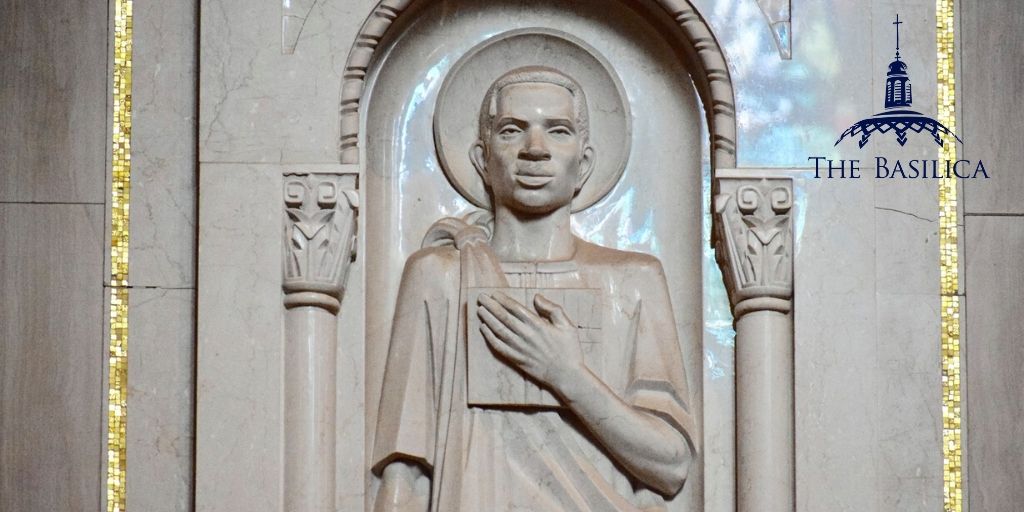
Statue at the Basilica of the National Shrine of the Immaculate Conception
13
posted on
06/03/2021 6:24:16 AM PDT
by
annalex
(fear them not)
To: annalex
NAVARRE BIBLE COMMENTARY (RSV) Ad Majorem Dei Gloriam (To the Greater Glory of God) Readings for June 3rd: Feast of St. Charles Lwanga and Companions
From: Tobit 6:10-11; 7:1bcde, 9-17; 8:4-9a (New American Bible)
Tobit 6:9-10; 7:1bcde, 8bcde-18; 8:4-9a (Revised Standard Version)
Arrival in Media
----------------
[9] When they (the angel Raphael and Tobias) approached Ecbatana, [10] the angel said to the young man, "Brother, today we shall stay with Raguel. He is your relative, and he has an only daughter named Sarah."
Sarah's Hand is Sought in Marriage (Continuation)
--------------------------------------------------
[1bcde] (When they) arrived at the house of Raguel, Sarah met them and greeted them. They returned her greeting, and she brought them into the house. [8bcde] They received them very warmly; and they killed a ram from the flock and set large servings of food before them.
Then Tobias said to Raphael, "Brother Azarias, speak of those things which you talked about on the journey, and let the matter be settled." [9] So he communicated the proposal to Raguel. And Raguel said to Tobias. "Eat, drink, and be merry; [10] for it is your right to take my child. But let me explain the true situation to you.
[11] I have given my daughter to seven husbands, and when each came to her he died in the night. But for the present be merry." And Tobias said, "I will eat nothing here until you make a binding agreement with me." [12] So Raguel said, "Take her right now, in accordance with the law. You are her relative, and she is yours. The merciful God will guide you both for the best." [13] Then he called his daughter Sarah, and taking her by the hand he gave her to Tobias to be his wife, saying, "Here she is; take her according to the law of Moses, and take her with you to your father." And he blessed them. [14] Next he called his wife Edna, and took a scroll and wrote out the contract; and they set their seals to it. [15] Then they began to eat.
[16] And Raguel called his wife Edna and said to her, "Sister, make up the other room, and take her into it." [17] So she did as he said, and took her there; and the girl began to weep. But the mother comforted her daughter in her tears, and said to her, [18] "Be brave, my child; the Lord of heaven and earth grant you joy in place of this sorrow of yours. Be brave, my daughter."
Tobias' and Sarah's Wedding Night (Continuation)
------------------------------------------------
[4] When the door was shut and the two were alone, Tobias got up from the bed and said, "Sister, get up, and let us pray that the Lord may have mercy upon us." [5] And Tobias began to pray, "Blessed art thou, 0 God of our fathers, and blessed be thy holy and glorious name for ever. Let the heavens and all thy creatures bless thee. [6] Thou madest Adam and gayest him Eve his wife as a helper and support. From them the race of mankind has sprung. Thou didst say, 'It is not good that the man should be alone; let us make a helper for him like himself.' [7] And now, 0 Lord, I am not taking this sister of mine because of lust, but with sincerity. Grant that I may find mercy and may grow old together with her." [8] And she said with him, "Amen." [9] Then they both went to sleep for the night.
***********************************************************************
Commentary:
6:9-17. According to the Law (cf. Num 36:1-13), when a daughter inherits from her father (cf. Num 27:1-11) she should marry a man of her own tribe, in order to ensure that her inheritance does not (as a dowry) become the property of another tribe. It is up to Tobias to marry Sarah because he is the closest relative (the text does not say whether the earlier husbands were relatives). The angel points out the advantages of complying with that law: Tobias will get Sarah's inheritance, but he will also get a beautiful and sensible wife; he encourages him not to delay (v. 12).
Tobias raises weighty objections, not just because he is afraid he will suffer the fate of the other husbands but because he feels a duty to his elderly parents (vv. 14-15)--as indeed the Law lays down. The angel tells him how these difficulties can be dealt with: he reminds Tobias of his father's instruction (v. 15; 4:12) and tells him how to deal with the demon (vv. 16-17), not only by using parts of the fish but also by having recourse to prayer (v. 17). The words "she was destined for you from all eternity"(v. 17) show that the love between the two young people which leads them to marriage is being guided by divine providence and is part of a mysterious plan of God's, an eternal plan. This is borne out by the fact that Tobias falls in love with the girl even before meeting her (v. 18). St J. Escriva advises young people to put themselves under the protection of the archangel Raphael: "How frankly you laughed when I advised you to put the years of your youth under the protection of Saint Raphael: so that he'll lead you, like young Tobias, to a holy marriage, with a girl who is good and pretty and rich', I told you, jokingly. And then how thoughtful you became!...when I went on to advise you to put yourself also under the patronage of that young apostle John; in case God were to ask more of you" (The Way, 360).
The Vulgate, after v. 16, adds the following: "For they who in such manner receive matrimony, as to shut out God from themselves, and from their mind, and to give themselves to their lust, as the horse and mule, which have not understanding: over them the devil hath power. But thou, when thou shalt take her, go into the chamber: and for three days keep thyself continent from her, and give thyself to nothing else but to prayers with her. And on that night lay the liver of the fish on the fire: and the devil shall be driven away. But the second night, thou shalt be admitted into the society of the holy Patriarchs. And the third night, thou shalt obtain a blessing that sound children may be born of you. And when the third night is past, thou shalt take the virgin with the fear of the Lord, moved rather for love of children than for lust: that in the seed of Abraham thou mayst obtain a blessing in children."
7:1-12. At this point Tobias takes the initiative and asks the angel to speak on his behalf (v. 8). Raguel is clearly an upright man; he does not hide the situation from Tobias; he does not want the young man to die, so he tries to delay doing what the Law lays down (v. 10). Eventually he consents to the marriage: he will obey the law of Moses (v. 13), despite the possible consequences.
In the Vulgate, Raguel's decision is influenced by something the angel says to him: "Be not afraid to give her to this man, for to him who feareth God is thy daughter due to be his wife. Therefore another could not have her. Then Raguel said: I doubt not but God hath regarded my prayers and tears in his sight. And I believe he hath therefore made you come to me, that this maid might be married to one of her own kindred, according to the law of Moses: and now doubt not but I will give her to thee."
7:14-18. This is the first time we find in the Bible a formal marriage contract involving a written document. In time, this document will be called by Jews the "Ketubah". For Sarah's parents the wedding is almost a mournful affair, but they still hope that things will work out well because they have done everything according to the Law of the Lord, whom they invoke.
8:1-12. Three things happen in parallel here: the demon flees, chased off by a puff of smoke (which shows how weak he is when man lets himself be guided by the word of God), and the angel binds him; Sarah's father digs a grave for Tobias (this symbolizes those who are guided by human prudence, not trusting in divine providence; they are proved wrong); and Tobias and Sarah spend the night in prayer and win the Lord's blessing: their prayer praises God, recalling the creation of man and woman (cf. Gen 2:18) and implores his blessing.
The Church offers this passage (vv. 5-7) as a reading for the rite of marriage, because it touches on the divine and human aspects of married love. The Second Vatican Council says that "married love is eminently human love because it is an affection between two rooted in the will and it embraces the good of the whole person; it can enrich the sentiments of the spirit and their physical expression with a unique dignity and ennoble them as the special elements and signs of the friendship proper to marriage. The Lord, wishing to bestow special gifts of grace and divine love on it, has restored, perfected, and elevated it. A love like that, bringing together the human and the divine, leads the partners to a free and mutual giving of self, experienced in tenderness and action, and permeates their whole lives; besides, this love is actually developed and increased by the exercise of it. This is a far cry from mere erotic attraction, which is pursued in selfishness and soon fades away in wretchedness.
"Married love is uniquely expressed and perfected by the exercise of the acts proper to marriage. Hence the acts in marriage by which the intimate and chaste union of the spouses take place are noble and honorable; the truly human performance of these acts fosters the self-giving they signify and enriches the spouses in joy and gratitude'." (Gaudium Et Spes, 49).
14
posted on
06/03/2021 7:50:15 AM PDT
by
fidelis
(Defeatism and despair are like poison to men's souls. If you can't be positive, at least be quiet.)
To: fidelis
From: From: Mark 12:28-34The Greatest Commandment of All
-------------------------------
[28] One of the scribes came up and heard them disputing with one another, and seeing that He (Jesus) answered them well, asked Him, "Which commandment is the first of all?" [29] Jesus answered, "The first is, `Hear, O Israel: The Lord our God, the Lord is one; [30] and you shall love the Lord your God with all your heart, and with all your soul, and with all your mind, and with all your strength.' [31] The second is this, `You shall love your neighbor as yourself.' There is no other commandment greater than these." [32] And the scribe said to Him, "You are right, Teacher; You have truly said that He is one, and there is no other than He; [33] and to love with all the heart, and with all the understanding, and with all the strength, and to love one's neighbor as oneself, is much more than all whole burnt offerings and sacrifices." [34] And when Jesus saw that he answered wisely, He said to him, "You are not far from the Kingdom of God." And after that no one dared to ask Him any question.
***********************************************************************
Commentary:
28-34. The doctor of the law who asks Jesus this question is obviously an upright man who is sincerely seeking the truth. He was impressed by Jesus' earlier reply (verses 18-27) and he wants to learn more from Him. His question is to the point and Jesus devotes time to instructing him, though he will soon castigate the scribes, of whom this man is one (cf. Mark 12:38ff).
Jesus sees in this man not just a scribe but a person who is looking for the truth. And His teaching finds its way into the man's heart. The scribe repeats what Jesus says, savoring it, and our Lord offers him an affectionate word which encourages his definitive conversion: "You are not far from the Kingdom of God." This encounter reminds us of His meeting with Nicodemus (cf. John 3:1ff). On the doctrinal content of these two commandments cf. note on Matthew 22:34-40.
[Note on Matthew 22:34-40 states:
In reply to the question, our Lord points out that the whole law can be condensed into two commandments: the first and more important consists in unconditional love of God; the second is a consequence and result of the first, because when man is loved, St. Thomas says, God is loved, for man is the image of God (cf. Commentary on St. Matthew, 22:4).
A person who genuinely loves God also loves his fellows because he realizes that they are his brothers and sisters, children of the same Father, redeemed by the same blood of our Lord Jesus Christ: "This commandment we have from Him, that he who loves God should love his brother also" (1 John 4:21). However, if we love man for man's sake without reference to God, this love will become an obstacle in the way of keeping the first commandment, and then it is no longer genuine love of our neighbor. But love of our neighbor for God's sake is clear proof that we love God: "If anyone says, `I love God', and hates his brother, he is a liar" (1 John 4:20).
"You shall love your neighbor as yourself": here our Lord establishes as the guideline for our love of neighbor the love each of us has for himself; both love of others and love of self are based on love of God. Hence, in some cases it can happen that God requires us to put our neighbor's need before our own; in others, not: it depends on what value, in light of God's love, needs to be put on the spiritual and material factors involved.
Obviously spiritual goods take absolute precedence over material ones, even over life itself. Therefore, spiritual goods, be they our own or our neighbor's, must be the first to be safeguarded. If the spiritual good in question is the supreme one for the salvation of the soul, no one is justified in putting his own soul into certain danger of being condemned in order to save another, because given human freedom we can never be absolutely sure what personal choice another person may make: this is the situation in the parable (cf. Matthew 25:1-13), where the wise virgins refuse to give oil to the foolish ones; similarly St. Paul says that he would wish himself to be rejected if that could save his brothers (cf. Romans 9:3)--an unreal theoretical situation. However, what is quite clear is that we have to do all we can to save our brothers, conscious that, if someone helps to bring a sinner back to the way, he will save himself from eternal death and cover a multitude of his own sins (James 5:20). From all this we can deduce that self-love of the right kind, based on God's love for man, necessarily involves forgetting oneself in order to love God and our neighbor for God.]
30. This commandment of the Old Law, ratified by Jesus, shows, above all, God's great desire to engage in intimate conversation with man: "would it not have sufficed to publish a permission giving us leave to love Him? [...]. He makes a stronger declaration of His passionate love for us, and commands us to love Him with all our power, lest the consideration of His majesty and our misery, which make so great a distance and inequality between us, or some other pretext, divert us from His love. In this He well shows that He did not leave in us for nothing the natural inclination to love Him, for to the end that it may not be idle, He urges us by His general commandment to employ it, and that this commandment may be effected, there is no living man He has not furnished him abundantly with all means requisite thereto" (St. Francis de Sales, Treatise on the Love of God, Book 2, Chapter 8).
Daily Word for Reflection—Navarre Bible Commentary
15
posted on
06/03/2021 7:50:42 AM PDT
by
fidelis
(Defeatism and despair are like poison to men's souls. If you can't be positive, at least be quiet.)
To: fidelis
NAVARRE BIBLE COMMENTARY (RSV) Ad Majorem Dei Gloriam (To the Greater Glory of God) Readings for the Solemnity of the Most Holy Body and Blood of Christ
From: Exodus 24:3-8
A sacred meal and sprinkling with blood
----------------------------------------------------------
[3] Moses came and told the people all the words of the LORD and all the ordinances; and all the people answered with one voice, and said, “All the words which the LORD has spoken we will do.” [4] And Moses wrote all the words of the LORD. And he rose early in the morning, and built an altar at the foot of the mountain, and twelve pillars, according to the twelve tribes of Israel. [5] And he sent young men of the people of Israel, who offered burnt offerings and sacrificed peace offerings of oxen to the LORD. [6] And Moses took half of the blood and put it in basins, and half of the blood he threw against the altar. [7] Then he took the book of the covenant, and read it in the hearing of the people; and they said, “All that the LORD has spoken we will do, and we will be obedient.” [8] And Moses took the blood and threw it upon the people, and said, “Behold the blood of the covenant which the LORD has made with you in accordance with all these words.”
*******************************************************************************
Commentary:
24:-18. It was common practice for those peoples to ratify pacts by means of a rite or a meal. This section recounts a meal or rite whereby the Covenant was sealed. This event is very important for salvation history: it prefigures the sacrifice of Jesus Christ, which brought in the New Covenant.
The usual interpretation is that there were two stages in this ratification -- first involving Moses and the elders, that is, authorities (vv. 1-2, 9-11) and then the entire people (vv. 3-8). Other commentators think that there was only one ceremony, relayed by two different traditions. In both cases the final editor has tried to make it clear that both the leaders and the people themselves took part in and formally accepted the divine Covenant and all it laid down.
24:1-11. Nabab and Abihu are priests of Aaron’s line (cf. 6:33; 28:1; Lev 10:1-2); the elders represent the people on important matters. The ceremony takes place on the top of the mountain, which all the leaders ascended – Moses; the priests, holders of religious authority; and the elders, that is, the civil and legal authorities (cf. 18:21-26).
Only Moses has direct access to God (v. 2), but all are able to see God without dying: what they see far outstrips in brilliance and luxury the great palaces and temples of the East (cf. the vision of Isaiah in Is 6:10). In fact, they all share the same table with God (v. 11): the description is reminiscent of a royal banquet, in which the guests are treated on a par with the host: thus, the king of Babylonia will show his benevolence to King Jehoiachin by having him as his dinner guest (cf. 2 Kings 25:27-30). But it is, above all, a ritual banquet in which sharing the same table shows the intimate relationship that exists between God and the leaders of the people, and shows too that both parties are mutually responsible for the covenant now being sealed. 24:3-8. The ceremony takes place on the ‘slope of the mountain; Moses alone is the intermediary; but the protagonists are God and his people. The ceremony has two parts -- the reading and accepting of the clauses of the Covenant (vv. 3-4), that is, the Words (Decalogue) and the laws (the so-called Code of the Covenant); then comes the offering which seals the pact.
The acceptance of the clauses is done with all due solemnity, using the ritual formula: “all the words which the Lord has spoken we will do”. The people, who have already made this commitment (19:8), now repeat it after listening to Moses’ address (v. 3) and just before being sprinkled with the blood of the offering. The binding force of the pact is thereby assured.
The offering has some very ancient features -- the altar specially built for the occasion (v. 4; cf. 20:25); the twelve pillars, probably set around the altar; the young men, not priests, making the offerings; and particularly the sprinkling with blood which is at the very core of the rite.
The dividing of the blood in two (one half for the altar which represents God, and the other for the people) means that both commit themselves to the requirements of the Covenant. There is evidence that nomadic peoples used to seal their pacts with the blood of sacrificed animals. But there are no traces in the Bible of blood being used in that way. This rite probably has deeper significance: given that blood, which stands for life (cf. Gen 4), belongs to God alone, it must only be poured on the altar or used to anoint people who are consecrated to God, such as priests (cf. Ex 29:19-22). When Moses sprinkled the blood of the offering on to the entire people, he was consecrating it, making it divine property and “a kingdom of priests” (cf. 19:3-6). The Covenant therefore is not only a commitment to obey its precepts but, particularly, the right to belong to the holy nation, which is God’s possession. At the Last Supper, when instituting the Eucharist, Jesus uses the very same terms, “blood of the Covenant”, thereby indicating the nature of the new people of God who, having been redeemed, is fully “the holy people of God” (cf. Mt 26:27 and par.; 1 Cor 11:23-25).
The Second Vatican Council has this to say about the connection between the New and Old Covenants, pointing out that the Church is the true people of God: “God chose the Israelite race to be his own people and established a covenant with it. He gradually instructed this people -- in its history manifesting both himself and the decree of his will -- and made it holy unto himself. All these things, however, happened as a preparation and figure of that new and perfect covenant which was to be ratified in Christ, and of the fuller revelation which was to be given through the Word of God made flesh. […] Christ instituted this new covenant, namely the new covenant in his blood (cf. 1 Cor 11:25); he called a race made up of Jews and Gentiles which would he one, not according to the flesh, but in the Spirit, and this race would he the new People of God” (Lumen gentium, 4 and 9).
16
posted on
06/03/2021 8:01:19 AM PDT
by
fidelis
(Defeatism and despair are like poison to men's souls. If you can't be positive, at least be quiet.)
To: fidelis
From: Hebrews 9:2-3, 11-15Christ Sealed the New Covenant with His Blood Once and for All
--------------------------------------------------------------
[11] But when Christ appeared as a high priest of the good things that have come, then through the greater and more perfect tents (not made with hands, that is, not of this creation) [12] he entered once for all into the Holy Place, taking not the blood of goats and calves but his own blood, thus securing an eternal redemption. [13] For if the sprinkling of defiled persons with the blood of goats and bulls and with the ashes of a heifer sanctifies for the purification of the flesh, [14] how much more shall the blood of Christ, who through the eternal Spirit offered himself without blemish to God, purify your conscience from dead works to serve the living God.
[15] Therefore he is the mediator of a new covenant, so that those who are called may receive the promised eternal inheritance, since a death has occurred which redeems them from the transgressions under the first covenants.
***********************************************************************
Commentary:
11-14. The sacrifices of the Old Law could only promise ephemeral benefits, whereas Christ's redemptive sacrifice obtained for man, once and for all, "the good things to come", that is, the heavenly and eternal benefits proper to the messianic age--sanctifying grace and entry to heaven. Like the high priest on the Day of Atonement, Christ entered once for all into the Holy of Holies, through the curtain. This sanctuary which he entered is the heavenly one; that is why it is "greater and more perfect" and not made by men (cf. 8:2). Christ passed through the heavens into the very presence of the Father (cf. 7:26) and is seated in heaven at his right hand (cf. 8:1).
Many Fathers, Doctors of the Church and modern scholars see the expression "through the greater and more perfect tent" as referring to the sacred humanity of our Lord, virginally conceived in the womb of Mary, that is, "not made with hands". The tent or tabernacle would be our Lord's body, in which the Godhead dwells. The text then says that it is "not of this creation", because Jesus as man was conceived without the action of a man and without original sin: he did not follow "the law of nature which holds sway in the created world" (Theodoret, "Interpretatio Ep. ad Hebraeos, ad loc."). In this case the inspired text would be saying that Christ redeemed us by means of his human nature (cf. v. 12). However, the words "through the greater and more perfect tent" can also be understood as referring to heaven, in the sense of a greater and more perfect sanctuary. In any event, whether by passing through the heavens or through his most sacred body, Christ achieved Redemption by offering his own blood. This does not have a temporary value--like the blood of animals shed each year when the priest entered the Holy of Holies: Jesus secured eternal Redemption. In the Old Law the Jews were cleansed by the blood of sacrificed animals from legal impurities which prevented them from taking part in the liturgy; but Christ's blood does so much more, for it cleanses man of his sins. "Do you want to know how effective the blood of Christ is? Let us go back to the symbols which foretold it and remind ourselves of the ancient accounts of (the Jews in) Egypt. Moses told them to kill a year-old lamb and put its blood on the two doorposts and the lintel of each house [...]. Would you like an additional way to appreciate the power of Christ's blood? See where it flowed from, what its source is. It began to flow from the very Cross and its source was the Lord's side. For, as the Gospel says, when our Lord was already dead, one of the soldiers went up to him with a lance and pierced his side and at once there came out water and blood--water, the symbol of Baptism; blood, the symbol of the Eucharist. The soldier pierced his side, he opened a breach in the wall of the holy temple, and there I discover the hidden treasure and I rejoice at the treasure I have found" (Chrysostom, "Baptismal Catechesis", III, 13-19).
And so the Church includes in the prayers it recommends to be said after Mass, one which reads: "I beseech thee, most sweet Lord Jesus, may your passion be the virtue which strengthens, protects and defends me; your wounds, food and drink to nourish, inebriate and delight me; your death, everlasting life for me; your cross, my eternal glory" ("Roman Missal of St Pius V", recommended prayer of thanksgiving after Mass).
12. "Thus securing an eternal redemption": the Greek text uses "having found", here translated as "securing". St John Chrysostom points out that the verb "to find" in this context has a shade of meaning that implies finding something unexpected: the reference is to finding, "as it were, something very unknown and very unexpected" ("Hom. on Heb, ad loc."). However, taking into account the whole context and the possible Hebraic background of the expression, the verb "to find" is synonymous with "to search keenly, to reach, to attain": in other words, Christ eagerly sought to redeem man and he did so by his sacrifice. The verse refers to an "eternal" redemption, in contrast to the provisional nature of Mosaic sacrifices.
13. These words refer to a ceremony of purification described in the Old Testament (cf. Num 19). To cleanse a person from certain transgressions of the Law, the Israelites could avail of certain expiatory ablutions. There were done with water mixed with the ashes of a heifer, which the high priest had sacrificed in front of the tabernacle and then burned in its entirety. Into the fire cedar-wood, hyssop and scarlet wool (9:19) had also to be thrown. Thus lustral water was only useful for legal purification or "purification of the flesh", as distinct from purification of the spirit.
14. The Messiah acts "through the eternal Spirit", which may be taken as a reference to the Holy Spirit, as St Thomas, for example, interprets it: "Christ shed his blood, because the Holy Spirit did so; that is to say, it was by the Spirit's influence and prompting, that is, out of love of God and love of neighbor, that he did what he did. For it is the Spirit who purifies" ("Commentary on Heb, ad loc.").
Pope John Paul II has referred to this text to show the presence of the Holy Spirit in the redemptive sacrifice of the Incarnate Word: "In the sacrifice of the Son of Man the Holy Spirit is present and active just as he acted in Jesus' conception, in his coming into the world, in his hidden life and in his public ministry. According to the Letter to the Hebrews, on the way to his 'departure' through Gethsemani and Golgotha, the same "Jesus Christ" in his own humanity "opened himself totally" to this "action of the Spirit-Paraclete", who from suffering enables eternal salvific love to spring forth" ("Dominum et Vivificantem", 40).
The Son of God desired that the Holy Spirit should turn his death into a perfect sacrifice. Only Christ "in his humanity was worthy to become this sacrifice, for "he alone" was 'without blemish' (Heb 9:14). But he offered it 'through the eternal Spirit', which means that the Holy Spirit acted in a special way in this absolute self-giving of the Son of Man, in order to transform this suffering into redemptive love" ("ibid.").
It is also possible that "the eternal Spirit" is a more general reference to the Godhead present in Christ; in which case it would be the same as saying that Christ, being God and man, offered himself as an unblemished victim and therefore this offering was infinitely efficacious. Thus, as Pius XII says, Christ "labored unceasingly by prayer and self-sacrifice for the salvation of souls until, hanging on the Cross, he offered himself as a victim unblemished in God's sight, that he might purify our consciences and set them free from lifeless observances to serve the living God. All men were thus rescued from the path of ruin and perdition and set once more on the way to God, to whom they were now to give due glory by co-operating personally in their sanctification, making their own the holiness that springs from the blood of the unspotted Lamb" ("Mediator Dei", 1).
Christ's sacrifice purifies us completely, thereby rendering us fit to worship the living God. As St Alphonsus puts it, "Jesus Christ offered himself to God pure and without the trace of a fault; otherwise he would not have been a worthy mediator, would not have been capable of reconciling God and sinful man, nor would his blood have had the power to purify and cleanse our conscience from 'dead works', that is, from sins which are given that name because (our) works are in no way meritorious or else are worthy of eternal punishment. 'So that you might serve the living God"' ("Reflections on the Passion", 9, 2).
15-22. The covenant is shown to be new because it has been ratified by the death and by the shedding of the blood of the testator or mediator. "Man, having fallen into sin, was in debt to divine justice and was the enemy of God. The Son of God came into the world and clothed himself in human flesh; being both God and man he became the mediator between man and God, the representative of both sides, so as to restore peace between them and obtain divine grace for man, giving himself as an offering to pay man's debt with his blood and his death. This reconciliation was prefigured in the Old Testament in all the sacrifices that were offered in that period and in all the symbols which God ordained--the tabernacle, the altar, the veil, the lampstand, the thurible and the ark where the rod of Aaron and the tables of the Law were kept. All these were a sign and type of the Promised redemption; and it was because that redemption would come about through the blood of Christ that God specified the blood of animals--a symbol of the blood of the divine Lamb--and laid it down that all the symbolic objects mentioned above should be sprinkled with blood: Hence even the first Covenant was not ratified without blood"' ("ibid.", 9, 2).
For a third time Christ is stated to be the mediator of a New Covenant. Hebrews 7:22 and 8:6 say that he is the mediator of a better covenant because it can give eternal life. Here, as in 12:24, it is explained that Christ is the mediator of a New Covenant, ratified by blood which gives an eternal inheritance. The emphasis is on the sacrificial aspect: Christ is the mediator insofar as he is the atoning victim and at the same time the offerer of the sacrifice: in his sacrifice he is both priest and victim. "Christ is priest indeed; but he is priest for us, not for himself. It is in the name of the whole human race that he offers prayer and acts of human religious homage to his Eternal Father. He is likewise victim; but victim for us, since he substitutes himself for guilty mankind. Now the Apostle's exhortation, 'Yours is to be the same mind as Christ Jesus showed ' (Phil 2:5), requires all Christians, so far as human power allows, to reproduce in themselves the sentiments that Christ had when he was offering himself in sacrifice—sentiments of humility, of adoration, praise, and thanksgiving to the divine Majesty. It requires them also to become victims, as it were; cultivating a spirit of self-denial according to the precepts of the Gospel, willingly doing works of penance, detesting and expiating their sins" ("Mediator Dei", 22).
Christ's sacrifice is not only effective to forgive our sins; it is a manifestation of our Redeemer's love for us and it sets an example which we should follow. "And if God forgives us our sins it is so that we might use the time that remains to us in his service and love. And the Apostle concludes, saying, 'Therefore he is the mediator of a new covenant.' Our Redeemer, captivated by his boundless love for us, chose to rescue us, at the cost of his blood, from eternal death; and he succeeded in doing so, for if we serve him faithfully until we die we shall obtain from the Lord forgiveness and eternal life. Such were the terms of the testament, mediation or compact between Jesus Christ and God" ("Reflections on the Passion", 9, 2).
15-17. As the RSV note points out the Greek word can be translated as either "covenant" or "will". The context and the parallel with the covenant of Sinai suggest the idea of covenant or pact, since the covenant with the chosen people was an unilateral pact, that is, a concession granted by God; however, it too can also be taken in a broad sense as a "will". Both the word "mediator" and the word "testator" (the one who makes the will) applied here to Christ serve to emphasize that his death needed to involve the shedding of blood. His is a death whereby we are called to "receive the promised eternal inheritance": "The work of our Redemption has been accomplished. We are now children of God, because Jesus has died for us and his death has ransomed us. "Empti enim estis pretio magno!" (1 Cor 6:20), you and I have been bought at a great price.
"We must bring into our life, to make them our own, the life and death of Christ. We must die through mortification and penance, so that Christ may live in us through Love. And then follow in the footsteps of Christ, with a zeal to co-redeem all mankind" ([St] J. Escriva, "The Way of the Cross", XIV).
17
posted on
06/03/2021 8:02:14 AM PDT
by
fidelis
(Defeatism and despair are like poison to men's souls. If you can't be positive, at least be quiet.)
To: fidelis
From: Mark 14:12-16, 22-26The Last Supper
---------------
[12] And on the first day of Unleavened Bread, when they sacrificed the passover lamb, his disciples said to him (Jesus), "Where will you have us go and prepare for you to eat the passover?" [13] And he sent two of his disciples, and said to them, "Go into the city, and a man carrying a jar of water will meet you; follow him, [14] and wherever he enters, say to the householder, 'The Teacher says, where is my guest room, where I am to eat the passover with my disciples?' [15] And he will show you a large upper room furnished and ready; there prepare for us." [16] And the disciples set out and went to the city, and found it as he had told them; and they prepared the passover.
The Institution of the Eucharist
--------------------------------
[22] And as they were eating, he took bread, and blessed, and broke it, and gave it to them, and said, "Take; this is my body." [23] And he took a cup, and when he had given thanks he gave it to them, and they all drank of it. [24] And he said to them, "This is my blood of the covenant, which is poured out for many. [25] Truly, I say to you, I shall not drink again of the fruit of the vine until that day when I drink it new in the kingdom of God."
[26] And when they had sung a hymn, they went out to the Mount of Olives.
*************************************************************
Commentary:
12-16. At first sight our Lord's behavior described here seems quite out of character. However, if we think about it, it is quite consistent: probably Jesus wanted to avoid Judas knowing in advance the exact place where the Supper will be held, to prevent him notifying the Sanhedrin. And so God's plans for that memorable night of Holy Thursday were fulfilled: Judas was unable to advise the Sanhedrin where they could find Jesus until after the celebration of the passover meal (during which Judas left the Cenacle): cf. Jn 13:30.
St Mark describes in more detail than the other evangelists the place where the meal took place: he says it was a large, well-appointed room--a dignified place. There is an ancient Christian tradition that the house of the Cenacle was owned by Mary the mother of St Mark, to whom, it seems, the Garden of Olives also belonged.
22. The word "this" does not refer to the act of breaking the bread but to the "thing" which Jesus gives his disciples, that is, something which looked like bread and which was no longer bread but the body of Christ. "This is my body. That is to say, what I am giving you now and what you are taking is my body. For the bread is not only a symbol of the body of Christ; it becomes his very body, as the Lord has said: the bread which I shall give for the life of the world is my flesh. Therefore, the Lord conserves the appearances of bread and wine but changes the bread and wine into the reality of his flesh and his blood" (Theophylact, "Enarratio in Evangelium Marci, in loc."). Therefore, any interpretation in the direction of symbolism or metaphor does not fit the meaning of the text. The same applies to the "This is my blood" (v. 24). on the realism of these expressions, cf. first part of note on Mt 26:26-29.
24. The words of consecration of the chalice clearly show that the Eucharist is a sacrifice: the blood of Christ is poured out, sealing the new and definitive Covenant of God with men. This Covenant remains sealed forever by the sacrifice of Christ on the cross, in which Jesus is both Priest and Victim. The Church has defined this truth in these words: "If anyone says that in the Mass a true and proper sacrifice is not offered to God, or that to be offered is nothing else but that Christ is given us to eat, let him be anathema" (Council of Trent, "De S. Missae sacrificio", chap. 1, can. 1).
These words pronounced over the chalice must have been very revealing for the Apostles, because they show that the sacrifices of the Old Covenant were in fact a preparation for and anticipation of Christ's sacrifice. The Apostles were able to grasp that the Covenant of Sinai and the various sacrifices of the temple were merely an imperfect pre-figurement of the definitive sacrifice and definitive Covenant, which would take place on the cross and which they were anticipating in this Supper.
A clear explanation of the sacrificial character of the Eucharist can be found in the inspired text in chapters 8 and 9 of the Letter to the Hebrews. Similarly, the best preparation for understanding the real presence and the Eucharist as food for the soul is a reading of chapter 6 of the Gospel of St John.
In the Last Supper, then, Christ already offered himself voluntarily to his Father as a victim to be sacrificed. The Supper and the Mass constitute with the Cross one and the same unique and perfect sacrifice, for in all these cases the victim offered is the same--Christ; and the priest is the same--Christ. The only difference is that the Supper, which takes place prior to the Cross, anticipates the Lord's Death in an unbloody way and offers a victim soon to be immolated whereas the Mass offers, also in an unbloody manner, the victim already immolated on the cross, a victim who exists forever in heaven.
26. "When they had sung a hymn": it was a custom at the passover meal to recite prayers, called "Hallel", which included Psalms 113 to 118; the last part was recited at the end of the meal.
Daily Word for Reflection—Navarre Bible Commentary
18
posted on
06/03/2021 8:02:28 AM PDT
by
fidelis
(Defeatism and despair are like poison to men's souls. If you can't be positive, at least be quiet.)
To: fidelis
from Revised NAB
Memorial of Saint Charles Lwanga and Companions, Martyrs
When the angel Raphael and Tobiah had entered Media
and were getting close to Ecbatana,
Raphael said to the boy,
“Tobiah, my brother!”
He replied: “Here I am!”
He said: “Tonight we must stay with Raguel, who is a relative of yours.
He has a daughter named Sarah.”
So he brought him to the house of Raguel,
whom they found seated by his courtyard gate.
They greeted him first.
He said to them, “Greetings to you too, brothers!
Good health to you, and welcome!”
And he brought them into his home.
Raguel slaughtered a ram from the flock
and gave them a cordial reception.
When they had bathed and reclined to eat, Tobiah said to Raphael,
“Brother Azariah, ask Raguel to let me marry
my kinswoman Sarah.”
Raguel overheard the words; so he said to the boy:
“Eat and drink and be merry tonight,
for no man is more entitled
to marry my daughter Sarah than you, brother.
Besides, not even I have the right to give her to anyone but you,
because you are my closest relative.
But I will explain the situation to you very frankly.
I have given her in marriage to seven men,
all of whom were kinsmen of ours,
and all died on the very night they approached her.
But now, son, eat and drink.
I am sure the Lord will look after you both.”
Tobiah answered,
“I will eat or drink nothing until you set aside what belongs to me.”
Raguel said to him: “I will do it.
She is yours according to the decree of the Book of Moses.
Your marriage to her has been decided in heaven!
Take your kinswoman;
from now on you are her love, and she is your beloved.
She is yours today and ever after.
And tonight, son, may the Lord of heaven prosper you both.
May he grant you mercy and peace.”
Then Raguel called his daughter Sarah, and she came to him.
He took her by the hand and gave her to Tobiah with the words:
“Take her according to the law.
According to the decree written in the Book of Moses
she is your wife.
Take her and bring her back safely to your father.
And may the God of heaven grant both of you peace and prosperity.”
Raguel then called Sarah’s mother and told her to bring a scroll,
so that he might draw up a marriage contract
stating that he gave Sarah to Tobiah as his wife
according to the decree of the Mosaic law.
Her mother brought the scroll,
and Raguel drew up the contract, to which they affixed their seals.
Afterward they began to eat and drink.
Later Raguel called his wife Edna and said,
“My love, prepare the other bedroom and bring the girl there.”
She went and made the bed in the room, as she was told,
and brought the girl there.
After she had cried over her, she wiped away the tears and said:
“Be brave, my daughter.
May the Lord grant you joy in place of your grief.
Courage, my daughter.”
Then she left.
When the girl’s parents left the bedroom
and closed the door behind them,
Tobiah arose from bed and said to his wife,
“My love, get up.
Let us pray and beg our Lord to have mercy on us
and to grant us deliverance.”
She got up, and they started to pray
and beg that deliverance might be theirs.
And they began to say:
“Blessed are you, O God of our fathers,
praised be your name forever and ever.
Let the heavens and all your creation
praise you forever.
You made Adam and you gave him his wife Eve
to be his help and support;
and from these two the human race descended.
You said, ‘It is not good for the man to be alone;
let us make him a partner like himself.’
Now, Lord, you know that I take this wife of mine
not because of lust,
but for a noble purpose.
Call down your mercy on me and on her,
and allow us to live together to a happy old age.”
They said together, “Amen, amen,” and went to bed for the night.
R. (see 1a) Blessed are those who fear the Lord.
Blessed are you who fear the LORD,
who walk in his ways!
For you shall eat the fruit of your handiwork;
Blessed shall you be, and favored.
R. Blessed are those who fear the Lord.
Your wife shall be like a fruitful vine
in the recesses of your home;
Your children like olive plants
around your table.
R. Blessed are those who fear the Lord.
Behold, thus is the man blessed
who fears the LORD.
The LORD bless you from Zion:
may you see the prosperity of Jerusalem
all the days of your life.
R. Blessed are those who fear the Lord.
R. Alleluia, alleluia.
Our Savior Jesus Christ has destroyed death
and brought life to light through the Gospel.
R. Alleluia, alleluia.
One of the scribes came to Jesus and asked him,
“Which is the first of all the commandments?”
Jesus replied, “The first is this:
Hear, O Israel!
The Lord our God is Lord alone!
You shall love the Lord your God with all your heart,
with all your soul, with all your mind,
and with all your strength.
The second is this:
You shall love your neighbor as yourself.
There is no other commandment greater than these.”
The scribe said to him, “Well said, teacher.
You are right in saying,
He is One and there is no other than he.
And to love him with all your heart,
with all your understanding,
with all your strength,
and to love your neighbor as yourself
is worth more than all burnt offerings and sacrifices.”
And when Jesus saw that he answered with understanding,
he said to him, “You are not far from the Kingdom of God.”
And no one dared to ask him any more questions.
19
posted on
06/03/2021 2:01:37 PM PDT
by
Salvation
("With God all things are possible." Matthew 19:26)
To: Salvation
Thanks, Salvation. Nice to hear from you! I hope you are doing well. 🙂
20
posted on
06/03/2021 5:20:26 PM PDT
by
fidelis
(Defeatism and despair are like poison to men's souls. If you can't be positive, at least be quiet.)
Navigation: use the links below to view more comments.
first 1-20, 21-25 next last
Disclaimer:
Opinions posted on Free Republic are those of the individual
posters and do not necessarily represent the opinion of Free Republic or its
management. All materials posted herein are protected by copyright law and the
exemption for fair use of copyrighted works.
FreeRepublic.com is powered by software copyright 2000-2008 John Robinson