Free Republic
Browse · Search
Religion
Topics · Post Article

Skip to comments.

Catholic Caucus: Daily Mass Readings 05-27-2021, Thursday of the 8th week of Ordinary time; Memorial of St. Augustine of Canterbury, Bishop
Universalis/Jerusalem Bible ^ | 27 May 2021 | God

Posted on 05/27/2021 3:15:20 AM PDT by Cronos

May 27 , 2021

Thursday of the 8th week of Ordinary time; Memorial of St. Augustine of Canterbury, Bishop


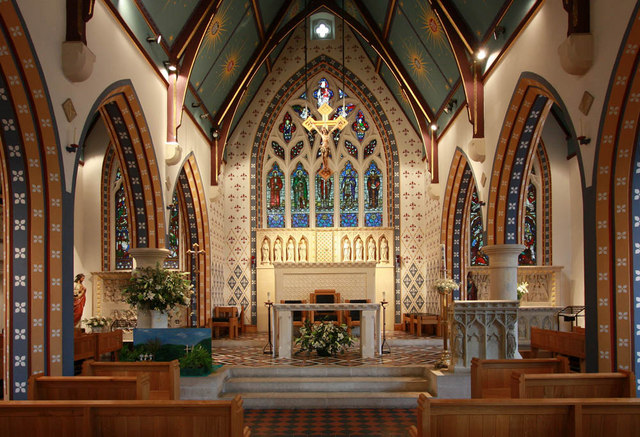
St. Thomas of Canterbury catholic church, Canterbury, UK

Readings at Mass

Liturgical Colour: Green


First reading
Ecclesiasticus 42:15-26 ©

The work of the Lord is full of his glory

I will remind you of the works of the Lord,
  and tell of what I have seen.
By the words of the Lord his works come into being
  and all creation obeys his will.
As the sun in shining looks on all things,
  so the work of the Lord is full of his glory.
The Lord has not granted to the holy ones
  to tell of all his marvels
which the Almighty Lord has solidly constructed
  for the universe to stand firm in his glory.
He has fathomed the deep and the heart,
  and seen into their devious ways;
for the Most High knows all the knowledge there is,
  and has observed the signs of the times.
He declares what is past and what will be,
  and uncovers the traces of hidden things.
Not a thought escapes him,
  not a single word is hidden from him.
He has imposed an order on the magnificent works of his wisdom,
  he is from everlasting to everlasting,
nothing can be added to him, nothing taken away,
  he needs no one’s advice.
How desirable are all his works,
  how dazzling to the eye!
They all live and last for ever,
  whatever the circumstances all obey him.
All things go in pairs, by opposites,
  and he has made nothing defective;
the one consolidates the excellence of the other,
  who could ever be sated with gazing at his glory?

Responsorial Psalm
Psalm 32(33):2-9 ©
By the word of the Lord the heavens were made.
Give thanks to the Lord upon the harp,
  with a ten-stringed lute sing him songs.
O sing him a song that is new,
  play loudly, with all your skill.
By the word of the Lord the heavens were made.
For the word of the Lord is faithful
  and all his works to be trusted.
The Lord loves justice and right
  and fills the earth with his love.
By the word of the Lord the heavens were made.
By his word the heavens were made,
  by the breath of his mouth all the stars.
He collects the waves of the ocean;
  he stores up the depths of the sea.
By the word of the Lord the heavens were made.
Let all the earth fear the Lord
  all who live in the world revere him.
He spoke; and it came to be.
  He commanded; it sprang into being.
By the word of the Lord the heavens were made.

Gospel Acclamationcf.Ps129:5
Alleluia, alleluia!
My soul is waiting for the Lord,
I count on his word.
Alleluia!
Or:Jn8:12
Alleluia, alleluia!
I am the light of the world, says the Lord;
anyone who follows me will have the light of life.
Alleluia!

GospelMark 10:46-52 ©

Go; your faith has saved you

As Jesus left Jericho with his disciples and a large crowd, Bartimaeus (that is, the son of Timaeus), a blind beggar, was sitting at the side of the road. When he heard that it was Jesus of Nazareth, he began to shout and to say, ‘Son of David, Jesus, have pity on me.’ And many of them scolded him and told him to keep quiet, but he only shouted all the louder, ‘Son of David, have pity on me.’ Jesus stopped and said, ‘Call him here.’ So they called the blind man. ‘Courage,’ they said ‘get up; he is calling you.’ So throwing off his cloak, he jumped up and went to Jesus. Then Jesus spoke, ‘What do you want me to do for you?’ ‘Rabbuni,’ the blind man said to him ‘Master, let me see again.’ Jesus said to him, ‘Go; your faith has saved you.’ And immediately his sight returned and he followed him along the road.

The readings on this page are from the Jerusalem Bible, which is used at Mass in most of the English-speaking world. The New American Bible readings, which are used at Mass in the United States, are available in the Universalis apps, programs and downloads.
You can also view this page with the Gospel in Greek and English.


TOPICS: Catholic; General Discusssion; Prayer; Worship
KEYWORDS: catholic; mk10; prayer
For your reading, reflection, faith-sharing, comments, questions, discussion.

1 posted on 05/27/2021 3:15:20 AM PDT by Cronos
[ Post Reply | Private Reply | View Replies]

catholic,prayer,mk10


2 posted on 05/27/2021 3:15:30 AM PDT by Cronos ( )
[ Post Reply | Private Reply | To 1 | View Replies]

To: nickcarraway; NYer; ELS; Pyro7480; livius; ArrogantBustard; Catholicguy; RobbyS; marshmallow; ...
Alleluia Ping

Please FReepmail me to get on/off the Alleluia Ping List.


3 posted on 05/27/2021 3:15:55 AM PDT by Cronos ( )
[ Post Reply | Private Reply | To 1 | View Replies]

Catena Aurea by St. Thomas Aguinas

10:46–52

46. And they came to Jericho: and as he went out of Jericho with his disciples and a great number of people, blind Bartimæus, the son of Timæus, sat by the highway side begging.

47. And when he heard that it was Jesus of Nazareth, he began to cry out, and say, Jesus, thou Son of David, have mercy on me.

48. And many charged him that he should hold his peace: but he cried the more a great deal, Thou Son of David, have mercy on me.

49. And Jesus stood still, and commanded him to be called. And they call the blind man, saying unto him, Be of good comfort, rise; he calleth thee.

50. And he, casting away his garment, rose, and came to Jesus.

51. And Jesus answered and said unto him, What wilt thou that I should do unto thee? The blind man said unto him, Lord, that I might receive my sight.

52. And Jesus said unto him, Go thy way; thy faith hath made thee whole. And immediately he received his sight, and followed Jesus in the way.

JEROME. The name of the city agrees with the approaching Passion of our Lord; for it is said, And they came to Jericho. Jericho means moon or anathema; but the failing of the flesh of Christ is the preparation of the heavenly Jerusalem. It goes on: And as he went out of Jericho with his disciples, and a great number of people, blind Bartimæus, the son of Timæus, sat by the wayside begging.

BEDE. (ubi sup.) Matthew says, that there were two blind men sitting by the wayside, who cried to the Lord, and received their sight; but Luke relates that one blind man was enlightened by Him, with a like order of circumstances, as He was going into Jericho; where no one, at least no wise man, will suppose that the Evangelists wrote things contrary to one another, but that one wrote more fully, what another has left out. We must therefore understand that one of them was the more important, which appears from this circumstance, that Mark has related his name and the name of his father.

AUGUSTINE. (de Con. Evan. ii. 65) It is for this reason that Mark wished to relate his case alone, because his receiving his sight had gained for the miracle a fame, illustrious in proportion to the extent of the knowledge of his affliction. But although Luke relates a miracle done entirely in the same way, nevertheless we must understand that a similar miracle was wrought on another blind man, and a similar method of the same miracle. It goes on: And when he heard that it was Jesus of Nazareth, he began to cry out, and say, Jesus, thou Son of David, have mercy upon me.

PSEUDO-CHRYSOSTOM. (Vict. Ant. e Cat. in Marc.) The blind man calls the Lord, the Son of David, hearing the way in which the passing multitude praised Him, and feeling sure that the expectation of the prophets was fulfilled. There follows: And many charged him that he should hold his peace.t

ORIGEN. (in Matt. tom. xvi. 13) As if he said, Those who were foremost in believing rebuked him when he cried, Thou Son of David, that he might hold his peace, and cease to call Him by a contemptible name, when he ought to say, Son of God, have pity upon me. He however did not cease; wherefore it goes on: But he cried the more a great deal, Thou Son of David, have mercy upon me; and the Lord heard his cry; wherefore there follows: And Jesus stood still, and commanded him to be called. But observe, that the blind man, of whom Luke speaks, is inferior to this one; for neither did Jesus call him, nor order him to be called, but He commanded him to be brought to Him, as though unable to come by himself; but this blind man by the command of our Lord is called to Him. Wherefore it goes on: And they call the blind man, saying unto him, Be of good comfort, rise, he calleth thee; but he casting away his garment, comes to Him. It goes on: And he casting away his garment, rose, and came to Jesus. Perchance, the garment of the blind man means the veil of blindness and poverty, with which he was surrounded, which he cast away and came to Jesus; and the Lord questions him, as he is approaching. Wherefore there follows: And Jesus answered and said unto him, What will thou that I should do unto thee.

BEDE. (ubi sup.) Could He who was able to restore sight be ignorant of what the blind man wanted? His reason then for asking is that prayer may be made to Him; He puts the question, to stir up the blind man’s heart to pray.

CHRYSOSTOM. (Hom. in Matt. 66) Or He asks, lest men should think that what He granted the man was not what he wanted. For it was His practice to make the good disposition of those who were to be cured known to all men, and then to apply the remedy, in order to stir up others to emulation, and to shew that he who was to be cured was worthy to obtain the grace. It goes on: The blind man said unto him, Lord, that I may receive my sight.

BEDE. For the blind man looks down upon every gift except light, because, whatever a blind man may possess, without light he cannot see what he possesses.

PSEUDO-JEROME. But Jesus, considering his ready will, rewards him with the fulfilment of his desire.

ORIGEN. (ubi sup.) Again, it is more worthy to say Rabboni, or, as it is in other places, Master, than to say Son of David; wherefore He gives him health, not on his saying, Son of David, but when he said Rabboni. Wherefore there follows: And Jesus said unto him, Go thy way; thy faith hath made thee whole. And immediately he received his sight, and followed him in the way.

THEOPHYLACT. The mind of the blind man is grateful, for when he was made whole, he did not leave Jesus, but followed Him.

BEDE. (ubi sup.) In a mystical sense, however, Jericho, which means the moon, points out the waning of our fleeting race. The Lord restored sight to the blind man, when drawing near to Jericho, because coming in the flesh and drawing near to His Passion, He brought many to the faith; for it was not in the first years of His Incarnation, but in the few years before He suffered, that He shewed the mystery of the Word to the world.

PSEUDO-JEROME. But the blindness in part, brought upon the Jews, will in the end be enlightened when He sends unto them the Prophet Elias. (Rom. 11:25)

BEDE. (ubi sup.) Now in that on approaching Jericho, He restored sight to one man, and on quitting it to two, He intimated, that before His Passion He preached only to one nation, the Jews, but after His resurrection and ascension, through His Apostles He opened the mysteries both of His Divinity and His Humanity to Jews and Gentiles. Mark indeed, in writing that one received his sight, refers to the saving of the Gentiles, that the figure might agree with the salvation of those, whom he instructed in the faith; but Matthew, who wrote his Gospel to the faithful among the Jews, because it was also to reach the knowledge of the Gentiles, fitly says that two received their sight, that He might teach us that the grace of faith belonged to each people. Therefore, as the Lord was departing with His disciples and a great multitude from Jericho, the blind man was sitting, begging by the way-side; that is, when the Lord ascended into heaven, and many of the faithful followed Him, yea when all the elect from the beginning of the world entered together with Him the gate of heaven,u, presently the Gentile people began to have hope of its own illumination; for it now sits begging by the wayside, because it has not entered upon and reached the path of truth.

PSEUDO-JEROME. The people of the Jews also, because it kept the Scriptures and did not fulfil them, begs and starves by the wayside; but he cries out, Son of David, have mercy upon me, because the Jewish people is enlightened by the merits of the Prophets. Many rebuke him that he may hold his peace, that is, sins and devils restrain the cry of the poor; and he cried the more, because when the battle waxes great, hands are to be lifted up with crying to the Rock of help, that is, Jesus of Nazareth.

BEDE. Again, the people of the Gentiles, having heard of the fame of the name of Christ, sought to be made a partaker of Him, but many spoke against Him, first the Jews, then also the Gentiles, lest the world which was to be enlightened should call upon Christ. The fury of those who attacked Him, however, could not deprive of salvation those who were fore-ordained to life. And He heard the blind man’s cry as He was passing, but stood when He restored his sight, because by His Humanity He pitied him, who by the power of His Divinity has driven away the darkness from our mind; for in that Jesus was born and suffered for our sakes, He as it were passed by, because this action is temporal; but when God is said to stand, it means, that, Himself without change, He sets in order all changeable things. But the Lord calls the blind man, who cries to Him, when He sends the word of faith to the people of the Gentiles by preachers; and they call on the blind man to be of good cheer and to rise, and bid him come to the Lord, when by preaching to the simple, they bid them have hope of salvation, and rise from the sloth of vice, and gird themselves for a life of virtue. Again, he throws away his garment and leaps, who, throwing aside the bands of the world, with unencumbered pace hastens to the Giver of eternal light.

PSEUDO-JEROME. Again, the Jewish people comes leaping, stripped of the old man, as a hart leaping on the mountains, that is, laying aside sloth, it meditates on Patriarchs, Prophets, and Apostles on high, and raises itself to heights of holiness. How consistent also is the order of salvation. First we heard by the Prophets, then we cry aloud by faith, next we are called by Apostles, we rise up by penitence, we are stripped of our old garment by baptism, and of our choice we are questioned. Again, the blind man when asked requires, that he may see the will of the Lord.

BEDE. (ubi sup.) Therefore let us also imitate him, let us not seek for riches, earthly goods, or honours from the Lord, but for that Light, which we alone with the Angels can see, the way to which is faith; wherefore also Christ answers to the blind man, Thy faith hath saved thee. But he sees and follows who works what his understanding tells him is good; for he follows Jesus, who understands and executes what is good, who imitates Him, who had no wish to prosper in this world, and bore reproach and derision. And because we have fallen from inward joy, by delight in the things of the body, He shews us what bitter feelings the return thither will cost us.

THEOPHYLACT. Further, it says that he followed the Lord in the way, that is, in this life, because after it all are excluded who follow Him not here, by working His commandments.

PSEUDO-JEROME. Or, this is the way of which He said, I am the Way, the Truth, and the Life. This is the narrow way, which leads to the heights of Jerusalem, and Bethany, to the mount of Olives, which is the mount of light and consolation.



Copyright ©1999-2018 e-Catholic2000.com
4 posted on 05/27/2021 3:17:10 AM PDT by Cronos ( )
[ Post Reply | Private Reply | To 1 | View Replies]

To: Cronos
Mark
 English: Douay-RheimsLatin: Vulgata ClementinaGreek NT: Byzantine/Majority Text (2000)
 Mark 10
46And they came to Jericho: and as he went out of Jericho, with his disciples, and a very great multitude, Bartimeus the blind man, the son of Timeus, sat by the way side begging. Et veniunt Jericho : et proficiscente eo de Jericho, et discipulis ejus, et plurima multitudine, filius Timæ Bartimæus cæcus, sedebat juxta viam mendicans.και ερχονται εις ιεριχω και εκπορευομενου αυτου απο ιεριχω και των μαθητων αυτου και οχλου ικανου υιος τιμαιου βαρτιμαιος ο τυφλος εκαθητο παρα την οδον προσαιτων
47Who when he had heard, that it was Jesus of Nazareth, began to cry out, and to say: Jesus son of David, have mercy on me. Qui cum audisset quia Jesus Nazarenus est, cœpit clamare, et dicere : Jesu fili David, miserere mei.και ακουσας οτι ιησους ο ναζωραιος εστιν ηρξατο κραζειν και λεγειν ο υιος δαυιδ ιησου ελεησον με
48And many rebuked him, that he might hold his peace; but he cried a great deal the more: Son of David, have mercy on me. Et comminabantur ei multi ut taceret. At ille multo magis clamabat : Fili David, miserere mei.και επετιμων αυτω πολλοι ινα σιωπηση ο δε πολλω μαλλον εκραζεν υιε δαυιδ ελεησον με
49And Jesus, standing still, commanded him to be called. And they call the blind man, saying to him: Be of better comfort: arise, he calleth thee. Et stans Jesus præcepit illum vocari. Et vocant cæcum, dicentes ei : Animæquior esto : surge, vocat te.και στας ο ιησους ειπεν αυτον φωνηθηναι και φωνουσιν τον τυφλον λεγοντες αυτω θαρσει εγειραι φωνει σε
50Who casting off his garment leaped up, and came to him. Qui projecto vestimento suo exiliens, venit ad eum.ο δε αποβαλων το ιματιον αυτου αναστας ηλθεν προς τον ιησουν
51And Jesus answering, said to him: What wilt thou that I should do to thee? And the blind man said to him: Rabboni, that I may see. Et respondens Jesus dixit illi : Quid tibi vis faciam ? Cæcus autem dixit ei : Rabboni, ut videam.και αποκριθεις λεγει αυτω ο ιησους τι θελεις ποιησω σοι ο δε τυφλος ειπεν αυτω ραββουνι ινα αναβλεψω
52And Jesus saith to him: Go thy way, thy faith hath made thee whole. And immediately he saw, and followed him in the way. Jesus autem ait illi : Vade, fides tua te salvum fecit. Et confestim vidit, et sequebatur eum in via.ο δε ιησους ειπεν αυτω υπαγε η πιστις σου σεσωκεν σε και ευθεως ανεβλεψεν και ηκολουθει τω ιησου εν τη οδω

5 posted on 05/27/2021 5:26:41 AM PDT by annalex (fear them not)
[ Post Reply | Private Reply | To 4 | View Replies]

To: annalex


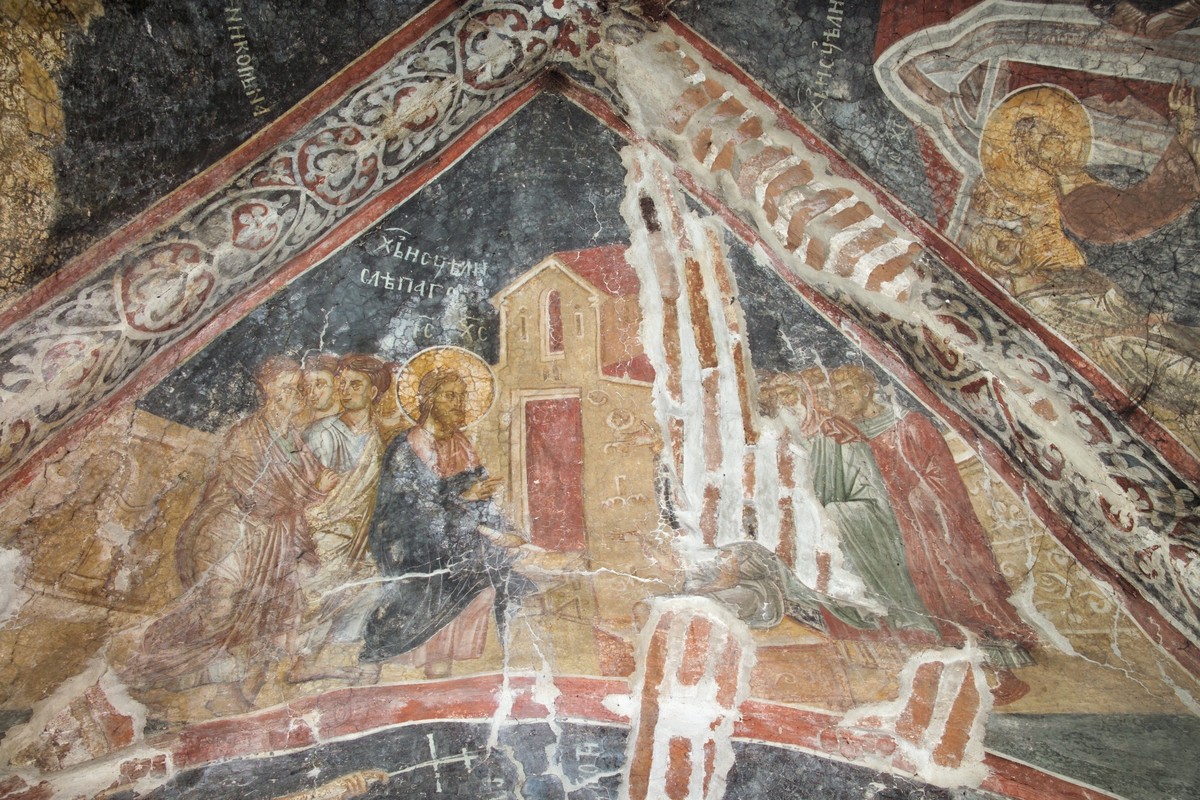
The healing of blind son of Timaeus

Decani
17c.
Serbia

6 posted on 05/27/2021 5:29:18 AM PDT by annalex (fear them not)
[ Post Reply | Private Reply | To 5 | View Replies]

To: annalex
Saint Augustine of Canterbury’s Story

In the year 596, some 40 monks set out from Rome to evangelize the Anglo-Saxons in England. Leading the group was Augustine, the prior of their monastery. Hardly had he and his men reached Gaul when they heard stories of the ferocity of the Anglo-Saxons and of the treacherous waters of the English Channel. Augustine returned to Rome and to Gregory the Great—the pope who had sent them—only to be assured by him that their fears were groundless.

Augustine set out again. This time the group crossed the English Channel and landed in the territory of Kent, ruled by King Ethelbert, a pagan married to a Christian, Bertha. Ethelbert received them kindly, set up a residence for them in Canterbury and within the year, on Pentecost Sunday 597, was himself baptized. After being consecrated a bishop in France, Augustine returned to Canterbury, where he founded his see. He constructed a church and monastery near where the present cathedral, begun in 1070, now stands. As the faith spread, additional sees were established at London and Rochester.

Work was sometimes slow and Augustine did not always meet with success. Attempts to reconcile the Anglo-Saxon Christians with the original Briton Christians—who had been driven into western England by Anglo-Saxon invaders—ended in dismal failure. Augustine failed to convince the Britons to give up certain Celtic customs at variance with Rome and to forget their bitterness, helping him evangelize their Anglo-Saxon conquerors.

Laboring patiently, Augustine wisely heeded the missionary principles—quite enlightened for the times—suggested by Pope Gregory: purify rather than destroy pagan temples and customs; let pagan rites and festivals be transformed into Christian feasts; retain local customs as far as possible. The limited success Augustine achieved in England before his death in 605, a short eight years after his arrival, would eventually bear fruit long after in the conversion of England. Augustine of Canterbury can truly be called the “Apostle of England.”


Reflection

Augustine of Canterbury comes across today as a very human saint, one who could suffer like many of us from a failure of nerve. For example, his first venture to England ended in a big U-turn back to Rome. He made mistakes and met failure in his peacemaking attempts with the Briton Christians. He often wrote to Rome for decisions on matters he could have decided on his own had he been more self-assured. He even received mild warnings against pride from Pope Gregory, who cautioned him to “fear lest, amidst the wonders that are done, the weak mind be puffed up by self-esteem.” Augustine’s perseverance amidst obstacles and only partial success teaches today’s apostles and pioneers to struggle on despite frustrations and be satisfied with gradual advances.


Saint Augustine of Canterbury is the Patron Saint of:

England


franciscanmedia.org
7 posted on 05/27/2021 5:33:47 AM PDT by annalex (fear them not)
[ Post Reply | Private Reply | To 6 | View Replies]

To: annalex


Baptism of King Ethelbert of Kent by St Augustine of Canterbury

by Peter Murphy, iconographer

8 posted on 05/27/2021 5:39:00 AM PDT by annalex (fear them not)
[ Post Reply | Private Reply | To 7 | View Replies]

To: Cronos
NAVARRE BIBLE COMMENTARY (RSV)

Ad Majorem Dei Gloriam (To the Greater Glory of God)

From: Sirach 42:15-25

The Splendor of the Created World
---------------------------------
[15] I will now call to mind the works of the Lord, and will declare what I have seen. By the words of the Lord his works are done. [16] The sun looks down on everything with its light, and the work of the Lord is full of his glory. [17] The Lord has not enabled his holy ones to recount all his marvellous works, which the Lord the Almighty has established that the universe may stand firm in his glory. [18] He searches out the abyss, and the hearts of men, and considers their crafty devices. For the Most High knows all that may be known, and he looks into the signs of the age. [19] He declares what has been and what is to be, and he reveals the tracks of hidden things. [20] No thought escapes him, and not one word is hidden from him. [21] He has ordained the splendors of his wisdom, and he is from everlasting and to everlasting. Nothing can be added or taken away, and he needs no one to be his counsellor. [22] How greatly to be desired are all his works, and how sparkling they are to see! [23] All these things live and remain for ever for every need, and are all obedient. [24] All things are twofold, one opposite the other, and he has made nothing incomplete. [25] One confirms the good things of the other, and who can have enough of beholding his glory?

***********************************************************************
Commentary:

42:15-50:29 As in the other "parts" of the book, we can say that this one has two sections to it--a doctrinal section (dealing with the origin of the universe, God as Creator and provident Lord: 42:15-43:33) and then a sort of practical section (44:1-50:29), dealing with praise of the ancestors of Israel to whom God "granted wisdom" (43:33). In this sense, this last part of Sirach is a recapitulation and a development of the two central ideas contained in the poems that mark the high point of the book (1:1-2:18 and 24:1-34). In Sirach 1:1 it said that "All wisdom comes from God" and, now in 42:15-43:33, it describes appreciation of the created world as discernment of that Wisdom that the Lord left imprinted upon it. And similarly, in 24:3-8, it said that Wisdom came from the mouth of the Most High, to dwell in Israel; and now, in 44:1- 50:29, it describes how Wisdom was at work in "famous men" who lived in, keeping with the Law. The glory of God is to be seen in nature and in the history of mankind.

42:15-43:33. This last introductory section marks the climax of the book message. The author began by establishing that all wisdom comes from God (1:1-2:21). Then he said that the study of the world and, of man is the, route to understanding because wisdom can be seen in the laws that God has built into everything he made (16:24-18:14). Therefore, in the third part of the book, it said that a person who desires to have wisdom must keep the commandments (24:1-34), that is, be steeped in "fear of the Lord", which was the focus, of the fourth part (32; 14-33:18). Now it extols the glory of God, who creates and rules the world. When it says that "by the words of the Lord his works are done" (42:15) it must have in mind the first chapter of Genesis which narrates how God went about his work of creation and distinguished his works one from another by means of his word ("And God said ...". Gen 1:3, etc.); but the passage also prepares the way to understand the Word of God made flesh, as we discover in Jesus Christ in the New Testament. In the prologue to his Gospel, St. John proclaims that "all things were made through him, and without him was not anything made that was made" (Jn 1:3; see the note on 1:1-2:21). Thus, God's Revelation reached its climax in his incarnate Son: "In many and various ways God spoke of old to our fathers by the prophets; but in these last days he has spoken to us by a Son, whom he appointed the heir of all things, through whom also he created the world" (Heb 1:1-2).

In his reflection on the glory of God as manifested in creation, Ben Sirach begins with thoughts on God's wisdom and knowledge (42:15-25) and then goes on to show how heavenly bodies manifest the glory of God--the sun (43:1-5), the moon (43:6-8), the stars (43:9-10) and the rainbow (43:11-12). Later he comments on God's power over the elements--snow, lightning, haiI, thunder, winds, frost etc. (43:13-27). Finally he ponders the greatness of God over everything that exists and invites us to worship him as he deserves (43:27-32), for "the Lord has made all things, and to the godly he has granted wisdom" (43:33).

"God is infinitely greater than all works (Sir 43:30): 'You have set your glory above the heavens' (Ps 8:1; Sir 43:28). Indeed, 'God's greatness is unsearchable' (Ps 8:2). But because he is the free and sovereign Creator, the first cause of all that exists, God is present to his creatures' inmost being: 'In him we live and move and have our being' 17:28). In the words of St Augustine God is 'higher than my highest and more inward than my innermost self' (Conf., 3, 6, 11)" (Catechism of the Catholic Church, 300).

9 posted on 05/27/2021 5:59:11 AM PDT by fidelis (Defeatism and despair are like poison to men's souls. If you can't be positive, at least be quiet.)
[ Post Reply | Private Reply | To 1 | View Replies]

To: fidelis
From: Mark 10:46-52

The Blind Man of Jericho
------------------------
[46] And they (Jesus and His disciples) came to Jericho; and as He was leaving Jericho with His disciples and a great multitude, Bartimaeus, a blind beggar, the son of Timaeus, was sitting by the roadside. [47] And when he heard that it was Jesus of Nazareth, he began to cry out and say, "Jesus, Son of David, have mercy on me!: [48] And many rebuked him, telling him to be silent; but he cried out all the more, "Son of David, have mercy on me!" [49] And Jesus stopped and said, "Call him." And they called the blind man, saying to him, "Take heart; rise, He is calling you." [50] And throwing off his mantle he sprang up and came to Jesus. [51] And Jesus said to him, "What do you want Me to do for you?" And the blind man said to Him, "Master, let me receive my sight." [52] And Jesus said to him, "Go your way; your faith has made you well." And immediately he received his sight and followed him on the way.

***********************************************************************
Commentary:

46-52. "Hearing the commotion the crowd was making, the blind man asks, `What is happening?' They told him, `It is Jesus of Nazareth.' At this his soul was so fired with faith in Christ that he cried out, `Jesus, Son of David, have mercy on me!'

"Don't you feel the same urge to cry out? You who are also waiting at the side of the way, of this highway of life that is so very short? You who need more light, you who need more grace to make up your mind to seek holiness? Don't you feel an urgent need to cry out, `Jesus, Son of David, have mercy on me'? What a beautiful aspiration for you to repeat again and again!...

"`Many rebuked him, telling him to be silent.' As people have done to you, when you sensed that Jesus was passing your way. Your heart beats faster and you too began to cry out, prompted by an intimate longing. Then your friends, the need to do the done thing, the easy life, your surroundings, all conspired to tell you: `Keep quiet, don't cry out. Who are you to be calling Jesus? Don't bother Him.'

"But poor Bartimaeus would not listen to them. He cried out all the more: `Son of David, have mercy on me.' Our Lord, who had heard him right from the beginning, let him persevere in his prayer. He does the same with you. Jesus hears our cries from the very first, but he waits. He wants us to be convinced that we need Him. He wants us to beseech Him, to persist, like the blind man waiting by the road from Jericho. `Let us imitate him. Even if God does not immediately give us what we ask, even if many people try to put us off our prayers, let us still go on praying' (St. John Chrysostom, Hom. on St. Matthew, 66).

"`And Jesus stopped, and told them to call Him.' Some of the better people in the crowd turned to the blind man and said, `Take heart; rise, He is calling you.' Here you have the Christian vocation! But God does not call only once. Bear in mind that our Lord is seeking us at every moment: get up, He tells us, put aside your indolence, your easy life, your petty selfishness, your silly little problems. Get up from the ground, where you are lying prostrate and shapeless. Acquire height, weight and volume, and a supernatural outlook.

"And throwing off his mantle the man sprang up and came to Jesus. He threw off his mantle! I don't know if you have ever lived through a war, but many years ago I had occasion to visit a battlefield shortly after an engagement. There strewn all over the ground, were greatcoats, water bottles, haversacks stuffed with family souvenirs, letters, photographs of loved ones...which belonged, moreover, not to the vanquished but to the victors! All these items had become superfluous in the bid to race forward and leap over the enemy defenses. Just as happened to Bartimaeus, as he raced towards Christ.

"Never forget that Christ cannot be reached without sacrifice. We have to get rid of everything that gets in the way--greatcoat, haversack, water bottle. You have to do the same in this battle for the glory of God, in this struggle of love and peace by which we are trying to spread Christ's Kingdom. In order to serve the Church, the Pope and all souls, you must be ready to give up everything superfluous....

"And now begins a dialogue with God, a marvelous dialogue that moves us and sets our hearts on fire, for you and I are now Bartimaeus. Christ, who is God, begins to speak and asks, `Quid tibi vis faciam?' `What do you want Me to do for you?' The blind man answers. `Lord, that I may see.' How utterly logical! How about yourself, can you really see? Haven't you too experienced at times what happened to the blind man of Jericho? I can never forget how, when meditating on this passage many years back, and realizing that Jesus was expecting something of me, though I myself did not know what it was, I made up my own aspirations: `Lord, what is it You want! What are You asking of me'? I had a feeling that He wanted me to take on something new and the cry, `Rabboni, ut videam', `Master, that I may see,' moved me to beseech Christ again and again, `Lord, whatever it is that You wish, let it be done.'

"Pray with me now to our Lord: `doce me facere voluntatem tuam, quia Deus meus es tu" (Psalm 142:10) (`teach me to do Thy will, for You art my God'). In short, our lips should express a true desire on our part to correspond effectively to our Creator's promptings, striving to follow out His plans with unshakeable faith, being fully convinced that He cannot fail us....

"But let us go back to the scene outside Jericho. It is now to you that Christ is speaking. He asks you, `What do you want Me to do for you?' `Master, let me receive my sight.' Then Jesus answers, `Go your way. Your faith has made you well.' And immediately he received his sight and followed Him on His way." Following Jesus on His way. You have understood what our Lord was asking to from you and you have decided to accompany Him on His way. You are trying to walk in His footsteps, to clothe yourself in Christ's clothing, to be Christ Himself: well, your faith, your faith in the light our Lord is giving you, must be both operative and full of sacrifice. Don't fool yourself. Don't think you are going to find new ways. The faith He demands of us is as I have said. We must keep in step with Him, working generously and at the same time uprooting and getting rid of everything that gets in the way" (St J. Escriva, Friends of God, 195-198).

Daily Word for Reflection—Navarre Bible Commentary

10 posted on 05/27/2021 5:59:36 AM PDT by fidelis (Defeatism and despair are like poison to men's souls. If you can't be positive, at least be quiet.)
[ Post Reply | Private Reply | To 9 | View Replies]

Disclaimer: Opinions posted on Free Republic are those of the individual posters and do not necessarily represent the opinion of Free Republic or its management. All materials posted herein are protected by copyright law and the exemption for fair use of copyrighted works.

Free Republic
Browse · Search
Religion
Topics · Post Article

FreeRepublic, LLC, PO BOX 9771, FRESNO, CA 93794
FreeRepublic.com is powered by software copyright 2000-2008 John Robinson