Free Republic
Browse · Search
Religion
Topics · Post Article

Skip to comments.

Catholic Caucus: Daily Mass Readings 4-29-2021, Saint Catherine of Siena, Virgin, Doctor
Universalis/Jerusalem Bible | 29 April 2021 | God

Posted on 04/29/2021 12:55:07 AM PDT by Cronos

April 29, 2021

Thursday of the 4th week of Eastertide - Saint Catherine of Siena, Virgin, Doctor


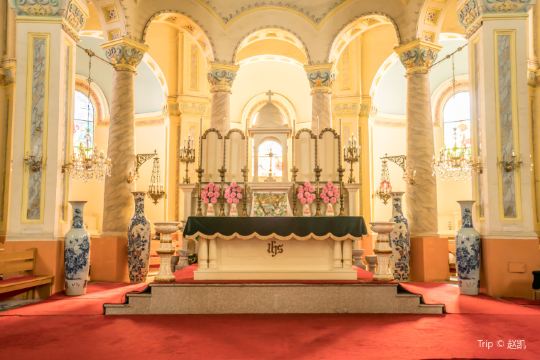
St. Joseph's Cathedral, Tianjin, China

Readings at Mass

Liturgical Colour: White.


First readingActs 13:13-25 ©

God has raised up one of David's descendants, Jesus, as Saviour

Paul and his friends went by sea from Paphos to Perga in Pamphylia where John left them to go back to Jerusalem. The others carried on from Perga till they reached Antioch in Pisidia. Here they went to synagogue on the sabbath and took their seats. After the lessons from the Law and the Prophets had been read, the presidents of the synagogue sent them a message: ‘Brothers, if you would like to address some words of encouragement to the congregation, please do so.’ Paul stood up, held up a hand for silence and began to speak:
  ‘Men of Israel, and fearers of God, listen! The God of our nation Israel chose our ancestors, and made our people great when they were living as foreigners in Egypt; then by divine power he led them out, and for about forty years took care of them in the wilderness. When he had destroyed seven nations in Canaan, he put them in possession of their land for about four hundred and fifty years. After this he gave them judges, down to the prophet Samuel. Then they demanded a king, and God gave them Saul son of Kish, a man of the tribe of Benjamin. After forty years, he deposed him and made David their king, of whom he approved in these words, “I have selected David son of Jesse, a man after my own heart, who will carry out my whole purpose.” To keep his promise, God has raised up for Israel one of David’s descendants, Jesus, as Saviour, whose coming was heralded by John when he proclaimed a baptism of repentance for the whole people of Israel. Before John ended his career he said, “I am not the one you imagine me to be; that one is coming after me and I am not fit to undo his sandal.”’

Responsorial Psalm
Psalm 88(89):2-3,21,22,25,27 ©
I will sing for ever of your love, O Lord.
or
Alleluia!
I will sing for ever of your love, O Lord;
  through all ages my mouth will proclaim your truth.
Of this I am sure, that your love lasts for ever,
  that your truth is firmly established as the heavens.
I will sing for ever of your love, O Lord.
or
Alleluia!
I have found David my servant
  and with my holy oil anointed him.
My hand shall always be with him
  and my arm shall make him strong.
I will sing for ever of your love, O Lord.
or
Alleluia!
My truth and my love shall be with him;
  by my name his might shall be exalted.
He will say to me: ‘You are my father,
  my God, the rock who saves me.’
I will sing for ever of your love, O Lord.
or
Alleluia!

Gospel Acclamationcf.Rv1:5
Alleluia, alleluia!
You, O Christ, are the faithful witness,
the First-born from the dead,
you have loved us and have washed away our sins with your blood.
Alleluia!

GospelJohn 13:16-20 ©

Whoever welcomes the one I send welcomes me

After he had washed the feet of his disciples, Jesus said to them:
‘I tell you most solemnly,
no servant is greater than his master,
no messenger is greater than the man who sent him.
‘Now that you know this, happiness will be yours if you behave accordingly. I am not speaking about all of you: I know the ones I have chosen; but what scripture says must be fulfilled: Someone who shares my table rebels against me.
‘I tell you this now, before it happens,
so that when it does happen
you may believe that I am He.
I tell you most solemnly,
whoever welcomes the one I send welcomes me,
and whoever welcomes me welcomes the one who sent me.’

Continue

These are the readings for the memorial


First reading1 John 1:5-2:2 ©

The blood of Jesus Christ purifies us all from sin

This is what we have heard from Jesus Christ,
and the message that we are announcing to you:
God is light; there is no darkness in him at all.
If we say that we are in union with God
while we are living in darkness,
we are lying because we are not living the truth.
But if we live our lives in the light,
as he is in the light,
we are in union with one another,
and the blood of Jesus, his Son,
purifies us from all sin.
If we say we have no sin in us,
we are deceiving ourselves
and refusing to admit the truth;
but if we acknowledge our sins,
then God who is faithful and just
will forgive our sins and purify us
from everything that is wrong.
To say that we have never sinned
is to call God a liar
and to show that his word is not in us.
I am writing this, my children,
to stop you sinning;
but if anyone should sin,
we have our advocate with the Father,
Jesus Christ, who is just;
he is the sacrifice that takes our sins away,
and not only ours,
but the whole world’s.

Responsorial Psalm
Psalm 102(103):1-4,8-9,13-14,17-18 ©
My soul, give thanks to the Lord.
My soul, give thanks to the Lord
  all my being, bless his holy name.
My soul, give thanks to the Lord
  and never forget all his blessings.
My soul, give thanks to the Lord.
It is he who forgives all your guilt,
  who heals every one of your ills,
who redeems your life from the grave,
  who crowns you with love and compassion.
My soul, give thanks to the Lord.
The Lord is compassion and love,
  slow to anger and rich in mercy.
His wrath will come to an end;
  he will not be angry for ever.
My soul, give thanks to the Lord.
As a father has compassion on his sons,
  the Lord has pity on those who fear him;
for he knows of what we are made,
  he remembers that we are dust.
My soul, give thanks to the Lord.
But the love of the Lord is everlasting
  upon those who hold him in fear;
his justice reaches out to children’s children
  when they keep his covenant in truth,
  when they keep his will in their mind.
My soul, give thanks to the Lord.

Gospel AcclamationMt11:25
Alleluia, alleluia!
Blessed are you, Father,
Lord of heaven and earth,
for revealing the mysteries of the kingdom
to mere children.
Alleluia!

Gospel
Matthew 11:25-30 ©

You have hidden these things from the wise and revealed them to little children

Jesus exclaimed, ‘I bless you, Father, Lord of heaven and of earth, for hiding these things from the learned and the clever and revealing them to mere children. Yes, Father, for that is what it pleased you to do. Everything has been entrusted to me by my Father; and no one knows the Son except the Father, just as no one knows the Father except the Son and those to whom the Son chooses to reveal him.
  ‘Come to me, all you who labour and are overburdened, and I will give you rest. Shoulder my yoke and learn from me, for I am gentle and humble in heart, and you will find rest for your souls. Yes, my yoke is easy and my burden light.’

The readings on this page are from the Jerusalem Bible, which is used at Mass in most of the English-speaking world. The New American Bible readings, which are used at Mass in the United States, are available in the Universalis apps, programs and downloads.
You can also view this page with the Gospel in Greek and English.


TOPICS: Catholic; General Discusssion; Prayer; Worship
KEYWORDS: catholic; easter; mt11; prayer
For your reading, reflection, faith-sharing, comments, questions, discussion.

1 posted on 04/29/2021 12:55:07 AM PDT by Cronos
[ Post Reply | Private Reply | View Replies]

catholic; easter; mt11; prayer;


2 posted on 04/29/2021 12:55:22 AM PDT by Cronos
[ Post Reply | Private Reply | To 1 | View Replies]

To: nickcarraway; NYer; ELS; Pyro7480; livius; ArrogantBustard; Catholicguy; RobbyS; marshmallow; ...
Alleluia Ping

Please FReepmail me to get on/off the Alleluia Ping List.


3 posted on 04/29/2021 12:55:45 AM PDT by Cronos
[ Post Reply | Private Reply | To 2 | View Replies]

Catena Aurea by St. Thomas Aguinas

11:25–26

25. At that time Jesus answered and said, I thank thee, O Father, Lord of heaven and earth, because thou hast hid these things from the wise and prudent, and hast revealed them unto babes.

26. Even so, Father: for so it seemed good in thy sight.

GLOSS. (non occ.) Because the Lord knew that many would doubt respecting the foregoing matter, namely, that the Jews would not receive Christ whom the Gentile world has so willingly received, He here makes answer to their thoughts; And Jesus answered and said, I confess unto thee, Father, Lord of heaven and earth.

GLOSS. (ord.) That is, Who makest of heaven, or leavest in earthliness, whom Thou wilt. Or literally,

AUGUSTINE. (Serm. 67. 1.) If Christ, from whom all sin is far, said, I confess, confession is not proper for the sinner only, but sometimes also for him that gives thanks. We may confess either by praising God, or by accusing ourselves. When He said, I confess unto thee, it is, I praise Thee, not I accuse Myself.

JEROME. Let those hear who falsely argue, that the Saviour was not born but created, how He calls His Father Lord of heaven and earth. For if He be a creature, and the creature can call its Maker Father, it was surely foolish here to address Him as Lord of heaven and earth, and not of Him (Christ) likewise. He gives thanks that His coming has opened to the Apostles sacraments, which the Scribes and Pharisees knew not, who seemed to themselves wise, and understanding in their own eyes; That thou hast hid these things from the wise and understanding, and hast revealed them unto babes.

AUGUSTINE. (Serm. 67. 5.) That the wise and understanding are to be taken as the proud, Himself opens to us when He says, and hast revealed them unto babes; for who are babes but the humble?

GREGORY. (Mor. xxvii. 13.) He says not’ to the foolish,’ but to babes, shewing that He condemns pride, not understanding.

CHRYSOSTOM. (Horn. xxxviii.) Or when He says, The wise, He does not speak of true wisdom, but of that which the Scribes and Pharisees seemed to have by their speech. Wherefore He said not, ‘And hast revealed them to the foolish,’ but, to babes, that is, uneducated, or simple; teaching us in all things to keep ourselves from pride, and to seek humility.

HILARY. The hidden things of heavenly words and their power are hid from the wise, and revealed to the babes; babes, that is, in malice, not in understanding; hid from the wise because of their presumption of their own wisdom, not because of their wisdom.

CHRYSOSTOM. That it is revealed to the one is matter of joy, that it is hid from the other not of joy, but of sorrow; He does not therefore joy on this account, but He joys that these have known what the wise have not known.

HILARY. The justice of this the Lord confirms by the sentence of the Father’s will, that they who disdain to be made babes in God, should become fools in their own wisdom; and therefore He adds, Even so, Father; for so it seemed good before thee.

GREGORY. (Mor. xxv. 14.) In which words we have a lesson of humility, that we should not rashly presume to discuss the counsels of heaven concerning the calling of some, and the rejection of others shewing that that cannot be unrighteous which is willed by Him that is righteous.

JEROME. In these words moreover He speaks to the Father with the desire of one petitioning, that His mercy begun in the Apostles might be completed in them.

CHRYSOSTOM. These things which the Lord spoke to His disciples, made them more zealous. As afterwards they thought great things of themselves, because they cast out dæmons, therefore He here reproves them; for what they had, was by revelation, not by their own efforts. The Scribes who esteemed themselves wise and understanding were excluded because of them-pride, and therefore He says, Since on this account the mysteries of God were hid from them, fear ye, and abide as babes, for this it is that has made you partakers in the revelation. But as when Paul says, God gave them, over to a reprobate mind, (Rom. 1:28), he does not mean that God did this, but they who gave Him cause, so here, Thou hast hid these things from the wise and understanding. And wherefore were they hid from them? Hear Paul speaking, Seeking to set up their own righteousness, they were not subject to the righteousness of God (Rom. 10:3.)

11:27

27. All things are delivered unto me of my Father: and no man knoweth the Son, but the Father; neither knoweth any man the Father, save the Son, and he to whomsoever the Son will reveal him.

CHRYSOSTOM. Because He had said, I confess unto thee, Father, because thou hast hid these things from the wise, that you should not suppose that He thus thanks the Father as though He Himself was excluded from this power, He adds, All things are committed to me by my Father. Hearing the words are committed, do not admit suspicion of any thing human, for He uses this word that you may not think there be two gods unbegotten. For at the time that He was begotten He was Lord of all.

JEROME. For if we conceive of this thing according to our weakness, when he who receives begins to have, he who gives begins to be without. Or when He says, All things are committed to him, He may mean, not the heaven and earth and the elements, and the rest of the things which He created and made, but those who through the Son have access to the Father.

HILARY. Or that we may not think that there is any thing less in Him than in God, therefore He says this.

AUGUSTINE. (cont. Maximin. ii. 12.) For if He has aught less in His power than the Father has, then all that the Father has, are not His; for by begetting Him the Father gave power to the Son, as by begetting Him He gave all things which He has in His substance to Him whom He begot of His substance.

HILARY. And also in the mutual knowledge between the Father and the Son, He teaches us that there is nothing in the Son beyond what was in the Father, for it follows, And none knoweth the Son but the Father, nor does any man know the Father but the Son.

CHRYSOSTOM. By this that He only knows the Father, He shews covertly that He is of one substance with the Father. As though He had said, What wonder if I be Lord of all, when I have somewhat yet greater, namely to know the Father and to be of the same substance with Him?

HILARY. For this mutual knowledge proclaims that they are of one substance, since He that should know the Son, should know the Father also in the Son, since all things were delivered to Him by the Father.

CHRYSOSTOM. When He says, Neither does any know the Father but the Son, He does not mean that all men are altogether ignorant of Him; but that none knows Him with that knowledge wherewith He knows Him; which may also be said of the Son. For it is not said of some unknown God (i. e. who was not the Creator.) as Marcion declares.

AUGUSTINE. (De Trin. i. 8.) And because their substance is inseparable, it is enough sometimes to name the Father, sometimes the Son, nor is it possible to separate from either His Spirit, who is especially called the Spirit of truth.

JEROME. Let the heretic Eunomius therefore blush hereat who claims to himself such a knowledge of the Father and the Son, as they have one of anothera. But if he argues from what follows, and props up his madness by that, And he to whom the Son will reveal him, it is one thing to know what you know by equality with God, another to know it by His vouchsafing to reveal it.

AUGUSTINE. (De Trin. vii. 3.) The Father is revealed by the Son, that is, by His Word. For if the temporal and transitory word which we utter both shews itself, and what we wish to convey, how much more the Word of God by which all things were made, which so shews the Father as He is Father, because itself is the same and in the same manner as the Father.

AUGUSTINE. (Quæst. Ev. i. 1.) When He said, None knoweth the Son but the Father, He did not add, And he to whom the Father will reveal the Son. But when He said, None knoweth the Father but the Son, He added, And he to whom the Son will reveal him. But this must not be so understood as though the Son could be known by none but by the Father only; while the Father may be known not only by the Son, but also by those to whom the Son shall reveal Him. But it is rather expressed thus, that we may understand that both the Father and the Son Himself are revealed by the Son, inasmuch as He is the light of our mind; and what is afterwards added, And he to whom the Son will reveal, is to be understood as spoken of the Son as well as the Father, and to refer to the whole of what had been said. For the Father declares Himself by His Word, but the Word declares not only that which is intended to be declared by it, but in declaring this declares itself.

CHRYSOSTOM. If then He reveals the Father, He reveals Himself also. But the one he omits as a thing manifest, but mentions the other because there might be a doubt concerning it. Herein also He instructs us that He is so one with the Father, that it is not possible for any to come to the Father, but through the Son. For this had above all things given offence, that He seemed to be against God, and therefore He strove by all means to overthrow this notion.

11:28–30

28. Come unto me, all ye that labour and are heavy laden, and I will give you rest.

29. Take my yoke upon you, and learn of me; for I am meek and lowly in heart: and ye shall find rest unto your souls.

30. For my yoke is easy, and my burden is light.

CHRYSOSTOM. By what He had said, He brought His disciples to have a desire towards Him, shewing them His unspeakable excellence; and now He invites them to Him, saying, Come unto me, all ye that labour and are heavy laden.

AUGUSTINE. (Serm. 69. 1.) Whence do we all thus labour, but that we are mortal men, bearing vessels of clay which cause us much difficulty. But if the vessels of flesh are straitened, the regions of love will be enlarged. To what end then does He say, Come unto me, all ye that labour, but that ye should not labour?

HILARY. He calls to Him those that were labouring under the hardships of the Law, and those who are burdened with the sins of this world.

JEROME. That the burden of sin is heavy the Prophet Zachariah bears witness, saying, that wickedness sitteth upon a talent of lead. (Zech. 5:7.) And the Psalmist fills it up, Thy iniquities are grown heavy upon me. (Ps. 38:4)

GREGORY. (Mor. xxx. 15.) For a cruel yoke and hard weight of servitude it is to be subject to the things of time, to be ambitious of the things of earth, to cling to falling things, to seek to stand in things that stand not, to desire things that pass away, but to be unwilling to pass away with them. For while all things fly away against our wish, those things which had first harassed the mind in desire of gaining them, now oppress it with fear of losing them.

CHRYSOSTOM. He said not, Come ye, this man and that man, but All whosoever are in trouble, in sorrow, or in sin, not that I may exact punishment of you, but that I may remit your sins. Come ye, not that I have need of your glory, but that I seek your salvation. And I will refresh you; not, I will save you, only; but that is much greater, I will refresh you, that is, I will set you in all quietness.

RABANUS. (non occ.) I will not only take from you your burden, but will satisfy you with inward refreshment.

REMIGIUS. Come, He says, not with the feet, but with the life, not in the body, but in faith. For that is a spiritual approach by which any man approaches God; and therefore it follows, Take my yoke upon you.

RABANUS. The yoke of Christ is Christ’s Gospel, which joins and yokes together Jews and Gentiles in the unity of the faith. This we are commanded to take upon us, that is, to have in honour; lest perchance setting it beneath us, that is wrongly despising it, we should trample upon it with the miry feet of unholiness; wherefore He adds, Learn of me.

AUGUSTINE. (Serm. 69. 1.) Not to create a world, or to do miracles in that world; but that I am meek and lowly in heart. Wouldest thou be great? Begin with the least. Wouldest thou build up a mighty fabric of greatness? First think of the foundation of humility; for the mightier building any seeks to raise, the deeper let him dig for his foundation. Whither is the summit of our building to rise? To the sight of God.

RABANUS. We must learn then from our Saviour to be meek in temper, and lowly in mind; let us hurt none, let us despise none, and the virtues which we have shewn in deed let us retain in our heart.

CHRYSOSTOM. And therefore in beginning the Divine Law He begins with humility, and sets before us a great reward, saying, And ye shall find rest for your souls. This is the highest reward, you shall not only be made useful to others, but shall make yourself to have peace; and He gives you the promise of it before it comes, but when it is come, you shall rejoice in perpetual rest. And that they might not be afraid because He had spoken of a burden, therefore He adds, For my yoke is pleasant, and my burden light.

HILARY. He holds forth the inducements of a pleasant yoke, and a light burden, that to them that believe He may afford the knowledge of that good which He alone knoweth in the Father.

GREGORY. (Mor. iv. 33.) What burden is it to put upon the neck of our mind that He bids us shun all desire that disturbs, and turn from the toilsome paths of this world?

HILARY. And what is more pleasant than that yoke, what lighter than that burden? To be made better, to abstain from wickedness, to choose the good, and refuse the evil, to love all men, to hate none, to gain eternal things, not to be taken with things present, to be unwilling to do that to another which yourself would be pained to suffer.

RABANUS. But how is Christ’s yoke pleasant, seeing it was said above, Narrow is the way which leadeth unto life? (Mat. 7:14.) That which is entered upon by a narrow entrance is in process of time made broad by the unspeakable sweetness of love.

AUGUSTINE. (Serm. 70. 1.) So then they who with unfearing neck have submitted to the yoke of the Lord endure such hardships and dangers, that they seem to be called not from labour to rest, but from rest to labour. But the Holy Spirit was there who, as the outward man decayed, renewed the inward man day by day, and giving a foretaste of spiritual rest in the rich pleasures of God in the hope of blessedness to come, smoothed all that seemed rough, lightened all that was heavy. Men suffer amputations and burnings, that at the price of sharper pain they may be delivered from torments less but more lasting, as boils or swellings. What storms and dangers will not merchants undergo that they may acquire perishing riches? Even those who love not riches endure the same hardships; but those that love them endure the same, but to them they are not hardships. For love makes right easy, and almost nought all things however dreadful and monstrous. How much more easily then does love do that for true happiness, which avarice does for misery as far as it can?

JEROME. And how is the Gospel lighter than the Law, seeing in the Law murder and adultery, but under the Gospel anger and concupiscence also, are punished? Because by the Law many things are commanded which the Apostle fully teaches us cannot be fulfilled; by the Law works are required, by the Gospel the will is sought for, which even if it goes not into act, yet does not lose its reward. The Gospel commands what we can do, as that we lust not; this is in our own power; the Law punishes not the will but the act, as adultery. Suppose a virgin to have been violated in time of persecution; as here was not the will she is held as a virgin under the Gospel; under the Law she is cast out as defiled.





Copyright ©1999-2018 e-Catholic2000.com
4 posted on 04/29/2021 12:57:23 AM PDT by Cronos
[ Post Reply | Private Reply | To 3 | View Replies]

To: Cronos

Catena Aurea by St. Thomas Aguinas, John 13

16. Verily, verily, I say unto you, The servant is not greater than his lord: neither he that is sent greater than he that sent him.

17. If ye know these things, happy are ye if ye do them.

18. I speak not of you all: I know whom I have chosen: but that the Scripture may be fulfilled, He that eateth bread with me hath lifted up his heel against me.

19. Now I tell you before it come, that, when it is come to pass, ye may believe that I am he.

20. Verily, verily, I say unto you, He that receiveth whomsoever I send receiveth me; and he that receiveth me receiveth him that sent me.CHRYSOSTOM. (Hom. lxxi. 2) He continues to urge them to wash one another’s feet; Verily, verily, I say unto you, The servant is not greater than his lord, neither He that is sent greater than He that sent Him; as if to say, If I do it, much more ought you.

THEOPHYLACT. This was a necessary admonition to the Apostles, some of whom were about to rise higher, others to lower degrees of eminence. That none might exult over another, He changes the hearts of all.

BEDE. To know what is good, and not to do it, tendeth not to happiness, but to condemnation; as James saith, To him that knoweth to do good, and doeth it not, to him it is sin (James 4:17). Wherefore He adds, If ye know these things, happy are ye if yo do them.

CHRYSOSTOM. (Hom. Lxxi. 2) For all know, but all do not do. He then rebukes the traitor, not openly, but covertly: I speak not of you all.

AUGUSTINE. (Tr. lix. 1) As if to say, There is one among you who will not be blessed, nor doeth these things. I know whom I have chosen. Whom, but those who shall be happy by doing His commandments? Judas therefore was not chosen. But if so, why does He say in another place, Have not I chosen you twelve? Because Judas was chosen for that for which he was necessary, but not for that happiness of which He says, Happy are ye, if ye do them.

ORIGEN. (t. xxxii. 8.) Or thus: I speak not of you all, does not refer to, Happy are ye if ye do them. For of Judas, or any other person, it may be said, Happy is he if he do them. The words refer to the sentence above, The servant is not greater than his lord, neither He that is sent greater than He that sent Him. For Judas, being a servant of sin, was not a servant of the Divine Word; nor an Apostle, when the devil had entered into him. Our Lord knew those who were His, and did not know who were not His, and therefore says, not, I know all present, but, I know whom I have chosen, i. e. I know My Elect.

CHRYSOSTOM. (Hom. lxxi. 1) Then, that He might not sadden them all, He adds, But that the Scripture must be fulfilled, He that eateth bread with Me, hath lifted up his heel against Me: shewing that He knew who the traitor was, an intimation that would surely have checked him, if any thing would. He does not say, shall betray Me, but, shall lift up his heel against Me, alluding to his deceit and secret plotting.

AUGUSTINE. (Tr. lix. 1) Shall lift up his heel against Me, i. e. shall tread upon Me. The traitor Judas is meant.

CHRYSOSTOM. (Hom. lxxi. 2) He that eateth bread with Me; i. e. who was fed by Me, who partook of My table. So that if injured ever by our servants or inferiors, we need not be offended. Judas had received infinite benefits, and yet thus requited his Benefactor.

AUGUSTINE. (Tr. lix. 1) They then who were chosen ate the Lord; he ate the bread of the Lord, to injure the Lord; they ate life, he damnation; for he that eateth unworthily, eateth damnation to himself. (1 Cor. 11:27)

Now I tell you before it come, that when it is come, ye may believe that I am He, i. e. of whom that Scripture foretold.

ORIGEN. (t. xxxii. 9.) That ye may believe, is not said, as if the Apostles did not believe already, but is equivalent to saying, Do as ye believe, and persevere in your belief, seeking for no occasion of falling away. For besides the evidences the disciples had already seen, they had now that of the fulfilment of prophecy.

CHRYSOSTOM. (Hom. Lxxii. 3) As the disciples were about to go forth and to suffer many things, He consoles them by promising His own assistance and that of others; His own, when He says, Happy are ye if ye do them; that of others, in what follows, Verily, verily, I say unto you, He that receiveth whomsoever I send, receiveth Me; and he that receiveth Me receiveth Him that sent Me.

ORIGEN. (t. xxxii. 10.) For he that receiveth him whom Jesus sends, receiveth Jesus who is represented by him; and he that receiveth Jesus, receiveth the Father. Therefore he that receiveth whom Jesus sends, receiveth the Father that sent. The words may have this meaning too: He that receiveth whom I send, had attained unto receiving Me: he who receiveth Me not by means of any Apostle, but by My own entrance into his soul, receiveth the Father; so that not only I abide in him, but the Father also.

AUGUSTINE. (Tr. xlix. 2) The Arians, when they hear this passage, appeal immediately to the gradations in their system, that as far as the Apostle is from the Lord, so far is the Son from the Father. But our Lord hath left us no room for doubt on this head; for He saith, I and My Father are one. (supr. 10:30) But how shall we understand those words of our Lord, He that receiveth Me, receiveth Him that sent Me? If we take them to mean that the Father and the Son are of one nature, it will seem to follow, when He says, He that receiveth whomsoever I send, receiveth Me, that the Son and an Apostle are of one nature. May not the meaning be, He that receiveth whosoever I send, receiveth Me, i. e. Me as man: But He that receiveth Me, i. e. as God, receiveth Him that sent Me. But it is not this unity of nature, which is here put forth, but the authority of the Sender, as represented by Him who is sent. In Peter hear Christ, the Master of the disciple, in the Son the Father, the Begotten of the Only Begotten.

Catena Aurea John 13

5 posted on 04/29/2021 5:29:07 AM PDT by annalex (fear them not)
[ Post Reply | Private Reply | To 4 | View Replies]

To: annalex


Christ Washing the Feet of the Disciples

Paolo Veronese

1580s
Oil on canvas, 139 x 283 cm
Národní Galerie, Prague

6 posted on 04/29/2021 5:30:20 AM PDT by annalex (fear them not)
[ Post Reply | Private Reply | To 5 | View Replies]

To: annalex
John
 English: Douay-RheimsLatin: Vulgata ClementinaGreek NT: Byzantine/Majority Text (2000)
 John 13
16Amen, amen I say to you: The servant is not greater than his lord; neither is the apostle greater than he that sent him. Amen, amen dico vobis : non est servus major domino suo : neque apostolus major est eo qui misit illum.αμην αμην λεγω υμιν ουκ εστιν δουλος μειζων του κυριου αυτου ουδε αποστολος μειζων του πεμψαντος αυτον
17If you know these things, you shall be blessed if you do them. Si hæc scitis, beati eritis si feceritis ea.ει ταυτα οιδατε μακαριοι εστε εαν ποιητε αυτα
18I speak not of you all: I know whom I have chosen. But that the scripture may be fulfilled: He that eateth bread with me, shall lift up his heel against me. Non de omnibus vobis dico : ego scio quos elegerim ; sed ut adimpleatur Scriptura : Qui manducat mecum panem, levabit contra me calcaneum suum.ου περι παντων υμων λεγω εγω οιδα ους εξελεξαμην αλλ ινα η γραφη πληρωθη ο τρωγων μετ εμου τον αρτον επηρεν επ εμε την πτερναν αυτου
19At present I tell you, before it come to pass: that when it shall come to pass, you may believe that I am he. Amodo dico vobis, priusquam fiat : ut cum factum fuerit, credatis, quia ego sum.απ αρτι λεγω υμιν προ του γενεσθαι ινα οταν γενηται πιστευσητε οτι εγω ειμι
20Amen, amen I say to you, he that receiveth whomsoever I send, receiveth me; and he that receiveth me, receiveth him that sent me. Amen, amen dico vobis : qui accipit si quem misero, me accipit ; qui autem me accipit, accipit eum qui me misit.αμην αμην λεγω υμιν ο λαμβανων εαν τινα πεμψω εμε λαμβανει ο δε εμε λαμβανων λαμβανει τον πεμψαντα με

7 posted on 04/29/2021 5:31:37 AM PDT by annalex (fear them not)
[ Post Reply | Private Reply | To 5 | View Replies]

To: Cronos
Matthew
 English: Douay-RheimsLatin: Vulgata ClementinaGreek NT: Byzantine/Majority Text (2000)
 Matthew 11
25At that time Jesus answered and said: I confess to thee, O Father, Lord of heaven and earth, because thou hast hid these things from the wise and prudent, and hast revealed them to the little ones. In illo tempore respondens Jesus dixit : Confiteor tibi, Pater, Domine cæli et terræ, quia abscondisti hæc a sapientibus, et prudentibus, et revelasti ea parvulis.εν εκεινω τω καιρω αποκριθεις ο ιησους ειπεν εξομολογουμαι σοι πατερ κυριε του ουρανου και της γης οτι απεκρυψας ταυτα απο σοφων και συνετων και απεκαλυψας αυτα νηπιοις
26Yea, Father; for so hath it seemed good in thy sight. Ita Pater : quoniam sic fuit placitum ante te.ναι ο πατηρ οτι ουτως εγενετο ευδοκια εμπροσθεν σου
27All things are delivered to me by my Father. And no one knoweth the Son, but the Father: neither doth any one know the Father, but the Son, and he to whom it shall please the Son to reveal him. Omnia mihi tradita sunt a Patre meo. Et nemo novit Filium, nisi Pater : neque Patrem quis novit, nisi Filius, et cui voluerit Filius revelare.παντα μοι παρεδοθη υπο του πατρος μου και ουδεις επιγινωσκει τον υιον ει μη ο πατηρ ουδε τον πατερα τις επιγινωσκει ει μη ο υιος και ω εαν βουληται ο υιος αποκαλυψαι
28Come to me, all you that labour, and are burdened, and I will refresh you. Venite ad me omnes qui laboratis, et onerati estis, et ego reficiam vos.δευτε προς με παντες οι κοπιωντες και πεφορτισμενοι καγω αναπαυσω υμας
29Take up my yoke upon you, and learn of me, because I am meek, and humble of heart: and you shall find rest to your souls. Tollite jugum meum super vos, et discite a me, quia mitis sum, et humilis corde : et invenietis requiem animabus vestris.αρατε τον ζυγον μου εφ υμας και μαθετε απ εμου οτι πραος ειμι και ταπεινος τη καρδια και ευρησετε αναπαυσιν ταις ψυχαις υμων
30For my yoke is sweet and my burden light. Jugum enim meum suave est, et onus meum leve.ο γαρ ζυγος μου χρηστος και το φορτιον μου ελαφρον εστιν

8 posted on 04/29/2021 5:32:52 AM PDT by annalex (fear them not)
[ Post Reply | Private Reply | To 4 | View Replies]

To: annalex


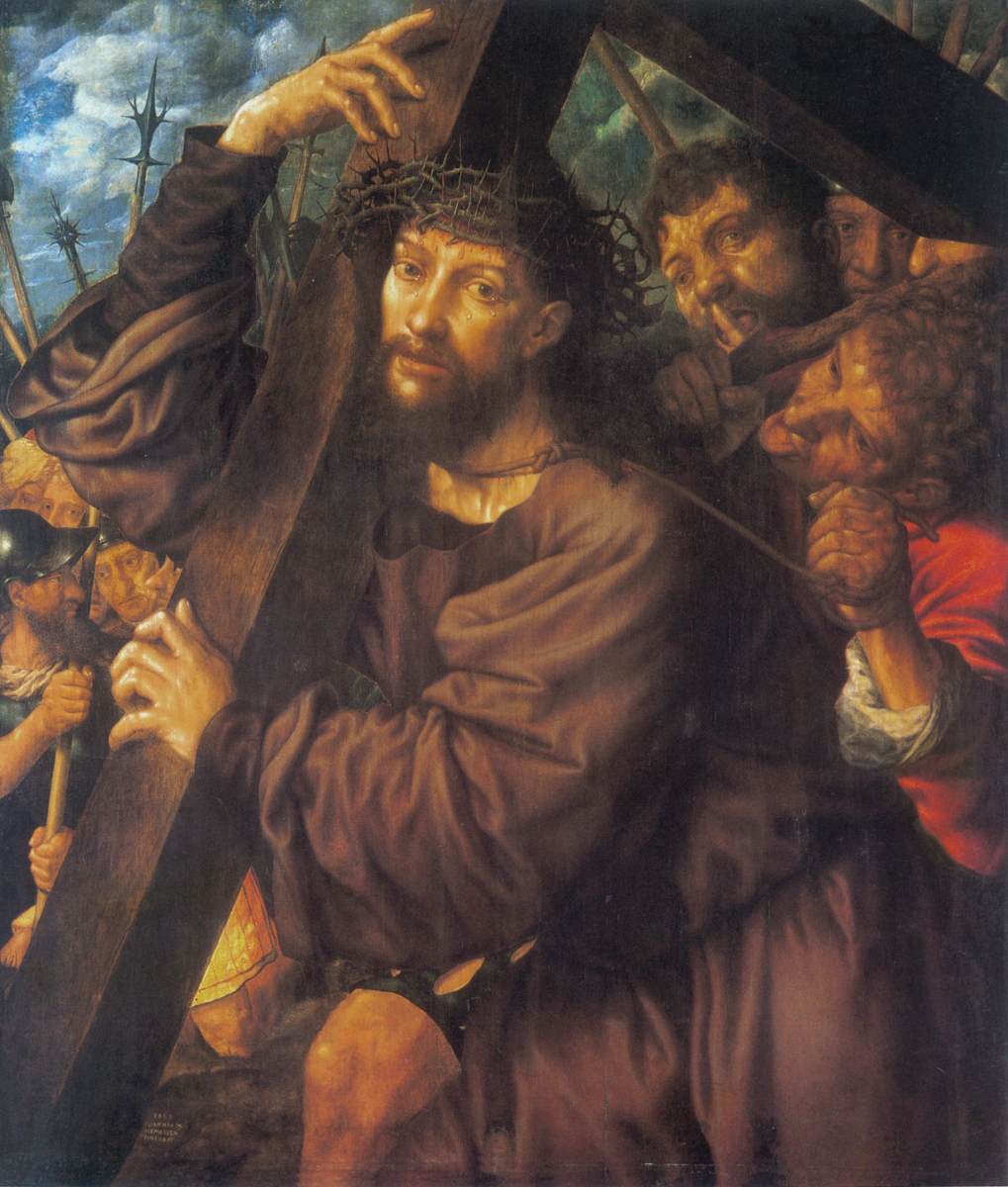
Christ Carrying the Cross

Jan Sanders van Hemessen

1553
Oil on wood, 111 x 97,5 cm
Christian Museum, Esztergom

9 posted on 04/29/2021 5:34:03 AM PDT by annalex (fear them not)
[ Post Reply | Private Reply | To 8 | View Replies]

To: annalex
Saint Catherine of Siena’s Story

The value Catherine makes central in her short life and which sounds clearly and consistently through her experience is complete surrender to Christ. What is most impressive about her is that she learns to view her surrender to her Lord as a goal to be reached through time.

She was the 23rd child of Jacopo and Lapa Benincasa and grew up as an intelligent, cheerful, and intensely religious person. Catherine disappointed her mother by cutting off her hair as a protest against being overly encouraged to improve her appearance in order to attract a husband. Her father ordered her to be left in peace, and she was given a room of her own for prayer and meditation.

She entered the Dominican Third Order at 18 and spent the next three years in seclusion, prayer, and austerity. Gradually, a group of followers gathered around her—men and women, priests and religious. An active public apostolate grew out of her contemplative life. Her letters, mostly for spiritual instruction and encouragement of her followers, began to take more and more note of public affairs. Opposition and slander resulted from her mixing fearlessly with the world and speaking with the candor and authority of one completely committed to Christ. She was cleared of all charges at the Dominican General Chapter of 1374.

Her public influence reached great heights because of her evident holiness, her membership in the Dominican Third Order, and the deep impression she made on the pope. She worked tirelessly for the crusade against the Turks and for peace between Florence and the pope.

In 1378, the Great Schism began, splitting the allegiance of Christendom between two, then three, popes and putting even saints on opposing sides. Catherine spent the last two years of her life in Rome, in prayer and pleading on behalf of the cause of Pope Urban VI and the unity of the Church. She offered herself as a victim for the Church in its agony. She died surrounded by her “children” and was canonized in 1461.

Catherine ranks high among the mystics and spiritual writers of the Church. In 1939, she and Francis of Assisi were declared co-patrons of Italy. Pope Paul VI named her and Teresa of Avila doctors of the Church in 1970. Her spiritual testament is found in The Dialogue.


Reflection

Though she lived her life in a faith experience and spirituality far different from that of our own time, Catherine of Siena stands as a companion with us on the Christian journey in her undivided effort to invite the Lord to take flesh in her own life. Events which might make us wince or chuckle or even yawn fill her biographies: a mystical experience at six, childhood betrothal to Christ, stories of harsh asceticism, her frequent ecstatic visions. Still, Catherine lived in an age which did not know the rapid change of 21st-century mobile America. The value of her life for us today lies in her recognition of holiness as a goal to be sought over the course of a lifetime.


Saint Catherine of Siena is the Patron Saint of:

Europe
Fire Prevention
Italy


franciscanmedia.org
More patronage: against fire; bodily ills; Diocese of Allentown, Pennsylvania, USA; Europe; illness; Italy; Bambang, Nueva Vizcaya, Samal, Bataan, Philippines; miscarriages; people ridiculed for their piety; sexual temptation; sick people; sickness; nurses
10 posted on 04/29/2021 5:39:30 AM PDT by annalex (fear them not)
[ Post Reply | Private Reply | To 9 | View Replies]

To: Cronos; All
NAVARRE BIBLE COMMENTARY (RSV)

Ad Majorem Dei Gloriam (To the Greater Glory of God)

From: Acts 13:13-25

They Cross into Asia Minor
--------------------------
[13] Now Paul and his company set sail from Paphos, and came to Perga in Pamphylia. And John left them and returned to Jerusalem; [14] but they passed on from Perga and came to Antioch of Pisidia.

Preaching in the Synagogue of Antioch of Pisidia<
> ------------------------------------------------
And on the Sabbath day they went into the synagogue and sat down. [15] After the reading of the law and the prophets, the rulers of the synagogue sent to them, saying, "Brethren, if you have any word of exhortation for the people, say it." [16] So Paul stood up, and motioning with his hand said: "Men of Israel, and you that fear God, listen. [17] The God of this people Israel chose our fathers and made the people great during their stay in the land of Egypt, and with uplifted arm He led them out of it. [18] And for about forty years He bore with them in the wilderness. [19] And when He had destroyed seven nations in the land of Canaan, He gave them their land as an inheritance, for about four hundred and fifty years. [20] And after that He gave them judges until Samuel the prophet. [21] Then they asked for a king; and God gave them Saul the son of Kish, a man of the tribe of Benjamin, for forty years. [22] And when He had removed him, He raised up David to be their king; of whom He testified and said, "I have found in David the son of Jesse a man after My heart, who will do all My will.' [23] Of this man's posterity God has brought Israel a Savior, Jesus, as He promised. [24] Before His coming John had preached a baptism of repentance to all the people of Israel. [25] And as John was finishing his course, he said, 'What do you suppose that I am? I am not He. No, but after me One is coming, the sandals of whose feet I am not worthy to untie.'"

***********************************************************************
Commentary:

15. Sabbath services in synagogues went right back to the post-exilic period (after the Babylonian Captivity, which lasted from 586 to 539 B.C.), and by now they had a very settled form. They consisted of readings from Sacred Scripture, preaching and public prayers. No one was especially appointed to preside over these services; the president or ruler of the synagogue could ask any member of the community to take the ceremony (cf. 18:8); he supervised the preparations and made sure that everything was done properly.

16-41. Paul's address here is an excellent example of the way he used to present the Gospel to a mixed congregation of Jews and proselytes. He lists the benefits conferred by God on the chosen people from Abraham down to John the Baptism (verses 16-25); he then shows how all the messianic prophecies were fulfilled in Jesus (verses 26-37), and, by way of conclusion, states that justification comes about through faith in Jesus, who died and then rose from the dead (verse 38-41).

This address contains all the main themes of apostolic preaching, that is, God's saving initiative in the history of Israel (verses 17-22); reference to the Precursor (verses 24-25); the proclamation of the Gospel or "kerygma" in the proper sense (verses 26b-31a); mention of Jerusalem (verse 31b); arguments from Sacred Scripture (verses 33-37), complementing apostolic teaching and tradition (verses 38-39); and a final exhortation, eschatological in character, announcing the future (verses 40-41). In many respects this address is like those of St. Peter (cf. 2:14ff; 3:12ff), especially where it proclaims Jesus as Messiah and in its many quotations from Sacred Scripture, chosen to show that the decisive event of the Resurrection confirms Christ's divinity.

Paul gives a general outline of salvation history and then locates Jesus in it as the expected Messiah, the point at which all the various strands in that history meet and all God's promises are fulfilled. He shows that all the steps which lead up to Jesus Christ, even the stage of John the Baptist, are just points on a route. Earlier, provisional elements must now, in Christ, give way to a new, definitive situation.

11 posted on 04/29/2021 5:39:50 AM PDT by fidelis (Zonie and USAF Cold Warrior)
[ Post Reply | Private Reply | To 1 | View Replies]

To: Cronos; All
From: John 13:16-20

Jesus Washes His Disciples' Feet (Continued)
--------------------------------
(Jesus said to His disciples,) [16] "Truly, truly, I say to you, a servant is not greater than his master; nor is he who is sent greater than he who sent him. [17] If you know these things, blessed are you if you do them. [18] I am not speaking to you all; I know whom I have chosen; it is that the Scripture may be fulfilled, `He who ate my bread has lifted his heel against me.' [19] I tell you this now, before it takes place, that when it does take place you may believe that I am He. [20] Truly, truly, I say to you, he who receives any man whom I send receives Me; and he who receives Me receives Him who sent Me."

***********************************************************************
Commentary:

15-17. Jesus' whole life was an example of service towards men, fulfilling His Father's will to the point of dying on the Cross. Here our Lord promises us that if we imitate Him, our Teacher, in disinterested service (which always implies sacrifice), we will find true happiness which no one can wrest from us (cf. 16:22; 17:13). "`I have given you an example', He tells His disciples after washing their feet, on the night of the Last Supper. Let us reject from our hearts any pride, any ambition, any desire to dominate; and peace and joy will reign around us and within us, as a consequence of our personal sacrifice" (St J. Escriva, Christ Is Passing By, 94).

18. Lifting one's heel against someone means hitting him brutally; metaphorically, therefore, it means violent enmity. Judas' treachery fulfills the words of Psalm 41:10 where the psalmist complains bitterly of a friend's treachery. Once again the Old Testament prefigures events which find their full expression in the New.

Through Baptism, the Christian has become a son of God and is called to share in God's good things, not only in Heaven but also on earth: He has received grace, he shares in the Eucharistic Banquet..., he shares with his brethren, other Christians, the friendship of Jesus. Therefore, if a person sins who has been born again through Baptism, in some sense his is a sort of treachery similar to Judas'. However, we have the recourse of repentance: if we trust in God's mercy we can set about recovering our friendship with God.

"React. Listen to what the Holy Spirit tells you: `Si inimicus meus maledixisset mihi, sustinuissem utique'. If it were the enemy who insulted me, I could put up with that. But you...`tu vero homo unanimis, dux meus, et notus meus, qui simul mecum dulces capiebas cibos': you, My friend, My Apostle, who sit at My table and take sweet food with Me!" (St J. Escriva, The Way, 244).

19. Jesus tells the Apostles in advance about Judas' treachery, so that when they see Christ's predictions come true, they will realize He has divine knowledge and that in Him are fulfilled the Scriptures of the Old Testament (cf. John 2:22). On the words "I am", cf. note on John 8:21-24.

Daily Word for Reflection—Navarre Bible Commentary

12 posted on 04/29/2021 5:41:05 AM PDT by fidelis (Zonie and USAF Cold Warrior)
[ Post Reply | Private Reply | To 3 | View Replies]

To: annalex


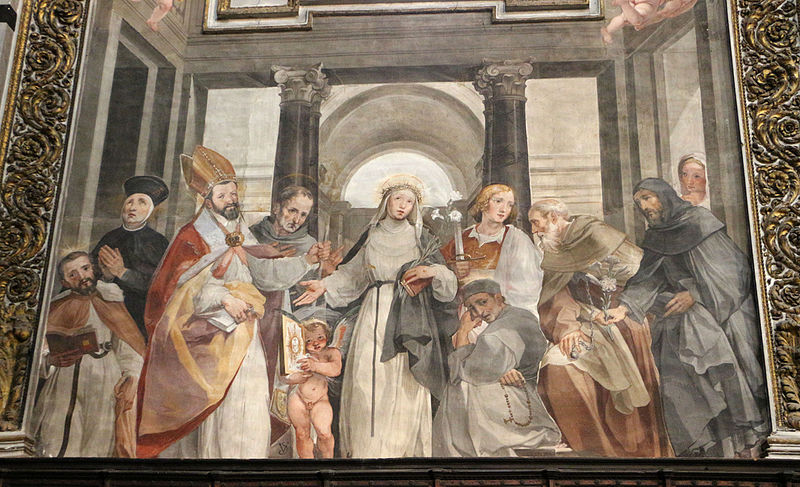
St. Catherine of Siena among saints

Ventura Salimbeni (1568 – 1613)

Cathedral of Siena - Choir

13 posted on 04/29/2021 5:53:05 AM PDT by annalex (fear them not)
[ Post Reply | Private Reply | To 10 | View Replies]

Disclaimer: Opinions posted on Free Republic are those of the individual posters and do not necessarily represent the opinion of Free Republic or its management. All materials posted herein are protected by copyright law and the exemption for fair use of copyrighted works.

Free Republic
Browse · Search
Religion
Topics · Post Article

FreeRepublic, LLC, PO BOX 9771, FRESNO, CA 93794
FreeRepublic.com is powered by software copyright 2000-2008 John Robinson