Free Republic
Browse · Search
Religion
Topics · Post Article

Skip to comments.

Catholic Caucus: Daily Mass Readings 4-27-2021, Tuesday of the 4th week of Eastertide
Universalis/Jerusalem Bible ^ | 27 April 2021 | God

Posted on 04/27/2021 3:51:57 AM PDT by Cronos

April 27, 2021

Tuesday of the 4th week of Eastertide


Church of the Holy Cross, Dhaka, Bangladesh

Readings at Mass

Liturgical Colour: White.


First readingActs 11:19-26 ©

They started preaching to the Greeks, proclaiming the Lord Jesus

Those who had escaped during the persecution that happened because of Stephen travelled as far as Phoenicia and Cyprus and Antioch, but they usually proclaimed the message only to Jews. Some of them, however, who came from Cyprus and Cyrene, went to Antioch where they started preaching to the Greeks, proclaiming the Good News of the Lord Jesus to them as well. The Lord helped them, and a great number believed and were converted to the Lord.
  The church in Jerusalem heard about this and they sent Barnabas to Antioch. There he could see for himself that God had given grace, and this pleased him, and he urged them all to remain faithful to the Lord with heartfelt devotion; for he was a good man, filled with the Holy Spirit and with faith. And a large number of people were won over to the Lord.
  Barnabas then left for Tarsus to look for Saul, and when he found him he brought him to Antioch. As things turned out they were to live together in that church a whole year, instructing a large number of people. It was at Antioch that the disciples were first called ‘Christians.’

Responsorial PsalmPsalm 86(87) ©
O praise the Lord, all you nations!
or
Alleluia!
On the holy mountain is his city
  cherished by the Lord.
The Lord prefers the gates of Zion
  to all Jacob’s dwellings.
Of you are told glorious things,
  O city of God!
O praise the Lord, all you nations!
or
Alleluia!
‘Babylon and Egypt I will count
  among those who know me;
Philistia, Tyre, Ethiopia,
  these will be her children
and Zion shall be called “Mother”
  for all shall be her children.’
O praise the Lord, all you nations!
or
Alleluia!
It is he, the Lord Most High,
  who gives each his place.
In his register of peoples he writes:
  ‘These are her children,’
and while they dance they will sing:
  ‘In you all find their home.’
O praise the Lord, all you nations!
or
Alleluia!

Gospel AcclamationJn10:27
Alleluia, alleluia!
The sheep that belong to me listen to my voice,
says the Lord,
I know them and they follow me.
Alleluia!

GospelJohn 10:22-30 ©

The Father and I are one

It was the time when the feast of Dedication was being celebrated in Jerusalem. It was winter, and Jesus was in the Temple walking up and down in the Portico of Solomon. The Jews gathered round him and said, ‘How much longer are you going to keep us in suspense? If you are the Christ, tell us plainly.’ Jesus replied:
‘I have told you, but you do not believe.
The works I do in my Father’s name are my witness;
but you do not believe,
because you are no sheep of mine.
The sheep that belong to me listen to my voice;
I know them and they follow me.
I give them eternal life;
they will never be lost
and no one will ever steal them from me.
The Father who gave them to me is greater than anyone,
and no one can steal from the Father.
The Father and I are one.’

The readings on this page are from the Jerusalem Bible, which is used at Mass in most of the English-speaking world. The New American Bible readings, which are used at Mass in the United States, are available in the Universalis apps, programs and downloads.
You can also view this page with the Gospel in Greek and English.


TOPICS: Catholic; General Discusssion; Prayer; Worship
KEYWORDS: catholic; easter; jn10; prayer
For your reading, reflection, faith-sharing, comments, questions, discussion.

1 posted on 04/27/2021 3:51:57 AM PDT by Cronos
[ Post Reply | Private Reply | View Replies]

catholic; easter; jn10; prayer;


2 posted on 04/27/2021 3:52:16 AM PDT by Cronos
[ Post Reply | Private Reply | To 1 | View Replies]

To: nickcarraway; NYer; ELS; Pyro7480; livius; ArrogantBustard; Catholicguy; RobbyS; marshmallow; ...
Alleluia Ping

Please FReepmail me to get on/off the Alleluia Ping List.


3 posted on 04/27/2021 3:52:43 AM PDT by Cronos
[ Post Reply | Private Reply | To 1 | View Replies]

Catena Aurea by St. Thomas Aguinas

10:22–30

22. And it was at Jerusalem the feast of the dedication, and it was winter.

23. And Jesus walked in the temple in Solomon’s porch.

24. Then came the Jews round about him, and said unto him, How long dost thou make us to doubt? If thou be the Christ, tell us plainly,

25. Jesus answered them, I told you, and ye believed not: the works that I do in my Father’s name, they bear witness of me.

26. But ye believe not, because ye are not of my sheep, as I said unto you.

27. My sheep hear my voice, and I know them, and they follow me.

28. And I give unto them eternal life; and they shall never perish, neither shall any man pluck them out of my hand.

29. My Father, which gave them me, is greater than all; and no man is able to pluck them out of my Father’s hand.

30. I and my Father are one.

AUGUSTINE. (Tract. xlviii. 2) And it was at Jerusalem the feast of the dedication. Encænia is the feast of the dedication of the temple; from the Greek word καινὸν, signifying new. The dedication of any thing new was called encænia.

CHRYSOSTOM. (Hom. lxi. 1) It was the feast of the dedication of the temple, after the return from the Babylonish captivity.

ALCUIN. Or, it was in memory of the dedication under Judas Maccabeus. The first dedication was that of Solomon in the autumn; the second that of Zorobabel, and the priest Jesus in the spring. This was in winter time.

BEDE. Judas Maccabeus instituted an annual commemoration of this dedication.

THEOPHYLACT. The Evangelist mentions the time of winter, to shew that it was near His passion. He suffered in the following spring; for which reason He took up His abode at Jerusalem.

GREGORY. (i. Mor. e. 11) Or because the season of cold was in keeping with the cold malicious hearts of the Jews.

CHRYSOSTOM. (Hom. lxi. 1.) Christ was present with much zeal at this feast, and thenceforth stayed 1in Judæa; His passion being now at hand. And Jesus walked in the temple in Solomon’s porch.

ALCUIN. It is called Solomon’s porch, because Solomon went to pray there. The porches of a temple are usually named after the temple. If the Son of God walked in a temple where the flesh of brute animals was offered up, how much more will He delight to visit our house of prayer, in which His own flesh and blood are consecrated?

THEOPHYLACT. Be thou also careful, in the winter time, i. e. while yet in this stormy wicked world, to celebrate the dedication of thy spiritual temple, by ever renewing thyself, ever rising upward in heart. Then will Jesus be present with thee in Solomon’s porch, and give thee safety under His covering. (τῇ σκέπῃ αὐτοῦ) But in another life no man will be able to dedicate Himself.

AUGUSTINE. (Tract. xlviii. 3) The Jews cold in love, burning in their malevolence, approached Him not to honour, but persecute. Then came the Jews round about Him, and said unto Him, How long dost Thou make us to doubt? If Thou be the Christ, tell us plainly. They did not want to know the truth, but only to find ground of accusation.

CHRYSOSTOM. (Hom. lxi) Being able to find no fault with His works, they tried to catch Him in His words. And mark their perversity. When He instructs by His discourse, they say, What sign shewest Thou? When He demonstrates by His works, they say, If Thou be the Christ, tell us plainly. Either way they are determined to oppose Him. There is great malice in that speech, Tell us plainly. He had spoken plainly1, when up at the feasts, and had hid nothing. They preface however with flattery: How long dost Thou make us2 to doubt? as if they were anxious to know the truth, but really only meaning to provoke Him to say something that they might lay hold of.

ALCUIN. They accuse Him of keeping their minds in suspense and uncertainty, who had come to save their soulsa.

AUGUSTINE. (Tract. xlviii) They wanted our Lord to say, I am the Christ. Perhaps, as they had human notions of the Messiah, having failed to discern His divinity in the Prophets, they wanted Christ to confess Himself the Messiah, of the seed of David; that they might accuse Him of aspiring to the regal power.

ALCUIN. And thus they intended to give Him into the hands of the Proconsul for punishment, as an usurper against the emperor. Our Lord so managed His reply as to stop the mouths of His calumniators, open those of the believers; and to those who enquired of Him as a man, reveal the mysteries of His divinity: Jesus answered them, I told you, and ye believed not; the works that I do in My Father’s name, they bear witness of Me.

CHRYSOSTOM. (Hom. lxi. 2) He reproves their malice, for pretending that a single word would convince them, whom so many words had not. If you do not believe My works, He says, how will you believe My words? And He adds why they do not believe: But ye believe not, because ye are not of My sheep.

AUGUSTINE. (Tract. xlviii. c. 4) He saw that they were persons predestinated to eternal death, and not those for whom He had bought eternal life, at the price of His blood. The sheep believe, and follow the Shepherd.

THEOPHYLACT. After He had said, Ye are not of My sheep, He exhorts them to become such: My sheep hear My voice.

ALCUIN. i. e. Obey My precepts from the heart. And I know them, and they follow Me, here by walking in gentleness and innocence, hereafter by entering the joys of eternal life: And I give unto them eternal life.

AUGUSTINE. (Tract. xlviii. 5, 6) This is the pasture of which He spoke before: And shall find pasture. Eternal life is called a goodly pasture: the grass thereof withereth not, all is spread with verdure. But these cavillers thought only of this present life. And they shall not perish eternally; (οὐ μὴ ἀπόλλυνται εἰς τὸν αἴωνα) as if to say, Ye shall perish eternally, because ye are not of My sheep.

THEOPHYLACT. But how then did Judas perish? Because he did not continue to the end. Christ speaks of them who persevere. If any sheep is separated from the flock, and wanders from the Shepherd, it incurs danger immediately.

AUGUSTINE. (Tract. xlviii. 6) And He adds why they do not perish: Neither shall any man pluck them out of My hand. (2 Tim. 2:19) Of those sheep of which it is said, The Lord knoweth then that are His, the wolf robbeth none, the thief taketh none, the robber killeth none. Christ is confident of their safety; and He knows what He gave up for them.

HILARY. (de Trin. vii. c. 22) This is the speech of conscious power. Yet to shew, that though of the Divine nature He hath His nativity from God, He adds, My Father which gave Me them is greater than all. He does not conceal His birth from the Father, but proclaims it. For that which He received from the Father, He received in that He was born from Him. He received it in the birth itself, not after it; though He was born when He received it.

AUGUSTINE. (Tract. xlviii) The Son, born from ever lasting of the Father, God from God, has not equality with the Father by growth, but by birth. This is that greater than all which the Father gave Himb; viz. to be His Word, to be His Only-Begotten Son, to be the brightness of His light. Wherefore no man taketh His sheep out of His hand, any more than from His Father’s hand: And no man is able to pluck them out of My Father’s hand. If by hand we understand power, the power of the Father and the Son is one, even as Their divinity is one. If we understand the Son, the Son is the hand of the Father, not in a bodily sense, as if God the Father had limbs, but as being He by Whom all things were made. Men often call other men hands, when they make use of them for any purpose. And sometimes a man’s work is itself called his hand, because made by his hand; as when a man is said to know his own hand, when he recognises his own handwriting. In this place, however, hand signifies power. If we take it for Son, we shall be in danger of imagining that if the Father has a hand, and that hand is His Son, the Son must have a Son too.

HILARY. (vii. de Trin. c. 22) The hand of the Son is spoken of as the hand of the Father, to let thee see, by a bodily representation, that both have the same nature, that the nature and virtue of the Father is in the Son also.

CHRYSOSTOM. (Hom. lxi) Then that thou mayest not suppose that the Father’s power protects the sheep, while He is Himself too weak to do so, He adds, I and My Father are one.

AUGUSTINE. (Tract. xxxvi. non occ.) Mark both those words, one and are, and thou wilt be delivered from Scylla and Charybdis. In that He says, one the Arian, in we are the Sabellian, is answered. There are both Father and Son. And if one, then there is no difference of persons between them.

AUGUSTINE. (vii. de Trin. c. 2) We are one. What He is, that am I, in respect of essence, not of relation.

HILARY. (viii. de Trin. c. 5) The heretics, since they cannot gainsay these words, endeavour by an impious lie to explain them away. They maintain that this unity is unanimity only; a unity of will, not of nature; i. e. that the two are one, not in that they are the same, but in that they will the same. But they are one, not by any economy merely, but by the nativity of the Son’s nature, since there is no falling off of the Father’s divinity in begetting Him. They are one whilst the sheep that are not plucked out of the Son’s hand, are not plucked out of the Father’s hand: whilst in Him working, the Father worketh; whilst He is in the Father, and the Father in Him. This unity, not creation but nativity, not will but power, not unanimity but nature accomplisheth. But we deny not therefore the unanimity of the Father and Son; for the heretics, because we refuse to admit concord in the place of unity, accuse us of making a disagreement between the Father and Son. We deny not unanimity, but we place it on the ground of unity. The Father and Son are one in respect of nature, honour, and virtue: and the same nature cannot will different things.




Copyright ©1999-2018 e-Catholic2000.com


4 posted on 04/27/2021 3:54:09 AM PDT by Cronos
[ Post Reply | Private Reply | To 1 | View Replies]

To: Cronos
John
 English: Douay-RheimsLatin: Vulgata ClementinaGreek NT: Byzantine/Majority Text (2000)
 John 10
22And it was the feast of the dedication at Jerusalem: and it was winter. Facta sunt autem Encænia in Jerosolymis, et hiems erat.εγενετο δε τα εγκαινια εν ιεροσολυμοις και χειμων ην
23And Jesus walked in the temple, in Solomon's porch. Et ambulabat Jesus in templo, in porticu Salomonis.και περιεπατει ο ιησους εν τω ιερω εν τη στοα σολομωνος
24The Jews therefore came round about him, and said to him: How long dost thou hold our souls in suspense? If thou be the Christ, tell us plainly. Circumdederunt ergo eum Judæi, et dicebant ei : Quousque animam nostram tollis ? si tu es Christus, dic nobis palam.εκυκλωσαν ουν αυτον οι ιουδαιοι και ελεγον αυτω εως ποτε την ψυχην ημων αιρεις ει συ ει ο χριστος ειπε ημιν παρρησια
25Jesus answered them: I speak to you, and you believe not: the works that I do in the name of my Father, they give testimony of me. Respondit eis Jesus : Loquor vobis, et non creditis : opera quæ ego facio in nomine Patris mei, hæc testimonium perhibent de me :απεκριθη αυτοις ο ιησους ειπον υμιν και ου πιστευετε τα εργα α εγω ποιω εν τω ονοματι του πατρος μου ταυτα μαρτυρει περι εμου
26But you do not believe, because you are not of my sheep. sed vos non creditis, quia non estis ex ovibus meis.αλλ υμεις ου πιστευετε ου γαρ εστε εκ των προβατων των εμων καθως ειπον υμιν
27My sheep hear my voice: and I know them, and they follow me. Oves meæ vocem meam audiunt, et ego cognosco eas, et sequuntur me :τα προβατα τα εμα της φωνης μου ακουει καγω γινωσκω αυτα και ακολουθουσιν μοι
28And I give them life everlasting; and they shall not perish for ever, and no man shall pluck them out of my hand. et ego vitam æternam do eis, et non peribunt in æternum, et non rapiet eas quisquam de manu mea.καγω ζωην αιωνιον διδωμι αυτοις και ου μη απολωνται εις τον αιωνα και ουχ αρπασει τις αυτα εκ της χειρος μου
29That which my Father hath given me, is greater than all: and no one can snatch them out of the hand of my Father. Pater meus quod dedit mihi, majus omnibus est : et nemo potest rapere de manu Patris mei.ο πατηρ μου ος δεδωκεν μοι μειζων παντων εστιν και ουδεις δυναται αρπαζειν εκ της χειρος του πατρος μου
30I and the Father are one. Ego et Pater unum sumus.εγω και ο πατηρ εν εσμεν

5 posted on 04/27/2021 4:55:20 AM PDT by annalex (fear them not)
[ Post Reply | Private Reply | To 4 | View Replies]

To: annalex


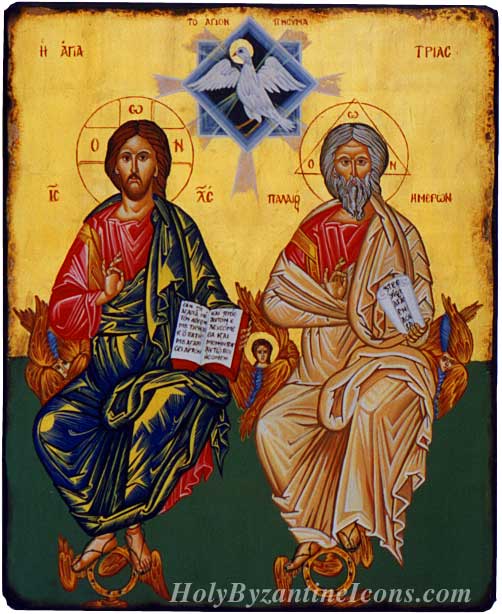
The New Testament Trinity

Interesting that God the Father is inscribed "The Ancient of Days" to avoid depicting God the Father directly.

6 posted on 04/27/2021 4:56:19 AM PDT by annalex (fear them not)
[ Post Reply | Private Reply | To 5 | View Replies]

To: annalex

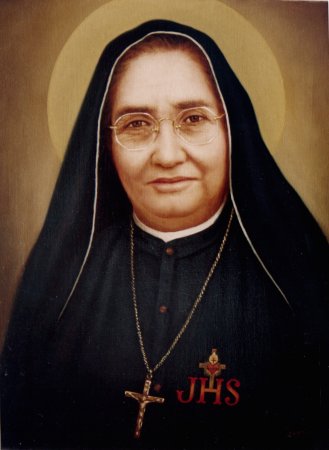
St Maria Guadalupe García Zavala

Saint of the Day – St Maria Guadalupe García Zavala (1878-1963) – born Anastasia Guadalupe García Zavala on 27 April 1878 in Zapopan, Jalisco, Mexico and died on 24 June 1963 in Guadalajara, Jalisco, Mexico of natural causes – Virgin and co-foundress of the Handmaids of Santa Margherita and the Poor. She is also known as “Mother Lupita”. Patronages – Nurses, Handmaids of Santa Margherita Maria and the Poor.St Maria Guadalupe García Zavala (1878-1963)

María Guadalupe García Zavala was born on 27 April 1878 in Zapopan, Jalisco, Mexico, to Fortino García and Refugio Zavala de García. As a child she was known for her piety and made frequent visits to the Basilica of Our Lady of Zapopan, which was located next to the religious goods shop run by her father . Her love for God was particularly demonstrated in her love for the poor.

“No’ to matrimony, “yes’ to Jesus:st maria guadalupe garcia
With uncommon transparency and simplicity, María treated everyone with equal love and respect. Although as a young woman she planned to marry Gustavo Arreola, she suddenly broke off her engagement when she was 23 years old. The reason: María “understood” that Jesus was calling her to love Him with an undivided heart as part of the religious life and she fully believed, that she was called to do this, by giving assistance to the poor and sick.

Foundress of the “Servants’:
When María confided to her spiritual director, Fr Cipriano Iñiguez, her “sudden change of heart”, he told her that for some time he had the inspiration to found a religious congregation that would provide assistance to the hospitalised. He invited María to join him in this foundation.

The new Congregation, which officially began on 13 October 1901, was known as the “Handmaids of St Margaret Mary (Alacoque) and the Poor”.st maria guadalupe garcia diocesan approval.JPG

“Poor with the poor’:
María worked as a nurse, giving assistance to the first patients that were welcomed into “their hospital”. Regardless of the poverty and lack of material goods of the patients, compassion and care for the physical and spiritual well-being of the sick were the primary concerns and María gave of herself wholeheartedly to carry out this task of love.

Sr María was named Superior General of the quickly-growing Congregation and taught the Sisters entrusted to her, mostly by means of her example, the importance of living a genuine and joyful exterior and interior poverty. She was convinced that it was only through loving and living poverty that one could be truly “poor with the poor”.

Indeed, Mother María was known for her simplicity, humility and willingness to accept all that came from the hand of God.st maria guadalupe garcia older

In times of “dire straits”, Mother María asked her spiritual director for permission to go begging in order to collect money for the hospital. Together with other Sisters, she would seek offerings until the needs of the hospital and patients were me, and would ask no more than was necessary. The Sisters also worked in parishes to assist the priests and to teach catechism.

Risking life to help those hiding:
From 1911 until 1936, the political-religious situation in Mexico became uneasy and the Catholic Church underwent persecution. Mother María put her own life at risk to help the priests and the Archbishop of Guadalajara to “go into hiding” in the hospital.

She did not limit her charity simply to helping the “righteous” but also gave food and care to the persecutors who lived near the hospital, it was not long before they, too, began defending the sick in the hospital run by the Sisters.

The last two years of Mother María’s life were lived in extreme suffering because of a grave illness and on 24 June 1963, she died at the age of 85.

During the lifetime of the foundress, 11 foundations were established in the Republic of Mexico.
Today, the Congregation has 22 foundations and is present in five different Nations: Mexico, Peru, Iceland, Greece and Italy.

Her Beatification cause began in mid-1984 and her formal Beatification was celebrated on 25 April 2004. Pope Francis later Canonised her as a saint on 12 May 2013 in Saint Peter’s Square.


anastpaul.com

Patronage: Nurses, Handmaids of Santa Margherita Maria and the Poor

7 posted on 04/27/2021 5:03:28 AM PDT by annalex (fear them not)
[ Post Reply | Private Reply | To 6 | View Replies]

To: annalex; All
NAVARRE BIBLE COMMENTARY (RSV)

Ad Majorem Dei Gloriam (To the Greater Glory of God)

From: Acts 11:19-26

The Beginning of the Church in Antioch (Continuation)
--------------------------------------
[19] Now those who were scattered because of the persecution that arose over Stephen travelled as far as Phoenicia and Cyprus and Antioch, speaking the word to none except Jews. [20] But there were some of them, men of Cyprus and Cyrene, who on coming to Antioch spoke to the Greeks also, preaching the Lord Jesus. [21] A great number that believed turned to the Lord. [22] News of this came to the ears of the Church in Jerusalem, and they sent Barnabas to Antioch. [23] When he came and saw the grace of God, he was glad; and he exhorted them all to remain faithful to the Lord with steadfast purpose; [24] for he was a good man, full of the Holy Spirit and of faith. And a large company was added to the Lord. [25] So Barnabas went to Tarsus to look for Saul; [26] and when he had found him, he brought him to Antioch. For a whole year they met with the Church, and taught a large company of people and in Antioch the disciples were for the first time called Christians.

***********************************************************************
Commentary:

19-30. This account links up with Acts 8:1-4, which describes the flight of Christians from Jerusalem due to the first persecution following on the martyrdom of St. Stephen. We are now told about the spread of the Gospel to Antioch on the Orontes, the capital of the Roman province of Syria. Antioch was the first major city of the ancient world where the word of Jesus Christ was preached. It was the third city of the empire, after Rome and Alexandria, with a population of about half a million and a sizeable Jewish colony, and was a very important cultural, economic and religious center.

In Antioch the Gospel is proclaimed not only to Jews and proselytes. These Hellenist Jews from Jerusalem preached the Gospel to all and sundry as part of their ordinary everyday activity. St. Luke does not give us any names: the preachers are ordinary Christians. "Notice", says Chrysostom, "that it is grace which does everything. And also reflect on the fact that this work is begun by unknown workers and only when it begins to prosper do the Apostles send Barnabas" (Hom. On Acts, 25).

The Christian mission at Antioch played a key part in the spread of Christianity. Evangelization of non-Jews becomes the norm; it is not just something which happens in a few isolated cases. Nor is it limited to "God-fearers"; it extends to all the Gentiles. The center of gravity of the Christian Church begins to move from Jerusalem to Antioch, which will become the springboard for the evangelization of the pagan world.

22-26. The community at Jerusalem, where the Apostles were based, felt responsible for everything that happened in the Christian mission-field. This was why they sent Barnabas to oversee developments in Antioch. Barnabas was a man whom the Apostles trusted, noted for his virtue (he was mentioned in Acts 4:36).

No doubt it was because of all the work opening before the preacher of the Gospel that Barnabas sought out Paul, who had returned to Tarsus after his conversion and his visit to Jerusalem (9:30). Barnabas probably knew that the future Apostle was the very man he needed to join him in the work of evangelization about to be undertaken by the Antiochene Church. Barnabas' sense of responsibility and his zeal to find laborers for the Lord's harvest (cf. Matthew 9:38) lead to the first of the great missionary journeys, in which Paul's vocation find full scope.

26. We do not exactly know who first began to describe the disciples as "Christians". In any event the fact that they were given a name shows that everyone recognized them as an identifiable group. The name also suggests that the term "Christos"--Messiah, Anointed--is no longer regarded simply as a messianic title but also as a proper name.

Some Fathers of the Church see this name as further indication that people do not become disciples of the Lord through human causes. "Although the holy Apostles were our teachers and have given us the Gospel of the Savior, it is not from them that we have taken our name: we are "Christians" through Christ and it is for Him that we are called in this way" (St. Athanasius, Oratio I Contra Arianos, 2).

1. From this point onwards Luke's account centers on the Church of Antioch. This was a flourishing community, with members drawn from all sectors of society. In some respects its organization structure was like that of the Jerusalem Church; in others, not. It clearly had ordained ministers who were responsible for its government, who preached and administered the Sacraments; along these we find prophets (cf. 11:28) and teachers, specially trained members of the community.

In the early Church "teachers" were disciples well versed in Sacred Scripture who were given charge of catechesis. They instructed the catechumens and other Christians in the basic teaching of the Gospel as passed on by the Apostles, and some of them had a capacity for acquiring and communicating to others an extensive and profound knowledge of the faith.

Teachers do not necessarily have to be priests or preachers. Preaching was usually reserved to ordained ministers; teachers had an important position in the Church: they were responsible for on-going doctrinal and moral education and were expected faithfully to hand on the same teaching as they themselves had received. A virtuous life and due learning would have protected them against any temptation to invent new teachings or go in for mere speculation not based on the Gospel (cf. 1 Timothy 4:7; 6:20; Titus 2:1).

The Letter to Diognetus describes the ideal Christian teacher: "I do not speak of passing things nor do I go in search of new things, but, like the disciple of the Apostles that I am, I become a teacher of peoples. I do nothing but hand on what was given me by those who made themselves worthy disciples of the truth" (XI, 1).

8 posted on 04/27/2021 6:02:20 AM PDT by fidelis (Zonie and USAF Cold Warrior)
[ Post Reply | Private Reply | To 7 | View Replies]

To: annalex; All
From: John 10:22-30

Jesus and the Father are One
----------------------------
[22] It was the feast of the Dedication at Jerusalem; [23] it was winter, and Jesus was walking in the temple, in the portico of Solomon. [24] So the Jews gathered round Him and said to Him, "How long will You keep us in suspense? If you are the Christ, tell us plainly." [25] Jesus answered them, "I told you, and you do not believe. The works that I do in My Father's name, they bear witness to Me; [26] but you do not believe, because you do not belong to My sheep. [27] My sheep hear My voice, and I know them, and they follow Me; [28] and I give them eternal life, and they shall never perish, and no one shall snatch them out of My hand. [29] My Father, who has given them to Me, is greater than all, and no one is able to snatch them out of the Father's hand. [30] I and the Father are one."

***********************************************************************
Commentary:

22. This feast commemorates an episode in Jewish history (cf. 1 Maccabees 4:36-59; 2 Maccabees 1-2:19; 10:1-8) when Judas Maccabeus, in the year 165 B.C., after liberating Jerusalem from the control of the Seleucid kings of Syria, cleansed the temple of the profanations of Antiochus Epiphanes (1 Maccabees 1:54). From then onwards, on the twenty-fifth day of the month of Kislev (November-December) and throughout the following week, all Judea celebrated the anniversary of the dedication of the new altar. It was also known as the "Festival of Lights" because it was customary to light lamps, a symbol of the Law, and put them in the windows of the houses (cf. 2 Maccabees 1:18).

24-25. When these Jews ask Jesus if He is the Messiah, "they speak in this way", St. Augustine comments, "not because they desire truth, but to prepare the way for calumny" (In Ioann. Evang., 48, 3). We have already seen Jesus reveal, by His words and deeds, that He is the Only Son of God (5:19ff; 7:16ff; 8:25ff). In view of their good dispositions, He explicitly told the Samaritan woman (4:26) and the man born blind (9:37) that He was the Messiah and Savior. Now He reproaches His listeners for refusing to recognize the works He does in His Father's name (cf. 5:36; 10:38). On other occasions He referred to works as a way to distinguish true prophets from false ones: "You will know them by their fruits" (Matthew 7:16; cf. Matthew 12:33).

26-29. Certainly faith and eternal life cannot be merited by man's own efforts: they are a gift of God. But the Lord does not deny anyone grace to believe and be saved, because He `wishes all men to be saved and to come to the knowledge of the Truth" (1 Timothy 2:4). If someone tries to avoid receiving the gift of faith, his unbelief is blameworthy. On this point St. Thomas Aquinas teaches: "I can see, thanks to the light of the sun; but if I close my eyes, I cannot see: this is no fault of the sun, it is my own fault, because by closing my eyes, I prevent the sunlight from reaching me" (Commentary on St. John, ad loc.).

But those who do not oppose divine grace do come to believe in Jesus. They are known to and loved by Him, enter under His protection and remain faithful with the help of His grace, which is a pledge of the eternal life which the Good Shepherd will eventually give them. It is true that in this world they will have to strive and in the course of striving they will sustain wounds; but if they stay united to the Good Shepherd nothing and no one will snatch Christ's sheep from Him, because our Father, God, is stronger than the Evil One. Our hope that God will grant us final perseverance is not based on our strength but on God's mercy: this hope should always motivate us to strive to respond to grace and to be more faithful to the demands of our faith.

30. Jesus reveals that He and the Father are one in substance. Earlier He proclaimed that God was His Father, "making Himself equal with God"--which is why a number of times the Jewish authorities think of putting Him to death (cf. 5:18; 8:59). Now He speaks about the mystery of God, which is something we can know about only through Revelation. Later on He will reveal more about this mystery, particularly at the Last Supper (14:10; 17:21-22). It is something the evangelist reflects on at the very beginning of the Gospel, in the prologue (cf. John 1:1 and note).

"Listen to the Son Himself", St. Augustine invites us. "`I and the Father are one.' He did not say, `I am the Father' or `I and the Father are one [Person].' But when He says, `I and the Father are one,' notice the two words `[we are]' and `one'...For if they are one, then they are not diverse; if `[we] are', then there is both a Father and a Son" (In Ioann. Evang., 36, 9). Jesus reveals that He is one in substance with the Father as far as divine essence or nature is concerned, but He also reveals that the Father and the Son are distinct Persons: "We believe then in the Father who eternally begets the Son; in the Son, the Word of God, who is eternally begotten; in the Holy Spirit, the uncreated Person who proceeds from the Father and the Son as their eternal Love. Thus in the three divine Persons, coaeternae sibi et coaequales, the life and beatitude of God perfectly One superabound and are consummated in the supreme excellence and glory proper to uncreated Being, and always `there should be venerated Unity in the Trinity and Trinity in the Unity'" (Pope St Paul VI, Creed of the People of God, 10).

Daily Word for Reflection—Navarre Bible Commentary

9 posted on 04/27/2021 6:03:23 AM PDT by fidelis (Zonie and USAF Cold Warrior)
[ Post Reply | Private Reply | To 7 | View Replies]

Disclaimer: Opinions posted on Free Republic are those of the individual posters and do not necessarily represent the opinion of Free Republic or its management. All materials posted herein are protected by copyright law and the exemption for fair use of copyrighted works.

Free Republic
Browse · Search
Religion
Topics · Post Article

FreeRepublic, LLC, PO BOX 9771, FRESNO, CA 93794
FreeRepublic.com is powered by software copyright 2000-2008 John Robinson