Posted on 04/01/2021 3:03:22 AM PDT by Cronos
Today, Wednesday, it would seem that Jesus stays in Bethany. According to Matthew’s Gospel, the day begins with an ominous warning:
When Jesus had finished saying all these things, he said to his disciples, “As you know, the Passover is two days away—and the Son of Man will be handed over to be crucified” (Matthew 26:1-2).
The scene then shifts across the Kidron valley, where we “overhear” this conversation:
Then the chief priests and the elders of the people assembled in the palace of the high priest, whose name was Caiaphas, and they schemed to arrest Jesus secretly and kill him. “But not during the festival,” they said, “or there may be a riot among the people” (Matthew 26:3-5).
It is interesting that they say, “not during the festival,” because according to the Synoptic Gospels that is exactly when it ended up happening. This serves as a reminder that things unfold according to the Lord’s authority. Nothing is out of His control. No one takes the Jesus’ life; He lays it down freely. Even if one considers the Johannine tradition, which uses a different Jewish calendar to date the Passover (one day later), this all takes place right in the thick of the Passover. Why? Because the Lord is fulfilling Passover. The priests and elders can plan all they want, but God is in control.
The Lord Jesus and the Twelve likely spent a quiet sort of day and it is now later in the afternoon. Matthew’s Gospel places Jesus in Bethany, at the home of Simon the Leper (Matthew 26:6-7). According to Luke (7:36), Simon was a Pharisee. His leprosy was in remission and he had been readmitted to the community. Could he have been one of the lepers Jesus cured? We do not know. The story here is complex; there are significant differences among the various Gospel accounts. Matthew records it as follows:
A woman came to him with an alabaster jar of very expensive perfume, which she poured on his head as he was reclining at the table. When the disciples saw this, they were indignant. “Why this waste?” they asked. “This perfume could have been sold at a high price and the money given to the poor.” Aware of this, Jesus said to them, “Why are you bothering this woman? She has done a beautiful thing to me. The poor you will always have with you, but you will not always have me. When she poured this perfume on my body, she did it to prepare me for burial. Truly I tell you, wherever this gospel is preached throughout the world, what she has done will also be told, in memory of her” (Matthew 26:7-13).
The act of anointing Jesus may have happened more than once; in the four accounts of it there are differences in both the details and the timeframes.
Luke presents this story (or a similar one) much earlier in his Gospel (Chapter 7). In his account it is Jesus’ feet not His head that are anointed. Further, Luke portrays Simon in a bad light.
Mark and Matthew place the incident on Wednesday of Holy Week, but report that it is those at the dinner (likely the apostles) who take offense at the anointing.
John’s Gospel places this event six days before Passover, but at the home of Martha, Mary, and Lazarus. In John’s account it is Mary who anoints the Lord (His feet, not His head) and Judas alone who takes offense.
For our purposes on this Wednesday of Holy Week, it is enough to note that Jesus sets the meaning of this woman’s action as anointing His body for burial. Jesus is clearly moved by her act of devotion and insight.
Jesus does not slight the poor in His response, but He teaches that the worship of God and obedience to His truth are higher goods than even the care of the poor. Serving the poor is not to be set in opposition to serving God. They are related, but God always comes first. For example, one cannot skip sacred worship on Sunday simply to serve the poor (except in a grave and urgent situation); serving the poor is not a substitute for worship. The worship of God comes first and is meant to fuel our charitable and just works. Further, set in the light of the looming passion, the dying One takes precedence over the poor ones.
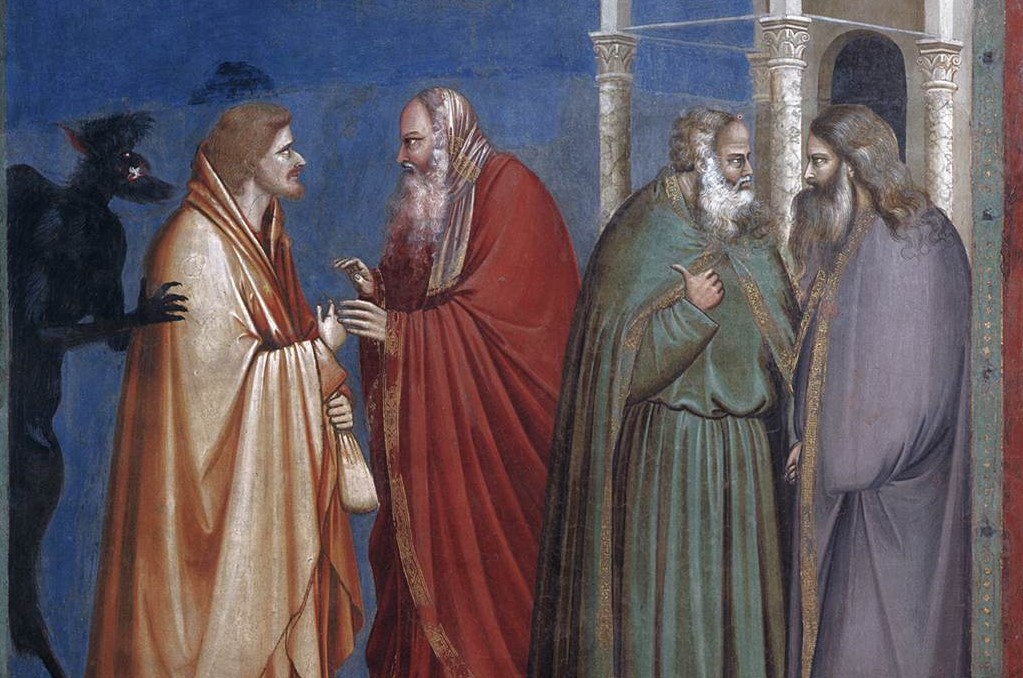
One of the Twelve, Judas, has become increasingly disaffected. He has not been featured prominently among the Twelve; mention of him in the Gospels is minimal. Now he emerges, as if from the shadows, to betray Jesus. Matthew, Mark, and Luke all seem to place Judas’ plans to betray Jesus as set into motion at some point on this day. The Gospel of Matthew recounts,
Then one of the Twelve—the one called Judas Iscariot—went to the chief priests and asked, “What are you willing to give me if I deliver him over to you?” So they counted out for him thirty pieces of silver. From then on Judas watched for an opportunity to hand him over (Matt 26:14-16).
Why did he do it? There were storm clouds gathering for Judas, by which he may have opened the door to Satan. Scripture reveals that he was a thief, stealing from the common money bag (Jn 12:6). Jesus also hints that Judas was grieved by the Bread of Life discourse, which led many to abandon Jesus when He insisted that they must eat His Flesh and drink His Blood. Jesus said, “Did I not choose you, the Twelve? And yet one of you is a devil.” He spoke of Judas the son of Simon Iscariot … (Jn 6:70-71).
We can only guess at Judas’ motivations. The most likely explanation is that he was disillusion when Jesus did not measure up to the common Jewish conception of the Messiah as a revolutionary warrior who would overthrow Roman power and reestablish the Kingdom of David. Judas may have been a member of the Zealot Party or at least influenced by them in this regard. Zealots are seldom interested in hearing of their own need for personal healing and repentance, let alone the call to love their enemies. This is obviously only speculative; Judas’ motivations remain to a large degree shrouded in the mystery of iniquity.
Yes, Judas betrayed Jesus for money—a significant amount—but compared to his salvation and his soul, it was but “a mess of pottage for his birthright” (see Gen 25:34). What will it profit a man that he should gain the whole world and lose his soul? (Mk 8:36)
The widespread belief that Judas might be in Heaven may be just a tad optimistic. The Church does not declare that any particular person is in Hell, however Jesus said the following about Judas: The Son of Man will go just as it is written about him. But woe to that man who betrays the Son of Man! It would be better for him if he had not been born. (Matt 26:24). It is hard to imagine Jesus saying this of any human person who ultimately makes it to Heaven.
The more likely biblical judgment on Judas is that he died in sin, despairing of God’s mercy on His terms. One is free to hope for a different outcome for Judas, but while the story of Judas and his possible repentance does generate some sympathy in many people today, the judgment belongs to God.
It is the saddest story never told: The repentance of Judas and his restoration by Jesus. Think of all the churches that were never built: “The Church of St. Judas, Penitent.” Think of the feast day never celebrated: “The Repentance of Judas.”
Judas goes his way, freely. God did not force him to play this role. He only knew what Judas would do beforehand and based His plans on Judas’ free choice.
Thus ends this Wednesday of Holy Week. It was a calmer day, a day spent among friends, yet a day on which Satan entered one man, who set a betrayal in motion. The storm clouds gather.
Please FReepmail me to get on/off the Msgr Charles Pope Ping List.
My question is “ What was the Lord doing in Nov 3rd , 2020?”
Jesus said he would be in the tomb for 3 DAYS! There's no such thing in the bible as "good Friday."
You really are being a Pharisee. You are detracting from the storu of salvation because of your blind dogma to the things of the world. You SHOULD be pointing at the death and rising of our Lord who humbled Himself to death. Even death on a cross for the atonement of we the fallen.
You sre part of the brood of Vipers and certainly doing the work of the devil to detract of the story. Jesus says he will be crucified and rise in the third day. Friday day 1. Saturday day 2. Sunday day 3.
The opening of the tomb completely changed the course of humanity and reconciles is once and for all with God. I will pray that you learn and become faithful to the truth and purpose of the passion instead of detracting from it with your earthly interpretations of things id no relevance. I will leave you with this.
Who may call Good Friday, •good•
This a a term oft misunderstood
You who were washed by the blood of His cross
You will call Good Friday good.
10 Nisan, Palm Sunday. Luke 18:31-33
Monday 11 Nisan. Clearing The Temple. Matt. 21:14-17
Tuesday 12 Nisan. A Long Day Of Teaching, Parables And Confrontation, Then A Prophecy Lesson. To many things for a Link to.
Wednesday 13 Nisan. The Betrayal. Luke 22:1-6
Thursday 14 Nisan. The Crucifixion, Passover, day of Preparation. John 19:31 All four gospels agree that Preparation day was the day on which Jesus was crucified.
Friday, 15 Nisan. The Feast Of Unleavened Bread. 1 Peter 3:18-20
Saturday, 16 Nisan. The Weekly Sabbath. Exodus 20:10
Sunday, 17 Nisan. The Resurrection, The Feast Of First Fruits. Heb. 9:11-12
Now before anyone gets on me about the date 10 Nisan read Exodus 12 first please.
Also before commenting on the day of our Lords crucifixion consider Luke 24:18-21 below.
“Are you the only one visiting Jerusalem who does not know the things that have happened there in these days?”
19 “What things?” he asked.
“About Jesus of Nazareth,” they replied. “He was a prophet, powerful in word and deed before God and all the people.
20 The chief priests and our rulers handed him over to be sentenced to death, and they crucified him;
21 but we had hoped that he was the one who was going to redeem Israel. And what is more, it is the third day since all this took place.
It was Sunday, the third day since it happened. That means Saturday would have been the second day since it happened, and Friday the first day since, thus Thursday the day it happened.
Later that day he came to the ten, for Judas was dead and Thomas off somewhere else.
45 Then he opened their minds so they could understand the Scriptures. (Is this why Thomas was doubting?)
46 He told them, “This is what is written: The Messiah will suffer and rise from the dead on the third day,
47 and repentance for the forgiveness of sins will be preached in his name to all nations, beginning at Jerusalem.
48 You are witnesses of these things.
49 I am going to send you what my Father has promised; but stay in the city until you have been clothed with power from on high.”(Luke 24:45-49).
The empty tomb is proof that our faith is not in vain. Amen Father, in Jesus' name.
Countries, nations come and go. The USA is 200+ years old. The bigger loss was in 640 with the loss of Jerusalem to the Arab armies
The Gospels all agree that Jesus died on a Friday during Passover on the Day of Preparation for the Sabbath (cf. Matthew 27:62, Mark 15:42, Luke 23:54, John 19:42), that he shared a “last supper” with his disciples, and was crucified in the reign of Tiberius, when Pontius Pilate was governor of Judaea (AD 26–36); Caiaphas, high priest in Jerusalem (AD 18–36); and Herod Antipas, tetrarch of Galilee (circa 4 BC–AD 39) (Tacitus, Annals, XV.44; Josephus, Antiquities of the Jews, XVIII.2.2, XVII.8.1; Luke 3:1-2).
Christ died around three in the afternoon on Friday and was entombed shortly thereafter. The Resurrection occurred by dawn on Sunday. Thus he was in the tomb less than nine hours Friday (by the modern reckoning), twenty-four hours Saturday, and less than six hours Sunday–at any rate, far less than the seventy-two hours that comprise three full days and nights.
Is there a contradiction here? No, because the ancient Jews counted as a whole day any part of a day, so “three days and three nights” (which means the same as “three days” in modern usage) could be as little as twenty-four hours plus a few seconds on either side–if there had been, back then, clocks that could register seconds.
In our way of reckoning things, from lunch time today to lunch time tomorrow is one day. Ancient Jews would have counted it as two days because it includes parts of two distinct days.
Jesus died at around 3 p.m. (cf. Luke 23:44-46), which means the first day of his death was the remainder of the day of preparation, between 3 p.m. and sunset.
The second day then began at sunset and lasted through the entire sabbath (i.e., it was Friday night and Saturday daytime).
The third day then began at sundown on the sabbath and lasted until sunset on the first day of the week (i.e., it was Saturday night and Sunday daytime).
This is why, on the road to Emmaus, the disciples can tell Jesus that “it is now the third day” since the Crucifixion (Luke 24:21).
Besides, you do realize that English as a language developed centuries after the New Testament books were written. And Modern English dates to 1500 years later.
In Latin, the name used by the Catholic Church until 1955 was Feria sexta in Parasceve (”Friday of Preparation [for the Sabbath]”). In the 1955 reform of Holy Week, it was renamed Feria sexta in Passione et Morte Domini (”Friday of the Passion and Death of the Lord”), and in the new rite introduced in 1970, shortened to Feria sexta in Passione Domini (”Friday of the Passion of the Lord”).
In German-speaking countries, it is generally referred to as Karfreitag (”Mourning Friday”, with Kar from Old High German kara‚ “bewail”, “grieve”‚ “mourn”, which is related to the English word “care” in the sense of cares and woes), but it is sometimes also called Stiller Freitag (”Silent Friday”) and Hoher Freitag (”High Friday, Holy Friday”). In the Scandinavian languages and Finnish (”pitkäperjantai”), it is called the equivalent of “Long Friday” as it was in Old English (”Langa frigedæg”).
In Greek, Polish, Hungarian, and Romanian it is generally referred to as the equivalent of “Great Friday” (Μεγάλη Παρασκευή, Wielki Piątek, Nagypéntek, Vinerea Mare). In Bulgarian, it is called either Велики петък (”Great Friday”), or, more commonly, Разпети петък (”Crucified Friday”). In French and Spanish it is referred to as Vendredi saint and Viernes Santo (”Holy Friday”). In Arabic, it is known as “الجمعة العظيمة” (”Great Friday”).
Quote’Passover is not on a specific day each year ....and the Sabbath that was talked about at the time of Jesus’ death was a special “High Holy” sabbath, which could have been any day of the week.
Jesus said he would be in the tomb for 3 DAYS! There’s no such thing in the bible as “good Friday.” ‘
Passover is the same day every year.
The 14th Day of the Father’s first month.
He changes not.
It’s always the Father’s 6th and final work day of His 2nd work week.
He changes not.
In every month on the Father’s calendar.
He changes not.
If Passover appears to float or wander around, that’s because of the Roman Beast and its Pope calendar.
Not because of His calendar.
Because again, He changes not.
Don’t ask Judaism about this . They follow the Roman Beast too..
So does Islam. So does the whole world.
Prophetic.
Hahaha... I’m a Pharisee? They didn’t believe the teachings of the Bible - they followed the lies and went against the truth of Jesus because they couldn’t keep their high dominance and glorious robes with him in charge. Have a great day.
You seem to have missed the point
That day has always been Saturday, the seventh day, and it still is.
Jesus was Jewish, after all, and followed His Father’s Law, even in death and resurrection. Everything ties together and testifies and confirms itself.
But, things are as they are now and few question it. We like our traditions.
None the less, lots of paganism was adapted into Christian tradition, like Christmas trees and Easter bunnies and other such things.
Beautiful! Thank you. And for you, 2 thoughts:
22 I will place on his shoulder the key to the house of David; what he opens no one can shut, and what he shuts no one can open. 23 I will drive him like a peg into a firm place; he will become a seat[a] of honor for the house of his father. 24 All the glory of his family will hang on him: its offspring and offshoots—all its lesser vessels, from the bowls to all the jars.
Isaiah 22:22-24
I know your deeds. See, I have placed before you an open door that no one can shut. I know that you have little strength, yet you have kept my word and have not denied my name.
Revelation 3:8
Must be pretty strange to follow a "savior" whose followers had utterly corrupted things barely a century after he left the scene. (If you want to quibble about the date of composition of the Didache, that's okay, but Ignatius of Antioch (+ AD 110) was already congratulating his followers for "no longer sabbathing," so it's less than a century after the resurrection no matter how you figure it.)
God really isn't in control in your world, is he?
No appeal to ego there, nope, none at all.
The scriptures are the source of what is right/wrong or true/false.
It’s not an ego thing.
It’s a test and prove all things, thing.
It’s a Chief/first importance of the gospel, thing.
Scriptures are the only weapon against Satan’s deceits.
Disclaimer: Opinions posted on Free Republic are those of the individual posters and do not necessarily represent the opinion of Free Republic or its management. All materials posted herein are protected by copyright law and the exemption for fair use of copyrighted works.