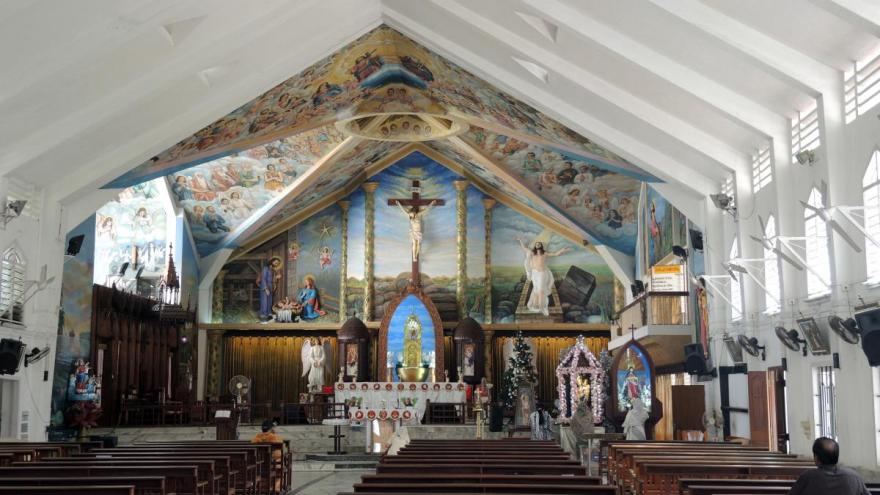
St. Mary's Cathedral and Basilica, seat of the Syro-Malabar diocese in Kochi, Kerala.
Posted on 03/21/2021 4:37:06 AM PDT by Cronos
St. Mary's Cathedral and Basilica, seat of the Syro-Malabar diocese in Kochi, Kerala.
| First reading |
|---|
| Jeremiah 31:31-34 © |
| Responsorial Psalm |
|---|
| Psalm 50(51):3-4,12-15 © |
| Second reading | Hebrews 5:7-9 © |
|---|
| Gospel Acclamation | Jn12:26 |
|---|
| Gospel | John 12:20-33 © |
|---|
The readings on this page are from the Jerusalem Bible, which is used at Mass in most of the English-speaking world. The New American Bible readings, which are used at Mass in the United States, are available in the Universalis apps, programs and downloads.
You can also view this page with the Gospel in Greek and English.
catholic,prayer,lent,jn12
Please FReepmail me to get on/off the Alleluia Ping List.

12:20–26
20. And there were certain Greeks among them that came up to worship at the feast.
21. The same came therefore to Philip, which was of Bethsaida of Galilee, and desired him, saying, Sir, we would see Jesus.
22. Philip cometh and telleth Andrew: and again Andrew and Philip tell Jesus.
23. And Jesus answered them, saying, The hour is come, that the Son of man should be glorified.
24. Verily, verily, I say unto you, Except a corn of wheat fall into the ground and die, it abideth alone: but if it die, it bringeth forth much fruit.
25. He that loveth his life shall lose it, and he that hateth his life in this world shall keep it unto life eternal.
26. If any man serve me, let him follow me; and where I am, there shall also my servant be: if any man serve me, him will my Father honour.
BEDE. The temple at Jerusalem was so famous, that on the feast days, not only the people near, but many Gentiles from distant countries came to worship in it; as that eunuch of Candace, Queen of the Ethiopians, mentioned in the Acts. The Gentiles who were at Jerusalem now, had come up for this purpose: And there were certain Gentiles among them who came to worship at the feast.
CHRYSOSTOM. (Hom. lxvi. 2) The time being now near, when they would be made proselytes. They hear Christ talked of, and wish to see Him: The same came therefore to Philip, which was of Bethsaida of Galilee, and desired him, saying, Sir, we would see Jesus.
AUGUSTINE. (Tr. li. 8) Lo! the Jews wish to kill Him, the Gentiles to see Him. But they also were of the Jews who cried, Blessed is He that cometh in the name of the Lord. So behold them of the circumcision, and them of the uncircumcision, once so wide apart, coming together like two walls, and meeting in one faith of Christ by the kiss of peace.
Philip cometh and telleth Andrew.
CHRYSOSTOM. (Hom. lxvii. 2) As being the elder disciple. He had heard our Saviour say, Go not into the way of the Gentiles; (Matt. 10:5) and therefore he communicates with his fellow-disciple, and they refer the matter to their Lord: And again Andrew and Philip tell Jesus.
AUGUSTINE. (Tr. li. 8) Listen we to the voice of the corner stone: And Jesus answered them, saying, The hour is come, that the Son of man should be glorified. Did He think Himself glorified, because the Gentiles wished to see? No. But He saw that after His passion and resurrection, the Gentiles in all lands would believe on Him; and took occasion from this request of some Gentiles to see Him, to announce the approaching fulness of the Gentiles, for that the hour of His being glorified was now at hand, and that after He was glorified in the heavens, the Gentiles would believe; according to the passage in the Psalm, Set up Thyself, O God, above the heavens, and Thy glory above all the earth. (Ps. 56, and 107) But it was necessary that His exaltation and glory should be preceded by His humiliation and passion; wherefore He says, Verily, verily, I say unto you, Except a corn of wheat fall into they round and die, it abideth alone: but if it die, it bringeth forth much fruit. That corn was He; to be mortified in the unbelief of the Jews, to be multiplied in the faith of the Gentiles.
BEDE. He Himself, of the seed of the Patriarchs, was sown in the field of this world, that by dying, He might rise again with increase. He died alone; He rose again with many.
CHRYSOSTOM. (Hom. lxvi. 2) He illustrates His discourse by an example from nature. A grain of corn produces fruit, after it has died. How much more then must the Son of God? The Gentiles were to be called after the Jews had finally offended; i. e. after His crucifixion. Now then that the Gentiles of their own accord offered their faith, He saw that His crucifixion could not be far off. And to console the sorrow of His disciples, which He foresaw would arise, He tells them that to bear patiently not only His death, but their own too, is the only way to good: He that loveth his life shall lose it.
AUGUSTINE. (Tr. li. 10) This may be understood in two ways: 1. If thou lovest it, lose it: if thou wouldest preserve thy life in Christ, fear not death for Christ. 2. Do not love thy life here, lest thou lose it hereafter. The latter seems to be the more evangelical (evangelicus) sense; for it follows, And he that hateth his life in this world, shall keep it unto life eternal.
CHRYSOSTOM. (Hom. lxvii. 1) He loveth his life in this world, who indulges its inordinate desires; he hateth it, who resists them. It is not, who doth not yield to, but, who hateth. For as we cannot bear to hear the voice or see the face of them whom we hate; so when the soul invites us to things contrary to God, we should turn her away from them with all our might.
THEOPHYLACT. It were harsh to say that a man should hate his soul; so He adds, in this world: i. e. for a particular time, not for ever. And we shall gain in the end by so doing: shall keep it unto life eternal.
AUGUSTINE. (Tr. li. 10) But think not for an instant, that by hating thy soul, is meant that thou mayest kill thyself. For wicked and perverse men have sometimes so mistaken it, and have burnt and strangled themselves, thrown themselves from precipices, and in other ways put an end to themselves. This did not Christ teach; nay, when the devil tempted Him to cast Himself down, He said, Get thee hence, Satanb. But when no other choice is given thee; when the persecutor threatens death, and thou must either disobey God’s law, or depart out of this life, then hate thy life in this world, that thou mayest keep it unto life eternal.
CHRYSOSTOM. (Hom. lxvii. 1) This present life is sweet to them who are given up to it. But he who looks heavenwards, and sees what good things are there, soon despises this life. When the better life appears, the worse is despised. This is Christ’s meaning, when He says, If any man serve Me, let him follow Me, i. e. imitate Me, both in My death, and life. For he who serves, should follow him whom he serves.
AUGUSTINE. (Tr. li) But what is it to serve Christ? The very words explain. They serve Christ who seek not their own things, but the things of Jesus Christ, i. e. who follow Him, walk in His, not their own, ways, do all good works for Christ’s sake, not only works of mercy to men’s bodies, but all others, till at length they fulfil that great work of love, and lay down their lives for the brethren. But what fruit, what reward? you ask. The next words tell you: And where I am, there shall also My servant be. Love Him for His own sake, and think it a rich reward for thy service, to be with Him.
CHRYSOSTOM. (Hom. lxvii) So then death will be followed by resurrection. Where I am, He says; for Christ was in heaven before His resurrection. Thither let us ascend in heart and in mind.
If any man serve Me, him will My Father honour. This must be understood as an explanation of the preceding. There also shall My servant be. For what greater honour can an adopted son receive than to be where the Only Son is?
CHRYSOSTOM. (Hom. lxvii) He says, My Father will honour him, not, I will honour him; because they had not yet proper notions of His nature, and thought Him inferior to the Father.
12:27–33
27. Now is my soul troubled; and what shall I say? Father, save me from this hour: but for this cause came I unto this hour.
28. Father, glorify thy name. Then came there a voice from heaven, saying, I have both glorified it, and will glorify it again.
29. The people therefore, that stood by, and heard it, said that it thundered: others said, An angel spake to him.
30. Jesus answered and said, This voice came not because of me, but for your sakes.
31. Now is the judgment of this world: now shall the prince of this world be cast out.
32. And I, if I be lifted up from the earth, will draw all men unto me.
33. This he said, signifying what death he should die.
CHRYSOSTOM. (Hom. lxvi) To our Lord’s exhortation to His disciples to endurance, they might have replied that it was easy for Him, Who was out of the reach of human pain, to talk philosophically about death, and to recommend others to bear what He is in no danger of having to bear Himself. So He lets them see that He is Himself in an agony, but that He does not intend to decline death, merely for the sake of relieving Himself: Now is My soul troubled.
AUGUSTINE. (Tr. lii. 2) I hear Him say, He that hateth his life in this world, shall keep it unto life eternal; and I am ravished, I despise the world; the whole of this life, however long, is but a vapour in My sight; all temporal things are vile, in comparison with eternal. And again I hear Him say, Now is My soul troubled. Thou biddest my soul follow Thee; but I see Thy soul troubled. What foundation shall I seek, if the Rock gives way? Lord, I acknowledge Thy mercy. Thou of Thy love wast of Thine own will troubled, to console those who are troubled through the infirmity of nature; that the members of Thy body perish not in despair. The Head took upon Himself the affections of His members. He was not troubled by any thing, but, as was said above, He troubled Himself. (c. 11:33)
CHRYSOSTOM. (Hom. lxvii) As He draws near to the Cross, His human nature appears, a nature that did not wish to die, but cleaved to this present life. He shews that He is not quite without human feelings. For the desire of this present life is not necessarily wrong, any more than hunger. Christ had a body free from sin, but not from natural infirmities. But these attach solely to the dispensation of His humanity, not to His divinity.
AUGUSTINE. (Tr. lii) Lastly, let the man who would follow Him, hear at what hour he should follow. A fearful hour has perhaps come: a choice is offered, either to do wrong, or suffer: the weak soul is troubled. Hear our Lord. What shall I say?
BEDE. i. e. What but something to confirm My followers? Father, save Me from this hour.
AUGUSTINE. (Tr. lii. 3) He teaches thee Whom thou shouldest call on, whose will prefer to thine own. Let Him not seem to fall from His greatness, because He wishes thee to rise from thy meanness. He took upon Him man’s infirmity, that He might teach the afflicted to say, Not what I will, but what Thou wilt. Wherefore He adds, But for this cause came I unto this hour. Father, glorify Thy name: i. e. in My passion and resurrection.
CHRYSOSTOM. (Hom. lxvii. 2) As if He said, I cannot say why I should ask to be saved from it; For for this cause came I unto this hour. However ye may be troubled and dejected at the thought of dying, do not run away from death. I am troubled, yet I ask not to be spared. I do not say, Save Me from this hour, but the contrary, Glorify Thy name. To die for the truth was to glorify God, as the event shewed; for after His crucifixion the whole world was to be converted to the knowledge and worship of God, both the Father and the Son. But this He is silent about.
Then came there a voice from heaven, saying, I have both glorified it, and will glorify it again.
GREGORY. (Moral. xxviii.) When God speaks audibly, as He does here, but no visible appearance is seen, He speaks through the medium of a rational creature: i. e. by the voice of an Angel.
AUGUSTINE. (Tr. lii. 4) I have glorified it, i. e. before I made the world; and will glorify it again, i. e. when Thou shalt rise from the dead. Or, I have glorified it, when Thou wast born of a Virgin, didst work miracles, wast made manifest by the Holy Ghost descending in the shape of a dove; and will glorify it again, when Thou shalt rise from the dead, and, as God, be exalted above the heavens, and Thy glory above all the earth.
The people therefore that stood by and heard it, said that it thundered.
CHRYSOSTOM. (Hom. lxvii. 2) The voice though loud and distinct, soon passed off from their gross, carnal, and sluggish minds; only the sound remaining. Others perceived an articulate voice, but did not catch what it said: Others said, An Angel spake to Him.
Jesus answered and said, This voice came not because of Me, but for your sakes.
AUGUSTINE. (Tr. lii. 5) i. e. It did not come to tell Him what He knew already, but them what they ought to know. And as that voice did not come for His sake, but for theirs, so His soul was not troubled for His sake, but for theirs.
CHRYSOSTOM. (Hom. lxvii. 2) The voice of the Father proved what they were so fond of denying, that He was from God. For He must be from God, if He was glorified by God. It was not that He needed encouragement of such a voice Himself, but He condescended to receive it for the sake of those who were by. Now is the judgment of this world: this fits on to the preceding, as shewing the mode of His being glorified.
AUGUSTINE. (Tr. lii. 6) The judgment at the end of the world will be of eternal rewards and punishments. But there is another judgment, not of condemnation, but of selection, which is the one meant here; the selection of His own redeemed, and their deliverance from the power of the devil: Now shall the prince of this world be cast out. The devil is not called the prince of this world, in the sense of being lord over heaven and earth; God forbid. The world here stands for the wicked dispersed over all the world. In this sense the devil is the prince of the world, i. e. of all the wicked men who live in the world. The world also sometimes stands for the good dispersed throughout the world: God was in Christ reconciling the world unto Himself. (2 Cor. 5:19) These are they from whose hearts the prince of this world shall be cast out. Our Lord foresaw that after His passion and glorifying, great nations all over the world would be converted, in whom the devil was then, but from whose hearts, on their truly renouncing him1, he would be cast out. But was he not cast out of the hearts of righteous men of old? Why is it, Now shall be cast out? Because that which once took place in a very few persons, was now to take place in whole nations. What then, does the devil not tempt at all the minds of believers? Yea, he never ceases to tempt them. But it is one thing to reign within, another to lay siege from without.
CHRYSOSTOM. (Hom. lxvii. 2) What kind of judgment it is by which the devil is cast out, I will explain by an example. A man demands payment from his debtors, beats them, and sends them to prison. He treats with the same insolence one who owes him nothing. The latter will take vengeance both for himself and the others too. This Christ does. He revenges what He has suffered at the devil’s hands, and with Himself He revenges us too. But that none may say, How will he be cast out, if he overcome thee? He adds, And I, if I be lifted up from the earth, will draw all men unto Me. How can He be overcome, who draws others unto Him? This is more than saying, I shall rise again. Had He said this, it would not have proved that He would draw all things unto Him; but, I shall draw, includes the resurrection, and this besides.
AUGUSTINE. (Tr. lii. 11) What is this all that He draweth, but that from which the devil is cast out? He does not say, All men, but, All things; for all men have not faith. He does not mean then all mankind, but the whole of a man, i. e. spirit, soul, and body; by which respectively we understand, and live, and are visible. Or, if all means all men, it means those who are predestined to salvation: or all kinds of men, all varieties of character, excepting in the article of sin.
CHRYSOSTOM. (Hom. lxvii. 3.) Why then did He say above, that the Father drew men? (c. 6:46.) Because the Father draws, by the Son who draws. I shall draw, He says, as if men were in the grasp of some tyrant, from which they could not extricate themselves.
AUGUSTINE. (Tr. lii. 11) If I be lifted up from the earth, He says, i. e. when I shall be lifted up. He does not doubt that the work will be accomplished which He came to do. By His being lifted up, He means His passion on the cross, as the Evangelist adds: This He said, signifying by what death He should die.
From: Jeremiah 31:31-34
The New Covenant
----------------
[31] ”Behold, the days are coming, says the LORD, when I will make a new covenant with the house of Israel and the house of Judah, not like the covenant which I made with their fathers when I took them by the hand to bring them out of the land of Egypt, my covenant which they broke, though I was their husband, says the LORD. [33] But this is the covenant which I will make with the house of Israel after those days, says the LORD: I will put my law within them, and I will write it upon their hearts; and I will be their God, and they shall be my people. [34] And no longer shall each man teach his neighbor and each his brother, saying, ‘Know the LORD,’ for they shall all know me, from the least of them to the greatest, says the LORD; for I will forgive their iniquity, and I will remember their sin no more.”
*******************************
Commentary:
31:31-37. The words of this oracle are central to Jeremiah’s message, and they constitute the passage in the book that has had most impact on the New Testament and on Christian teaching. Most ancient and modern commentators consider these words to be original words of Jeremiah, and they generally attribute them to the early stages of his, ministry, because they express support for King Josiah’s religious reform.
The oracle is made up of two contrasting parts: the first (vv. 31-32) describes the Old Covenant, broken by the people’s sins; the second (vv. 33-35) speaks very forcefully of the New Covenant which will endure forever.
The old Covenant is described in terms of three characteristic features: it carried the force of tradition because it was a pact made “with the fathers”; it was a sign of divine election, as can be seen from a phrase exclusive to Jeremiah: “when "I took them by the hand" to bring them out of the land of Egypt”; and it showed the Lord’s authority over his people.
The new pact has three key features, too: it is "new", it is something "interior", and it is "heartfelt", written upon their hearts. It is "new", because prior to this the pact with God was never described in that way; that is, it is new not in terms of the previous covenant which has ceased to operate (cf. Heb 8:18-13) but in the sense that it is definitive and will not be superseded. When, at the Last Supper, Jesus said the words of consecration over the chalice: “This cup which is poured out for you is the new covenant” (Lk 22:20; 1 Cor 11:25), he brings Jeremiah’s words to fulfillment. It is "interior" because it is etched in the heart of the people and of each individual. Its content did not change (it is the Law of God) but people will know it in a different way: the previous covenant was written on tablets of stone (Ex 31:38; 34:28ff), but this one will be written on the heart and soul of man. Therefore, it is part of a person’s very being; it is not just an external obligation; people’s well-formed consciences tell them what they ought to do; if they fail to live up to the demands of the Covenant, they lose their identity until they are converted and are redeemed from sin. In the Letter to the Hebrews it says, by way of explaining this passage, that in the New Covenant Christ has obtained forgiveness of sins for us through the cross, and therefore the old sin offerings no longer have any effect: “Where there is forgiveness (of sins), there is no longer any offering for sin” (Heb 10:18). Finally, it is "heartfelt" because it is based on a loving relationship between God and his people. The wording that Jeremiah likes so much (“I will be their God, and they shall be my people” (Jer 31:33; cf. 7:23) implies bonds, of fidelity and love. The nearest precedent for this is Hosea, who used the metaphor of marriage as the hinge of his preaching and who defined sin as estrangement from God, and punishment in terms of marital breakdown: “Call his name not my people, for you are not my people and I am not your God” (Hos 1:9). Therefore, moral imperatives should not come via legal imposition from outside; they should arise from a person’s heart--the aim being not so much perfect, guiltless behavior as living in union with God: “All who keep his commandments abide in him, and he in them” (1 Jn 3:24).
The New Covenant has given its name to the, “New Testament”, on which the new people of God is founded, as the Second Vatican Council says: “At all times and in every race God has given welcome to whosoever fears him and does what is right. God, however, does not make men holy and save them merely as individuals, without bond or link between one another. Rather has it pleased him to bring men together as one people, a people that acknowledges him in truth and serves him in holiness. He therefore chose the race of Israel as a people unto himself. With it he setup a covenant. Step by step he taught and prepared this people, making known in its history both himself and the decree of his will and making it holy unto himself. All these things, however, were done by way of preparation and as a figure of that new and perfect covenant, which was to be ratified in Christ, and of that fuller revelation which was to be given through the Word of God Himself made flesh. ‘Behold the days shall come saith the Lord, and I will make a new covenant with the House of Israel, and with the house of Judah. [...] I will give my law in their bowels, and I will write it in their heart, and I will be their God, and they shall be my people.[...] For all of them shall know Me, from the least of them even to the greatest, saith the Lord’ (Jer 31:31-34). Christ instituted this new covenant, the new testament, that is to say, in his Blood, calling together a people made up of Jew and Gentile, making them one, not according to the flesh but in the Spirit" (Lumen Gentium, 9).
Christ Has Been Made High Priest by God the Father
--------------------------------------------------
[7] In the days of his flesh, Jesus offered up prayers and supplications, with loud cries and tears, to him who has able to save him from death, and he was heard for his godly fear. [8] Although he was a Son, he learned obedience through what he suffered; [9] and being made perfect he became the source of eternal salvation to all who obey him.
***********************************************************************
Commentary:
7-9. This brief summary of Christ's life stresses his perfect obedience to the Father's will, his intense prayer and his sufferings and redemptive death. As in the hymn to Christ in Philippians 2:6-11, the point is made that Christ set his power aside and, despite his being the only-begotten Son of God, out of obedience chose to die on the cross. His death was a true self-offering expressed in that "loud voice" when he cried out to the Father just before he died, "into thy hands I commit my spirit" (Lk 23:46). But although Jesus' obedience was most obvious on Calvary, it was a constant feature of "the days of his flesh": he obeyed Mary and Joseph, seeing in them the authority of the heavenly Father; he was obedient to political and religious authorities; and he always obeyed the Father, identifying himself with him to such a degree that he could say, "I have glorified thee on earth, having accomplished the work which thou gavest me to do [...]. All mine are thine and thine are mine" (Jn 17:4, 10).
The passage also points to Jesus prayer, the high point of which occurred in Gethsemane on the eve of his passion. The reference to "loud cries and supplications" recalls the Gospel account of his suffering: "And being in an agony he prayed more earnestly; and his sweat became like great drops of blood falling down upon the ground" (Lk 22:44).
Hebrews 5:7-9 is probably referring not so much to his prayer in the Garden, still less to any prayer of Christ asking to be delivered from death, but to our Lord's constant prayer for the salvation of mankind. "When the Apostle speaks of these supplications and cries of Jesus," St John Chrysostom comments, "he does not mean prayers which he made on his own behalf but prayers for those who would later believe in him. And, due to the fact that the Jews did not yet have the elevated concept of Christ that they ought to have had, St Paul says that 'he was heard', just as the Lord himself told his disciples, to console them, 'If you loved me, you would have rejoiced, because I go to the Father; for the Father is greater than I' [...]. Such was the respect and reverence shown by the Son, that God the Father could not but take note and heed his Son and his prayers" (Hom. on Heb, 11).
7. "In the days of his flesh", a reference to the Incarnation. "Flesh" is synonymous with mortal life; this is a reference to Christ's human nature--as in the prologue to St John's Gospel (elf. Jn 1:14) and many other places (Heb 2:14; Gal 2:20; Phil 1:22-24; 1 Pet 4:1-2) including where mention is made of Jesus being a servant and capable of suffering (cf. Phil 2:8; Mt 20:27-28). Jesus' human nature "in the days of his flesh" is quite different from his divine nature and also from his human nature after its glorification (cf. 1 Cor 15:50). "It must be said that the word 'flesh' is occasionally used to refer to the weakness of the flesh, as it says in 1 Cor 15:50: 'flesh and blood cannot inherit the kingdom of God'. Christ had a weak and mortal flesh. Therefore it says in the text, 'In the days of his flesh', referring to when he was living in a flesh which seemed to be like sinful flesh, but which was sinless" (St Thomas Aquinas, Commentary on Heb, 5, 1). So, this text underlines our Lord's being both Victim and Priest.
"Prayers and supplications": very fitting in a priest. The two words mean much the same; together they are a form of words which used to be employed in petitions to the king or some important official. The plural tells us that there were lots of these petitions. The writer seems to have in mind the picture of the Redeemer who "going a little farther fell on his face and prayed, 'My Father, if it be possible, let this cup pass from me; nevertheless, not as I will, but as thou wilt" (Mt 26:39). St Thomas comments on this description of Christ's prayer as follows: "His action was indeed one of offering prayers and supplications, that is, a spiritual sacrifice: that was what Christ offered. It speaks of prayers in the sense of petitions because 'The prayer of a righteous man has great power' (Jas 5:16); and it speaks of supplications to emphasize the humility of the one who is praying, who falls on his knees, as we see happening in the case of him who 'fell on his face and prayed' (Mt 26:39)" (Commentary on Heb., 5, 1).
To emphasize the force of Christ's prayer, the writer adds, "with loud cries and tears". According to rabbinical teaching, there were three degrees of prayer, each stronger than the last--supplications, cries and tears. Christian tradition has always been touched by the humanity of the Redeemer as revealed in the way he prays. "Everything that is being said here may be summed up in one word--humility: that stops the mouths of those who blaspheme against Christ's divinity saying that it is completely inappropriate for a God to act like this. For, on the contrary, the Godhead laid it down that [Christ's] human nature should suffer all this, in order to show us the extreme to which he truly became incarnate and assumed a human nature, and to show us that the mystery of salvation was accomplished in a real and not an apparent or fictitious manner" (Theodoret of Cyrus, Interpretatio Ep. ad Haebreos, ad loc.). Christ's prayer, moreover, teaches us that prayer must 1) be fervent and 2) involve interior pain. "Christ had both [fervor and pain], for the Apostle by mentioning 'tears' intends to show the interior groaning of him who weeps in this way [...]. But he did not weep on his own account: he wept for us, who receive the fruit of his passion" (St Thomas, Commentary on Heb., ad loc.).
"He was heard for his godly fear." St John Chrysostom's commentary is very apposite: "'He gave himself up for our sins', he says in Gal 1:4; and elsewhere (cf. 1 Tim 2:6) he adds, 'He gave himself as a ransom for all'. What does he mean by this? Do you not see that he is speaking with humility of himself, because of his mortal flesh? And, nevertheless, because he is the Son, it says that he was heard for his godly fear" (Hom. on Heb., 8). It is like a loving contention between Father and Son. The Son wins the Father's admiration, so generous is his self-surrender.
And yet Christ's prayer did not seem to be heeded, for his Father God did not save him from ignominious death--the cup he had to drink—nor were all the Jews, for whom he prayed, converted. But it was only apparently so: in fact Christ's prayer was heard. It is true that, like every one, the idea of dying was repugnant to him, because he had a natural instinct to live; but, on the other hand, he wished to die through a deliberate and rational act of his will, hence in the course of the prayer, he said, "not my will, but thine, be done" (Lk 22:42). Similarly Christ wanted to save all mankind--but he wanted them to accept salvation freely (cf. Commentary on Heb., ad loc.).
8. In Christ there are two perfect and complete natures and therefore two different levels of knowledge--divine knowledge and human knowledge. Christ's human knowledge includes 1 ) the knowledge that the blessed in heaven have, that is, the knowledge that comes from direct vision of the divine essence; 2) the knowledge with which God endowed man before original sin (infused knowledge); and 3) the knowledge which man acquires through experience. This last-mentioned knowledge could and in fact did increase (cf. Lk 2:52) in Christ's case. Christ's painful experience of the passion, for example, increased this last type of knowledge, which is why the verse says that Christ learned obedience through suffering. There was a Greek proverb which said, "Sufferings are lessons." Christ's teaching and example raise this positive view of suffering onto the supernatural level. "In 'suffering there is concealed' a particular 'power that draws a person interiorly close to Christ', a special grace [...]. A result of such a conversion is not only that the individual discovers the salvific meaning of suffering but above all that he becomes a completely new person. He discovers a new dimension, as it were, 'of his entire life and vocation'" (St John Paul II, Salvifici Doloris, 26).
In our Lord's case, his experience of suffering was connected with his generosity in obedience. He freely chose to obey even unto death (cf. Heb 10:5-9; Rom 5:19; Phil 2:8), consciously atoning for the first sin, a sin of disobedience. "In his suffering, sins are canceled out precisely because he alone as the only-begotten Son could take them upon himself, accept them 'with that love for the Father which overcomes' the evil of every sin; in a certain sense he annihilates this evil in the spiritual space of the relationship between God and humanity, and fills this space with good" (Salvifici Doloris, 17). Christ "learned obedience" not in the sense that this virtue developed in him, for his human nature was perfect in its holiness, but in the sense that he put into operation the infused virtue his human soul already possessed. "Christ knew what obedience was from all eternity, but he learned obedience in practice through the severities he underwent particularly in his passion and death" (St Thomas Aquinas, Commentary on Heb., ad loc.).
Christ's example of obedience is something we should copy. A Christian writer of the fifth century, Diadochus of Photike, wrote: "The Lord loved (obedience) because it was the way to bring about man's salvation and he obeyed his Father unto the cross and unto death; however, his obedience did not in any sense diminish his majesty. And so, having—by his obedience--dissolved man's disobedience, he chose to lead to blessed and immortal life those who followed the way of obedience" (Chapters on Spiritual Perfection, 41).
9. Obviously Christ as God could not increase in perfection. Nor could his sacred humanity become any holier, for from the moment of his Incarnation he received the fullness of grace, that is, he had the maximum degree of holiness a man could have. In this connection Thomas Aquinas points out that Christ had union (that is, the personal union to the Son of God gratuitously bestowed on human nature): clearly this grace is infinite as the person of the Word is infinite. The other grace is habitual grace which, although it is received in a limited human nature, is yet infinite in its perfection because grace was conferred on Christ as the universal source of the justification of human nature (cf. Summa Theologiae, III, q. 7, a. 11). In what sense, then, could Christ be "made perfect"? St Thomas provides the answer: Christ, through his passion, achieved a special glory—the impassibility and glorification of his body. Moreover, he attained the same perfections as we shall participate in when we are raised from the dead in glory, those of us who believe in him (cf. Commentary on Heb., ad loc.). For this reason our Redeemer could exclaim before his death, "It is finished" (Jn 19:30)--referring not only to his own sacrifice but also to the fact that he had completely accomplished the redeeming atonement. Christ triumphed on the cross and attained perfection for himself and for others. In Hebrews the same verb is used for what is translated into English as "to be made perfect" and "to finish". Christ, moreover, by obeying and becoming a perfect victim, truly pleasing to the Father, is more perfectly positioned to perfect others. "Obedience" is essentially docility to what God asks of us and readiness to listen to him (cf. Rom 1:5; 16:26; 2 Cor 10:5; Heb 4:3). Christ's obedience is a source of salvation for us; if we imitate him we will truly form one body with him and he will be able to pass on to us the fullness of his grace.
"Now, when you find it hard to obey, remember your Lord: factus obediens usque ad mortem, mortem autem crucis: obedient even to accepting death, death on a cross!'" (St J. Escriva, The Way, 628).
Jesus Foretells His Glorification (Continuation)
------------------------------------------------
[20] Now among those who went up to worship at the feast were some Greeks. [21] So these came to Philip, who was from Bethsaida in Galilee, and said to him, "Sir, we wish to see Jesus." [22] Philip went and told Andrew; Andrew went with Philip and they told Jesus. [23] And Jesus answered them, "The hour has come for the Son of man to be glorified. [24] "Truly, truly, I say to you, unless a grain of wheat falls into the earth and dies, it remains alone; but if it dies, it bears much fruit. [25] He who loves his life loses it, and he who hates his life in this world will keep it for eternal life. [26] If anyone serves me, he must follow me; and where I am, there shall my servant be also; if any one serves me, the Father will honor him. [27] Now is my soul troubled. And what shall I say? 'Father, save me from this hour'? No, for this purpose I have come to this hour. [28] Father, glorify thy name." Then a voice came from heaven, "I have glorified it, and I will glorify it again." [29] The crowd standing by heard it and said that it had thundered. Others said, "An angel has spoken to him." [30] Jesus answered, "This voice has come for your sake, not for mine. [31] Now is the judgment of this world, now shall the ruler of this world be cast out; [32] and I, when I am lifted up from the earth, will draw all men to myself." [33] He said this to show by what death he was to die.
*********************************
Commentary:
20-23. These "Greeks" approach Philip because seemingly this Apostle, who has a Greek name, must have understood Greek and been able to act as interpreter. If that was the case, then this is a very important moment because it means that people of a non-Jewish culture came in search of Christ: which would make them the firstfruits of the spread of the Christian faith in the Hellenic world. This would make it easier to understand our Lord's exclamation in v. 23, about his own glorification, which has to do not only with his being raised up to the right hand of the Father (cf. Phil 2:6-11) but also with his attracting all men to himself (cf. Jn 12:32).
Jesus refers to "the hour" on other occasions also. Sometimes he means the end of the world (cf. Mt 13:32; Jn 5:25); sometimes, as is the case here, it means the moment of Redemption through his death and glorification (cf. Mk 14:41; Jn 2:4; 4:23; 7:30; 8:20; 12:27; 13:1; 17:1).
24-25. There is an apparent paradox here between Christ's humiliation and his glorification. Thus, "it was appropriate that the loftiness of his glorification should be preceded by the lowliness of his passion" (St Augustine, In Ioann. Evang., 51, 8).
This is the same idea we find in St Paul, when he says that Christ humbled himself and became obedient unto death, even death on a cross, and that therefore God the Father exalted him above all created things (cf. Phil 2:8-9). This is a lesson and an encouragement to the Christian, who should see every type of suffering and contradiction as a sharing in Christ's cross, which redeems us and exalts us. To be supernaturally effective, a person has to die to himself, forgetting his comfort and shedding his selfishness. "If the grain of wheat does not die, it remains unfruitful. Don't you want to be a grain of wheat, to die through mortification, and to yield a rich harvest? May Jesus bless your wheatfield!" (St J. Escriva, The Way, 199).
26. Our Lord has spoken about his sacrifice being a condition of his entering into glory. And what holds good for the Master also applies to his disciples (cf. Mt 10:24; Lk 6:40). Jesus wants each of us to be of service to him. It is a mystery of God's plan that he--who is all, who has all and who needs nothing and nobody--should choose to need our help to ensure that his teaching and the salvation wrought by him reaches all men.
"To follow Christ: that is the secret. We must accompany him so closely that we come to live with him, like the first Twelve did; so closely, that we become identified with him. Soon we will be able to say, provided we have not put obstacles in the way of grace, that we have put on, have clothed ourselves with our Lord Jesus Christ (cf. Rom 13:14). [...]
"I have distinguished as it were four stages in our effort to identify ourselves with Christ--seeking him, finding him, getting to know him, loving him. It may seem clear to you that you are only at the first stage. Seek him then, hungrily; seek him within yourselves with all your strength. If you act with determination, I am ready to guarantee that you have already found him, and have begun to get to know him and to love him, and to hold your conversation in heaven (cf. Phil 3:20)" (St J. Escriva, Friends of God, 299-300).
27. The thought of the death that awaits him saddens Jesus, and he turns to the Father in a prayer very similar to that of Gethsemane (cf. Mt 26:39; Mk 14:36; Lk 22:42): our Lord, as man, seeks support in the love and power of his Father God, to be strengthened to fulfill his mission. We find this very consoling, for we often feel weak in moments of trial: like Jesus we should seek support in God's strength, for "thou art my rock and my fortress" (Ps 31:4).
28. "Glory" in Sacred Scripture implies God's holiness and power; the "glory of God" dwelt in the sanctuary in the desert and in the temple of Jerusalem (cf. Ex 40:35; 1 Kings 8:11). The voice of the Father saying "I have glorified it and I will glorify it again" is a solemn ratification that the fullness of divinity dwells in Jesus (cf. Col 2:9; Jn 1:14) and that, through his passion, death and resurrection, it will be made patent, in his human nature itself, that Jesus is the Son of God (cf. Mk 15:39).
This episode evokes other occasions--at Christ's baptism (cf. Mt 3:13-17 and par.) and his transfiguration (Mt 17: 1-5 and par.) --when God the Father bears witness to the divinity of Jesus.
31-33. Jesus tells them the results that will flow from his passion and death. "Now is the judgment of this world", that is, of those who persist in serving Satan, the "prince of this world". Although 'world' means the totality of mankind whom Christ comes to save (cf. In 3:16-17), it also often means all that is opposed to God (cf. note on Jn 1:10), which is the sense it has here. On being nailed to the cross, Jesus is the supreme sign of contradiction for all men: those who recognize him as Son of God will be saved (cf Lk 23:39-43); those who reject him will be condemned. Christ crucified is the maximum expression of the Father's love for us (cf. Jn 3:14-16; Rom 8:32), the sign raised on high which was prefigured in the bronze serpent raised up by Moses in the wilderness (cf. In 3:14; Num 21:9).
Our Lord on the cross, then, is the Judge who will condemn the world (cf. Jn 3:17) and the devil (cf. Jn 16:11); in fact they have provoked their own condemnation by not accepting or believing in God's love. From the Cross the Lord will attract all men to himself, for all will be able to see him there, crucified.
"Christ our Lord was crucified; from the height of the cross he redeemed the world, thereby restoring peace between God and men. Jesus reminds all of us: ”et ego, si exaltatus fuero a terra, omnia traham ad meipsum” (Jn 12:32), and I, when I am lifted up from the earth, will draw all things to myself'. If you put me at the center of all earthly activities, he is saying, by fulfilling the duty of each moment, in what appears important and what appears unimportant, I will draw everything to myself. My kingdom among you will be a reality!" (St J. Escriva, Christ Is Passing By, 183). Every Christian, following Christ, has to be a flag raised aloft, a light on a lampstand--through prayer and mortification, securely attached to the cross, always and in every situation, a sign to men of the saving love of God the Father.
"Through his Incarnation, through his work at Nazareth and his preaching and miracles in the land of Judea and Galilee, through his death on the Cross, and through his resurrection, Christ is the center of the universe, the firstborn and Lord of all creation.
"Our task as Christians is to proclaim this kingship of Christ, announcing it through what we say and do. Our Lord wants men and women of his own in all walks of life. Some he calls away from society, asking them to give up involvement in the world, so that they remind the rest of us by their example that God exists. To others he entrusts the priestly ministry. But he wants the vast majority to stay right where they are, in all earthly occupations in which they work--the factory, the laboratory, the farm, the trades, the streets of the big cities and the trails of the mountains" (Ibid., 105).
32. "I will draw all men to myself". The Latin Vulgate, following important Greek manuscripts, translates this as omnia, "all things"; the New Vulgate, using equally important and more numerous manuscripts, opts for omnes, "everyone". There is no compelling reason for adopting one or other reading: in fact, both are theologically correct and neither excludes the other, for Christ attracts all creation to himself, but especially mankind (cf. Rom 8:18-23).
This Sunday's Logical Bible Study Podcast on the daily mass Gospel reading is John 12:20-33 - 'Jesus Foretells His Glorification'
---------------------------------------
Catechism of the Catholic Church Paragraphs:
- 2731 (in 'Facing Difficulties in Prayer') - Another difficulty, especially for those who sincerely want to pray, is dryness. Dryness belongs to contemplative prayer when the heart is separated from God, with no taste for thoughts, memories, and feelings, even spiritual ones. This is the moment of sheer faith clinging faithfully to Jesus in his agony and in his tomb. "Unless a grain of wheat falls into the earth and dies, it remains alone; but if dies, it bears much fruit." If dryness is due to the lack of roots, because the word has fallen on rocky soil, the battle requires conversion.
- 607 (in 'Christ's whole life is an offering to the Father') - The desire to embrace his Father's plan of redeeming love inspired Jesus' whole life, for his redemptive passion was the very reason for his Incarnation. and so he asked, "and what shall I say? 'Father, save me from this hour'? No, for this purpose I have come to this hour" (abbreviated).
- 550 (in 'The Signs of the Kingdom of God') - The coming of God's kingdom means the defeat of Satan's: "If it is by the Spirit of God that I cast out demons, then the kingdom of God has come upon you." Jesus' exorcisms free some individuals from the domination of demons. They anticipate Jesus' great victory over "the ruler of this world". The kingdom of God will be definitively established through Christ's cross: "God reigned from the wood."
- 2853 (in 'But Deliver us from Evil') - Victory over the "prince of this world" was won once for all at the Hour when Jesus freely gave himself up to death to give us his life. This is the judgment of this world, and the prince of this world is "cast out" (abbreviated).
- 542 (in 'The Kingdom of God is at hand') - Christ stands at the heart of this gathering of men into the "family of God". By his word, through signs that manifest the reign of God, and by sending out his disciples, Jesus calls all people to come together around him. But above all in the great Paschal mystery - his death on the cross and his Resurrection - he would accomplish the coming of his kingdom. "and I, when I am lifted up from the earth, will draw all men to myself." Into this union with Christ all men are called.
- 786 (in 'A Priestly, prophetic and royal people') - Finally, the People of God shares in the royal office of Christ. He exercises his kingship by drawing all men to himself through his death and Resurrection. Christ, King and Lord of the universe, made himself the servant of all, for he came "not to be served but to serve, and to give his life as a ransom for many" (abbreviated).
- 2795 (in 'Who Art in Heaven') - The symbol of the heavens refers us back to the mystery of the covenant we are living when we pray to our Father. He is in heaven, his dwelling place; the Father's house is our homeland. Sin has exiled us from the land of the covenant, but conversion of heart enables us to return to the Father, to heaven. In Christ, then, heaven and earth are reconciled, for the Son alone "descended from heaven" and causes us to ascend there with him, by his Cross, Resurrection, and Ascension.
- 363 (in 'Body and Soul but Truly One')
- 662 (in 'He Ascended into Heaven and is seated at the right hand of the Father')
- 1428 (in 'The Conversion of the Baptised')
---------------------------------------
Questions for discussion, reflection and personal application (from Sunday Scripture Study:
1. In the 1st reading, what will be some of the differences between the “old covenant” Jeremiah prophesies, and the “new covenant”? Who will be included?
2. How does the 2nd reading illuminate the life of Jesus? What did he give up to be our Savior?
3. In the Gospel, what brought Gentiles to Jerusalem during the time of Jewish feasts? What was so unique about their request that Philip would filter it first through Andrew?
4. Jesus said several times that “his hour had not yet come” (John 2:4; 7:6, 30). What regarding the Gentile’s request caused him to say that now the time has come (verse 23)?
5. In Jesus’ parable (verse 24), who is the grain of wheat?
6. What is Jesus calling his disciples to do in verses 25-26? What promise do they receive?
7. In verses 27-32, what is about to occur “now”? How does this affect Jesus?
8. Where is Jesus calling you to die so that you might live? How has this principal of the spiritual life manifested itself in your life? What was the fruit that resulted?
9. What do you tend to hold on to, rather than follow Jesus?
(Questions adapted from The Catholic Serendipity Bible For Personal and Small Group Study (NAB) Zondervan, 1999, The Ignatius Catholic Study Bible: Gospel of Mark, Ignatius Press, 2001-2010, and from the Catholic Commentary on Sacred Scripture: Mark, Baker Academic, 2008)
--------------------------------------------
Meditation on the Gospel Reading from Daily Scripture Reading and Meditations
| John | |||
| English: Douay-Rheims | Latin: Vulgata Clementina | Greek NT: Byzantine/Majority Text (2000) | |
| John 12 | |||
| 20. | Now there were certain Gentiles among them, who came up to adore on the festival day. | Erant autem quidam gentiles, ex his qui ascenderant ut adorarent in die festo. | ησαν δε τινες ελληνες εκ των αναβαινοντων ινα προσκυνησωσιν εν τη εορτη |
| 21. | These therefore came to Philip, who was of Bethsaida of Galilee, and desired him, saying: Sir, we would see Jesus. | Hi ergo accesserunt ad Philippum, qui erat a Bethsaida Galilææ, et rogabant eum, dicentes : Domine, volumus Jesum videre. | ουτοι ουν προσηλθον φιλιππω τω απο βηθσαιδα της γαλιλαιας και ηρωτων αυτον λεγοντες κυριε θελομεν τον ιησουν ιδειν |
| 22. | Philip cometh, and telleth Andrew. Again Andrew and Philip told Jesus. | Venit Philippus, et dicit Andreæ ; Andreas rursum et Philippus dixerunt Jesu. | ερχεται φιλιππος και λεγει τω ανδρεα και παλιν ανδρεας και φιλιππος λεγουσιν τω ιησου |
| 23. | But Jesus answered them, saying: The hour is come, that the Son of man should be glorified. | Jesus autem respondit eis, dicens : Venit hora, ut clarificetur Filius hominis. | ο δε ιησους απεκρινατο αυτοις λεγων εληλυθεν η ωρα ινα δοξασθη ο υιος του ανθρωπου |
| 24. | Amen, amen I say to you, unless the grain of wheat falling into the ground die, | Amen, amen dico vobis, nisi granum frumenti cadens in terram, mortuum fuerit, | αμην αμην λεγω υμιν εαν μη ο κοκκος του σιτου πεσων εις την γην αποθανη αυτος μονος μενει εαν δε αποθανη πολυν καρπον φερει |
| 25. | Itself remaineth alone. But if it die, it bringeth forth much fruit. He that loveth his life shall lose it; and he that hateth his life in this world, keepeth it unto life eternal. | ipsum solum manet : si autem mortuum fuerit, multum fructum affert. Qui amat animam suam, perdet eam ; et qui odit animam suam in hoc mundo, in vitam æternam custodit eam. | ο φιλων την ψυχην αυτου απολεσει αυτην και ο μισων την ψυχην αυτου εν τω κοσμω τουτω εις ζωην αιωνιον φυλαξει αυτην |
| 26. | If any man minister to me, let him follow me; and where I am, there also shall my minister be. If any man minister to me, him will my Father honour. | Si quis mihi ministrat, me sequatur, et ubi sum ego, illic et minister meus erit. Si quis mihi ministraverit, honorificabit eum Pater meus. | εαν εμοι διακονη τις εμοι ακολουθειτω και οπου ειμι εγω εκει και ο διακονος ο εμος εσται και εαν τις εμοι διακονη τιμησει αυτον ο πατηρ |
| 27. | Now is my soul troubled. And what shall I say? Father, save me from this hour. But for this cause I came unto this hour. | Nunc anima mea turbata est. Et quid dicam ? Pater, salvifica me ex hac hora. Sed propterea veni in horam hanc : | νυν η ψυχη μου τεταρακται και τι ειπω πατερ σωσον με εκ της ωρας ταυτης αλλα δια τουτο ηλθον εις την ωραν ταυτην |
| 28. | Father, glorify thy name. A voice therefore came from heaven: I have both glorified it, and will glorify it again. | Pater, clarifica nomen tuum. Venit ergo vox de cælo : Et clarificavi, et iterum clarificabo. | πατερ δοξασον σου το ονομα ηλθεν ουν φωνη εκ του ουρανου και εδοξασα και παλιν δοξασω |
| 29. | The multitude therefore that stood and heard, said that it thundered. Others said: An angel spoke to him. | Turba ergo, quæ stabat, et audierat, dicebat tonitruum esse factum. Alii dicebant : Angelus ei locutus est. | ο ουν οχλος ο εστως και ακουσας ελεγεν βροντην γεγονεναι αλλοι ελεγον αγγελος αυτω λελαληκεν |
| 30. | Jesus answered, and said: This voice came not because of me, but for your sakes. | Respondit Jesus, et dixit : Non propter me hæc vox venit, sed propter vos. | απεκριθη [ο] ιησους και ειπεν ου δι εμε αυτη η φωνη γεγονεν αλλα δι υμας |
| 31. | Now is the judgment of the world: now shall the prince of this world be cast out. | Nunc judicium est mundi : nunc princeps hujus mundi ejicietur foras. | νυν κρισις εστιν του κοσμου τουτου νυν ο αρχων του κοσμου τουτου εκβληθησεται εξω |
| 32. | And I, if I be lifted up from the earth, will draw all things to myself. | Et ego, si exaltatus fuero a terra, omnia traham ad meipsum. | καγω εαν υψωθω εκ της γης παντας ελκυσω προς εμαυτον |
| 33. | (Now this he said, signifying what death he should die.) | (Hoc autem dicebat, significans qua morte esset moriturus.) | τουτο δε ελεγεν σημαινων ποιω θανατω εμελλεν αποθνησκειν |
(*) "αυτος μονος μενει εαν δε αποθανη πολυν καρπον φερει" went to verse 25 in the translations.

Patronage: Benedictine Sisters of Providence, educators

Disclaimer: Opinions posted on Free Republic are those of the individual posters and do not necessarily represent the opinion of Free Republic or its management. All materials posted herein are protected by copyright law and the exemption for fair use of copyrighted works.