Posted on 03/13/2021 6:00:47 PM PST by marshmallow
Alejandra Frausto, the Mexican government’s Secretary of Culture, lamented the March 7 destruction of the church on social media.
MORELIA, Mexico — St. James the Apostle church in Nurio, in the Mexican state of Michoacán, was destroyed by a fire on Sunday.
The church building which dates to 1639, contained historical works of indigenous art preserved there for centuries. Its exterior walls are standing, but the roof and interior have been gutted.
Nurio is located about 80 miles west of Morelia.
Alejandra Frausto, the Mexican government’s Secretary of Culture, lamented the March 7 destruction of the church on Twitter.
“Devastating images of the fire in the Santiago Apóstol church in Nurio, Paracho district, Michoacán. One of the most beautiful churches in the world. We will provide all necessary support,” Frausto wrote.
The Archdiocese of Morelia posted March 7 on its Facebook page, “we join in prayer with the community of Nurio, Paracho district, Michoacán, in its profound pain over the burning of St. James the Apostle church,” one of “the most beautiful and rustic” in the region where the Purépecha indigenous people live.
(Excerpt) Read more at ncregister.com ...
Ping
Beautiful, beautiful church. I wonder who set the fire?
Left wing “feminist” groups have been the ones behind other recent church burnings in Latin America.
thanks for the ping, from the link fidelis did above:
[snip] Inside, the nave is now roofed by a plain, beamed ceiling. This was repaired following a disastrous fire in the 1980s, and any former painted panels there have been lost.
However, the highly decorative arched under choir has survived. [/snip]
blast from the past sidebar:
Botched Restoration of Jesus Fresco Miraculously Saves Spanish Town
Christie Chu, December 15, 2014
https://news.artnet.com/app/news-upload/2014/04/Ecce-Homo.jpg
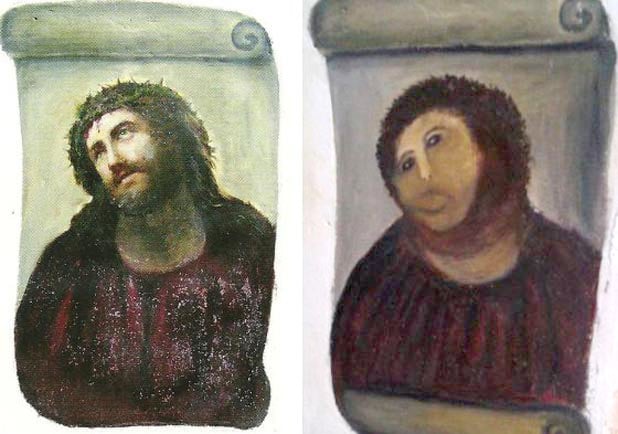
Elías García Martínez, Ecce Homo (1930), and Cecilia Giménez’s infamous 2012 restoration attempt.
In 2012, Cecilia Giménez, an 82-year-old widow and amateur painter, attempted to restore Ecce Homo, an almost century-old fresco of Jesus crowned with thorns in her local church in Borja, Spain.
Despite a valiant effort, the tragically failed restoration went viral and Giménez’s attempt was met with mockery and scorn. Images of the botched fresco swirled around Twitter and Facebook, inspiring a slew of memes and parodies now found on the Internet.
But, two years later, the village has reassessed their attitudes and turned their ridicule into gratitude, reports the New York Times. The viral images and memes gifted the rural town with free publicity—150,000 tourists from all over the world came to see Giménez’s artistic endeavor and visit the sanctuary overlooking Borja.
“Why are people coming to see it if it is such a terrible work of art?” asked Andrew Flack, an opera librettist who traveled to Borja for research on a new production. “It’s a pilgrimage of sorts, driven by the media into a phenomenon. God works in mysterious ways. Your disaster could be my miracle.”
A much-needed bolstering to the sleepy local economy ensued with restaurants opening and local and neighboring museums reporting the highest rates of visitation from the spill-over of tourists.
“The impact of Ecce Homo has been really great for businesses,” said Mr. Baya, a restaurateur who has done well enough to open a second restaurant. “Sadly, everyone heads to look at a painting that, frankly, is ugly.”
However “ugly” the fresco may be, Ecce Homo is stamped on the town’s lottery tickets and nearby vineyards are fighting over the right to use the image on wine labels. It’s even gotten plum positioning in a Spanish film in which thieves attempt to steal it.
Disclaimer: Opinions posted on Free Republic are those of the individual posters and do not necessarily represent the opinion of Free Republic or its management. All materials posted herein are protected by copyright law and the exemption for fair use of copyrighted works.