
OSt. Mary's Catholic Church, Boise, Idaho

Posted on 02/21/2021 6:16:30 AM PST by Cronos
Liturgical Colour: Violet.
| First reading | Genesis 9:8-15 © |
|---|
| Responsorial Psalm |
|---|
| Psalm 24(25):4-6,7b-9 © |
| Second reading | 1 Peter 3:18-22 © |
|---|
| Gospel Acclamation | Mt4:4 |
|---|
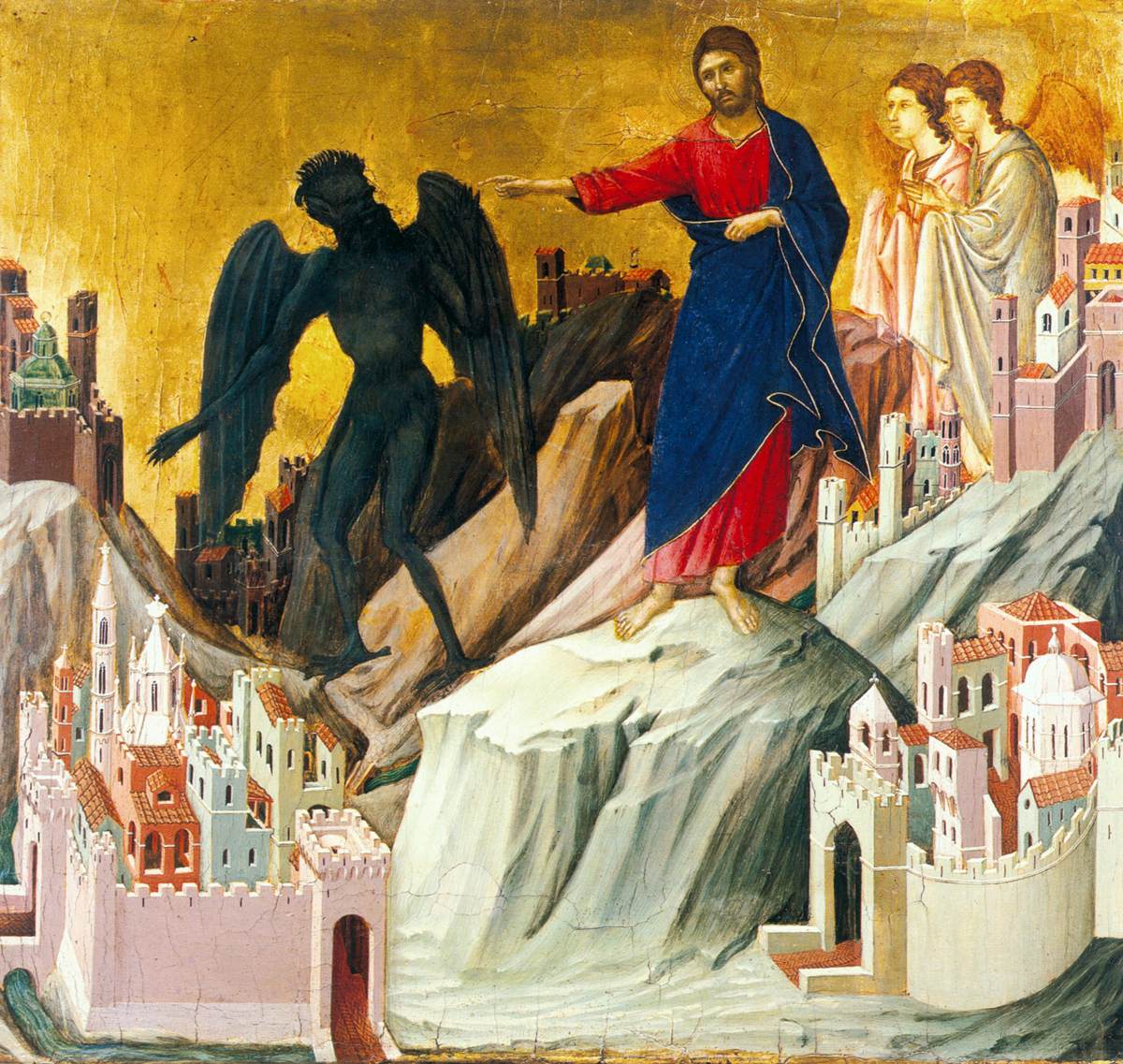
| Gospel | Mark 1:12-15 © |
|---|
The readings on this page are from the Jerusalem Bible, which is used at Mass in most of the English-speaking world. The New American Bible readings, which are used at Mass in the United States, are available in the Universalis apps, programs and downloads.
You can also view this page with the Gospel in Greek and English.
catholic,prayer,lent,mk1
Please FReepmail me to get on/off the Alleluia Ping List.
| Mark | |||||
| English: Douay-Rheims | Latin: Vulgata Clementina | Greek NT: Byzantine/Majority Text (2000) | Aramaic NT: Peshitta | ||
| 12. | And immediately the Spirit drove him out into the desert. | Et statim Spiritus expulit eum in desertum. | και ευθυς το πνευμα αυτον εκβαλλει εις την ερημον | ܘܡܚܕܐ ܐܦܩܬܗ ܪܘܚܐ ܠܡܕܒܪܐ ܀ | .12 |
| 13. | And he was in the desert forty days and forty nights, and was tempted by Satan; and he was with beasts, and the angels ministered to him. | Et erat in deserto quadraginta diebus, et quadraginta noctibus : et tentabatur a Satana : eratque cum bestiis, et angeli ministrabant illi. | και ην εκει εν τη ερημω ημερας τεσσαρακοντα πειραζομενος υπο του σατανα και ην μετα των θηριων και οι αγγελοι διηκονουν αυτω | ܘܗܘܐ ܬܡܢ ܒܡܕܒܪܐ ܝܘܡܬܐ ܐܪܒܥܝܢ ܟܕ ܡܬܢܤܐ ܡܢ ܤܛܢܐ ܘܐܝܬܘܗܝ ܗܘܐ ܥܡ ܚܝܘܬܐ ܘܡܫܡܫܝܢ ܗܘܘ ܠܗ ܡܠܐܟܐ ܀ | .13 |
| 14. | And after that John was delivered up, Jesus came into Galilee, preaching the gospel of the kingdom of God, | Postquam autem traditus est Joannes, venit Jesus in Galilæam, prædicans Evangelium regni Dei, | μετα δε το παραδοθηναι τον ιωαννην ηλθεν ο ιησους εις την γαλιλαιαν κηρυσσων το ευαγγελιον της βασιλειας του θεου | ܒܬܪ ܕܐܫܬܠܡ ܕܝܢ ܝܘܚܢܢ ܐܬܐ ܠܗ ܝܫܘܥ ܠܓܠܝܠܐ ܘܡܟܪܙ ܗܘܐ ܤܒܪܬܐ ܕܡܠܟܘܬܗ ܕܐܠܗܐ ܀ | .14 |
| 15. | And saying: The time is accomplished, and the kingdom of God is at hand: repent, and believe the gospel. | et dicens : Quoniam impletum est tempus, et appropinquavit regnum Dei : pœnitemini, et credite Evangelio. | και λεγων οτι πεπληρωται ο καιρος και ηγγικεν η βασιλεια του θεου μετανοειτε και πιστευετε εν τω ευαγγελιω | ܘܐܡܪ ܫܠܡ ܠܗ ܙܒܢܐ ܘܡܛܬ ܡܠܟܘܬܐ ܕܐܠܗܐ ܬܘܒܘ ܘܗܝܡܢܘ ܒܤܒܪܬܐ ܀ | .15 |

1:12–13
12. And immediately the spirit driveth him into the wilderness.
13. And he was there in the wilderness forty days, tempted of Satan; and was with the wild beasts; and the angels ministered unto him.
CHRYSOSTOM. (Hom in Matt. xiii) Because all that Christ did and suffered was for our teaching, He began after His baptism to dwell in the wilderness, and fought against the devil, that every baptized person might patiently sustain greater temptations after His baptism, nor be troubled, as if this which happened to Him was contrary to His expectation, but might bear up against all things, and come off conqueror. For although God allows that we should be tempted for many other reasons, yet for this cause also He allows it, that we may know, that man when tempted is placed in a station of greater honour. For the Devil approaches not save where he has beheld one set in a place of greater honour; and therefore it is said, And immediately the Spirit drove him into the wilderness. And the reason why He does not simply say, that He went into the wilderness, but was driven, is, that thou mayest understand that it was done according to the word of Divine Providence. By which also He shews, that no man should thrust himself into temptation, but that those who from some other state are as it were driven into temptation, remain conquerors.
BEDE. (in Marc. i. 5) And that no one might doubt, by what spirit he said that Christ was driven into the wilderness, Luke has on purpose premised, that Jesus being full of the Spirit returned from Jordan, (Luke 4:12) and then has added, and was led by the Spirit into the wilderness; lest the evil spirit should be thought to have any power over Him, who, being full of the Holy Spirit, departed whither He was willing to go, and did what He was willing to do.
CHRYSOSTOM. (in Mat. Hom. xiii) But the Spirit drove Him into the wilderness, because He designed to provoke the devil to tempt Him, and thus gave Him an opportunity not only by hunger, but also by the place. For then most of all does the devil thrust himself in, when he sees men remaining solitary.
BEDE. (ubi sup.) But He retires into the desert that He may teach us that, leaving the allurements of the world, and the company of the wicked, we should in all things obey the Divine commands. He is left alone and tempted by the devil, that He might teach us, that all that will live godly in Christ Jesus shall suffer persecution; (2 Tim. 3:12) whence it follows, And he was in the wilderness forty days and forty nights, and was tempted of Satan. But He was tempted forty days and forty nights, that He might shew us, that as long as we live here and serve God, whether prosperity smile upon us, which is meant by the day, or adversity smite us, which agrees with the figure of night, at all times our adversary is at hand, who ceases not to trouble our way by temptations. For the forty days and forty nights imply the whole time of this world, for the globe in which we are serving God is divided into four quarters. Again, there are Ten Commandments, by observing which we fight against our enemy, but four times ten are forty.
There follows, and he was with the wild beasts.
PSEUDO-CHRYSOSTOM. (Vict. Ant. e Cat. in Marc.) But He says this to shew of what nature was the wilderness, for it was impassable by man and full of wild beasts. It goes on; and angels ministered unto him. For after temptation, and a victory against the devil, He worked the salvation of man. And thus the Apostle says, Angels are sent to minister for them who shall be heirs of salvation. (Heb. 1:14) We must also observe, that to those who conquer in temptation angels stand near and minister.
BEDE. (ubi sup.) Consider also that Christ dwells among the wild beasts as man, but, as God, uses the ministry of Angels. Thus, when in the solitude of a holy life we bear with unpolluted mind the bestial manners of men, we merit to have the ministry of Angels, by whom, when freed from the body, we shall be transferred to everlasting happiness.
PSEUDO-JEROME. Or, then the beasts dwell with us in peace, as in the ark clean animals with the unclean, when the flesh lusts not against the spirit. After this, ministering Angels are sent to us, that they may give answers and comforts to hearts that watch.
1:14–15
14. Now after that John was put in prison, Jesus came into Galilee, preaching the Gospel of the kingdom of God,
15. And saying, The time is fulfilled, and the kingdom of God is at hand: repent ye, and believe the Gospel.
PSEUDO-CHRYSOSTOM. (Vict. Ant. e Cat. 1 Marc.) The Evangelist Mark follows Matthew in his order, and therefore after having said that Angels minister, he subjoins, But after that John was put into prison, Jesus came, &c. After the temptation and the ministry of Angels, He goes back into Galilee, teaching us not to resist the violence of evil men.
THEOPHYLACT. And to shew us that in persecutions we ought to retire, and not to await them; but when we fall into them, we must sustain them.
PSEUDO-CHRYSOSTOM. (Vict. Ant. e Cat. in Marc.) He retired also that He might keep Himself for teaching and for healing, before He suffered, and after fulfilling all these things, might become obedient unto death.
BEDE. (ubi sup.) John being put in prison, fitly does the Lord begin to preach: wherefore there follows, Preaching the Gospel, &c. For when the Law ceases, the Gospel arises in its steps.
PSEUDO-JEROME. When the shadow ceases, the truth comes on; first, John in prison, the Law in Judæa; then, Jesus in Galilee, Paul among the Gentiles preaching the Gospel of the kingdom. For to an earthly kingdom succeeds poverty, to the poverty of Christians is given an everlasting kingdom; but earthly honour is like the foam of water, or smoke, or sleep.
BEDE. (ubi sup.) Let no one, however, suppose that the putting of John in prison took place immediately after the forty days’ temptation and the fast of the Lord; for whosoever reads the Gospel of John will find, that the Lord taught many things before the putting of John in prison, and also did many miracles; for you have in his Gospel, This beginning of miracles did Jesus; (John 2:11) and afterwards, for John was not yet cast into prison. (John 3:24) Now it is said, that when John read the books of Matthew, Mark, and Luke, he approved indeed the text of the history, and affirmed that they had spoken truth, but said that they had composed the history of only one year after John was cast into prison, in which year also he suffered. Passing over then the year of which the transactions had been published by the three others, he related the events of the former period, before John was cast into prison. When therefore Mark had said that Jesus came into Galilee, preaching the Gospel of the kingdom, he subjoins, saying, Since the time is fulfilled, &c.
PSEUDO-CHRYSOSTOM. (Vict. Ant. Cat. in Marc.) Since then the time was fulfilled, when the fulness of time was come, and God sent his Son, it was fitting that the race of man should obtain the last dispensation of God. And therefore he says, for the kingdom of heaven is at hand. (Orig. in Matt. tom. x. 14. v. Orig. de Orat. 25, 26. in Matt. t. 12 14). But the kingdom of God is essentially the same as the kingdom of heaven, though they differ in idea. For by the kingdom of God is to be understood that in which God reigns; (non occ. v. Chrys, in Matt. Hom. 19. in c. 6:9.). and this in truth is in the region of the living, where, seeing God face to face, they will abide in the good things now promised to them; whether by this region one chooses to understand Love, or some other confirmatione of those who put on the likeness of things above, which are signified by the heavens. () For it is clear enough that the kingdom of God is confined neither by place nor by time.
THEOPHYLACT. Or else, the Lord means that the time of the Law is completed; as if He said, Up to this time the Law was at work; from this time the kingdom of God will work, that is, a conversation according to the Gospel, which is with reason likened to the kingdom of heaven. For when you see a man clothed in flesh living according to the Gospel, do you not say that he has the kingdom of heaven, which is not meat and drink, but righteousness and peace and joy in the Holy Ghost? (Rom. 14:17)
The next word is, Repent.
PSEUDO-JEROME. For he must repent, who would keep close to eternal good, that is, to the kingdom of God. For he who would have the kernel, breaks the shell; the sweetness of the apple makes up for the bitterness of its root; the hope of gain makes the dangers of the sea pleasant; the hope of health takes away from the painfulness of medicine. They are able worthily to proclaim the preaching of Christ who have deserved to attain to the reward of forgiveness; and therefore after He has said, Repent, He subjoins, and believe the Gospel. For unless ye have believed, ye shall not understand.
BEDE. (ubi sup.) Repent, therefore, and believe; that is, renounce dead works; for of what use is believing without good works? The merit of good works does not, however, bring to faith, but faith begins, that good works may follow.
For: Sunday, February 21, 2021
1st Sunday of Lent
From: Genesis 9:8-15
God's Covenant with Noah (Continuation)
-----------------------------------------------------------
[8] Then God said to Noah and to his sons with him, [9] "Behold, I establish my covenant with you and. your descendants after you, [10] and with every living creature that is with you, the birds, the cattle, and every beast of the earth with you, as many as came out of the ark. [11] I establish my covenant with you, that never again shall all flesh be cut off by the waters of a flood, and never again shall there be a flood to destroy the earth.” [12] And God said, "This is the sign of the covenant which I make between me and you and every living creature that is with you, for all future generations: I set my bow in the cloud, and it shall be a sign of the covenant between me and the earth. [14] When I bring clouds over the earth and the bow is seen in the clouds, [15] I will remember my covenant which is between me and you and every living creature of all flesh; and the waters shall never again become a flood to destroy all flesh."
*******************************************************************
Commentary:
9:8-17. To show that he was pleased by Noah’s sacrifice, God promised that he would never again flood the earth (cf. 8:20-22); now he renews that promise in the context of a covenant that covers all creation and which is ratified by a sign—the rainbow.
This marks the start of a series of covenants which God will freely establish with men. The first covenant (with Noah) takes in all creation, now purified and renewed by the flood. Later there will be the covenant with Abraham, which will affect only himself and his descendants (cf. chap. 17). Finally, under Moses, he will establish the covenant of Sinai (cf. Ex 19), also confined to the people of Israel. But because man proved unable to keep these successive covenants, God promised, through the prophets, to establish a new covenant in the messianic age: "I will put my law within them and I will write it upon their hearts; and I will be their God, and they shall be my people” (Jer 31:33). This promise found its fulfillment in Christ, as he himself said when he instituted the eucharistic sacrifice of his body. and blood: "This cup which is poured out for you is the new covenant in my blood” (Lk 22:20).
The Fathers and ecclesiastical writers saw this rainbow as the first proclamation of this new covenant. Rupert of Deutz, for example, writes: "In it God established a covenant with men through his son Jesus Christ; by the death (of Christ) on the cross God reconciled us to himself, cleansing us of our sins in his blood, and he gave us through (Christ) the Holy Spirit of his love, instituting the baptism of water and the Holy Spirit by which we are reborn. Therefore, that rainbow which appears in the clouds is a sign of the Son of God. [...] It is the sign that God will never again destroy all flesh by the waters of the flood; the Son of God himself, who was taken out of sight by a cloud, and who is lifted up beyond the clouds, above all the heavens, is forever a sign which reminds God the Father; he is an eternal memorial of our peace: now that he in his flesh has destroyed the old enmity, friendship between God and men is secure: men are no longer servants but friends and children of God" (Commentarium in Genesim, 4,36).
Christ's Suffering and Glorification
-------------------------------------------------
[18] For Christ also died for sins once for all, the righteous for the unrighteous, that he might bring us to God, being put to death in the flesh but made alive in the spirit; [19] in which he went and preached to the spirits in prison, [20] who formerly did not obey, when God's patience waited in the days of Noah, during the building of the ark, in which a few, that is, eight persons, were saved through water. [21] Baptism, which corresponds to this, now saves you, not as a removal of dirt from the body but as an appeal to God for a clear conscience, through the resurrection of Jesus Christ, [22] who has gone into heaven and is at the right hand of God, with angels, authorities, and powers subject to him.
********************************************************************
Commentary:
18-22. This passage may include parts of a Creed used in early Christian baptismal instruction. It very clearly expresses the essence of faith in Jesus Christ, as preached from the beginning by the Apostles (cf. Acts 2:14-36; 1 Cor 15:1ff) and as articulated in the Apostles' Creed: "He was crucified, died and was buried. He descended into hell; the third day He rose again from the dead. He ascended into Heaven and sits at the right hand of God the Father Almighty."
Jesus Christ, who suffers for the sins of mankind--"the righteous for the unrighteous"--and then is glorified, gives meaning to the sufferings of Christians. "Oh, how great thanks am I bound to return to You for having shown me and all the faithful the right and good way to Your everlasting Kingdom! For Your life is our life; and by holy patience we walk on to You, who are our crown. If You had not gone before and taught us, who would care to follow? Alas, how many would have stayed afar off and a great way behind if they had not had before their eyes your wonderful example!" (Imitation of Christ, 3, 18).
18. "Christ has died for sins once for all": our Lord's sacrifice is unrepeatable (cf. Heb 9:12-28; 10-10) and superabundantly sufficiently to obtain the remission of all sins. The fruits of the Cross are applied to man, in a special way, by means of the sacraments, particularly by taking part in the Mass, the unbloody renewal of the sacrifice of Calvary.
"Being put to death in the flesh but made alive in the spirit": there is disagreement among commentators as to what "flesh" and "spirit" mean here. Some identify them with our concepts of body and soul--"dead as regards the body, alive as regards the soul". Others see them as equivalent to the humanity-divinity of our Lord: "dead as far as His human nature is concerned, alive (continuous to live) as far as His divinity is concerned". Finally, having regard to the meaning these terms have in the Old Testament, the phrase may refer to the earthly consolation of our Lord compared with the glorious condition He had after His resurrection; in which case it would be an early form of words used to convey the idea that Jesus Christ, on dying, left His mortal condition behind for ever in order to move into His glorious, immortal state through His Resurrection (cf. 1 Cor 15:35-49).
19-20. "In which", that is, in the spirit. The ambiguity of the original text (referred to in the previous note) continues, so it is possible to understand the "in which" in the three ways outlined. Some take it as meaning that Christ went to preach to the spirits in prison "with his soul", separated from his body; for some he went "in his glorious condition", which is not incompatible with the resurrection in the strict sense happening afterwards.
In any event, these verses are one of the clear references in the New Testament to our Lord descending into hell (cf. also Mt 12:38-41; Acts 2:24-36; Rom 10:6-7; Eph 4:8-9; Rev 1:18). After dying on the cross, Jesus Christ went to bring his message of salvation "to the spirits in prison": many Fathers and commentators are inclined to the view that this is a reference to the just of the Old Testament who, not being able to enter heaven until the Redemption took place, were kept in the bosom of Abraham, which is also called the "limbo" of the just (cf. St Pius V Catechism, I, 6, 1-6).
The reference to the contemporaries of Noah is probably explained by the fact that, for the Jews of the time, those people (along with the people of Sodom and Gomorrah: cf. Mt 24:36-39; Lk 17:26-30) were the classic inveterate sinners. By bringing in this reference St Peter is teaching that the Redemption embraces all men: even the contemporaries of Noah, if they repented, could have attained salvation through the merits of Christ.
21-22. The waters of the Flood are a figure of Baptism: in the same way as Noah and his family were saved by being in the Ark, now men are saved through Baptism, which makes them members of Christ's Church.
"As an appeal to God for a clear conscience, through the resurrection of Jesus Christ": the obvious meaning of this is that the Christian asks for perseverance in the good way of life he entered into at Baptism. However, the Greek word translated as "appeal", a rarely used one, contains the idea of "commitment". It is possible that this may be a reference to a part of the baptismal rite--for example, the profession of faith the neophyte made, and his promise to stay true to it. Or it may refer to a permanent effect of Baptism whereby the Christian is given a share in "the resurrection of Christ": it would not be surprising if St Peter were referring to what later came to be known as the baptismal "character". In fact, the context suggests something permanent and indelible: just as Noah's salvation was a lasting one and there was never again a flood, so too the condition of the Christian is something permanent; now that he has risen Jesus can never die again (cf. Rom 6:3) and neither can the baptized return to their former sinful condition.
Verse 22, possibly taken from a baptismal hymn, is a very concise account of the glorification of Christ. After descending into hell, he arose and ascended into heaven, where he is seated "at the right hand of God": this phrase, already common in early Christian catechesis (cf., e.g., Mt 22:41-46; Mk 16:19; Acts 2:33) means that our Lord, who is equal to the Father in his divinity, also, as man, occupies at his side the place of honor over all other created beings. This universal lordship of Christ is further emphasized by the statement that all heavenly beings are subject to him (cf. Phil 2:10; Eph 1:21); three degrees of angels are mentioned, that is, all the angels, because the number three symbolizes totality.
The Tempting of Jesus
---------------------------------
[12] The Spirit immediately drove him out into the wilderness. [13] And he was in the wilderness forty days, tempted by Satan; and he was with the wild beasts; and the angels ministered to him.
Jesus Begins to Preach and Calls His First Disciples
-----------------------------------------------------------------------------
[14] Now after John was arrested, Jesus came into Galilee, preaching the gospel of God, [15] and saying, "The time is fulfilled, and the kingdom of God is at hand; repent, and believe in the Gospel."
********************************************************************
Commentary:
13. St Matthew (4: 1-11) and St Luke (4: 1-13) relate the temptations of Jesus in more detail. By submitting to temptation, Jesus wanted to show us that we should not be afraid of temptations: on the contrary, they give us an opportunity to progress in the interior life.
"Yet the Lord sometimes permits that souls, which are dear to him, should be tempted with some violence, in order that they may better understand their own weakness, and the necessity of grace to prevent them from falling [...]; God permits us to be tempted, that we may be more detached from the things of earth, and conceive a more ardent desire to behold him in heaven [...]; God also permits us to be tempted, in order to increase our merits. [...] When it is disturbed by temptation, and sees itself in danger of committing sin, the soul has recourse to the Lord and to his divine Mother; it renews its determination to die rather than offend God; it humbles itself and takes refuge in the arms of divine mercy. By this means, as is proved by experience, it acquires more strength and is united more closely to God" (St Alphonsus Mary de Liguori, The Love of our Lord Jesus Christ Reduced to Practice, chap. 17).
Besides, as in our Lord's own case, we will always have God's help to overcome temptation: "Jesus has stood up to the test. And it was a real test [...]. The devil, with twisted intention, quoted the Old Testament: 'God will send his angels to protect the just man wherever he goes' (Ps 91:11). But Jesus refuses to tempt his Father; he restores true meaning to this passage from the Bible. And, as a reward for his fidelity, when the time comes, ministers of God the Father appear and wait upon him [...]. We have to fill ourselves with courage, for the grace of God will not fail us. God will be at our side and will send his angels to be our traveling companions, our prudent advisers along the way, our cooperators in all that we take on" (St J. Escriva, Christ Is Passing By, 63).
14-15. "The gospel of God": this expression is found in St Paul (Rom 1:1; 2 Cor 11:7; etc.) where it means the same as "the gospel of Jesus Christ" (2 Thess 1: 8; etc.), thereby implying the divinity of Jesus Christ. The imminence of the Kingdom requires a genuine conversion of man to God (Mt 4:17; Mk 6:12; etc.). The prophets had already spoken of the need for conversion and for Israel to abandon its evil ways (Jer 3:22; Is 30:15; Os 14:2; etc.).
Both John the Baptist and Jesus and his Apostles insist on the need for conversion, the need to change one's attitude and conduct as a prerequisite for receiving the Kingdom of God. Bl. John Paul II underlines the importance of conversion for entry into the Kingdom of God: "Therefore, the Church professes and proclaims conversion. Conversion to God always consists in discovering his mercy, that is, in discovering that love which is patient and kind (cf. 1 Cor 13:4) as only the Creator and Father can be; the love to which the 'God and Father of our Lord Jesus Christ' (2 Cor 1:3) is faithful to the uttermost consequences in the history of his covenant with man: even to the Cross and to the death and resurrection of the Son. Conversion to God is always the fruit of the 'rediscovery' of this Father, who is rich in mercy.
"Authentic knowledge of the God of mercy, the God of tender love, is a constant and inexhaustible source of conversion, not only as a momentary interior act but also as a permanent attitude, as a state of mind. Those who come to know God in this way, who 'see' him in this way, can live only in a state of being continually converted to him. They live, therefore, in statu conversionis and it is this state of conversion which marks out the most profound element of the pilgrim age ofevery man and woman on earth in statu viatoris (St. John Paul II, Dives In Misericordia, 13).
Logical Bible Study podcast on the daily mass Gospel reading for Saturday, February 19, 2021. Today's Gospel reading is Mark 1:12-15 - 'Jesus was tempted by Satan, and the angels looked after him.'
-----------------------------------------------------------
Jerusalem Bible translation (used in this study):
The Spirit drove Jesus out into the wilderness and he remained there for forty days, and was tempted by Satan. He was with the wild beasts, and the angels looked after him.
After John had been arrested, Jesus went into Galilee. There he proclaimed the Good News from God. ‘The time has come’ he said ‘and the kingdom of God is close at hand. Repent, and believe the Good News.’
NABRE translation (USA):
The Spirit drove Jesus out into the desert, and he remained in the desert for forty days, tempted by Satan. He was among wild beasts, and the angels ministered to him.
After John had been arrested, Jesus came to Galilee proclaiming the gospel of God: “This is the time of fulfillment. The kingdom of God is at hand. Repent, and believe in the gospel.”
----------------------------------------------------------
Catechism of the Catholic Church Paragraphs:
- 333 (in 'Christ with all his angels') - From the Incarnation to the Ascension, the life of the Word incarnate is surrounded by the adoration and service of angels. When God "brings the firstborn into the world, he says: 'Let all God's angels worship him.'" Their song of praise at the birth of Christ has not ceased resounding in the Church's praise: "Glory to God in the highest!" They protect Jesus in his infancy, serve him in the desert, strengthen him in his agony in the garden, when he could have been saved by them from the hands of his enemies as Israel had been. Again, it is the angels who "evangelize" by proclaiming the Good News of Christ's Incarnation and Resurrection. They will be present at Christ's return, which they will announce, to serve at his judgement.
- 541 (in 'The Kingdom of God is at hand') - “Now after John was arrested, Jesus came into Galilee, preaching the gospel of God, and saying: ‘The time is fulfilled, and the kingdom of God is at hand: repent, and believe in the gospel.’” “To carry out the will of the Father Christ inaugurated the kingdom of heaven on earth.” Now the Father’s will is “to raise up men to share in his own divine life.” He does this by gathering men around his Son Jesus Christ. This gathering is the Church, “on earth the seed and beginning of that kingdom.”
- 1423 (in 'The Sacrament of Reconciliation') - It is called the sacrament of conversion because it makes sacramentally present Jesus’ call to conversion, the first step in returning to the Father from whom one has strayed by sin (abbreviated)
- 1427 (in 'The Conversion of the Baptised') - Jesus calls to conversion. This call is an essential part of the proclamation of the kingdom: “The time is fulfilled, and the kingdom of God is at hand; repent, and believe in the gospel.” In the Church’s preaching this call is addressed first to those who do not yet know Christ and his Gospel. Also, Baptism is the principal place for the first and fundamental conversion. It is by faith in the Gospel and by Baptism that one renounces evil and gains salvation, that is, the forgiveness of all sins and the gift of new life.
-----------------------------------------------------------
Questions for discussion, reflection and personal application (from sundayscripturestudy.com):
1. In the 2nd reading, what inference does St. Peter draw about baptism from the story of Noah? By what power does he say this is accomplished?
2. What is the significance of the number “forty” in Mark 1:13? What other great events in salvation history revolve around this number (Genesis 7:11-12; Exodus 25:15-18; Numbers 15:26-35; 1 Kings 19:1-8)?
3. What is the common preaching theme of John the Baptist (Mark 1:2-4), Jesus (verse 15), and the first disciples (Acts 2:37-38)? What does it mean to “repent”?
4. Why do you think it is important for us to hear about Jesus’ temptation by Satan in the wilderness? What benefit is it for us to undergo our own temptations (Hebrews 12:3-11; James 1:2-4)?
5. Besides Satan, where do temptations come from (1 John 2:15-17; Romans 7:15-25a)?
6. After his temptation, Jesus was ministered to by angels (verse 13). When we have successfully resisted temptation, are we able to see how God sustains and rewards us? How?
7. Both John the Baptist (Mark 1:6) and Jesus followed practices of self-discipline for religious reasons. What self-disciplining practices do you use for religious reasons? How have they influenced your own “change of heart” (repentance)?
(Questions adapted from The Catholic Serendipity Bible For Personal and Small Group Study (NAB) Zondervan, 1999, The Ignatius Catholic Study Bible: Gospel of Mark, Ignatius Press, 2001-2010, and from the Catholic Commentary on Sacred Scripture: Mark, Baker Academic, 2008)
-----------------------------------------------------------
Meditation on the Gospel Reading from Daily Scripture Reading and Meditations
Disclaimer: Opinions posted on Free Republic are those of the individual posters and do not necessarily represent the opinion of Free Republic or its management. All materials posted herein are protected by copyright law and the exemption for fair use of copyrighted works.