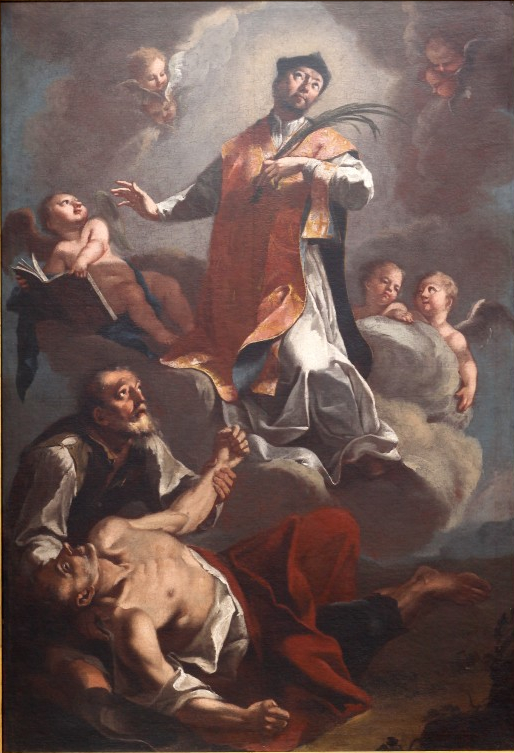
The Triumph of Saint Valentine
Valentin Metzinger
Posted on 02/14/2021 9:05:40 AM PST by annalex
St. Valentine, officially known as St. Valentine of Rome, is a third-century Roman saint widely celebrated on February 14 and commonly associated with "courtly love."
Although not much of St. Valentine's life is reliably known, it is generally agreed that St. Valentine was martyred in about 270 AD and then buried on the Via Flaminia to the north of Rome. In 1969, the Roman Catholic Church removed St. Valentine from the General Roman Calendar, because so little is known about him. However, the Church still recognizes him as a saint, listing him in the February 14 spot of Roman Martyrology. (link)
One common story about St. Valentine is that at one point of his life, as the former Bishop of Terni, Narnia and Amelia, he was placed on house arrest by Judge Asterius. While discussing religion and faith with the Judge, Valentine pledged the validity of Jesus. The judge immediately put Valentine and his faith to the test. St. Valentine was presented with the judge's blind daughter and told to restore her sight. If he succeeded, the judge vowed to do anything for Valentine. Placing his hands onto her eyes, Valentine restored the child's vision.
Judge Asterius was humbled and obeyed Valentine's requests. Asterius broke all the idols around his house, fasted for three days and became baptized, along with his family and entire 44-member household. The now faithful judge then freed all of his Christian inmates.
St. Valentine was evidently later arrested again for continuing to try to convert people to Christianity. He was sent to Rome under the emperor Claudius Gothicus (Claudius II).
The story tells that St. Valentine was imprisoned for marrying Christian couples and aiding Christians being persecuted by Claudius in Rome. Both acts were considered serious crimes. A relationship between the saint and emperor began to grow, until Valentine attempted to convince Claudius of Christianity. Claudius became enraged and sentenced Valentine to death, commanding him to renounce his faith or be beaten with clubs and beheaded.
St. Valentine refused to renounce his faith and Christianity and was executed outside the Flaminian Gate on February 14, 269. (However, other tales of St. Valentine's life claim he was executed either in the year 270, 273 or 280.)
Other accounts of St. Valentine's arrests tell that he secretly married couples so husbands wouldn't have to go to war.
Another variation of the legend of St. Valentine says he refused to sacrifice to pagan gods, was imprisoned and while imprisoned he healed the jailer's blind daughter. On the day of his execution, he left the girl a note signed, "Your Valentine."
Pope Julius I is said to have built a church near Ponte Mole in his memory, which for a long time gave name to the gate now called Porta del Popolo.
The romantic nature of Valentine's Day may have derived during the Middle Ages, when it was believed that birds paired couples in mid-February. According to English 18th-century antiquarians Alban Butler and Francis Douce, Valentine's Day was most likely created to overpower the pagan holiday, Lupercalia. Although the exact origin of the holiday is not widely agreed upon, it is widely recognized as a day for love, devotion and romance.
Whoever he was, Valentine did really exist, because archaeologists have unearthed a Roman catacomb and an ancient church dedicated to St. Valentine. In 496 AD, Pope Gelasius marked February 14th as a celebration in honor of his martyrdom.
Relics of St. Valentine can be found all over the world. A flower-crowned skull of St. Valentine can be found in the Basilica of Santa Maria in Cosmedin, Rome. In 1836, other relics were exhumed from the catacombs of St. Hippolytus on the Via Tiburtina and were identified as Valentine's. These were transported for a special Mass dedicated to those young and in love.
In 1836, Fr. John Spratt received a gift from Pope Gregory XVI, a "small vessel tinged" with St. Valentine's blood. This gift now stands placed in Whitefriar Street Church in Dublin, Ireland. Other alleged relics were found in Prague in the Church of St Peter and Paul at Vysehrad; in the parish church of St. Mary's Assumption in Chelmno Poland; at the reliquary of Roquemaure in France; in the Stephansdom in Vienna; in Balzan in Malta and also in Blessed John Duns Scotus' church in the Gorbals area of Glasgow, Scotland.
St. Valentine is the Patron Saint of affianced couples, bee keepers, engaged couples, epilepsy, fainting, greetings, happy marriages, love, lovers, plague, travelers, and young people. He is represented in pictures with birds and roses and his feast day is celebrated on February 14.
A special St. Valentine Prayer (link)
Please FReepmail me to get on/off the Alleluia Ping List.
For years there was some confusion between the death of St. Valentine and that of St. Sebastian, because the latter was ordered to be killed by archers, which he survived, until he was beaten to death.
This was not helped by the use of the pagan god Cupid as an archer, whose arrows made others fall in love, most often seen on St. Valentine’s Day.
Feb 14th... Is just the day after the 13th and day before the 15th.
Part of the story of St. Valentine is that he passed secret notes between Christian lovers who were separated by persecution, hence a love letter is a valentine.
Chuck “Walker, Texas Ranger” Norris had an excellent essay on Valentine, the cultural warrior posted on World Net Daily:
https://www.wnd.com/2021/02/st-valentine-true-culture-warrior-hero/
"I think we must bear in mind that it was a very permissive society in which Valentine lived. Polygamy would have been much more popular than just one woman and one man living together. And yet some of them seemed to be attracted to Christian faith. But obviously, the church thought that marriage was very sacred between one man and one woman for their life and that it was to be encouraged. And so it immediately presented the problem to the Christian church of what to do about this."
Valentine's pro-marriage advocacy and actions were eventually found out, and he was imprisoned and tortured.
Excellent, thank you.
Disclaimer: Opinions posted on Free Republic are those of the individual posters and do not necessarily represent the opinion of Free Republic or its management. All materials posted herein are protected by copyright law and the exemption for fair use of copyrighted works.