Memorial of St. Sebastian

St. Sebastian's Church, Queens, New York, New York
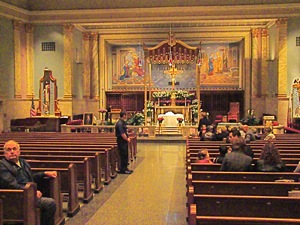

By Antony-22 - Own work, CC BY-SA 4.0, https://commons.wikimedia.org/w/index.php?curid=79276350
Posted on 01/19/2021 11:50:52 PM PST by Cronos
Liturgical Colour: Green.
| First reading |
|---|
| Hebrews 7:1-3,15-17 © |
| Responsorial Psalm |
|---|
| Psalm 109(110):1-4 © |
| Gospel Acclamation | Heb4:12 |
|---|
| Or: | cf.Mt4:23 |
|---|
| Gospel | Mark 3:1-6 © |
|---|
The readings on this page are from the Jerusalem Bible, which is used at Mass in most of the English-speaking world. The New American Bible readings, which are used at Mass in the United States, are available in the Universalis apps, programs and downloads.
You can also view this page with the Gospel in Greek and English.
catholic; mk3; ordinarytime; prayer;
Please FReepmail me to get on/off the Alleluia Ping List.
| Mark | ||||
| English: Douay-Rheims | Latin: Vulgata Clementina | Greek NT: Byzantine/Majority Text (2000) | Italian: Riveduta Bible (1927) | |
| 1. | AND he entered again into the synagogue, and there was a man there who had a withered hand. | Et introivit iterum in synagogam : et erat ibi homo habens manum aridam. | και εισηλθεν παλιν εις την συναγωγην και ην εκει ανθρωπος εξηραμμενην εχων την χειρα | Poi entrò di nuovo in una sinagoga; e quivi era un uomo che avea la mano secca. |
| 2. | And they watched him whether he would heal on the sabbath days; that they might accuse him. | Et observabant eum, si sabbatis curaret, ut accusarent illum. | και παρετηρουν αυτον ει τοις σαββασιν θεραπευσει αυτον ινα κατηγορησωσιν αυτου | E l’osservavano per vedere se lo guarirebbe in giorno di sabato, per poterlo accusare. |
| 3. | And he said to the man who had the withered hand: Stand up in the midst. | Et ait homini habenti manum aridam : Surge in medium. | και λεγει τω ανθρωπω τω εξηραμμενην εχοντι την χειρα εγειραι εις το μεσον | Ed egli disse all’uomo che avea la mano secca: Lèvati là nel mezzo! |
| 4. | And he saith to them: Is it lawful to do good on the sabbath days, or to do evil? to save life, or to destroy? But they held their peace. | Et dicit eis : Licet sabbatis benefacere, an male ? animam salvam facere, an perdere ? At illi tacebant. | και λεγει αυτοις εξεστιν τοις σαββασιν αγαθοποιησαι η κακοποιησαι ψυχην σωσαι η αποκτειναι οι δε εσιωπων | Poi disse loro: E’ egli lecito, in giorno di sabato, di far del bene o di far del male? di salvare una persona o di ucciderla? Ma quelli tacevano. |
| 5. | And looking round about on them with anger, being grieved for the blindness of their hearts, he saith to the man: Stretch forth thy hand. And he stretched it forth: and his hand was restored unto him. | Et circumspiciens eos cum ira, contristatus super cæcitate cordis eorum, dicit homini : Extende manum tuam. Et extendit, et restituta est manus illi. | και περιβλεψαμενος αυτους μετ οργης συλλυπουμενος επι τη πωρωσει της καρδιας αυτων λεγει τω ανθρωπω εκτεινον την χειρα σου και εξετεινεν και αποκατεσταθη η χειρ αυτου υγιης ως η αλλη | Allora Gesù, guardatili tutt’intorno con indignazione, contristato per l’induramento del cuor loro, disse all’uomo: Stendi la mano! Egli la stese, e la sua mano tornò sana. |
| 6. | And the Pharisees going out, immediately made a consultation with the Herodians against him, how they might destroy him. | Exeuntes autem pharisæi, statim cum Herodianis consilium faciebant adversus eum quomodo eum perderent. | και εξελθοντες οι φαρισαιοι ευθεως μετα των ηρωδιανων συμβουλιον εποιουν κατ αυτου οπως αυτον απολεσωσιν | E i Farisei, usciti, tennero subito consiglio con gli Erodiani contro di lui, con lo scopo di farlo morire. |

3:1–5
1. And he entered again into the synagogue; and there was a man there which had a withered hand.
2. And they watched him, whether he would heal him on the sabbath day; that they might accuse him.
3. And he saith unto the man which had the withered hand, Stand forth.
4. And he saith unto them, Is it lawful to do good on the sabbath days, or to do evil? to save life, or to kill? But they held their peace.
5. And when he had looked round about on them with anger, being grieved for the hardness of their hearts, he saith unto the man, Stretch forth thine hand. And he stretched it out: and his hand was restored whole as the other.
THEOPHYLACT. After confounding the Jews, who had blamed His disciples, for pulling the ears of corn on the sabbath day, by the example of David, the Lord now further bringing them to the truth, works a miracle on the sabbath; shewing that, if it is a pious deed to work miracles on the sabbath for the health of men, it is not wrong to do on the sabbath things necessary for the body: he says therefore, And he entered again into the synagogue; and there was a man there which had a withered hand. And they watched him, whether he would heal him on the sabbath-day; that they might accuse him.
BEDE. (in Marc. i. 14) For, since He had defended the breaking of the sabbath, which they objected to His disciples, by an approved example, now they wish, by watching Him, to calumniate Himself, that they might accuse Him of a transgression, if He cured on the sabbath, of cruelty or of folly, if He refused. It goes on: And he saith unto the man which had the withered hand, Stand in the midst.
PSEUDO-CHRYSOSTOM. (Vict. Ant. e Cat. in Marc. v. Chrys. Hom. in Matt. 40) He placed him in the midst, that they might be frightened at the sight, and on seeing him compassionate him, and lay aside their malice.
BEDE. (ubi sup.) And anticipating the calumny of the Jews, which they had prepared for Him, He accused them of violating the precepts of the law, by a wrong interpretation. Wherefore there follows: And he saith unto them, Is it lawful to do good on the sabbath-day, or to do evil? And this He asks, because they thought that on the sabbath they were to rest even from good works, whilst the law commands to abstain from bad, saying, Ye shall do no servile work therein; (Levit. 23:7) that is, sin: for Whosoever committeth sin is the servant of sin. (John 8:34) What He first says, to do good on the sabbath-day or to do evil, is the same as what He afterwards adds, to save a life or to lose it; that is, to cure a man or not. Not that God, Who is in the highest degree good, can be the author of perdition to us, but that His not saving is in the language of Scripture to destroy. But if it be asked, wherefore the Lord, being about to cure the body, asked about the saving of the soul, let him understand either that in the common way of Scripture the soul is put for the man; as it is said, All the souls that came out of the loins of Jacob; (Exodus 1:5) or because he did those miracles for the saving of a soul, or because the healing itself of the hand signified the saving of the soul.
AUGUSTINE. (de Con. Evan. ii. 35) But some one may wonder how Matthew could have said, that they themselves asked the Lord, if it was lawful to heal on the sabbath-day; when Mark rather relates that they were asked by our Lord, Is it lawful to do good on the sabbath-day, or to do evil? Therefore we must understand that they first asked the Lord, if it was lawful to heal on the sabbath-day, then that understanding their thoughts, and that they were seeking an opportunity to accuse Him, He placed in the middle him whom He was about to cure, and put those questions, which Mark and Luke relate. We must then suppose, that when they were silent, He propounded the parable of the sheep, and concluded, that it was lawful to do good on the sabbath-day. It goes on: But they were silent.
PSEUDO-CHRYSOSTOM. (Vict. Ant. e Cat, in Marc.) For they knew that He would certainly cure him. It goes on: And looking round about upon them with anger. His looking round upon them in anger, and being saddened at the blindness of their hearts, is fitting for His humanity, which He deigned to take upon Himself for us. He connects the working of the miracle with a word, which proves that the man is cured by His voice alone. It follows therefore, And he stretched it out, and his hand was restored. Answering by all these things for His disciples, and at the same time shewing that His life is above the law.
BEDE. (ubi sup.) But mystically, the man with a withered hand shews the human race, dried up as to its fruitfulness in good works, but now cured by the mercy of the Lord; the hand of man, which in our first parent had been dried up when he plucked the fruit of the forbidden tree, through the grace of the Redeemer, Who stretched His guiltless hands on the tree of the cross, has been restored to health by the juices of good works. Well too was it in the synagogue that the hand was withered; for where the gift of knowledge is greater, there also the danger of inexcusable guilt is greater.
PSEUDO-JEROME. Or else it means the avaricious, who, being able to give had rather receive, and love robbery rather than making gifts. And they are commanded to stretch forth their hands, that is, let him that stole steal no more, but rather let him labour, working with his hand the thing which is good, that he may have to give to him that needeth. (Eph. 4:28)
THEOPHYLACT. Or, he has his right hand withered, who does not the works which belong to the right side; for from the time that our hand is employed in forbidden deeds, from that time it is withered to the working of good. But it will be restored whenever it stands firm in virtue; wherefore Christ saith, Arise, that is, from sin, and stand in the midst; that thus it may stretch itself forth neither too little or too much.
3:6–12
6. And the Pharisees went forth, and straightway took counsel with the Herodians against him, how they might destroy him.
7. But Jesus withdrew himself with his disciples to the sea: and a great multitude from Galilee followed him, and from Judæa,
8. And from Jerusalem, and from Idumæa, and from beyond Jordan; and they about Tyre and Sidon, agr eat multitude, when they had heard what great things he did, came unto him.
9. And he spake to his disciples, that a small ship should wait on him, because of the multitude, lest they should throng him.
10. For he had healed many; insomuch that they pressed upon him for to touch him, as many as had plagues.
11. And unclean spirits, when they saw him, fell down before him, and cried, saying, Thou art the Son of God.
12. And he straitly charged them that they should not make him known.
BEDE. (in Marc. i. 15) The Pharisees, thinking it a crime that at the word of the Lord the hand which was diseased was restored to a sound state, agreed to make a pretext of the words spoken by our Saviour; wherefore it is said, And the Pharisees went forth, and straightway took counsel with the Herodians against him, how they might destroy him. As if every one amongst them did not greater things on the sabbath day, carrying food, reaching forth a cup, and whatever else is necessary for meals. Neither could He, Who said and it was done, be convicted of toiling on the sabbath day.
THEOPHYLACT. But the soldiers of Herod the king are called Herodians, because a certain new heresy had sprung up, which asserted that Herod was the Christ. For the prophecy of Jacob intimated, that when the princes of Judah failed, then Christ should come; because therefore in the time of Herod none of the Jewish princes remained, and he, an alien, was the sole ruler, some thought that he was the Christ, and set on foot this heresy. These, therefore, were with the Pharisees trying to kill Christ.
BEDE. (ubi sup.) Or else he calls Herodians the servants of Herod the Tetrarch, who on account of the hatred which their lord had for John, pursued with treachery and hate the Saviour also, Whom John preached. It goes on, But Jesus withdrew himself with his disciples to the sea; He fled from their treachery, because the hour of His passion had not yet come, and no place away from Jerusalem was proper for His Passion. By which also He gave an example to His disciples, when they suffer persecution in one city, to flee to another.
THEOPHYLACT. At the same time again, He goes away, that by quitting the ungrateful He might do good to more, for many followed him, and he healed them. For there follows, And a great multitude from Galilee, &c. Syrians and Sidonians, being foreigners, receive benefit from Christ; but His kindred the Jews persecute Him: thus there is no profit in relationship, if there be not a similarity in goodness.
BEDE. (ubi sup.) For the strangers followed Him, because they saw the works of His powers, and in order to hear the words or His teaching. But the Jews, induced solely by their opinion of His powers, in a vast multitude come to hear Him, and to beg for His aiding health; wherefore there follows, And he spake to his disciples, that they should wait, &c.
THEOPHYLACT. Consider then how He hid His glory, for He begs for a little ship, lest the crowd should hurt Him, so that entering into it, He might remain unharmed. It follows, As many as had scourges, &c. But he means by scourges, diseases, for God scourges us, as a father does His children.
BEDE. (ubi sup.) Both therefore fell down before the Lord, those who had the plagues of bodily diseases, and those who were vexed by unclean spirits. The sick did this simply with the intention of obtaining health, but the demoniacs, or rather the devils within them, because under the mastery of a fear of God they were compelled not only to fall down before Him, but also to praise His majesty; wherefore it goes on, And they cried out, saying, Thou art the Son of God. And here we must wonder at the blindness of the Arians, who, after the glory of His resurrection, deny the Son of God, Whom the devils confess to be the Son of God, though still clothed with human flesh. There follows, And he straitly charged them, that they should not make him known. (Ps. 50:16) For God said to the sinner, Why dost thou preach my laws? A sinner is forbidden to preach the Lord, lest any one listening to his preaching should follow him in his error, for the devil is an evil master, who always mingles false things with true, that the semblance of truth may cover the witness of fraud. But not only devils, but persons healed by Christ, and even Apostles, are ordered to be silent concerning Him before the Passion, lest by the preaching of the majesty of His Divinity, the economy of His Passion should be retarded. But allegorically, in the Lord’s coming out of the synagogue, and then retiring to the sea, He prefigured the salvation of the Gentiles, to whom He deigned to come through their faith, having quitted the Jews on account of their perfidy. For the nations, driven about in divers by-paths of error, are fitly compared to the unstable sea. (v. Cyprian. Ep. lxiii. Aug. de Civ. Dei, 20, 16.) Again, a great crowd from various provinces followed Him, because He has received with kindness many nations, who came to Him through the preaching of the Apostles. But the ship waiting upon the Lord in the sea is the Church, collected from amongst the nations; and He goes into it lest the crowd should throng Him, because flying from the troubled minds of carnal persons, He delights to come to those who despise the glory of this world, and to dwell within them. Further, there is a difference between thronging the Lord, and touching Him; for they throng Him, when by carnal thoughts and deeds they trouble peace, in which truth dwells; but he touches Him, who by faith and love has received Him into his heart; wherefore those who touched Him are said to have been saved.
THEOPHYLACT. Morally again, the Herodians, that is, persons who love the lusts of the flesh, wish to slay Christ. For the meaning of Herod is, ‘of skin.’ (pelliceus. v. Hier. de Nom. Hebr) But those who quit their country, that is, a carnal mode of living, follow Christ, and their plagues are healed, that is, the sins which wound their conscience. But Jesus in us is our reason, which commands that our vessel, that is, our body, should serve Him, lest the troubles of worldly affairs should press upon our reason.
For: Wednesday, January 20, 2021
22nd Week in Ordinary Time
Optional Memorial: St Fabian, Pope and Martyr
Optional Memorial: St Sebastian, Martyr
From: Hebrews 7:1-3, 15-17
Jesus Christ Is a Priest After the Order of Melchizedek
-------------------------------------------------------------------------------
[1] For this Melchizedek, king of Salem, priest of the Most High God, met Abraham returning from the slaughter of the kings and blessed him; [2] and to him Abraham apportioned a tenth part of everything. He is first, by translation of his name, king of righteousness, and then he is also king of Salem, that is, king of peace. [3] He is without father or mother or genealogy, and has neither beginning of days nor end of life, but resembling the Son of God he continues a priest forever.
[15] This becomes even more evident when another priest arises in the likeness of Melchizedek, [16] who has become a priest, not according to a legal requirement concerning bodily descent but by the power of an indestructible life. [17] For it is witnessed of him, "Thou art a priest for ever, after the order of Melchizedek."
****************************************************************
Commentary:
1-3. Melchizedek has special characteristics which make him a "figure" or "type" of Christ. The connections between Christ and Melchizedek are expounded in accordance with the rules of rabbinical bible commentary, this is particularly obvious in the use of the phrase "without father or mother or genealogy" to refer to the eternity of Melchizedek. It is not surprising that the writer brings in the figure of Melchizedek, for the mysterious mention of this personage in Genesis 14:18-20 and in Psalm 110:4 had for some time intrigued Jewish commentators. For example, Philo of Alexandria sees Melchizedek as a symbol for human reason enlightened by divine wisdom (cf. De Legum Allegoria, 3, 79-82). Also, apocryphal literature identified Melchizedek with other biblical figures--for example, with Shem, Noah's first-born son, or with the son of Nir, Noah's brother. Certainly the epistle is in line with Jewish tradition on one important point: Melchizedek belongs to a priesthood established by God in pre-Mosaic times.
The Jewish historian Flavius Josephus (A.D. 37-100) refers to Melchizedek as a "prince of Canaan", who founded and was high priest of Jerusalem. The name Melchizedek, meaning "my king is righteous" or "King of Righteousness", was a Canaanite name (cf. Josh 10:13). "Salem" is probably an abbreviation of Jerusalem (cf. Ps 76:2); and Elioh, that is, God Most High, may also have been the name of one of the divinities worshipped by the inhabitants of Palestine before the Jewish conquest. Genesis tells us that, in spite of living in a Canaanite and polytheistic environment, Melchizedek was a priest of the true God. Despite not being a member of the chosen people, he had knowledge of the Supreme God. Psalm 110 adds a further revelation to that contained in Genesis: the promised Messiah, a descendant of David, will not only be a king (which they already knew) but also a priest; and he will not be a priest of Aaron: by a new disposition of God he will be a priest according to the order, or as the Hebrew text says, "after the manner of Melchizedek".
The Epistle to the Hebrews views the Genesis episode through the prism of Psalm 110: Melchizedek is above all a representative of a new priesthood instituted by God independently of the Mosaic Law. That is why it gives so much importance to the words of Genesis: Melchizedek is "king of righteousness", according to one popular etymology, and he is also "king of Salem", that is, "king of peace" according to another which changes the second vowel of the Hebrew word shalom, which means "peace". Thus, in Melchizedek the two foremost characteristics of the messianic kingdom meet--righteousness and peace (cf. Ps 85:10; 89:14; 97:2; Is 9:5-7; 2:4; 45:8; Lk 2:14). Moreover, since Genesis says nothing about Melchizedek's background (he did not belong to the chosen people), the sacred writer, following a common rabbinical rule of interpretation (what is not in Scripture--in the Torah--has no existence in the real world"), sees Scripture's silence on this point as symbolic: Melchizedek, since his genealogy is unknown, is a figure or "type" of Christ, who is eternal.
"Resembling the Son of God": it is not Christ who resembles Melchizedek but Melchizedek who is like Christ indeed, who has been made to resemble Christ. Christ is the perfection of priesthood. Melchizedek was created and made like Christ so that we by reflecting on him might learn something about the Son of God.
Theoderet of Cyrus develops on this idea: "Christ the Lord possesses all these qualifications really and by nature. He is 'without mother', for God as Father alone begot him. He is 'without father', for he was conceived by mother alone, that is, the Virgin. He is 'without genealogy', as God, for he who was begotten by the unbegotten Father has no need of genealogy. 'He has not beginning of days', for his is an eternal generation. 'He has no end of life', for he possesses an immortal nature. For all those reasons Christ himself is not compared to Melchizedek but Melchizedek to Christ" (Interpretatio Ep. Ad Haebreos, ad loc.). St Ephraem put this very nicely: "Thus, Melchizedek's priesthood continues for ever --not in Melchizedek himself but in the Lord of Melchizedek" (Com. in Epist. Ad Haebreos, ad loc.).
3. A priest of the true God, of the Most High God, yet not a member of the chosen people, Melchizedek is an example of how God sows the seeds of saving truth beyond limitations of geography, epoch or nation. "The priesthood of Christ, of which priests have been really made sharers, is necessarily directed to all people and all times, and is not confined by any bounds of blood, race, or age, as was already typified in a mysterious way by the figure of Melchizedek. Priests, therefore, should recall that the solicitude of all the churches ought to be their intimate concern" (Vatican II, Presbyterorum Ordinis, 10).
At the same time the sacred text, by saying that Melchizedek was "without father or mother", gives grounds for thinking that also in the case of the consecration of Christ's priests they, in order to fulfill their mission, should be ready to leave their family behind -- which is what often in fact happens. "The character and life of the man called to be a minister in the worship of the one true God bear the marks of a halo and a destiny to be 'set apart'. This puts him in someway outside and above the common history of other men--"sine patre, sine matre, sine genealogia", as St Paul says of the mysterious prophetic Melchizedek" (A. del Portillo, On Priesthood, p. 44).
Addressing Christians, particularly those consecrated to the service of God, St John of Avila writes: "Forget your people (Ps 45:10) and be like another Melchizedek, whom we are told had no father or mother or genealogy. In this way […] example is given to the servants of God who must be so forgetful of their family and relations that they are like Melchizedek in this world, as far as their heart is concerned--having nothing that ties their heart and slows them up on their way to God" (Audi, Filia, 98).
15-19. The superiority of Christ's priesthood is now demonstrated by reference to the inferiority of the Old Law, in line with the inferiority of its priesthood. The Law is defined as "a legal requirement concerning bodily descent" as opposed to something spiritual (cf. 1 Cor 2:13-15; Gal 6:1; Eph 1:3; Col 1:8; 2 Cor 3:6-8); it is "weak" as opposed to effective; "useless" as opposed to being able to do what it is designed for. From this two things follow: the Law made nothing perfect (cf. note on 7:11); and its function was that of "introducing" us to a better law – that of Christ, a law that is full of hope, and hope enables us to draw near to God (cf. Rom 3:21; Gal 3:24; 1 Tim 1:8).
The epistle's verdict on the Law of Moses may seem somewhat harsh, but it fits in exactly with the gratuitous nature of glorification: "The Law", Theodoret comments, "has come to an end, as the Apostle says, and its place is taken by hope of better things. The Law has ended, however, not because it was bad, as some heretics foolishly say, but because it was weak and was not perfectly useful. But we must understand that it is the [now] superfluous parts of the Law that are described as weak or useless--circumcision, the sabbath precept, and similar things. For, the New Testament insistently commands observance of the 'Thou shalt not kill, Thou shalt not commit adultery' and the other commandments. In place of the old precepts we have now received hope of future good things, a hope that makes us God's own household" (Interpretatio Ep. Ad Haebreos, ad loc.). St Thomas Aquinas points out that the commandments were and are useful. The Old Testament was not in itself bad, but it is unsuited to the new times; there is no reason why the new priesthood should continue the ways of the old (cf. Ps 40:6f). That was why the Old Law was abrogated--because it was weak and served no purpose: "We say something is weak when it fails to produce its [designed] effect; and the effect proper to the Law and the priesthood is justification [...]. This the Law was unable to do, because it did not bring man to beatitude, which is his end. However, in its time it was useful, in that it prepared men for faith" (Commentary On Heb., 7, 3).
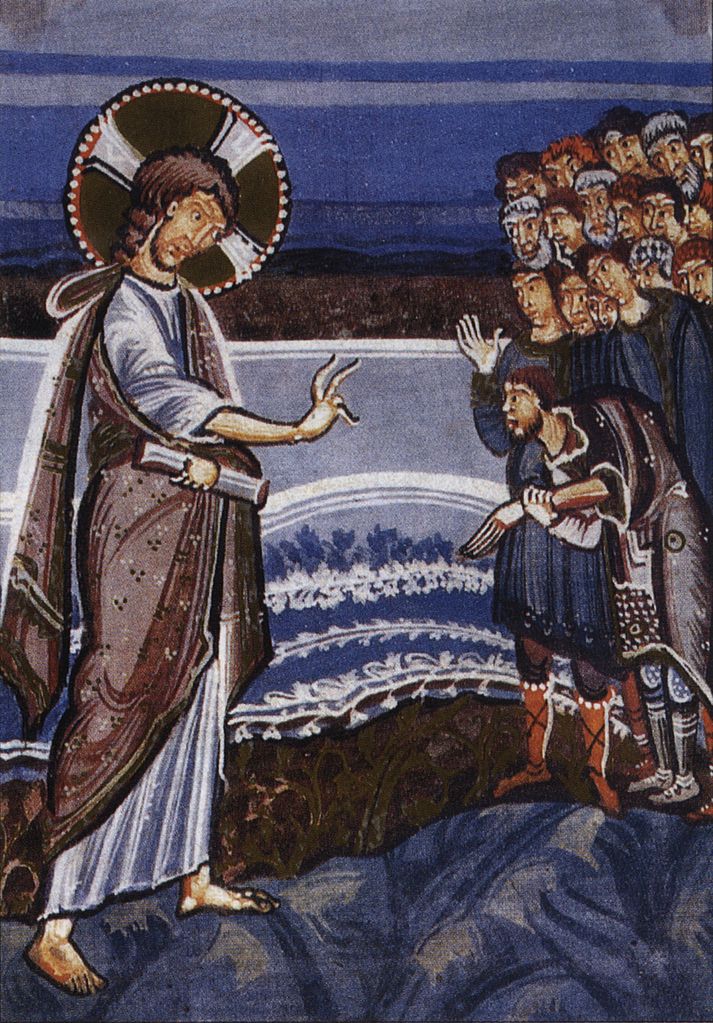
The Curing of the Man with a Withered Hand
----------------------------------------------------------------
[1] Again He (Jesus) entered the synagogue, and a man was there who had a withered hand. [2] And they watched Him, to see whether He would heal him on the Sabbath, so that they might accuse Him. [3] And He said to the man who had the withered hand, "Come here." [4] And He said to them, "Is it lawful on the Sabbath to do good or to do harm, to save life or to kill?" But they were silent. [5] And He looked around at them with anger, grieved at their hardness of heart, and said to the man, "Stretch out your hand." He stretched it out, and his hand was restored. [6] The Pharisees went out, and immediately held counsel with the Herodians against Him, how to destroy Him.
*****************************************************
Commentary:
5. The evangelists refer a number of times to the way Jesus looks at people (e.g. at the young man: Mark 10:21; at St. Peter: Luke 22:61, etc). This is the only time we are told He showed indignation--provoked by the hypocrisy shown in verse 2.
6. The Pharisees were the spiritual leaders of Judaism; the Herodians were those who supported the regime of Herod, benefiting politically and financially thereby. The two were completely opposed to one another and avoided each other's company, yet they combined forces against Jesus. The Pharisees wanted to see the last of Him because they considered Him a dangerous innovator. The most recent occasion may have been when He pardoned sins (Mark 2:1ff) and interpreted with full authority the law of the Sabbath (Mark 3:2); they also want to get rid of Him because they consider that He lowered their own prestige in the eyes of the people by the way He cured the man with the withered hand. The Herodians, for their part, despised the supernatural and eschatological tone of Christ's message, since they looked forward to a purely political and temporal Messiah.
Almost nothing is historically certain about Sebastian except that he was a Roman martyr, was venerated in Milan even in the time of Saint Ambrose and was buried on the Appian Way, probably near the present Basilica of St. Sebastian. Devotion to him spread rapidly, and he is mentioned in several martyrologies as early as 350.
The legend of Saint Sebastian is important in art, and there is a vast iconography. Scholars now agree that a pious fable has Sebastian entering the Roman army because only there could he assist the martyrs without arousing suspicion. Finally he was found out, brought before Emperor Diocletian and delivered to Mauritanian archers to be shot to death. His body was pierced with arrows, and he was left for dead. But he was found still alive by those who came to bury him. He recovered, but refused to flee.
One day he took up a position near where the emperor was to pass. He accosted the emperor, denouncing him for his cruelty to Christians. This time the sentence of death was carried out. Sebastian was beaten to death with clubs. He was buried on the Appian Way, close to the catacombs that bear his name.
Reflection
The fact that many of the early saints made such a tremendous impression on the Church—awakening widespread devotion and great praise from the greatest writers of the Church—is proof of the heroism of their lives. As has been said, legends may not be literally true. Yet they may express the very substance of the faith and courage evident in the lives of these heroes and heroines of Christ.
Saint Sebastian is the Patron Saint of:
Athletes

Disclaimer: Opinions posted on Free Republic are those of the individual posters and do not necessarily represent the opinion of Free Republic or its management. All materials posted herein are protected by copyright law and the exemption for fair use of copyrighted works.