Free Republic
Browse · Search
Religion
Topics · Post Article

Skip to comments.

Catholic Caucus: Daily Mass Readings, 11-17-2020,Memorial of Saint Elizabeth of Hungary, religious
USCCB/RNAB ^ | 17 November 2020 | USCCB/RNAB

Posted on 11/17/2020 4:02:13 AM PST by Cronos

November 17 2020

Memorial of Saint Elizabeth of Hungary, religious

Thirty Third Tuesday in Ordinary Time

Lectionary: 498

I, John, heard the Lord saying to me:
“To the angel of the Church in Sardis, write this:

“‘The one who has the seven spirits of God
and the seven stars says this: “I know your works,
that you have the reputation of being alive, but you are dead.
Be watchful and strengthen what is left, which is going to die,
for I have not found your works complete in the sight of my God.
Remember then how you accepted and heard; keep it, and repent.
If you are not watchful, I will come like a thief,
and you will never know at what hour I will come upon you.
However, you have a few people in Sardis
who have not soiled their garments;
they will walk with me dressed in white,
because they are worthy.“‘

The victor will thus be dressed in white,
and I will never erase his name from the book of life
but will acknowledge his name in the presence of my Father
and of his angels.

“‘Whoever has ears ought to hear what the Spirit says to the churches.’”“

"To the angel of the Church in Laodicea, write this:

“‘The Amen, the faithful and true witness,
the source of God’s creation, says this:
“I know your works;
I know that you are neither cold nor hot.
I wish you were either cold or hot.
So, because you are lukewarm, neither hot nor cold,
I will spit you out of my mouth.
For you say, ‘I am rich and affluent and have no need of anything,’
and yet do not realize that you are wretched,
pitiable, poor, blind, and naked.
I advise you to buy from me gold refined by fire so that you may be rich,
and white garments to put on
so that your shameful nakedness may not be exposed,
and buy ointment to smear on your eyes so that you may see.
Those whom I love, I reprove and chastise.
Be earnest, therefore, and repent.

“‘Behold, I stand at the door and knock.
If anyone hears my voice and opens the door,
then I will enter his house and dine with him,
and he with me.
I will give the victor the right to sit with me on my throne,
as I myself first won the victory
and sit with my Father on his throne.

“‘Whoever has ears ought to hear
what the Spirit says to the churches.’”

Responsorial Psalm

R. (Rev. 3: 21) I will seat the victor beside me on my throne.
He who walks blamelessly and does justice;
who thinks the truth in his heart
and slanders not with his tongue.
R. I will seat the victor beside me on my throne.
Who harms not his fellow man,
nor takes up a reproach against his neighbor;
By whom the reprobate is despised,
while he honors those who fear the LORD.
R. I will seat the victor beside me on my throne.
Who lends not his money at usury
and accepts no bribe against the innocent.
He who does these things
shall never be disturbed.
R. I will seat the victor beside me on my throne.

Alleluia

R. Alleluia, alleluia.
God loved us, and send his Son
as expiation for our sins.
R. Alleluia, alleluia.

At that time Jesus came to Jericho and intended to pass through the town.
Now a man there named Zacchaeus,
who was a chief tax collector and also a wealthy man,
was seeking to see who Jesus was;
but he could not see him because of the crowd,
for he was short in stature.
So he ran ahead and climbed a sycamore tree in order to see Jesus,
who was about to pass that way.
When he reached the place, Jesus looked up and said,
“Zacchaeus, come down quickly,
for today I must stay at your house.”
And he came down quickly and received him with joy.
When they saw this, they began to grumble, saying,
“He has gone to stay at the house of a sinner.”
But Zacchaeus stood there and said to the Lord,
“Behold, half of my possessions, Lord, I shall give to the poor,
and if I have extorted anything from anyone
I shall repay it four times over.”
And Jesus said to him,
“Today salvation has come to this house
because this man too is a descendant of Abraham.
For the Son of Man has come to seek
and to save what was lost.”


TOPICS: Catholic; General Discusssion; Prayer; Worship
KEYWORDS: atholic; catholic; lk19; ordinarytime; prayer

For your reading, reflection, faith-sharing, comments, questions, discussion.

1 posted on 11/17/2020 4:02:13 AM PST by Cronos
[ Post Reply | Private Reply | View Replies]

To: All

Catholic; lk19; ordinarytime; prayer;


2 posted on 11/17/2020 4:02:36 AM PST by Cronos
[ Post Reply | Private Reply | To 1 | View Replies]

To: nickcarraway; NYer; ELS; Pyro7480; livius; ArrogantBustard; Catholicguy; RobbyS; marshmallow; ...

Alleluia Ping

Please FReepmail me to get on/off the Alleluia Ping List.


3 posted on 11/17/2020 4:02:56 AM PST by Cronos
[ Post Reply | Private Reply | To 2 | View Replies]

To: All

Luke
 English: Douay-RheimsEnglish: New American Standard BibleLatin: Vulgata ClementinaGreek NT: Byzantine/Majority Text (2000)
1AND entering in, he walked through Jericho. He entered Jericho and was passing through.Et ingressus perambulabat Jericho.και εισελθων διηρχετο την ιεριχω
2And behold, there was a man named Zacheus, who was the chief of the publicans, and he was rich. And there was a man called by the name of Zaccheus; he was a chief tax collector and he was rich.Et ecce vir nomine Zachæus : et hic princeps erat publicanorum, et ipse dives :και ιδου ανηρ ονοματι καλουμενος ζακχαιος και αυτος ην αρχιτελωνης και ουτος ην πλουσιος
3And he sought to see Jesus who he was, and he could not for the crowd, because he was low of stature. Zaccheus was trying to see who Jesus was, and was unable because of the crowd, for he was small in stature.et quærebat videre Jesum, quis esset : et non poterat præ turba, quia statura pusillus erat.και εζητει ιδειν τον ιησουν τις εστιν και ουκ ηδυνατο απο του οχλου οτι τη ηλικια μικρος ην
4And running before, he climbed up into a sycamore tree, that he might see him; for he was to pass that way. So he ran on ahead and climbed up into a sycamore tree in order to see Him, for He was about to pass through that way.Et præcurrens ascendit in arborem sycomorum ut videret eum : quia inde erat transiturus.και προδραμων εμπροσθεν ανεβη επι συκομωραιαν ινα ιδη αυτον οτι [δι] εκεινης εμελλεν διερχεσθαι
5And when Jesus was come to the place, looking up, he saw him, and said to him: Zacheus, make haste and come down; for this day I must abide in thy house. When Jesus came to the place, He looked up and said to him, "Zaccheus, hurry and come down, for today I must stay at your house."Et cum venisset ad locum, suspiciens Jesus vidit illum, et dixit ad eum : Zachæe, festinans descende : quia hodie in domo tua oportet me manere.και ως ηλθεν επι τον τοπον αναβλεψας ο ιησους ειδεν αυτον και ειπεν προς αυτον ζακχαιε σπευσας καταβηθι σημερον γαρ εν τω οικω σου δει με μειναι
6And he made haste and came down; and received him with joy. And he hurried and came down and received Him gladly.Et festinans descendit, et excepit illum gaudens.και σπευσας κατεβη και υπεδεξατο αυτον χαιρων
7And when all saw it, they murmured, saying, that he was gone to be a guest with a man that was a sinner. When they saw it, they all began to grumble, saying, "He has gone to be the guest of a man who is a sinner."Et cum viderent omnes, murmurabant, dicentes quod ad hominem peccatorem divertisset.και ιδοντες παντες διεγογγυζον λεγοντες οτι παρα αμαρτωλω ανδρι εισηλθεν καταλυσαι
8But Zacheus standing, said to the Lord: Behold, Lord, the half of my goods I give to the poor; and if I have wronged any man of any thing, I restore him fourfold. Zaccheus stopped and said to the Lord, "Behold, Lord, half of my possessions I will give to the poor, and if I have defrauded anyone of anything, I will give back four times as much."Stans autem Zachæus, dixit ad Dominum : Ecce dimidium bonorum meorum, Domine, do pauperibus : et si quid aliquem defraudavi, reddo quadruplum.σταθεις δε ζακχαιος ειπεν προς τον κυριον ιδου τα ημιση των υπαρχοντων μου κυριε διδωμι τοις πτωχοις και ει τινος τι εσυκοφαντησα αποδιδωμι τετραπλουν
9Jesus said to him: This day is salvation come to this house, because he also is a son of Abraham. And Jesus said to him, "Today salvation has come to this house, because he, too, is a son of Abraham.Ait Jesus ad eum : Quia hodie salus domui huic facta est : eo quod et ipse filius sit Abrahæ.ειπεν δε προς αυτον ο ιησους οτι σημερον σωτηρια τω οικω τουτω εγενετο καθοτι και αυτος υιος αβρααμ εστιν
10For the Son of man is come to seek and to save that which was lost. "For the Son of Man has come to seek and to save that which was lost."Venit enim Filius hominis quærere, et salvum facere quod perierat.ηλθεν γαρ ο υιος του ανθρωπου ζητησαι και σωσαι το απολωλος

4 posted on 11/17/2020 4:54:44 AM PST by Cronos
[ Post Reply | Private Reply | To 3 | View Replies]

To: All

Catena Aurea by St. Thomas Aguinas

19:1–10

1. And Jesus entered and passed through Jericho.

2. And, behold, there was a man named Zacchæus, which was the chief among the Publicans, and he was rich.

3. And he sought to see Jesus who he was; and could not for the press, because he was little of stature.

4. And he ran before, and climbed up into a sycomore tree to see him: for he was to pass that way.

5. And when Jesus came to the place, he looked up, and saw him, and said unto him, Zacchæus, make haste, and come down; for to day I must abide at thy house.

6. And he made haste, and came down, and received him joyfully.

7. And when they saw it, they all murmured, saying, That he was gone to be guest with a man that is a sinner.

8. And Zacchæus stood, and said unto the Lord; Behold, Lord, the half of my goods I give to the poor; and if I have taken any thing from any man by false accusation, I restore him fourfold.

9. And Jesus said unto him, This day is salvation come to this house, forsomuch as he also is a son of Abraham.

10. For the Son of man is come to seek and to save that which was lost.

AMBROSE. Zacchæus in the sycamore, the blind man by the way side: upon the one our Lord waits to shew mercy, upon the other He confers the great glory of abiding in his house. The chief among the Publicans is here fitly introduced. For who will hereafter despair of himself, now that he attains to grace who gained his living by fraud. And he too moreover a rich man, that we may know that not all rich men are covetous.

CYRIL OF ALEXANDRIA. But Zacchæus made no delay in what he did, and so was accounted worthy of the favour of God, which gives sight to the blind, and calls them who are afar off.

TITUS BOSTRENSIS. The seed of salvation had begun to spring up in him, for he desired to see Jesus, having never seen Him. For if he had seen Him, he would long since have given up the Publican’s wicked life. No one that sees Jesus can remain any longer in wickedness. But there were two obstacles to his seeing Him. The multitude not so much of men as of his sins prevented him, for he was little of stature.

AMBROSE. What means the Evangelist by describing his stature, and that of none other? It is perhaps because he was young in wickedness, or as yet weak in the faith. For he was not yet prostrate in sin who could climb up. He had not yet seen Christ.

TITUS BOSTRENSIS. But he discovered a good device; running before he climbed up into a sycamore, and saw Him whom he had long wished for, i. e. Jesus, passing by. Now Zacchæus desired no more than to see, but He who is able to do more than we ask for, granted to Him far above what he expected; as it follows, And when Jesus came to the place, he looked up, and saw him. He saw the soul of the man striving earnestly to live a holy life, and converts him to godliness.

AMBROSE. Uninvited he invites Himself to his house; as it follows, Zacchæus, make haste, and come down, & c. for He knew how richly He would reward his hospitality. And though He had not yet heard the word of invitation, He had already seen the will.

BEDE. See here, the camel disencumbered of his hunch passes through the eye of a needle, that is, the rich man and the publican abandoning his love of riches, and loathing his dishonest gains, receives the blessing of his Lord’s company. It follows, And he made haste, and came down, and received him joyfully.

AMBROSE. Let the rich learn that guilt attaches not to the goods themselves, but to those who know not how to use them. For riches, as they are hindrances to virtue in the unworthy, so are they means of advancing it in the good.

PSEUDO-CHRYSOSTOM. (Hom. de cæc. et Zacc.) Observe the gracious kindness of the Saviour. The innocent associates with the guilty, the fountain of justice with covetousness, which is the source of injustice. Having entered the publican’s house, He suffers no stain from the mists of avarice, but disperses them by the bright beam of His righteousness. But those who deal with biting words and reproaches, try to cast a slur upon the things which were done by Him; for it follows, And when they saw it, they all murmured, saying, That he was gone to be guest with a man that is a sinner. But He, though accused of being a wine-bibber and a friend of publicans, regarded it not, so long as He could accomplish His end. As a physician sometimes can not save his patients from their diseases without the defilement of blood. And so it happened here, for the publican was converted, and lived a better life. Zacchæus stood, and said unto the Lord, Behold, Lord, the half of my goods I give to the poor; and if I have defrauded any man, I restore him fourfold. Behold here is a marvel: without learning he obeys. And as the sun pouring its rays into a house enlightens it not by word, but by work, so the Saviour by the rays of righteousness put to flight the darkness of sin; for the light shineth in darkness. Now every thing united is strong, but divided, weak; therefore Zacchæus divides into two parts his substance. But we must be careful to observe, that his wealth was not made up from unjust gains, but from his patrimony, else how could he restore fourfold what he had unjustly extorted. He knew that the law ordered what was wrongly taken away to be restored fourfold, that if the law deterred not, a man’s losses might soften him. Zacchæus waits not for the judgment of the law, but makes himself his own judge.

THEOPHYLACT. If we examine more closely, we shall see that nothing was left of his own property. For having given half of his goods to the poor, out of the remainder he restored fourfold to those whom he had injured. He not only promised this, but did it. For he says not, “I will give the half, and I will restore fourfold, but, I give, and I restore. To such Christ announces salvation; Jesus saith unto him, This day is salvation come to this house, signifying that Zacchæus had attained to salvation, meaning by the house the inhabitant thereof. And it follows, forasmuch as he also is a son of Abraham. For He would not have given the name of a son of Abraham to a lifeless building.

BEDE. Zacchæus is called the son of Abraham, not because he was born of Abraham’s seed, but because he imitates his faith, that as Abraham left his country and his father’s house, so he abandoned all his goods in giving them to the poor. And He well says, “He also,” to declare that not only those who had lived justly, but those who are raised up from a life of injustice, belong to the sons of promise.

THEOPHYLACT. He said not that he “was” a son of Abraham, but that he now is. For before when he was the chief among the publicans, and bore no likeness to the righteous Abraham, he was not his son. But because some murmured that he tarried with a man who was a sinner, he adds in order to restrain them, For the Son of man came to seek and to save that which was lost.

PSEUDO-CHRYSOSTOM. (ubi sup.) Why do ye accuse me if I bring sinners to righteousness? So far am I from hating them, that for their sakes I came. For I came to heal, not to judge, therefore am I the constant guest of those that are sick, and I suffer their noisomeness that I may supply remedies. But some one may ask, how does Paul bid us, If we have a brother that is a fornicator or covetous man, with such not even to take food; (1 Cor. 5:11.) whereas Christ was the guest of publicans? They were not as yet so far advanced as to be brethren, and besides, St. Paul bids us avoid our brethren only when they persist in evil, but these were converted.

BEDE. Mystically, Zacchæus, which is by interpretation “justified,” signifies the Gentile believers, who were depressed and brought very low by their worldly occupations, but sanctified by God. And he was desirous to see our Saviour entering Jericho, inasmuch as he sought to share in that faith which Christ brought into the world.

CYRIL OF ALEXANDRIA. The crowd is the tumultuous state of an ignorant multitude, which cannot see the lofty top of wisdom. Zacchæus therefore, while he was in the crowd, saw not Christ, but having advanced beyond the vulgar ignorance, was thought worthy to entertain Him, whom he desired to look upon.

BEDE. Or the crowd, that is, the general habit of vice, which rebuked the blind man crying out, lest he should seek the light, also impedes Zacchæus looking up, that he might not see Jesus; that as by crying out the more the blind man overcame the crowd, so the man weak in the faith by forsaking earthly things, and climbing the tree of the Cross, surmounts the opposing multitude. The sycamore, which is a tree resembling the mulberry in foliage, but exceeding it in height, whence by the Latins it is called “lofty,” is called the “foolish fig-tree;” and so the Cross of our Lord sustains believers, as the fig-tree figs, and is mocked by unbelievers as foolishness. This tree Zacchæus, who was little in stature, climbed up, that he might be raised together with Christ; for every one who is humble, and conscious of his own weakness, cries out, God forbid that I should glory, save in the cross of our Lord Jesus Christ. (Gal. 6:14.)

AMBROSE. He has well added, that our Lord was to pass that way, either where the sycamore-tree was, or where he was who was about to believe, that so He might preserve the mystery, and sow the seeds of grace. For He had so come as that through the Jews He came to the Gentiles. He sees then Zacchæus above, for already the excellence of his faith shone forth amidst the fruits of good works, and the loftiness of the fruitful tree; but Zacchæus stands out above the tree, as one who is above the law.

BEDE. The Lord as He journeyed came to the place where Zacchæus had climbed the sycamore, for having sent His preachers throughout the world in whom He Himself spoke and went, He comes to the Gentile people, who were already raised up on high through faith in His Passion, and whom when He looked up He saw, for He chose them through grace. Now our Lord once abode in the house of the chief of the Pharisees, but when He did works such as none but God could do, they railed at Him. Wherefore hating their deeds He departed, saying, Your house shall be left unto you desolate; (Matt. 23:38.) but now He must needs stay at the house of the weak Zacchæus, that is, by the grace of the new law brightly shining, He must take rest in the hearts of the lowly nations. But that Zacchæus is bid to come down from the sycamore tree, and prepare an abode for Christ, this is what the Apostle says, Yea, though we have known Christ after the flesh, yet now henceforth know we Him no more. (2 Cor. 5:16.) And again elsewhere, For though he was crucified through weakness, yet he liveth by the power of God. (2 Cor. 13:4.) It is plain that the Jews always hated the salvation of the Gentiles; but salvation, which formerly filled the houses of the Jews, has this day shone upon the Gentiles, forasmuch as this people also by believing on God is a son of Abraham.

THEOPHYLACT. It is easy to turn this to a moral use. For whoever surpasses many in wickedness is small in spiritual growth, and cannot see Jesus for the crowd. For disturbed by passion and worldly things, he beholds not Jesus walking, that is, working in us, not recognising His operation. But he climbs up to the top of a sycamore-tree, in that he rises above the sweetness of pleasure, which is signified by a fig, and subduing it, and so becoming more exalted, he sees and is seen by Christ.

GREGORY. (Mor. 27. c. 46.) Or because the sycamore is from its name called the foolish fig, the little Zacchæus gets up into the sycamore and sees the Lord, for they who humbly choose the foolish things of this world are those who contemplate most closely the wisdom of God. For what is more foolish in this world than not to seek for what is lost, to give our possessions to robbers, to return not injury for injury? However, by this wise foolishness, the wisdom of God is seen, not yet really as it is, but by the light of contemplation.

THEOPHYLACT. The Lord said to him, Make haste and come down, that is, “Thou hast ascended by penitence to a place too high for thee, come down by humility, lest thy exaltation cause thee to slip. I must abide in the house of a humble man. We have two kinds of goods in us, bodily, and spiritual; the just man gives up all his bodily goods to the poor, but he forsakes not his spiritual goods, but if he has extorted any thing from any one, he restores to him fourfold; signifying thereby that if a man by repentance walks in the opposite path to his former perverseness, he by the manifold practice of virtue heals all his old offences, and so merits salvation, and is called the son of Abraham, because he went out from his own kindred, that is, from his ancient wickedness.


Copyright ©1999-2018 e-Catholic2000.com

Link at https://www.ecatholic2000.com/catena/untitled-79.shtml#_Toc384506979


5 posted on 11/17/2020 4:57:45 AM PST by Cronos
[ Post Reply | Private Reply | To 4 | View Replies]

To: Cronos


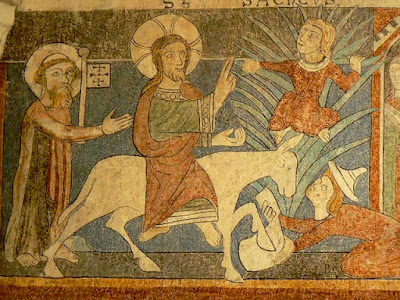
Jesus and Zacchaeus

Medieval, provenance unknown

6 posted on 11/17/2020 5:39:50 AM PST by annalex (fear them not)
[ Post Reply | Private Reply | To 5 | View Replies]

To: annalex

Saint Elizabeth of Hungary’s Story

In her short life, Elizabeth manifested such great love for the poor and suffering that she has become the patroness of Catholic charities and of the Secular Franciscan Order. The daughter of the King of Hungary, Elizabeth chose a life of penance and asceticism when a life of leisure and luxury could easily have been hers. This choice endeared her in the hearts of the common people throughout Europe.

At the age of 14, Elizabeth was married to Louis of Thuringia, whom she deeply loved. She bore three children. Under the spiritual direction of a Franciscan friar, she led a life of prayer, sacrifice, and service to the poor and sick. Seeking to become one with the poor, she wore simple clothing. Daily she would take bread to hundreds of the poorest in the land who came to her gate.

After six years of marriage, her husband died in the Crusades, and Elizabeth was grief-stricken. Her husband’s family looked upon her as squandering the royal purse, and mistreated her, finally throwing her out of the palace. The return of her husband’s allies from the Crusades resulted in her being reinstated, since her son was legal heir to the throne.

In 1228, Elizabeth joined the Secular Franciscan Order, spending the remaining few years of her life caring for the poor in a hospital which she founded in honor of Saint Francis of Assisi. Elizabeth’s health declined, and she died before her 24th birthday in 1231. Her great popularity resulted in her canonization four years later.


Reflection

Elizabeth understood well the lesson Jesus taught when he washed his disciples’ feet at the Last Supper: The Christian must be one who serves the humblest needs of others, even if one serves from an exalted position. Of royal blood, Elizabeth could have lorded it over her subjects. Yet she served them with such a loving heart that her brief life won for her a special place in the hearts of many. Elizabeth is also an example to us in her following the guidance of a spiritual director. Growth in the spiritual life is a difficult process. We can play games very easily if we don’t have someone to challenge us.


Saint Elizabeth of Hungary is the Patron Saint of:

Bakers
Catholic Charities
Secular Franciscan Order


franciscanmedia.org
Additionally, patronage: hospitals, nurses, brides, countesses, dying children, exiles, homeless people, lace-makers, widows, Roman Catholic Archdiocese of Jaro and the Third Order of Saint Francis

Patron Archive

7 posted on 11/17/2020 5:44:32 AM PST by annalex (fear them not)
[ Post Reply | Private Reply | To 6 | View Replies]

To: annalex


St. Stephen's Basilica, Budapest

8 posted on 11/17/2020 5:50:13 AM PST by annalex (fear them not)
[ Post Reply | Private Reply | To 7 | View Replies]

To: annalex

NAVARRE BIBLE COMMENTARY (RSV)

From: Revelation 3:1-6, 14-22

Letter to the Church of Sardis
-------------------------------------------
[1] "And to the angel of the church in Sardis write: 'The words of him who has the seven spirits of God and the seven stars. "'I know your works; you have the name of being alive, and you are dead. [2] Awake, and strengthen what remains and is on the point of death, for I have not found your works perfect in the sight of my God. [3] Remember then what you received and heard; keep that, and repent. If you will not awake, I will come like a thief, and you will not know at what hour I will come upon you. [4] Yet you have still a few names in Sardis, people who have not soiled their garments; and they shall walk with me in white, for they are worthy. [5] He who conquers shall be clad thus in white garments, and I will not blot his name out of the book of life; I will confess his name before my Father and before his angels. [6] He who has an ear, let him hear what the Spirit says to the churches.'

Letter to the Church of Laodicea
-----------------------------------------------
[14] "And to the angel of the church in Laodicea write: 'The words of the Amen, the faithful and true witness, the beginning of God's creation.

[15] "'I know your works: you are neither cold nor hot. Would that you were cold or hot! [16] So, because you are lukewarm, and neither cold nor hot, I will spew you out of my mouth. [17] For you say, I am rich, I have prospered, and I need nothing; not knowing that you are wretched, pitiable, poor, blind, and naked. [18] Therefore I counsel you to buy from me gold refined by fire, that you may be rich, and white garments to clothe you and to keep the shame of your nakedness from being seen, and salve to anoint your eyes, that you may see. [19] Those whom I love, I reprove and chasten; so be zealous and repent. [20] Behold, I stand at the door and knock; if any one hears my voice and opens the door, I will come in to him and eat with him, and he with me. [21] He who conquers, I will grant him to sit with me on my throne, as I myself conquered and sat down with my Father on his throne. [22] He who has an ear, let him hear what the Spirit says to the churches.'"

*********************************************************************
Commentary:

1. Sardis, about 50 kilometers (30 miles) south-east of Thyatira, was an important hub in the highway system; it was also famous for its acropolis, which was located in an unassailable position. Herodotus describes its inhabitants as immoral, licentious people (cf. "History", 1, 55). The Christians of the city were probably somewhat infected by the general atmosphere.

Christ is now depicted as possessing the fullness of the Spirit, with the power to effect radical change by sanctifying the churches from within (cf. note on 1:4). He is also portrayed as the sovereign Lord of the universal Church (cf. note on 2:1), ever ready to imbue it with new life.

The church of Sardis is accused of seeming to be alive but in fact being dead: in other words, although its external practice of religion makes it look Christian, most of its members (not all: cf. v. 4) are estranged from Christ, devoid of interior life, in a sinful condition. Anyone who lives like that is dead. Our Lord himself described the situation of the prodigal son as being a kind of death: "my son was dead, and is alive again", the father exclaims in the parable (Lk 15: 24); and St Paul invites Christians to offer themselves to God "as men who have been brought from death to life" (Rom 6:13). Now, in this passage of Revelation, we are told that the cause of this spiritual, but real, death is the fact that the works of this church are imperfect in the sight of God (v. 2); they were works which led to spiritual death, that is, what we would term mortal sins. "With the whole tradition of the Church", John Paul II says, "we call 'mortal sin' the act by which man freely and consciously rejects God, his law, the covenant of love that God offers, preferring to turn in on himself or to some created and finite reality, something contrary to the divine will (conversio ad creaturam) [...]. Man perceives that this disobedience to God destroys the bond that unites him with his life-principle: it is a mortal sin, that is, an act which gravely offends God and ends in turning against man himself with a dark and powerful force of destruction" (Reconciliatio Et Paenitentia, 17).

2-3. Vigilance is always necessary, particularly in certain situations like that of Sardis where there was a number of people who had not fallen victim to sin. In this kind of peril, Christians need to be alerted and confirmed in the faith. They need to remember what they learned at the beginning, when they were instructed in the faith, and try to bring their lives into line with that teaching. And so they are not simply exhorted to conversion but told how to go about it -- by comparing their lives with the Word of God and making the necessary changes: "no one is safe if he ceases to strive against himself. Nobody can save himself by his own efforts. Everyone in the Church needs specific means to strengthen himself -- humility, which disposes us to accept help and advice; mortifications, which temper the heart and allow Christ to reign in it; the study of abiding, sound doctrine, which leads us to conserve and spread our faith" (St. J. Escriva, Christ Is Passing By, 81).

"I will come like a thief": an image also found elsewhere in the New Testament (cf. Mt 24:42-51, Mk 13:36; Lk 12:39ff; 1 Thess 5:2; 2 Pet 3: 10). This does not mean that our Lord is lying in wait, ready to pounce on man when he is unawares, like a hunter waiting for his prey. It is simply a warning to us to live in the grace of God and be ready to render our account to him. If we do that we will not run the risk of being found empty-handed at the moment of death. "That day will come for us. It will be our last day, but we are not afraid of it. Trusting firmly in God's grace, we are ready from this very moment to be generous and courageous, and take loving care of little things: we are ready to go and meet our Lord, with our lamps burning brightly. For the feast of feasts awaits us in heaven" (St. J. Escriva, Friends of God, 40).

4-5. Despite the corrupt environment in which they were living, there were some Christians who had not been contaminated by the immoral cults and lifestyles of the pagans: their loyalty is symbolized by white garments. In the course of narrating his visions St John mentions white garments a number of times (cf. 7:9, 13; 15:6; 19:14); this color symbolizes purity and also the joy of victory.

The symbol of the "book of life", which occurs often in the Apocalypse (cf. 13:8; 17:8; 20:12, 15; 21:27; etc.), is taken from the Old Testament, where those who belong to the people of Israel are described as enrolled in the "book of the living", which is also referred to as the book of the Lord (cf. Ps 69:28; Ex 32:32ff). Those whose names are in the book will share in the promises of salvation (cf. Is 4:3), whereas those who are unfaithful to the Law will be excluded from the people of God and their names blotted out of the "book of the living". Other New Testament texts use the same image (cf., e.g., Lk 10:20; Phil 4:3).

The names of the victors will stay in the "book of life" which lists those who have proved loyal to Christ, as well as those who belonged to the people of Israel.

Finally, on Judgment Day, those Christians who have kept the faith, will be spoken for by Christ (cf. Mt 10:32; Lk 12:8).

14. Laodicea was a city on the border of Phrygia, about 75 kilometers (45 miles) south-west of Philadelphia. It is also mentioned by St Paul when he suggests to the Colossians that they exchange his letter to them for the one he sent the Laodiceans (cf. Col 4:16).

Jesus Christ is given the title of "the Amen"; a similar description is applied to Christ in 2 Corinthians 1:20. Both texts are instances of a divine name being applied to Christ, thereby asserting his divinity. "Amen", so be it, is an assertion of truth and veracity and connects with the title of "the true one" in the previous letter. It highlights the fact that our Lord is strong, dependable and unchangeable; the words that follow, "faithful and true witness", spell out the full meaning of the "Amen" title (cf. 1:5).

The most satisfactory interpretation of the phrase "the beginning of God's creation" is in terms of Jesus Christ's role in creation: for "all things were made through him" (Jn 1:3) and therefore he, along with the Father and the Holy Spirit, is the Creator of heaven and earth.

15-16. The prosperity Laodicea enjoyed may have contributed to the laxity and lukewarmness the church is accused of here (Israel tended to take the same direction when living was easy: the people would become forgetful of Yahweh and adopt an easy-going lifestyle: cf., e.g., Deut 31:20; 32:15; Hos 13:6; Jer 5:7).

The presence of hot springs close to the city explains the language used in this passage, which amounts to a severe indictment of lukewarmness. It shows God's repugnance for mediocrity and bourgeois living. As observed by Cassian, one of the founders of Western monasticism, lukewarmness is something that needs to be nipped in the bud: "No one should attribute his going astray to any sudden collapse, but rather [...] to his having moved away from virtue little by little, through prolonged mental laziness. That is the way bad habits gain ground without one's even noticing it, and eventually lead to a sudden collapse. 'Pride goes before destruction, and a haughty spirit before a fall' (Prov 16:18). The same thing happens with a house: it collapses one fine day due to some ancient defect in its foundation or long neglect by the occupiers" (Collationes, VI, 17).

Spiritual lukewarmness and mediocrity are very closely related: neither is the route Christian life should take. As St. Escriva puts it, "'In medio virtus'.... Virtue is to be found in the middle, so the saying goes, warning us against extremism. But do not make the mistake of turning that advice into a euphemism to disguise your own comfort, calculation, lukewarmness, easygoingness, lack of idealism and mediocrity.

"Meditate on these words of Sacred Scripture: 'Would that you were cold or hot. So, because you are lukewarm, and neither cold nor hot, I will spew you out of my mouth"' (Furrow, 541).

17-19. The Christians of Laodicea did not realize how precarious their spiritual situation was. The city's flourishing trade and industry, and the fact that the church was not being persecuted in any way, made them feel prosperous and content: they were proud as well as lukewarm. They had fallen victim to that self-conceit the wealthy are always inclined to feel and which moved our Lord to say that rich people enter heaven only with difficulty (cf. Mt 19:23); he often pointed to the dangers of becoming attached to material things (cf. Lk 1:53; 6:24; 12:21; 16:19-31; 18:23-25). The Laodiceans had become proud in their prosperity and did not see the need for divine grace (which is worth more than all the wealth in the world). As St Paul says in one of his letters: "Whatever gain I had, I counted as loss for the sake of Christ. Indeed I count everything as loss because of the surpassing worth of knowing Christ Jesus my Lord. For his sake I have suffered the loss of all things, and count them as refuse, in order that I may gain Christ" (Phil 3:7-8).

There was an important textile industry in Laodicea which specialized in the manufacture of black woolen cloth. Instead of wearing that material, the Laodiceans must dress in garments which only our Lord can provide and which are the mark of the elect (cf., e.g., Mt 17:2 and par; Rev 3:4-5; 7:9). The city was also famous for its oculists, like Zeuxis and Philetos, who had developed a very effective ointment for the eyes. Jesus offers an even better ointment -- one which will show them the dangerous state they are in. This dire warning comes from God's love, not his anger: it is his affection that leads him to reprove and correct his people: 'the Lord reproves whom he loves, as a father the son in whom he delights" (Prov 3:12). After quoting these same words the Epistle to the Hebrews adds: "It is for discipline that you have to endure. God is treating you as sons; for what son is there whom his father does not discipline? If you are left without discipline, in which all have participated, then you are illegitimate children and not sons" (12:7-8).

"Be zealous": stop being lukewarm and enter the fervor of charity, have an ardent zeal for the glory of God.

20-21. Christ knocking on the door is one of the most touching images in the Bible. It is reminiscent of the Song of Songs, where the bridegroom says, "Open to me, my sister, my dove, my perfect one; for my head is wet with dew, my locks with the drops of the night" (Song 5:2). It is a way of describing God's love for us, inviting us to greater intimacy with him, as happens in a thousand ways in the course of our life. We should be listening for his knock, ready to open the door to Christ. A writer from the Golden Age of Spanish literature evokes this scene in poetry: "How many times the angel spoke to me:/'Look out of your window now, /you'll see how lovingly he calls and calls.'/Yet, sovereign beauty, how often/I replied, 'We'll open for you tomorrow',/ to reply the same when the morrow came" (Lope de Vega, Rimas Sacras, Sonnet 18).

Our Lord awaits our response to his call, and when we make the effort to revive our interior life we experience the indescribable joy of intimacy with him. "At first it will be a bit difficult. You must make an effort to seek out the Lord, to thank him for his fatherly and practical concern for us. Although it is not really a matter of feeling, little by little the love of God makes itself felt like a rustle in the soul. It is Christ who pursues us lovingly: 'Behold, I stand at the door and knock' (Rev 3:20). How is your life of prayer going? At times during the day don't you feel the impulse to have a longer talk with him? Don't you then whisper to him that you will tell him about it later, in a heart-to-heart conversation [...]. Prayer then becomes continuous, like the beating of our heart, like our pulse. Without this presence of God, there is no contemplative life; and without contemplative life, our working for Christ is worth very little, for vain is the builder's toil if the house is not of the Lord's building (cf. Ps 126:1)" (St. J. Escriva, Christ Is Passing By, 8).

Jesus promises that those who conquer will sit beside him on his throne. He gave a similar promise to St Peter about how the Apostles would sit on twelve thrones to Judge the twelve tribes of Israel (cf. Mt 19:28; 20:20ff). The "throne" is a reference to the sovereign authority Christ has received from the Father. Therefore, the promise of a seat beside him is a way of saying that those who stay faithful will share in Christ's victory and kingship (cf. 1 Cor 6:2-3).

9 posted on 11/17/2020 7:12:20 AM PST by fidelis (Zonie and USAF Cold Warrior)
[ Post Reply | Private Reply | To 8 | View Replies]

To: fidelis

From: Luke 19:1-10

The Conversion of Zacchaeus
-------------------------------------------
[1] He (Jesus) entered Jericho and was passing through. [2] And there was a rich man named Zacchaeus; he was a chief tax collector, and rich. [3] And he sought to see who Jesus was, but could not, on account of the crowd, because he was small of stature. [4] So he ran on ahead and climbed up into a sycamore tree to see Him, for He was to pass that way. [5] And when Jesus came to the place, He looked up and said to him, "Zacchaeus, make haste and come down; for I must stay at your house today." [6] So he made haste and came down, and received Him joyfully. [7] And when they saw it they all murmured, "He has gone into be the guest of a man who is a sinner." [8] And Zacchaeus stood and said to the Lord, "Behold, Lord, the half of my goods I give to the poor; and if I have defrauded any one of anything, I restore it fourfold." [9] And Jesus said to him, "To- day salvation has come to this house, since he also is a son of Abraham. [10] For the Son of Man came to seek and save the lost."

**********************************************************************
Commentary:

1-10. Jesus Christ is the Savior of mankind; He has healed many sick people, has raised the dead to life and, particularly, has brought forgiveness of sin and the gift of grace to those who approach Him in faith. As in the case of the sinful woman (cf. Luke 7:36-50), here He brings salvation to Zacchaeus, for the mission of the Son of Man is to save that which was lost.

Zacchaeus was a tax collector and, as such, was hated by the people, because the tax collectors were collaborators of the Roman authorities and were often guilty of abuses. The Gospel implies that this man also had things to seek forgiveness for (cf. verses 7-10). Certainly he was very keen to see Jesus (no doubt moved by grace) and he did everything he could to do so. Jesus rewards his efforts by staying as a guest in his house. Moved by our Lord's presence Zacchaeus begins to lead a new life.

The crowd begin to grumble against Jesus for showing affection to a man they consider to be an evildoer. Our Lord makes no excuses for his behavior: He explains that this is exactly why He has come--to seek out sinners. He is putting into practice the parable of the lost sheep (cf. Luke 15:4-7), which was already prophesied in Ezekiel: "I will seek the lost, and I will bring back the strayed, and I will bind up the crippled, and I will strengthen the weak" (34:16).

4. Zacchaeus wants to see Jesus, and to do so he has to go out and mix with the crowd. Like the blind man of Jericho he has to shed any kind of human respect. In our own search for God we should not let false shame or fear of ridicule prevent us from using the resources available to us to meet our Lord. "Convince yourself that there is no such thing as ridicule for whoever is doing what is best" (St. J. Escriva, The Way, 392).

5-6. This is a very good example of the way God acts to save men. Jesus calls Zacchaeus personally, using his name, suggesting he invite Him home. The Gospel states that Zacchaeus does so promptly and joyfully. This is how we should respond when God calls us by means of grace.

8. Responding immediately to grace, Zacchaeus makes it known that he will restore fourfold anything he obtained unjustly--thereby going beyond what is laid down in the Law of Moses (cf. Exodus 21:37f). And in generous compensation he gives half his wealth to the poor." Let the rich learn", St. Ambrose comments, "that evil does not consist in having wealth, but in not putting it to good use; for just as riches are an obstacle to evil people, they are also a means of virtue for good people" (Expositio Evangelii Sec. Lucam, in loc.). Cf. note on Luke 16: 9-11).

10. Jesus' ardent desire to seek out a sinner to save him fills us with hope of attaining eternal salvation. "He chooses a chief tax collector: who can despair when such a man obtains grace?" (St. Ambrose, Expositio Evangelii Sec. Lucam, in loc.).


10 posted on 11/17/2020 7:19:00 AM PST by fidelis (Zonie and USAF Cold Warrior)
[ Post Reply | Private Reply | To 9 | View Replies]

Disclaimer: Opinions posted on Free Republic are those of the individual posters and do not necessarily represent the opinion of Free Republic or its management. All materials posted herein are protected by copyright law and the exemption for fair use of copyrighted works.

Free Republic
Browse · Search
Religion
Topics · Post Article

FreeRepublic, LLC, PO BOX 9771, FRESNO, CA 93794
FreeRepublic.com is powered by software copyright 2000-2008 John Robinson