Skip to comments.
Catholic Caucus: Daily Mass Readings, 11-10-2020, Memorial of Saint Leo the Great, Pope and doctor of the Church
USCCB/RNAB ^
| 10 November 2020
| USCCB/RNAB
Posted on 11/10/2020 1:01:56 AM PST by Cronos
November 10 2020
Memorial of Saint Leo the Great, Pope and doctor of the Church
Thirty Second Tuesday in Ordinary Time
Lectionary: 491
Reading 1
Beloved:
You must say what is consistent with sound doctrine,
namely, that older men should be temperate, dignified,
self-controlled, sound in faith, love, and endurance.
Similarly, older women should be reverent in their behavior,
not slanderers, not addicted to drink,
teaching what is good, so that they may train younger women
to love their husbands and children,
to be self-controlled, chaste, good homemakers,
under the control of their husbands,
so that the word of God may not be discredited.
Urge the younger men, similarly, to control themselves,
showing yourself as a model of good deeds in every respect,
with integrity in your teaching, dignity, and sound speech
that cannot be criticized,
so that the opponent will be put to shame
without anything bad to say about us.
For the grace of God has appeared, saving all
and training us to reject godless ways and worldly desires
and to live temperately, justly, and devoutly in this age,
as we await the blessed hope,
the appearance of the glory of the great God
and of our savior Jesus Christ,
who gave himself for us to deliver us from all lawlessness
and to cleanse for himself a people as his own,
eager to do what is good.
R. (39a) The salvation of the just comes from the Lord.
Trust in the LORD and do good,
that you may dwell in the land and be fed in security.
Take delight in the LORD,
and he will grant you your heart’s requests.
R. The salvation of the just comes from the Lord.
The LORD watches over the lives of the wholehearted;
their inheritance lasts forever.
By the LORD are the steps of a man made firm,
and he approves his way.
R. The salvation of the just comes from the Lord.
Turn from evil and do good,
that you may abide forever;
The just shall possess the land
and dwell in it forever.
R. The salvation of the just comes from the Lord.
R. Alleluia, alleluia.
Whoever loves me will keep my word,
and my Father will love him,
and we will come to him.
R. Alleluia, alleluia.
Jesus said to the Apostles:
“Who among you would say to your servant
who has just come in from plowing or tending sheep in the field,
‘Come here immediately and take your place at table’?
Would he not rather say to him,
‘Prepare something for me to eat.
Put on your apron and wait on me while I eat and drink.
You may eat and drink when I am finished’?
Is he grateful to that servant because he did what was commanded?
So should it be with you.
When you have done all you have been commanded, say,
‘We are unprofitable servants;
we have done what we were obliged to do.’”
TOPICS: Catholic; General Discusssion; Prayer; Worship
KEYWORDS: catholic; lk17; ordinarytime; prayer
For your reading, reflection, faith-sharing, comments, questions, discussion.
1
posted on
11/10/2020 1:01:56 AM PST
by
Cronos
To: All
catholic; lk17; ordinarytime; prayer;
2
posted on
11/10/2020 1:02:10 AM PST
by
Cronos
To: nickcarraway; NYer; ELS; Pyro7480; livius; ArrogantBustard; Catholicguy; RobbyS; marshmallow; ...
Alleluia Ping Please FReepmail me to get on/off the Alleluia Ping List.
3
posted on
11/10/2020 1:02:27 AM PST
by
Cronos
To: All
| Luke |
| |
English: Douay-Rheims |
Latin: Vulgata Clementina |
Greek NT: Byzantine/Majority Text (2000) |
English: New Revised Standard Version |
| 7. |
But which of you having a servant ploughing, or feeding cattle, will say to him, when he is come from the field: Immediately go, sit down to meat: |
Quis autem vestrum habens servum arantem aut pascentem, qui regresso de agro dicat illi : Statim transi, recumbe : |
τις δε εξ υμων δουλον εχων αροτριωντα η ποιμαινοντα ος εισελθοντι εκ του αγρου ερει ευθεως παρελθων αναπεσε |
"Who among you would say to your slave who has just come in from plowing or tending sheep in the field, 'Come here at once and take your place at the table'? |
| 8. |
And will not rather say to him: Make ready my supper, and gird thyself, and serve me, whilst I eat and drink, and afterwards thou shalt eat and drink? |
et non dicat ei : Para quod cœnem, et præcinge te, et ministra mihi donec manducem, et bibam, et post hæc tu manducabis, et bibes ? |
αλλ ουχι ερει αυτω ετοιμασον τι δειπνησω και περιζωσαμενος διακονει μοι εως φαγω και πιω και μετα ταυτα φαγεσαι και πιεσαι συ |
Would you not rather say to him, 'Prepare supper for me, put on your apron and serve me while I eat and drink; later you may eat and drink'? |
| 9. |
Doth he thank that servant, for doing the things which he commanded him? |
Numquid gratiam habet servo illi, quia fecit quæ ei imperaverat ? |
μη χαριν εχει τω δουλω εκεινω οτι εποιησεν τα διαταχθεντα ου δοκω |
Do you thank the slave for doing what was commanded? |
| 10. |
I think not. So you also, when you shall have done all these things that are commanded you, say: We are unprofitable servants; we have done that which we ought to do. |
non puto. Sic et vos cum feceritis omnia quæ præcepta sunt vobis, dicite : Servi inutiles sumus : quod debuimus facere, fecimus. |
ουτως και υμεις οταν ποιησητε παντα τα διαταχθεντα υμιν λεγετε οτι δουλοι αχρειοι εσμεν οτι ο οφειλομεν ποιησαι πεποιηκαμεν |
So you also, when you have done all that you were ordered to do, say, 'We are worthless slaves; we have done only what we ought to have done!'" |
4
posted on
11/10/2020 1:03:49 AM PST
by
Cronos
To: All

Catena Aurea by St. Thomas Aguinas
CHAP. 17
17:7–10
7. But which of you, having a servant plowing or feeding cattle, will say unto him by and by, when he is come from the field, Go and sit down to meat?
8. And will not rather say unto him, Make ready wherewith I may sup, and gird thyself, and serve me, till I have eaten and drunken; and afterward thou shalt eat and drink?
9. Doth he thank that servant because he did the things that were commanded him? I trow not.
10. So likewise ye, when ye shall have done all those things which are commanded you, say, We are unprofitable servants: we have done that which was our duty to do.
THEOPHYLACT. Because faith makes its possessor a keeper of God’s commandments, and adorns him with wonderful works; it would seem from thence that a man might thereby fall into the sin of pride. Our Lord therefore forewarned His Apostles by a fit example, not to boast themselves in their virtues, saying, But which of you having a servant plowing, &c.
AUGUSTINE. (de Quæst. Ev. l. 2. qu. 39.) Or else; To the many who understand not this faith in the truth already present, our Lord might seem not to have answered the petitions of His disciples. And there appears a difficulty in the connexion here, unless we suppose He meant the change from faith to faith, from that faith, namely, by which we serve God, to that whereby we enjoy Him. For then will our faith be increased when we first believe the word preached, next the reality present. But that joyful contemplation possesseth perfect peace, which is given unto us in the everlasting kingdom of God. And that perfect peace is the reward of those righteous labours, which are performed in the administration of the Church. Be then the servant in the field ploughing, or feeding, that is, in this life either following his worldly business, or serving foolish men, as it were cattle, he must after his labours return home, that is, be united to the Church.
BEDE. Or the servant departs from the field when giving up for a time his work of preaching, the teacher retires into his own conscience, pondering his own words or deeds within himself. To whom our Lord does not at once say, Go from this mortal life, and sit down to meat, that is, refresh thyself in the everlasting resting-place of a blessed life.
AMBROSE. For we know that no one sits down before he has first passed over. Moses indeed also passed over, that he might see a great sight. Since then thou not only sayest to thy servant, Sit down to meat, but requirest from him another service, so in this life the Lord does not put up with the performance of one work and labour, because as long as we live we ought always to work. Therefore it follows, And will not rather say, Make ready wherewith I may sup.
BEDE. He bids make ready wherewith he may sup, that is, after the labours of public discourse, He bids him humble himself in self-examination. With such a supper our Lord desires to be fed. But to gird one’s self is to collect the mind which has been enfolded in the base coil of fluctuating thoughts, whereby its steps in the cause of good works are wont to be entangled. For he who girds up his garments does so, that in walking he may not be tripped up. But to minister unto God, is to acknowledge that we have no strength without the help of His grace.
AUGUSTINE. (de Quæst. Ev. ubi sup.) While His servants also are ministering, that is, preaching the Gospel, our Lord is eating and drinking the faith and confession of the Gentiles. It follows, And afterward thou shall eat and drink. As if He says, After that I have been delighted with the work of thy preaching, and refreshed myself with the choice food of thy compunction, then at length shalt thou go, and feast thyself everlastingly with the eternal banquet of wisdom.
CYRIL OF ALEXANDRIA. Our Lord teaches us that it is no more than the just and proper right of a master to require, as their bounden duty, subjection from servants, adding, Doth he thank that servant because he did the things that were commanded him? I trow not. Here then is the disease of pride cut away. Why boastest thou thyself? Dost thou know that if thou payest not thy debt, danger is at hand, but if thou payest, thou doest nothing thankworthy? As St. Paul says, For though I preach the Gospel I have nothing to glory of, for necessity is laid upon me, yea, woe is unto me if I preach not the Gospel. (1 Cor. 9:16.)
Observe then that they who have rule among us, do not thank their subjects, when they perform their appointed service, but by kindness gaining the affections of their people, breed in them a greater eagerness to serve them. So likewise God requires from us that we should wait upon Him as His servants, but because He is merciful, and of great goodness, He promises reward to them that work, and the greatness of His loving-kindness far exceeds the labours of His servants.
AMBROSE. Boast not thyself then that thou hast been a good servant. Thou hast done what thou oughtest to have done. The sun obeys, the moon submits herself, the angels are subject; let us not then seek praise from ourselves. Therefore He adds in conclusion, So likewise ye, when ye have done all good things, say, We are unprofitable servants, we have done that which it was our duty to do.
BEDE. Servants, I say, because bought with a price; (1 Cor. 6:20) unprofitable, for the Lord needeth not our good things, (Ps. 16:2) or because the sufferings of this present time are not worthy to be compared to the glory which shall be revealed in us. (Rom. 8:18.) Herein then is the perfect faith of men, when having done all things which were commanded them, they acknowledge themselves to be imperfect.
5
posted on
11/10/2020 1:30:48 AM PST
by
Cronos
To: Cronos
6
posted on
11/10/2020 5:10:54 AM PST
by
annalex
(fear them not)
To: annalex
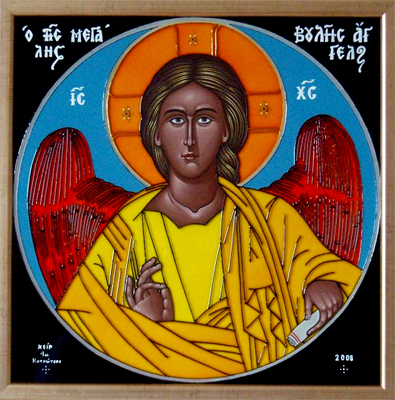
Christ the Angel of the Great Council
No attribution, Greek
7
posted on
11/10/2020 5:11:44 AM PST
by
annalex
(fear them not)
To: annalex
Saint Leo the Great’s Story
With apparent strong conviction of the importance of the Bishop of Rome in the Church, and of the Church as the ongoing sign of Christ’s presence in the world, Leo the Great displayed endless dedication as pope. Elected in 440, he worked tirelessly as “Peter’s successor,” guiding his fellow bishops as “equals in the episcopacy and infirmities.”
Leo is known as one of the best administrative popes of the ancient Church. His work branched into four main areas, indicative of his notion of the pope’s total responsibility for the flock of Christ. He worked at length to control the heresies of Pelagianism—overemphasizing human freedom—Manichaeism—seeing everything material as evil—and others, placing demands on their followers so as to secure true Christian beliefs.
A second major area of his concern was doctrinal controversy in the Church in the East, to which he responded with a classic letter setting down the Church’s teaching on the two natures of Christ. With strong faith, he also led the defense of Rome against barbarian attack, taking the role of peacemaker.
In these three areas, Leo’s work has been highly regarded. His growth to sainthood has its basis in the spiritual depth with which he approached the pastoral care of his people, which was the fourth focus of his work. He is known for his spiritually profound sermons. An instrument of the call to holiness, well-versed in Scripture and ecclesiastical awareness, Leo had the ability to reach the everyday needs and interests of his people. One of his sermons is used in the Office of Readings on Christmas.
It is said of Leo that his true significance rests in his doctrinal insistence on the mysteries of Christ and the Church and in the supernatural charisms of the spiritual life given to humanity in Christ and in his Body, the Church. Thus Leo held firmly that everything he did and said as pope for the administration of the Church represented Christ, the head of the Mystical Body, and Saint Peter, in whose place Leo acted.
Reflection
At a time when there is widespread criticism of Church structures, we also hear criticism that bishops and priests—indeed, all of us—are too preoccupied with administration of temporal matters. Pope Leo is an example of a great administrator who used his talents in areas where spirit and structure are inseparably combined: doctrine, peace, and pastoral care. He avoided an “angelism” that tries to live without the body, as well as the “practicality” that deals only in externals.
franciscanmedia.org
8
posted on
11/10/2020 5:16:28 AM PST
by
annalex
(fear them not)
To: annalex

Saint Leo Magnus
Francisco de Herrera el Mozo (1622-1685)
Prado Museum, Madrid
9
posted on
11/10/2020 5:18:38 AM PST
by
annalex
(fear them not)
To: annalex
NAVARRE BILE COMMENTARY (RSV)
From: Titus 2:1-8, 11-14
Duties of Christians in Different Situations
---------------------------------------------
[1] But as for you, teach what befits sound doctrine. [2] Bid the older men be temperate, serious, sensible, sound in faith, in love, and in steadfastness. [3] Bid the older women likewise to be reverent in behavior, not to be slanderers or slaves to drink; they are to teach what is good, [4] and so train the young women to love their husbands and children, [5] to be sensible, chaste, domestic, kind, and submissive to their husbands, that the word of God may not be discredited. [6] Likewise urge the younger men to control themselves. [7] Show yourself in all respects a model of good deeds, and in your teaching show integrity, gravity, [8] and sound speech that cannot be censured, so that an opponent may be put to shame, having nothing evil to say to us.
The Incarnation, the Basis of Christian Ethics and Piety
--------------------------------------------------------
[11] For the grace of God has appeared for the salvation of all men, [12] training us to renounce irreligion and worldly passions, and to live sober, upright, and godly lives in this world, [13] awaiting our blessed hope, the appearing of the glory of our great God and Savior Jesus Christ, [14] who gave himself for us to redeem us from all iniquity and to purify for himself a people of his own who are zealous for good deeds.
*********************************************************************
Commentary:
1-10. To counter the fallacies of those whose depraved conduct is at odds with what they profess to believe, Titus is urged to be sincere in everything he does and always to act in accordance with the faith. A key feature of Christian morality is that it can never be reduced to an abstract ethical code with no theological basis; rather, it flows directly from the deep truth one professes: doctrinal orthodoxy leads to upright conduct--and upright conduct equips one to understand and accept revealed truth. As the Second Vatican Council teaches, faith is meant to shape the Christian life: "Bishops should be especially concerned about catechetical instruction. Its function is to develop in men a living, explicit and active faith, enlightened by doctrine. It should be very carefully imparted, not only to children and adolescents but also to young people and even to adults. In imparting this instruction the teachers must observe an order and method suited not only to the matter in hand but also to the character, the ability, the age and the lifestyle of their audience. This instruction should be based on holy Scripture, tradition, liturgy, and on the teaching authority and life of the Church" (Christus Dominus, 14).
In this section of the letter St. Paul reminds Titus about the obligations and the virtues people have (depending on their age, state-in-life, social position, etc.); this advice is very like that given to Timothy in 1 Timothy (cf. 1 Tim 5:1-6:2).
2-3. "Sound in faith...": in the Pastoral Epistles physical health is often used metaphorically in connection with Christian doctrine and its transmission (cf. 1 Tim 6:3; 2 Tim 1:13; 4:3; Tit 1:9; 2:8); it is also applied to people: as the years go on their interior life should grow stronger and stronger.
"Be reverent in behavior": older women are given special mention (cf. 1 Tim 5:2-16); they must be exemplary, because younger women have to learn from them.
4-5. All members of the Church are responsible for the formation and Christian life of their juniors; this general principle applies to adult women: they have to show younger women that their role as mothers, their place in the home, is so important that it must be given priority over outside activities (in which they do have a right to engage). In connection with the role of women in society and in the fa- mily Bl. John Paul II said: "the mentality which honors women more for their work outside the home than for their work within the family must be over- come. This requires that men should truly esteem and love women with total respect for their personal dignity, and that society should create and develop conditions favoring work in the home" (Familiaris Consortio, 23).
"That the word of God may not be discredited": an expression very similar to that used by St. Paul when advising slaves to be submissive (cf. 1 Tim 6:1). The Apostle is not approving behavior which women or slaves find obnoxious; what he is saying is that obedience and humility is the best way to do God honor and to offer others a testimony of love, following the example of the Master, who "humbled himself and became obedient unto death" (cf. Phil 2:6-11).
6-8. The model for the younger men should be Titus himself; as in the case of Timothy in Ephesus (1 Tim 4:12), Titus' duty to be exemplary derives from the fact that pastors have an obligation to reflect Jesus' life in their life: "Be imitators of me, as I am of Christ" (1 Cor 11:1; cf. Phil 3:17; 2 Thess 3:9). "The priestly personality must be for others a clear sign and indication." This is the first condition for our pastoral service. The people from among whom we have been chosen and for whom we have been appointed want above all to see in us such a sign and indication, and to this they have a right" (Bl. John Paul II, Letter to All Priests, 8 April 1979).
9-10. The fact that there are these references to the duties and slaves (and others in 1 Tim 6:1-2) shows that slaves were very much taken account of in the early Christian community. Christianity has been responsible for an enormous amount of social change, because being a Christian means that, whatever one's position in society, one should give honor and glory to God and recognize the innate dignity of everyone, without exception.
11-14. This section is almost like a hymn in praise of saving grace and God's loving kindness as manifested in Christ. The terse, sober style, with phrases piled on one another, and very few verbs, is typical of St. Paul. The duties just described (2L1-10)--of older men, women, young people and slaves--all point to Christians' having a common lifestyle, which is the fruit of grace. God is the source of that grace, and salvation its goal, and it is given to us through Jesus Christ.
Thus, divine grace manifested in the Incarnation is actively at work to redeem us; it brings salvation; it sanctifies us, enabling us to live godly lives; and it is the basis of our hope in the second coming of the Lord. All these dimensions of the action of grace summarize revealed doctrine on righteousness (justification) in Jesus Christ. Thus, in the Incarnation, God's salvific will, embracing all men, is manifested in a special way (cf. 1 Tim 2:4); in the Redemption, Christ, the only Mediator and Savior (cf. 1 Tim 2:5) obtains for us the gift of grace, whereby man be- comes a sharer in the good things of salvation. Jesus is our model; by means of grace he instructs the Christian on how to control his defects and grow in virtue. The instruction we receive is not only an external one: God inwardly moves us to seek holiness (cf. Rom 5:1-5 and note). Grace also channels our hope, for Christians are motivated not only by the memory of a past event (our Lord's life on earth) but also, and especially, by the fact that Jesus is in the glory of heaven even now and that we are invited to share his inheritance (cf. 2 Pet 3:12-13).
13. "The glory of our great God and Savior Jesus Christ": an explicit confession of faith in the divinity of Jesus Christ, who is stated at one and at the same time (with only one article in the original Greek) to be God and Savior. This expression is the hinge on which the entire hymn turns: Jesus Christ our God is the one who came at the Incarnation, who will manifest himself fully at his second coming, and who through his work of redemption has made it possible for man to live a life pleasing to God.
This verse is reminiscent of Romans 9:5, where St. Paul wrote: "to them belong the patriarchs, and of their race according to the flesh is the Christ, who is God over all, blessed for ever. Amen."
14. The mention of Jesus Christ at the end of the previous verse leads St. Paul to summarize the doctrine of the Redemption in this lovely passage. Four essential elements in redemption are listed: Christ's self-giving; redemption from all iniquity; purification; and Christ's establishment of a people of his own dedicated to good deeds. The reference to Christ's self -giving clearly means whereby we are set free from the slavery of sin; Christ's sacrifice is the cause of the freedom of the children of God (analogously, God's action during the Exodus liberated the people of Israel). Purification, a consequence of redemption, enables a man to become part of God's own people (cf. Ezek 37-23). The expression "a people of his own" is a clear allusion to Exodus 19:5: through the covenant of Sinai God made Israel his own people, different from other nations; through the New Covenant of his blood Jesus forms his own people, the Church, which is open to all nations: "As Israel according to the flesh which wandered in the desert was already called the Church of God, so, too, the new Israel, which advances in this present era in search of a future and permanent city, is called also the Church of Christ. It is Christ indeed who has purchased it with his own blood; he has filled it with his Spirit; he has provided means adapted to its visible and social union [...]. Destined to extend to all regions of the earth, it enters into human history, though it transcends at once all times and all racial boundaries" (Lumen Gentium, 9).
10
posted on
11/10/2020 5:46:43 AM PST
by
fidelis
(Zonie and USAF Cold Warrior)
To: annalex
Thanks
To all -- a correction to the Catena Aurea
17:7–10
7. But which of you, having a servant plowing or feeding cattle, will say unto him by and by, when he is come from the field, Go and sit down to meat?
8. And will not rather say unto him, Make ready wherewith I may sup, and gird thyself, and serve me, till I have eaten and drunken; and afterward thou shalt eat and drink?
9. Doth he thank that servant because he did the things that were commanded him? I trow not.
10. So likewise ye, when ye shall have done all those things which are commanded you, say, We are unprofitable servants: we have done that which was our duty to do.
THEOPHYLACT. Because faith makes its possessor a keeper of God’s commandments, and adorns him with wonderful works; it would seem from thence that a man might thereby fall into the sin of pride. Our Lord therefore forewarned His Apostles by a fit example, not to boast themselves in their virtues, saying, But which of you having a servant plowing, &c.
AUGUSTINE. (de Quæst. Ev. l. 2. qu. 39.) Or else; To the many who understand not this faith in the truth already present, our Lord might seem not to have answered the petitions of His disciples. And there appears a difficulty in the connexion here, unless we suppose He meant the change from faith to faith, from that faith, namely, by which we serve God, to that whereby we enjoy Him. For then will our faith be increased when we first believe the word preached, next the reality present. But that joyful contemplation possesseth perfect peace, which is given unto us in the everlasting kingdom of God. And that perfect peace is the reward of those righteous labours, which are performed in the administration of the Church. Be then the servant in the field ploughing, or feeding, that is, in this life either following his worldly business, or serving foolish men, as it were cattle, he must after his labours return home, that is, be united to the Church.
BEDE. Or the servant departs from the field when giving up for a time his work of preaching, the teacher retires into his own conscience, pondering his own words or deeds within himself. To whom our Lord does not at once say, Go from this mortal life, and sit down to meat, that is, refresh thyself in the everlasting resting-place of a blessed life.
AMBROSE. For we know that no one sits down before he has first passed over. Moses indeed also passed over, that he might see a great sight. Since then thou not only sayest to thy servant, Sit down to meat, but requirest from him another service, so in this life the Lord does not put up with the performance of one work and labour, because as long as we live we ought always to work. Therefore it follows, And will not rather say, Make ready wherewith I may sup.
BEDE. He bids make ready wherewith he may sup, that is, after the labours of public discourse, He bids him humble himself in self-examination. With such a supper our Lord desires to be fed. But to gird one’s self is to collect the mind which has been enfolded in the base coil of fluctuating thoughts, whereby its steps in the cause of good works are wont to be entangled. For he who girds up his garments does so, that in walking he may not be tripped up. But to minister unto God, is to acknowledge that we have no strength without the help of His grace.
AUGUSTINE. (de Quæst. Ev. ubi sup.) While His servants also are ministering, that is, preaching the Gospel, our Lord is eating and drinking the faith and confession of the Gentiles. It follows, And afterward thou shall eat and drink. As if He says, After that I have been delighted with the work of thy preaching, and refreshed myself with the choice food of thy compunction, then at length shalt thou go, and feast thyself everlastingly with the eternal banquet of wisdom.
CYRIL OF ALEXANDRIA. Our Lord teaches us that it is no more than the just and proper right of a master to require, as their bounden duty, subjection from servants, adding, Doth he thank that servant because he did the things that were commanded him? I trow not. Here then is the disease of pride cut away. Why boastest thou thyself? Dost thou know that if thou payest not thy debt, danger is at hand, but if thou payest, thou doest nothing thankworthy? As St. Paul says, For though I preach the Gospel I have nothing to glory of, for necessity is laid upon me, yea, woe is unto me if I preach not the Gospel. (1 Cor. 9:16.)
Observe then that they who have rule among us, do not thank their subjects, when they perform their appointed service, but by kindness gaining the affections of their people, breed in them a greater eagerness to serve them. So likewise God requires from us that we should wait upon Him as His servants, but because He is merciful, and of great goodness, He promises reward to them that work, and the greatness of His loving-kindness far exceeds the labours of His servants.
AMBROSE. Boast not thyself then that thou hast been a good servant. Thou hast done what thou oughtest to have done. The sun obeys, the moon submits herself, the angels are subject; let us not then seek praise from ourselves. Therefore He adds in conclusion, So likewise ye, when ye have done all good things, say, We are unprofitable servants, we have done that which it was our duty to do.
BEDE. Servants, I say, because bought with a price; (1 Cor. 6:20) unprofitable, for the Lord needeth not our good things, (Ps. 16:2) or because the sufferings of this present time are not worthy to be compared to the glory which shall be revealed in us. (Rom. 8:18.) Herein then is the perfect faith of men, when having done all things which were commanded them, they acknowledge themselves to be imperfect.
11
posted on
11/10/2020 5:48:15 AM PST
by
Cronos
To: fidelis
From: Luke 17:7-10Humble Service
-----------------------
(Jesus said to His disciples,) [7] "Will any of you, who has a servant ploughing or keeping sheep, say to him when he has come in from the field, 'Come at once and sit down at table'? [8] Will he not rather say to him, 'Prepare supper for me, and gird yourself and serve me, till I eat and drink; and afterward you shall eat and drink'? [9] Does he thank the servant because he did what was commanded? [10] So you also, when you have done all that is commanded you, say, 'We are unworthy servants; we have only done what was our duty.'"
*********************************************************************
Commentary:
7-10. Jesus is not approving this master's abusive and arbitrary behavior: He is using an example very familiar to His audience to show the attitude a person should have towards his Creator: everything, from our very existence to the eternal happiness promised us, is one huge gift from God. Man is always in debt to God; no matter what service he renders Him he can never adequately repay the gifts God has given him. There is no sense in a creature adopting a proud attitude towards God. What Jesus teaches us here we see being put into practice by our Lady, who replied to God's messenger (the Archangel Gabriel), "Behold, I am the handmaid of the Lord" (Luke 1:38).
12
posted on
11/10/2020 5:51:17 AM PST
by
fidelis
(Zonie and USAF Cold Warrior)
Disclaimer:
Opinions posted on Free Republic are those of the individual
posters and do not necessarily represent the opinion of Free Republic or its
management. All materials posted herein are protected by copyright law and the
exemption for fair use of copyrighted works.
FreeRepublic.com is powered by software copyright 2000-2008 John Robinson