Skip to comments.
Catholic Caucus: Daily Mass Readings, 09-25-2020
USCCB/RNAB ^
| 25 September 2020
| USCCB/RNAB
Posted on 09/25/2020 12:49:35 AM PDT by Cronos
September 25 2020
Friday of the Twenty-fifth Week in Ordinary Time
Twenty-fifth Friday in Ordinary Time
Lectionary: 453
Reading 1
There is an appointed time for everything,
and a time for every thing under the heavens.
A time to be born, and a time to die;
a time to plant, and a time to uproot the plant.
A time to kill, and a time to heal;
a time to tear down, and a time to build.
A time to weep, and a time to laugh;
a time to mourn, and a time to dance.
A time to scatter stones, and a time to gather them;
a time to embrace, and a time to be far from embraces.
A time to seek, and a time to lose;
a time to keep, and a time to cast away.
A time to rend, and a time to sew;
a time to be silent, and a time to speak.
A time to love, and a time to hate;
a time of war, and a time of peace.
What advantage has the worker from his toil?
I have considered the task that God has appointed
for the sons of men to be busied about.
He has made everything appropriate to its time,
and has put the timeless into their hearts,
without man’s ever discovering,
from beginning to end, the work which God has done.
R. (1)
Blessed be the Lord, my Rock!Blessed be the LORD, my rock,
my mercy and my fortress,
my stronghold, my deliverer,
My shield, in whom I trust.
R.
Blessed be the Lord, my Rock!LORD, what is man, that you notice him;
the son of man, that you take thought of him?
Man is like a breath;
his days, like a passing shadow.
R.
Blessed be the Lord, my Rock!
R. Alleluia, alleluia.
The Son of Man came to serve
and to give his life as a ransom for many.
R. Alleluia, alleluia.
Once when Jesus was praying in solitude,
and the disciples were with him,
he asked them, “Who do the crowds say that I am?”
They said in reply, “John the Baptist; others, Elijah;
still others, ‘One of the ancient prophets has arisen.’”
Then he said to them, “But who do you say that I am?”
Peter said in reply, “The Christ of God.”
He rebuked them and directed them not to tell this to anyone.
He said, “The Son of Man must suffer greatly
and be rejected by the elders, the chief priests, and the scribes,
and be killed and on the third day be raised.”
TOPICS: Catholic; General Discusssion; Prayer; Worship
KEYWORDS: catholic; lk9; ordinarytime; prayer
For your reading, reflection, faith-sharing, comments, questions, discussion.
1
posted on
09/25/2020 12:49:35 AM PDT
by
Cronos
To: All
catholic; lk9; ordinarytime; prayer;
2
posted on
09/25/2020 12:50:03 AM PDT
by
Cronos
(Re-elect President Trump 2020!)
To: Cronos
Alleluia Ping Please FReepmail me to get on/off the Alleluia Ping List.
3
posted on
09/25/2020 12:50:23 AM PDT
by
Cronos
(Re-elect President Trump 2020!)
To: All
| Luke |
| |
English: Douay-Rheims |
Latin: Vulgata Clementina |
Greek NT: Byzantine/Majority Text (2000) |
Aramaic NT: Peshitta |
|
| |
Luke 9
|
| 18. |
And it came to pass, as he was alone praying, his disciples also were with him: and he asked them, saying: Whom do the people say that I am? |
Et factum est cum solus esset orans, erant cum illo et discipuli : et interrogavit illos, dicens : Quem me dicunt esse turbæ ? |
και εγενετο εν τω ειναι αυτον προσευχομενον καταμονας συνησαν αυτω οι μαθηται και επηρωτησεν αυτους λεγων τινα με λεγουσιν οι οχλοι ειναι |
ܘܟܕ ܡܨܠܐ ܒܠܚܘܕܘܗܝ ܘܬܠܡܝܕܘܗܝ ܥܡܗ ܫܐܠ ܐܢܘܢ ܘܐܡܪ ܡܢܘ ܐܡܪܝܢ ܥܠܝ ܟܢܫܐ ܕܐܝܬܝ ܀ |
.18 |
| 19. |
But they answered, and said: John the Baptist; but some say Elias; and others say that one of the former prophets is risen again. |
At illi responderunt, et dixerunt : Joannem Baptistam, alii autem Eliam, alii vero unus propheta de prioribus surrexit. |
οι δε αποκριθεντες ειπον ιωαννην τον βαπτιστην αλλοι δε ηλιαν αλλοι δε οτι προφητης τις των αρχαιων ανεστη |
ܥܢܘ ܘܐܡܪܝܢ ܠܗ ܕܝܘܚܢܢ ܡܥܡܕܢܐ ܘܐܚܪܢܐ ܕܐܠܝܐ ܐܚܪܢܐ ܕܝܢ ܕܢܒܝܐ ܚܕ ܡܢ ܢܒܝܐ ܩܕܡܝܐ ܩܡ ܀ |
.19 |
| 20. |
And he said to them: But whom do you say that I am? Simon Peter answering, said: The Christ of God. |
Dixit autem illis : Vos autem quem me esse dicitis ? Respondens Simon Petrus, dixit : Christum Dei. |
ειπεν δε αυτοις υμεις δε τινα με λεγετε ειναι αποκριθεις δε ο πετρος ειπεν τον χριστον του θεου |
ܐܡܪ ܠܗܘܢ ܐܢܬܘܢ ܕܝܢ ܡܢܘ ܐܡܪܝܢ ܐܢܬܘܢ ܕܐܝܬܝ ܥܢܐ ܫܡܥܘܢ ܘܐܡܪ ܡܫܝܚܗ ܕܐܠܗܐ ܀ |
.20 |
| 21. |
But he strictly charging them, commanded they should tell this to no man. |
At ille increpans illos, præcepit ne cui dicerent hoc, |
ο δε επιτιμησας αυτοις παρηγγειλεν μηδενι ειπειν τουτο |
ܗܘ ܕܝܢ ܟܐܐ ܒܗܘܢ ܘܙܗܪ ܐܢܘܢ ܕܗܕܐ ܠܐܢܫ ܠܐ ܢܐܡܪܘܢ ܀ |
.21 |
| 22. |
Saying: The Son of man must suffer many things, and be rejected by the ancients and chief priests and scribes, and be killed, and the third day rise again. |
dicens : Quia oportet Filium hominis multa pati, et reprobari a senioribus, et principibus sacerdotum, et scribis, et occidi, et tertia die resurgere. |
ειπων οτι δει τον υιον του ανθρωπου πολλα παθειν και αποδοκιμασθηναι απο των πρεσβυτερων και αρχιερεων και γραμματεων και αποκτανθηναι και τη τριτη ημερα αναστηναι |
ܘܐܡܪ ܠܗܘܢ ܕܥܬܝܕ ܗܘ ܒܪܗ ܕܐܢܫܐ ܕܤܓܝܐܬܐ ܢܚܫ ܘܕܢܤܬܠܐ ܡܢ ܩܫܝܫܐ ܘܪܒܝ ܟܗܢܐ ܘܤܦܪܐ ܘܢܩܛܠܘܢܝܗܝ ܘܠܝܘܡܐ ܕܬܠܬܐ ܢܩܘܡ ܀ |
.22 |
4
posted on
09/25/2020 12:53:16 AM PDT
by
Cronos
(Re-elect President Trump 2020!)
To: All
9:18–22
18. And it came to pass, as he was alone praying, his disciples were with him: and he asked them, saying, Whom say the people that I am?
19. They answering said, John the Baptist; but some say, Elias; and others say, that one of the old prophets is risen again.
20. He said unto them, But whom say ye that I am? Peter answering said, The Christ of God.
21. And he straitly charged them, and commanded them to tell no man that thing;
22. Saying, The Son of man must suffer many things, and be rejected of the elders and Chief Priests and Scribes, and be slain, and be raised the third day.
CYRIL OF ALEXANDRIA. Our Lord having retired from the multitude, and being in a place apart, was engaged in prayer. As it is said, And it came to pass, as he was alone praying. For He ordained Himself as an example of this, instructing His disciples by an easy method of teaching. For I suppose the rulers of the people ought to be superior also in good deeds, to those that are under them, ever holding converse with them in all necessary things, and treating of those things in which God delights.
BEDE. Now the disciples were with the Lord, but He alone prayed to the Father, since the saints may be joined to the Lord in the bond of faith and love, but the Son alone is able to penetrate the incomprehensible secrets of the Father’s will. Every where then He prays alone, for human wishes comprehend not the counsel of God, nor can any one be a partaker with Christ of the deep things of God.
CYRIL OF ALEXANDRIA. Now His engaging in prayer might perplex His disciples. For they saw Him praying like a man, Whom before they had seen performing miracles with divine power. In order then to banish all perplexity of this kind, He asks them this question, not because He did not know the reports which they had gathered from without, but that He might rid them of the opinion of the many, and instil into them the true faith. Hence it follows, And he asked them, saying, Whom say the people that I am?
BEDE. Rightly does our Lord, when about to enquire into the faith of the disciples, first inquire into the opinion of the multitudes, lest their confession should appear not to be determined by their knowledge, but to be formed by the opinion of the generality, and they should be considered not to believe from experience, but like Herod to be perplexed by different reports which they heard.
AUGUSTINE. (de Con. Ev. l. ii. c. 53.) Now it may raise a question, that Luke says that our Lord asked His disciples, Whom do men say that I am, at the same time that He was alone praying, and they also were with Him; whereas Mark says, that they were asked this question by our Lord on the way; but this is difficult only to him who never prayed on the way.
AMBROSE. But it is no trifling opinion of the multitude which the disciples mention, when it is added, But they answering said, John the Baptist, (whom they knew to be beheaded;) but some say, Elias, (whom they thought would come,) but others say that one of the old Prophets is risen again. But to make this enquiry belongs to a different kind of wisdom from ours, for if it were enough for the Apostle Paul to know nothing but Christ Jesus, and Him crucified, what more can I desire to know than Christ? (1 Cor. 2:2.)
CYRIL OF ALEXANDRIA. But mark the subtle skill of the question. For he directs them first to the praises of strangers, that having overthrown these, He might beget in them the right opinion. So when the disciples had given the opinion of the people, He asks them their own opinion; as it is added, And He said unto them, Whom say ye that I am? How marked is ye! He excludes them from the other, that they may avoid their opinions; as if He said, Ye who by my decree are called to the Apostleship, the witnesses of my miracles, whom do ye say that I am? But Peter anticipated the rest, and becomes the mouthpiece of the whole company, and launching forth into the eloquence of divine love, utters the confession of faith, as it is added, Peter answering said, The Christ of God. He says not merely that He was Christ of God, but now He uses the article. Hence it is in the Greek, τὸν χριστόν. For many divinely accounted persons are in diverse ways called Christs, for some were anointed kings, some prophets. But we through Christ have been anointed by the holy Spirit, have obtained the name of Christ. But there is only one who is the Christ of God and the Father, He alone as it were having His own Father who is in heaven. And so Luke agrees indeed in the same opinion as Matthew, who relates Peter to have said, Thou art Christ, the Son of the living God, but speaking briefly Luke says that Peter answered, the Christ of God.
AMBROSE. In this one name there is the expression both of His divinity and incarnation, and the belief of His passion. He has therefore comprehended every thing, having expressed both the nature and the name wherein is all virtue. (summa virtutum)
CYRIL OF ALEXANDRIA. But we must observe, that Peter most wisely confessed Christ to be one, against those who presumed to divide Immanuel into two Christs. For Christ did not enquire of them, saying, Whom do men say the divine Word is? but the Son of man, whom Peter confessed to be the Son of God. Herein then is Peter to be admired, and thought worthy of such chief honour, seeing that Him whom he marvelled at in our form, he believed to be the Christ of the Father, that is to say, that the Word which proceeded of the Father’s Substance was become man.
AMBROSE. But our Lord Jesus Christ was at first unwilling to be preached, lest an uproar should arise; as it follows, And he straitly charged them, and commanded them to tell no man any thing. For many reasons He commands His disciples to be silent; to deceive the prince of this world, to reject boasting, to teach humility. Christ then would not boast and dost thou boast who art of ignoble birth? Likewise He did it to prevent rude and as yet imperfect disciples from being oppressed with the wonder of this awful announcement. They are then forbid to preach Him as the Son of God, that they might afterwards preach Him crucified.
CHRYSOSTOM. (Hom. 54. in Matt.) Timely also was our Lord’s command that no one should tell that He was Christ, in order that when offences should be taken away and the sufferings of the cross completed, a proper opinion of Him might be firmly rooted in the minds of the hearers. For that which has once taken root and afterwards been torn up. when fresh planted will scarcely ever be preserved. But that which when once planted continues undisturbed, grows up securely. For if Peter was offended merely by what he heard, what would be the feelings of those many who, after they had heard that He was the Son of God, saw Him crucified, and spit upon?
CYRIL OF ALEXANDRIA. It was the duty then of the disciples to preach Him throughout the world. For this was the work of those who were chosen by Him to the office of the Apostleship. But as holy Scripture bears witness, There is a time for every thing. For it was fitting that the cross and resurrection should be accomplished, and then should follow the preaching of the Apostles; as it is spoken, saying, The Son of man must needs suffer many things.
AMBROSE. Perhaps because the Lord knew that the disciples would believe even the difficult mystery of the Passion and Resurrection, He wished to be Himself the proclaimer of His own Passion and Resurrection.
5
posted on
09/25/2020 1:02:48 AM PDT
by
Cronos
(Re-elect President Trump 2020!)
To: All

Jesus said to his disciples, “But you—who do you say that I am?”
Peter stepped forward and, in a moment of politically incorrect courage, declared, “You are the Messiah of God.”

Jesus giving the Farewell Discourse (John 14–17) to his disciples, after the Last Supper, from the Maestà by Duccio, 1308-1311.
6
posted on
09/25/2020 1:13:50 AM PDT
by
Cronos
(Re-elect President Trump 2020!)
To: All
Saint of the day - St Finbar
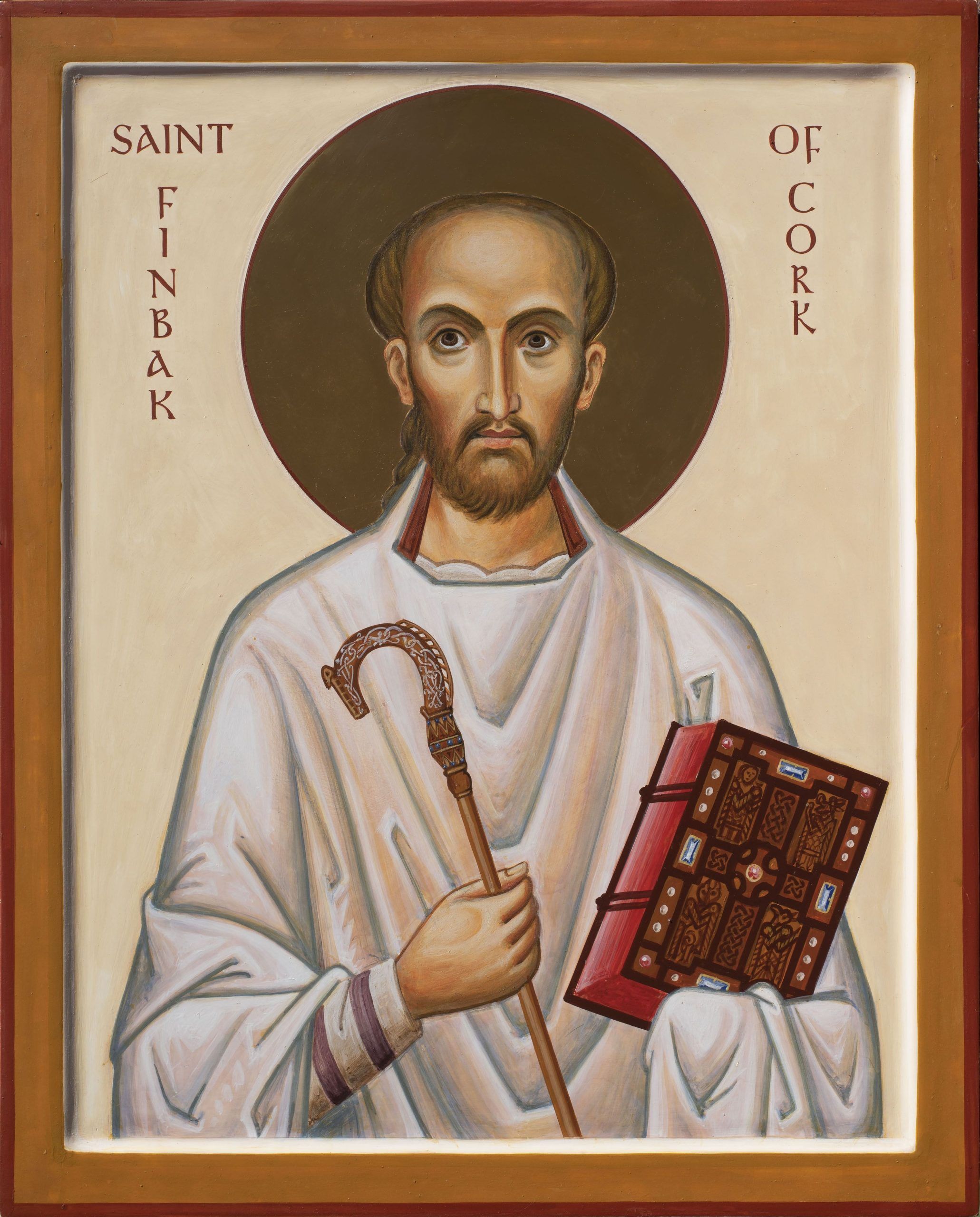
He was the son of an artisan and a lady of the Irish royal court. Born in Connaught, Ireland, and baptized Lochan, he was educated at Kilmacahil, Kilkenny, where the monks named him Fionnbharr (white head) because of his light hair; he is also known as Bairre and Barr. He went on pilgrimage to Rome with some of the monks, visiting St. David in Wales on the way back. Supposedly, on another visit to Rome the Pope wanted to consecrate him a bishop but was deterred by a vision, notifying the pope that God had reserved that honor to Himself, and Finbar was consecrated from heaven and then returned to Ireland. At any rate, he may have preached in Scotland, definitely did in southern Ireland, lived as a hermit on a small island at Lough Eiroe, and then, on the river Lee, founded a monastery that developed into the city of Cork, of which he was the first bishop. His monastery became famous in southern Ireland and attracted numerous disciples. Many extravagant miracles are attributed to him, and supposedly, the sun did not set for two weeks after he died at Cloyne about the year 633. His feast day is September 25th.
7
posted on
09/25/2020 1:15:51 AM PDT
by
Cronos
(Re-elect President Trump 2020!)
To: Cronos
NAVARRE BIBLE COMMENTARY (RSV) ********************************************************************************
From: Ecclesiastes 3:1-11
For everything there is a season
----------------------------------------------
[1] For everything there is a season, and a time for every matter
under heaven:
[2] a time to be born, and a time to die;
a time to plant, and a time to pluck up what is planted;
[3] a time to kill, and a time to heal;
a time to break down, and a time to build up;
[4] a time to weep, and a time to laugh;
a time to mourn, and a time to dance;
[5] a time to cast away stones, and a time to gather stones together;
a time to embrace, and a time to refrain from embracing;
[6] a time to seek, and a time to lose;
a time to keep, and a time to cast away;
[7] a time to rend, and a time to sew;
a time to keep silence, and a time to speak;
[8] a time to love, and a time to hate;
a time for war, and a time for peace.
[9] What gain has the worker from his toil?
Man cannot see far
----------------------------
[10] have seen the business that God has given to the sons of men to be busy with. He has made everything beautiful in its time; also he has put eternity into man’s mind, yet so that he cannot find out what God has done from the beginning to the end.
************************************************
Commentary:
3:1-15. After arriving at the previous conclusion, the sacred writer picks up the thread of his discourse to say something along the same lines as 1:3-7, but this time focusing not on the created world but on “seasonal” changes in human life. These, too, are fixed in advance and man can do nothing to alter them (vv. 1-9). However, even though he may not be able to make sense of them, man has to accept that it is God who makes “everything beautiful in its time” (vv. 10-11), and therefore man should enjoy life as a gift from God (vv. 12-13), conscious that God controls what happens now and in the future (vv. 14-15; cf. 1:9).
3:1-9. In this passage the teacher of Israel uses some ideas from the Greek philosophers. He lists fourteen pairs of “times” in the ordinary life of man. In Hebrew culture, numbers had symbolic values, multiples of seven denoting completeness; so this list is meant to include all the stages and tasks of life. By putting birth and death first he is giving them pride of place: all the other pairs fit in between birth and death. The Stoic philosophers claimed that the human mind can know the season fixed for each activity, and that a virtuous man knows and respects the appropriate time for each thing. As the Preacher sees it, man can know them, but he cannot change them, because it is God who has established those times and he has charged man with the task of discovering them. Moreover, the “seasons of life, the times at which events in man’s life happen, are presented here as transcending man’s understanding, while, at the same time, they lie at the core of his existence. Believing, as we do, that the coming of Christ marks the fullness of time, we see time to be the backdrop against which the salvation history unfolds: “In Christianity, time has a fundamental importance, says John Paul II. “Within the dimension of time the world was created; within it the history of salvation unfolds, finding its culmination in the ‘fullness of time’ of the Incarnation, and its goal in the glorious return of the Son of God at the end of time.
“In Jesus Christ, the Word made flesh, time becomes a dimension of God, who is himself eternal. With the coming of Christ there begin ‘the last days’ (cf. Heb 1:2), the ‘last hour’ (cf. 1 Jn 2:18), and the time of the Church, which will last until the Parousia. From this relationship of God with time there arises the duty to sanctify time. This is done, for example, when individual times, days or weeks, are dedicated to God, as once happened in the religion of the Old Covenant, and as happens still, though in a new way, in Christianity. In the liturgy of the Easter Vigil the celebrant, as he blesses the candle which symbolizes the Risen Christ, proclaims: ‘Christ yesterday and today, the beginning and the end. Alpha and Omega, all time belongs to him, and all the ages, to him be glory and power through every age for ever.’ He says these words as he inscribes on the candle the numerals of the current year. The meaning of this rite is clear: it emphasizes the fact that Christ is the Lord of time; he is its beginning and its end; every year, every day and every moment are embraced by his Incarnation and Resurrection, and thus become part of the ‘fullness of time’” (Tertio millenio adveniente , 10). Thus, every time, every moment, is not purely transitory; it is an eternal dimension. So, “what is important is to make good use of time, that time which is always slipping from our grasp and which to a Christian is more precious than gold, because it represents a foretaste of the glory that will he granted us hereafter” (St. J. Escriva, Friends of God, 212).
3:10-15. Earlier, the sacred writer spoke about his personal reflections (“I said to myself”: 1:16; 2:1, 15); now he is going to speak about what he sees, what his own experience has been (“I have seen”: v. 10; cf. 3:16; 4:1; etc.). He sees man’s activity as the “business” entrusted to him by God. Although man does not grasp the full import of his actions, he can still take some pleasure from them and benefit from them.
8
posted on
09/25/2020 8:00:58 AM PDT
by
fidelis
(Zonie and USAF Cold Warrior)
To: fidelis
From: Luke 9:18-22Peter's Confession of Faith
---------------------------
[18] Now it happened that as He (Jesus) was praying alone the disciples were with Him; and He asked them, "Who do the people say that I am?" [19] And they answered, "John the Baptist; but others say, Elijah; and others, that one of the old prophets has risen." [20] And He said to them, "But who do you say that I am?" And Peter answered, "The Christ of God."
First Prophecy of the Passion
-----------------------------
[21] But He charged and commanded them to tell this to no one, [22] saying, "The Son of Man must suffer many things, and be rejected by the elders and chief priests and scribes, and be killed, and on the third day be raised."
***********************************************************************
Commentary:
20. "Christ" means "anointed" and is a name indicating honor and office. In the Old Law "priests" were anointed (Exodus 29:7 and 40:13), as were "kings" (1 Samuel 9:16), because God laid down that they should receiving anointing in view of their position; there was also a custom to anoint "prophets" (1 Samuel 16:13) because they were interpreters and intermediaries of God. "When Jesus Christ our Savior came into the world, He assumed the position and obligations of the three offices of priest, king and prophet and was therefore called Christ" (St. Pius V Catechism, I, 3, 7).
22. Jesus prophesied His passion and death in order to help His disciples believe in him. It also showed that He was freely accepting these sufferings He would undergo. "Christ did not seek to be glorified: He chose to come without glory in order to undergo suffering; and you, who have been born without glory, do you wish to be glorified? The route you must take is the one Christ took. This means recognizing Him and it means imitating Him both in His ignominy and in His good repute; thus you will glory in the Cross, which was His path to glory. That was what Paul did, and therefore he glorified in saying, `Far be it from me to glory except in the cross of our Lord Jesus Christ' (Galatians 6:14)" (St. Ambrose, Expositio Evangelii Sec. Lucam, in loc.).
Daily Word for Reflection -- The Navarre Bible: Text and Commentaries
9
posted on
09/25/2020 8:01:33 AM PDT
by
fidelis
(Zonie and USAF Cold Warrior)
Disclaimer:
Opinions posted on Free Republic are those of the individual
posters and do not necessarily represent the opinion of Free Republic or its
management. All materials posted herein are protected by copyright law and the
exemption for fair use of copyrighted works.
FreeRepublic.com is powered by software copyright 2000-2008 John Robinson