Skip to comments.
Catholic Caucus: Daily Mass Readings, 09-13-2020
USCCB/RNAB ^
| Sep 13,2020
| USCCB/RNAB
Posted on 09/13/2020 5:08:38 AM PDT by Cronos
September 13 2020 Sunday of the Twenty-fourth Week in Ordinary Time
Twenty-fourth Sunday in Ordinary Time
Lectionary: 130
Wrath and anger are hateful things,
yet the sinner hugs them tight.
The vengeful will suffer the LORD’s vengeance,
for he remembers their sins in detail.
Forgive your neighbor’s injustice;
then when you pray, your own sins will be forgiven.
Could anyone nourish anger against another
and expect healing from the LORD?
Could anyone refuse mercy to another like himself,
can he seek pardon for his own sins?
If one who is but flesh cherishes wrath,
who will forgive his sins?
Remember your last days, set enmity aside;
remember death and decay, and cease from sin!
Think of the commandments, hate not your neighbor;
remember the Most High’s covenant, and overlook faults.
Responsorial Psalm
R. (8) The Lord is kind and merciful, slow to anger, and rich in compassion.
Bless the LORD, O my soul;
and all my being, bless his holy name.
Bless the LORD, O my soul,
and forget not all his benefits.
R. The Lord is kind and merciful, slow to anger, and rich in compassion.
He pardons all your iniquities,
heals all your ills.
He redeems your life from destruction,
crowns you with kindness and compassion.
R. The Lord is kind and merciful, slow to anger, and rich in compassion.
He will not always chide,
nor does he keep his wrath forever.
Not according to our sins does he deal with us,
nor does he requite us according to our crimes.
R. The Lord is kind and merciful, slow to anger, and rich in compassion.
For as the heavens are high above the earth,
so surpassing is his kindness toward those who fear him.
As far as the east is from the west,
so far has he put our transgressions from us.
R. The Lord is kind and merciful, slow to anger, and rich in compassion.
Reading 2
Brothers and sisters:
None of us lives for oneself, and no one dies for oneself.
For if we live, we live for the Lord,
and if we die, we die for the Lord;
so then, whether we live or die, we are the Lord’s.
For this is why Christ died and came to life,
that he might be Lord of both the dead and the living.
Alleluia
R. Alleluia, alleluia.
I give you a new commandment, says the Lord:
love one another as I have loved you.
R. Alleluia, alleluia.
Peter approached Jesus and asked him,
“Lord, if my brother sins against me,
how often must I forgive?
As many as seven times?”
Jesus answered, “I say to you, not seven times but seventy-seven times.
That is why the kingdom of heaven may be likened to a king
who decided to settle accounts with his servants.
When he began the accounting,
a debtor was brought before him who owed him a huge amount.
Since he had no way of paying it back,
his master ordered him to be sold,
along with his wife, his children, and all his property,
in payment of the debt.
At that, the servant fell down, did him homage, and said,
Be patient with me,and I will pay you back in full'
Moved with compassion the master of that servant
let him go and forgave him the loan.
When that servant had left, he found one of his fellow servants
who owed him a much smaller amount.
He seized him and started to choke him, demanding,
‘Pay back what you owe.’
Falling to his knees, his fellow servant begged him,
‘Be patient with me, and I will pay you back.’
But he refused.
Instead, he had the fellow servant put in prison
until he paid back the debt.
Now when his fellow servants saw what had happened,
TOPICS: Catholic; General Discusssion; Prayer; Worship
KEYWORDS: catholic; mt18; ordinarytime; prayer
Navigation: use the links below to view more comments.
first 1-20, 21-28 next last
For your reading, reflection, faith-sharing, comments, questions, discussion.
1
posted on
09/13/2020 5:08:38 AM PDT
by
Cronos
To: Cronos
The last part of the gospel wasn't posting (need to investigate), so here it is - apologies for the inconvenience
they were deeply disturbed, and went to their master
and reported the whole affair.
His master summoned him and said to him, ‘You wicked servant!
I forgave you your entire debt because you begged me to.
Should you not have had pity on your fellow servant,
as I had pity on you?’
Then in anger his master handed him over to the torturers
until he should pay back the whole debt.
So will my heavenly Father do to you,
unless each of you forgives your brother from your heart.”
2
posted on
09/13/2020 5:09:24 AM PDT
by
Cronos
(Re-elect President Trump 2020!)
To: All
catholic; mt18; ordinarytime; prayer;
3
posted on
09/13/2020 5:09:42 AM PDT
by
Cronos
(Re-elect President Trump 2020!)
To: nickcarraway; NYer; ELS; Pyro7480; livius; ArrogantBustard; Catholicguy; RobbyS; marshmallow; ...
Alleluia Ping Please FReepmail me to get on/off the Alleluia Ping List.
4
posted on
09/13/2020 5:10:12 AM PDT
by
Cronos
(Re-elect President Trump 2020!)
To: nickcarraway; NYer; ELS; Pyro7480; livius; ArrogantBustard; Catholicguy; RobbyS; marshmallow; ...
Alleluia Ping Please FReepmail me to get on/off the Alleluia Ping List.
5
posted on
09/13/2020 5:10:15 AM PDT
by
Cronos
(Re-elect President Trump 2020!)
To: All
Apologies - there seems to be some issue with overly long text posted, so I’m not able to post the Catena aurea and Greek/Latin texts today.
I’ll try other alternatives - shorter texts work in posting, so will post Catena Aurea as separate texts
6
posted on
09/13/2020 5:14:40 AM PDT
by
Cronos
(Re-elect President Trump 2020!)
To: All
18:21–22
21. Then came Peter to him, and said, Lord, how oft shall my brother sin against me, and I forgive him? till seven times?
22. Jesus saith unto him, I say not unto thee, Until seven times: but, Until seventy times seven.
JEROME. The Lord had said above, See that ye despise not one of these little ones, and had added, If thy brother sin against thee, &c. making also a promise, If two of you, & c. by which the Apostle Peter was led to ask, Lord, how oft shall my brother sin against me, and I forgive him? And to his question he adds an opinion, Until seven times?
CHRYSOSTOM. (Hom. lxi.) Peter thought that he had made a large allowance; but what answers Christ the Lover of men? it follows, Jesus saith unto him, I say not unto thee, Until seven times, but, Until seventy times seven.
AUGUSTINE. (Serm. 83. 3.) I am bold to say, that if he shall sin seventy-eight times, thou shouldest forgive him; yea, and if a hundred; and how oft soever he sin against thee, forgive him. For if Christ found a thousand sins, yet forgave them all, do not you withdraw your forgiveness. For the Apostle says, Forgiving one another, if any man hath a quarrel against any, even as God in Christ forgave you. (Col. 3:13.)
CHRYSOSTOM. When He says, Until seventy times seven, He does not limit a definite number within which forgiveness must be kept; but He signifies thereby something endless and ever enduring.
AUGUSTINE. (ubi sup.) Yet not without reason did the Lord say, Seventy times seven; for the Law is set forth in ten precepts; and the Law is signified by the number ten, sin by eleven, because it is passing the denary line. Seven is used to be put for a whole, because time goes round in seven days. Take eleven seven times, and you have seventy. He would therefore have all trespasses forgiven, for this is what He signifies by the number seventy-seven.
ORIGEN. Or, because the number six seems to denote toil and labour, and the number seven repose, He says that forgiveness should be given to all brethren who live in this world, and sin in the things of this world. But if any commit transgressions beyond these things, he shall then have no further forgiveness.
JEROME. Or understand it of four hundred and ninety times, that He bids us forgive our brother so oft.
RABANUS. It is one thing to give pardon to a brother when he seeks it, that he may live with us in social charity, as Joseph to his brethren; and another to a hostile foe, that we may wish him good, and if we can do him good, as David mourning for Saul.
7
posted on
09/13/2020 5:15:15 AM PDT
by
Cronos
(Re-elect President Trump 2020!)
To: All
18:23–35
23. Therefore is the kingdom of heaven likened unto a certain king, which would take account of his servants.
24. And when he had begun to reckon, one was brought unto him, which owed him ten thousand talents.
25. But forasmuch as he had not to pay, his lord commanded him to be sold, and his wife, and children, and all that he had, and payment to be made.
26. The servant therefore fell down, and worshipped him, saying, Lord, have patience with me, and I will pay thee all.
27. Then the lord of that servant was moved with compassion, and loosed him, and forgave him the debt.
28. But the same servant went out, and found one of his fellow-servants, which owed him an hundred pence: and he laid hands on him, and took him by the throat, saying, Pay me that thou owest.
29. And his fellowservant fell down at his feet, and besought him, saying, Have patience with me, and I will pay thee all.
30. And he would not: but went and cast him into prison, till he should pay the debt.
31. So when his fellowservants saw what was done, they were very sorry, and came and told unto their lord all that was done.
32. Then his lord, after that he had called him, said unto him, O thou wicked servant, I forgave thee all that debt, because thou desiredst me:
33. Shouldest not thou also have had compassion on thy fellowservant, even as I had pity on thee?
34. And his lord was wroth, and delivered him to the tormentors, till he should pay all that was due unto him.
35. So likewise shall my heavenly Father do also unto you, if ye from your hearts forgive not every one his brother their trespasses.
CHRYSOSTOM. That none should think that the Lord had enjoined something great and burdensome in saying that we must forgive till seventy times seven, He adds a parable.
JEROME. For it is customary with the Syrians, especially they of Palestine, to add a parable to what they speak; that what their hearers might not retain simply, and in itself, the instance and similitude may be the means of retaining.
ORIGEN. The Son of God, as He is wisdom, righteousness, and truth (vid. 1 Cor. 1:30.), so is He a kingdom; not indeed any of those which are beneath, but all those which are above, reigning over those in whose senses reigns justice and the other virtues; these are made of heaven because they bear the image of the heavenly. This kingdom of heaven then, i. e. the Son of God, when He was made in the likeness of sinful flesh, was then like to a king, in uniting man to himself.
REMIGIUS. Or, by the kingdom of heaven is reasonably understood the holy Church, in which the Lord works what He speaks of in this parable. By the man is sometimes represented the Father, as in that, The kingdom of heaven is like to a king, who made a marriage for his son; and sometimes the Son; but here we may take it for both, the Father and the Son, who are one God. God is called a King, inasmuch as He created and governs all things.
ORIGEN. The servants, in these parables, are only they who are employed in dispensing the word, and to whom this business is committed.
REMIGIUS. Or, by the servants of this King are signified all mankind whom He has created for His own praise, and to whom He gave the law of nature; He takes account with them, when He would look into each man’s manners, life, and deeds, that He may render to each according to that He has done; as it follows, And when He had begun to reckon, one was brought unto Him which owed Him ten, thousand talents.
ORIGEN. The King takes account of our, whole life then, when we must all be presented before the judgment-seat of Christ. (2 Cor. 5:10.) We mean not this so as that any should think that the business itself must needs require a long time. For God, when He will scrutinize the minds of all, will by some undescribable power cause every thing that every man has done to pass speedily before the mind of each. He says, And when he began to take account, because the beginning of the judgment is that it begin from the house of God. (1 Pet. 4:17.) At His beginning to take account there is brought unto Him one who owes Him many talents; one, that is, who had wrought great evils; one on whom much had been enjoined, and had yet brought no gain; who perhaps had destroyed as many men as he owed talents; one who was therefore become a debtor of many talents, because he had followed the woman sitting upon a talent of lead, whose name is Iniquity. (Zech. 5:7.)
JEROME. I know that some interpret the man who owed the ten thousand talents to be the devil, and by his wife and children who were to be sold when he persevered in his wickedness, understand foolishness, and hurtful thoughts. For as wisdom is called the wife of the righteous man, so the wife of the unrighteous and the sinner is called foolishness. But how the Lord remits to the devil ten thousand talents, and how he would not remit ten denarii to us his fellow-servants, of this there is no ecclesiastical interpretation, nor is it to be admitted by thoughtful men.
AUGUSTINE. (Serm. 83, 6.) Therefore let us say, that because the Law is set forth in ten precepts, the ten thousand talents which he owed denote all sins which can be done under the Law.
REMIGIUS. Man who sinned of his own will and choice, has no power to rise again by his own endeavour, and has not wherewith to pay, because he finds nothing in himself by which he may loose himself from his sins; whence it follows, And when he had not to pay, his lord commanded him to be sold, and his wife and children, and all that he had, and payment to be made. The fool’s wife is folly, and the pleasure or lust of the flesh.
AUGUSTINE. (Quæst. Ev. i. 25.) This signifies that the transgressor of the decalogue deserves punishment for his lusts and evil deeds; and that is his price; for the price for which they sell is the punishment of him that is damned.
CHRYSOSTOM. This command issued not of cruelty, but of unspeakable tenderness. For he seeks by these terrors to bring him to plead that he be not sold, which fell out, as he shews when he adds, The servant therefore fell down and besought him, saying, Have patience with me, and I will pay thee all.
REMIGIUS. That he says, falling down, shews how the sinner humbled himself, and offered amends. Have patience with me, expresses the sinner’s prayer, begging respite, and space to correct his error. Abundant is the bounty of God, and His clemency to sinners converted, seeing He is ever ready to forgive sins by baptism or penitence, as it follows, But the lord of that servant had mercy upon him, and loosed him, and forgave him the debt.
CHRYSOSTOM. See the exuberance of heavenly love! The servant asked only a brief respite, but he gives him more than he had asked, a full remittance and cancelling of the whole debt. He was minded to have forgiven him from the very first, but he would not have it to be of his own mere motion, but also of the other’s suit, that he might not depart without a gift. But he did not remit the debt till he had taken account, because he would have him know how great debts he set him free of, that by this he should at the least be made more merciful to his fellow servants. And indeed as far as what has gone he was worthy to be accepted; for he made confession, and promised that he would pay the debt, and fell down and begged, and confessed the greatness of his debt. But his after deeds were unworthy of the former, for it follows, But the same servant went out, and found one of his fellow-servants which owed him a hundred denarii.
AUGUSTINE. (Serm. 83. 6.) That He says he owed him a hundred denarii is taken from the same number, ten, the number of the Law. For a hundred times a hundred are ten thousand, and ten times ten are a hundred; and those ten thousand talents and these hundred denarii are still keeping to the number of the Law; in both of them you find sins. Both are debtors, both are suitors for remission; so every man is himself a debtor to God, and has his brother his debtor.
CHRYSOSTOM. But there is as great difference between sins committed against men, and sins committed against God, as between ten thousand talents and a hundred denarii; yea rather there is still greater difference. This appears from the difference of the persons, and from the fewness of the offenders. For when we are seen of man we withhold and are loath to sin, but we cease not daily though God see us, but act and speak all things fearlessly. Not by this only are our sins against God shewn to be more heinous, but also by reason of the benefits which we have received from Him; He gave us being, and has done all things in our behalf, has breathed into us a rational soul, has sent His Son, has opened heaven to us, and made us His sons. If then we should every day die for Him, could we make Him any worthy return? By no means; it should rather redound again to our advantage. But, on the contrary, we offend against His laws.
REMIGIUS. So by him who owed ten thousand talents are represented those that commit the greater crimes; by the debtor of a hundred denarii those who commit the lesser.
8
posted on
09/13/2020 5:16:47 AM PDT
by
Cronos
(Re-elect President Trump 2020!)
To: All
JEROME. That this may be made plainer, let us speak it in instances. If any one of you shall have committed an adultery, a homicide, or a sacrilege, these greater sins of ton thousand talents shall be remitted when you beg for it, if you also shall remit lesser offences to those that trespass against you.
AUGUSTINE. (ubi sup.) But this unworthy, unjust servant would not render that which had been rendered to him, for it follows, And he laid hands on him, and held him by the throat, saying, Pay me that thou, owest.
REMIGIUS. That is, he pressed him hardly, that he might exact vengeance from him.
ORIGEN. He therefore, as I suppose, took him by the throat, because he had come forth from the king; for he would not have so handled his fellow servant, if he had not gone forth from the king.
CHRYSOSTOM. By saying, as he went out, He shews that it was not after long time, but immediately, while the favour he had received still sounded in his ears, he abused to wickedness the liberty his lord had accorded him. What the other did is added, And his fellow-servant fell down, and besought him, saying, Have patience with me, and I will pay thee all,
ORIGEN. Observe the exactness of Scripture; the servant who owed many talents fell down, and worshipped the king; he who owed the hundred denarii falling down, did not worship, but besought his fellow servant, saying, Have patience. But the ungrateful servant did not even respect the very words which had saved himself, for it follows, but he would not.
AUGUSTINE. (Quæst. Ev. i. 25.) That is, he nourished such thoughts towards him that he sought his punishment. But he went his way.
REMIGIUS. That is, his wrath was the rather inflamed, to exact vengeance of him; And he cast him into prison, until he should pay the debt; that is, he seized his brother, and exacted vengeance of him.
CHRYSOSTOM. Observe the Lord’s tenderness, and the servant’s cruelty; the one for ten thousand talents, the other for ten denarii; the one a suitor to his fellow, the other to his lord; the one obtained entire remission, the other sought only respite, but he got it not. They who owed nought grieved with him; his fellow-servants, seeing what was done, were very sorry.
AUGUSTINE. (Quæst. Ev. i. 25.) By the fellow-servants is understood the Church, which binds one and looses another.
REMIGIUS. Or perhaps they represent the Angels, or the preachers of the holy Church, or any of the faithful, who when they see a brother whose sins are forgiven refusing to forgive his fellow-servant, they are sorrowful over his perdition. And they came, and told their lord, what was done. They came not in body, but in spirit. To tell their Lord, is to shew the woe and sorrow of the heart in their carriage. It follows, Then his lord called him. He called him by the sentence of death, and bade him pass out of this world, and said unto him, Thou wicked servant, I forgave thee all that debt, because thou prayedst me.
CHRYSOSTOM. When he owed him ten thousand talents, he did not call him wicked, nor did he at all chide him, but had mercy on him; but now when he had been ungenerous to his fellow-servant, then he says to him, Thou wicked servant; and this is what is said, Oughtest thou not to have had mercy upon thy fellow-servant.
REMIGIUS. And it is to be known, that we read no answer made by that servant to his lord; by which it is shewn us, that in the day of judgment, and altogether after this life, all excusing of ourselves shall be out off,
CHRYSOSTOM. Because kindness had not mended him, it remains that he be corrected by punishment; whence it follows, And the lord of that servant was angry, and delivered him to the torturers until he should pay the whole debt. He said not merely, Delivered him, but was angry, this he had not said before; when his Lord commanded that he should be sold; for that was not in wrath, but in love, for his correction; now this is a sentence of penalty and punishment,
REMIGIUS. For God is said then to be wroth, when he takes vengeance on sinners. Torturers are intended for the dæmons, who are always ready to take up lost souls, and torture them in the pangs of eternal punishment. Will any who is once sunk into everlasting condemnation ever come to find season of repentance, and a way to escape? Never; that until is put for infinity; and the meaning is, He shall be ever paying, and shall never quit the debt, but shall be ever under punishment,
CHRYSOSTOM. By this is shewn that his punishment shall be increasing and eternal, and that he shall never pay. And however irrevocable are the graces and callings of God, yet wickedness has that force, that it seems to break even this law.
AUGUSTINE. (Serm. 83, 7.) or God says, Forgive, and ye shall be forgiven; (Luke 6:37.) I have first forgiven, forgive you then after Me; for if you forgive not, I will call you back, and will require again all that I had remitted to you. For Christ neither deceives nor is deceived; and He adds here, Thus will my heavenly Father do unto you, if ye from your hearts forgive not every one his brother their trespasses. It is better that you should cry out with your mouth, and forgive in your heart, than that you should speak smoothly, and be unrelenting in your heart For the Lord adds, From your hearts, to the end that though, out of affection you put him to discipline, yet gentleness should not depart out of your heart. What is more beneficial than the knife of the surgeon? He is rough with the sore that the man may be healed; should he be tender with the sore, the man were lost.
JEROME. Also this, from your hearts, is added to take away all feigned reconciliations. Therefore the Lord’s command to Peter under this similitude of the king and his servant who owed him ten thousand talents, and was forgiven by his lord upon his entreaty, is, that he also should forgive his fellow-servants their lesser trespasses.
ORIGEN. He seeks to instruct us, that we should be ready to shew clemency to those who have done us harm, especially if they offer amends, and plead to have forgiveness.
RABANUS. Allegorically; The servant here who owed the ten thousand talents, is the Jewish people bound to the Ten Commandments in the Law. These the Lord oft forgave their trespasses, when being in difficulties they besought His mercy; but when they were set free, they exacted the utmost with great severity from all their debtors; and of the gentile people which they hated, they required circumcision and the ceremonies of the Law; yea, the Prophets and Apostles they barbarously put to death. For all this the Lord gave them over into the hands of the Romans as to evil spirits, who should punish them with eternal tortures.
9
posted on
09/13/2020 5:17:00 AM PDT
by
Cronos
(Re-elect President Trump 2020!)
To: All
| Matthew |
| |
English: Douay-Rheims |
Latin: Vulgata Clementina |
Greek NT: Byzantine/Majority Text (2000) |
| |
Matthew 18
|
| 21. |
Then came Peter unto him and said: Lord, how often shall my brother offend against me, and I forgive him? till seven times? |
Tunc accedens Petrus ad eum, dixit : Domine, quoties peccabit in me frater meus, et dimittam ei ? usque septies ? |
τοτε προσελθων αυτω ο πετρος ειπεν κυριε ποσακις αμαρτησει εις εμε ο αδελφος μου και αφησω αυτω εως επτακις |
| 22. |
Jesus saith to him: I say not to thee, till seven times; but till seventy times seven times. |
Dicit illi Jesus : Non dico tibi usque septies : sed usque septuagies septies. |
λεγει αυτω ο ιησους ου λεγω σοι εως επτακις αλλ εως εβδομηκοντακις επτα |
| 23. |
Therefore is the kingdom of heaven likened to a king, who would take an account of his servants. |
Ideo assimilatum est regnum cælorum homini regi, qui voluit rationem ponere cum servis suis. |
δια τουτο ωμοιωθη η βασιλεια των ουρανων ανθρωπω βασιλει ος ηθελησεν συναραι λογον μετα των δουλων αυτου |
| 24. |
And when he had begun to take the account, one was brought to him, that owed him ten thousand talents. |
Et cum cœpisset rationem ponere, oblatus est ei unus, qui debebat ei decem millia talenta. |
αρξαμενου δε αυτου συναιρειν προσηνεχθη αυτω εις οφειλετης μυριων ταλαντων |
| 25. |
And as he had not wherewith to pay it, his lord commanded that he should be sold, and his wife and children and all that he had, and payment to be made. |
Cum autem non haberet unde redderet, jussit eum dominus ejus venundari, et uxorem ejus, et filios, et omnia quæ habebat, et reddi. |
μη εχοντος δε αυτου αποδουναι εκελευσεν αυτον ο κυριος αυτου πραθηναι και την γυναικα αυτου και τα τεκνα και παντα οσα ειχεν και αποδοθηναι |
10
posted on
09/13/2020 5:17:43 AM PDT
by
Cronos
(Re-elect President Trump 2020!)
To: All
| 26. |
But that servant falling down, besought him, saying: Have patience with me, and I will pay thee all. |
Procidens autem servus ille, orabat eum, dicens : Patientiam habe in me, et omnia reddam tibi. |
πεσων ουν ο δουλος προσεκυνει αυτω λεγων κυριε μακροθυμησον επ εμοι και παντα σοι αποδωσω |
| 27. |
And the lord of that servant being moved with pity, let him go and forgave him the debt. |
Misertus autem dominus servi illius, dimisit eum, et debitum dimisit ei. |
σπλαγχνισθεις δε ο κυριος του δουλου εκεινου απελυσεν αυτον και το δανειον αφηκεν αυτω |
| 28. |
But when that servant was gone out, he found one of his fellow servants that owed him an hundred pence: and laying hold of him, throttled him, saying: Pay what thou owest. |
Egressus autem servus ille invenit unum de conservis suis, qui debebat ei centum denarios : et tenens suffocavit eum, dicens : Redde quod debes. |
εξελθων δε ο δουλος εκεινος ευρεν ενα των συνδουλων αυτου ος ωφειλεν αυτω εκατον δηναρια και κρατησας αυτον επνιγεν λεγων αποδος μοι ει τι οφειλεις |
| 29. |
And his fellow servant falling down, besought him, saying: Have patience with me, and I will pay thee all. |
Et procidens conservus ejus, rogabat eum, dicens : Patientiam habe in me, et omnia reddam tibi. |
πεσων ουν ο συνδουλος αυτου εις τους ποδας αυτου παρεκαλει αυτον λεγων μακροθυμησον επ εμοι και αποδωσω σοι |
| 30. |
And he would not: but went and cast him into prison, till he paid the debt. |
Ille autem noluit : sed abiit, et misit eum in carcerem donec redderet debitum. |
ο δε ουκ ηθελεν αλλα απελθων εβαλεν αυτον εις φυλακην εως ου αποδω το οφειλομενον |
11
posted on
09/13/2020 5:18:19 AM PDT
by
Cronos
(Re-elect President Trump 2020!)
To: All
| 31. |
Now his fellow servants seeing what was done, were very much grieved, and they came and told their lord all that was done. |
Videntes autem conservi ejus quæ fiebant, contristati sunt valde : et venerunt, et narraverunt domino suo omnia quæ facta fuerant. |
ιδοντες δε οι συνδουλοι αυτου τα γενομενα ελυπηθησαν σφοδρα και ελθοντες διεσαφησαν τω κυριω εαυτων παντα τα γενομενα |
| 32. |
Then his lord called him; and said to him: Thou wicked servant, I forgave thee all the debt, because thou besoughtest me: |
Tunc vocavit illum dominus suus : et ait illi : Serve nequam, omne debitum dimisi tibi quoniam rogasti me : |
τοτε προσκαλεσαμενος αυτον ο κυριος αυτου λεγει αυτω δουλε πονηρε πασαν την οφειλην εκεινην αφηκα σοι επει παρεκαλεσας με |
| 33. |
Shouldst not thou then have had compassion also on thy fellow servant, even as I had compassion on thee? |
nonne ergo oportuit et te misereri conservi tui, sicut et ego tui misertus sum ? |
ουκ εδει και σε ελεησαι τον συνδουλον σου ως και εγω σε ηλεησα |
| 34. |
And his lord being angry, delivered him to the torturers until he paid all the debt. |
Et iratus dominus ejus tradidit eum tortoribus, quoadusque redderet universum debitum. |
και οργισθεις ο κυριος αυτου παρεδωκεν αυτον τοις βασανισταις εως ου αποδω παν το οφειλομενον αυτω |
| 35. |
So also shall my heavenly Father do to you, if you forgive not every one his brother from your hearts. |
Sic et Pater meus cælestis faciet vobis, si non remiseritis unusquisque fratri suo de cordibus vestris. |
ουτως και ο πατηρ μου ο επουρανιος ποιησει υμιν εαν μη αφητε εκαστος τω αδελφω αυτου απο των καρδιων υμων τα παραπτωματα αυτων |
12
posted on
09/13/2020 5:18:48 AM PDT
by
Cronos
(Re-elect President Trump 2020!)
To: Cronos
NAVARRE BIBLE COMMENTARY (RSV) ********************************************************************************
From: Sirach 27:30 - 28:7
Forgiving others
-----------------------
27:[30] Anger and wrath, these also are abominations, and the sinful man will possess them.
28:[1] He that takes vengeance will suffer vengeance from the Lord, and he will firmly establish his sins. [2] Forgive your neighbor the wrong he has done, and then your sins will be pardoned when you pray. [3] Does a man harbor anger against another, and yet seek for healing from the Lord? [4] Does he have no mercy toward a man like himself, and yet pray for his own sins? [5] If he himself, being flesh, maintains wrath, who will make expiation for his sins? [6] Remember the end of your life, and cease from enmity, remember destruction and death, and be true to the commandments. [7] Remember the commandments, and do not be angry with your neighbor; remember the covenant of the Most High, and overlook ignorance.
**************************************************************
Commentary:
28:1-11. This passage contains three groups of sayings on one theme: seek peace and reconciliation, not discord. The first group (vv. 1-5) has to do with forgiveness: one to forgive others in order to be forgiven oneself. The second group (vv. 6-7) gives the various reasons for not bearing grudges against one's neighbour: we should "remember" who we are and how good God has been to us. The third (vv. 8-11) wants against getting into arguments because they only make matters worse.
Our Lord may well have had these or similar sayings in mind when he taught in the Our Father, "Forgive us our debts as we also forgive our debtors" (Mt 6:12; cf. also Mt 6:14). "Christian prayer extends to the 'forgiveness of enemies' (cf. Mt 5:43-44), transfiguring the disciple by configuring him to his Master. Forgiveness is a high-point of Christian prayer; only hearts attuned to God's compassion can receive the gift of prayer. Forgiveness also bears witness that, in our world, love is stronger than sin. The martyrs of yesterday and today bear this witness to Jesus. Forgiveness is the fundamental condition of the reconciliation of the children of God with their Father and of men with one another" (Catechism of the Catholic Church, 2844). And St John Chrysostom, quoting 28:2-4, writes: "Although you may not deliberately do harm to your enemies, if you fail to show goodwill to them and leave the wound open on their souls, you are disobeying the commandment laid down by Christ. How can you ask God to treat you with good grace, if you yourself do not show mercy to those who have sinned against you?" (De compunction, 1, 5).
13
posted on
09/13/2020 7:09:56 AM PDT
by
fidelis
(Zonie and USAF Cold Warrior)
To: fidelis
From: Romans 14:7-9 [7] None of us lives to himself, and none of us dies to himself. [8] If we live, we live to the Lord, and if we die, we die to the Lord; then, whether we live or whether we die, we are the Lord's. [9] For to this end Christ died and lived again, that he might be Lord both of the dead and of the living.
***********************************************************************
Commentary:
7-9. We do not own ourselves, we are not our own masters. God, One and Three, has created us, and Jesus Christ has freed us from sin by redeeming us with his Blood. Therefore, he is our lord, and we his servants, committed to him body and soul. Just as the slave is not his own master, but he himself and all he does redounds to the benefit of his master, everything we are and everything we have are geared, in the last analysis, not to our own use and benefit: we have to live and die for the glory of God. He is lord of our life and of our death. Commenting on these words St Gregory the Great says: "The saints, therefore, do not live and do not die for themselves. They do not live for themselves, because in all that they do they strive for spiritual gain: by praying, preaching and persevering in good works, they seek the increase of the citizens of the heavenly fatherland. Nor do they die for themselves because men see them glorifying God by their death, hastening to reach him through death" (In Ezechielem Homiliae, II, 10).
14
posted on
09/13/2020 7:10:36 AM PDT
by
fidelis
(Zonie and USAF Cold Warrior)
To: fidelis
From: Matthew 18:21-19:2Forgiveness of Injuries. The Parable of the Unforgiving Servant
----------------------------------------------------------------
[21] Then Peter came up and said to Him (Jesus), "Lord, how often shall my brother sin against me, and I forgive him? As many as seven times?" [22] Jesus said to him, "I do not say to you seven times, but seventy times seven.
[23] "Therefore the Kingdom of Heaven may be compared to a king who wished to settle accounts with his servants. [24] When he began the reckoning, one was brought to him who owed him ten thousand talents; [25] and as he could not pay, his lord ordered him to be sold, with his wife and children and all that he had, and payment to be made. [26] So the servant fell on his knees, imploring him, 'Lord, have patience with me, and I will pay you everything.' [27] And out of pity for him the lord of that servant released him and forgave him the debt. [28] But that same servant, as he went out, came upon one of his fellow servants who owed him a hundred denarii; and seizing him by the throat he said, `Pay what you owe.' [29] So his fellow servant fell down and besought him, `Have patience with me, and I will pay you.' [30] He refused and went and put him in prison till he should pay his debt. [31] When his fellow servants saw what had taken place, they were greatly distressed, and they went and reported to their lord all that had taken place. [32] Then his lord summoned him and said to him, `You wicked servant! I forgave you all that debt because you besought me; [33] and should not you have had mercy on your fellow servant, as I had mercy on you?' [34] And in anger his lord delivered him to the jailers, till he should pay all his debt. [35] So also My Heavenly Father will do to every one of you, if you do not forgive your brother from your heart."
***********************************************************************
Commentary:
21-35. Peter's question and particularly Jesus' reply prescribe the spirit of understanding and mercy which should govern Christians' behavior.
In Hebrew the figure of seventy times seven means the same as "always" (cf. Genesis 4:24): "Therefore, our Lord did not limit forgiveness to a fixed number, but declared that it must be continuous and forever" (Chrysostom, Hom. on St. Matthew, 6). Here also we can see the contrast between the man's ungenerous, calculating approach to forgiveness, and God's infinite mercy. The parable also clearly shows that we are totally in God's debt. A talent was the equivalent of six thousand denarii, and a denarius a working man's daily wage. Ten thousand talents, an enormous sum, gives us an idea of the immense value attaching to the pardon we receive from God. Overall, the parable teaches that we must always forgive our brothers, and must do so wholeheartedly.
"Force yourself, if necessary, always to forgive those who offend you, from the very first moment. For the greatest injury or offense that you can suffer from them is nothing compared to what God has pardoned you" ([St] J. Escriva, The Way, 452).
Daily Word for Reflection -- The Navarre Bible: Text and Commentaries
Other resources for this Sunday’s Readings:
Sunday Scripture Study for Catholics
The Sacred Page (Dr. John Bergsma)
Catholic Productions (Dr. Brant Pitre) – The Readings Explained (video): The Parable of the Unforgiving Servant
Catholic Productions (Dr. Brant Pitre) – The Readings Explained (video): Jesus of Nazareth [Romans 14]
LectioTube
15
posted on
09/13/2020 7:12:07 AM PDT
by
fidelis
(Zonie and USAF Cold Warrior)
To: Cronos
Do we have to forgive Antifa?
To: Cronos; John Robinson
John, this problem re-emerges with some regularity.
Short posts go through, longer posts are rejected.
17
posted on
09/13/2020 11:22:41 AM PDT
by
annalex
(fear them not)
To: Cronos
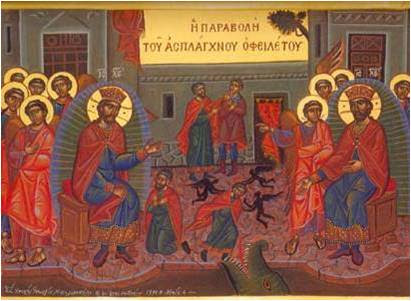
The Parable of the Unforgiving Servant
The ethical symmetry of the parable is enhanced here by the visual symmetry of the icon, where Christ is shown two times to offer both mercy and justice.
18
posted on
09/13/2020 11:25:54 AM PDT
by
annalex
(fear them not)
To: Phillyred
We must love them (not the same as “like them” or “approve of them”) and pray for them. We must forgive when they ask forgiveness with sincerity and take steps to repent. Just my opinion.
19
posted on
09/13/2020 11:28:44 AM PDT
by
annalex
(fear them not)
To: Cronos
Superseded by Sunday:
Saint John Chrysostom’s Story
The ambiguity and intrigue surrounding John, the great preacher (his name means “golden-mouthed”) from Antioch, are characteristic of the life of any great man in a capital city. Brought to Constantinople after a dozen years of priestly service in Syria, John found himself the reluctant victim of an imperial ruse to make him bishop in the greatest city of the empire. Ascetic, unimposing but dignified, and troubled by stomach ailments from his desert days as a monk, John became a bishop under the cloud of imperial politics.
If his body was weak, his tongue was powerful. The content of his sermons, his exegesis of Scripture, were never without a point. Sometimes the point stung the high and mighty. Some sermons lasted up to two hours.
His lifestyle at the imperial court was not appreciated by many courtiers. He offered a modest table to episcopal sycophants hanging around for imperial and ecclesiastical favors. John deplored the court protocol that accorded him precedence before the highest state officials. He would not be a kept man.
His zeal led him to decisive action. Bishops who bribed their way into office were deposed. Many of his sermons called for concrete steps to share wealth with the poor. The rich did not appreciate hearing from John that private property existed because of Adam’s fall from grace any more than married men liked to hear that they were bound to marital fidelity just as much as their wives were. When it came to justice and charity, John acknowledged no double standards.
Aloof, energetic, outspoken, especially when he became excited in the pulpit, John was a sure target for criticism and personal trouble. He was accused of gorging himself secretly on rich wines and fine foods. His faithfulness as spiritual director to the rich widow, Olympia, provoked much gossip attempting to prove him a hypocrite where wealth and chastity were concerned. His actions taken against unworthy bishops in Asia Minor were viewed by other ecclesiastics as a greedy, uncanonical extension of his authority.
Theophilus, archbishop of Alexandria, and Empress Eudoxia were determined to discredit John. Theophilus feared the growth in importance of the Bishop of Constantinople and took occasion to charge John with fostering heresy. Theophilus and other angered bishops were supported by Eudoxia. The empress resented his sermons contrasting gospel values with the excesses of imperial court life. Whether intended or not, sermons mentioning the lurid Jezebel and impious Herodias were associated with the empress, who finally did manage to have John exiled. He died in exile in 407.
Reflection
John Chrysostom’s preaching, by word and example, exemplifies the role of the prophet to comfort the afflicted and to afflict the comfortable. For his honesty and courage, he paid the price of a turbulent ministry as bishop, personal vilification, and exile.
Saint John Chrysostom is the Patron Saint of:
Orators
Preachers
Speakers
franciscanmedia.org
Additionally: Patronage: Constantinople; education; epilepsy
Patron_Archive
20
posted on
09/13/2020 11:37:45 AM PDT
by
annalex
(fear them not)
Navigation: use the links below to view more comments.
first 1-20, 21-28 next last
Disclaimer:
Opinions posted on Free Republic are those of the individual
posters and do not necessarily represent the opinion of Free Republic or its
management. All materials posted herein are protected by copyright law and the
exemption for fair use of copyrighted works.
FreeRepublic.com is powered by software copyright 2000-2008 John Robinson