Posted on 05/06/2020 10:21:20 AM PDT by Salvation
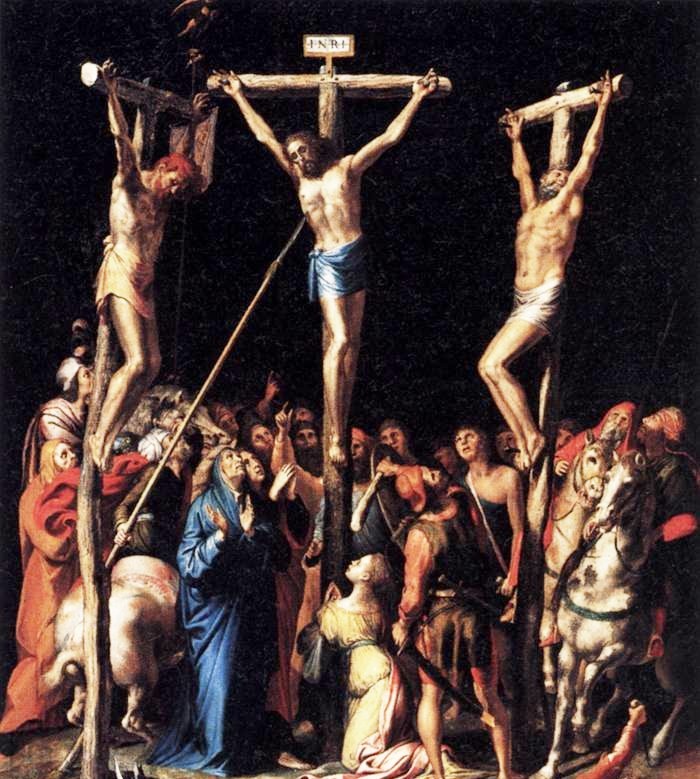
Although we are well into the Easter season, my mind harkens back to an event on Good Friday that has often puzzled me. What turned the crowd against Jesus? Recall that just six days earlier, on Palm Sunday, the crowds praised Him, acclaimed Him Son of David, and spoke of Him as a king and messiah. By the morning of Good Friday, though, they were calling for Him to be crucified. What turned them against Him?
My usual explanation was to suppose that the Temple leaders hired a crowd of ruffians and coached them on what to say. In other words, I conjectured that these were not the same people who welcomed Jesus on Palm Sunday but rather a carefully selected group assembled on the plaza in front of the governor’s residence (the Praetorium). While it may be true that the Temple leaders coached them, it still raises the question, how were they able to find so many people willing to turn against a man so widely admired and appreciated by the ordinary faithful?
Fr. Antonin-Gilbert Sertillanges gave a thoughtful and insightful analysis of this event and of the crowd’s motivation in his book What Jesus Saw from the Cross. Let us consider Fr. Sertillanges’ explanation of the mood of the crowd. (Note that he does notdiscount that many in the crowd may well have hailed Jesus as Messiah on Palm Sunday.)
At the beginning of his sacred ministry … Jesus had aroused intense enthusiasm …. [But now] what is the grievance? That the leaders of the Jews should have hated Jesus is perhaps intelligible, but the enmity of the crowd is most mysterious. It is only at the last moment that it becomes manifest, and then only under the stimulus of encouragement from the priests (pp. 157-158).
So, Fr. Sertillanges has pondered the mysterious shift in mood of the crowd. And while he notes that there was some stimulus from the Temple leaders, he does not presume that those leaders had gathered the crowd.
[On that Good Friday] morning the crowd assembled for reasons of its own. They have a right to have a prisoner released to them on this day and they are coming to claim that right. Perhaps they are thinking of Barabbas, perhaps of Jesus, who is just at this moment appearing before the tribunal. … Pilate [however] irritates them twice by referring jocularly to [Jesus] as “their king.” [And thus, Jesus now] arouses their division more than their pity: a messiah in chains before a Roman governor? This seems to be the kernel of the matter in the eyes of these Israelites, who were enthusiastic [on Palm Sunday], a few moments ago were in doubt, and now are suddenly hostile and furious (p. 158).
Now Father moves to the psychological shift that takes place:
Mobs do not like to be disillusioned; and the man who disappoints them may pass in a moment from the rank of a national hero to nothing, and even to less than nothing. … Think what a disillusionment it is for the Jews to see Jesus in this [scourged] condition before Pilate. … This is the Pauline “scandal of the cross” (p. 159).
From disappointment they pass to spite, from spite to anger, and under the ceaseless encouragement of their iniquitous leaders they are easily roused to exasperation. The word crosshas been spoken; it is taken up and repeated. … The taste of blood now begins to intoxicate the mob; a thrill of cruelty runs through them all. To any further questions or objections, the maddened crowd has only one reply, given with increasing violence: “Crucify him! Crucify him!” (pp. 159-160)
[And thus, Jesus departs the Preatorium] carrying all his blessings with him. As he processes along the way … the cruel gaiety of this day has gone to everybody’s head. Every savage instinct latent in the heart of man was awake; souls froth over with rage in this anticipatory delegation of those in every generation who would hate and oppose Christ vented itself in the cry of Satanic joy (p. 161).
Going even deeper into the cause of their disillusionment, Fr. Sertillanges ponders:
And yet, [at a deeper spiritual level] the problem still remains: how did this transformation which we have described become possible?
The mystics tell us that a great moral lapse is always preceded by hidden causes. [Some have noted that] the Jewish masses at that time were prone to mystical curiosity and superstitious practices. The success that Jesus achieved among the masses was due to the [messianic] interests of the moment and the enthusiasm aroused by his miracles, the fascination of his discourse, and to the sardonic satisfaction of hearing their leaders criticized and of seeing them defied …. [This explains their attraction to Jesus] more than a fully convinced adherence to Jesus and his teaching (pp. 161-162).
The people had become dazzled, not convinced, and their carnal expectations were disappointed. Jesus as a political Messiah … Casting off the Roman yoke, the abolition of taxes and the return of the Jews of the dispersal, this is what would have won them over. But the aims and the doctrines of the Savior were not of this kind; and this is the reason why, as soon as they see their selfish hopes disappointed, the crowd turned against him. Their favor becomes hostility (p. 162).
This is quite a rich examination of the puzzling shift in the mood of the crowd.To Father’s reflection I can only add that St. Paul calls the cross a stumbling block to Jews because Deuteronomy (21:23) says, “Cursed is everyone who hangs on a tree.” As they beheld Jesus horribly scourged, a prelude to crucifixion, they judge Him cursed by God and bitterly dismissed the idea that He could be the Messiah they hoped for.
There much to ponder in Fr. A.G. Sertillanges’ What Jesus Saw from the Cross. It is rich in history and spirituality and I highly recommend it for your reading.
Monsignor Pope Ping!
Argued with Race_Bannon about baptism?
Schumer’s and Schiff of there day were in charge!
The enthusiasm of the common people for Jesus was shallow, kind of a bread and circuses thing, I think. He spoke to them about showing up hoping to see miracles and get food when that wasn’t really the significant reason he was there. If the great mass of the Jewish public were in the right place for his message, God would not have had to graft in the Gentiles.
I believe there were two different crowds. The people entering on Palm Sunday had been traveling with Jesus to Jerusalem for Passover, and many had witnessed the raising of Lazarus. The crown calling for Crucifixion were part of the Jerusalem residents who had been stocked up by the Priests and Pharisees for months - many hand-picked to be there early in the morning.
But there is another very significant point: Both Satan and the Father wanted the same thing: Jesus dead as soon as possible. So nothing was going to get in the way of the Crucifixion of Jesus.
Good points!
He said something nice about Donald Trump?
I’ve always been curious why Jesus was not taken into custody again after he rose from the dead and was openly teaching large crowds of followers. Obviously the word went out that Jesus was alive if people came to hear him.
Frankly, I just figured they were different crowds. The first were throngs of followers who thought it was cool. The second were a lot of people who had bought in with the Romans, and saw Jesus as a threat to their way of life.
Plus also struggling under the superpower of the time,ancient Rome.
The Pharisees had everything to lose: their power, prestige/status and authority over the people. Their "glue" was the "promise" of a temporal/political Messiah, not the meek, sacrificing Lamb who saved us ALL from our sins.
Maybe the Jews had to be "sacrificed" for the Savior of ALL people. I dunno. It's an interesting topic, but 100% moot now.
There has not been a superpower like Rome since. There never will be, imho.
I think our good Lord allowed Rome to become the superpower so that Christianity and the saving power of God would be world wide...not just Jewish.
The part of the term “superpower” until a decisive date,July 4,1776,with the birth and growth of another superpower,the USA.
In terms of land and population control the British Empire was bigger than the Roman Empire and is the largest empire the world has ever seen.
What is strange is that the Pharisees saw his miracles and declared them from the devil. This was because Jesus both did miracles on the Sabbath and made statements that only God could make. They were 100% legalistic in their lifestyle with no real relationship with God.
True, but Rome ruled for 400 years. The British Empire lasted only 90 years.
It IS strange since prophets HAD performed miracles.
But, you are correct. Their legalities, rituals, laws and such blinded them to God. No wonder He was annoyed with them at times.
Disclaimer: Opinions posted on Free Republic are those of the individual posters and do not necessarily represent the opinion of Free Republic or its management. All materials posted herein are protected by copyright law and the exemption for fair use of copyrighted works.