
The Good Shepherd
Posted on 05/02/2020 7:37:58 PM PDT by Salvation
Then Peter stood up with the Eleven,
raised his voice, and proclaimed:
“Let the whole house of Israel know for certain
that God has made both Lord and Christ,
this Jesus whom you crucified.”
Now when they heard this, they were cut to the heart,
and they asked Peter and the other apostles,
“What are we to do, my brothers?”
Peter said to them,
“Repent and be baptized, every one of you,
in the name of Jesus Christ for the forgiveness of your sins;
and you will receive the gift of the Holy Spirit.
For the promise is made to you and to your children
and to all those far off,
whomever the Lord our God will call.”
He testified with many other arguments, and was exhorting them,
“Save yourselves from this corrupt generation.”
Those who accepted his message were baptized,
and about three thousand persons were added that day.
R. (1) The Lord is my shepherd; there is nothing I shall want.
or:
R. Alleluia.
The LORD is my shepherd; I shall not want.
In verdant pastures he gives me repose;
beside restful waters he leads me;
he refreshes my soul.
R. The Lord is my shepherd; there is nothing I shall want.
or:
R. Alleluia.
He guides me in right paths
for his name’s sake.
Even though I walk in the dark valley
I fear no evil; for you are at my side.
With your rod and your staff
that give me courage.
R. The Lord is my shepherd; there is nothing I shall want.
or:
R. Alleluia.
You spread the table before me
in the sight of my foes;
you anoint my head with oil;
my cup overflows.
R. The Lord is my shepherd; there is nothing I shall want.
or:
R. Alleluia.
Only goodness and kindness follow me
all the days of my life;
and I shall dwell in the house of the LORD
for years to come.
R. The Lord is my shepherd; there is nothing I shall want.
or:
R. Alleluia.
Beloved:
If you are patient when you suffer for doing what is good,
this is a grace before God.
For to this you have been called,
because Christ also suffered for you,
leaving you an example that you should follow in his footsteps.
He committed no sin, and no deceit was found in his mouth.
When he was insulted, he returned no insult;
when he suffered, he did not threaten;
instead, he handed himself over to the one who judges justly.
He himself bore our sins in his body upon the cross,
so that, free from sin, we might live for righteousness.
By his wounds you have been healed.
For you had gone astray like sheep,
but you have now returned to the shepherd and guardian of your souls.
R. Alleluia, alleluia.
I am the good shepherd, says the Lord;
I know my sheep, and mine know me.
R. Alleluia, alleluia.
Jesus said:
“Amen, amen, I say to you,
whoever does not enter a sheepfold through the gate
but climbs over elsewhere is a thief and a robber.
But whoever enters through the gate is the shepherd of the sheep.
The gatekeeper opens it for him, and the sheep hear his voice,
as the shepherd calls his own sheep by name and leads them out.
When he has driven out all his own,
he walks ahead of them, and the sheep follow him,
because they recognize his voice.
But they will not follow a stranger;
they will run away from him,
because they do not recognize the voice of strangers.”
Although Jesus used this figure of speech,
the Pharisees did not realize what he was trying to tell them.
So Jesus said again, “Amen, amen, I say to you,
I am the gate for the sheep.
All who came before me are thieves and robbers,
but the sheep did not listen to them.
I am the gate.
Whoever enters through me will be saved,
and will come in and go out and find pasture.
A thief comes only to steal and slaughter and destroy;
I came so that they might have life and have it more abundantly.”
KEYWORDS: catholic; easter; jn10; prayer;
Please FReepmail me to get on/off the Alleluia Ping List.
From: Acts 2:14a, 22-33, 36-41
Peter’s Address (Continuation)
[29] “Brethren, I may say to you confidently of the patriarch David that he both died and was buried, and his tomb is with us to this day. [30] Being therefore a prophet, and knowing that God had sworn with an oath to him that He would set one of his descendants upon his throne, [31] he foresaw and spoke of the resurrection of the Christ, that He was not abandoned to Hades, nor did His flesh see
corruption. [32] This Jesus God raised up, and of that we all are witnesses. [33] Being therefore exalted at the right hand of God, and having received from the Father the promise of the Holy Spirit, he has poured out this which you see and hear.”
The Baptism
***********************************************************************
Commentary:
14-36. Even as the Church takes its first steps St. Peter can be seen to occupy the position of main spokesman. In his address we can distinguish an introduction and two parts: in the first part (verses 16-21) he is explaining that the messianic times foretold by Joel have now arrived; in the second (verses 22-36) he proclaims that Jesus of Nazareth, whom the Jews crucified, is the Messiah promised by God and eagerly awaited by the righteous of the Old Testament; it is He who has effected God’s saving plan for mankind.
14. In his commentaries St. John Chrysostom draws attention to the change worked in Peter by the Holy Spirit: “Listen to him preach and argue so boldly, who shortly before had trembled at the word of a servant girl! This boldness is a significant proof of the resurrection of his Master: Peter preaches to men who mock and laugh at his enthusiasm. [...] Calumny (’they are filled with new wine’) does not deter the Apostles; sarcasm does not undermine their courage, for the coming of the Holy Spirit has made new men of them, men who can put up with every kind of human test. When the Holy Spirit enters into hearts He does so to elevate their affections and to change earthly souls, souls of clay, into chosen souls, people of great courage [...]. Look at the harmony that exists among the Apostles. See how they allow Peter to speak on behalf of them all. Peter raises his voice and speaks to the people with full assurance. That is the kind of courage a man has when he is the instrument of the Holy Spirit. [...] Just as a burning coal does not lose heat when it falls on a haystack but instead is enabled to release its heat, so Peter, now that he is in contact with the life-giving Spirit, spreads his inner fire to those around him” (”Hom. on Acts”, 4).
22-36. To demonstrate that Jesus of Nazareth is the Messiah foretold by the prophets, St. Peter reminds his listeners of our Lord’s miracles (verse 22), as well as of His death (verse 23), resurrection (verses 24-32) and glorious ascension (verses 33-35). His address ends with a brief summing-up (verse 36).
32. To proofs from prophecy, very important to the Jews, St. Peter adds his own testimony on the resurrection of Jesus, and that of his brothers in the Apostolate.
36. During His life on earth Jesus had often presented Himself as the Messiah and Son of God. His resurrection and ascension into Heaven reveal Him as such to the people at large.
In Peter’s address we can see an outline of the content of the apostolic proclamation (”kerygma”), the content of Christian preaching,
the object of faith. This proclamation bears witness to Christ’s death and resurrection and subsequent exaltation; it recalls the main points of Jesus’ mission, announced by John the Baptist, confirmed by miracles and brought to fulfillment by the appearances of the risen Lord and the outpouring of the Holy Spirit; it declares that the messianic time predicted by the prophets have arrived, and calls all men to conversion, in preparation for the Parousia or second coming of Christ in glory.
37. St. Peter’s words were the instrument used by God’s grace to move the hearts of his listeners: they are so impressed that they ask in all simplicity what they should do. Peter exhorts them to be converted, to repent (cf. note on 3:19). The “St. Pius V Catechism” explains that in order to receive Baptism adults “need to repent the sins they have committed and their evil past life and to be resolved not to commit sin henceforth [...], for nothing is more opposed to grace and power of Baptism than the outlook and disposition of those who never decide to abjure sin” (II, 2, 4).
38. “Be baptized in the name of Jesus Christ”: this does not necessarily mean that this was the form of words the Apostles normally
used in the liturgy, rather than Trinitarian formula prescribed by Jesus. In the “Didache” (written around the year 100) it is stated
that Baptism should be given in the name of the Father and of the Son and of the Holy Spirit, but this does not prevent it, in other
passages, from referring to “those baptized in the name of the Lord.” The expression “baptized in the name of Christ” means, therefore, becoming a member of Christ, becoming a Christian (cf. “Didache”, VII, 1; IX, 5).
“Like the men and women who came up to Peter on Pentecost, we too have been baptized. In baptism, our Father God has taken possession of our lives, has made us share in the life of Christ, and has given us the Holy Spirit” ([St] J. Escriva, “Christ Is Passing By”, 128). From this point onwards, the Trinity begins to act in the soul of the baptized person. “In the same way as transparent bodies, enlightened by the Holy Spirit become spiritual too and lead others to the light of grace. From the Holy Spirit comes knowledge of future events, understanding of mysteries and of hidden truths, an outpouring of gifts, Heavenly citizenship, conversation with angels. From Him comes never-ending joy, perseverance in good, likeness to God and—the most sublime thing imaginable—becoming God” (St. Basil, “On the Holy Spirit”, IX, 23).
This divinization which occurs in the baptized person shows how important it is for Christians to cultivate the Holy Spirit who has
been infused into their souls, where He dwells as long as He is not driven out by sin. “Love the Third Person of the Blessed Trinity.
Listen in the intimacy of your being to the divine motions of encouragement or reproach you receive from Him. Walk through the earth in the light that is poured out in your soul. [...] We can apply to ourselves the question asked by the Apostle: ‘Do you not know that you are God’s temple and that God’s Spirit dwells in you?’ (1 Corinthians 3:16). And we can understand it as an invitation to deal with God in a more personal and direct manner. For some, unfortunately, the Paraclete is the Great Stranger. He is merely a name that is mentioned, but not Someone—not one of the three Persons in the one God—with whom we can talk and with whose life we can live. No: we have to deal with Him simply and trustingly, as we are taught by the Church in its liturgy. Then we will come to know our Lord better, and at the same time, we will realize more fully the great favor that was granted us when we became Christians. We will see the greatness and truth of this divinization, which is a sharing in God’s own life” ([St] J. Escriva, “Christ Is Passing By”, 133-134).
39. The “promise” of the Holy Spirit applies to both Jews and Gentiles, but in the first instance it concerns the Jews: it is they to whom God entrusted His oracles; theirs was the privilege to receive the Old Testament and to be preached to directly by Jesus Himself. St. Peter makes it clear that this promise is also made “to all that are far off”—a reference to the Gentiles, as St. Paul explains (cf. Ephesians 2:13-17) and in line with Isaiah’s announcement, “Peace, peace to the far and to the near” (Isaiah 57:19). Cf. Acts 22:21.
40. “This crooked generation” is not only that part of the Jewish people who rejected Christ and His teaching, but everyone who is
estranged from God (cf. Deuteronomy 32:5; Philippians 2:5).
41. St. Luke here concludes his account of the events of the day of Pentecost and prepares to move on to a new topic. Before he does so he adds a note, as it were, to say that “about three thousand souls” became Christians as a result of Peter’s address.
St. Luke often makes reference to the numerical growth of the Church (2:47; 4:4; 5:14; 6:1, 7; 9:31; 11:21, 24; 16:5). Interesting in
itself, this growth clearly shows the effectiveness of the Gospel message boldly proclaimed by the Apostles. It proves that if the
Gospel is preached with constancy and clarity it can take root in any setting and will always find men and women ready to receive it and put it into practice.
“It is not true that everyone today—in general—is closed or indifferent to what our Christian faith teaches about man’s being and
destiny. It is not true that men in our time are turned only toward the things of this earth and have forgotten to look up to Heaven.
There is no lack of narrow ideologies, it is true, or of persons who maintain them. But in our time we find both great desires and base
attitudes, heroism and cowardice, zeal and disenchantment—people who dream of a new world, more just and more human, and others who, discouraged perhaps by the failure of their youthful idealism, take refuge in the selfishness of seeking only their own security or
remaining immersed in their errors.
“To all those men and women, wherever they may be, in their more exalted moments of in their crises and defeats, we have to bring the solemn and unequivocal message of St. Peter in the days that followed Pentecost: Jesus is the cornerstone, the Redeemer, the hope of our lives. ‘For there is no other name under Heaven given among men by which we must be saved’ (Acts 4:12)” ([St] J. Escriva, “Christ Is Passing By”, 132).
From: 1 Peter 2:20b-25
Duties Towards Masters—Christ’s Example
**************************************************************
Commentary:
18-25. The sacred writer now addresses all domestic servants (the Greek word means all who work in household tasks). He exhorts them to obey their masters, even if they are harsh (verse 18), because God is pleased if they put up with unfairness for His sake (verses 19-20); in doing so they are imitating the example of Jesus (verses 21-25). St. Paul, when addressing slaves in his letters (cf. Ephesians 5:5-9; Colossians 3:22-24), never encourages them to rebel. Christian teaching on social issues is not based on class struggle but on fraternal love: love eventually does away with all discrimination, for all men have created in the image of God and are equal in His sight. This peaceable policy gradually made for the suppression of slavery, and it will also lead to the solution of all social problems (cf. “Gaudium Et Spes”, 29).
The fact that St. Peter addresses only servants and does not go on to say anything to masters (as St. Paul usually does: cf. Ephesians 6:5-9; Colossians 3:23ff) has led some commentators to suggest that most of the Christians addressed in this letter must have been people of humble condition.
21-25. This passage is a beautiful hymn to Christ on the cross. Christ’s sufferings, which fulfill the prophecies about the Servant of
Yahweh contained in the Book of Isaiah (52:13-53:12), have not been in vain, for they have a redemptive value. He has taken our sins upon Himself and brought them with Him on the cross, offering Himself as an atoning sacrifice. This means that we are free of our sins (”dead to sin”) and can live “to righteousness”, that is, can live for holiness with the help of grace.
The example of the suffering of Christ is always a necessary reference point for Christians: however great the trials they experience, they will never be as great or as unjust as those of our Lord. Reflecting on Christ’s suffering led St. Bernard to comment: “I have come to see that true wisdom lies in meditating on these things [...]. Some have provided me with wholesome, if bitter, drink, and I have used others as gentle and soothing unction. This gives me strength in adversity and helps me to be humble in prosperity; it -allows me to walk with a sure step on the royal road of salvation, through the good things and the evil things of this present life, free from the dangers which threaten to right and left” (”Sermons on the Song of Songs”, 43, 4).
25. The messianic prophecy about the Servant of Yahweh includes the image of the scattered flock (cf. Isaiah 53:6), to which Jesus alludes in His allegory of the Good Shepherd (cf. John 10:11-16). St. Peter, to whom our Lord had given charge of His flock (cf. John 21:15-19), would have had a special liking for imagery connected with shepherding.
Jesus Christ is “the Shepherd and Guardian of your souls” and “the chief Shepherd” (1 Peter 5:4). The etymology of the Greek word—”episcopos” (guardian)—means “overseer”; the word was used in civic life to designate those who were responsible for seeing that the law was kept. In the Dead Sea manuscripts the Hebrew equivalent (”mebaqqer”) is used to designate the religious leaders of the schismatic community of Qumran. Whatever might be the origin of the term, in the New Testament the word “episcopos” (bishop) is often used to mean the pastor of the Church (cf., e.g., Acts 20:28; see the note on 1 Peter 5:1-4). Here St. Peter applies to Christ the words the prophet Ezekiel places on the lips of God: “I will seek out My sheep and I will rescue them from all places where they have been scattered” (Ezekiel 34:12). Our Lord founded the Church as a sheepfold “whose sheep, although watched over by human
shepherds, are nevertheless at all times led and brought to pasture by Christ Himself, the Good Shepherd and prince of shepherds (cf. John 10:11; 1 Peter 5:4), who gave His life for His sheep (cf. John 10:11-16)” (Vatican II, “Lumen Gentium”, 6).
From: John 10:1-10
The Good Shepherd
[7] So Jesus again said to them, “Truly, truly, I say to you, I am the door of the sheep. [8] All who came before Me are thieves and robbers; but the sheep did not heed them. [9] I am the door; if any one enters by Me, he will be saved, and will go in and out and find pasture. [10] The thief comes only to steal and kill and destroy; I came that they may have life, and have it abundantly.”
***********************************************************************
Commentary:
1-18. The image of the Good Shepherd recalls a favorite theme of Old Testament prophetic literature: the chosen people is the flock, and Yahweh is their shepherd (cf. Psalm 23). Kings and priests are also described as shepherds or pastors. Jeremiah inveighs against those pastors who had let their sheep go astray and in God’s name promises new pastors who will graze their flocks properly so that they will never again be harassed or anxious (cf. 23:1-6; also 2:8; 3:15; 10:21; Isaiah 40:1-11). Ezekiel reproaches pastors for their misdeeds and sloth, their greed and neglect of their responsibility: Yahweh will take the flock away from them and He Himself will look after their sheep: indeed, a unique shepherd will appear, descended from David, who will graze them and protect them (Ezekiel 34). Jesus presents Himself as this shepherd who looks after His sheep, seeks out the strays, cures the crippled and carries the weak on His shoulders (cf. Matthew 18:12-14; Luke 15:4-7), thereby fulfilling the ancient prophecies.
From earliest times, Christian art found its inspiration in this touching image of the Good Shepherd, thereby leaving us a representation of Christ’s love for each of us.
In addition to the title of Good Shepherd, Christ applies to Himself the image of the door into the sheepfold of the Church. “The Church,” Vatican II teaches, “is a sheepfold, the sole and necessary gateway to which is Christ (cf. John 10:1-10). It is also a flock, of which God foretold that He Himself would be the shepherd (cf. Isaiah 40:11; Ezekiel 34:11ff.), and whose sheep, although watched over by human shepherds, are nevertheless at all times led and brought to pasture by Christ Himself, the Good Shepherd and Prince of shepherds (cf. John 10:11; 1 Peter 5:4), who gave His life for His sheep (cf. John 10:11-15)” (”Lumen Gentium”, 6).
1-2. The flock can be harmed in a subtle, hidden way, or in a blatant way through abuse of authority. The history of the Church shows that its enemies have used both methods: sometimes they enter the flock in a secretive way to harm it from within; sometimes they attack it from outside, openly and violently. “Who is the good shepherd? `He who enters by the door’ of faithfulness to the Church’s doctrine and does not act like the hireling `who sees the wolf coming and leaves the sheep and flees’; whereupon `the wolf snatches them and scatters them’” ([St] J. Escriva, “Christ Is Passing By”, 34).
3-5. In those times it was usual at nightfall to bring a number of flocks together into one sheepfold, where they would be kept for the night with someone acting as look-out. Then at dawn the shepherds would come back and open the sheepfold and each would call his sheep which would gather round and follow him out of the pen (they were used to his voice because he used to call them to prevent them from going astray) and he would then lead them to pasture. Our Lord uses this image—one very familiar to His listeners—to teach them a divine truth: since there are strange voices around, we need to know the voice of Christ—which is continually addressing us through the Magisterium of the Church—and to follow it, if we are to get the nourishment our soul needs. “Christ has given His Church sureness in doctrine and a fountain of grace in the Sacraments. He has arranged things so that there will always be people to guide and lead us, to remind us constantly of our way. There is an infinite treasure of knowledge available to us: the word of God kept safe by the Church, the grace of Christ administered in the Sacraments and also the witness and example of those who live by our side and have known how to build with their good lives a road of faithfulness to God” ([St] J. Escriva, “Christ Is Passing By”, 34).
6. Christ develops and interprets the image of the shepherd and the flock, to ensure that everyone who is well-disposed can understand His meaning. But the Jews fail to understand—as happened also when He promised the Eucharist (John 6:41-43) and spoke of the “living water” (John 7:40-43), or when He raised Lazarus from the dead (John 11:45-46).
7. After describing His future Church through the image of the flock, Christ extends the simile and calls Himself the “door of the sheep”. The shepherds and the sheep enter the sheepfold: both must enter through the door, which is Christ. “I”, St. Augustine preached, “seeking to enter in among you, that is, into your heart, preach Christ: if I were to preach other than that, I should be trying to enter by some other way. Through Christ I enter in, not to your houses but to your hearts. Through Him I enter and you have willingly heard me speak of Him. Why? Because you are Christ’s sheep and you have been purchased with Christ’s blood” (”In Ioann. Evang.” 47, 2-3).
8. The severe reproach Jesus levels against those who came before Him does not apply to Moses or the prophets (cf. John 5:39, 45; 8:56; 12:41), nor to the Baptist (cf. John 5:33), for they proclaimed the future Messiah and prepared the way for Him. He is referring to the false prophets and deceivers of the people, among them some teachers of the Law—blind men and blind guides (cf. Matthew 23:16-24) who block the people’s way to Christ, as happened just a little before when the man born blind was cured (cf. John 9).
Liturgical Colour: White.
| First reading | Acts 2:14,36-41 © |
|---|
| Responsorial Psalm | Psalm 22(23) © |
|---|
| Second reading | 1 Peter 2:20-25 © |
|---|
| Gospel Acclamation | Jn10:14 |
|---|
| Gospel | John 10:1-10 © |
|---|
| John | |||
| English: Douay-Rheims | Latin: Vulgata Clementina | Greek NT: Byzantine/Majority Text (2000) | |
| John 10 |
|||
| 1. | AMEN, amen I say to you: He that entereth not by the door into the sheepfold, but climbeth up another way, the same is a thief and a robber. | Amen, amen dico vobis : qui non intrat per ostium in ovile ovium, sed ascendit aliunde, ille fur est et latro. | αμην αμην λεγω υμιν ο μη εισερχομενος δια της θυρας εις την αυλην των προβατων αλλα αναβαινων αλλαχοθεν εκεινος κλεπτης εστιν και ληστης |
| 2. | But he that entereth in by the door is the shepherd of the sheep. | Qui autem intrat per ostium, pastor est ovium. | ο δε εισερχομενος δια της θυρας ποιμην εστιν των προβατων |
| 3. | To him the porter openeth; and the sheep hear his voice: and he calleth his own sheep by name, and leadeth them out. | Huic ostiarius aperit, et oves vocem ejus audiunt, et proprias ovas vocat nominatim, et educit eas. | τουτω ο θυρωρος ανοιγει και τα προβατα της φωνης αυτου ακουει και τα ιδια προβατα καλει κατ ονομα και εξαγει αυτα |
| 4. | And when he hath let out his own sheep, he goeth before them: and the sheep follow him, because they know his voice. | Et cum proprias oves emiserit, ante eas vadit : et oves illum sequuntur, quia sciunt vocem ejus. | και οταν τα ιδια προβατα εκβαλη εμπροσθεν αυτων πορευεται και τα προβατα αυτω ακολουθει οτι οιδασιν την φωνην αυτου |
| 5. | But a stranger they follow not, but fly from him, because they know not the voice of strangers. | Alienum autem non sequuntur, sed fugiunt ab eo : quia non noverunt vocem alienorum. | αλλοτριω δε ου μη ακολουθησωσιν αλλα φευξονται απ αυτου οτι ουκ οιδασιν των αλλοτριων την φωνην |
| 6. | This proverb Jesus spoke to them. But they understood not what he spoke to them. | Hoc proverbium dixit eis Jesus : illi autem non cognoverunt quid loqueretur eis. | ταυτην την παροιμιαν ειπεν αυτοις ο ιησους εκεινοι δε ουκ εγνωσαν τινα ην α ελαλει αυτοις |
| 7. | Jesus therefore said to them again: Amen, amen I say to you, I am the door of the sheep. | Dixit ergo eis iterum Jesus : Amen, amen dico vobis, quia ego sum ostium ovium. | ειπεν ουν παλιν αυτοις ο ιησους αμην αμην λεγω υμιν οτι εγω ειμι η θυρα των προβατων |
| 8. | All others, as many as have come, are thieves and robbers: and the sheep heard them not. | Omnes quotquot venerunt, fures sunt, et latrones, et non audierunt eos oves. | παντες οσοι ηλθον κλεπται εισιν και λησται αλλ ουκ ηκουσαν αυτων τα προβατα |
| 9. | I am the door. By me, if any man enter in, he shall be saved: and he shall go in, and go out, and shall find pastures. | Ego sum ostium. Per me si quis introierit, salvabitur : et ingredietur, et egredietur, et pascua inveniet. | εγω ειμι η θυρα δι εμου εαν τις εισελθη σωθησεται και εισελευσεται και εξελευσεται και νομην ευρησει |
| 10. | The thief cometh not, but for to steal, and to kill, and to destroy. I am come that they may have life, and may have it more abundantly. | Fur non venit nisi ut furetur, et mactet, et perdat. Ego veni ut vitam habeant, et abundantius habeant. | ο κλεπτης ουκ ερχεται ει μη ινα κλεψη και θυση και απολεση εγω ηλθον ινα ζωην εχωσιν και περισσον εχωσιν |
10:1–5
1. Verily, verily, I say unto you, He that entereth not by the door into the sheepfold, but climbeth up some other way, the same is a thief and a robber.
2. But he that entereth in by the door is the shepherd of the sheep.
3. To him the porter openeth; and the sheep hear his voice: and he calleth his own sheep by name, and leadeth them out.
4. And when he putteth forth his own sheep, he goeth before them, and the sheep follow him: for they know his voice.
5. And a stranger will they not follow, but will flee from him: for they know not the voice of strangers.
CHRYSOSTOM. (Hom. lix. 2) Our Lord having reproached the Jews with blindness, they might have said, We are not blind, but we avoid Thee as a deceiver. Our Lord therefore gives the marks which distinguish a robber and deceiver from a true shepherd. First come those of the deceiver and robber: Verily, verily, I say unto you, He that entereth not by the door into the sheepfold, but climbeth up some other way, the same is a thief and a robber. There is an allusion here to Antichrist, and to certain false Christs who had been, and were to be. The Scriptures He calls the door. They admit us to the knowledge of God, they protect the sheep, they shut out the wolves, they bar the entrance to heretics. He that useth not the Scriptures, but climbeth up some other way, i. e. some self-chosen1, some unlawful way, is a thief. Climbeth up, He says, not, enters, as if it were a thief getting over a wall, and running all risks. Some other way, may refer too to the commandments and traditions of men which the Scribes taught, to the neglect of the Law. When our Lord further on calls Himself the Door, we need not be surprised. According to the office which He bears, He is in one place the Shepherd, in another the Sheep. In that He introduces us to the Father, He is the Door; in that He takes care of us, He is the Shepherd.
AUGUSTINE. (Tr. xlv. 2. et sq.) Or thus: Many go under the name of good men according to the standard of the world, and observe in some sort the commandments of the Law, who yet are not Christians. And these generally boast of themselves, as the Pharisees did; Are we blind also? But inasmuch as all that they do they do foolishly, without knowing to what end it tends, our Lord saith of them, Verily, verily, I say unto you, He that entereth not by the door into the sheepfold, hut climbeth up some other way, the name is a thief and a robber. Let the Pagans then, the Jews, the Heretics, say, “We lead a good life;” if they enter not by the door, what availeth it? A good life only profiteth, as leading to life eternal. Indeed those cannot be said to lead a good life, who are either blindly ignorant of, or wilfully despise, the end of good living. No one can hope for eternal life, who knows not Christ, who is the life, and by that door enters into the fold. Whoso wisheth to enter into the sheepfold, let him enter by the door; let him preach Christ; let him seek Christ’s glory, not his own. Christ is a lowly door, and he who enters by this door must be lowly, if he would enter with his head whole. He that doth not humble, but exalt himself, who wishes to climb up over the wall, is exalted that he may fall. Such men generally try to persuade others that they may live well, and not be Christians. Thus they climb up by some other way, that they may rob and kill. They are thieves, because they call that their own, which is not; robbers, because that which they have stolen, they kill.
CHRYSOSTOM. (Hom. lix. 2) You have seen His description of a robber, now see that of the Shepherd: But he that entereth in by the door is the shepherd of the sheep.
AUGUSTINE. (de Verb. Dom. Serm. xlix) He enters by the door, who enters by Christ, who imitates the suffering of Christ, who is acquainted with the humility of Christ, so as to feel and know, that if God became man for us, man should not think himself God, but man. He who being man wishes to appear God, does not imitate Him, who being God, became man. Thou art bid to think less of thyself than thou art, but to know what thou art.
To Him the porter openeth.
CHRYSOSTOM. (Hom. xlix. 2) The porter perhaps is Moses; for to him the oracles of God were committed.
THEOPHYLACT. Or, the Holy Spirit is the porter, by whom the Scriptures are unlocked, and reveal the truth to us.
AUGUSTINE. (Tr. xlvi. 2) Or, the porter is our Lord Himself; for there is much less difference between a door and a porter, than between a door and a shepherd. And He has called Himself both the door and the shepherd. Why then not the door and the porter? He opens Himself, i. e. reveals1 Himself. If thou seek another person for porter, take the Holy Spirit, of whom our Lord below saith, He will guide you into all truth. (c. 16:13) The door is Christ, the Truth; who openeth the door, but He that will guide you into all Truth? Whomsoever thou understand here, beware that thou esteem not the porter greater than the door; for in our houses the porter ranks above the door, not the door above the porter.
CHRYSOSTOM. (Hom. lix. 3. c. 7, 48.) As they had called Him a deceiver, and appealed to their own unbelief as the proof of it; (Which of the rulers believeth on Him?) He shews here that it was because they refused to hear Him, that they were put out of His flock. The sheep hear His voice. The Shepherd enters by the lawful door; and they who follow Him are His sheep; they who do not, voluntarily put themselves out of His flock.
And He calleth His own sheep by name.
AUGUSTINE. (Tr. xlv. 12) He knew the names of the predestinated; as He saith to His disciples, Rejoice that your names are written in heaven. (Luke 19:14)
And leadeth them out.
CHRYSOSTOM. (Hom. lix. 2) He led out the sheep, when He sent them not out of the reach of, but into the midst of, the wolves. There seems to be a secret allusion to the blind man. He called him out of the midst of the Jews; and he heard His voice.
AUGUSTINE. (Tr. xlv. 14) And who is He who leads them out, but the Same who loosens the chain of their sins, that they may follow Him with free unfettered step?
GLOSS. And when He putteth forth His own sheep, He goeth before them, He leadeth them out from the darkness of ignorance into light, while He goeth before in the pillar of cloud, and fire.
CHRYSOSTOM. (Hom. lix. 2) Shepherds always go behind their sheep; but He, on the contrary, goes before, to shew that He would lead all to the truth.
AUGUSTINE. (Tr. xlv. c. 14) And who is this that goeth before the sheep, but He who being raised from the dead, dieth no more; (Rom. 6:9) and who said, Father, I will also that they, whom Thou hast given Me, be with Me where I am? (Infra 17:24)
And the sheep follow Him, for they know His voice. And a stranger will they not follow, but will flee from him; for they know not the voice of strangers.
CHRYSOSTOM. (Hom. xlix. 3) The strangers are Theudas, and Judas, and the false apostles who came after Christ. That He might not appear one of this number, He gives many marks of difference between Him and them. First, Christ brought men to Him by teaching them out of the Scriptures; they drew men from the Scriptures. Secondly, the obedience of the sheep; for men believed on Him, not only during His life, but after death: their followers ceased, as soon as they were gone.
THEOPHYLACT. He alludes to Antichrist, who shall deceive for a time, but lose all his followers when he dies.
AUGUSTINE. (Tr. xlv. 10. ct seq.) But here is a difficulty. Sometimes they who are not sheep hear Christ’s voice; for Judas heard, who was a wolf. And sometimes the sheep hear Him not; for they who crucified Christ heard not; yet some of them were His sheep. You will say, While they did not hear, they were not sheep; the voice, when they heard it, changed them from wolves to sheep. Still I am disturbed by the Lord’s rebuke to the shepherds in Ezekiel, Neither have ye brought again that which strayed. (Ezek. 34:4) He calls it a stray sheep, but yet a sheep all the while; though, if it strayed, it could not have heard the voice of the Shepherd, but the voice of a stranger. What I say then is this; The Lord knoweth them that are His. (2 Tim. 2:19) He knoweth the foreknown, he knoweth the predestinated. They are the sheep: for a time they know not themselves, but the Shepherd knows them; for many sheep are without the fold, many wolves within. He speaks then of the predestinated. And now the difficulty is solved. The sheep do hear the Shepherd’s voice, and they only. When is that? It is when that voice saith, He that endureth to the end shall be saved. (Mat. 10:32) This speech His own hear, the alien hear not.
10:6
6. This parable spake Jesus unto them: but they understood not what things they were which he spake unto them.
AUGUSTINE. (ut sup.) Our Lord feedeth by plain words, exerciseth by obscure. For when two persons, one godly, the other ungodly, hear the words of the Gospel, and they happen to be such that neither can understand them; one says, What He saith is true and good, but we do not understand it: the other says, It is not worth attending to. The former, in faith, knocks, yea, and, if he continue to knock, it shall be opened unto him. The latter shall hear the words in Isaiah, If ye will not believe, surely ye shall not be established1. (Isa. 7:9)
10:7–10
7. Then said Jesus unto them again, Verily, verily, I say unto you, I am the door of the sheep.
8. All that ever came before me are thieves and robbers: but the sheep did not hear them.
9. I am the door: by me if any man enter in, he shall be saved, and shall go in and out, and find pasture.
10. The thief cometh not, but for to steal, and to kill, and to destroy: I am come that they might have life, and that they might have it more abundantly.
CHRYSOSTOM. (Hom. lix. 3) Our Lord, to waken the attention of the Jews, unfolds the meaning of what He has said; Then said Jesus unto them again, Verily, verily, I say unto you, I am the door of the sheep.
AUGUSTINE. (Tr. xlv. 8) Lo, the very door which He had shut up, He openeth; He is the Door: let us enter, and let us enter with joy.
All that ever came before Me are thieves and robbers.
CHRYSOSTOM. (Hom. lix. 3) He saith not this of the Prophets, as the heretics think, but of Theudas, and Judas, and other agitators. So he adds in praise of the sheep, The sheep heard them not; but he no where praises those who disobeyed the prophets, but condemns them severely.
AUGUSTINE. (Tr. xlv. 8) Understand, All that ever came at variance with Me. The Prophets were not at variance2 with Him. They came with Him, who came with the Word of God, who spake the truth. He, the Word, the Truth, sent heralds before Him, but the hearts of those whom He sent were His own. They came with Him, inasmuch as He is always, though He assumed the flesh in time: In the beginning was the Word. His humble advent in the flesh was preceded by just men, who believed on Him as about to come, as we believe on Him come. The times are different, the faith is the same. Our faith knitteth together both those who believed that He was about to come, and those who believe that He has come. All that ever came at variance with Him were thieves and robbers; i. e. they came to steal and to kill; but the sheep did not hear them. They had not Christ’s voice; but were wanderers, dreamers, deceivers. Why He is the Door, He next explains, I am the Door; by Me if any man enter in he shall be saved.
ALCUIN. As if to say, The sheep hear not them, but Me they hear; for I am the Door, and whoever entereth by Me not falsely but in sincerity, shall by perseverance be saved.
THEOPHYLACT. The door admits the sheep into the pasture; And shall go in and out, and find pasture. What is this pasture, but the happiness to come, the rest to which our Lord brings us?
AUGUSTINE. (Tr. xlv. c. 15) What is this, shall go in and out? To enter into the Church by Christ the Door, is a very good thing, but to go out of the Church is not. Going in must refer to inward cogitation; going out to outward action; as in the Psalm, Man goeth forth to his work. (Ps. 103:23)
THEOPHYLACT. Or, to go in is to watch over the inner man; to go out, (Colos. 3) to mortify the outward man, i. e. our members which are upon the earth. He that doth this shall find pasture in the life to come.
CHRYSOSTOM. (Hom. lix. 3) Or, He refers to the Apostles who went in and out boldly; for they became the masters of the world, none could turn them out of their kingdom, and they found pasture.
AUGUSTINE. (Tr. xlv. 15) But He Himself explains it more satisfactorily to me in what follows: The thief cometh not, but for to steal, and for to kill: I am come that they might have life, and that they might have it more abundantly. By going in they have life; i. e. by faith, which worketh by love; by which faith they go into the fold. The just liveth1 by faith. And by going out they will have it more abundantly: (Heb. 10:38) i. e. when true believers die, they have life more abundantly, even a life which never ends. Though in this fold there is not wanting pasture, then they will find pasture, such as will satisfy them. To-day shalt thou be with Me in paradise. (Luke 23:43)
GREGORY. (super Ezek. Hom. xiii.) Shall go in, i. e. to faith: shall go out, i. e. to sight: and find pasture, i. e. in eternal fulness.
ALCUIN. The thief cometh not but for to steal, and to kill. As if He said, And well may the sheep not hear the voice of the thief; for he cometh not but for to steal: he usurpeth another’s office, forming his followers not on Christ’s precepts, but on his own. And therefore it follows, and to kill, i. e. by drawing them from the faith; and to destroy, i. e. by their eternal damnation.
CHRYSOSTOM. (Hom. lix. 1) The thief cometh not but for to steal, and to kill, and to destroy; this was literally fulfilled in the case of those movers of seditiona, whose followers were nearly all destroyed; deprived by the thief even of this present life. But came, He saith, for the salvation of the sheep; That they might have life, and that they might have it more abundantly, in the kingdom of heaven. This is the third mark of difference between Himself, and the false prophets.
THEOPHYLACT. Mystically, the thief is the devil, steals by wicked thoughts, kills by the assent of the mind to them, and destroys by acts.Catena Aurea John 10
Pray for Pope Francis.
Catholic Church in Nigeria Appeals to the West: ‘Make Known the Atrocities’
50 Boko Haram Islamic Radicals Killed; 1,000 Hostages, Women and Children, Rescued in Nigeria
Nigeria: In the Face of Ongoing Islamist Attacks, the Faith is Growing
US Promises to Help Nigeria Exterminate Boko Haram
Is This Bishop Right about the Rosary Conquering Boko Haram? [Catholic Caucus]
Why Boko Haram and ISIS Target Women
Report reveals scale of Boko Haram violence inflictef on Nigerian Catholics
Military evacuating girls, women rescued from Boko Haram
Echos of Lepanto Nigerian bishop says rosary will bring down Boko Harm
After vision of Christ, Nigerian bishop says rosary will bring down Boko Haram (Catholic Caucus)
Nigerian Bishop Says Christ Showed Him How to Beat Islamic Terror Group
We thank you, God our Father, for those who have responded to your call to priestly ministry.
Accept this prayer we offer on their behalf: Fill your priests with the sure knowledge of your love.
Open their hearts to the power and consolation of the Holy Spirit.
Lead them to new depths of union with your Son.
Increase in them profound faith in the Sacraments they celebrate as they nourish, strengthen and heal us.
Lord Jesus Christ, grant that these, your priests, may inspire us to strive for holiness by the power of their example, as men of prayer who ponder your word and follow your will.
O Mary, Mother of Christ and our mother, guard with your maternal care these chosen ones, so dear to the Heart of your Son.
Intercede for our priests, that offering the Sacrifice of your Son, they may be conformed more each day to the image of your Son, our Lord and Savior, Jesus Christ. Amen.
Saint John Vianney, universal patron of priests, pray for us and our priests
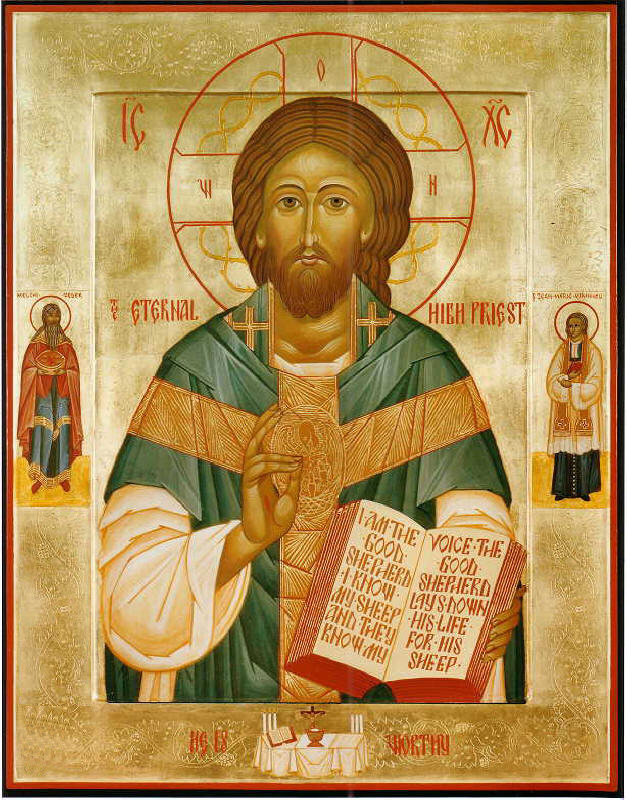
This icon shows Jesus Christ, our eternal high priest.
The gold pelican over His heart represents self-sacrifice.
The border contains an altar and grapevines, representing the Mass, and icons of Melchizedek and St. Jean-Baptiste Vianney.
Melchizedek: king of righteousness (left icon) was priest and king of Jerusalem. He blessed Abraham and has been considered an ideal priest-king.
St. Jean-Baptiste Vianney is the patron saint of parish priests.

1. Sign of the Cross: In the name of the Father, and of the Son, and of the Holy Spirit. Amen.
2. The Apostles Creed: I BELIEVE in God, the Father almighty, Creator of heaven and earth, and in Jesus Christ, His only Son, our Lord, who was conceived by the Holy Spirit, born of the Virgin Mary, suffered under Pontius Pilate, was crucified, died, and was buried. He descended into hell; on the third day he rose again from the dead; he ascended into heaven, and is seated at the right hand of God, the Father Almighty; from there He shall come to judge the living and the dead.
I believe in the Holy Spirit, the holy catholic Church, the communion of saints, the forgiveness of sins, the resurrection of the body, and the life everlasting. Amen.
3. The Lord's Prayer: OUR Father, who art in heaven, hallowed be Thy name. Thy kingdom come. Thy will be done on earth as it is in heaven. Give us this day our daily bread and forgive us our trespasses as we forgive those who trespass against us. And lead us not into temptation, but deliver us from evil. Amen.
4. (3) Hail Mary: HAIL Mary, full of grace, the Lord is with thee. Blessed art thou amongst women and blessed is the fruit of thy womb, Jesus. Holy Mary, Mother of God, pray for us sinners, now, and in the hour of our death. Amen. (Three times)
5. Glory Be: GLORY be to the Father, and to the Son, and to the Holy Spirit. As it was in the beginning, is now, and ever shall be, world without end. Amen.
6. Fatima Prayer: Oh, my Jesus, forgive us our sins, save us from the fires of hell, lead all souls to heaven, especially those in most need of your mercy.
Announce each mystery, then say 1 Our Father, 10 Hail Marys, 1 Glory Be and 1 Fatima prayer. Repeat the process with each mystery.
End with the Hail Holy Queen:
Hail, Holy Queen, Mother of Mercy, our life, our sweetness and our hope! To thee do we cry, poor banished children of Eve! To thee do we send up our sighs, mourning and weeping in this vale of tears! Turn then, most gracious advocate, thine eyes of mercy towards us; and after this, our exile, show unto us the blessed fruit of thy womb, Jesus!
O clement, O loving, O sweet Virgin Mary! Pray for us, O holy Mother of God, that we may be made worthy of the promises of Christ.
Final step -- The Sign of the Cross
The Mysteries of the Rosary By tradition, Catholics meditate on these Mysteries during prayers of the Rosary. The biblical references follow each of the Mysteries below.
The Glorious Mysteries
(Wednesdays and Sundays)
1.The Resurrection (Matthew 28:1-8, Mark 16:1-18, Luke 24:1-12, John 20:1-29) [Spiritual fruit - Faith]
2. The Ascension (Mark 16:19-20, Luke 24:50-53, Acts 1:6-11) [Spiritual fruit - Christian Hope]
3. The Descent of the Holy Spirit (Acts 2:1-13) [Spiritual fruit - Gifts of the Holy Spirit]
4. The Assumption [Spiritual fruit - To Jesus through Mary]
5. The Coronation [Spiritual fruit - Grace of Final Perseverance]
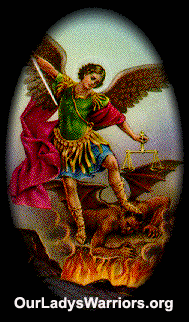
St. Michael the Archangel
~ PRAYER ~
St. Michael, the Archangel, defend us in battle
Be our protection against the wickedness
and snares of the devil;
May God rebuke him, we humbly pray,
and do thou, O Prince of the heavenly host,
by the power of God,
Cast into hell Satan and all the evil spirits
who prowl through the world seeking the ruin of souls.
Amen
+
|
May Devotion: Blessed Virgin Mary
|

Since the 16th century Catholic piety has assigned entire months to special devotions. Toward the end of the eighteenth century a zealous Jesuit priest, Father Lalomia, started among the students of the Roman college of his Society the practice of dedicating May to Our Lady. The devotion, which others had promoted in a small way, soon spread to other Jesuit Colleges and to the entire Latin church and since that time it has been a regular feature of Catholic life.
INVOCATIONS
Thou who wast a virgin before thy delivery, pray for us. Hail Mary, etc.
Thou who wast a virgin in thy delivery, pray for us. Hail Mary, etc.
Thou who wast a virgin after thy delivery, pray for us. Hail Mary, etc.
My Mother, deliver me from mortal sin.
Hail Mary (three times).
Mother of love, of sorrow and of mercy, pray for us.
Remember, O Virgin Mother of God, when thou shalt stand before the face of the Lord, that thou speak favorable things in our behalf and that He may turn away His indignation from us.
Roman Missal
Thou art my Mother, O Virgin Mary: keep me safe lest I ever offend thy dear Son, and obtain for me the grace to please Him always and in all things.
FOR THE HELP OF THE BLESSED VIRGIN MARY
May we be assisted, we beseech Thee, 0 Lord, by the worshipful intercession of Thy glorious Mother, the ever-Virgin Mary; that we, who have been enriched by her perpetual blessings, may be delivered from all dangers, and through her loving kindness made to be of one heart and mind: who livest and reignest world without end. Amen.
Roman Missal
THE SALVE REGINA
Hail, holy Queen, Mother of mercy, hail, our life, our sweetness, and our hope! To thee do we cry, poor banished children of Eve! To thee do we send up our sighs, mourning and weeping in this vale of tears! Turn then, most gracious advocate, thine eyes of mercy towards us; and after this, our exile, show unto us the blessed fruit of thy womb, Jesus! O clement, O loving, O sweet Virgin Mary!
Roman Breviary
PRAYER TO THE BLESSED VIRGIN MARY
O blessed Virgin Mary, who can worthily repay thee thy just dues of praise and thanksgiving, thou who by the wondrous assent of thy will didst rescue a fallen world? What songs of praise can our weak human nature recite in thy honor, since it is by thy intervention alone that it has found
the way to restoration? Accept, then, such poor thanks as we have here to offer, though they be unequal to thy merits; and, receiving our vows, obtain by thy prayers the remission of our offenses. Carry thou our prayers within the sanctuary of the heavenly audience, and bring forth from it the antidote of our reconciliation. May the sins we bring before Almighty God through thee, become pardonable through thee; may what we ask for with sure confidence, through thee be granted. Take our offering, grant us our requests, obtain pardon for what we fear, for thou art the sole hope of sinners. Through thee we hope for the remission of our sins, and in thee, 0 blessed Lady, is our hope of reward. Holy Mary, succour the miserable, help the fainthearted, comfort the sorrowful, pray for thy people, plead for the clergy, intercede for all women consecrated to God; may all who keep thy holy commemoration feel now thy help and protection. Be thou ever ready to assist us when we pray, and bring back to us the answers to our prayers. Make it thy continual care to pray for the people of God, thou who, blessed by God, didst merit to bear the Redeemer of the world, who liveth and reigneth, world without end. Amen.
Saint Augustine
PETITION TO MARY
Most holy Virgin Immaculate, my Mother Mary, to thee who art the Mother of my Lord, the queen of the universe, the advocate, the hope, the refuge of sinners, I who am the most miserable of all sinners, have recourse this day. I venerate thee, great queen, and I thank thee for the many graces thou hast bestowed upon me even unto this day; in particular for having delivered me from the hell which I have so often deserved by my sins. I love thee, most dear Lady; and for the love I bear thee, I promise to serve thee willingly for ever and to do what I can to make thee loved by others also. I place in thee all my hopes for salvation; accept me as thy servant and shelter me under thy mantle, thou who art the Mother of mercy. And since thou art so powerful with God, deliver me from all temptations, or at least obtain for me the strength to overcome them until death. From thee I implore a true love for Jesus Christ. Through thee I hope to die a holy death. My dear Mother, by the love thou bearest to Almighty God, I pray thee to assist me always, but most of all at the last moment of my life. Forsake me not then, until thou shalt see me safe in heaven, there to bless thee and sing of thy mercies through all eternity. Such is my hope. Amen.
Saint Alphonsus Liguori
Magnificat Prayer
My being proclaims the greatness of the Lord, my spirit finds joy in God my savior,
For he has looked upon his servant in her lowliness; all ages to come shall call me blessed.
God who is mighty has done great things for me,
holy is his name; His mercy is from age to age on those who fear him. He has shown might with his arm; he has confused the proud in their inmost thoughts. He has deposed the mighty from their thrones and raised the lowly to high places. The hungry he has given every good thing, while the rich he has sent empty away. He has upheld Israel his servant, ever mindful of his mercy; Even as he promised our fathers, promised Abraham and his descendants forever.
(Lk 1:46-55)
TO MARY, REFUGE OF SINNERS
Hail, most gracious Mother of mercy, hail, Mary, for whom we fondly yearn, through whom we obtain forgiveness! Who would not love thee? Thou art our light in uncertainty, our comfort in sorrow, our solace in the time of trial, our refuge from every peril and temptation. Thou art our sure hope of salvation, second only to thy only-begotten Son; blessed are they who love thee, our Lady! Incline, I beseech thee, thy ears of pity to the entreaties of this thy servant, a miserable sinner; dissipate the darkness of my sins by the bright beams of thy holiness, in order that I may be acceptable in thy sight.
FOR THE GRACE OF LOVE
O Mary, my dear Mother, how much I love thee! And yet in reality how little! Thou dost teach me what I ought to know, for thou teachest me what Jesus is to me and what I ought to be for Jesus. Dearly beloved Mother, how close to God thou art, and how utterly filled with Him! In the measure that we know God, we remind ourselves of thee. Mother of God, obtain for me the grace of loving my Jesus; obtain for me the grace of loving thee!
Cardinal Merry del Val
TO THE BLESSED VIRGIN MARY FOR MAY
O most august and blessed Virgin Mary! Holy Mother of God! glorious Queen of heaven and earth! powerful protectress of those who love thee, and unfailing advocate of all who invoke thee! look down, I beseech thee, from thy throne of glory on thy devoted child; accept the solemn offering I present thee of this month, specially dedicated to thee, and receive my ardent, humble desire, that by my love and fervor I could worthily honor thee, who, next to God, art deserving of all honor. Receive me, 0 Mother of Mercy, among thy best beloved children; extend to me thy maternal tenderness and solicitude; obtain for me a place in the Heart of Jesus, and a special share in the gifts of His grace. 0 deign, I beseech thee, to recognize my claims on thy protection, to watch over my spiritual and temporal interests, as well as those of all who are dear to me; to infuse into my soul the spirit of Christ, and to teach me thyself to become meek, humble, charitable, patient, and submissive to the will of God.
May my heart bum with the love of thy Divine Son, and of thee, His blessed Mother, not for a month alone, but for time and eternity; may I thirst for the promotion of His honor and thine, and contribute, as far as I can, to its extension. Receive me, 0 Mary, the refuge of sinners! Grant me a Mother's blessing and a Mother's care, now, and at the hour of my death. Amen.
TO OUR LADY
Saint John Vianney, better known as the Cure of Ars, when asked how long he had loved Mary, said: "I loved her almost before I could know her." In this prayer he expresses that love.
O thou most holy virgin Mary, who dost evermore stand before the most holy Trinity, and to whom it is granted at all times to pray for us to thy most beloved Son; pray for me in all my necessities; help me, combat for me, and obtain for me the pardon of all my sins. Help me especially at my last hour; and when I can no longer give any sign of the use of reason, then do thou encourage me, make the sign of the cross for me, and fight for me against the enemy. Make in my name a profession of faith; favor me with a testimony of my salvation, and never let me despair of the mercy of God. Help me to overthrow the wicked enemy. When I can no longer say: "Jesus, Mary, and Joseph, I place my soul in your hands," do thou say it for me; when I can no longer hear human words of consolation, do thou comfort me. Leave me not before I have been judged; and if I have to expiate my sins in purgatory, oh! pray for me earnestly; and admonish my friends to procure for me a speedy enjoyment of the blessed sight of God. Lessen my sufferings, deliver me speedily, and lead my soul into heaven with thee: that, united with all the elect, I may there bless and praise my God and thee for all eternity. Amen.
Saint John Vianney
ACT OF REPARATION
O blessed Virgin, Mother of God, look down in mercy from heaven, where thou art enthroned as Queen, upon me, a miserable sinner, thine unworthy servant. Although I know full well my own unworthiness, yet in order to atone for the offenses that are done to thee by impious and blasphemous
tongues, from the depths of my heart I praise and extol thee as the purest, the fairest, the holiest creature of all God's handiwork. I bless thy holy name, I praise thine exalted privilege of being truly Mother of God, ever virgin, conceived without stain of sin, co-redemptrix of the human race. I bless the Eternal Father who chose thee in an especial way for His daughter; I bless the Word Incarnate who took upon Himself our nature in thy bosom and so made thee His Mother; I bless the Holy Spirit who took thee as His bride. All honor, praise and thanksgiving to the ever-blessed Trinity, who predestined thee and loved thee so exceedingly from all eternity as to exalt thee above all creatures to the most sublime heights. 0 Virgin, holy and merciful, obtain for all who offend thee the grace of repentance, and graciously accept this poor act of homage from me thy servant, obtaining likewise for me from thy divine Son the pardon and remission of all my sins. Amen.
Prayer Source: Prayer Book, The by Reverend John P. O'Connell, M.A., S.T.D. and Jex Martin, M.A., The Catholic Press, Inc., Chicago, Illinois, 1954
| Memorare of the Blessed Virgin Mary |

Remember O Most Gracious Virgin Mary!
That never was it known
That anyone who fled to thy protection,
Implored thy help or sought thy intercession
Was left unaided.
Inspired by this confidence, I fly unto Thee!
O Virgin of virgins, My Mother!
To Thee I come before Thee I stand,
Sinful and Sorrowful,
Oh Mother of the Word Incarnate,
Despise not my petitions, but in thy mercy,
Hear and answer me.
Amen
Who Is Our Lady of Laus? "My name is Mary" (CATHOLIC CAUCUS)
What Happened to the Virgin Mary After Pentecost? [Catholic/Orthodox Caucus)
Saint Thomas Aquinas on the Hail Mary (Catholic Caucus)
Yes, Mary DOES Know
How Can Mary Hear Thousands Simultaneously?
Fr Paul Schenck: Immaculate Conception Tells us Who Mary Is and Who We Are (Catholic Caucus)
Mary,Our Lady of Quatlasupe,She who crushes the head of the serpent, is leading...(Catholic Caucus)
MARY, MOTHER OF EVANGELIZATION [Cath-Orth caucus]
On Mary, Model of Faith, Charity and Union with Christ [Weekly Audience]
Why Don't You honor Mary?
Columbus and the Virgin Mary [Catholic Caucus]
Pope Francis: Mary's faith unties the knot of sin
Pope consecrates world to immaculate heart of Mary
Mary, Mother of God
Mary 'can only bring us to God,' expert says as entrustment nears
Pope Francis: "Mary, look upon us" (Mass in Cagliari)
Devotion to the Most Holy Name of Mary [Catholic/Orthodox Caucus]
Pope Francis: contemplate the "suffering humanity" of Jesus and the sweetness of Mary
Mary's Nativity Draws Tens of Thousands to Indian Basilica
Veneration of Mary in Luke 11:27-28
Pope at Mass: Learning from Mary to keep the Word of God
Pope: Mary is always in a hurry to help us (first pastoral visit to a diocese in Rome)
Catholic Word of the Day: MARY'S SINLESSNESS, 04-01-13
Letter #47: To Mary (Pope Francis prays at (tomb of Pope St. Pius V) [Catholic Caucus]
Catholic Word of the Day: MARY'S VIRGINITY, 02-26-13
Mariaphobic Response Syndrome: Part Two
Mariaphobic Response Syndrome: Part One
A Mother's Love, The Blessed Virgin Mary Saying YES To God
Chesterton on devotion to the Blessed Virgin Mary [Ecumenical]
The Perpetual Virginity of Blessed Mary
A Comparison is Instituted Between the Disobedient and Sinning Eve and the Virgin Mary..
Magnificat: The Hymn of the Blessed Virgin Mary [Catholic Caucus]
The Blessed Virgin Mary's Role in the Celibate Priest's Spousal... (Pt 2) (CATHOLIC CAUCUS)
The Blessed Virgin Mary's Role in the Celibate Priest's Spousal and Paternal Love (CATHOLIC CAUCUS)
Discovering Mary [Excellent New Book For Converts]
Beginning Our Lady's Month [Catholic Caucus]
Give it all to Mary [Catholic Caucus]
JESUS LIVING IN MARY: HANDBOOK, SPIRITUALITY OF ST. LOUIS DE MONTFORT, ROSARY [Ecumenical]
Mary, Tabernacle of the Lord By Archbishop Fulton Sheen(Catholic Caucus)
A ... Discovers Mary
Mary is our Mother and Queen of the New Davidic Kingdom (Scriptures Agree With Catholic Church)
Hail Mary
Holy Water Silhouette (Virgin Mary -video))
How could Mary be the Mother of God?
Mary, the Mother of God (a defense)
Calling Mary "Mother of God" Tells Us Who Jesus Is
The Holy Spirit And Mary (Catholic Caucus)
Mary, Our Cause of Rejoicing
Mary in Byzantine Doctrine and Devotion (Catholic / Orthodox Caucus)
Radio Replies First Volume - Devotion to Mary
The Blessed Virgin Mary and the Catholic Discovery of America(Catholic Caucus)
Mary is the star that guides us to holiness, says Holy Father during Angelus [Catholic Caucus]
The Efficacy and Power of One Hail Mary [Ecumenical]
When Did Belief in the Virgin Birth Begin?
Mary, Motherhood, and the Home BY Archbishop Fulton Sheen
On Mary, Mother of Priests
Benedict reflects on Mary and the priesthood [Catholic Caucus]
Radio Replies First Volume - Mary
Scholar says ... neglect lessons from Virgin Mary
Mary and the Sword Continued Part #2 by Bishop Fulton J. Sheen
Mary and the Sword by Bishop Fulton J. Sheen(Catholic Caucus)
Why Did Mary Offer a Sin Offering? [Ecumenical]
Mary and Intercessory Prayer
Mary: Holy Mother
Mary not just for Catholics anymore
Pope concludes Month of Mary in the Vatican Gardens
Consecration to Mary(Catholic Caucus)
Mary's Marching Orders
Praying the Hail Mary Like Never Before [Ecumenical]
Our Lady of the Most Blessed Sacrament [Catholic Caucus]
Catholic Caucus: The Catechism of St. Thomas Aquinas - THE HAIL MARY
Our Jewish Roots: The Immaculate Conception [Ecumenical]
The Blessed Virgin in the History of Christianity [Ecumenical]
Archbishop Sheen Today! -- Mary and the Moslems
Mary Immaculate: Patroness of the United States [Catholic/Orthodox Caucus]
"The Woman He Loved": Fulton Sheen and the Blessed Mother(Catholic Caucus)
September 12: The Most Holy Name of Mary and Militant Islam
Catholic Devotional: Feast of the Holy Name of Mary
A Homily on the Feast of the Most Holy Name of Mary
May Devotion: Blessed Virgin Mary
Catholic Caucus: Mary, The Power of Her Name [The Most Holy Name of the Blessed Virgin Mary]
Disclaimer: Opinions posted on Free Republic are those of the individual posters and do not necessarily represent the opinion of Free Republic or its management. All materials posted herein are protected by copyright law and the exemption for fair use of copyrighted works.