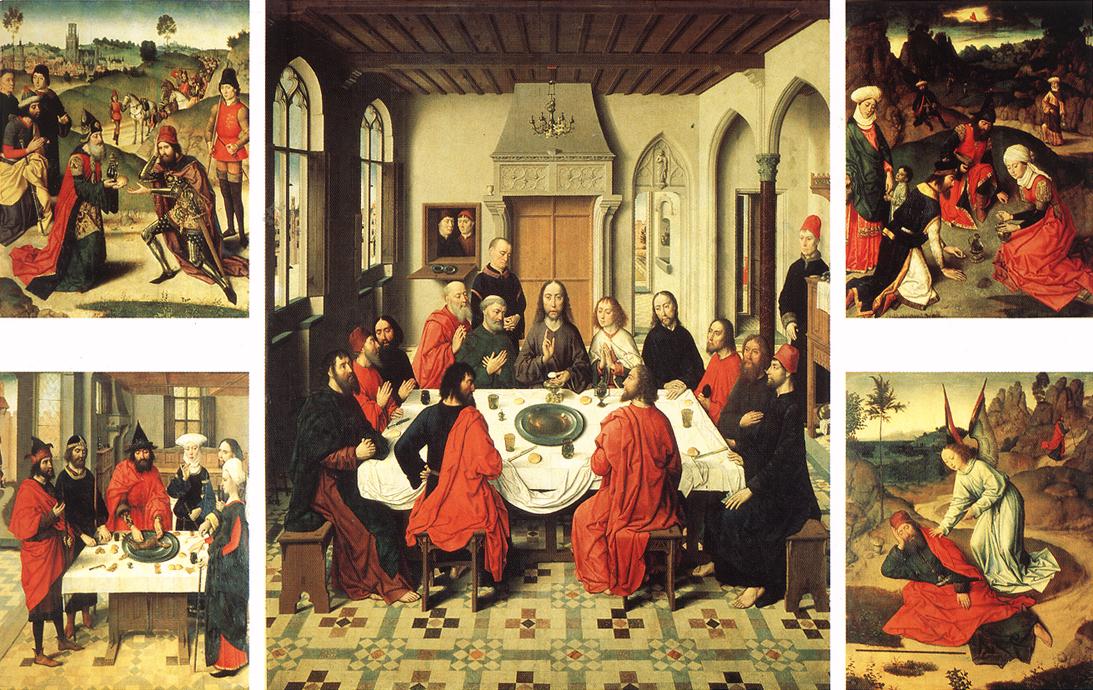
Altarpiece of the Holy Sacrament
Dieric Bouts the Elder
1464-67
Oil on panel, 185 x 294 cm
Sint-Pieterskerk, Leuven
Posted on 04/29/2020 11:07:43 PM PDT by Salvation
The angel of the Lord spoke to Philip,
“Get up and head south on the road
that goes down from Jerusalem to Gaza, the desert route.”
So he got up and set out.
Now there was an Ethiopian eunuch,
a court official of the Candace,
that is, the queen of the Ethiopians,
in charge of her entire treasury,
who had come to Jerusalem to worship, and was returning home.
Seated in his chariot, he was reading the prophet Isaiah.
The Spirit said to Philip,
“Go and join up with that chariot.”
Philip ran up and heard him reading Isaiah the prophet and said,
“Do you understand what you are reading?”
He replied,
“How can I, unless someone instructs me?”
So he invited Philip to get in and sit with him.
This was the Scripture passage he was reading:
Like a sheep he was led to the slaughter,
and as a lamb before its shearer is silent,
so he opened not his mouth.
In his humiliation justice was denied him.
Who will tell of his posterity?
For his life is taken from the earth.
Then the eunuch said to Philip in reply,
“I beg you, about whom is the prophet saying this?
About himself, or about someone else?”
Then Philip opened his mouth and, beginning with this Scripture passage,
he proclaimed Jesus to him.
As they traveled along the road
they came to some water,
and the eunuch said, “Look, there is water.
What is to prevent my being baptized?”
Then he ordered the chariot to stop,
and Philip and the eunuch both went down into the water,
and he baptized him.
When they came out of the water,
the Spirit of the Lord snatched Philip away,
and the eunuch saw him no more,
but continued on his way rejoicing.
Philip came to Azotus, and went about proclaiming the good news
to all the towns until he reached Caesarea.
R. (1) Let all the earth cry out to God with joy.
or:
R. Alleluia.
Bless our God, you peoples,
loudly sound his praise;
He has given life to our souls,
and has not let our feet slip.
R. Let all the earth cry out to God with joy.
or:
R. Alleluia.
Hear now, all you who fear God, while I declare
what he has done for me.
When I appealed to him in words,
praise was on the tip of my tongue.
R. Let all the earth cry out to God with joy.
or:
R. Alleluia.
Blessed be God who refused me not
my prayer or his kindness!
R. Let all the earth cry out to God with joy.
or:
R. Alleluia.
R. Alleluia, alleluia.
I am the living bread that came down from heaven, says the Lord;
whoever eats this bread will live forever.
R. Alleluia, alleluia.
Jesus said to the crowds:
“No one can come to me unless the Father who sent me draw him,
and I will raise him on the last day.
It is written in the prophets:
They shall all be taught by God.
Everyone who listens to my Father and learns from him comes to me.
Not that anyone has seen the Father
except the one who is from God;
he has seen the Father.
Amen, amen, I say to you,
whoever believes has eternal life.
I am the bread of life.
Your ancestors ate the manna in the desert, but they died;
this is the bread that comes down from heaven
so that one may eat it and not die.
I am the living bread that came down from heaven;
whoever eats this bread will live forever;
and the bread that I will give
is my Flesh for the life of the world.”
For the readings of the Optional Memorial of Saint Pius V, please go here.
KEYWORDS: catholic; easter; jn6; prayer; saints;
Please FReepmail me to get on/off the Alleluia Ping List.
From: Acts 8:26-40
Philip Baptizes a Eunuch
[34] And the eunuch said to Philip, “About whom, pray, does the prophet say this, about himself or about some one else?” [35] Then Philip opened his mouth, and beginning with this scripture he told him the good news of Jesus. [36] And as they went along the road they came to some water, and the eunuch said, “See, here is water! What is to prevent my being baptized?” [38] And he commanded the chariot to stop, and they both went down into the water, Philip, and the eunuch, and he baptized him. [39] And when they came up out of the water, the Spirit of the Lord caught up Philip; and the eunuch saw him no more, and went on his way rejoicing. [40] But Philip was found at Azotus, and passing on he preached the gospel to all the towns till he came to Caesarea.
***********************************************************************
Commentary:
26-40. The baptism of the Ethiopian official marks an important step in the spread of Christianity. St Luke’s account underlines the
importance of Sacred Scripture, and its correct interpretation, in the work of evangelization. This episode encapsulates the various stages in apostolate: Christ’s disciple is moved by the Spirit (v. 29) and readily obeys his instruction; he bases his preaching on Sacred
Scripture—as Jesus did in the case of the disciples of Emmaus—and then administers Baptism.
27. Ethiopia: the kingdom of Nubia, whose capital was Meroe, to the south of Egypt, below Aswan, the first cataract on the Nile (part of modern Sudan). Candace, or Kandake, is not the name of an individual; it was the dynastic name of the queens of that country, a country at that time ruled by women (cf. Eusebius, “Ecclesiastical History”, II, 1, 13).
The term “eunuch”, like its equivalent in Hebrew, was often used independently of its original physiological meaning and could refer to any court official (cf. for example, Gen 39:1; 2 Kings 25:19). This particular man was an important official, the equivalent of a minister of finance. We do not know if he was a member of the Jewish race, a proselyte (a Jew not by race but by religion) or—perhaps—a God-fearer (cf. note on Acts 2:5-11).
28. “Consider,” St John Chrysostom says, “what a good thing it is not to neglect reading Scripture even when one is on a journey.... Let those reflect on this who do not even read the Scriptures at home, and, because they are with their wife, or are fighting in the army, or are very involved in family or other affairs, think that there is no particular need for them to make the effort to read the divine
Scriptures...This Ethiopian has something to teach us all—those who have a family life, members of the army, officials, in a word, all
men, and women too (particularly those women who are always at home), and all those who have chosen the monastic way of life. Let all learn that no situation is an obstacle to reading the word of God: this is something one can do not only when one is alone at home but also in the public square, on a journey, in the company of others, or when engaged in one’s occupation. Let us not, I implore you, neglect to read the Scriptures” (St John Chrysostom, “Hom. on Acts”, 35).
29-30. The fact that they are alone, that the road is empty, makes it easier for them to have a deep conversation and easier for Philip to
explain Christian teaching. “I think so highly of your devotion to the early Christians that I will do all I can to encourage it, so that
you—like them—will put more enthusiasm each day into that effective Apostolate of discretion and friendship” (J. Escriva, “The Way”, 971). This was in fact one of the characteristic features of the kind of apostolate carried out by our first brothers and sisters in the faith
as they spread gradually all over the Roman empire. They brought the Christian message to the people around them—the sailor to the rest of the crew, the slave to his fellow slaves, soldiers, traders, housewives.... This eager desire of theirs to spread the Gospel showed
their genuine conviction and was an additional proof of the truth of the Christian message.
31. “How can I understand it, unless some one guides me?”: to a Jew of this period the very idea of a Messiah who suffers and dies at the hands of his enemies was quite repugnant. This explains why the Ethiopian has difficulty in understanding this passage—and, indeed, the entire song of the Servant of Yahweh, from which it comes (cf. Is 53).
Sometimes it is difficult to understand a passage of Scripture; as St Jerome comments: “I am not,” to speak in passing of himself, “more learned or more holy than that eunuch who traveled to the temple from Ethiopia, that is, from the end of the earth: he left the royal palace and such was his desire for divine knowledge that he was even reading the sacred words in his chariot. And yet...he did not realize whom he was venerating in that book without knowing it. Philip comes along, he reveals to him Jesus hidden and as it were imprisoned in the text...and in that very moment he believes, is baptized, is faithful and holy. [...] I tell you this to show you that, unless you have a guide who goes ahead of you to show you the way, you cannot enter the holy Scriptures” (”Letter 53”, 5-6).
This guide is the Church; God, who inspired the sacred books, has entrusted their interpretation to the Church. Therefore, the Second
Vatican Council teaches that “If we are to derive their true meaning from the sacred texts,” attention must be devoted “not only to their
content but to the unity of the whole of Scripture, the living tradition of the entire Church, and the analogy of faith....Everything to do with the interpretation of Scripture is ultimately subject to the judgment of the Church, which exercises the divinely conferred communion and ministry of watching over and interpreting the Word of God” (Vatican II, “Dei Verbum”, 12).
35. “The eunuch deserves our admiration for his readiness to believe,” St John Chrysostom comments. “He has not seen Jesus Christ nor has he witnessed any miracle; what then is the reason for his change? It is because, being observant in matters of religion, he applies himself to the study of the sacred books and makes them his book of meditation and reading” (”Hom. on Acts”, 19).
36. “What is to prevent my being baptized?”: the Ethiopian’s question reminds us of the conditions necessary for receiving Baptism. Adults should be instructed in the faith before receiving this sacrament; however, a period of “Christian initiation” is not required if there is a good reason, such as danger of death.
The Church’s Magisterium stresses the obligation to baptize children without delay. “The fact that children are incapable of making a
personal profession of faith does not deter the Church from conferring this sacrament on them; what it does is baptize them in its own faith. This teaching was already clearly expressed by St Augustine: ‘Children are presented for the reception of spiritual grace, not so much by those who carry them in their arms—although also by them, if they are good members of the Church as by the universal society of saints and faithful. [...] It is Mother Church herself who acts in her saints, because the whole Church begets each and all’ (”Letter 98”, 5; cf. “Sermon 176”, 2). St Thomas Aquinas, and after him most theologians, take up the same teaching: the child who is baptized does not believe for itself, by a personal act of faith, but rather through others ‘by the faith of the Church which is communicated to the child’ (”Summa Theologiae”, III, q.69, a.6, ad 3; cf. q. 68, a. 9, ad 3). This same teaching is expressed in the new rite of Baptism, when the celebrant asks the parents and godparents to profess the faith of the Church ‘in which the children are being baptized’”(”Instruction on Infant Baptism”, 20 October 1980).
The Instruction goes on to say that “it is true that apostolic preaching is normally addressed to adults, and that the first to be baptized were adults who had been converted to the Christian faith. From what we read in the New Testament we might be led to think that it
deals only with adults’ faith. However, the practice of Baptism of infants is based on an ancient tradition of apostolic origin, whose
value must not be underestimated; furthermore, Baptism has never been administered without faith: in the case of infants the faith that
intervenes is the Church’s own faith. Besides, according to the Council of Trent’s teaching on the sacraments, Baptism is not only a sign of faith: it is also the cause of faith” (”ibid.”).
Christian parents have a duty to see that their children are baptized quickly. The Code of Canon Law specifies that parents are obliged to see that their infants are baptized within the first few weeks. As soon as possible after the birth, indeed often before it, they are to
approach the parish priest to ask for the sacrament for their child, and to be themselves duly prepared for it” (can. 867).
37. This verse, not to be found in some Greek codexes or in the better translations, was probably a gloss which later found its way into the text. In the Vulgate it is given in this way: “Dixit autem Philippus: Si credis ex toto corde, licet. Et respondens ait: Credo, Filium Dei esse Jesum Christum”, which translated would be: “Philip said, If you believe with all your heart, you may. And he replied, I believe that Jesus Christ is the Son of God.” This very ancient gloss, inspired by baptismal liturgy, helps to demonstrate that faith in Christ’s divine worship was the nucleus of the creed a person had to subscribe to in order to be baptized. On this occasion Philip, guided by the Holy Spirit, lays down no further condition and he immediately proceeds to baptize the Ethiopian.
39. St John Chrysostom pauses to note that the Spirit takes Philip away without giving him time to rejoice with the man he has just baptized: “Why did the Spirit of the Lord bear him away? Because he had to go on to preach in other cities. We should not be surprised that this happened in a divine rather than a human way” (”Hom. on Acts”, 19).
The official “went on his way rejoicing” that God had made him his son through Baptism. He had received the gift of faith, and with the help of divine grace he was ready to live up to all the demands of that faith, even in adverse circumstances: quite probably he would be the only Christian in all Ethiopia.
Faith is a gift of God and is received as such at Baptism; but man’s response is necessary if this gift is not to prove fruitless.
Baptism is one of the sacraments which imprints an indelible mark on the soul and which can be received only once. However, a baptized person needs to be continually renewing his commitment; this is not something to be done only during the Easter liturgy: in his everyday activity he should be striving to act like a son of God.
It is natural and logical for the Ethiopian to be so happy, for Baptism brings with it many graces. These St John Chrysostom lists, using quotations from the Gospels and from the letters of St Paul: “The newly baptized are free, holy, righteous, sons of God, heirs of heaven, brothers and co-heirs of Christ, members of his body, temples of God, instruments of the Holy Spirit.... Those who yesterday were captives are today free men and citizens of the Church. Those who yesterday were in the shame of sin are now safe in righteousness; not alone are they free, they are holy” (”Baptismal Catechesis”, III, 5).
From: John 6:41-51
The Discourse on the Bread of Life (Continuation)
***********************************************************************
Commentary:
42. This is the second and last time St John mentions St Joseph in his Gospel, putting on record the general, though mistaken, opinion of those who knew Jesus and regarded him as the son of Joseph (cf. Jn 1:45; Lk 3:23; 4:22; Mt 13:55). Conceived in the virginal womb of Mary by the action of the Holy Spirit, our Lord’s only Father was God himself (cf. note on in 5:18). However, St Joseph acted as Jesus’ father on earth, as God had planned (cf. notes on Mt 1:16, 18). Therefore, Joseph was called the father of Jesus and he certainly was extremely faithful in fulfilling his mission to look after Jesus. St Augustine explains St Joseph’s fatherhood in this way: “Not only does Joseph deserve the name of father: he deserves it more than anyone else. In what way was he a father? As profoundly as his fatherhood was chaste. Some people thought that he was the father of our Lord Jesus Christ in the same way as others are fathers, begetting according to the flesh and not receiving their children as fruit of their spiritual affection. That is why St Luke says that they supposed he was the father of Jesus. Why does he say that they only supposed it? Because human thoughts and judgments are based on what normally happens. And our Lord was not born of the seed of Joseph. However, to the piety and charity of Joseph a son was born to him of the Virgin Mary, who was the Son of God” (”Sermon 51”, 20).
In this verse, as elsewhere (cf. Jn 7:42; 4:29), St John put on record the people’s ignorance, whereas he and his readers knew the truth about Jesus. The Jews’ objection is not directly refuted; it is simply reported, on the assumption that it presents no difficulty to the Christian reader, to whom the Gospel is addressed.
44-45. Seeking Jesus until one finds Him is a free gift which no one can obtain through his own efforts, although everyone should try to be well disposed to receiving it. The Magisterium of the Church has recalled this teaching in Vatican II: “Before this faith can be exercised, man must have the grace of God to move and assist him; he must have the interior help of the Holy Spirit, who moves the heart and converts it to God, who opens the eyes of the mind and makes it easy for all to accept and believe the truth” (”Dei Verbum”, 5).
When Jesus says, “They shall all be taught by God”, He is invoking Isaiah 54:13 and Jeremiah 31:33ff, where the prophets refer to the future Covenant which God will establish with His people when the Messiah comes, the Covenant which will be sealed forever with the blood of the Messiah and which God will write on their hearts (cf. Isaiah 53:10-12; Jeremiah 31:31-34).
The last sentence of verse 45 refers to God’s Revelation through the prophets and especially through Jesus Christ.
46. Men can know God the Father only through Jesus Christ, because only He has seen the Father, whom He has come to reveal to us. In his prologue St. John already said: “No one has ever seen God; the only Son, who is in the bosom of the Father, He has made Him known” (John 1:18). Later on Jesus will say to Philip at the Last Supper: “He who has seen Me has seen the Father” (John 14:9), for Christ is the Way, the Truth and the Life, and no one goes to the Father except through Him (cf. John 14:6).
In other words, in Christ God’s revelation to men reaches its climax: “For He sent His Son, the eternal Word who enlightens all men, to dwell among men and to tell them about the inner life of God (cf. John 1:1-18). Hence, Jesus Christ, sent as `a man among men’, `utters the words of God’ (John 3:34), and accomplishes the saving work which the Father gave Him to do (cf. John 5:36; 17:4). To see Jesus is to see His Father (cf. John 14:9)” (Vatican II, “Dei Verbum”, 4).
48. With this solemn declaration, which He repeats because of His audience’s doubts, (cf. John 6:35, 41, 48), Jesus begins the second part of His discourse, in which He explicitly reveals the great mystery of the Blessed Eucharist. Christ’s words have such a tremendous realism about them that they cannot be interpreted in a figurative way: if Christ were not really present under the species of bread and wine, this discourse would make absolutely no sense. But if His real presence in the Eucharist is accepted on faith, then His meaning is quite clear and we can see how infinite and tender His love for us is.
This is so great a mystery that it has always acted as a touchstone for Christian faith: it is proclaimed as “the mystery of our faith” immediately after the Consecration of the Mass. Some of our Lord’s hearers were scandalized by what He said on this occasion (cf. verses 60-66). Down through history people have tried to dilute the obvious meaning of our Lord’s words. In our own day the Magisterium of the Church has explained this teaching in these words” “When Transubstantiation has taken place, there is no doubt that the appearance of the bread and the appearance of the wine take on a new expressiveness and a new purpose since they are no longer common bread and common drink, but rather the sign of something sacred and the sign of spiritual food. But they take on a new expressiveness and a new purpose for the very reason that they contain a new `reality’ which we are right to call “ontological”. For beneath these appearances there is no longer what was there before but something quite different [...] since on the conversion of the bread and wine’s substance, or nature, into the body and blood of Christ, nothing is left of the bread and the wine but the appearances alone. Beneath these appearances Christ is present whole and entire, bodily present too, in His physical `reality’, although not in the manner in which bodies are present in place.
For this reason the Fathers have had to issue frequent warnings to the faithful, when they consider this august Sacrament, not to be satisfied with the senses which announce the properties of bread and wine. They should rather assent to the words of Christ: these are of such power that they change, transform, `transelement’ the bread and the wine into His body and blood. The reason for this, as the same Fathers say more than once, is that the power which performs this action is the same power of Almighty God that created the whole universe out of nothing at the beginning of time” (Paul VI, “Mysterium Fidei”).
49-51. The manna during the Exodus was a figure of this bread—Christ Himself—which nourishes Christians on their pilgrimage through this world. Communion is the wonderful banquet at which Christ gives Himself to us: “the bread which I shall give for the life of the world is My flesh”. These words promise the manifestation of the Eucharist at the Last Supper: “This is My body which is for you” (1 Corinthian11:24). The words “for the life of the world” and “for you” refer to the redemptive value of the sacrifice of Christ on the cross. In some sacrifices of the Old Testament, which were a figure of the sacrifice of Christ, part of the animal offered up was later used for food, signifying participation in the sacred rite (cf. Exodus 11:3-4). So, by receiving Holy Communion, we are sharing in the sacrifice of Christ: which is why the Church sings in the Liturgy of the Hours on the Feast of Corpus Christi: “O sacred feast in which we partake of Christ: His sufferings are remembered, our minds are filled with His grace and we receive a pledge of the glory that is to be ours” (”Magnificat Antiphon”, Evening Prayer II).
Liturgical Colour: White.
| First reading | Acts 8:26-40 © |
|---|
| Responsorial Psalm |
|---|
| Psalm 65(66):8-9,16-17,20 © |
| Gospel Acclamation |
|---|
| Or: | Jn6:51 |
|---|
| Gospel | John 6:44-51 © |
|---|
| John | |||
| English: Douay-Rheims | Latin: Vulgata Clementina | Greek NT: Byzantine/Majority Text (2000) | |
| John 6 |
|||
| 44. | No man can come to me, except the Father, who hath sent me, draw him; and I will raise him up in the last day. | nemo potest venire ad me, nisi Pater, qui misit me, traxerit eum ; et ego resuscitabo eum in novissimo die. | ουδεις δυναται ελθειν προς με εαν μη ο πατηρ ο πεμψας με ελκυση αυτον και εγω αναστησω αυτον εν τη εσχατη ημερα |
| 45. | It is written in the prophets: And they shall all be taught of God. Every one that hath heard of the Father, and hath learned, cometh to me. | Est scriptum in prophetis : Et erunt omnes docibiles Dei. Omnis qui audivit a Patre, et didicit, venit ad me. | εστιν γεγραμμενον εν τοις προφηταις και εσονται παντες διδακτοι θεου πας ουν ο ακουων παρα του πατρος και μαθων ερχεται προς με |
| 46. | Not that any man hath seen the Father; but he who is of God, he hath seen the Father. | Non quia Patrem vidit quisquam, nisi is, qui est a Deo, hic vidit Patrem. | ουχ οτι τον πατερα τις εωρακεν ει μη ο ων παρα του θεου ουτος εωρακεν τον πατερα |
| 47. | Amen, amen I say unto you: He that believeth in me, hath everlasting life. | Amen, amen dico vobis : qui credit in me, habet vitam æternam. | αμην αμην λεγω υμιν ο πιστευων εις εμε εχει ζωην αιωνιον |
| 48. | I am the bread of life. | Ego sum panis vitæ. | εγω ειμι ο αρτος της ζωης |
| 49. | Your fathers did eat manna in the desert, and are dead. | Patres vestri manducaverunt manna in deserto, et mortui sunt. | οι πατερες υμων εφαγον το μαννα εν τη ερημω και απεθανον |
| 50. | This is the bread which cometh down from heaven; that if any man eat of it, he may not die. | Hic est panis de cælo descendens : ut si quis ex ipso manducaverit, non moriatur. | ουτος εστιν ο αρτος ο εκ του ουρανου καταβαινων ινα τις εξ αυτου φαγη και μη αποθανη |
| 51. | I am the living bread which came down from heaven. 6:52 If any man eat of this bread, he shall live for ever; and the bread that I will give, is my flesh, for the life of the world. |
Ego sum panis vivus, qui de cælo descendi. 6:52 Si quis manducaverit ex hoc pane, vivet in æternum : et panis quem ego dabo, caro mea est pro mundi vita. |
εγω ειμι ο αρτος ο ζων ο εκ του ουρανου καταβας εαν τις φαγη εκ τουτου του αρτου ζησεται εις τον αιωνα και ο αρτος δε ον εγω δωσω η σαρξ μου εστιν ην εγω δωσω υπερ της του κοσμου ζωης |
44. No man can come to me, except the Father which hath sent me draw him: and I will raise him up at the last day.
45. It is written in the prophets, And they shall be all taught of God. Every man therefore that hath heard, and hath learned of the Father, cometh unto me.
46. Not that any man hath seen the Father, save he which is of God, he hath seen the Father.
AUGUSTINE. (Tr. xxvi) He took man’s flesh upon Him, but not after the manner of men; for, His Father being in heaven, He chose a mother upon earth, and was born of her without a father. The answer to the murmurers next follows: Jesus therefore answered and said unto them, Murmur not among yourselves; as if to say, I know why ye hunger not after this bread, and so cannot understand it, and do not seek it: No man can come to Me except the Father who hath sent Me draw him. This is the doctrine of grace: none cometh, except he be drawn. But whom the Father draws, and whom not, and why He draws one, and not another, presume not to decide, if thou wouldest avoid falling into error. Take the doctrine as it is given thee: and, if thou art not drawn, pray that thou mayest be.
CHRYSOSTOM. (Hom. xlvi. 1) But here the Manichees attack us, asserting that nothing is in our own power. Our Lord’s words however do not destroy our free agency, but only shew that we need Divine assistance. For He is speaking not of one who comes without the concurrence of his own will, but one who has many hindrances in the way of his coming.
AUGUSTINE. (Tr. xxvi. 2. et sq.) Now if we are drawn to Christ without our own will, we believe without our own will; the will is not exercised, but compulsion is applied. But, though a man can enter the Church involuntarily, he cannot believe other than voluntarily; for with the heart man believeth unto righteousness. Therefore if he who is drawn, comes without his will, he does not believe; if he does not believe, he does not come. For we do not come to Christ, by running, or walking, but by believing, not by the motion of the body, but the will of the mind. Thou art drawn by thy will. But what is it to be drawn by the will? Delight thou in the Lord, and He will give thee thy heart’s desire. (Ps. 36) There is a certain craving of the heart, to which that heavenly bread is pleasant. If the Poet could say, “Trahit sua quemque voluptas,” how much more strongly may we speak of a man being drawn to Christ, i. e. being delighted with truth, happiness, justice, eternal life, all which is Christ? Have the bodily senses their pleasures, and has not the soul hers? Give me one who loves, who longs, who burns, who sighs for the source of his being and his eternal home; and he will know what I mean. But why did He say, Except my Father draw him? If we are to be drawn, let us be drawn by Him to whom His love saith, Draw me, we will run after Thee. (Cant. 1:4) But let us see what is meant by it. The Father draws to the Son those who believe on the Son, as thinking that He has God for His Father. For the Father begat the Son equal to Himself; and whoso thinks and believes really and seriously that He on Whom He believes is equal to the Father, him the Father draws to the Son. Arius believed Him to be a creature; the Father drew not him. Thomas says, Christ is only a man. Because he so believes, the Father draws him not. He drew Peter who said, Thou art the Christ, the Son of the living God (Mat. 16); to whom accordingly it was told, For flesh and blood hath not revealed it unto thee, but My Father which is in heaven. That revelation is the drawing. For if earthly objects, when put before us, draw us; how much more shall Christ, when revealed by the Father? For what doth the soul more long after than truth? But here men hunger, there they will be filled. Wherefore He adds, And I will raise him up at the last day: as if He said, He shall be filled with that, for which he now thirsts, at the resurrection of the dead; for I will raise him up.
AUGUSTINE. (de Qu. Nov. et Vet.) Or the Father draws to the Son, by the works which He did by Him.
CHRYSOSTOM. (Hom. xlvi. 1) Great indeed is the Son’s dignity; the Father draws men, and the Son raises them up. This is no division of works, but an equality of power. He then shews the way in which the Father draws. It is written in the Prophets, And they shall all be taught of God. You see the excellence of faith; that it cannot be learnt from men, or by the teaching of man, but only from God Himself. The Master sits, dispensing His truth to all, pouring out His doctrine to all. But if all are to be taught of God, how is it that some believe not? Because all here only means the generality, or, all that have the will.
AUGUSTINE. (de Prædest. Sanctorum, c. viii) Or thus; When a schoolmaster is the only one in a town, we say loosely, This man teaches all here to read; not that all learn of him, but that he teaches all who do learn. And in the same way we say that God teaches all men to come to Christ: not that all do come, but that no one comes in any other way.
AUGUSTINE. (super Joan. Tr. xxv. 7) All the men of that kingdom shall be taught of God; they shall hear nothing from men: for, though in this world what they hear with the outward ear is from men, yet what they understand is given them from within; from within is light and revelation. I force certain sounds into your ears, but unless He is within to reveal their meaning, how, O ye Jews, can ye acknowledge Me, ye whom the Father hath not taught?
BEDE. He uses the plural, In the Prophets, because all the Prophets being filled with one and the same spirit, their prophecies, though different, all tended to the same end; and with whatever any one of them says, all the rest agree; as with the prophecy of Joel, All shall be taught of God. (Joel 2:23)
GLOSS. These words are not found in Joel, but something like them; Be glad then ye children of Sion, and rejoice in the Lord your God, for He hath given you a Teacher. (Quia dedit nobis lectorem justitiæ. Vulg.) And more expressly in Isaiah, And all thy children shall be taught of the Lord. (Isa. 54:13)
CHRYSOSTOM. (Hom. xlvi. 1) An important distinction. All men before learnt the things of God through men; now they learn them through the Only Son of God, and the Holy Spirit.
AUGUSTINE. (de Prædest. Sanctorum, c. viii. et seq.) All that are taught of God come to the Son, because they have heard and learnt from the Father of the Son: wherefore He proceeds, Every man that hath heard, and hath learned of the Father, cometh to Me. But if every one that hath heard and learnt of the Father cometh, every one that hath not heard of the Father hath not learnt. For beyond the reach of the bodily senses is this school, in which the Father is heard, and men taught to come to the Son. Here we have not to do with the carnal ear, but the ear of the heart; for here is the Son Himself, the Word by which the Father teacheth, and together with Him the Holy Spirit: the operations of the three Persons being inseparable from each other. This is attributed however principally to the Father, because from Him proceeds the Son, and the Holy Spirit. Therefore the grace which the Divine bounty imparts in secret to men’s hearts, is rejected by none from hardness of heart: seeing it is given in the first instance, in order to take away hard-heartedness. Why then does He not teach all to come to Christ? Because those whom He teaches, He teaches in mercy; and those whom He teaches not, He teaches not in judgment. But if we say, that those, whom He teaches not, wish to learn, we shall be answered, Why then is it said, Wilt thou not turn again, and quicken us? (Ps. 84:6) If God does not make willing minds out of unwilling, why prayeth the Church, according to our Lord’s command, for her persecutors? For no one can say, I believed, and therefore He called me: rather the preventing mercy of God called him, that he might believe.
AUGUSTINE. (Tr. xxvi. 7. et seq.) Behold then how the Father draweth; not by laying a necessity on man, but by teaching the truth. To draw, belongeth to God: Every one that hath heard, and hath learned of the Father, cometh to Me. What then? Hath Christ taught nothing? Not so. What if men saw not the Father teaching, but saw the Son. So then the Father taught, the Son spoke. As I teach you by My word, so the Father teaches by His Word. But He Himself explains the matter, if we read on: Not that any man hath seen the Father, save He which is of God, He hath seen the Father; as if He said, Do not when I tell you, Every man that hath heard and learnt of the Father, say to yourselves, We have never seen the Father, and how then can we have learnt from Him? Hear Him then in Me. I know the Father, and am from Him, just as a word is from him who speaks it; i. e. not the mere passing sound, but that which remaineth with the speaker, and draweth the hearer.
CHRYSOSTOM. (Hom. xlvi. s. 1) We are all from God. That which belongs peculiarly and principally to the Son, He omits the mention of, as being unsuitable to the weakness of His hearers.
6:47–51
47. Verily, verily, I say unto you, He that believeth on me hath everlasting life.
48. I am that bread of life.
49. Your fathers did eat manna in the wilderness, and are dead.
50. This is the bread which cometh down from heaven, that a man may eat thereof, and not die.
51. I am the living bread which came down from heaven: if any man eat of this bread, he shall live for ever.
AUGUSTINE. (Tr. xxvi. s. 10.) Our Lord wishes to reveal what He is; Verily, verily, I say unto you, He that believeth on Me, hath everlasting life. As if He said; He that believeth on Me hath Me: but what is it to have Me? It is to have eternal life: for the Word which was in the beginning with God is life eternal, and the life was the light of men. Life underwent death, that life might kill death.
CHRYSOSTOM. ([Nic.] Theoph.) The multitude being urgent for bodily food, and reminding Him of that which was given to their fathers, He tells them that the manna was only a type of that spiritual food which was now to be tasted in reality, I am that bread of life.
CHRYSOSTOM. (Hom. xlv. 1) He calls Himself the bread of life, because He constitutes one life, both present, and to come.
AUGUSTINE. (Tr. xxvi. 11) And because they had taunted Him with the manna, He adds, Your fathers did eat manna in the wilderness, and are dead. Your fathers they are, for ye are like them; murmuring sons of murmuring fathers. For in nothing did that people offend God more, than by their murmurs against Him. And therefore are they dead, because what they saw they believed, what they did not see they believed not, nor understood.
CHRYSOSTOM. (Hom. xlvi. 2) The addition, In the wilderness, is not put in without meaning, but to remind them how short a time the manna lasted; only till the entrance into the land of promise. And because the bread which Christ gave seemed inferior to the manna, in that the latter had come down from heaven, while the former was of this world, He adds, This is the bread which cometh down from heaven.
AUGUSTINE. (Tr. xxvi. s. 12) This was the bread the manna typified, this was the bread the altar typified. Both the one and the other were sacraments, differing in symbol, alike in the thing signified. Hear the Apostle, They did all eat the same spiritual meat. (1 Cor. 10)
CHRYSOSTOM. (Hom. xlvi. 2) He then gives them a strong reason for believing that they were given for higher privileges than their fathers. Their fathers eat manna and were dead; whereas of this bread He says, that a man may eat thereof, and not die. The difference of the two is evident from the difference of their ends. By bread here is meant wholesome doctrine, and faith in Him, or His body: for these are the preservatives of the soul.
AUGUSTINE. (Tr. xxvi. 11) But are we, who eat the bread that cometh down from heaven, relieved from death? From visible and carnal death, the death of the body, we are not: we shall die, even as they died. But from spiritual death which their fathers suffered, we are delivered. Moses and many acceptable of God, eat the manna, and died not, because they understood that visible food in a spiritual sense, spiritually tasted it, and were spiritually filled with it. And we too at this day receive the visible food; but the Sacrament is one thing, the virtue of the Sacrament another. Many a one receiveth from the Altar, and perisheth in receiving; eating and drinking his own damnation, (1 Cor. 11:29) as saith the Apostle. To eat then the heavenly bread spiritually, is to bring to the Altar an innocent mind. Sins, though they be daily, are not deadly. Before you go to the Altar, attend to the prayer you repeat: Forgive us our debts, as we forgive our debtors. (Matt. 6:12) If thou forgivest, thou art forgiven: approach confidently; it is bread, not poison. None then that eateth of this bread, shall die. But we speak of the virtue of the Sacrament, not the visible Sacrament itself; of the inward, not of the outward eater.
ALCUIN. Therefore I say, He that eateth this bread, dieth not: I am the living bread which came down from heaven.
THEOPHYLACT. (in v. 83) By becoming incarnate, He was not then first man, and afterwards assumed Divinity, as Nestorius fables.
AUGUSTINE. (Tr. xxvi. 13) was The manna too came down from heaven; but the manna was shadow, this is substance.
ALCUIN. But men must be quickened by my life: If any man eat of this bread, he shall live, not only now by faith and righteousness, but for ever.
6:51
51. —And the bread that I will give is my flesh, which I will give for the life of the world.
AUGUSTINE. (Gloss. Nic.) Our Lord pronounces Himself to be bread, not only in respect of that Divinity, which feeds all things, but also in respect of that human nature, which was assumed by the Word of God: And the bread, He says, that I will give is My flesh, which I will give for the life of the world.
BEDE. This bread our Lord then gave, when He delivered to His disciple the mystery of His Body and Blood, and offered Himself to God the Father on the altar of the cross. For the life of the world, i. e. not for the elements, but for mankind, who are called the world.
THEOPHYLACT. Which I shall give: this shews His power; for it shews that He was not crucified as a servant, in subjection to the Father, but of his own accord; for though He is said to have been given up by the Father, yet He delivered Himself up also. And observe, the bread which is taken by us in the mysteries, is not only the sign of Christ’s flesh, but is itself the very flesh of Christ; for He does not say, The bread which I will give, is the sign of My flesh, but, is My flesh. The bread is by a mystical benediction conveyed in unutterable words, and by the indwelling of the Holy Ghost, transmuted into the flesh of Christ. But why see we not the flesh? Because, if the flesh were seen, it would revolt us to such a degree, that we should be unable to partake of it. And therefore in condescension to our infirmity, the mystical food is given to us under an appearance suitable to our minds. He gave His flesh for the life of the world, in that, by dying, He destroyed death. By the life of the world too, I understand the resurrection; our Lord’s death having brought about the resurrection of the whole human race. It may mean too the sanctified, beatified, spiritual life; for though all have not attained to this life, yet our Lord gave Himself for the world, and, as far as lies in Him, the whole world is sanctified.
AUGUSTINE. (Tr. xxvi. 13) But when does flesh receive the bread which He calls His flesh? The faithful know and receive the Body of Christ, if they labour to be the body of Christ. And they become the body of Christ, if they study to live by the Spirit of Christ: for that which lives by the Spirit of Christ, is the body of Christ. This bread the Apostle sets forth, where he says, We being many are one body. (1 Cor. 12:12) O sacrament of mercy, O sign of unity, O bond of love! Whoso wishes to live, let him draw nigh, believe, be incorporated, that he may be quickened.
Catena Aurea John 6
This is the pope whose job it was to implement the historic Council of Trent. If we think popes had difficulties in implementing Vatican Council II, Pius V had even greater problems after Trent four centuries earlier.
During his papacy (1566-1572), Pius V was faced with the almost overwhelming responsibility of getting a shattered and scattered Church back on its feet. The family of God had been shaken by corruption, by the Reformation, by the constant threat of Turkish invasion, and by the bloody bickering of the young nation-states. In 1545, a previous pope convened the Council of Trent in an attempt to deal with all these pressing problems. Off and on over 18 years, the Fathers of the Church discussed, condemned, affirmed, and decided upon a course of action. The Council closed in 1563.
Pius V was elected in 1566 and charged with the task of implementing the sweeping reforms called for by the Council. He ordered the founding of seminaries for the proper training of priests. He published a new missal, a new breviary, a new catechism, and established the Confraternity of Christian Doctrine classes for the young. Pius zealously enforced legislation against abuses in the Church. He patiently served the sick and the poor by building hospitals, providing food for the hungry, and giving money customarily used for the papal banquets to poor Roman converts. His decision to keep wearing his Dominican habit led to the custom–to this day–of the pope wearing a white cassock.
In striving to reform both Church and state, Pius encountered vehement opposition from England’s Queen Elizabeth and the Roman Emperor Maximilian II. Problems in France and in the Netherlands also hindered Pius’s hopes for a Europe united against the Turks. Only at the last minute was he able to organize a fleet which won a decisive victory in the Gulf of Lepanto, off Greece, on October 7, 1571.
Pius’s ceaseless papal quest for a renewal of the Church was grounded in his personal life as a Dominican friar. He spent long hours with his God in prayer, fasted rigorously, deprived himself of many customary papal luxuries, and faithfully observed the spirit of the Dominican Rule that he had professed.
In their personal lives and in their actions as popes, Saint Pius V and Saint Paul VI both led the family of God in the process of interiorizing and implementing the new birth called for by the Spirit in major Councils. With zeal and patience, Pius and Paul pursued the changes urged by the Council Fathers. Like Pius and Paul, we too are called to constant change of heart and life.

Pray for Pope Francis.
Catholic Church in Nigeria Appeals to the West: ‘Make Known the Atrocities’
50 Boko Haram Islamic Radicals Killed; 1,000 Hostages, Women and Children, Rescued in Nigeria
Nigeria: In the Face of Ongoing Islamist Attacks, the Faith is Growing
US Promises to Help Nigeria Exterminate Boko Haram
Is This Bishop Right about the Rosary Conquering Boko Haram? [Catholic Caucus]
Why Boko Haram and ISIS Target Women
Report reveals scale of Boko Haram violence inflictef on Nigerian Catholics
Military evacuating girls, women rescued from Boko Haram
Echos of Lepanto Nigerian bishop says rosary will bring down Boko Harm
After vision of Christ, Nigerian bishop says rosary will bring down Boko Haram (Catholic Caucus)
Nigerian Bishop Says Christ Showed Him How to Beat Islamic Terror Group
We thank you, God our Father, for those who have responded to your call to priestly ministry.
Accept this prayer we offer on their behalf: Fill your priests with the sure knowledge of your love.
Open their hearts to the power and consolation of the Holy Spirit.
Lead them to new depths of union with your Son.
Increase in them profound faith in the Sacraments they celebrate as they nourish, strengthen and heal us.
Lord Jesus Christ, grant that these, your priests, may inspire us to strive for holiness by the power of their example, as men of prayer who ponder your word and follow your will.
O Mary, Mother of Christ and our mother, guard with your maternal care these chosen ones, so dear to the Heart of your Son.
Intercede for our priests, that offering the Sacrifice of your Son, they may be conformed more each day to the image of your Son, our Lord and Savior, Jesus Christ. Amen.
Saint John Vianney, universal patron of priests, pray for us and our priests
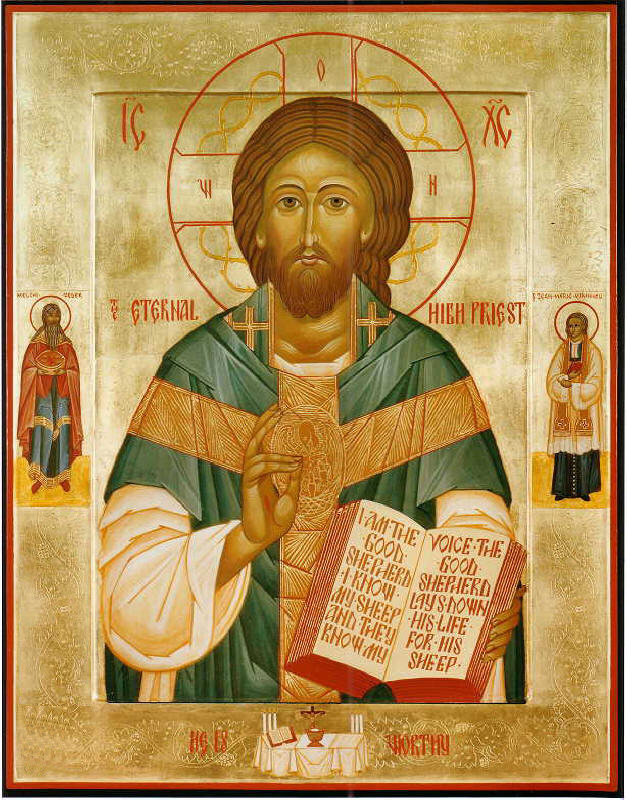
This icon shows Jesus Christ, our eternal high priest.
The gold pelican over His heart represents self-sacrifice.
The border contains an altar and grapevines, representing the Mass, and icons of Melchizedek and St. Jean-Baptiste Vianney.
Melchizedek: king of righteousness (left icon) was priest and king of Jerusalem. He blessed Abraham and has been considered an ideal priest-king.
St. Jean-Baptiste Vianney is the patron saint of parish priests.

1. Sign of the Cross: In the name of the Father, and of the Son, and of the Holy Spirit. Amen.
2. The Apostles Creed: I BELIEVE in God, the Father almighty, Creator of heaven and earth, and in Jesus Christ, His only Son, our Lord, who was conceived by the Holy Spirit, born of the Virgin Mary, suffered under Pontius Pilate, was crucified, died, and was buried. He descended into hell; on the third day he rose again from the dead; he ascended into heaven, and is seated at the right hand of God, the Father Almighty; from there He shall come to judge the living and the dead.
I believe in the Holy Spirit, the holy catholic Church, the communion of saints, the forgiveness of sins, the resurrection of the body, and the life everlasting. Amen.
3. The Lord's Prayer: OUR Father, who art in heaven, hallowed be Thy name. Thy kingdom come. Thy will be done on earth as it is in heaven. Give us this day our daily bread and forgive us our trespasses as we forgive those who trespass against us. And lead us not into temptation, but deliver us from evil. Amen.
4. (3) Hail Mary: HAIL Mary, full of grace, the Lord is with thee. Blessed art thou amongst women and blessed is the fruit of thy womb, Jesus. Holy Mary, Mother of God, pray for us sinners, now, and in the hour of our death. Amen. (Three times)
5. Glory Be: GLORY be to the Father, and to the Son, and to the Holy Spirit. As it was in the beginning, is now, and ever shall be, world without end. Amen.
6. Fatima Prayer: Oh, my Jesus, forgive us our sins, save us from the fires of hell, lead all souls to heaven, especially those in most need of your mercy.
Announce each mystery, then say 1 Our Father, 10 Hail Marys, 1 Glory Be and 1 Fatima prayer. Repeat the process with each mystery.
End with the Hail Holy Queen:
Hail, Holy Queen, Mother of Mercy, our life, our sweetness and our hope! To thee do we cry, poor banished children of Eve! To thee do we send up our sighs, mourning and weeping in this vale of tears! Turn then, most gracious advocate, thine eyes of mercy towards us; and after this, our exile, show unto us the blessed fruit of thy womb, Jesus!
O clement, O loving, O sweet Virgin Mary! Pray for us, O holy Mother of God, that we may be made worthy of the promises of Christ.
Final step -- The Sign of the Cross
The Mysteries of the Rosary By tradition, Catholics meditate on these Mysteries during prayers of the Rosary. The biblical references follow each of the Mysteries below.
The Luminous Mysteries or Mysteries of Light (Thursdays) see Rosarium Virginis Mariae
1. Jesus' Baptism in the Jordan (II Corinthians 5:21, Matthew 3:17 and parallels) [Spiritual fruit - Gratitude for the gift of Faith]
2. Jesus' self-manifestation at the wedding of Cana (John 2:1- 12) [Spiritual fruit - Fidelity]
3. Jesus' proclamation of the Kingdom of God, with His call to conversion (Mark 1:15, Mark 2:3-13; Luke 7:47- 48, John 20:22-23) [Spiritual fruit - Desire for Holiness]
4. Jesus' Transfiguration (Luke 9:35 and parallels) [Spiritual fruit - Spiritual Courage]
5. Jesus' institution of the Eucharist, as the sacramental expression of the Paschal Mystery. (Luke 24:13-35 and parallels, 1 Corinthians 11:24-25) [Spiritual fruit - Love of our Eucharistic Lord]
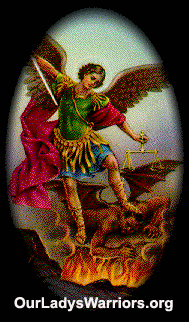
St. Michael the Archangel
~ PRAYER ~
St. Michael, the Archangel, defend us in battle
Be our protection against the wickedness
and snares of the devil;
May God rebuke him, we humbly pray,
and do thou, O Prince of the heavenly host,
by the power of God,
Cast into hell Satan and all the evil spirits
who prowl through the world seeking the ruin of souls.
Amen
+
Disclaimer: Opinions posted on Free Republic are those of the individual posters and do not necessarily represent the opinion of Free Republic or its management. All materials posted herein are protected by copyright law and the exemption for fair use of copyrighted works.