
View of the Cappella Maggiore
Piero della Francesca
1452-66
Fresco
San Francesco, Arezzo
Posted on 04/28/2020 7:23:47 PM PDT by Salvation
There broke out a severe persecution of the Church in Jerusalem,
and all were scattered
throughout the countryside of Judea and Samaria,
except the Apostles.
Devout men buried Stephen and made a loud lament over him.
Saul, meanwhile, was trying to destroy the Church;
entering house after house and dragging out men and women,
he handed them over for imprisonment.
Now those who had been scattered went about preaching the word.
Thus Philip went down to the city of Samaria
and proclaimed the Christ to them.
With one accord, the crowds paid attention to what was said by Philip
when they heard it and saw the signs he was doing.
For unclean spirits, crying out in a loud voice,
came out of many possessed people,
and many paralyzed and crippled people were cured.
There was great joy in that city.
R. (1) Let all the earth cry out to God with joy.
or:
R. Alleluia.
Shout joyfully to God, all the earth,
sing praise to the glory of his name;
proclaim his glorious praise.
Say to God, “How tremendous are your deeds!”
R. Let all the earth cry out to God with joy.
or:
R. Alleluia.
“Let all on earth worship and sing praise to you,
sing praise to your name!”
Come and see the works of God,
his tremendous deeds among the children of Adam.
R. Let all the earth cry out to God with joy.
or:
R. Alleluia.
He has changed the sea into dry land;
through the river they passed on foot;
therefore let us rejoice in him.
He rules by his might forever.
R. Let all the earth cry out to God with joy.
or:
R. Alleluia.
R. Alleluia, alleluia.
Everyone who believes in the Son has eternal life,
and I shall raise him up on the last day, says the Lord.
R. Alleluia, alleluia.
Jesus said to the crowds,
“I am the bread of life;
whoever comes to me will never hunger,
and whoever believes in me will never thirst.
But I told you that although you have seen me,
you do not believe.
Everything that the Father gives me will come to me,
and I will not reject anyone who comes to me,
because I came down from heaven not to do my own will
but the will of the one who sent me.
And this is the will of the one who sent me,
that I should not lose anything of what he gave me,
but that I should raise it on the last day.
For this is the will of my Father,
that everyone who sees the Son and believes in him
may have eternal life,
and I shall raise him on the last day.”
For the readings of the Memorial of Saint Catherine of Siena, please go here.
KEYWORDS: catholic; easter; jn6; prayer; saints;
Please FReepmail me to get on/off the Alleluia Ping List.
Unbelievably....... Hard sayings still... to this day.......
.
From: Acts 8:1b-8
Persecution of the Church (Continuation)
Philip’s Preaching in Samaria
***********************************************************************
Commentary:
1. Stephen’s death signals the start of a violent persecution of the Christian community and Hellenist members in particular.
A new situation has been created. “Far from diminishing the boldness of the disciples, Stephen’s death increased it. Christians were
scattered precisely in order to spread the Word further afield” (Chrysostom, “Hom. on Acts”, 18). This scattering of the disciples is
not simply flight from danger. It originates in danger, but they avail of it to serve God and the Gospel. “Flight, so far from implying
cowardice, requires often greater courage than not to flee. It is a great trial of heart. Death is an end of all trouble; he who flees is
ever expecting death, and dies daily. [...] Exile is full of miseries. The after-conduct of the saints showed they had not fled for fear. [...] How would the Gospel ever have been preached throughout the world, if the Apostles had not fled? And, since their time, those,
too, who have become martyrs, at first fled; or, if they advanced to meet their persecutors, it was by some secret suggestion of the Divine Spirit. But, above all, while these instances abundantly illustrate the rule of duty in persecution, and the temper of mind necessary in those who observe it, we have that duty itself declared in a plain precept by no other than our Lord: ‘When they shall persecute you in this city,’ He says, ‘flee into another’” (John Henry Newman,
“Historical Sketches”, II, 7).
4. “Observe how, in the middle of misfortune, the Christians keep up their preaching instead of neglecting it” (Chrysostom, “Hom. on Acts”, 18). Misfortune plays its part in the spread of the Gospel. God’s plan always exceeds man’s calculations and expectations. An apparently mortal blow for the Gospel in fact plays a decisive role in its spread. What comes from God cannot be destroyed; its adversaries in fact contribute to its consolidation and progress. “The religion founded by the mystery of the Cross of Christ cannot be destroyed by any form of cruelty. The Church is not diminished by persecutions; on the contrary, they make for its increase. The field of the Lord is clothed in a richer harvest. When the grain which falls dies, it is reborn and multiplied” (St. Leo the Great, “Hom. on the Feast of St. Peter and St. Paul”).
The disciples are disconcerted to begin with, but then they begin to have a better understanding of God’s providence. They may well have been reminded of Isaiah’s words: “My thoughts are not your thoughts, neither are your ways My ways” (55:8), and of the promises of a Heavenly Father, who arranges all events to the benefit of His elect.
The different periods of Church history show certain similarities, and difficulties caused by hidden or overt enemies never create totally new situations. Christians always have good reason to be optimistic—with an optimism based on faith, self-sacrifice and prayer. “Christianity has been too often in what seemed deadly peril that we should fear for it any new trial now. So far is certain; on the other hand, what is uncertain [...] is the particular mode by which, in the event, Providence rescues and saves His elect inheritance. Sometimes our enemy is turned into a friend; sometimes he is despoiled of that special virulence of evil which was so threatening; sometimes he falls to pieces himself; sometimes he does just so much as is beneficial, and then is removed. Commonly the Church has nothing more to do than to go on in her own proper duties, in confidence and peace; to stand still and to see the salvation of God” (J. H. Newman, “Biglieto Speech”, 1879).
Those who do not know Christ may resist the Gospel, but that resistance makes good Christians spiritually stronger and helps to purify the Church. “The storm of persecution is good. What is the loss? What is already lost cannot be lost. When the tree is not torn up by the roots—and there is no wind or hurricane that can uproot the tree of the Church—only the dry branches fall. And they...are well fallen” (St. J. Escriva, “The Way”, 685).
5. This is not Philip the Apostle (1:13) but one of the seven deacons appointed to look after Christians in need (6:5). The Gospel is
proclaimed to the Samaritans—who also were awaiting the Messiah. This means that it now spreads beyond the borders of Judea once and for all, and our Lord’s promise (Acts 1:8) is fulfilled: “You shall by My witnesses in Jerusalem and in all Judea and Samaria.”
The despised Samaritans became the first to benefit from the Gospel’s determination to spread all over the world. We can sense St. Luke’s pleasure in reporting its proclamation to the Samaritans; earlier he had already showed them in a favorable light: he is the only Evangelist to recount the parable of the Good Samaritan (cf. Luke 10:3-037) and to mention that the leper who came back to thank Jesus after being cured was a Samaritan (cf. Luke 17:16). On the Samaritans in general, see the note on John 4:20.
From: John 6:35-40
The Discourse on the Bread of Life (Continuation)
***********************************************************************
Commentary:
35. Going to Jesus means believing in Him, for it is through faith that we approach our Lord. Jesus uses the metaphor of food and drink to show that He is the one who really meets all man’s noblest aspirations: “How beautiful is our Catholic faith! It provides a solution for all our anxieties, calms our minds and fills our hearts with hope” ([St] J. Escriva, “The Way”, 582).
37-40. Jesus clearly reveals that He is the one sent by the Father. This is something St. John the Baptist proclaimed earlier on (Jn 3:33-36), and Jesus Himself stated it in His dialogue with Nicodemus (Jn 3:17-21) and announced publicly to the Jews in Jerusalem (Jn 5:20-30). Since Jesus is the one sent by the Father, the bread of life come down from Heaven to give life to the world, everyone who believes in Him has eternal life, for it is God’s will that everyone should be saved through Jesus Christ. These words of Jesus contain three mysteries: 1) that of faith in Jesus Christ, which means “going to Jesus”, accepting His miracles (signs) and His words; 2) the mystery of the resurrection of believers, something which begins in this life through faith and becomes fully true in Heaven; 3) the mystery of predestination, the will of our Father in Heaven that all men be saved. These solemn words of our Lord fill the believer with hope.
St. Augustine, commenting on vv. 37 and 38, praises the humility of Jesus, the perfect model for the humility of the Christian: Jesus chose not to do His own will but that of the Father who sent Him: “Humbly am I come, to teach humility am I come, as the master of humility am I come; he who comes to Me is incorporated in Me; he who comes to Me, becomes humble; he who cleaves to Me will be humble, for he does not his will but God’s” (”In Ioann. Evang.”, 25, 15 and 16).
Liturgical Colour: White.
These are the readings for the feria
| First reading | Acts 8:1-8 © |
|---|
| Responsorial Psalm |
|---|
| Psalm 65(66):1-7 © |
| Gospel Acclamation | Jn10:27 |
|---|
| Or: | cf.Jn6:40 |
|---|
| Gospel | John 6:35-40 © |
|---|
These are the readings for the memorial
| First reading | 1 John 1:5-2:2 © |
|---|
| Responsorial Psalm |
|---|
| Psalm 102(103):1-4,8-9,13-14,17-18 © |
| Gospel Acclamation | Mt11:25 |
|---|
| Gospel |
|---|
| Matthew 11:25-30 © |
What is unbelievable difficult for you to say?
| John | |||
| English: Douay-Rheims | Latin: Vulgata Clementina | Greek NT: Byzantine/Majority Text (2000) | |
| John 6 |
|||
| 35. | And Jesus said to them: I am the bread of life: he that cometh to me shall not hunger: and he that believeth in me shall never thirst. | Dixit autem eis Jesus : Ego sum panis vitæ : qui venit ad me, non esuriet, et qui credit in me, non sitiet umquam. | ειπεν δε αυτοις ο ιησους εγω ειμι ο αρτος της ζωης ο ερχομενος προς με ου μη πειναση και ο πιστευων εις εμε ου μη διψηση πωποτε |
| 36. | But I said unto you, that you also have seen me, and you believe not. | Sed dixi vobis quia et vidistis me, et non creditis. | αλλ ειπον υμιν οτι και εωρακατε με και ου πιστευετε |
| 37. | All that the Father giveth to me shall come to me; and him that cometh to me, I will not cast out. | Omne quod dat mihi Pater, ad me veniet : et eum qui venit ad me, non ejiciam foras : | παν ο διδωσιν μοι ο πατηρ προς εμε ηξει και τον ερχομενον προς με ου μη εκβαλω εξω |
| 38. | Because I came down from heaven, not to do my own will, but the will of him that sent me. | quia descendi de cælo, non ut faciam voluntatem meam, sed voluntatem ejus qui misit me. | οτι καταβεβηκα εκ του ουρανου ουχ ινα ποιω το θελημα το εμον αλλα το θελημα του πεμψαντος με |
| 39. | Now this is the will of the Father who sent me: that of all that he hath given me, I should lose nothing; but should raise it up again in the last day. | Hæc est autem voluntas ejus qui misit me, Patris : ut omne quod dedit mihi, non perdam ex eo, sed resuscitem illud in novissimo die. | τουτο δε εστιν το θελημα του πεμψαντος με πατρος ινα παν ο δεδωκεν μοι μη απολεσω εξ αυτου αλλα αναστησω αυτο [εν] τη εσχατη ημερα |
| 40. | And this is the will of my Father that sent me: that every one who seeth the Son, and believeth in him, may have life everlasting, and I will raise him up in the last day. | Hæc est autem voluntas Patris mei, qui misit me : ut omnis qui videt Filium et credit in eum, habeat vitam æternam, et ego resuscitabo eum in novissimo die. | τουτο δε εστιν το θελημα του πεμψαντος με ινα πας ο θεωρων τον υιον και πιστευων εις αυτον εχη ζωην αιωνιον και αναστησω αυτον εγω τη εσχατη ημερα |
6:35–40
35. And Jesus said unto them, I am the bread of life: he that cometh to me shall never hunger; and he that believeth on me shall never thirst.
36. But I said unto you, That ye also have seen me, and believe not.
37. All that the Father giveth me shall come to me; and him that cometh to me I will in no wise cast out.
38. For I came down from heaven, not to do mine own will, but the will of him that sent me.
39. And this is the Father’s will which hath sent me, that of all which he hath given me I should lose nothing, but should raise it up again at the last day.
40. And this is the will of him that sent me, that every one which seeth the Son, and believeth on him, may have everlasting life: and I will raise him up at the last day.
CHRYSOSTOM. (Hom. xlv. 2) Our Lord now proceeds to set forth mysteries; and first speaks of His Divinity: And Jesus said unto them, I am the bread of life. He does not say this of His body, for He speaks of that at the end; The bread that I will give you is My flesh. Here He is speaking of His Divinity. The flesh is bread, by virtue of the Word; this bread is heavenly bread, on account of the Spirit which dwelleth in it.
THEOPHYLACT. He does not say, I am the bread of nourishment, but of life, for, whereas all things brought death, Christ hath quickened us by Himself. But the life here, is not our common life, but that which is not cut short by death: He that cometh to Me shall never hunger; and He that believeth on Me shall never thirst.
AUGUSTINE. (Tr. xxv. 14) He that cometh to Me, i. e. that believeth on Me, shall never hunger, has the same meaning as shall never thirst; both signifying that eternal society, where there is no want.
THEOPHYLACT. Or, shall never hunger or thirst, i. e. shall never be wearied1 of hearing the word of God, and shall never thirst as to the understanding: as though He had not the water of baptism, and the sanctification of the Spirit.
AUGUSTINE. (Tr. xxv. 14) Ye desire bread from heaven: but, though you have it before you, you eat it not. This is what I told you: But I said unto you, that ye also have seen Me, and believe not.
ALCUIN. As if He said, I did not say what I did to you about the bread, because I thought you would eat it, but rather to convict you of unbelief. I say, that ye see Me, and believe not.
CHRYSOSTOM. (Hom. xliv. 2. c. 5.) Or, I said to you, refers to the testimony of the Scriptures, of which He said above, They are they which testify of Me; and again, I am come in My Father’s name, and ye receive Me not. That ye have seen Me, is a silent allusion to His miracles.
AUGUSTINE. (Tr. xxv. 14) But, because ye have seen Me, and believed not, I have not therefore lost the people of God: All that the Father giveth Me, shall come unto Me; and him that cometh to Me, I will in no wise cast out.
BEDE. All, He saith, absolutely, to shew the fulness of the number who should believe. These are they which the Father gives the Son, when, by His secret inspiration, He makes them believe in the Son.
ALCUIN. Whomsoever therefore the Father draweth to belief in Me, he, by faith, shall come to Me, that he may be joined to Me. And those, who in the steps of faith and good works, shall come to Me, I will in no wise cast out; i. e. in the secret habitation of a pure conscience, he shall dwell with Me, and at the last I will receive him to everlasting felicity.
AUGUSTINE. (Tr. xxv. 14) That inner place, whence there is no casting out, is a great sanctuary, a secret chamber, where is neither weariness, or the bitterness of evil thoughts, or the cross of pain and temptation: of which it is said, Enter thou into the joy of thy Lord. (Mat. 25)
CHRYSOSTOM. (Hom. xliv. 2) The expression, that the Father giveth Me, shews that it is no accident whether a man believes or not, and that belief is not the work of human cogitation, but requires a revelation from on high, and a mind devout enough to receive the revelation. Not that they are free from blame, whom the Father does not give, for they are deficient even in that which lies in their own power, the will to believe. This is a virtual rebuke to their unbelief, as it shews that whoever does not believe in Him, transgresses the Father’s will. Paul, however, says, that He gives them up to the Father: When He shall have given up the kingdom to God, even the Father. (1 Cor. 15:24) But as the Father, in giving, does not take from Himself, so neither does the Son when He gives up. The Son is said to give up to the Father, because we are brought to the Father by Him. And of the Father at the same time we read, By Whom ye were called unto the fellowship of His Son. (1 Cor. 1:9) Whoever then, our Lord says, cometh to Me, shall be saved, for to save such I took up flesh: For I came down from heaven not to do Mine own will, but the will of Him that sent Me. But what? Has thou one will, He another? No, certainly. Mark what He says afterwards; And this is the will of Him that sent Me, that every one which seeth the Son, and believeth on Him, should have everlasting life. And this is the Son’s will too; For the Son quickeneth whom He will. (c. 5:21) He says then, I came to do nothing but what the Father wills, for I have no will distinct from My Father’s: all things that the Father hath are Mine. But this not now: He reserves these higher truths for the end of His ministry.
AUGUSTINE. (Tr. xxv. 15) This is the reason why He does not cast out those who come to Him. For I came down from heaven not to do Mine own will, but the will of Him that sent Me. The soul departed from God, because it was proud. Pride casts us out, humility restores us. When a physician in the treatment of a disease, cures certain outward symptoms, but not the cause which produces them, his cure is only temporary. So long as the cause remains, the disease may return. That the cause then of all diseases, i. e. pride, might be eradicated, the Son of God humbled Himself. Why art thou proud, O man? The Son of God humbled Himself for thee. It might shame thee, perhaps, to imitate a humble man; but imitate at least a humble God. And this is the proof of His humility: I came not to do Mine own will, but the will of Him that sent Me. Pride does its own will; humility the will of God.
HILARY. (iii. de Trin. c. 9) Not that He does what He does not wish. He fulfils obediently His Father’s will, wishing also Himself to fulfil that will.
AUGUSTINE. (Tr. xxv in Joan. 16) For this very reason therefore, I will not cast out Him that cometh to Me; because I came not to do Mine own will. I came to teach humility, by being humble Myself. He that cometh to Me, is made a member of Me, and necessarily humble, because He will not do His own will, but the will of God; and therefore is not cast out. He was cast out, as proud; he returns to Me humble, he is not sent away, except for pride again; he who keeps his humility, falleth not from the truth. And further, that He does not cast out such, because He came not to do His will, He shews when He says, And this is the Father’s will which hath sent Me, that of all which He hath given Me, I should lose nothing. (Mat. 18:14) Every one of an humble mind is given to Him: It is not the will of your Father, that one of these little ones should perish. The swelling ones may perish; of the little ones none can; for except ye be as a little child, ye shall not enter into the kingdom of heaven. (Mat. 18:3, 5)
AUGUSTINE. (de Cor. et Gratia, c. ix) They therefore who by God’s unerring providence are foreknown, and predestined, called, justified, glorified, even before their new birth, or before they are born at all, are already the sons of God, and cannot possibly perish; these are they who truly come to Christ. By Him there is given also perseverance in good unto the end; which is given only to those who will not perish. Those who do not persevere will perish.
CHRYSOSTOM. (Hom. xliv. 3) I should lose nothing; He lets them know, he does not desire his own honour, but their salvation. After these declarations, I will in no wise cast out, and I should lose nothing, He adds, But should raise it up at the last day. In the general resurrection the wicked will be cast out, according to Matthew, Take him, and cast him into outer darkness. (Mat. 22:13) And, Who is able to cast both soul and body into hell. (Mat. 10:28) He often brings in mention of the resurrection for this purpose: viz. to warn men not to judge of God’s providence from present events, but to carry on their ideas to another world.
AUGUSTINE. (Tr. xxv. 19) See how the twofold resurrection is expressed here. He who cometh to Me, shall forthwith rise again; by becoming humble, and a member of Me. But then He proceeds; But I will raise him up at the last day. To explain the words, All that the Father hath given Me, and, I should lose nothing, He adds; And this is the will of Him that hath sent Me, that every one which seeth the Son, and believeth on Him, may have everlasting life: and I will raise him up at the last day. Above He said, Whoso heareth My word, and believeth on Him that sent Me: (c. 5:24) now it is, Every one which seeth the Son, and believeth on Him. He does not say, believe on the Father, because it is the same thing to believe on the Father, and on the Son; for as the Father hath life in Himself, even so hath He given to the Son to have life in Himself; and again, That whoso seeth the Son and believeth on Him, should have everlasting life: i. e. by believing, by passing over to life, as at the first resurrection. But this is only the first resurrection, He alludes to the second when He says, And I will raise him up at the last day.
Catena Aurea John 6
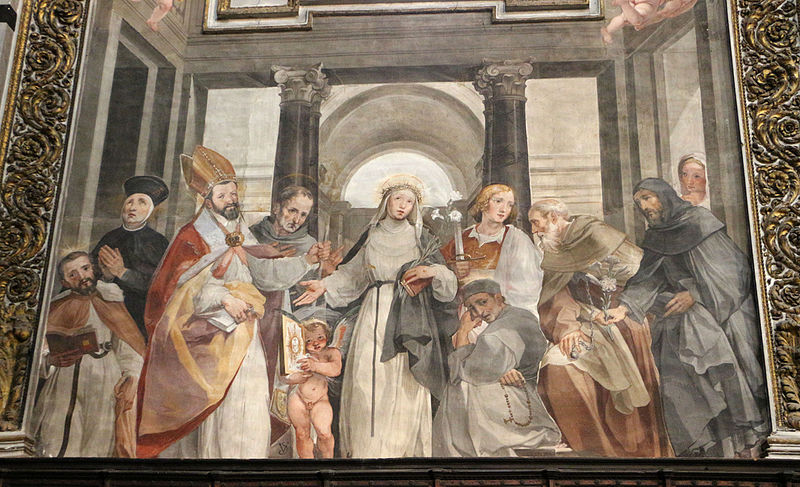
The value Catherine makes central in her short life and which sounds clearly and consistently through her experience is complete surrender to Christ. What is most impressive about her is that she learns to view her surrender to her Lord as a goal to be reached through time.
She was the 23rd child of Jacopo and Lapa Benincasa and grew up as an intelligent, cheerful, and intensely religious person. Catherine disappointed her mother by cutting off her hair as a protest against being overly encouraged to improve her appearance in order to attract a husband. Her father ordered her to be left in peace, and she was given a room of her own for prayer and meditation.
She entered the Dominican Third Order at 18 and spent the next three years in seclusion, prayer, and austerity. Gradually, a group of followers gathered around her—men and women, priests and religious. An active public apostolate grew out of her contemplative life. Her letters, mostly for spiritual instruction and encouragement of her followers, began to take more and more note of public affairs. Opposition and slander resulted from her mixing fearlessly with the world and speaking with the candor and authority of one completely committed to Christ. She was cleared of all charges at the Dominican General Chapter of 1374.
Her public influence reached great heights because of her evident holiness, her membership in the Dominican Third Order, and the deep impression she made on the pope. She worked tirelessly for the crusade against the Turks and for peace between Florence and the pope.
In 1378, the Great Schism began, splitting the allegiance of Christendom between two, then three, popes and putting even saints on opposing sides. Catherine spent the last two years of her life in Rome, in prayer and pleading on behalf of the cause of Pope Urban VI and the unity of the Church. She offered herself as a victim for the Church in its agony. She died surrounded by her “children” and was canonized in 1461.
Catherine ranks high among the mystics and spiritual writers of the Church. In 1939, she and Francis of Assisi were declared co-patrons of Italy. Pope Paul VI named her and Teresa of Avila doctors of the Church in 1970. Her spiritual testament is found in The Dialogue.
Though she lived her life in a faith experience and spirituality far different from that of our own time, Catherine of Siena stands as a companion with us on the Christian journey in her undivided effort to invite the Lord to take flesh in her own life. Events which might make us wince or chuckle or even yawn fill her biographies: a mystical experience at six, childhood betrothal to Christ, stories of harsh asceticism, her frequent ecstatic visions. Still, Catherine lived in an age which did not know the rapid change of 21st-century mobile America. The value of her life for us today lies in her recognition of holiness as a goal to be sought over the course of a lifetime.
Europe
Fire Prevention
Italy
Pray for Pope Francis.
(Which goes against a precedent.)
Catholic Church in Nigeria Appeals to the West: ‘Make Known the Atrocities’
50 Boko Haram Islamic Radicals Killed; 1,000 Hostages, Women and Children, Rescued in Nigeria
Nigeria: In the Face of Ongoing Islamist Attacks, the Faith is Growing
US Promises to Help Nigeria Exterminate Boko Haram
Is This Bishop Right about the Rosary Conquering Boko Haram? [Catholic Caucus]
Why Boko Haram and ISIS Target Women
Report reveals scale of Boko Haram violence inflictef on Nigerian Catholics
Military evacuating girls, women rescued from Boko Haram
Echos of Lepanto Nigerian bishop says rosary will bring down Boko Harm
After vision of Christ, Nigerian bishop says rosary will bring down Boko Haram (Catholic Caucus)
Nigerian Bishop Says Christ Showed Him How to Beat Islamic Terror Group
Disclaimer: Opinions posted on Free Republic are those of the individual posters and do not necessarily represent the opinion of Free Republic or its management. All materials posted herein are protected by copyright law and the exemption for fair use of copyrighted works.