
The Trinity with Christ Crucified
Austrian Master
egg on silver fir
circa 1410
National Gallery, London
Posted on 04/22/2020 9:23:20 PM PDT by Salvation
When the court officers had brought the Apostles in
and made them stand before the Sanhedrin,
the high priest questioned them,
“We gave you strict orders did we not,
to stop teaching in that name.
Yet you have filled Jerusalem with your teaching
and want to bring this man’s blood upon us.”
But Peter and the Apostles said in reply,
“We must obey God rather than men.
The God of our ancestors raised Jesus,
though you had him killed by hanging him on a tree.
God exalted him at his right hand as leader and savior
to grant Israel repentance and forgiveness of sins.
We are witnesses of these things,
as is the Holy Spirit whom God has given to those who obey him.”
When they heard this,
they became infuriated and wanted to put them to death.
R. (7a) The Lord hears the cry of the poor.
or:
R. Alleluia.
I will bless the LORD at all times;
his praise shall be ever in my mouth.
Taste and see how good the LORD is;
blessed the man who takes refuge in him.
R. The Lord hears the cry of the poor.
or:
R. Alleluia.
The LORD confronts the evildoers,
to destroy remembrance of them from the earth.
When the just cry out, the LORD hears them,
and from all their distress he rescues them.
R. The Lord hears the cry of the poor.
or:
R. Alleluia.
The LORD is close to the brokenhearted;
and those who are crushed in spirit he saves.
Many are the troubles of the just man,
but out of them all the LORD delivers him.
R. The Lord hears the cry of the poor.
or:
R. Alleluia.
R. Alleluia, alleluia.
You believe in me, Thomas, because you have seen me, says the Lord;
blessed are those who have not seen, but still believe!
R. Alleluia, alleluia.
The one who comes from above is above all.
The one who is of the earth is earthly and speaks of earthly things.
But the one who comes from heaven is above all.
He testifies to what he has seen and heard,
but no one accepts his testimony.
Whoever does accept his testimony certifies that God is trustworthy.
For the one whom God sent speaks the words of God.
He does not ration his gift of the Spirit.
The Father loves the Son and has given everything over to him.
Whoever believes in the Son has eternal life,
but whoever disobeys the Son will not see life,
but the wrath of God remains upon him.
For the readings of the Optional Memorial of Saint George, please go here.
For the readings of the Optional Memorial of Saint Adalbert, please go here.
KEYWORDS: catholic; easter; jn3; prayer; saints;
Please FReepmail me to get on/off the Alleluia Ping List.
From: Acts 5:27-33
The Apostles Before the Sanhedrin
[33] When they heard this they were enraged and wanted to kill them.
*********************************************************************************************
Commentary:
29. The Apostles’ failure to obey the Sanhedrin is obviously not due to pride or to their not knowing their place (as citizens they are subject to the Sanhedrin’s authority); the Sanhedrin is imposing a ruling which would have them go against God’s law and their own conscience. The Apostles humbly and boldly remind their judges that obedience to God comes first. They know that many members
of the Sanhedrin are religious men, good Jews who can understand their message; they try not so much to justify themselves as to get the Sanhedrin to react: they are more concerned about their judges’ spiritual health than about their own safety. St. John Chrysostom comments: “God allowed the Apostles to be brought to trial so that their adversaries might be instructed, if they so desired. [...] The Apostles are not irritated by the judges; they plead with them compassionately, with tears in their eyes, and their only aim is to free them from error and from divine wrath” (”Hom. on Acts”, 13). They are convinced that “those who fear God are in no danger, only those who do not fear Him” (”ibid.”) and that it is worse to commit injustice than to suffer it. We can see from the Apostles’ behavior how deep their convictions run; grace and faith in Jesus Christ have given them high regard for the honor of God. They have begun at
last to love and serve God without counting the cost. This is true of Christian maturity. “In that cry “serviam”! [I will serve!] you express your determination to `serve’ the Church of God most faithfully, even at the cost of fortune, of reputation and of life” ([St] J. Escriva, “The Way”, 519).
The Church often prays to God to give its children this resilience: they need it because there is always the danger of growing indifferent and of abandoning the faith to some extent. “Lord, fill us with that spirit of courage which gave your martyr Sebastian,” his feast’s liturgy says, “strength to offer his life in faithful witness. Help us to learn from him to cherish your law and to obey
you rather than men” (”Roman Missal”).
A Christian should conform his behavior to God’s law: that law should be his very life. He should obey and love God’s commandments as taught by the Church, if he wishes to live a truly human life. The law of God is not something burdensome: it is a way of freedom, as Sacred Scripture is at pains to point out: “The Lord is my portion, I promise to keep Thy words. I entreat Thy favor with all my heart; be gracious to me according to Thy promise. When I think of Thy ways, I turn my feet to Thy testimonies; I hasten and do not delay to keep Thy commandments. Though the cord of the wicked ensnare me, I do not forget Thy law. At midnight I rise to praise Thee, because of Thy righteous ordinances. I am a companion of all who fear Thee, of those who keep Thy
precepts. The earth, O Lord, is full of Thy steadfast love; teach me Thy statutes” (Psalm 119:57-64).
Conscience, which teaches man in the depths of his heart, gradually shows him what the law of God involves: “Man has in his heart a law inscribed by God. His dignity lies in observing this law, and by it he will be judged (cf. Romans 2:15-16). His conscience is man’s most secret core, and his sanctuary. There he is alone with God, whose voice echoes in his depths. By conscience, in a
wonderful way, that law is made known. [...] The more a correct conscience prevails, the more do persons and groups turn aside from blind choice and try to be guided by the objective standards of moral conduct” (Vatican II, “Gaudium Et Spes”, 16).
Good and evil are facts of life. A person can identify them. There are such things as good actions—and there are evil actions, which should always be avoided. The goodness or badness of human actions is not essentially dependent on the circumstances, although sometimes these can affect it to some extent.
Like the eye, conscience is designed to enable a person to see, but it needs light from outside (God’s law and the Church’s guidance) to discover religious and moral truths and properly appreciate them. Without that help man simply tires himself out in his search; he seeks only himself and forgets about good and evil, and his conscience becomes darkened by sin and moral opportunism.
“With respect to conscience,” [Pope] Paul VI teaches, “an objection can arise: Is conscience not enough on its own as the norm of our conduct? Do the Decalogues, the codes, imposed on us from outside, not undermine conscience [...]? This is a delicate and very current problem. Here all we will say is that subjective conscience is the first and immediate norm of our conduct, but is needs light,
it needs to see which standard it should follow, especially when the action in question does not evidence its own moral exigencies. Conscience needs to be instructed and trained about what is the best choice to make, by the authority of a law” (”General Audience”, 28 March 1973).
A right conscience, which always goes hand in hand with moral prudence, will help a Christian to obey the law like a good citizen and also to take a stand, personally or in association with others, against any unjust laws which may be proposed or enacted. The State is not almighty in the sphere of law. It may not order or permit anything it likes; therefore not everything legal is morally lawful or just. Respect due to civil authority—which is part of the Gospel message and has always been taught by the Church—should not prevent Christians and people of good will from opposing legislators and rulers when they legislate and govern in a way that is contrary to the law of God and therefore to the common good. Obviously, this legitimate kind of resistance to authority should always involve the use of lawful methods.
It is not enough for good Christians to profess PRIVATELY the teaching of the Gospel and the Church regarding human life, the family, education, freedom, etc. They should realize that these are subjects of crucial importance for the welfare of their country, and they should strive, using all the usual means at their disposal, to see that the laws of the State are supportive of the common good. Passivity towards ideologies and stances that run counter to Christian values is quite deplorable.
30. “Hanging Him on a tree”: this is reminiscent of Deuteronomy 21:23: if a criminal is put to death “and you hang him on a tree, his body shall not remain all night upon a tree, but you shall bury him the same day, for a hanged man is accursed by God.” This is a reference to crucifixion, a form of capital punishment which originated in Persia; it was common throughout the East and was later adopted by the Romans.
32. God sends the Holy Spirit to those who obey Him, and, in turn, the Apostles obey the indications of the Spirit with complete docility.
If we are to obey the Holy Spirit and do what He asks us, we need to cultivate Him and listen to what He says. “Get to know the Holy Spirit, the Great Stranger, on whom depends your sanctification.
“Don’t forget that you are God’s temple. The Advocate is in the center of your soul; listen to Him and be docile to His inspirations” ([St] J. Escriva, “The Way”, 57).
From: John 3:31-36
The Visit of Nicodemus (Continuation)
***********************************************************************
Commentary:
31-36. This paragraph shows us Christ’s divinity, His relationship with the Father and the Holy Spirit, and the share those have in God’s eternal life who believe in Jesus Christ. Outside of faith there is no life nor any room for hope.
Liturgical Colour: White.
| First reading | Acts 5:27-33 © |
|---|
| Responsorial Psalm |
|---|
| Psalm 33(34):2,9,17-20 © |
| Gospel Acclamation |
|---|
| Or: | Jn20:29 |
|---|
| Gospel | John 3:31-36 © |
|---|
| John | |||
| English: Douay-Rheims | Latin: Vulgata Clementina | Greek NT: Byzantine/Majority Text (2000) | |
| John 3 |
|||
| 31. | He that cometh from above, is above all. He that is of the earth, of the earth he is, and of the earth he speaketh. He that cometh from heaven, is above all. | Qui desursum venit, super omnes est. Qui est de terra, de terra est, et de terra loquitur. Qui de cælo venit, super omnes est. | ο ανωθεν ερχομενος επανω παντων εστιν ο ων εκ της γης εκ της γης εστιν και εκ της γης λαλει ο εκ του ουρανου ερχομενος επανω παντων εστιν |
| 32. | And what he hath seen and heard, that he testifieth: and no man receiveth his testimony. | Et quod vidit, et audivit, hoc testatur : et testimonium ejus nemo accipit. | και ο εωρακεν και ηκουσεν τουτο μαρτυρει και την μαρτυριαν αυτου ουδεις λαμβανει |
| 33. | He that hath received his testimony, hath set to his seal that God is true. | Qui accepit ejus testimonium signavit, quia Deus verax est. | ο λαβων αυτου την μαρτυριαν εσφραγισεν οτι ο θεος αληθης εστιν |
| 34. | For he whom God hath sent, speaketh the words of God: for God doth not give the Spirit by measure. | Quem enim misit Deus, verba Dei loquitur : non enim ad mensuram dat Deus spiritum. | ον γαρ απεστειλεν ο θεος τα ρηματα του θεου λαλει ου γαρ εκ μετρου διδωσιν ο θεος το πνευμα |
| 35. | The Father loveth the Son: and he hath given all things into his hand. | Pater diligit Filium et omnia dedit in manu ejus. | ο πατηρ αγαπα τον υιον και παντα δεδωκεν εν τη χειρι αυτου |
| 36. | He that believeth in the Son, hath life everlasting; but he that believeth not the Son, shall not see life; but the wrath of God abideth on him. | Qui credit in Filium, habet vitam æternam ; qui autem incredulus est Filio, non videbit vitam, sed ira Dei manet super eum. | ο πιστευων εις τον υιον εχει ζωην αιωνιον ο δε απειθων τω υιω ουκ οψεται [την] ζωην αλλ η οργη του θεου μενει επ αυτον |
3:31–32
31. He that cometh from above is above all: he that is of the earth is earthly, and speaketh of the earth: he that cometh from heaven is above all.
32. And what he hath seen and heard, that he testifieth;
CHRYSOSTOM. (Hom. xxx. 1) As the worm gnaws wood, and rusts iron, so vainglory destroys the soul that cherishes it. But it is a most obstinate fault. John with all his arguments can hardly subdue it in his disciples: for after what he has said above, he saith yet again, He that cometh from above is above all: meaning, Ye extol my testimony, and say that the witness is more worthy to be believed, than He to whom he bears witness. Know this, that He who cometh from heaven, cannot be accredited by an earthly witness. He is above all; being perfect in Himself, and above comparison.
THEOPHYLACT. Christ cometh from above, as descending from the Father; and is above all, as being elected in preference to all.
ALCUIN. Or, cometh from above; i. e. from the height of that human nature which was before the sin of the first man. For it was that human nature which the Word of God assumed: He did not take upon Him man’s sin, as He did his punishment.
He that is of the earth is of the earth; i. e. is earthly, and speaketh of the earth, speaketh earthly things.
CHRYSOSTOM. (Hom. xxx. 1) And yet he was not altogether of the earth; for he had a soul, and partook of a spirit, which was not of the earth. What means he then by saying that he is of the earth? Only to express his own worthlessness, that he is one born on the earth, creeping on the ground, and not to be compared with Christ, Who cometh from above. Speaketh of the earth, does not mean that he spoke from his own understanding; but that, in comparison with Christ’s doctrine, he spoke of the earth: as if he said, My doctrine is mean and humble, compared with Christ’s; as becometh an earthly teacher, compared with Him, (Col. 2:3) in Whom are hid all the treasures of wisdom and knowledge.
AUGUSTINE. (Tr. xiv. c. 6) Or, speaketh of the earth, he saith of the man, i. e. of himself, so far as he speaks merely humanly. If he says ought divine, he is enlightened by God to say it: as saith the Apostle; Yet not I, but the grace of God which was with me. (1 Cor. 15:10) John then, so far as pertains to John, is of the earth, and speaketh of the earth: if ye hear ought divine from him, attribute it to the Enlightener, not to him who hath received the light.
CHRYSOSTOM. (Hom. xxx. 1) Having corrected the bad feeling of his disciples, he comes to discourse more deeply upon Christ. Before this it would have been useless to reveal the truths which could not yet gain a place in their minds. It follows therefore, He that cometh from heaven.
GLOSS. That is, from the Father. He is above all in two ways; first, in respect of His humanity, which was that of man before he sinned: secondly, in respect of the loftiness of the Father, to whom He is equal.
CHRYSOSTOM. (Hom. xxx. 1) But after this high and solemn mention of Christ, his tone lowers: And what he hath seen and heard, that he testifieth. As our senses are our surest channels of knowledge, and teachers are most depended on who have apprehended by sight or hearing what they teach, John adds this argument in favour of Christ, that, what he hath seen and heard, that he testifieth; meaning that every thing which He saith is true. I want, saith John, to hear what things He, Who cometh from above, hath seen and heard, i. e. what He, and He alone, knows with certainty.
THEOPHYLACT. When ye hear then, that Christ speaketh what He saw and heard from the Father, do not suppose that He needs to be taught by the Father; but only that that knowledge, which He has naturally, is from the Father. For this reason He is said to have heard, whatever He knows, from the Father.
AUGUSTINE. (Tr. xiv. c. 7) But what is it, which the Son hath heard from the Father? Hath He heard the word of the Father? Yea, but He is the Word of the Father. When thou conceivest a word, wherewith to name a thing, the very conception of that thing in the mind is a word. Just then as thou hast in thy mind and with thee thy spoken word; even so God uttered the Word, i. e. begat the Son. Since then the Son is the Word of God, and the Son hath spoken the Word of God to us, He hath spoken to us the Father’s word. What John said is therefore true.
3:32–36
32. —and no man receiveth his testimony.
33. He that hath received his testimony hath set to his seal that God is true.
34. For he whom God hath sent speaketh the words of God: for God giveth not the Spirit by measure unto him.
35. The Father loveth the Son, and hath given all things into his hand.
36. He that believeth on the Son hath everlasting life: and he that believeth not the Son shall not see life; but the wrath of God abideth on him.
CHRYSOSTOM. (Hom. xxx. 1) Having said, And what he hath seen and heard, that he testifieth, to prevent any from supposing, that what he said was false, because only a few for the present believed, he adds, And no man receiveth his testimony; i. e. only a few; for he had disciples who received his testimony. John is alluding to the unbelief of his own disciples, and to the insensibility of the Jews, of whom we read in the beginning of the Gospel, He came unto His own, and His own received Him not.
AUGUSTINE. (Tr. xiv. c. 8) Or thus; There is a people reserved for the wrath of God, and to be condemned with the devil; of whom none receiveth the testimony of Christ. And others there are ordained to eternal life. Mark how mankind are divided spiritually, though as human beings they are mixed up together: and John separated them by the thoughts of their heart, though as yet they were not divided in respect of place, and looked on them as two classes, the unbelievers, and the believers. Looking to the unbelievers, he saith, No man receiveth his testimony. Then turning to those on the right hand he saith, He that hath received his testimony, hath set to his seal.
CHRYSOSTOM. (Hom. xxx. 2) i. e. hath shewn that God is true. This is to alarm them: for it is as much as saying, no one can disbelieve Christ without convicting God, Who sent Him, of falsehood: inasmuch as He speaks nothing but what is of the Father. For He, it follows, Whom God hath sent, speaketh the words of God.
ALCUIN. Or, Hath put to his seal, i. e. hath put a seal on his heart, for a singular and special token, that this is the true God, Who suffered for the salvation of mankind.
AUGUSTINE. (Tr. xiv. c. 8) What is it, that God is true, except that God is true, and every man a liar? For no man can say what truth is, till he is enlightened by Him who cannot lie. God then is true, and Christ is God. Wouldest thou have proof? Hear His testimony, and thou wilt find it so. But if thou dost not yet understand God, thou hast not yet received His testimony. Christ then Himself is God the true, and God hath sent Him; God hath sent God, join both together; they are One God. For John saith, Whom God hath sent, to distinguish Christ from himself. What then, was not John himself sent by God? Yes; but mark what follows, For God giveth not the Spirit by measure unto Him. To men He giveth by measure, to His only Son He giveth not by measure. To one man is given by the Spirit the word of wisdom, to another the word of knowledge: one has one thing, another another; for measure implies a kind of division of gifts. But Christ did not receive by measure, though He gave by measure.
CHRYSOSTOM. (Hom. xxx. 2) By Spirit here is meant the operation of the Holy Spirit. He wishes to shew that all of us have received the operation of the Spirit by measure, but that Christ contains within Himself the whole operation of the Spirit. How then shall He be suspected, Who saith nothing, but what is from God, and the Spirit? For He makes no mention yet of God the Word, but rests His doctrine on the authority of the Father and the Spirit. For men knew that there was God, and knew that there was the Spirit, (although they had not right belief about His nature;) but that there was the Son they did not know.
AUGUSTINE. (Tr. xiv. c. 11) Having said of the Son, God giveth not the Spirit by measure unto Him; he adds, The Father loveth the Son, and farther adds, and hath given all things into His hand; in order to shew that the Father loveth the Son, in a peculiar sense. For the Father loveth John, and Paul, and yet hath not given all things into their hands. But the Father loveth the Son, as the Son, not as a master his servant: as an only, not as an adopted, Son. Wherefore He hath given all things into His hand; so that, as great as the Father is, so great is the Son; let us not think then that, because He hath deigned to send the Son, any one inferior to the Father has been sent.
THEOPHYLACT. The Father then hath given all things to the Son in respect of His divinity; of right, not of grace. Or; He hath given all things into His hand, in respect of His humanity: inasmuch as He is made Lord of all things that are in heaven, and that are in earth.
ALCUIN. And because all things are in His hand, the life everlasting is too: and therefore it follows, He that believeth on the Son hath everlasting life.
BEDE. We must understand here not a faith in words only, but a faith which is developed in works.
CHRYSOSTOM. (Hom. xxxi. 1) He means not here, that to believe on the Son is sufficient to gain everlasting life, for elsewhere He says, Not every one that saith unto Me, Lord, Lord, shall enter into the kingdom of heaven. (Matt. 7) And the blasphemy against the Holy Ghost is of itself sufficient to send into hell. But we must not think that even a right belief on Father, Son, and Holy Ghost, is sufficient for salvation; for we have need of a good life and conversation. Knowing then that the greater part are not moved so much by the promise of good, as by the threat of punishment, he concludes, But He that believeth not the Son, shall not see life; but the wrath of God abideth on him. See how He refers to the Father again, when He speaketh of punishment. He saith not, the wrath of the Son, though the Son is judge; but maketh the Father the judge, in order to alarm men more. And He does not say, in Him, but on Him, meaning that it will never depart from Him; and for the same reason He says, shall not see life, i. e. to shew that He did not mean only a temporary death.
AUGUSTINE. (Tr. xiv. c. 13) Nor does He say, The wrath of God cometh to him, but, abideth on him. For all who are born, are under the wrath of God, which the first Adam incurred. The Son of God came without sin, and was clothed with mortality: He died that thou mightest live. Whosoever then will not believe on the Son, on him abideth the wrath of God, of which the Apostle speaks, We were by nature the children of wrath. (Eph. 2:3)
Catena Aurea John 3
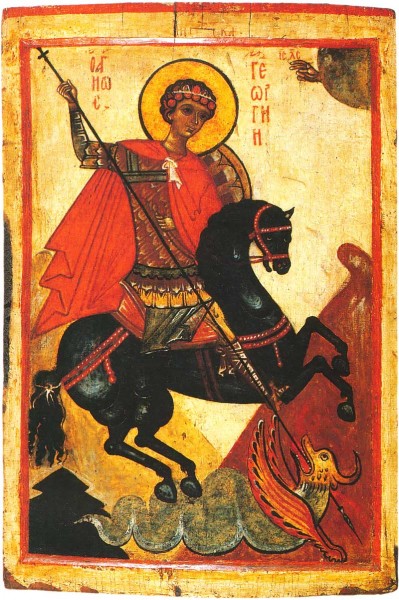
Saint George is the object of a vast amount of imagination. There is every reason to believe that he was a real martyr who suffered at Lydda in Palestine, probably before the time of Constantine. The Church adheres to his memory, but not to the legends surrounding his life. That he was willing to pay the supreme price to follow Christ is what the Church believes. And it is enough.
The story of George’s slaying the dragon, rescuing the king’s daughter, and converting Libya is a 12th-century Italian fable. George was a favorite patron saint of crusaders, as well as of Eastern soldiers in earlier times. He is a patron saint of England, Portugal, Germany, Aragon, Catalonia, Genoa, and Venice.
Human nature seems to crave more than cold historical data. Americans have Washington and Lincoln, but we somehow need Paul Bunyan, too. The life of Saint Francis of Assisi is inspiring enough, but for centuries the Italians have found his spirit in the legends of the Fioretti, too. Santa Claus is the popular extension of the spirit of Saint Nicholas. The legends about Saint George are part of this yearning. Both fact and legend are human ways of illumining the mysterious truth about the One who alone is holy.
Boy Scouts
England
Portugal
Soldiers
Germany
Opposition to the Good News of Jesus did not discourage Adalbert, who is now remembered with great honor in the Czech Republic, Poland, Hungary, and Germany.
Born to a noble family in Bohemia, he received part of his education from Saint Adalbert of Magdeburg. At the age of 27, he was chosen as bishop of Prague. Those who resisted his program of clerical reform forced him into exile eight years later.
In time, the people of Prague requested his return as their bishop. Within a short time, however, he was exiled again after excommunicating those who violated the right of sanctuary by dragging a woman accused of adultery from a church and murdering her.
After a short ministry in Hungary, he went to preach the Good News to people living near the Baltic Sea. He and two companions were martyred by pagan priests in that region. Adalbert’s body was immediately ransomed and buried in the Gniezno, Poland, cathedral. In the mid-11th century his relics were moved to Saint Vitus Cathedral in Prague. His Liturgical Feast day is April 23.
Preaching the Good News can be dangerous work whether the audience is already baptized or not. Adalbert fearlessly preached Jesus’ gospel and received a martyr’s crown for his efforts. Similar zeal has created modern martyrs in many places, especially in Central and South America. Some of those martyrs grew up in areas once evangelized by Adalbert.

Pray for Pope Francis.
Catholic Church in Nigeria Appeals to the West: ‘Make Known the Atrocities’
50 Boko Haram Islamic Radicals Killed; 1,000 Hostages, Women and Children, Rescued in Nigeria
Nigeria: In the Face of Ongoing Islamist Attacks, the Faith is Growing
US Promises to Help Nigeria Exterminate Boko Haram
Is This Bishop Right about the Rosary Conquering Boko Haram? [Catholic Caucus]
Why Boko Haram and ISIS Target Women
Report reveals scale of Boko Haram violence inflictef on Nigerian Catholics
Military evacuating girls, women rescued from Boko Haram
Echos of Lepanto Nigerian bishop says rosary will bring down Boko Harm
After vision of Christ, Nigerian bishop says rosary will bring down Boko Haram (Catholic Caucus)
Nigerian Bishop Says Christ Showed Him How to Beat Islamic Terror Group
We thank you, God our Father, for those who have responded to your call to priestly ministry.
Accept this prayer we offer on their behalf: Fill your priests with the sure knowledge of your love.
Open their hearts to the power and consolation of the Holy Spirit.
Lead them to new depths of union with your Son.
Increase in them profound faith in the Sacraments they celebrate as they nourish, strengthen and heal us.
Lord Jesus Christ, grant that these, your priests, may inspire us to strive for holiness by the power of their example, as men of prayer who ponder your word and follow your will.
O Mary, Mother of Christ and our mother, guard with your maternal care these chosen ones, so dear to the Heart of your Son.
Intercede for our priests, that offering the Sacrifice of your Son, they may be conformed more each day to the image of your Son, our Lord and Savior, Jesus Christ. Amen.
Saint John Vianney, universal patron of priests, pray for us and our priests
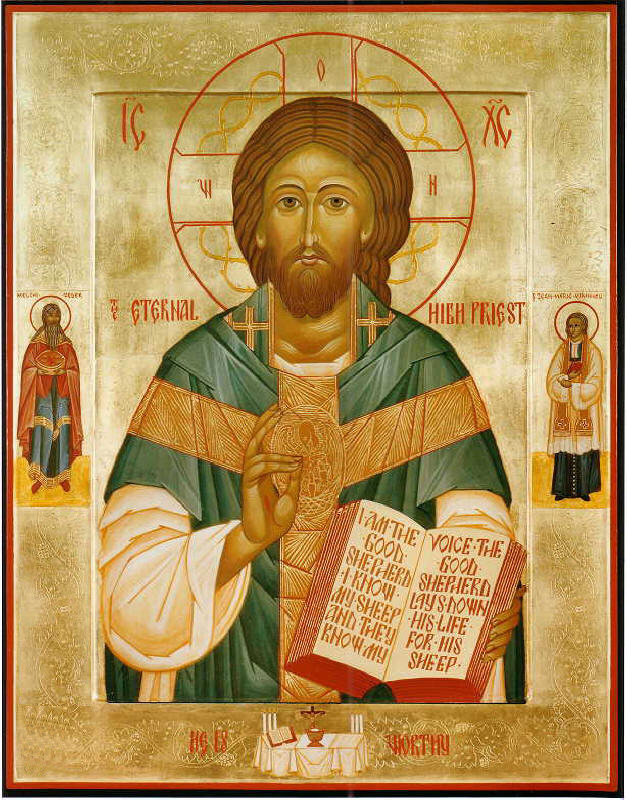
This icon shows Jesus Christ, our eternal high priest.
The gold pelican over His heart represents self-sacrifice.
The border contains an altar and grapevines, representing the Mass, and icons of Melchizedek and St. Jean-Baptiste Vianney.
Melchizedek: king of righteousness (left icon) was priest and king of Jerusalem. He blessed Abraham and has been considered an ideal priest-king.
St. Jean-Baptiste Vianney is the patron saint of parish priests.
Disclaimer: Opinions posted on Free Republic are those of the individual posters and do not necessarily represent the opinion of Free Republic or its management. All materials posted herein are protected by copyright law and the exemption for fair use of copyrighted works.