
Baptismal font
Reiner de Huy
1107-18
Cast bronze, height 60 cm, diameter 80 cm
Saint-Barthélemy, Liège
Posted on 04/20/2020 9:01:26 PM PDT by Salvation
The community of believers was of one heart and mind,
and no one claimed that any of his possessions was his own,
but they had everything in common.
With great power the Apostles bore witness
to the resurrection of the Lord Jesus,
and great favor was accorded them all.
There was no needy person among them,
for those who owned property or houses would sell them,
bring the proceeds of the sale,
and put them at the feet of the Apostles,
and they were distributed to each according to need.
Thus Joseph, also named by the Apostles Barnabas
(which is translated "son of encouragement”),
a Levite, a Cypriot by birth,
sold a piece of property that he owned,
then brought the money and put it at the feet of the Apostles.
R. (1a) The Lord is king; he is robed in majesty.
or:
R. Alleluia.
The LORD is king, in splendor robed;
robed is the LORD and girt about with strength.
R. The Lord is king; he is robed in majesty.
or:
R. Alleluia.
And he has made the world firm,
not to be moved.
Your throne stands firm from of old;
from everlasting you are, O LORD.
R. The Lord is king; he is robed in majesty.
or:
R. Alleluia.
Your decrees are worthy of trust indeed:
holiness befits your house,
O LORD, for length of days.
R. The Lord is king; he is robed in majesty.
or:
R. Alleluia.
R. Alleluia, alleluia.
The Son of Man must be lifted up,
so that everyone who believes in him
may have eternal life.
R. Alleluia, alleluia.
Jesus said to Nicodemus:
“‘You must be born from above.’
The wind blows where it wills, and you can hear the sound it makes,
but you do not know where it comes from or where it goes;
so it is with everyone who is born of the Spirit.”
Nicodemus answered and said to him,
‘How can this happen?”
Jesus answered and said to him,
“You are the teacher of Israel and you do not understand this?
Amen, amen, I say to you,
we speak of what we know and we testify to what we have seen,
but you people do not accept our testimony.
If I tell you about earthly things and you do not believe,
how will you believe if I tell you about heavenly things?
No one has gone up to heaven
except the one who has come down from heaven, the Son of Man.
And just as Moses lifted up the serpent in the desert,
so must the Son of Man be lifted up,
so that everyone who believes in him may have eternal life.”
KEYWORDS: catholic; easter; jn3; prayer;
Please FReepmail me to get on/off the Alleluia Ping List.
From: Acts 4:32-37
The Way of Life of the Early Christians
*********************************************************************************************
Commentary:
32-37. Here we are given a second summary of the life of the first Christian community — which, presided over by Peter and the other Apostles, was the Church, the entire Church of Jesus Christ. The Church of God on earth was only beginning, all contained within the Jerusalem foundation. Now every Christian community — no matter how small it be—which is in communion of faith and obedience
with the Church of Rome is the Church.
“The Church of Christ”, Vatican II teaches, “is really present in all legitimately organized local groups of the faithful, which, in so far as they are united to their pastors, are also quite appropriately called churches in the New Testament. [...] In them the faithful are gathered together through the preaching of the Gospel of Christ, and the mystery of the Lord’s Supper is celebrated. [...] In each altar
community, under the sacred ministry of the bishop, a manifest symbol is to be seen of that charity and ‘unity of the Mystical Body, without which there can be no salvation’ (”Summa Theologiae”, III, q. 73, a. 3). In these communities, though they may often be small and poor, or existing in the diaspora, Christ is present through whose power and influence the one, holy, catholic and apostolic Church
is constituted” (”Lumen Gentium”, 26).
32. The text stresses the importance of “being one”: solidarity, unity, is a virtue of good Christians and one of the marks of the Church: “The Apostles bore witness to the Resurrection not only by word by also by their virtues” (Chrysostom, “Hom. on Acts”, 11). The disciples obviously were joyful and self-sacrificing. This disposition, which results from charity, strives to promote forgiveness and
harmony among the brethren, all sons and daughters of the same Father. The Church realizes that this harmony is often threatened by rancor, envy, misunderstanding and self-assertion. By asking, in prayers and hymns like “Ubi Caritas”, for evil disputes and conflicts to cease, “so that Christ our God may dwell among us”, it is drawing its inspiration from the example of unity and charity left it by the first Christian community in Jerusalem.
Harmony and mutual understanding among the disciples both reflect the internal and external unity of the Church itself and helps its practical implementation.
There is only one Church of Jesus Christ because it has only “one Lord, one baptism” (Ephesians 4:5), and only one visible head — the Pope — who represents Christ on earth. The model and ultimate source of this unity is the Trinity of divine persons, that is, “the unity of one God, the Father and the son in the Holy Spirit” (Vatican II, “Unitatis Redintegratio”, 2). This characteristic work of the Church is visibly expressed: in confession of one and the same faith, in one system of government, in the celebration of the same form of divine worship, and in fraternal concord among all God’s family (cf. “ibid.”).
The Church derives its life from the Holy Spirit; a main factor in nourishing this life and thereby reinforcing the Church’s unity is the Blessed Eucharist: it acts in a mysterious but real way, incessantly, to build up the Mystical Body of the Lord.
God desires all Christians separated from the Church (they have Baptism, and the Gospel truths in varying degrees) to find their way back to the flock of Christ — which they can do by spiritual renewal, and prayer, dialogue and study.
34-35. St. Luke comes back again to the subject of renunciation of possessions, repeating what he says in 2:44 and going on to give two different kinds of example — that of Barnabas (4:36f) and that of Ananias and Sapphira (5:1f).
The disciples’ detachment from material things does not only mean that they have a caring attitude to those in need. It also shows their simplicity of heart, their desire to pass unnoticed and the full confidence they place in the Twelve. “They gave up their possessions and in doing so demonstrated their respect for the Apostles. For they did not presume to give it into their hands, that is, they did not present it ostentatiously, but left it at their feet and made the Apostles its owners and dispensers” (Chrysostom, “Hom. on Acts”, 11).
The text suggests that the Christians in Jerusalem had an organized system for the relief of the poor in the community. Judaism had social welfare institutions and probably the early Church used one of these as a model. However, the Christian system of helping each according to his need would have had characteristics of its own, deriving from the charity from which it sprang and as a result of
gradual differentiation from the Jewish way of doing things.
36-37. Barnabas is mentioned because of his generosity and also in view of his important future role in the spreading of the Gospel. It will be he who introduces the new convert Saul to the Apostles (9:27). Later, the Apostles will send him to Antioch when the Christian church begins to develop there (11:22). He will be Paul’s companion on his first journey (13:2) and will go up to Jerusalem with him in connection with the controversy about circumcising Gentile converts (15:2).
From: John 3:13-17
The Visit of Nicodemus (Continuation)
***********************************************************************
Commentary:
13. This is a formal declaration of the divinity of Jesus. No one has gone up into Heaven and, therefore, no one can have perfect knowledge of God’s secrets, except God Himself who became man and came down from Heaven—Jesus, the second Person of the Blessed Trinity, the Son of Man foretold in the Old Testament (cf. Daniel 7:13), to whom has been given eternal lordship over all peoples.
The Word does not stop being God on becoming man: even when He is on earth as man, He is in Heaven as God. It is only after the Resurrection and the Ascension that Christ is in Heaven as man also.
14-15. The bronze serpent which Moses set up on a pole was established by God to cure those who had been bitten by the poisonous serpents in the desert (cf. Numbers 21:8-9). Jesus compares this with His crucifixion, to show the value of His being raised up on the cross: those who look on Him with faith can obtain salvation. We could say that the good thief was the first to experience the saving power of Christ on the cross: he saw the crucified Jesus, the King of Israel, the Messiah, and was immediately promised that he would be in Paradise that very day (cf. Luke 23:39-43).
The Son of God took on our human nature to make known the hidden mystery of God’s own life (cf. Mark 4:11; John 1:18; 3:1-13; Ephesians 3:9) and to free from sin and death those who look at Him with faith and love and who accept the cross of every day.
The faith of which our Lord speaks is not just intellectual acceptance of the truths He has taught: it involves recognizing Him as Son of God (cf. 1 John 5:1), sharing His very life (cf. John 1:12) and surrendering ourselves out of love and therefore becoming like Him (cf. John 10:27; 1 John 3:2). But this faith is a gift of God (cf. John 3:3, 5-8), and we should ask Him to strengthen it and increase it as the Apostles did: Lord “increase our faith!” (Luke 17:5). While faith is a supernatural, free gift, it is also a virtue, a good habit, which a person can practise and thereby develop: so the Christian, who already has the divine gift of faith, needs with the help of grace to make explicit acts of faith in order to make this virtue grow.
16-21. These words, so charged with meaning, summarize how Christ’s death is the supreme sign of God’s love for men (cf. the section on charity in the “Introduction to the Gospel according to St. John”: pp. 31ff above). “For God so loved the world that He gave His only Son for its salvation. All our religion is a revelation of God’s kindness, mercy and love for us. `God is love’ (1 John 4:16), that is, love poured forth unsparingly. All is summed up in this supreme truth, which explains and illuminates everything. The story of Jesus must be seen in this light. `(He) loved me, St. Paul writes. Each of us can and must repeat it for himself—`He loved me, and gave Himself for me’ (Galatians 2:20)” (Paul VI, “Homily on Corpus Christi”, 13 June 1976).
Christ’s self-surrender is a pressing call to respond to His great love for us: “If it is true that God has created us, that He has redeemed us, that He loves us so much that He has given up His only-begotten Son for us (John 3:16), that He waits for us—every day!—as eagerly as the father of the prodigal son did (cf. Luke 15:11-32), how can we doubt that He wants us to respond to Him with all love? The strange thing would be not to talk to God, to draw away and forget Him, and busy ourselves in activities which are closed to the constant promptings of His grace” ([St] J. Escriva, “Friends of God”, 251).
“Man cannot live without love. He remains a being that is incomprehensible for himself, his life is senseless, if love is not revealed to him, if he does not encounter love, if he does not experience it and make it his own, if he does not participate intimately in it. This [...] is why Christ the Redeemer `fully reveals man to himself’. If we may use the expression, this is the human dimension of the mystery of the Redemption. In this dimension man finds again the greatness, dignity and value that belong to his humanity.[...] The one who wishes to understand himself thoroughly [...] must, with his unrest and uncertainty and even his weakness and sinfulness, with his life and death, draw near to Christ. He must, so to speak, enter into Him with all his own self, he must `appropriate’ and assimilate the whole of the reality of the Incarnation and Redemption in order to find himself. If this profound process takes place within him, he then bears fruit not only of adoration of God but also of deep wonder at himself.
How precious must man be in the eyes of the Creator, if he `gained so great a Redeemer’, (”Roman Missal, Exultet” at Easter Vigil), and if God `gave His only Son’ in order that man `should not perish but have eternal life’. [...]
`Increasingly contemplating the whole of Christ’s mystery, the Church knows with all the certainty of faith that the Redemption that took place through the Cross has definitively restored his dignity to man and given back meaning to his life in the world, a meaning that was lost to a considerable extent because of sin. And for that reason, the Redemption was accomplished in the paschal mystery, leading through the Cross and death to Resurrection” (John Paul II, “Redemptor Hominis”, 10).
Jesus demands that we have faith in Him as a first prerequisite to sharing in His love. Faith brings us out of darkness into the light, and sets us on the road to salvation. “He who does not believe is condemned already” (verse 18).
“The words of Christ are at once words of judgment and grace, of life and death. For it is only by putting to death that which is old that we can come to newness of life. Now, although this refers primarily to people, it is also true of various worldly goods which bear the mark both of man’s sin and the blessing of God.[...] No one is freed from sin by himself or by his own efforts, no one is raised above himself or completely delivered from his own weakness, solitude or slavery; all have need of Christ, who is the model, master, liberator, savior, and giver of life. Even in the secular history of mankind the Gospel has acted as a leaven in the interests of liberty and progress, and it always offers itself as a leaven with regard to brotherhood, unity and peace” (Vatican II, “Ad Gentes”, 8).
Liturgical Colour: White.
| First reading | Acts 4:32-37 © |
|---|
| Responsorial Psalm |
|---|
| Psalm 92(93):1-2,5 © |
| Gospel Acclamation | cf.Rv1:5 |
|---|
| Or: | Jn3:15 |
|---|
| Gospel | John 3:7-15 © |
|---|
The Lord is King. He is robed in Majesty!
| John | |||
| English: Douay-Rheims | Latin: Vulgata Clementina | Greek NT: Byzantine/Majority Text (2000) | |
| John 3 |
|||
| 7. | Wonder not, that I said to thee, you must be born again. | Non mireris quia dixi tibi : oportet vos nasci denuo . | μη θαυμασης οτι ειπον σοι δει υμας γεννηθηναι ανωθεν |
| 8. | The Spirit breatheth where he will; and thou hearest his voice, but thou knowest not whence he cometh, and whither he goeth: so is every one that is born of the Spirit. | Spiritus ubi vult spirat, et vocem ejus audis, sed nescis unde veniat, aut quo vadat : sic est omnis qui natus est ex spiritu. | το πνευμα οπου θελει πνει και την φωνην αυτου ακουεις αλλ ουκ οιδας ποθεν ερχεται και που υπαγει ουτως εστιν πας ο γεγεννημενος εκ του πνευματος |
| 9. | Nicodemus answered, and said to him: How can these things be done? | Respondit Nicodemus, et dixit ei : Quomodo possunt hæc fieri ? | απεκριθη νικοδημος και ειπεν αυτω πως δυναται ταυτα γενεσθαι |
| 10. | Jesus answered, and said to him: Art thou a master in Israel, and knowest not these things? | Respondit Jesus, et dixit ei : Tu es magister in Israël, et hæc ignoras ? | απεκριθη ιησους και ειπεν αυτω συ ει ο διδασκαλος του ισραηλ και ταυτα ου γινωσκεις |
| 11. | Amen, amen I say to thee, that we speak what we know, and we testify what we have seen, and you receive not our testimony. | amen, amen dico tibi, quia quod scimus loquimur, et quod vidimus testamur, et testimonium nostrum non accipitis. | αμην αμην λεγω σοι οτι ο οιδαμεν λαλουμεν και ο εωρακαμεν μαρτυρουμεν και την μαρτυριαν ημων ου λαμβανετε |
| 12. | If I have spoken to you earthly things, and you believe not; how will you believe, if I shall speak to you heavenly things? | Si terrena dixi vobis, et non creditis : quomodo, si dixero vobis cælestia, credetis ? | ει τα επιγεια ειπον υμιν και ου πιστευετε πως εαν ειπω υμιν τα επουρανια πιστευσετε |
| 13. | And no man hath ascended into heaven, but he that descended from heaven, the Son of man who is in heaven. | Et nemo ascendit in cælum, nisi qui descendit de cælo, Filius hominis, qui est in cælo. | και ουδεις αναβεβηκεν εις τον ουρανον ει μη ο εκ του ουρανου καταβας ο υιος του ανθρωπου ο ων εν τω ουρανω |
| 14. | And as Moses lifted up the serpent in the desert, so must the Son of man be lifted up: | Et sicut Moyses exaltavit serpentem in deserto, ita exaltari oportet Filium hominis : | και καθως μωσης υψωσεν τον οφιν εν τη ερημω ουτως υψωθηναι δει τον υιον του ανθρωπου |
| 15. | That whosoever believeth in him, may not perish; but may have life everlasting. | ut omnis qui credit in ipsum, non pereat, sed habeat vitam æternam. | ινα πας ο πιστευων εις αυτον μη αποληται αλλ εχη ζωην αιωνιον |
CHRYSOSTOM. (Hom. xxvi. in Joan. 1) Do not look then for any material production, or think that the Spirit generates flesh; for even the Lord’s flesh is generated not by the Spirit only, but also by the flesh. That which is born of the Spirit is spiritual. The birth here spoken of takes place not according to our substance, but according to honour and grace. But the birth of the Son of God is otherwise; for else what would He have been more than all who are born again? And He would be proved too inferior to the Spirit, inasmuch as His birth would be by the grace of the Spirit. How does this differ from the Jewish doctrine?—But mark next the part of the Holy Spirit, in the divine work. For whereas above some are said to be born of God, (c. 1:13.) here, we find, the Spirit generates them.—The wonder of Nicodemus being roused again by the words, He who is born of the Spirit is spirit, Christ meets him again with an instance from nature; Marvel not that I said unto thee, Ye must be born again. The expression, Marvel not, shews that Nicodemus was surprised at His doctrine. He takes for this instance some thing, not of the grossness of other bodily things, but still removed from the incorporeal nature, the wind; The wind bloweth where it listeth, and thou hearest the sound thereof, but canst not tell whence it cometh, and whither it goeth: so is every one that is born of the Spirit. That is to say, if no one can restrain the wind from going where it will; much less can the laws of nature, whether the condition of our natural birth, or any other, restrain the action of the Spirit. That He speaks of the wind here is plain, from His saying, Thou hearest the sound thereof, i. e. its noise when it strikes objects. He would not in talking to an unbeliever and ignorant person, so describe the action of the Spirit. He says, Bloweth where it listethc; not meaning any power of choice in the wind, but only its natural movements, in their uncontrolled power. But canst not tell whence it cometh or whither it goeth; i. e. If thou canst not explain the action of this wind which comes under the cognizance both of thy feeling and hearing, why examine into the operation of the Divine Spirit? He adds, So is every one that is born of the Spirit.
AUGUSTINE. (Tr. xii. c. 7) But who of us does not see, for example, that the south wind blows from south to north, another wind from the east, another from the west? And how then do we not know whence the wind cometh, and whither it goeth?
BEDE. (in Hom. in part. Invent. S. Cruc. Ed. Nic.) It is the Holy Spirit therefore, Who bloweth where He listeth. It is in His own power to choose, whose heart to visit with His enlightening grace. And thou hearest the sound thereof. When one filled with the Holy Spirit is present with thee and speaks to thee.
AUGUSTINE. (Tr. xii. c. 5) The Psalm soundeth, the Gospel soundeth, the Divine Word soundeth; it is the sound of the Spirit. This means that the Holy Spirit is invisibly present in the Word and Sacrament, to accomplish our birth.
ALCUIN. Therefore, Thou knowest not whence it cometh, or whither it goeth; for, although the Spirit should possess a person in thy presence at a particular time, it could not be seen how He entered into him, or how He went away again, because He is invisible.
HAYMO. (Hom. in Oct. Pent.) Or, Thou canst not tell whence it cometh; i. e. thou knowest not how He brings believers to the faith; or whither it goeth, i. e. how He directs the faithful to their hope. And so is every one that is born of the Spirit; as if He said, The Holy Spirit is an invisible Spirit; and in like manner, every one who is born of the Spirit is born invisibly.
AUGUSTINE. (Tr. xii. c. 5) Or thus: If thou art born of the Spirit, thou wilt be such, that he, who is not yet born of the Spirit, will not know whence thou comest, or whither thou goest. For it follows, So is every one that is born of the Spirit.
THEOPHYLACT. (in loc.) This completely refutes Macedonius the impugner of the Spirit, who asserted that the Holy Ghost was a servant. The Holy Ghost, we find, works by His own power, where He will, and what He will.
3:9–12
9. Nicodemus answered and said unto him, How can these things be?
10. Jesus answered and said unto him, Art thou a master of Israel, and knowest not these things?
11. Verily, verily, I say unto thee, We speak that we do know, and testify that we have seen; and ye receive not our witness.
12. If I have told you earthly things, and ye believe not, how shall ye believe, if I tell you of heavenly things.
HAYMO. Nicodemus cannot take in the mysteries of the Divine Majesty, which our Lord reveals, and therefore asks how it is, not denying the fact, not meaning any censure, but wishing to be informed: Nicodemus answered and said unto Him, How can these things be?
CHRYSOSTOM. (Hom. xxvi. 2) Forasmuch then as he still remains a Jew, and, after such clear evidence, persists in a low and carnal system, Christ addresses him henceforth with greater severity: Jesus answered and said unto him, Art thou a master in Israel, and knowest not these things?
AUGUSTINE. (Tr. xii. c. 6) What think we? that our Lord wished to insult this master in Israel? He wished him to be born of the Spirit: and no one is born of the Spirit except he is made humble; for this very humility it is, which makes us to be born of the Spirit. He however was inflated with his eminence as a master, and thought himself of importance because he was a doctor of the Jews. Our Lord then casts down his pride, in order that he may be born of the Spirit.
CHRYSOSTOM. (Hom. xxvi. 2) Nevertheless He does not charge the man with wickedness, but only with want of wisdom, and enlightenment. But some one will say, What connexion hath this birth, of which Christ speaks, with Jewish doctrines? Thus much. The first man that was made, the woman that was made out of his rib, the barren that bare, the miracles which were worked by means of water, I mean, Elijah’s bringing up the iron from the river, the passage of the Red Sea, and Naaman the Syrian’s purification in the Jordan, were all types and figures of the spiritual birth, and of the purification which was to take place thereby. Many passages in the Prophets too have a hidden reference to this birth: as that in the Psalms, Making thee young and lusty as an eagle: (Ps. 102:5) and, Blessed is he whose unrighteousness is forgiven. (Ps. 31:1) And again, Isaac was a type of this birth. Referring to these passages, our Lord says, Art thou a master in Israel, and knowest not these things? A second time however He condescends to his infirmity, and makes use of a common argument to render what He has said credible: Verily, verily, I say unto thee, We speak that we do know, and testify that we have seen, and ye receive not our testimony. (ver. 11) Sight we consider the most certain of all the senses; so that when we say, we saw such a thing with our eyes, we seem to compel men to believe us. In like manner Christ, speaking after the manner of men, does not indeed say that he has seen actually, i. e. with the bodily eye, the mysteries He reveals; but it is clear that He means it of the most certain absolute knowledge. This then, viz. That we do know, he asserts of Himself alone.
HAYMO. (Hom. in Oct. Pent.) Why, it is asked, does He speak in the plural number, We speak that we do know? Because the speaker being the Only-Begotten Son of God, He would shew that the Father was in the Son, and the Son in the Father, and the Holy Ghost from both, proceeding indivisibly.
ALCUIN. Or, the plural number may have this meaning; I, and they who are born again of the Spirit, alone understand what we speak; and having seen the Father in secret, this we testify openly to the world; and ye, who are carnal and proud, receive not our testimony.
THEOPHYLACT. This is not said of Nicodemus, but of the Jewish race, who to the very last persisted in unbelief.
CHRYSOSTOM. (Hom. xxvi. 3) They are words of gentleness, not of anger; a lesson to us, when we: argue and cannot converse, not by sore and angry words, but by the absence of anger and clamour, (for clamour is the material of anger,) to prove the soundness of our views. Jesus in entering upon high doctrines, ever checks Himself in compassion to the weakness of His hearer: and does not dwell continuously on the most important truths, but turns to others more humble. Whence it follows: If I have told you earthly things, and ye believe not, how shall ye believe if I tell you of heavenly things.
AUGUSTINE. (Tr. xii. in Joan. c. 7) That is: If ye do not believe that I can raise up a temple, which you have thrown down, how can ye believe that men can be regenerated by the Holy Ghost?
CHRYSOSTOM. (Hom. xxvii. 1) Or thus: Be not surprised at His calling Baptism earthly. It is performed upon earth, and is compared with that stupendous birth, which is of the substance of the Father, an earthly birth being one of mere grace. And well hath He said, not, Ye understand not, but, Ye believe not: for when the understanding cannot take in certain truths, we attribute it to natural deficiency or ignorance: but where that is not received which it belongs to faith only to receive, the fault is not deficiency, but unbelief. These truths, however, were revealed that posterity might believe and benefit by them, though the people of that age did not.
3:13
13. And no man hath ascended up to heaven, but he that came down from heaven, even the Son of man which is in heaven.
AUGUSTINE. (De Pecc. mer. et remiss. c. xxxi) After taking notice of this lack of knowledge in a person, who, on the strength of his magisterial station, set himself above others, and blaming the unbelief of such men, our Lord says, that if such as these do not believe, others will: No one hath ascended into heaven, but He that came down from heaven, even the Son of man who is in heaven. This may be rendered: The spiritual birth shall be of such sort, as that men from being earthly shall become heavenly: which will not be possible, except they are made members of Me; so that he who ascends, becomes one with Him who descended. Our Lord accounts His body, i. e. His Church, as Himself.
GREGORY. (xxvii. Mor. c. 8. al. 11.) For as much as we are made one with Him, to the place from which He came alone in Himself, thither He returns alone in us; and He who is ever in heaven, daily ascendeth to heaven.
AUGUSTINE. (ut sup.) Although He was made the Son of man upon earth, yet His Divinity with which, remaining in heaven, He descended to earth, He hath declared not to disagree with the title of Son of man, as He hath thought His flesh worthy the name of Son of God. For through the Unity of person, by which both substances are one Christ, He walked upon earth, being Son of God; and remained in heaven, being Son of man. And the belief of the greater, involves belief in the less. If then the Divine substance, which is so far more removed from us, and could for our sake take up the substance of man so as to unite them in one person; how much more easily may we believe, that the Saints united with the man Christ, become with Him one Christ; so that while it is true of all, that they ascend by grace, it is at the same time true, that He alone ascends to heaven, Who came down from heaven.
CHRYSOSTOM. (Hom. xxvii. 1) Or thus: Nicodemus having said, We know that Thou art a teacher sent from God; our Lord says, And no man hath ascended, &c. in that He might not appear to be a teacher only like one of the Prophets.
THEOPHYLACT. But when thou hearest that the Son of man came down from heaven, think not that His flesh came down from heaven; for this is the doctrine of those heretics, who held that Christ took His Body from heaven, and only passed through the Virgin.
CHRYSOSTOM. (Hom. xxvii. 1) By the title Son of man here, He does not mean His flesh, but Himself altogether; the lesser part of His nature being put to express the whole. It is not uncommon with Him to name Himself wholly from His humanity, or wholly from His divinity.
BEDE. If a man of set purpose descend naked to the valley, and there providing himself with clothes and armour, ascend the mountain again, he who ascended may be said to be the same with him who descended.
HILARY. (de Trin. c. 16.) Or, His descending from heaven is the source of His origin as conceived by the Spirit: Mary gave not His body its origin, though the natural qualities of her sex contributed its birth and increase. That He is the Son of man is from the birth of the flesh which was conceived in the Virgin. That He is in heaven is from the power of His everlasting nature, which did not contract the power of the Word of God, which is infinite, within the sphere of a finite body. Our Lord remaining in the form of a servant, far from the whole circle, inner and outer, of heaven and the world, yet as Lord of heaven and the world, was not absent therefrom. So then He came down from heaven because He was the Son of man; and He was in heaven, because the Word, which was made flesh, had not ceased to be the Word.
AUGUSTINE. (Tr. xii. c. 8) But thou wonderest that He was at once here, and in heaven. Yet such power hath He given to His disciples. Hear Paul, Our conversation is in heaven. (Phil. 3:20) If the man Paul walked upon earth, and had his conversation in heaven; shall not the God of heaven and earth be able to be in heaven and earth?
CHRYSOSTOM. (Hom xxvii. 1) That too which seemeth very lofty is still unworthy of His vastness. For He is not in heaven only, but every where, and filleth all things. But for the present He accommodates Himself to the weakness of His hearer, that by degrees He may convert him.
3:14–15
14. And as Moses lifted up the serpent in the wilderness, even so must the Son of man be lifted up:
15. That whosoever believeth in him should not perish, but have eternal life.
CHRYSOSTOM. (Hom. xxvii. 1) Having made mention of the gift of baptism, He proceeds to the. source of it, i. e. the cross: And as Moses lifted up the serpent in the wilderness, even so must the Son of man be lifted up.
BEDE. He introduces the teacher of the Mosaic law, to the spiritual sense of that law; by a passage from the Old Testament history, which was intended to be a figure of His Passion, and of man’s salvation.
AUGUSTINE. (de Pecc. mer. et remiss. c. xxxii) Many dying in the wilderness from the attack of the serpents, Moses, by commandment of the Lord, lifted up a brazen serpent: and those who looked upon it were immediately healed. The lifting up of the serpent is the death of Christ; the cause, by a certain mode of construction, being put for the effect. The serpent was the cause of death, inasmuch as he persuaded man into that sin, by which he merited death. Our Lord, however, did not transfer sin, i. e. the poison of the serpent, to his flesh, but death; in order that in the likeness of sinful flesh, there might be punishment without sin, by virtue of which sinful flesh might be delivered both from punishment and from sin.
THEOPHYLACT. (in loc.) See then the aptness of the figure. The figure of the serpent has the appearance of the beast, but not its poison: in the same way Christ came in the likeness of sinful flesh, being free from sin. By Christ’s being lifted up, understand His being suspended on high, by which suspension He sanctified the air, even as He had sanctified the earth by walking upon it. Herein too is typified the glory of Christ: for the height of the cross was made His glory: for in that He submitted to be judged, He judged the prince of this world; for Adam died justly, because he sinned; our Lord unjustly, because He did no sin. So He overcame him, who delivered Him over to death, and thus delivered Adam from death. And in this the devil found himself vanquished, that he could not upon the cross torment our Lord into hating His murderers: but only made Him love and pray for them the more. In this way the cross of Christ was made His lifting up, and glory.
CHRYSOSTOM. (Hom. xxvii. 2) Wherefore He does not say, ‘The Son of man must be suspended, but lifted up, a more honourable term, but coming near the figure. He uses the figure to shew that the old dispensation is akin to the new, and to shew on His hearers’ account that He suffered voluntarily; and that His death issued in life.
AUGUSTINE. (Tr. xii. c. 11) As then formerly he who looked to the serpent that was lifted up, was healed of its poison, and saved from death; so now he who is conformed to the likeness of Christ’s death by faith and the grace of baptism, is delivered both from sin by justification, and from death by the resurrection: as He Himself saith; That whosoever believeth on Him should not perish, but have everlasting life. What need then is there that the child should be conformed by baptism to the death of Christ, if he be not altogether tainted by the poisonous bite of the serpent?
CHRYSOSTOM. (Hom. xxvii. 2) Observe; He alludes to the Passion obscurely, in consideration to His hearer; but the fruit of the Passion He unfolds plainly; viz. that they who believe in the Crucified One should not perish. And if they who believe in the Crucified live, much more shall the Crucified One Himself.
AUGUSTINE. (Tr. xii. c. 11) But there is this difference between the figure and the reality, that the one recovered from temporal death, the other from eternal.
Catena Aurea John 3
For some unknown reason, NAB omits it.
Pray for Pope Francis.
Catholic Church in Nigeria Appeals to the West: ‘Make Known the Atrocities’
50 Boko Haram Islamic Radicals Killed; 1,000 Hostages, Women and Children, Rescued in Nigeria
Nigeria: In the Face of Ongoing Islamist Attacks, the Faith is Growing
US Promises to Help Nigeria Exterminate Boko Haram
Is This Bishop Right about the Rosary Conquering Boko Haram? [Catholic Caucus]
Why Boko Haram and ISIS Target Women
Report reveals scale of Boko Haram violence inflictef on Nigerian Catholics
Military evacuating girls, women rescued from Boko Haram
Echos of Lepanto Nigerian bishop says rosary will bring down Boko Harm
After vision of Christ, Nigerian bishop says rosary will bring down Boko Haram (Catholic Caucus)
Nigerian Bishop Says Christ Showed Him How to Beat Islamic Terror Group
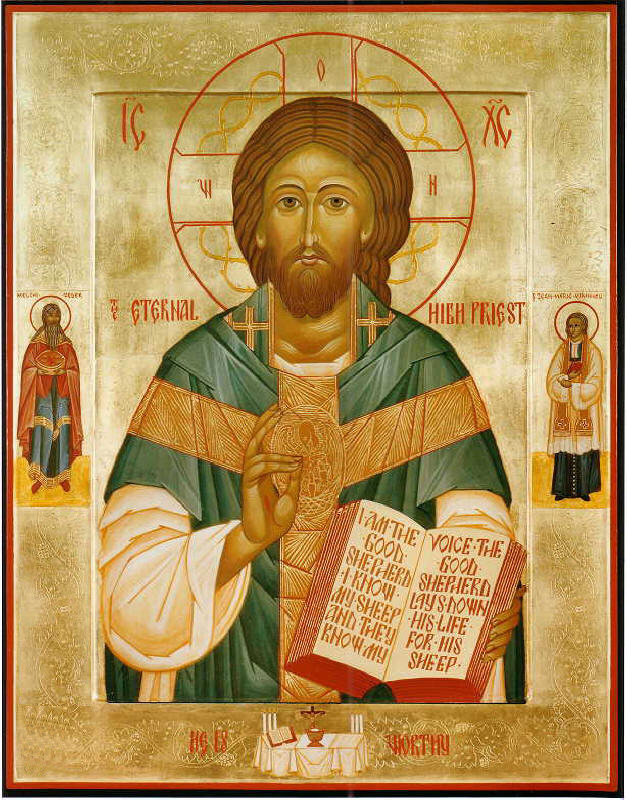
We thank you, God our Father, for those who have responded to your call to priestly ministry.
Accept this prayer we offer on their behalf: Fill your priests with the sure knowledge of your love.
Open their hearts to the power and consolation of the Holy Spirit.
Lead them to new depths of union with your Son.
Increase in them profound faith in the Sacraments they celebrate as they nourish, strengthen and heal us.
Lord Jesus Christ, grant that these, your priests, may inspire us to strive for holiness by the power of their example, as men of prayer who ponder your word and follow your will.
O Mary, Mother of Christ and our mother, guard with your maternal care these chosen ones, so dear to the Heart of your Son.
Intercede for our priests, that offering the Sacrifice of your Son, they may be conformed more each day to the image of your Son, our Lord and Savior, Jesus Christ. Amen.
Saint John Vianney, universal patron of priests, pray for us and our priests
This icon shows Jesus Christ, our eternal high priest.
The gold pelican over His heart represents self-sacrifice.
The border contains an altar and grapevines, representing the Mass, and icons of Melchizedek and St. Jean-Baptiste Vianney.
Melchizedek: king of righteousness (left icon) was priest and king of Jerusalem. He blessed Abraham and has been considered an ideal priest-king.
St. Jean-Baptiste Vianney is the patron saint of parish priests.

1. Sign of the Cross: In the name of the Father, and of the Son, and of the Holy Spirit. Amen.
2. The Apostles Creed: I BELIEVE in God, the Father almighty, Creator of heaven and earth, and in Jesus Christ, His only Son, our Lord, who was conceived by the Holy Spirit, born of the Virgin Mary, suffered under Pontius Pilate, was crucified, died, and was buried. He descended into hell; on the third day he rose again from the dead; he ascended into heaven, and is seated at the right hand of God, the Father Almighty; from there He shall come to judge the living and the dead.
I believe in the Holy Spirit, the holy catholic Church, the communion of saints, the forgiveness of sins, the resurrection of the body, and the life everlasting. Amen.
3. The Lord's Prayer: OUR Father, who art in heaven, hallowed be Thy name. Thy kingdom come. Thy will be done on earth as it is in heaven. Give us this day our daily bread and forgive us our trespasses as we forgive those who trespass against us. And lead us not into temptation, but deliver us from evil. Amen.
4. (3) Hail Mary: HAIL Mary, full of grace, the Lord is with thee. Blessed art thou amongst women and blessed is the fruit of thy womb, Jesus. Holy Mary, Mother of God, pray for us sinners, now, and in the hour of our death. Amen. (Three times)
5. Glory Be: GLORY be to the Father, and to the Son, and to the Holy Spirit. As it was in the beginning, is now, and ever shall be, world without end. Amen.
6. Fatima Prayer: Oh, my Jesus, forgive us our sins, save us from the fires of hell, lead all souls to heaven, especially those in most need of your mercy.
Announce each mystery, then say 1 Our Father, 10 Hail Marys, 1 Glory Be and 1 Fatima prayer. Repeat the process with each mystery.
End with the Hail Holy Queen:
Hail, Holy Queen, Mother of Mercy, our life, our sweetness and our hope! To thee do we cry, poor banished children of Eve! To thee do we send up our sighs, mourning and weeping in this vale of tears! Turn then, most gracious advocate, thine eyes of mercy towards us; and after this, our exile, show unto us the blessed fruit of thy womb, Jesus!
O clement, O loving, O sweet Virgin Mary! Pray for us, O holy Mother of God, that we may be made worthy of the promises of Christ.
Final step -- The Sign of the Cross
The Mysteries of the Rosary By tradition, Catholics meditate on these Mysteries during prayers of the Rosary. The biblical references follow each of the Mysteries below.
The Sorrowful Mysteries
(Tuesdays and Fridays)
1. The Agony in the Garden (Matthew 26:36-46, Luke 22:39-46) [Spiritual fruit - God's will be done]
2. The Scourging at the Pillar (Matthew 27:26, Mark 15:15, John 19:1) [Spiritual fruit - Mortification of the senses]
3. The Crowning with Thorns (Matthew 27:27-30, Mark 15:16-20, John 19:2) [Spiritual fruit - Reign of Christ in our heart]
4. The Carrying of the Cross (Matthew 27:31-32, Mark 15:21, Luke 23:26-32, John 19:17) [Spiritual fruit - Patient bearing of trials]
5. The Crucifixion (Matthew 27:33-56, Mark 15:22-39, Luke 23:33-49, John 19:17-37) [Spiritual fruit - Pardoning of Injuries]
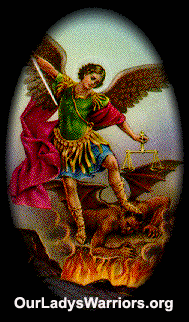
St. Michael the Archangel
~ PRAYER ~
St. Michael, the Archangel, defend us in battle
Be our protection against the wickedness
and snares of the devil;
May God rebuke him, we humbly pray,
and do thou, O Prince of the heavenly host,
by the power of God,
Cast into hell Satan and all the evil spirits
who prowl through the world seeking the ruin of souls.
Amen
+
Disclaimer: Opinions posted on Free Republic are those of the individual posters and do not necessarily represent the opinion of Free Republic or its management. All materials posted herein are protected by copyright law and the exemption for fair use of copyrighted works.