
Resurrection
Piero della Francesca
1463-65
Mural in fresco and tempera, 225 x 200 cm
Pinacoteca Comunale, Sansepolcro
Posted on 04/17/2020 10:01:10 PM PDT by Salvation
Observing the boldness of Peter and John
and perceiving them to be uneducated, ordinary men,
the leaders, elders, and scribes were amazed,
and they recognized them as the companions of Jesus.
Then when they saw the man who had been cured standing there with them,
they could say nothing in reply.
So they ordered them to leave the Sanhedrin,
and conferred with one another, saying,
“What are we to do with these men?
Everyone living in Jerusalem knows that a remarkable sign
was done through them, and we cannot deny it.
But so that it may not be spread any further among the people,
let us give them a stern warning
never again to speak to anyone in this name.”
So they called them back
and ordered them not to speak or teach at all in the name of Jesus.
Peter and John, however, said to them in reply,
“Whether it is right in the sight of God
for us to obey you rather than God, you be the judges.
It is impossible for us not to speak about what we have seen and heard.”
After threatening them further,
they released them,
finding no way to punish them,
on account of the people who were all praising God
for what had happened.
R. (21a) I will give thanks to you, for you have answered me.
or:
R. Alleluia.
Give thanks to the LORD, for he is good,
for his mercy endures forever.
My strength and my courage is the LORD,
and he has been my savior.
The joyful shout of victory
in the tents of the just.
R. I will give thanks to you, for you have answered me.
or:
R. Alleluia.
“The right hand of the LORD is exalted;
the right hand of the LORD has struck with power.”
I shall not die, but live,
and declare the works of the LORD.
Though the LORD has indeed chastised me,
yet he has not delivered me to death.
R. I will give thanks to you, for you have answered me.
or:
R. Alleluia.
Open to me the gates of justice;
I will enter them and give thanks to the LORD.
This is the gate of the LORD;
the just shall enter it.
I will give thanks to you, for you have answered me
and have been my savior.
R. I will give thanks to you, for you have answered me.
or:
R. Alleluia.
R. Alleluia, alleluia.
This is the day the LORD has made;
let us be glad and rejoice in it.
R. Alleluia, alleluia.
When Jesus had risen, early on the first day of the week,
he appeared first to Mary Magdalene,
out of whom he had driven seven demons.
She went and told his companions who were mourning and weeping.
When they heard that he was alive
and had been seen by her, they did not believe.
After this he appeared in another form
to two of them walking along on their way to the country.
They returned and told the others;
but they did not believe them either.
But later, as the Eleven were at table, he appeared to them
and rebuked them for their unbelief and hardness of heart
because they had not believed those
who saw him after he had been raised.
He said to them, “Go into the whole world
and proclaim the Gospel to every creature.”
KEYWORDS: catholic; easter; mk16; prayer;
Please FReepmail me to get on/off the Alleluia Ping List.
Blessings to all as we continue to rely on the goodness of God in these troubled times.
From: Acts 4:13-21
Address To the Sanhedrin (Continuation)
***********************************************************************
Commentary:
13. The members of the Sanhedrin are surprised by Peter’s confidence and by the way these men, who are not well versed in the Law, are able to use Sacred Scripture. “Did not the Apostles,” (St. John) Chrysostom asks in admiration, “poor and without earthly weapons, enter into battle against enemies who were fully armed [...]? Without experience, without skill of the tongue, they fought against experts in rhetoric and the language of the academies” (”Hom. on Acts”, 4).
18-20. In one of his homilies [Pope] John Paul II gives us a practical commentary on this passage, which help us see the right order of priorities and give pride of place to the things of God: “Whereas the elders of Israel charge the Apostles not to speak about Christ, God, on the other hand, does not allow them to remain silent. [...] In Peter’s few sentences we find a full testimony to the Resurrection of the Lord. [...] The word of the living God addressed to men obliges us more than any other human commandment or purpose. This word carries with it the supreme eloquence of truth, it carries the authority of God Himself. [...]
“Peter and the Apostles are before the Sanhedrin. They are completely and absolutely certain that God Himself has spoken in Christ, and has spoken definitely through His Cross and Resurrection. Peter and the Apostles to whom this truth was directly given—as also those who in their time received the Holy Spirit—must bear witness TO IT.
BELIEVING means accepting with complete conviction the truth that comes from God, drawing support from the grace of the Holy Spirit ‘whom God has given to those who obey Him’ (Acts 5:32) to accept what God has revealed and what comes to us through the Church in its living transmission, that is, in Tradition. The organ of this Tradition is the teaching of Peter and of the Apostles and of their successors.
“Over the centuries the sanhedrins change which seek to impose silence, abandonment or distortion of this truth. The “sanhedrins of the contemporary world” are many and of all types. These sanhedrins are each and every person who rejects divine truth; they are systems of human thought, of human knowledge; they are various “conceptions of the world” and also the various programs of human behavior; they are also the different “forms of pressure” used by so-called public opinion, mass civilization, media of social communication, which are materialist or secular agnostic or anti-religious; they are, finally, certain contemporary “systems of government” which—if they do not totally deprive citizens of scope to profess the faith—at least limit that scope in different ways, marginalize believers and turn them into second-class citizens...and against all these modern types of the Sanhedrin of that time, the response of faith is always the same: ‘We must obey God rather than men’ (Acts 5:29)” (”Homily”, 20 April 1980).
From: Mark 16:9-15
Jesus Appears to Mary Magdalene and to Two Disciples
[12] After this He appeared in another form to two of them, as they were walking into the country. [13]And they went back and told the rest, but they did not believe them.
Jesus Appears to the Eleven. The Apostles’ Mission
***********************************************************************
Commentary:
11-14. When reporting these first appearances of the risen Jesus, St. Mark stresses the disciples’ disbelief and their reluctance to accept the fact of the Resurrection, even though Jesus foretold it (cf. Mark 8:31; 9:31; 10:34). This resistance shown by the Apostles is a further guarantee of the truth of Jesus’ resurrection; they were to be direct, specially-appointed witnesses to the risen Christ, yet they were reluctant to accept this role. They had personal, direct proof of the truth of the Resurrection.
However, our Lord will say: “Blessed are those who have not seen and yet believe” (John 20:29). In the Apostles’ case, they needed, in addition to faith in the risen Christ, clear evidence of His resurrection, for they were to be the eye-witnesses, key witnesses who would proclaim it as an irrefutable fact. In this connection [Pope] St. Gregory the Great comments: “The reason why the disciples were slow to believe in the Resurrection was not so much due to their weakness as to our future firmness in the faith; what other purposes does this have (the very Resurrection being demonstrated by many arguments to those who were in doubt) than that our faith should be strengthened by their doubt?” (”In Evangelia Homilae”, 16).
12. Our Lord’s appearance to these two disciples is reported more fully by St. Luke (cf. 24:13-35).
15. This verse contains what is called the “universal apostolic mandate” (paralleled by Matthew 28:19-20 and Luke 24:46-48). This is an imperative command from Christ to His Apostles to preach the Gospel to the whole world. This same apostolic mission applies, especially to the Apostles’ successors, the bishops in communion with Peter’s successor, the Pope.
But this mission extends further: the whole “Church was founded to spread the Kingdom of Christ over all the earth for the glory of God the Father, to make all men partakers in redemption and salvation....Every activity of the Mystical Body with this in view goes by the name of `apostolate’; the Church exercises it through all its members, though in various ways. In fact, the Christian vocation is, of its nature, a vocation to the apostolate as well. In the organism of a living body no member plays a purely passive part, sharing in the life of the body it shares at the same time in its activity. The same is true for the body of Christ, the Church: `the whole body achieves full growth in dependence on the full functioning of each part’ (Ephesians 4:16). Between the members of this body there exists,
further, such a unity and solidarity (cf. Ephesians 4:16) that a member who does not work at the growth of the body to the extent of his possibilities must be considered useless both to the Church and to himself.
“In the Church there is diversity of ministry but unity of mission. To the apostles and their successors Christ has entrusted the office of teaching, sanctifying and governing in His name and by His power. But the laity are made to share in the priestly, prophetical and kingly office of Christ; they have therefore, in the Church and in the world, their own assignment in the mission of the whole people of God” (Vatican II, “Apostolicam Actuositatem”, 2).
It is true that God acts directly on each person’s soul through grace, but it must also be said that it is Christ’s will (expressed here and elsewhere) that men should be an instrument or vehicle of salvation for others.
Vatican II also teaches this: “On all Christians, accordingly, rests the noble obligation of working to bring all men throughout the whole world to hear and accept the divine message of salvation” (”ibid.”, 3).
Liturgical Colour: White.
| First reading | Acts 4:13-21 © |
|---|
| Responsorial Psalm |
|---|
| Psalm 117(118):1,14-21 © |
| Sequence |
|---|
| Gospel Acclamation | Ps117:24 |
|---|
| Gospel | Mark 16:9-15 © |
|---|
| Mark | |||
| English: Douay-Rheims | Latin: Vulgata Clementina | Greek NT: Byzantine/Majority Text (2000) | |
| Mark 16 |
|||
| 9. | But he rising early the first day of the week, appeared first to Mary Magdalen, out of whom he had cast seven devils. | Surgens autem mane prima sabbati, apparuit primo Mariæ Magdalene, de qua ejecerat septem dæmonia. | αναστας δε πρωι πρωτη σαββατου εφανη πρωτον μαρια τη μαγδαληνη αφ ης εκβεβληκει επτα δαιμονια |
| 10. | She went and told them that had been with him, who were mourning and weeping. | Illa vadens nuntiavit his, qui cum eo fuerant, lugentibus et flentibus. | εκεινη πορευθεισα απηγγειλεν τοις μετ αυτου γενομενοις πενθουσιν και κλαιουσιν |
| 11. | And they hearing that he was alive, and had been seen by her, did not believe. | Et illi audientes quia viveret, et visus esset ab ea, non crediderunt. | κακεινοι ακουσαντες οτι ζη και εθεαθη υπ αυτης ηπιστησαν |
| 12. | And after that he appeared in another shape to two of them walking, as they were going into the country. | Post hæc autem duobus ex his ambulantibus ostensus est in alia effigie, euntibus in villam : | μετα δε ταυτα δυσιν εξ αυτων περιπατουσιν εφανερωθη εν ετερα μορφη πορευομενοις εις αγρον |
| 13. | And they going told it to the rest: neither did they believe them. | et illi euntes nuntiaverunt ceteris : nec illis crediderunt. | κακεινοι απελθοντες απηγγειλαν τοις λοιποις ουδε εκεινοις επιστευσαν |
| 14. | At length he appeared to the eleven as they were at table: and he upbraided them with their incredulity and hardness of heart, because they did not believe them who had seen him after he was risen again. | Novissime recumbentibus illis undecim apparuit : et exprobravit incredulitatem eorum et duritiam cordis : quia iis, qui viderant eum resurrexisse, non crediderunt. | υστερον ανακειμενοις αυτοις τοις ενδεκα εφανερωθη και ωνειδισεν την απιστιαν αυτων και σκληροκαρδιαν οτι τοις θεασαμενοις αυτον εγηγερμενον ουκ επιστευσαν |
| 15. | And he said to them: Go ye into the whole world, and preach the gospel to every creature. | Et dixit eis : Euntes in mundum universum prædicate Evangelium omni creaturæ. | και ειπεν αυτοις πορευθεντες εις τον κοσμον απαντα κηρυξατε το ευαγγελιον παση τη κτισει |
16:1–8
1. And when the sabbath was past, Mary Magdalene, and Mary the mother of James, and Salome, had bought sweet spices, that they might come and anoint him.
2. And very early in the morning the first day of the week, they came unto the sepulchre at the rising of the sun.
3. And they said among themselves, Who shall roll us away the stone from the door of the sepulchre?
4. And when they looked, they saw that the stone was rolled away: for it was very great.
5. And entering into the sepulchre, they saw a young man sitting on the right side, clothed in a long white garment; and they were affrighted.
6. And he saith unto them, Be not affrighted: Ye seek Jesus of Nazareth, which was crucified: he is risen; he is not here: behold the place where they laid him.
7. But go your way, tell his disciples and Peter that he goeth before you into Galilee: there shall ye see him, as he said unto you.
8. And they went out quickly, and fled from the sepulchre; for they trembled and were amazed: neither said they any thing to any man; for they were afraid.
PSEUDO-JEROME. After the sadness of the sabbath, a happy day dawns upon them, which holds the chief place amongst days, for in it the chief light shines forth, and the Lord rises in triumph. Wherefore it is said, And when the sabbath was past, Mary Magdalene, and Mary the mother of James and Salome, had bought sweet spices.
GLOSS. (ord. ex Bedâ.) For these religious women after the burial of the Lord, as long as it was lawful to work, that is, up to sunset, prepared ointment, as Luke says. (Luke 23:56) And because they could not finish their work from the shortness of the time, when the sabbath was over, that is, at sunset, as soon as the time for working came round again, they hastened to buy spices, as Mark says, that they might go in the morning to anoint the body of Jesus. Neither could they come to the sepulchre on the evening of the sabbath, for night prevented them. Wherefore it goes on: And very early in the morning the first day of the week, they came unto the sepulchre at the rising of the sun.
SEVERIANUS. (occ. ap. Chrysologum, serm. 82) The women in this place run abroad with womanly devotion, for they do not bring Him faith as though He were alive, but ointments as to one dead; and they prepare the service of their grief for Him as buried, not the joys of heavenly triumph for Him as risen.
THEOPHYLACT. For they do not understand the greatness and dignity of the wisdom of Christ. But they came according to the custom of the Jews to anoint the body of Christ, that it might remain sweet-smelling, and might not burst forth into moisture, for spices have the property of drying up, and absorb the moisture of the body, so that they keep the body from corruption.
GREGORY. (Hom. in Evan. 21) But if we believe on Him who is dead, and are filled with the sweet smell of virtue, and seek the Lord with the fame of good works, we come to His sepulchre with spices. There follows: And very early in the morning the first day of the week, they came unto the sepulchre at the rising of the sun.
AUGUSTINE. (Con. Evang. iii. 24) What Luke expresses by very early in the morning, and John by early when it was yet dark, Mark must be understood to mean, when he says, very early in the morning, at the rising of the sun, that is, when the sky was growing bright in the east, as is usual in places near the rising sun; for this is the light which we call the dawning. Therefore there is no discrepancy with the report which says, while it was yet dark. For when the day is dawning, the remains of darkness lessen in proportion as the light grows brighter; and we must not take the words very early in the morning, at the rising of the sun, to mean that the sun himself was seen upon the earth, but as expressing the near approach of the sun into those parts, that is, when his rising begins to light up the sky.
PSEUDO-JEROME. By very early in the morning, (Luke 24:1. diluculo Vulg.) he means what another Evangelist expresses by at the dawning. But the dawn is the time between the darkness of night, and the brightness of day, in which the salvation of man is coming forth with a happy closeness, to be declared in the Church, just as the sun, when he is rising and the light is near, sends before him the rosy dawn, that with prepared eyes she may bear to see the graciousness of his glorious brightness, when the time of our Lord’s resurrection has dawned; that then the whole Church, after the example of the women, may sing the praises of Christ, since He has quickened the race of man after the pattern of His resurrection, since He has given life, and has poured upon them the light of belief.
BEDE. (in Marc. 4, 45) As then the women shew the great fervency of their love, by coming very early in the morning to the sepulchre, as the history relates, according to the mystical sense an example is given to us, that with a shining face, and shaking off the darkness of wickedness, we may be careful to offer the fragrance of good works and the sweetness of prayer to the Lord.
THEOPHYLACT. He says, On the first of the sabbaths, (μιᾱς σαββάτων.) that is, on the first of the days of the week. For the days of the week are called sabbaths, and by the word ‘una’ is meant ‘prima.’
BEDE. (ubi sup.) Or else, by this phrase is meant the first day from the day of sabbaths, or rests, which were kept on the sabbath. There follows: And they said among themselves, Who shall roll us away the stone from the door of the sepulchre?
SEVERIANUS. (Chrysologus ubi sup.) Your breast was darkened, your eyes shut, and therefore ye did not before see the glory of the opened sepulchre. It goes on: And they looked, and saw that the stone was rolled away.
BEDE. (ubi sup.) Matthew shews clearly enough, that the stone was rolled away by an Angel. This rolling away of the stone means mystically the opening of the Christian sacraments, which were held under the veil of the letter of the law; for the law was written on stone. It goes on: For it was very great.
SEVERIANUS. (Chrysologus ubi sup.) Great indeed by its office rather than its size, for it can shut in and throw open the body of the Lord.
GREGORY. (ubi sup.) But the women who came with spices see the Angels; because those minds who come to the Lord with their virtues, through holy desires, see the heavenly citizens. Wherefore it goes on: And entering into the sepulchre, they saw a young man sitting on the right side, clothed in a long white garment; and they were affrighted.
THEOPHYLACT. Though Matthew says that the Angel was sitting on the stone, whilst Mark relates that the women entering into the sepulchre saw a young man sitting, yet we need not wonder, for they afterwards saw sitting within the sepulchre the same Angel as sat without on the stone.
AUGUSTINE. (ubi sup.) Either let us suppose that Matthew was silent about that Angel, whom they saw on entering, whilst Mark said nothing of him, whom they saw outside sitting on the stone, so that they saw two and heard severally from two, the things which the Angels said concerning Jesus; or we must understand by entering into the sepulchre, their coming within some inclosure, by which it is probable that the place was surrounded a little space before the stone, by the cutting out of which the burial place had been made, so that they saw sitting on the right hand in that space him whom Matthew designates as sitting on the stone.
THEOPHYLACT. But some say the women mentioned by Matthew were different from those in Mark. But Mary Magdalene was with all parties, from her burning zeal and ardent love.
SEVERIANUS. (Chrysologus ubi sup.) The women, then, entered the sepulchre, that being buried with Christ, they might rise again from the tomb with Christ. They see the young man, that is, they see the time of the Resurrection, for the Resurrection has no old age, and the period, in which man knows neither birth nor death, admits of no decay, and requires no increase. Wherefore what they saw was a young man, not an old man, nor an infant, but the age of joy.
BEDE. (ubi sup.) Now they saw a young man sitting on the right side, that is, on the south part of the place where the body was laid. For the body, which was lying on its back, and had its head to the west, must have had its right to the south.
GREGORY. (ubi sup.) But what is meant by the left hand, but this present life, and what by the right, but everlasting life? Because then our Redeemer had already gone through the decay of this present life, fitly did the Angel, who had come to announce His everlasting life, sit on the right hand.
SEVERIANUS. (Chrysologus ubi sup.) Again, they saw a young man sitting on the right, because the Resurrection has nothing sinister in it. They also see him dressed in a long white robe; that robe is not from mortal fleece, but of living virtue, blazing with heavenly light, not of an earthly dye, as saith the Prophet, Thou deckest thyself with light as with a garment; and of the just it is said, Then shall the righteous shine forth as the sun. (Ps. 104:2) (Matt. 13:43)
GREGORY. (ubi sup.) Or else, he appeared covered with a white robe, because he announced the joys of our festivity, for the whiteness of the robe shews the splendour of our solemnity.
PSEUDO-JEROME. The white robe is also true joy, now that the enemy is driven away, the kingdom won, the King of Peace sought for and found and never let go by us. This young man then shews an image of the Resurrection to them who feared death. But their being frightened shews that eye hath not seen, nor ear heard, neither have entered into the heart of man to conceive the things which God hath prepared for them that love Him. (1 Cor 2:9) There follows, And he saith unto them, Be not affrighted.
GREGORY. (ubi sup.) As though he had said, Let them fear, who love not the coming of the inhabitants of heaven; let them fear, who, weighed down with carnal desires, despair that they can ever attain to their company; but why should ye fear, ye who see your own fellow citizens.
PSEUDO-JEROME. For there is no fear in love. Why should they fear, who had found Him whom they sought?
GREGORY. (ubi sup.) But let us hear what the Angel adds; Ye seek Jesus of Nazareth. Jesus means the Saviour, but at that time there may have been many a Jesus, not indeed really, but in name, therefore the place Nazareth is added, that it might be evident of what Jesus it was spoken. And immediately he subjoins the reason, Which was crucified.
THEOPHYLACT. For he does not blush at the Cross, for in it is the salvation of men, and the beginning of the Blessed.
PSEUDO-JEROME. But the bitter root of the Cross has disappeared. The flower of life has burst forth with its fruits, that is, He who lay in death has risen in glory. Wherefore he adds, He is risen; he is not here.
GREGORY. (ubi sup.) He is not here, is spoken of His carnal presence, for He was not absent from any place as to the presence of His majesty.
THEOPHYLACT. As if he had said, Do ye wish to be certain of His resurrection, he adds, Behold the place where they laid him. This too was the reason why he had rolled away the stone, that he might shew the the place.
PSEUDO-JEROME. But immortality is shewn to mortals as1 due to thankfulness, that we may understand what we were, and that we may know what we are to be. There follows, But go your way, tell his disciples and Peter that he goeth before you into Galilee. The women are ordered to tell the Apostles, that as by a woman death was announced, so also might life rising again. But He says specially unto Peter, because he had shewn himself unworthy of being a disciple, since he had thrice denied his Master; but past sins cease to hurt us when they cease to be pleasing to us.
GREGORY. (ubi sup.) If again the Angel had not expressly named him who had denied his Master, he would not have dared to come amongst the disciples; he is therefore called by name, lest he should despair on account of his denial.
AUGUSTINE. (Con. Evan. iii. 25) By saying, He will go before you into Galilee, there shall ye see him, as he said unto you, he seems to imply, that Jesus would not shew Himself to His disciples after His resurrection except in Galilee, which shewing of Himself Mark himself has not2 mentioned. For that which He has related, Early the first day of the week he appeared to Mary Magdalene, and after that to two of them as they walked and went into the country, we know took place in Jerusalem, on the very day of the resurrection; then he comes to His last manifestation, which we know was on the Mount of Olives, not far from Jerusalem. Mark therefore never relates the fulfilment of that which was foretold by the Angel; but Matthew does not mention any place at all, where the disciples saw the Lord after He arose, except Galilee, according to the Angel’s prophecy. But since it is not set down when this happened, whether first, before He was seen any where else, and since the very place where Matthew says that He went into Galilee to the mountain, does not explain the day, or the order of the narration, Matthew does not oppose the account of the others, but assists in explaining and receiving them. But nevertheless since the Lord was not first to shew Himself there, but sent word that He was to be seen in Galilee, where He was seen subsequently, it makes every faithful Christian on the look out, to find out in what mysterious sense it may be understood.
GREGORY. (ubi sup.) For Galilee means1 ‘a passing over;’ for our Redeemer had already passed from His Passion to His resurrection, from death unto life, and we shall have joy in seeing the glory of His resurrection, if only we pass over from vice to the heights of virtue. He then who is announced at the tomb, is shewn in ‘passing over,’ because He who is first known in mortification of the flesh, is seen in this passing over of the soul.
PSEUDO-JEROME. This sentence is but short in the number of syllables, but the promise is vast in its greatness. Here is the fountain of our joy, and the source of everlasting life is prepared. Here all that are scattered are brought together, and the contrite hearts are healed. There, he says, ye shall see Him, but not as ye have seen Him.
AUGUSTINE. (ubi sup.) It is also signified that the grace of Christ is about to pass over from the people of Israel to the Gentiles, by whom the Apostles would never have been received when they preached, if the Lord had not gone before them and prepared a way in their hearts; and this is what is meant by, He goeth before you into Galilee, there shall ye see him, that is, there shall ye find His members. There follows: And they went out quickly, and fled from the sepulchre, for they trembled and were amazed.
THEOPHYLACT. That is, they trembled because of the vision of Angels, and were amazed because of the resurrection.
SEVERIANUS. (Chrysologus ubi sup.) The Angel indeed sits on the sepulchre, the women fly from it; he, on account of his heavenly substance, is confident, they are troubled because of their earthly frame. He who cannot die, cannot fear the tomb, but the women both fear from what was then done, and still, as being mortals, fear the sepulchre as mortals are wont.
PSEUDO-JEROME. This also is spoken of the life to come, in which grief and groaning will flee away. For the women prefigure before the resurrection all that is to happen to them after the resurrection, namely, they flee away from death and fear. There follows, Neither said they any thing to any man, for they were afraid.
THEOPHYLACT. Either on account of the Jews, or else they said nothing because the fear of the vision prevented them.
AUGUSTINE. (de Con. Evan. iii. 24.) We may however enquire how Mark can say this, when Matthew says, they departed quickly from the sepulchre with fear and great joy, and did run to bring his disciples word, (Matt. 28:8) unless we understand it to mean, that they did not dare to say a word to any of the Angels themselves, that is, to answer the words which they had spoken to them; or else to the guards whom they saw lying there; for that joy of which Matthew speaks is not inconsistent with the fear which Mark mentions. For we ought to have understood that both feelings were in their minds, even though Matthew had not mentioned the fear. But since he has also said that they came out with fear and great joy, he does not allow room for any question to be raised.
SEVERIANUS. (Chrysologus ubi sup.) It is said also in a marked manner, that they said nothing to any one, because it is the part of women to hear, and not to speak, to learn, not to teach.
16:9–13
9. Now when Jesus was risen early the first day of the week, he appeared first to Mary Magdalene, out of whom he had cast seven devils.
10. And she went and told them that had been with him, as they mourned and wept.
11. And they, when they had heard that he was alive, and had been seen of her, believed not.
12. After that he appeared in another form unto two of them, as they walked, and went into the country.
13. And they went and told it unto the residue: neither believed they them.
AUGUSTINE. (de Con. Evan. iii. 25) Now we must consider how the Lord appeared after the resurrection. For Mark says, Now when Jesus was risen early the first day of the week, he appeared first to Mary Magdalene, out of whom he had cast seven devils.
BEDE. (ubi sup.) John tells us most fully how and when this appearance took place. But the Lord rose in the morning from the sepulchre in which He had been laid in the evening, that those words of the Psalm might be fulfilled, Heaviness may endure for a night, but joy cometh in the morning. (Ps. 30:5)
THEOPHYLACT. Or else put a stop at, Now when Jesus was risen, and then read, early the first day of the week he appeared, &c.
GREGORY. (ubi sup.) For as Samson at midnight not only left Gaza, but also carried away the gates of it, so also our Redeemer rising before the light, did not only come out free from hell, but destroyed also the very gates of hell. 1But Mark here testifies that seven devils were cast out of Mary; and what is meant by seven devils save all vices? for as by seven days is understood all time, so by the number seven 2 a whole is fitly figured.
THEOPHYLACT. But Mary had seven devils, because she was filled with all vices. Or else, by seven devils are meant seven spirits contrary to the seven virtues, as a spirit without fear, without wisdom, without understanding, and whatsoever else is opposed to the gifts of the Holy Ghost.
PSEUDO-JEROME. Again, He is shewn to her, out of whom He had cast seven devils, because harlots and publicans shall go before the synagogue into the kingdom of heaven, as the thief reached it before the Apostles.
BEDE. (ubi sup.) In the beginning also woman brought man into sin, now she, who first tasted death, first sees the resurrection, lest she should have to bear the reproach of perpetual guilt amongst men; and she who had been the channel of guilt to man, now has become the first channel of grace. For it goes on: And she went and told them that had been with him as they mourned and wept.
PSEUDO-JEROME. They mourn and weep because they had not yet seen, but after a short time they shall receive a consolation. For blessed are they that weep now, for they shall be comforted.
BEDE. (ubi sup.) Fitly too is this woman, who was the first to announce the joy of our Lord’s resurrection, said to have been cured of seven devils, lest any one worthily repenting of his sins should despair of pardon for what he had done, and that it might be shewn that where sin abounded, grace did much more abound. (Rom. 5:20)
SEVERIANUS. (Chrysologus ubi sup.) Mary brings the news, not now as a woman, but in the person of the Church, so that, as above woman was silent, here as the Church she might bring tidings and speak. There follows, And they when they heard that he was alive and had been seen by her, believed not.
GREGORY. (Hom. in Evan. xxix.) That the disciples were slow in believing our Lord’s resurrection was not so much a weakness of theirs as it is our strength. For the resurrection itself through their doubts was manifested by many proofs; and whilst we read and acknowledge them, what do we but become firmer through their doubting? There follows, After this he appeared in another form unto two of them as they walked and went to a farm house.
AUGUSTINE. (ubi sup.) Luke relates the whole story respecting these two, one of whom was Cleophas, but Mark here touches but slightly upon it. That village of which Luke speaks may without absurdity be supposed to be what is here called a farm house, and indeed in some Greek manuscripts it is called the country. But by this name are understood not only villages, but also boroughs and country towns, because they are without the city, which is the head and mother of all the rest. That which Mark expresses by the Lord’s appearance in another form, is what Luke means by saying that their eyes were holden that they could not know him. For something was upon their eyes, which was allowed to remain there, until the breaking of bread.
SEVERIANUS. (Chrysologus ubi sup.) But let no one suppose that Christ changed the form of His face by His resurrection, but the form is changed when of mortal it becomes immortal, so that this means that He gained a glorious countenance, not that He lost the substance of His countenance. But He was seen of two; because faith in the resurrection is to be preached and shewn to two people, that is, the Gentiles and the Jews. There follows, And they went and told it unto the residue, neither believed they them. How are we to understand the words of Mark compared with the account of Luke, that they then said, The Lord hath risen indeed, and hath appeared unto Simon, (Luke 24:34) if we do not suppose that there were some there who would not believe?
THEOPHYLACT. For he does not say this of the eleven, but of some others, whom He calls the residue.
PSEUDO-JEROME. But in a mystic sense we may understand that faith here labours, leading the active life, but there it reigns secure in the contemplative vision. Here we see His face through a glass, there we shall see the truth face to face, wherefore He was shewn to them as they were walking, that is, labouring, in another form. And when it was told, the disciples did not believe, because they saw, like Moses, that which was not enough for them, for he said, Shew me thyself; (Exod. 33:18. Sept.) forgetting his flesh, he prays in this life for that which we hope for in the life to come.
16:14–18
14. Afterward he appeared unto the eleven as they sat at meat, and upbraided them with their unbelief and hardness of heart, because they believed not them which had seen him after he was risen.
15. And he said unto them, Go ye into all the world, and preach the Gospel to every creature.
GLOSS. (non occ.) Mark, when about to finish his Gospel, relates the last appearance of our Lord to His disciples after His resurrection, saying,1 For the last time he appeared unto the eleven as they sat at meat. (Acts 1:4, 9)
GREGORY. (ubi sup.) We should observe that Luke says in the Acts, As he2 was eating with them he commanded that they should not depart from Jerusalem, and shortly afterwards, while they beheld he was taken up. For He ate, and then ascended, that by the act of eating, the truth of the flesh might be declared; wherefore it is also here said, that he appeared to them for the last time as they sat at meat.
PSEUDO-JEROME. But He appeared when all the eleven were together, that all might be witnesses, and relate to all men what they had seen and heard in common. It goes on: And upbraided them with their unbelief and hardness of heart, because they believed not them who had seen him after his resurrection.
AUGUSTINE. (ubi sup.) But how was this done the last time? The last occasion on which the Apostles saw the Lord upon earth happened forty days after the resurrection; but would He then have upbraided them for not believing those who had seen Him risen, when they themselves had so often seen Him after His resurrection? It remains therefore that we should understand that Mark wished to say it in few words, and said for the last time, because it was the last time that He shewed Himself that day, as night was coming on, when the disciples returned from the country into Jerusalem, and found, as Luke says (Luke 24:33.), the eleven and those who were with them, speaking together concerning the resurrection of our Lord. But there were some there who did not believe; when these then were sitting at meat, (as Mark says,) and were still speaking, (as Luke relates,) The Lord stood in the midst of them, and saith unto them, Peace be unto you; (Luke 24:36) as Luke and John say. (John 20:19) The rebuke therefore which Mark here mentions, must have been amongst those words, which Luke and John say, that the Lord at that time spoke to the disciples. But another question is raised, how Mark says that He appeared when the eleven sat at meat, if the time was the first part of the night on the Lord’s day, when John plainly says that Thomas was not with them, who, we believe, had gone out, before the Lord came in to them, after those two had returned from the village, and spoken with the eleven, as we find in Luke’s Gospel. But Luke in his relation leaves room for supposing that Thomas went out first, while they spoke these things, and that the Lord entered afterwards; Mark however from his saying, for the last time he appeared to the eleven as they sat at meat, forces us to believe that he was there, unless indeed, though one of them was absent, he chose to call them the eleven, because the company of the Apostles was then called by this number, before Matthias was chosen into the place of Judas. Or if this be a harsh way of understanding it, let us understand that it means that after many appearances, He shewed Himself for the last time, that is, on the fortieth day, to the Apostles, as they sat at meat, and that since He was about to ascend from them, He rather wished on that day to reprove them for not having believed those who had seen Him risen before seeing Him themselves, because after His ascension even the Gentiles on their preaching were to believe a Gospel, which they had not seen. And so the same Mark immediately after that rebuke says, And he said unto them, Go ye into all the world, and preach the Gospel to every creature. And lower down, He that believeth not shall be condemned. Since then they were to preach this, were not they themselves to be first rebuked, because before they saw the Lord they had not believed those to whom He had first appeared?
GREGORY. (ubi sup.) Another reason also why our Lord rebuked His disciples, when He left them as to His bodily presence, was, that the words which He spoke on leaving them might remain more deeply impressed upon the hearts of His hearers.
PSEUDO-JEROME. But He rebukes their want of faith, that faith might take its place; He rebukes the hardness of their stony heart, that the fleshy heart, full of love, might take its place.
GREGORY. (ubi sup.) After rebuking the hardness of their hearts, let us hear the words of advice which He speaks. For it goes on: Go ye into all the world, and preach the Gospel to every creature. Every man must be understood by every creature; for man partakes something of every creature; he has existence as have stones, life as trees, feeling as animals, understanding as have Angels. For the Gospel is preached to every creature, because he is taught by it, for whose sake all are created, whom all things are in some way like, and from whom therefore they are not alien. By the name of every creature also every nation of the Gentiles may be meant. For it had been said before, Go not into the way of the Gentiles. (Matt. 10:5) But now it is said, Preach the Gospel to every creature, so that the preaching of the Apostles which was thrust aside by Judæa, might be an assistance to us, since Judæa had haughtily rejected it, thus witnessing to her own damnation.
THEOPHYLACT. Or else; to every creature, that is, whether believing or unbelieving. It goes on: He that believeth and is baptized shall be saved. For it is not enough to believe, for he who believeth and is not baptized, but is a catechumen, has not yet attained to perfect salvation.
Catena Aurea Mark 16
Pray for Pope Francis.
Catholic Church in Nigeria Appeals to the West: ‘Make Known the Atrocities’
50 Boko Haram Islamic Radicals Killed; 1,000 Hostages, Women and Children, Rescued in Nigeria
Nigeria: In the Face of Ongoing Islamist Attacks, the Faith is Growing
US Promises to Help Nigeria Exterminate Boko Haram
Is This Bishop Right about the Rosary Conquering Boko Haram? [Catholic Caucus]
Why Boko Haram and ISIS Target Women
Report reveals scale of Boko Haram violence inflictef on Nigerian Catholics
Military evacuating girls, women rescued from Boko Haram
Echos of Lepanto Nigerian bishop says rosary will bring down Boko Harm
After vision of Christ, Nigerian bishop says rosary will bring down Boko Haram (Catholic Caucus)
Nigerian Bishop Says Christ Showed Him How to Beat Islamic Terror Group
We thank you, God our Father, for those who have responded to your call to priestly ministry.
Accept this prayer we offer on their behalf: Fill your priests with the sure knowledge of your love.
Open their hearts to the power and consolation of the Holy Spirit.
Lead them to new depths of union with your Son.
Increase in them profound faith in the Sacraments they celebrate as they nourish, strengthen and heal us.
Lord Jesus Christ, grant that these, your priests, may inspire us to strive for holiness by the power of their example, as men of prayer who ponder your word and follow your will.
O Mary, Mother of Christ and our mother, guard with your maternal care these chosen ones, so dear to the Heart of your Son.
Intercede for our priests, that offering the Sacrifice of your Son, they may be conformed more each day to the image of your Son, our Lord and Savior, Jesus Christ. Amen.
Saint John Vianney, universal patron of priests, pray for us and our priests
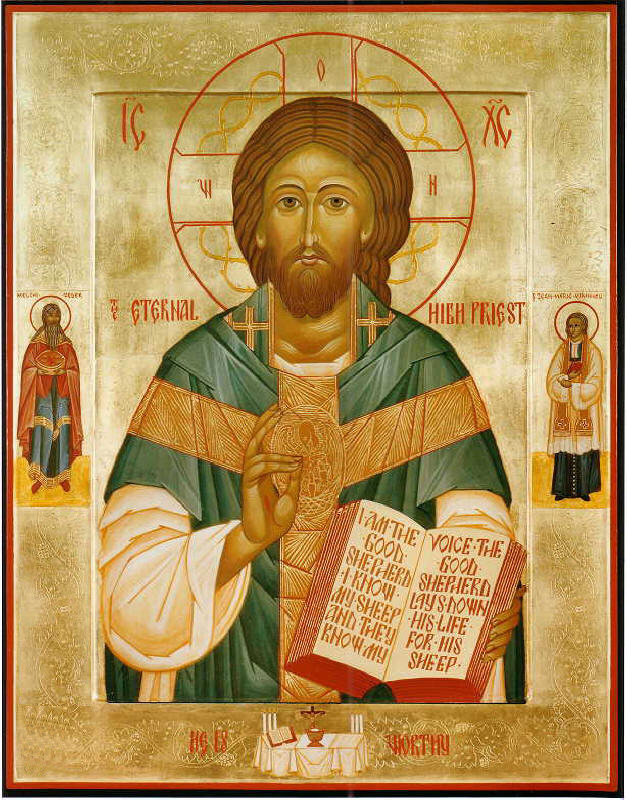
This icon shows Jesus Christ, our eternal high priest.
The gold pelican over His heart represents self-sacrifice.
The border contains an altar and grapevines, representing the Mass, and icons of Melchizedek and St. Jean-Baptiste Vianney.
Melchizedek: king of righteousness (left icon) was priest and king of Jerusalem. He blessed Abraham and has been considered an ideal priest-king.
St. Jean-Baptiste Vianney is the patron saint of parish priests.

1. Sign of the Cross: In the name of the Father, and of the Son, and of the Holy Spirit. Amen.
2. The Apostles Creed: I BELIEVE in God, the Father almighty, Creator of heaven and earth, and in Jesus Christ, His only Son, our Lord, who was conceived by the Holy Spirit, born of the Virgin Mary, suffered under Pontius Pilate, was crucified, died, and was buried. He descended into hell; on the third day he rose again from the dead; he ascended into heaven, and is seated at the right hand of God, the Father Almighty; from there He shall come to judge the living and the dead.
I believe in the Holy Spirit, the holy catholic Church, the communion of saints, the forgiveness of sins, the resurrection of the body, and the life everlasting. Amen.
3. The Lord's Prayer: OUR Father, who art in heaven, hallowed be Thy name. Thy kingdom come. Thy will be done on earth as it is in heaven. Give us this day our daily bread and forgive us our trespasses as we forgive those who trespass against us. And lead us not into temptation, but deliver us from evil. Amen.
4. (3) Hail Mary: HAIL Mary, full of grace, the Lord is with thee. Blessed art thou amongst women and blessed is the fruit of thy womb, Jesus. Holy Mary, Mother of God, pray for us sinners, now, and in the hour of our death. Amen. (Three times)
5. Glory Be: GLORY be to the Father, and to the Son, and to the Holy Spirit. As it was in the beginning, is now, and ever shall be, world without end. Amen.
6. Fatima Prayer: Oh, my Jesus, forgive us our sins, save us from the fires of hell, lead all souls to heaven, especially those in most need of your mercy.
Announce each mystery, then say 1 Our Father, 10 Hail Marys, 1 Glory Be and 1 Fatima prayer. Repeat the process with each mystery.
End with the Hail Holy Queen:
Hail, Holy Queen, Mother of Mercy, our life, our sweetness and our hope! To thee do we cry, poor banished children of Eve! To thee do we send up our sighs, mourning and weeping in this vale of tears! Turn then, most gracious advocate, thine eyes of mercy towards us; and after this, our exile, show unto us the blessed fruit of thy womb, Jesus!
O clement, O loving, O sweet Virgin Mary! Pray for us, O holy Mother of God, that we may be made worthy of the promises of Christ.
Final step -- The Sign of the Cross
The Mysteries of the Rosary By tradition, Catholics meditate on these Mysteries during prayers of the Rosary. The biblical references follow each of the Mysteries below.
The Joyful Mysteries
(Mondays and Saturdays)
1. The Annunciation (Luke 1:26-38) [Spiritual fruit - Humility]
2. The Visitation (Luke 1: 39-56) [Spiritual fruit - Love of Neighbor]
3. The Nativity (Luke 2:1-20) [Spiritual fruit - Poverty of Spirit]
4. The Presentation (Luke 2:21-38) [Spiritual fruit - Purity of mind & body]
5. The Finding of Jesus in the Temple (Luke 2:41-52) [Spiritual fruit - Obedience ]

St. Michael the Archangel
~ PRAYER ~
St. Michael, the Archangel, defend us in battle
Be our protection against the wickedness
and snares of the devil;
May God rebuke him, we humbly pray,
and do thou, O Prince of the heavenly host,
by the power of God,
Cast into hell Satan and all the evil spirits
who prowl through the world seeking the ruin of souls.
Amen
+
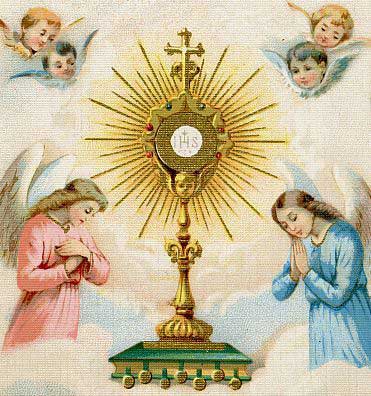
ACT OF ADORATION
I adore Thee, 0 Jesus, true God and true Man, here present in the Holy Eucharist, humbly kneeling before Thee and united in spirit with all the faithful on earth and all the blessed in heaven. In deepest gratitude for so great a blessing, I love Thee, my Jesus, with my whole heart, for Thou art all perfect and all worthy of love.
Give me grace nevermore in any way to offend Thee, and grant that I, being refreshed by Thy Eucharistic presence here on earth, may be found worthy to come to the enjoyment with Mary of Thine eternal and everblessed presence in heaven. Amen.
FAITH IN THE EUCHARIST
O my God, I firmly believe that Thou art really and corporally present in the Blessed Sacrament of the altar. I adore Thee here present from the very depths of my heart, and I worship Thy sacred presence with all possible humility. O my soul, what joy to have Jesus Christ always with us, and to be able to speak to Him, heart to heart, with all confidence. Grant, O Lord, that I, having adored Thy divine Majesty here on earth in this wonderful Sacrament, may be able to adore it eternally in Heaven. Amen.
FOR THE PEACE OF CHRIST
O most sacred, most loving heart of Jesus, Thou art concealed in the Holy Eucharist, and Thou beatest for us still. Now as then Thou sayest, "With desire I have desired." I worship Thee, then, with all my best love and awe, with my fervent affection, with my most subdued, most resolved will. O make my heart beat with Thy heart. Purify it of all that is earthly, all that is proud and sensual, all that is hard and cruel, of all perversity, of all disorder, of all deadness. So fill it with Thee, that neither the events of the day nor the circumstances of the time may have power to ruffle it; but that in Thy love and Thy fear it may have peace. --Cardinal Newman
ACT OF LOVE
I believe Thou art present in the Blessed Sacrament, O Jesus. I love Thee and desire Thee. Come into my heart. I embrace Thee, O never leave me. I beseech Thee, O Lord Jesus, may the burning and most sweet power of Thy love absorb my mind, that I may die through love of Thy love, who wast graciously pleased to die through love of my love. --St. Francis of Assisi
ACT OF REPARATION
Saint Margaret Mary Alacoque, well known in connection with devotion to the Sacred Herat of Jesus, led the way in making reparation to Jesus in the Blessed Sacrament for the coldness and ingratitude of men. This prayer of hers can become our own as we attempt to make amends for our own and others' neglect of the great Sacrament of His love, the Eucharist.
O kind and merciful savior, from my heart I earnestly desire to return Thee love for love. My greatest sorrow is that Thou art not loved by men, and, in particular, that my own heart is so cold, so selfish, so ungrateful. Keenly aware of my own weakness and poverty, I trust that Thy own grace will enable me to offer Thee an act of pure love. And I wish to offer Thee this act of love in reparation for the coldness and neglect that are shown to Thee in the sacrament of Thy love by Thy creatures. O Jesus, my supreme good, I love Thee, not for the sake of the reward which Thou hast promised to those who love Thee, but purely for Thyself. I love Thee above all things that can be loved, above all pleasures, and above myself and all that is not Thee, promising in the presence of heaven and earth that I will live and die purely and simply in Thy holy love, and that if to love Thee thus I must endure persecution and suffering I am completely satisfied, and I will ever say with Saint Paul: Nothing "will be able to separate us from the love of God." 0 Jesus, supreme master of all hearts, I love Thee, I adore Thee, I praise Thee, I thank Thee, because I am now all Thine own. Rule over me, and transform my soul into the likeness of Thyself, so that it may bless and glorify Thee forever in the abode of the saints.
--Saint Margaret Mary Alacoque
OFFERING
My Lord, I offer Thee myself in turn as a sacrifice of thanksgiving. Thou hast died for me, and I in turn make myself over to Thee. I am not my own. Thou hast bought me; I will by my own act and deed complete the purchase. My wish is to be separated from everything of this world; to cleanse myself simply from sin; to put away from me even what is innocent, if used for its own sake, and not for Thine. I put away reputation and honor, and influence, and power, for my praise and strength shall be in Thee. Enable me to carry out what I profess. Amen. --Cardinal Newman
Prayer Source: Prayer Book, The by Reverend John P. O'Connell, M.A., S.T.D. and Jex Martin, M.A., The Catholic Press, Inc., Chicago, Illinois, 1954

Litany of the Most Blessed Sacrament
Lord, have mercy, Lord, have mercy.
Christ, have mercy, Christ, have mercy.
Lord, have mercy, Lord, have mercy.
Christ, hear us, Christ, hear us.
Christ, graciously hear us, Christ, graciously hear us.
God the Father of Heaven, have mercy on us.
God the Son, Redeemer of the world, have mercy on us.
God, the Holy Spirit, have mercy on us.
Holy Trinity, One God, have mercy on us.
O Living Bread, Who from Heaven descended, have mercy on us.
Hidden God and Savior, have mercy on us.
Grain of the elect, have mercy on us.
Vine sprouting forth virgins, have mercy on us.
Wholesome Bread and delicacy of kings, have mercy on us.
Perpetual sacrifice, have mercy on us.
Clean oblation, have mercy on us.
Lamb without spot, have mercy on us.
Most pure feast, have mercy on us.
Food of Angels, have mercy on us.
Hidden manna, have mercy on us.
Memorial of God's wonders, have mercy on us.
Supersubstantial Bread, have mercy on us.
Word made flesh, dwelling in us, have mercy on us.
Holy Victim, have mercy on us.
O Cup of blessing, have mercy on us.
O Mystery of faith, have mercy on us.
O Most high and venerable Sacrament, have mercy on us.
O Most holy of all sacrifices, have mercy on us.
O True propitiatory Sacrifice for the living and the dead, have mercy on us.
O Heavenly antidote, by which we are preserved from sin, have mercy on us.
O stupendous miracle above all others, have mercy on us.
O most holy Commemoration of the Passison of Christ, have mercy on us.
O Gift transcending all abundance, have mercy on us.
O extraordinary memorial of Divine love, have mercy on us.
O affluence of Divine largess, have mercy on us.
O most holy and august mystery, have mercy on us.
Medicine of immortality, have mercy on us.
Awesome and life-giving Sacrament, have mercy on us.
Unbloody Sacrifice, have mercy on us.
Food and guest, have mercy on us.
Sweetest banquet at which the Angels serve, have mercy on us.
Bond of love, have mercy on us.
Offering and oblation, have mercy on us.
Spiritual sweetness tasted in its own foutain, have mercy on us.
Refreshment of holy souls, have mercy on us.
Viaticum of those dying in the Lord, have mercy on us.
Pledge of future glory, have mercy on us.
Be merciful, spare us, O Lord.
Be merciful, graciously hear us, O Lord.
From the unworthy reception of Thy Body and Blood, deliver us, O Lord.
From passions of the flesh, deliver us, O Lord.
From the concupiscence of the eyes, deliver us, O Lord.
From pride, deliver us, O Lord.
From every occasion of sin, deliver us, O Lord.
Through that desire, with which Thou desiredst to eat the Passover with Thy disciples, deliver us, O Lord.
Through that profound humility with which Thou didst wash Thy disciples' feet, deliver us, O Lord.
Through that most ardent love, with which Thou instituted this Divine Sacrament,
deliver us, O Lord.
Through the most precious Blood, which Thou hast left for us upon the altar, deliver us, O Lord.
Through those Five Wounds of Thy most holy Body, which was given up for us, deliver us, O Lord.
Sinners we are, we beseech Thee, hear us.
That Thou wouldst graciously preserve and augment the faith, reverence, and devotion in us towards this admirable Sacrament, we beseech Thee, hear us.
That Thou wouldst graciously lead us through the true confession of we beseech Thee, hear us.
our sins to a frequent reception of the Eucharist, we beseech Thee, hear us.
That Thou wouldst graciously free us from every heresy, falsehood, and blindness of the heart, we beseech Thee, hear us.
That Thou wouldst graciously impart to us the Heavenly and precious fruits of this most Holy Sacrament, we beseech Thee, hear us.
That Thou wouldst graciously protect and strengthen us in our hour of death with this Heavenly Viaticum, we beseech Thee, hear us.
O Son of God, we beseech Thee, hear us.
Lamb of God, Who taketh away the sins of the world, spare us, O Lord.
Lamb of God, Who taketh away the sins of the world, graciously hear us, O Lord.
Lamb of God, Who taketh away the sins of the world, have mercy on us, O Lord.
Christ, hear us, Christ, hear us.
Christ, graciously hear us, Christ, graciously hear us.
Lord, have mercy, Lord, have mercy.
Christ, have mercy, Christ, have mercy.
Lord, have mercy, Lord, have mercy.
Our Father . . .
Hail Mary . . .
V. Thou didst furnish them with Bread from Heaven, Alleluia.
R. Having in it every delight.
Let us pray.
O God, Who under a marvelous Sacrament has left us a memorial of Thy Passion; grant us; we beseech Thee; so to venerate the sacred mysteries of Thy Body and Blood, that we may ever perceive within us the fruit of Thy Redemption. Thou, Who livest and reignest forever and ever. Amen.
From the Manuale Sacerdotum, P. Josephus Schneider, S. J., 1867
[Catholic Caucus] Lenten Series 2015: The Blessed Eucharist
The Eucharist: Is the Real Presence Biblical?
Our Lady of the Holy Eucharist
Demons Believe and Tremble: A Reflection on the Theft of the Eucharist by Satanists
Finding My Way Home: The Eucharist drew me back [Johnnie Bernhard]
Bishop Paprocki: I Direct the Eucharist be Placed in the Center of the Sanctuary
Victory at Harvard: Satan defeated, the Eucharist enthroned (satanist reactions)
The Real Presence: The Eucharist and Chastity [Catholic/Orthodox Caucus]
The Real Presence: Faith in the Life of a Priest [Catholic/Orthodox Caucus]
The Real Presence: Eucharistic Devotion and the Real Presence [Catholic/Orthodox Caucus]
The Real Presence: The Holy Eucharist is the Whole Christ [Catholic/Orthodox Caucus]
The Real Presence: Eucharist as Presence-Sacrament [Catholic/Orthodox Caucus]
The Real Presence: Understanding the Eucharist, The Greatest Need in Church Today [Catholic/Orthodox Caucus'
The Real Presence: Living in the Presence of God [Catholic/Orthodox Caucus]
The Real Presence: The Sacred Heart Is The Holy Eucharist [Catholic/Orthodox Caucus]
The Real Presence: The Eucharist as the Living Christ [Catholic/Orthodox Caucus]
The Real Presence: Christ in the Eucharist, Introduction to the Eucharist,[Catholic/Orthodox Caucus]
The Real Presence: Christ in the Eucharist, The Last Supper, [Catholic/Orthodox Caucus]
The Eucharist: Foundation of the Christian Family(Catholic/Orthodox Caucus)
A Beautiful Summary of Eucharistic theology in an antiphon by Aquinas
Christ in the Eucharist (Ecumenical)
Canon Law and Consecrating the Eucharist (Catholic Caucus)
COMMUNION THROUGH A FEEDING TUBE (And More on Confirmations)
The Eucharist -- John 6
Catholicism and Fundamentalism - The Eucharist
On the Giving and Receiving of Holy Communion: Some norms to recall [Catholic Caucus]
Catholic Word of the Day: HOLY COMMUNION, 05-19-12
Following the Truth: Recognizing Jesus In The Eucharist [Catholic Caucus]
The Fourth Cup
The Last Supper and the Forgiveness of Sins
Bread from Heaven: The Eucharist Sustains Us and Lifts Us Up [Catholic Caucus]
Essays for Lent: The Eucharist
Essays for Lent: The Mass
Excerpt from: The Didache (The Teaching of the Twelve Apostles) [Catholic/Orthodox Caucus]
Divorced Catholics and the Eucharist
Following The Truth: So, You Just Received Jesus...Now What? (Catholic or Open)
The Coptic Orthodox doctrine of the Eucharistic sacrifice
Auxiliary Bishop Says Communion In the Hand is a Calvinist Novelty [Ecumenical]
How Something We Consider Solidly Traditional was Once Thought Progressive (Catholic)
Transubsta ntiation: Change We Can Believe In
Diocese limits Communion under both kinds, laments excessive extraordinary ministers
Phoenix Diocese to adopt new norms for Holy Communion [Catholic Caucus]
What Does GIRM 160 for the USA Really Say?
Lift the City - a Catholic Eucharistic flash mob (Catholic Caucus)
Justin Martyr: 1st apology: Sacraments, Eucharist {Catholic/Orthodox caucus}
The Institution of the Eucharist in Scripture [Catholic Caucus]
How the Mass is a sacrifice, and why so many deny this doctrine (Catholic/Orthodox Caucus)
[Ecumenical] Lent through Eastertide - Divine Mercy Diary Exerpts: Holy Communion and the Eucharist
Vatican consultant responds to Cardinal Mahoney 'Christ gave Judas communion' argument
New book connects the Eucharist with its Jewish roots
THE SACRAMENT OF THE EUCHARIST (sections 3 only) {Ecumenical Thread}
THE SACRAMENT OF THE EUCHARIST (sections 1&2 only) {Ecumenical Thread}
The Perfect Sacrifice: When Heaven Comes to Earth [Catholic Caucus]
The Real Presence [Church Fathers on the Holy Eucharist, cont'd ]
Is the Mass a Sacrifice? (Once and for all, Heb 9-10) {Catholic/Orthodox Caucus}
Radio Replies Second Volume - Holy Communion
The Real presence of Christ in the Eucharist {Catholic/Orthodox Caucus}
Radio Replies Second Volume - The Sacrifice of the Mass
Radio Replies Second Volume - Holy Eucharist
How Do We Prepare Well for the Coming of the Lord
Thanksgiving, the Prophets and the Eucharist
[CATHOLIC CAUCUS] The Pope of a Eucharistic Springtime
Lex Orandi, Lex Credendi, Lex Vivendi. As we Worship, So we Believe, So we Live
[CATHOLIC/ ORTHODOX CAUCUS] 5th Luminous Mystery: Institution of the Eucharist (Patristic Rosary)
Wounded in the house of them that loved Me
[CATHOLIC / ORTHODOX CAUCUS] Eucharist is Jesus' greatest gift to us, teaches Pope Benedict XVI
[CATHOLIC CAUCUS] What makes Jesus present in the Eucharist: broadening one's view.
The Catholic Mass in 155 A.D.
Pope's Q--A at End of Priestly Year Pt 4 "We Celebrate,..Meditate..on Eucharist" [Catholic Caucus]
Sacrifice, Transubstantiation, and Real Presence (Pope Benedict XVI) [Catholic Caucus]
Catholic Caucus: Eucharist is the Heart of God
[CATHOLIC CAUCUS]'Body, Blood, Soul and Divinity': The Miracle and Gift of the Most Holy Eucharist
A Secular Eucharist
Paul and the Eucharist
Centered in the Eucharist
Centered in the Eucharist
Who Can Receive Communion? (Catholic Caucus)
Respect For Christ In The Eucharist - One Priest's Perspective
From The Gospel To Life: The Disciples and the Eucharist
Catholic Biblical Apologetics: Opportunities of Grace: The Eucharist: The Lord's Supper
THE PRIEST IN THE COMMUNION RITES - Liturgy Prepares for Reception of the Eucharist
Novena with Saint Peter Julian Eymard for Prayer in the Presence of the Blessed Sacrament [Prayer]
Boston Cardinal: Church Needs 'Clear' Injunction Denying Pro-Abortion Pols Communion
Benedict XVI calls priests to protect communion between God and man
Eucharist: Holy Sacrifice
Fr. Men: The Eucharist [Cath-Orth caucus]
Catholics in Costa Rica outraged by disrespect toward Eucharist [Catholic Caucus]
The Institution of the Eucharist in Scripture
St Anthony and the Real Presence
The Essentials of the Catholic Faith, Part Two: Channels of Grace: The Eucharist
EWTN - October 29 - 8PM - Fr. Antoine and the Eucharist
All Should Offer Their Bodies and Blood at Mass (Father Cantalamessa) [Catholic Caucus]
The Role of the Bishop of Rome in the Communion of the Church in the First Millennium
Radio Replies First Volume - Holy Eucharist
The Institution of the Eucharist in Scripture
Catholic Caucus: The Spiritual Combat Ch 54. MANNER IN WHICH WE OUGHT TO RECEIVE...BLESSED SACRAMENT
Catholic Caucus: The Spiritual Combat: Ch 53. CONCERNING THE MOST HOLY SACRAMENT OF THE EUCHARIST
A Few Texts From Saint Cyril of Jerusalem on the Eucharist
Catholic Devotional: On Visiting Jesus Christ In the Blessed Sacrament
The Early Christians Believed in the Real Presence of Christ in the Eucharist
Focus on the Real Presence
A Chinese Girl-True Story That Inspired Bishop Fulton Sheen- Eucharist Adoration (Catholic Caucus)
Doubting Thomases(Eucharist); the Pitfalls of Folly(Catholic Caucus)
Rainbow sash-wearers prohibited from receiving [the Eucharist at Cathedral of St. Paul]
The significance of Holy Thursday (institution of the Eucharist and priesthood)
Our Lady of the Most Blessed Sacrament [Catholic Caucus]
The Catechism of St. Thomas Aquinas THE HOLY EUCHARIST
Holy Communion and Non-Catholics (with a Quiz!)
Beginning Catholic: The Eucharist: In the Presence of the Lord Himself [Ecumenical]
Beginning Catholic: Receiving the Lord in Holy Communion [Ecumenical]
Faithful Invited to Follow Pope, Adore Eucharist [Catholic Caucus]
Christmas and the Eucharist(Catholic/Orthodox Caucus)
Eucharist kneeling request sparks controversy [Catholic Caucus]
Eucharist vs. the Word (which is more important in the Catholic Church)
Christ the Miracle Worker in the Eucharist(Catholic Caucus)
Imitating Christ in the Eucharist(Catholic Caucus)
The Eucharist - the Lord's Sacrifice, Banquet and Presence (OPEN)
Pope Calls Eucharist History's Greatest Revolution [OPEN]
A Brief Catechism for Adults - Lesson 22: The Sacrament of the Holy Eucharist (Holy Communion)
A series of reflections from St. Peter Julian Eymard Blessed Sacrament(Catholic Caucus)
Eucharist, Holy Meal
Imitating Christ in the Eucharist
Christmas and the Eucharist
Prayer Before the Blessed Sacrament
This is My Body, This is My Blood
THE HOLY EUCHARIST IS THE WHOLE CHRIST
Gift Of Life, Gift Eternal: The Most Holy Eucharist and the Holy Sacrifice of the Mass
Area worshipers march to celebrate Holy Eucharist
Grace of the Eucharist is secret to holy priests, says Pope
The Disposition of Priests [Valid Mass, Valid Holy Eucharist?]
The Body of Christ?
Holy Sacrifice, Living Sacrament
Knights of the Eucharist
The Banquet of Corpus Christi - "Why did Jesus give us His Body and Blood?"
The Eucharist: Eternity and Time Together
Restored Order of the Sacraments of Initiation? Confirmation and First Eucharist together? (Vanity)
Reflection s of Cardinal Ratzinger on the Eucharist
THE HOLY EUCHARIST: NOURISHMENT TO FINISH OUR COURSE
The Eucharist in Scripture - Part 1 - Old Testament
LITANY OF REPARATION TO OUR LORD IN THE BLESSED SACRAMENT
Benedictio n of the Blessed Sacrament
POPE GRANTS PLENARY INDULGENCE FOR YEAR OF THE EUCHARIST
New Plenary Indulgence to Mark Year of the Eucharist
Kneeling and Faith in the Eucharist
The Immaculate Conception and the Eucharist, a course in Christian culture in Tashkent
The Year of the Eucharist by Bishop Donald Wuerl
"While We're At It": What can we do to show that the Eucharist is a communal activity?
CATHOLICS AND ....... WITNESSED UNUSUAL IMAGES IN BLESSED SACRAMENT
The Discipline of the Eucharist Holy See Releases Redemptionis Sacramentum...
Vatican: Matters to be observed or to be avoided regarding the Most Holy Eucharist (April 23, 2004)
Devotion to the Holy Eucharist Advances Devotion to Jesus' Person
New rules on the Holy Eucharist on Holy Thursday
The Reverence due to the Holy Eucharist
The Holy Face of Jesus Christ as appeared on the Holy Eucharist
The Fourth Cup: The Sacrament of the Eucharist [Holy Thursday] [Passover]
Holy Father stresses Need of Devotion to Holy Eucharist outside of Mass: Pope Paul VI
Disclaimer: Opinions posted on Free Republic are those of the individual posters and do not necessarily represent the opinion of Free Republic or its management. All materials posted herein are protected by copyright law and the exemption for fair use of copyrighted works.