
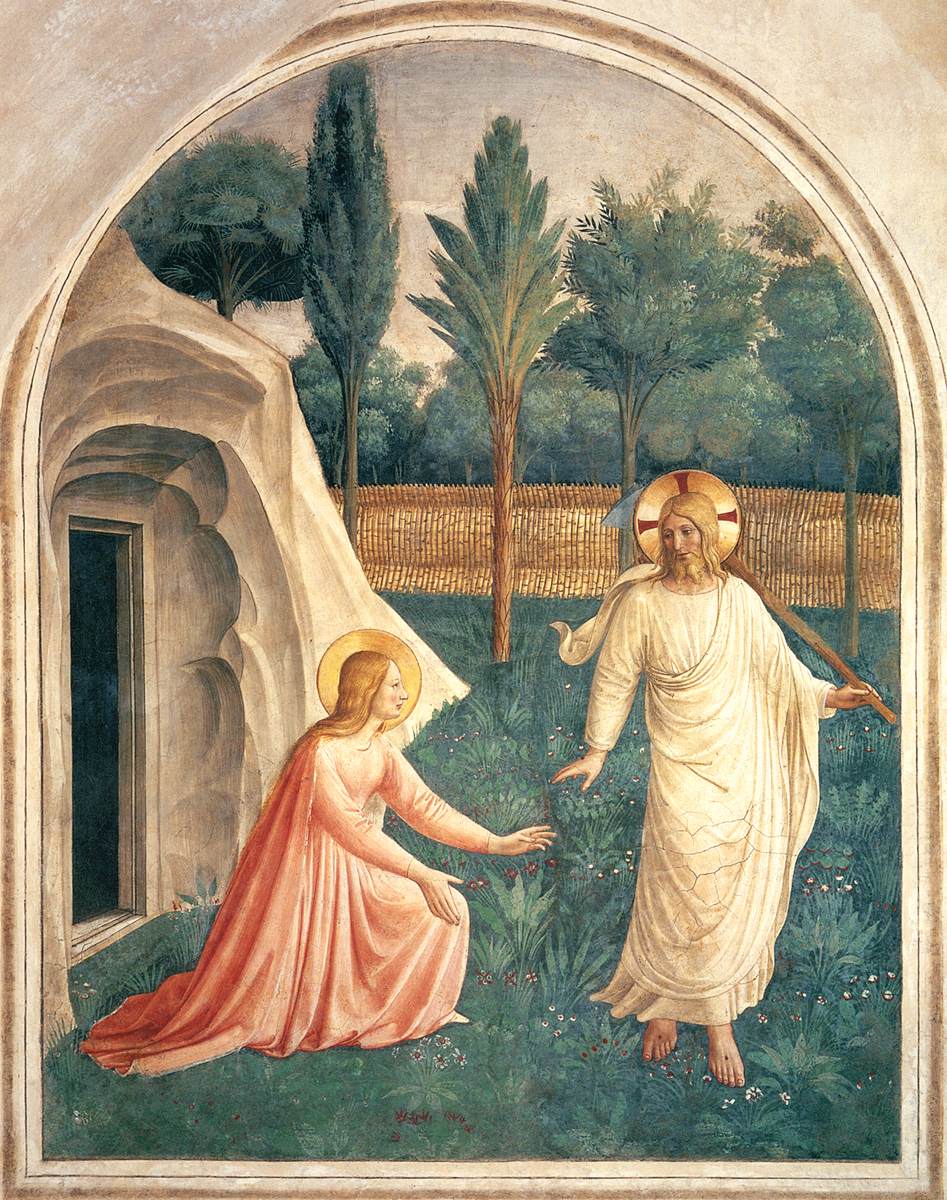
Appearence to Mary Magdalene (Noli me tangere)
Duccio di Buoninsegna
1308-11
Tempera on wood, 51 x 57 cm
Museo dell'Opera del Duomo, Siena
Posted on 04/13/2020 9:50:42 PM PDT by Salvation
On the day of Pentecost, Peter said to the Jewish people,
“Let the whole house of Israel know for certain
that God has made him both Lord and Christ,
this Jesus whom you crucified.”
Now when they heard this, they were cut to the heart,
and they asked Peter and the other Apostles,
“What are we to do, my brothers?”
Peter said to them,
“Repent and be baptized, every one of you,
in the name of Jesus Christ, for the forgiveness of your sins;
and you will receive the gift of the Holy Spirit.
For the promise is made to you and to your children
and to all those far off,
whomever the Lord our God will call.”
He testified with many other arguments, and was exhorting them,
“Save yourselves from this corrupt generation.”
Those who accepted his message were baptized,
and about three thousand persons were added that day.
R. (5b) The earth is full of the goodness of the Lord.
or:
R. Alleluia.
Upright is the word of the LORD,
and all his works are trustworthy.
He loves justice and right;
of the kindness of the LORD the earth is full.
R. The earth is full of the goodness of the Lord.
or:
R. Alleluia.
See, the eyes of the LORD are upon those who fear him,
upon those who hope for his kindness,
To deliver them from death
and preserve them in spite of famine.
R. The earth is full of the goodness of the Lord.
or:
R. Alleluia.
Our soul waits for the LORD,
who is our help and our shield.
May your kindness, O LORD, be upon us
who have put our hope in you.
R. The earth is full of the goodness of the Lord.
or:
R. Alleluia.
R. Alleluia, alleluia.
This is the day the LORD has made;
let us be glad and rejoice in it.
R. Alleluia, alleluia.
Mary Magdalene stayed outside the tomb weeping.
And as she wept, she bent over into the tomb
and saw two angels in white sitting there,
one at the head and one at the feet
where the Body of Jesus had been.
And they said to her, “Woman, why are you weeping?”
She said to them, “They have taken my Lord,
and I don’t know where they laid him.”
When she had said this, she turned around and saw Jesus there,
but did not know it was Jesus.
Jesus said to her, “Woman, why are you weeping?
Whom are you looking for?”
She thought it was the gardener and said to him,
“Sir, if you carried him away,
tell me where you laid him,
and I will take him.”
Jesus said to her, “Mary!”
She turned and said to him in Hebrew, “Rabbouni,”
which means Teacher.
Jesus said to her, “Stop holding on to me,
for I have not yet ascended to the Father.
But go to my brothers and tell them,
‘I am going to my Father and your Father,
to my God and your God.’”
Mary went and announced to the disciples,
“I have seen the Lord,”
and then reported what he had told her.
KEYWORDS: catholic; easter; jn20; prayer;
Please FReepmail me to get on/off the Alleluia Ping List.
From: Acts 2:14a, 22-33, 36-41
Peter’s Address (Continuation)
[29] “Brethren, I may say to you confidently of the patriarch David that he both died and was buried, and his tomb is with us to this day. [30] Being therefore a prophet, and knowing that God had sworn with an oath to him that He would set one of his descendants upon his throne, [31] he foresaw and spoke of the resurrection of the Christ, that He was not abandoned to Hades, nor did His flesh see
corruption. [32] This Jesus God raised up, and of that we all are witnesses. [33] Being therefore exalted at the right hand of God, and having received from the Father the promise of the Holy Spirit, he has poured out this which you see and hear.”
The Baptism
***********************************************************************
Commentary:
14-36. Even as the Church takes its first steps St. Peter can be seen to occupy the position of main spokesman. In his address we can distinguish an introduction and two parts: in the first part (verses 16-21) he is explaining that the messianic times foretold by Joel have now arrived; in the second (verses 22-36) he proclaims that Jesus of Nazareth, whom the Jews crucified, is the Messiah promised by God and eagerly awaited by the righteous of the Old Testament; it is He who has effected God’s saving plan for mankind.
14. In his commentaries St. John Chrysostom draws attention to the change worked in Peter by the Holy Spirit: “Listen to him preach and argue so boldly, who shortly before had trembled at the word of a servant girl! This boldness is a significant proof of the resurrection of his Master: Peter preaches to men who mock and laugh at his enthusiasm. [...] Calumny (’they are filled with new wine’) does not deter the Apostles; sarcasm does not undermine their courage, for the coming of the Holy Spirit has made new men of them, men who can put up with every kind of human test. When the Holy Spirit enters into hearts He does so to elevate their affections and to change earthly souls, souls of clay, into chosen souls, people of great courage [...]. Look at the harmony that exists among the Apostles. See how they allow Peter to speak on behalf of them all. Peter raises his voice and speaks to the people with full assurance. That is the kind of courage a man has when he is the instrument of the Holy Spirit. [...] Just as a burning coal does not lose heat when it falls on a haystack but instead is enabled to release its heat, so Peter, now that he is in contact with the life-giving Spirit, spreads his inner fire to those around him” (”Hom. on Acts”, 4).
22-36. To demonstrate that Jesus of Nazareth is the Messiah foretold by the prophets, St. Peter reminds his listeners of our Lord’s miracles (verse 22), as well as of His death (verse 23), resurrection (verses 24-32) and glorious ascension (verses 33-35). His address ends with a brief summing-up (verse 36).
32. To proofs from prophecy, very important to the Jews, St. Peter adds his own testimony on the resurrection of Jesus, and that of his brothers in the Apostolate.
36. During His life on earth Jesus had often presented Himself as the Messiah and Son of God. His resurrection and ascension into Heaven reveal Him as such to the people at large.
In Peter’s address we can see an outline of the content of the apostolic proclamation (”kerygma”), the content of Christian preaching,
the object of faith. This proclamation bears witness to Christ’s death and resurrection and subsequent exaltation; it recalls the main points of Jesus’ mission, announced by John the Baptist, confirmed by miracles and brought to fulfillment by the appearances of the risen Lord and the outpouring of the Holy Spirit; it declares that the messianic time predicted by the prophets have arrived, and calls all men to conversion, in preparation for the Parousia or second coming of Christ in glory.
37. St. Peter’s words were the instrument used by God’s grace to move the hearts of his listeners: they are so impressed that they ask in all simplicity what they should do. Peter exhorts them to be converted, to repent (cf. note on 3:19). The “St. Pius V Catechism” explains that in order to receive Baptism adults “need to repent the sins they have committed and their evil past life and to be resolved not to commit sin henceforth [...], for nothing is more opposed to grace and power of Baptism than the outlook and disposition of those who never decide to abjure sin” (II, 2, 4).
38. “Be baptized in the name of Jesus Christ”: this does not necessarily mean that this was the form of words the Apostles normally
used in the liturgy, rather than Trinitarian formula prescribed by Jesus. In the “Didache” (written around the year 100) it is stated
that Baptism should be given in the name of the Father and of the Son and of the Holy Spirit, but this does not prevent it, in other
passages, from referring to “those baptized in the name of the Lord.” The expression “baptized in the name of Christ” means, therefore, becoming a member of Christ, becoming a Christian (cf. “Didache”, VII, 1; IX, 5).
“Like the men and women who came up to Peter on Pentecost, we too have been baptized. In baptism, our Father God has taken possession of our lives, has made us share in the life of Christ, and has given us the Holy Spirit” ([St] J. Escriva, “Christ Is Passing By”, 128). From this point onwards, the Trinity begins to act in the soul of the baptized person. “In the same way as transparent bodies, enlightened by the Holy Spirit become spiritual too and lead others to the light of grace. From the Holy Spirit comes knowledge of future events, understanding of mysteries and of hidden truths, an outpouring of gifts, Heavenly citizenship, conversation with angels. From Him comes never-ending joy, perseverance in good, likeness to God and—the most sublime thing imaginable—becoming God” (St. Basil, “On the Holy Spirit”, IX, 23).
This divinization which occurs in the baptized person shows how important it is for Christians to cultivate the Holy Spirit who has
been infused into their souls, where He dwells as long as He is not driven out by sin. “Love the Third Person of the Blessed Trinity.
Listen in the intimacy of your being to the divine motions of encouragement or reproach you receive from Him. Walk through the earth in the light that is poured out in your soul. [...] We can apply to ourselves the question asked by the Apostle: ‘Do you not know that you are God’s temple and that God’s Spirit dwells in you?’ (1 Corinthians 3:16). And we can understand it as an invitation to deal with God in a more personal and direct manner. For some, unfortunately, the Paraclete is the Great Stranger. He is merely a name that is mentioned, but not Someone—not one of the three Persons in the one God—with whom we can talk and with whose life we can live. No: we have to deal with Him simply and trustingly, as we are taught by the Church in its liturgy. Then we will come to know our Lord better, and at the same time, we will realize more fully the great favor that was granted us when we became Christians. We will see the greatness and truth of this divinization, which is a sharing in God’s own life” ([St] J. Escriva, “Christ Is Passing By”, 133-134).
39. The “promise” of the Holy Spirit applies to both Jews and Gentiles, but in the first instance it concerns the Jews: it is they to whom God entrusted His oracles; theirs was the privilege to receive the Old Testament and to be preached to directly by Jesus Himself. St. Peter makes it clear that this promise is also made “to all that are far off”—a reference to the Gentiles, as St. Paul explains (cf. Ephesians 2:13-17) and in line with Isaiah’s announcement, “Peace, peace to the far and to the near” (Isaiah 57:19). Cf. Acts 22:21.
40. “This crooked generation” is not only that part of the Jewish people who rejected Christ and His teaching, but everyone who is
estranged from God (cf. Deuteronomy 32:5; Philippians 2:5).
41. St. Luke here concludes his account of the events of the day of Pentecost and prepares to move on to a new topic. Before he does so he adds a note, as it were, to say that “about three thousand souls” became Christians as a result of Peter’s address.
St. Luke often makes reference to the numerical growth of the Church (2:47; 4:4; 5:14; 6:1, 7; 9:31; 11:21, 24; 16:5). Interesting in
itself, this growth clearly shows the effectiveness of the Gospel message boldly proclaimed by the Apostles. It proves that if the
Gospel is preached with constancy and clarity it can take root in any setting and will always find men and women ready to receive it and put it into practice.
“It is not true that everyone today—in general—is closed or indifferent to what our Christian faith teaches about man’s being and
destiny. It is not true that men in our time are turned only toward the things of this earth and have forgotten to look up to Heaven.
There is no lack of narrow ideologies, it is true, or of persons who maintain them. But in our time we find both great desires and base
attitudes, heroism and cowardice, zeal and disenchantment—people who dream of a new world, more just and more human, and others who, discouraged perhaps by the failure of their youthful idealism, take refuge in the selfishness of seeking only their own security or
remaining immersed in their errors.
“To all those men and women, wherever they may be, in their more exalted moments of in their crises and defeats, we have to bring the solemn and unequivocal message of St. Peter in the days that followed Pentecost: Jesus is the cornerstone, the Redeemer, the hope of our lives. ‘For there is no other name under Heaven given among men by which we must be saved’ (Acts 4:12)” ([St] J. Escriva, “Christ Is Passing By”, 132).
From: John 20:1-18 (or 1-9)
The Empty Tomb
The Appearance To Mary Magdalene
*********************************************************************************************
Commentary:
1-2. All four Gospels report the first testimonies of the holy women and the disciples regarding Christ’s glorious resurrection, beginning with the fact of the empty tomb (cf. Matthew 28:1-15; Mark 16:1ff; Luke 24:1-12) and then telling of the various appearances of the risen Jesus.
Mary Magdalene was one of the women who provided for our Lord during His journeys (Luke 8:1-3); along with the Virgin Mary she bravely stayed with Him right up to His final moments (John 19:25), and she saw where His body was laid (Luke 23:55). Now, after the obligatory Sabbath rest, she goes to visit the tomb. The Gospel points out that she went “early, when it was still dark”: her love and veneration led her to go without delay, to be with our Lord’s body.
4. The Fourth Gospel makes it clear that, although the women, and specifically Mary Magdalene, were the first to reach the tomb, the Apostles were the first to enter it and see the evidence that Christ had risen (the empty tomb, the linen clothes “lying” and the napkin in a place by itself). Bearing witness to this will be an essential factor in the mission which Christ will entrust to them: “You shall be My witnesses in Jerusalem...and to the end of the earth” (Acts 1:8; cf. Acts 2:32).
John, who reached the tomb first (perhaps because he was the younger), did not go in, out of deference to Peter. This is an indication that Peter was already regarded as leader of the Apostles.
5-7. The words the Evangelist uses to describe what Peter and he saw in the empty tomb convey with vivid realism the impression it made on them, etching on their memory details which at first sight seem irrelevant. The whole scene inside the tomb in some way caused them to intuit that the Lord had risen. Some of the words contained in the account need further explanation, so terse is the translation.
“The linen clothes lying there”: the Greek participle translated as “lying there” seems to indicate that the clothes were flattened, deflated, as if they were emptied when the body of Jesus rose and disappeared—as if it had come out of the clothes and bandages without their being unrolled, passing right through them (just as later He entered the Cenacle when the doors were shut). This would explain the clothes being “fallen”, “flat” “lying”, which is how the Greek literally translates, after Jesus’ body—which had filled them—left them. One can readily understand how this would amaze a witness, how unforgettable the scene would be.
“The napkin...rolled up in a place by itself”: the first point to note is that the napkin, which had been wrapped round the head, was not on top of the clothes, but placed on one side. The second, even more surprising thing is that, like the clothes, it was still rolled up but, unlike the clothes, it still had a certain volume, like a container, possibly due to the stiffness given it by the ointments: this is what the Greek participle, here translated as “rolled”, seems to indicate.
From these details concerning the empty tomb one deduces that Jesus’ body must have risen in a heavenly manner, that is, in a way which transcended the laws of nature. It was not only a matter of the body being reanimated as happened, for example, in the case of Lazarus, who had to be unbound before he could walk (cf. John 11:44).
8-10. As Mary Magdalene had told them, the Lord was not in the tomb; but the two Apostles realized that there was no question of any robbery, which was what she thought had happened, because they saw the special way the clothes and napkin were; they know began to understand what the Master had so often told them about His death and resurrection (cf. Matthew 16:21; Mark 8:31; Luke 9:22; etc....)
The empty tomb and the other facts were perceptible to the senses; but the resurrection, even though it had effects that could be tested by experience, requires faith if it is to be accepted. Christ’s resurrection is a real, historic fact: His body and soul were re-united. But since His was a glorious resurrection unlike Lazarus’, far beyond our capacity in this life to understand what happened, and outside the scope of sense experience, a special gift of God is required—the gift of faith—to know and accept as a certainty this fact which, while it is historical, is also supernatural. Therefore, St. Thomas Aquinas can say that “the individual arguments taken alone are not sufficient proof of Christ’s resurrection, but taken together, in a cumulative way, they manifest it perfectly. Particularly important in this regard are the spiritual proofs (cf. specially Luke 24:25-27), the angelic testimony (cf. Luke 24:4-7) and Christ’s own post-resurrection word confirmed by miracles (cf. John 3:13; Matthew 16:21; 17:22; 20:18)” (St. Thomas Aquinas, “Summa Theologiae”, III, q. 55, a. 6 ad 1).
In addition to Christ’s predictions about His passion, death and resurrection (cf. John 2:19; Matthew 16:21; Mark 9:31; Luke 9:22), the Old Testament also foretells the glorious victory of the Messiah and, in some way, His resurrection (cf. Psalm 16:9; Isaiah 52:13; Hosea 6:2). The Apostles begin to grasp the true meaning of Sacred Scripture after the resurrection, particularly once they receive the Holy Spirit, who fully enlightens their minds to understand the content of the Word of God. It is easy to imagine the surprise and elation they all feel when Peter and John tell them what they have seen in the tomb.
11-18. Mary’s affection and sensitivity lead her to be concerned about what has become of the dead body of Jesus. This woman out of whom seven demons were cast (cf. Luke 8:2) stayed faithful during His passion and even now her love is still ardent: our Lord had freed her from the Evil One and she responded to that grace humbly and generously.
After consoling Mary Magdalene, Jesus gives her a message for the Apostles, whom He tenderly calls His “brethren”. This message implies that He and they have the same Father, though each in an essentially different way: “I am ascending to My Father”—My own Father by nature—”and to your Father”—for He is your Father through the adoption I have won for you and by My death. Jesus, the Good Shepherd, shows His great mercy and understanding by gathering together all His disciples who had abandoned Him during His passion and were now in hiding for fear of the Jews (John 20:19).
Mary Magdalene’s perseverance teaches us that anyone who sincerely keeps searching for Jesus Christ will eventually find Him. Jesus’ gesture in calling His disciples His “brethren” despite their having run away should fill us with love in the midst of our own infidelities.
15. From Jesus’ dialogue with Mary Magdalene, we can see the frame of mind all His disciples must have been in: they were not expecting the resurrection.
17. “Do not hold Me”: the use of the negative imperative in the Greek, reflected in the New Vulgate (”noli me tenere”) indicates that our Lord is telling Mary to release her hold of Him, to let Him go, since she will have another chance to see Him before His ascension into Heaven.
Liturgical Colour: White.
| First reading | Acts 2:36-41 © |
|---|
| Responsorial Psalm |
|---|
| Psalm 32(33):4-5,18-20,22 © |
| Sequence |
|---|
| Gospel Acclamation | Ps117:24 |
|---|
| Gospel | John 20:11-18 © |
|---|
| John | |||
| English: Douay-Rheims | Latin: Vulgata Clementina | Greek NT: Byzantine/Majority Text (2000) | |
| John 20 |
|||
| 11. | But Mary stood at the sepulchre without, weeping. Now as she was weeping, she stooped down, and looked into the sepulchre, | Maria autem stabat ad monumentum foris, plorans. Dum ergo fleret, inclinavit se, et prospexit in monumentum : | μαρια δε ειστηκει προς το μνημειον κλαιουσα εξω ως ουν εκλαιεν παρεκυψεν εις το μνημειον |
| 12. | And she saw two angels in white, sitting, one at the head, and one at the feet, where the body of Jesus had been laid. | et vidit duos angelos in albis sedentes, unum ad caput, et unum ad pedes, ubi positum fuerat corpus Jesu. | και θεωρει δυο αγγελους εν λευκοις καθεζομενους ενα προς τη κεφαλη και ενα προς τοις ποσιν οπου εκειτο το σωμα του ιησου |
| 13. | They say to her: Woman, why weepest thou? She saith to them: Because they have taken away my Lord; and I know not where they have laid him. | Dicunt ei illi : Mulier, quid ploras ? Dicit eis : Quia tulerunt Dominum meum : et nescio ubi posuerunt eum. | και λεγουσιν αυτη εκεινοι γυναι τι κλαιεις λεγει αυτοις οτι ηραν τον κυριον μου και ουκ οιδα που εθηκαν αυτον |
| 14. | When she had thus said, she turned herself back, and saw Jesus standing; and she knew not that it was Jesus. | Hæc cum dixisset, conversa est retrorsum, et vidit Jesum stantem : et non sciebat quia Jesus est. | και ταυτα ειπουσα εστραφη εις τα οπισω και θεωρει τον ιησουν εστωτα και ουκ ηδει οτι ιησους εστιν |
| 15. | Jesus saith to her: Woman, why weepest thou? whom seekest thou? She, thinking it was the gardener, saith to him: Sir, if thou hast taken him hence, tell me where thou hast laid him, and I will take him away. | Dicit ei Jesus : Mulier, quid ploras ? quem quæris ? Illa existimans quia hortulanus esset, dicit ei : Domine, si tu sustulisti eum, dicito mihi ubi posuisti eum, et ego eum tollam. | λεγει αυτη ο ιησους γυναι τι κλαιεις τινα ζητεις εκεινη δοκουσα οτι ο κηπουρος εστιν λεγει αυτω κυριε ει συ εβαστασας αυτον ειπε μοι που εθηκας αυτον καγω αυτον αρω |
| 16. | Jesus saith to her: Mary. She turning, saith to him: Rabboni (which is to say, Master). | Dicit ei Jesus : Maria. Conversa illa, dicit ei : Rabboni (quod dicitur Magister). | λεγει αυτη ο ιησους μαρια στραφεισα εκεινη λεγει αυτω ραββουνι ο λεγεται διδασκαλε |
| 17. | Jesus saith to her: Do not touch me, for I am not yet ascended to my Father. But go to my brethren, and say to them: I ascend to my Father and to your Father, to my God and your God. | Dicit ei Jesus : Noli me tangere, nondum enim ascendi ad Patrem meum : vade autem ad fratres meos, et dic eis : Ascendo ad Patrem meum, et Patrem vestrum, Deum meum, et Deum vestrum. | λεγει αυτη ο ιησους μη μου απτου ουπω γαρ αναβεβηκα προς τον πατερα μου πορευου δε προς τους αδελφους μου και ειπε αυτοις αναβαινω προς τον πατερα μου και πατερα υμων και θεον μου και θεον υμων |
| 18. | Mary Magdalen cometh, and telleth the disciples: I have seen the Lord, and these things he said to me. | Venit Maria Magdalene annuntians discipulis : Quia vidi Dominum, et hæc dixit mihi. | ερχεται μαρια η μαγδαληνη απαγγελλουσα τοις μαθηταις οτι εωρακεν τον κυριον και ταυτα ειπεν αυτη |
12. And seeth two angels in white sitting, the one at the head, and the other at the feet, where the body of Jesus had lain.
13. And they say unto her, Woman, why weepest thou? She saith unto them, Because they have taken away my Lord, and I know not where they have laid him.
14. And when she had thus said, she turned herself back, and saw Jesus standing, and knew not that it was Jesus.
15. Jesus saith unto her, Woman, why weepest thou? whom seekest thou? She, supposing him to be the gardener, saith unto him, Sir, if thou have borne him hence, tell me where thou hast laid him, and I will take him away.
16. Jesus saith unto her, Mary. She turned, herself, and saith unto him, Rabboni; which is to say, Master.
17. Jesus saith unto her, Touch me not; for I am not yet ascended to my Father: but go to my brethren, and say unto them, I ascend unto my Father, and your Father; and to my God, and your God.
18. Mary Magdalene came and told the disciples that she had seen the Lord, and that he had spoken these things unto her.
GREGORY. (Hom. xxv. in Evang.) Mary Magdalene, who had been the sinner in the city, and who had washed out the spots of her sins by her tears, whose soul burned with love, did not retire from the sepulchre when the others did: Then the disciples went away again unto their own home.
AUGUSTINE. (Tr. cxxi. 1) i. e. To the place where they were lodging, and from which they had ran to the sepulchre. But though the men returned, the stronger love of the woman fixed her to the spot. But Mary stood without at the sepulchre weeping.
AUGUSTINE. (de Con. Ev. iii. xxiv. 69) i. e. Outside of the place where the stone sepulchre was, but yet within the garden.
CHRYSOSTOM. (Hom. lxxxvi) Be not astonished that Mary wept for love at the sepulchre, and Peter did not; for the female sex is naturally tender, and inclined to weep.
AUGUSTINE. (Tr. cxxi. 1) The eyes then which had sought our Lord, and found Him not, now wept without interruption; more for grief that our Lord had been removed, than for His death upon the cross. For now even all memorial of Him was taken away.
AUGUSTINE. (de Con. Ev. iii. xxiv. 69) She then saw, with the other women, the Angel sitting on the right, on the stone which had been rolled away from the sepulchre, at whose words it was that she looked into the sepulchre. (Mat. 28:5.)
CHRYSOSTOM. (Hom. lxxxvi) The sight of the sepulchre itself was some consolation. Nay, behold her, to console herself still more, stooping down, to see the very place where the body lay: And as she wept, she stooped down, and looked into the sepulchre.
GREGORY. (Hom. xxv. ut supr.) For to have looked once is not enough for love. Love makes one desire to look over and over again.
AUGUSTINE. (Tr. cxxi) In her too great grief she could believe neither her own eyes, nor the disciples’. Or was it a divine impulse which caused her to look in?
GREGORY. (Hom. xxv.) She sought the body, and found it not; she persevered in seeking; and so it came to pass that she found. Her longings, growing the stronger, the more they were disappointed, at last found and laid hold on their object. For holy longings ever gain strength by delay; did they not, they would not be longings. Mary so loved, that not content with seeing the sepulchre, she stooped down and looked in: let us see the fruit which came of this persevering love: And seeth two Angels in white sitting, the one at the head, and the other at the feet, where the body of Jesus had lain.
CHRYSOSTOM. (Hom. lxxxvi. 1) As her understanding was not so raised as to be able to gather from the napkins the fact of the resurrection, she is given the sight of Angels in bright apparel, who sooth her sorrow.
AUGUSTINE. (Tr. cxxi) But why did one sit at the head, the other at the feet? To signify that the glad tidings of Christ’s Gospel was to be delivered from the head to the feet, from the beginning to the end. The Greek word Angel means one who delivers news.
GREGORY. (Hom. xxv. in Evang. c. 1, 14) The Angel sits at the head when the Apostles preach that in the beginning was the Word: he sits, as it were, at the feet, when it is said, The Word was made flesh. By the two Angels too we may understand the two testaments; both of which proclaim alike the incarnation, death, and resurrection of our Lord. The Old seems to sit at the head, the New at the feet.
CHRYSOSTOM. (Hom. lxxxvi) The Angels who appear say nothing about the resurrection; but by degrees the subject is entered on. First of all they address her compassionately, to prevent her from being overpowered by a spectacle of such extraordinary brightness: And they say unto her, Woman, why weepest thou? The Angels forbad tears, and announced, as it were, the joy that was at hand: Why weepest thou? As if to say, Weep not.
GREGORY. (Hom. fin.) The very declarations of Scripture which excite our tears of love, wipe away those very tears, by promising us the sight of our Redeemer again.
AUGUSTINE. (Tr. cxxi) But she, thinking that they wanted to know why she wept, tells them the reason: She saith unto them, Because they have taken away my Lord. The lifeless body of her Lord, she calls her Lord, putting the part for the whole; just as we confess that Jesus Christ the Son of God was buried, when only His flesh was buried. And I know not where they have placed Him: it was a still greater grief, that she did not know where to go to console her grief.
CHRYSOSTOM. (Hom. lxxxvi) As yet she knew nothing of the resurrection, but thought the body had been taken away.
AUGUSTINE. (de Con. Evang. iii. xxiv) Here the Angels must be understood to rise up, for Luke describes them as seen standing.
AUGUSTINE. (Tr. cxxi) The hour was now come, which the Angels announced, when sorrow should be succeeded by joy: And when she had thus said, she turned herself back.
CHRYSOSTOM. (Hom. l) But why, when she is talking to the Angels, and before she has heard any thing from them, does she turn back? It seems to me that while she was speaking, Christ appeared behind her, and that the Angels by their posture, look, and motion, shewed that they saw our Lord, and that thus it was that she turned back.
GREGORY. (Hom. xxv.) We must observe that Mary, who as yet doubted our Lord’s resurrection, turned back to see Jesus. By her doubting she turned her back, as it were, upon our Lord. Yet inasmuch as she loved, she saw Him. She loved and doubted: she saw, and did not recognise Him: And saw Jesus standing, and knew not that it was Jesus.
CHRYSOSTOM. (Hom. lxxxvi) To the Angels He appeared as their Lord, but not so to the woman, for the sight coming upon her all at once, would have stupified her. She was not to be lifted suddenly, but gradually to high things.
GREGORY. (Hom. xxv.) Jesus saith unto her, Woman, why weepest thou? He asks the cause of her grief, to set her longing still more. For the mere mentioning His name whom she sought would inflame her love for Him.
CHRYSOSTOM. (Hom. lxxxvi 1) Because He appeared as a common person, she thought Him the gardener: She, supposing Him to be the gardener, saith unto Him, Sir, if Thou have borne Him hence, tell me where Thou hast laid Him, and I will take Him away. i. e. If thou hast taken Him away from fear of the Jews, tell me, and I will take Him again.
THEOPHYLACT. She was afraid that the Jews might vent their rage even on the lifeless body, and therefore wished to remove it to some secret place.
GREGORY. (Hom. xxv.) Perhaps, however, the woman was right in believing Jesus to be the gardener. Was not He the spiritual Gardener, who by the power of His love had sown strong seeds of virtue in her breast? But how is it that, as soon as she sees the gardener, as she supposes Him to be, she says, without having told Him who it was she was seeking, Sir, if Thou hast borne Him hence? It arises from her love; when one loves a person, one never thinks that any one else can be ignorant of him. Our Lord, after calling her by the common name of her sex, and not being recognised, calls her by her own name: Jesus saith unto her, Mary; as if to say, Recognise Him, who recognises thee. Mary, being called by name, recognises Him; that it was He whom she sought externally, and He who taught her internally to seek: She turned herself, and saith unto Him, Rabboni; which is to say, Master.
CHRYSOSTOM. (Hom. lxxxvi. 1) Just as He was sometimes in the midst of the Jews, and they did not know Him till He pleased to make Himself known. But why does she turn herself, when she had turned herself before? It seems to me that when she said, Where thou hast laid Him, she turned to the Angels, to ask why they were astonished. Then Christ, calling her, discovered Himself by His voice, and made her turn to Him again.
AUGUSTINE. (Tr. cxxi) Or she first turned her body, but thought Him what He was not; now she was turned in heart, and knew who He was. Let no one however blame her, because she called the gardener, Lord, and Jesus, Master. The one was a title of courtesy to a person from whom she was asking a favour; the other of respect to a Teacher from whom she was used to learn to distinguish the divine from the human. The word Lord is used in different senses, when she says, They have taken away my Lord, and when she says, Lord, if Thou have borne Him away.
GREGORY. (Hom. xxv.) The Evangelist does not add what she did upon recognising Him, but we know from what our Lord said to her: Jesus saith unto her, Touch Me not. Mary then had tried to embrace His feet, but was not allowed. Why not? The reason follows: For I am not yet ascended to My Father.
AUGUSTINE. (Tr. cxxi. 3) But if standing upon the earth, He is not touched, how shall He be touched sitting in heaven? And did He not before His ascension offer Himself to the touch of the disciples: Handle Me and see, for a spirit hath not flesh and bones? (Luke 24:39) Who can be so absurd as to suppose that He was willing that disciples should touch Him before He ascended to His Father, and unwilling that women should till after? Nay, we read of women after the resurrection, and before He ascended to His Father, touching Him, one of whom was Mary Magdalene herself, according to Matthew. Either then Mary here is a type of the Gentile Church, which did not believe in Christ till after His ascension: or the meaning is that Jesus is to be believed in, i. e. spiritually touched, in no other way, but as being one with the Father. He ascends to the Father mystically, as it were, in the mind of him who hath so far advanced as to acknowledge that He is equal to the Father. But how could Mary believe in Him otherwise than carnally, when she wept for Him as a man?
AUGUSTINE. (i. de Trin) Touch is as it were the end of knowledge1; and He was unwilling that a soul intent upon Him should have its end, in thinking Him only what He seemed to be.
CHRYSOSTOM. (Hom. lxxxvi. 2) Mary wished to be as familiar with Christ now, as she was before His Passion; forgetting, in her joy, that His body was made much more holy by its resurrection. So, Touch Me not, He says, to remind her of this, and make her feel awe in talking with Him. For which reason too He no longer keeps company with His disciples, viz. that they might look upon Him with the greater awe. Again, by saying I have not yet ascended, He shews that He is hastening there. And He who was going to depart and live no more with men, ought not to be regarded with the same feeling that He was before: But go to My brethren, and say unto them, I ascend unto My Father, and your Father; and to My God, and your God.
HILARY. (de Trin.) Heretics, among their other impieties, misinterpret these words of our Lord’s, and say, that if His Father is their Father, His God their God, He cannot be God Himself. But though He remained in the form of God, He took upon Him the form of a servant; and Christ says this in the form of a servant to men. And we cannot doubt that in so far as He is man, the Father is His Father in the same sense in which He is of other men, and God His God in like manner. Indeed He begins with saying, Go to My brethren. But God can only have brethren according to the flesh; the Only-Begotten God, being Only-Begotten, is without brethren.
AUGUSTINE. (Tr. cxxi) He does not say, Our Father, but, My Father and your Father: Mine therefore and yours in a different sense; Mine by nature, yours by grace. Nor does He say, Our God, but, My God—under Him I am man—and your God; between you and Him I am Mediator.
AUGUSTINE. (de Con. Evang. iii. xxiv. 69) She then went away from the sepulchre, i. e. from that part of the garden before the rock which had been hollowed out, and with her the other women. But these, according to Mark, were seized with trembling and amazement, and said nothing to any man: Mary Magdalene came and told the disciples that she had seen the Lord, and that He had spoken these things unto her.
GREGORY. (Hom. xxv.) So the sin of mankind is buried in the very place whence it came forth. For whereas in Paradise the woman gave the man the deadly fruit, a woman from the sepulchre announced life to men; a woman delivers the message of Him who raises us from the dead, as a woman had delivered the words of the serpent who slew us.
AUGUSTINE. (de Con. Evang. iii. 25) While she was going with the other women, according to Matthew, Jesus met them, saying, All hail. (Matt 28:9) So we gather that there were two visions of Angels; and that our Lord too was seen twice, once when Mary took Him for the gardener, and again, when He met them by the way, and by this repeating His presence confirmed their faith. And so Mary Magdalen came and told the disciples, not alone, but with the other women whom Luke mentions.
BEDE. Mystically, Mary, which name signifies, mistress, enlightened, enlightener, star of the sea, stands for the Church, which is also Magdalen, i. e. towered, (Magdalen being Greek for tower,) as we read in the Psalms, Thou hast been a strong tower for me. (Ps. 61:3) In that she announced Christ’s resurrection to the disciples, all, especially those to whom the office of preaching is committed, are admonished to be zealous in setting forth to others whatever is revealed from above.
Catena Aurea John 20

Pray for Pope Francis.
Catholic Church in Nigeria Appeals to the West: ‘Make Known the Atrocities’
50 Boko Haram Islamic Radicals Killed; 1,000 Hostages, Women and Children, Rescued in Nigeria
Nigeria: In the Face of Ongoing Islamist Attacks, the Faith is Growing
US Promises to Help Nigeria Exterminate Boko Haram
Is This Bishop Right about the Rosary Conquering Boko Haram? [Catholic Caucus]
Why Boko Haram and ISIS Target Women
Report reveals scale of Boko Haram violence inflictef on Nigerian Catholics
Military evacuating girls, women rescued from Boko Haram
Echos of Lepanto Nigerian bishop says rosary will bring down Boko Harm
After vision of Christ, Nigerian bishop says rosary will bring down Boko Haram (Catholic Caucus)
Nigerian Bishop Says Christ Showed Him How to Beat Islamic Terror Group
We thank you, God our Father, for those who have responded to your call to priestly ministry.
Accept this prayer we offer on their behalf: Fill your priests with the sure knowledge of your love.
Open their hearts to the power and consolation of the Holy Spirit.
Lead them to new depths of union with your Son.
Increase in them profound faith in the Sacraments they celebrate as they nourish, strengthen and heal us.
Lord Jesus Christ, grant that these, your priests, may inspire us to strive for holiness by the power of their example, as men of prayer who ponder your word and follow your will.
O Mary, Mother of Christ and our mother, guard with your maternal care these chosen ones, so dear to the Heart of your Son.
Intercede for our priests, that offering the Sacrifice of your Son, they may be conformed more each day to the image of your Son, our Lord and Savior, Jesus Christ. Amen.
Saint John Vianney, universal patron of priests, pray for us and our priests
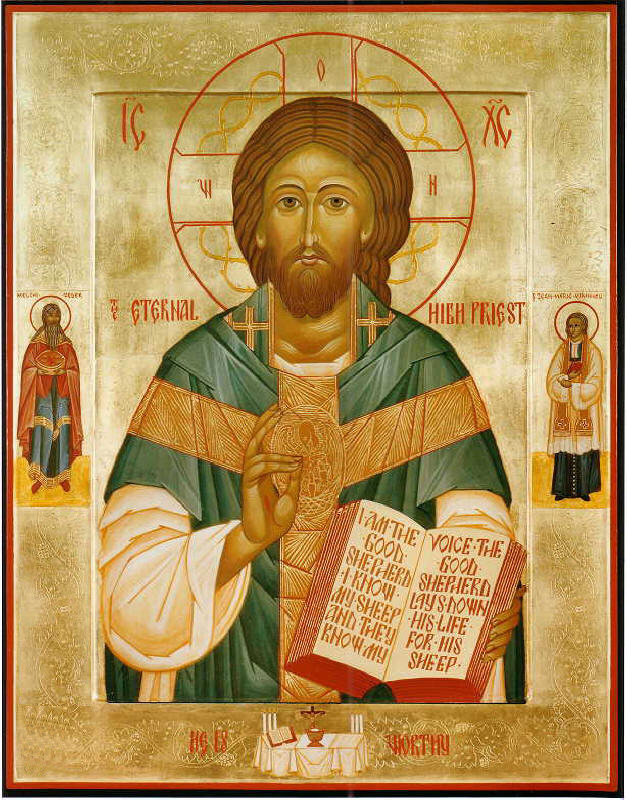
This icon shows Jesus Christ, our eternal high priest.
The gold pelican over His heart represents self-sacrifice.
The border contains an altar and grapevines, representing the Mass, and icons of Melchizedek and St. Jean-Baptiste Vianney.
Melchizedek: king of righteousness (left icon) was priest and king of Jerusalem. He blessed Abraham and has been considered an ideal priest-king.
St. Jean-Baptiste Vianney is the patron saint of parish priests.

1. Sign of the Cross: In the name of the Father, and of the Son, and of the Holy Spirit. Amen.
2. The Apostles Creed: I BELIEVE in God, the Father almighty, Creator of heaven and earth, and in Jesus Christ, His only Son, our Lord, who was conceived by the Holy Spirit, born of the Virgin Mary, suffered under Pontius Pilate, was crucified, died, and was buried. He descended into hell; on the third day he rose again from the dead; he ascended into heaven, and is seated at the right hand of God, the Father Almighty; from there He shall come to judge the living and the dead.
I believe in the Holy Spirit, the holy catholic Church, the communion of saints, the forgiveness of sins, the resurrection of the body, and the life everlasting. Amen.
3. The Lord's Prayer: OUR Father, who art in heaven, hallowed be Thy name. Thy kingdom come. Thy will be done on earth as it is in heaven. Give us this day our daily bread and forgive us our trespasses as we forgive those who trespass against us. And lead us not into temptation, but deliver us from evil. Amen.
4. (3) Hail Mary: HAIL Mary, full of grace, the Lord is with thee. Blessed art thou amongst women and blessed is the fruit of thy womb, Jesus. Holy Mary, Mother of God, pray for us sinners, now, and in the hour of our death. Amen. (Three times)
5. Glory Be: GLORY be to the Father, and to the Son, and to the Holy Spirit. As it was in the beginning, is now, and ever shall be, world without end. Amen.
6. Fatima Prayer: Oh, my Jesus, forgive us our sins, save us from the fires of hell, lead all souls to heaven, especially those in most need of your mercy.
Announce each mystery, then say 1 Our Father, 10 Hail Marys, 1 Glory Be and 1 Fatima prayer. Repeat the process with each mystery.
End with the Hail Holy Queen:
Hail, Holy Queen, Mother of Mercy, our life, our sweetness and our hope! To thee do we cry, poor banished children of Eve! To thee do we send up our sighs, mourning and weeping in this vale of tears! Turn then, most gracious advocate, thine eyes of mercy towards us; and after this, our exile, show unto us the blessed fruit of thy womb, Jesus!
O clement, O loving, O sweet Virgin Mary! Pray for us, O holy Mother of God, that we may be made worthy of the promises of Christ.
Final step -- The Sign of the Cross
The Mysteries of the Rosary By tradition, Catholics meditate on these Mysteries during prayers of the Rosary. The biblical references follow each of the Mysteries below.
The Sorrowful Mysteries
(Tuesdays and Fridays)
1. The Agony in the Garden (Matthew 26:36-46, Luke 22:39-46) [Spiritual fruit - God's will be done]
2. The Scourging at the Pillar (Matthew 27:26, Mark 15:15, John 19:1) [Spiritual fruit - Mortification of the senses]
3. The Crowning with Thorns (Matthew 27:27-30, Mark 15:16-20, John 19:2) [Spiritual fruit - Reign of Christ in our heart]
4. The Carrying of the Cross (Matthew 27:31-32, Mark 15:21, Luke 23:26-32, John 19:17) [Spiritual fruit - Patient bearing of trials]
5. The Crucifixion (Matthew 27:33-56, Mark 15:22-39, Luke 23:33-49, John 19:17-37) [Spiritual fruit - Pardoning of Injuries]
Disclaimer: Opinions posted on Free Republic are those of the individual posters and do not necessarily represent the opinion of Free Republic or its management. All materials posted herein are protected by copyright law and the exemption for fair use of copyrighted works.