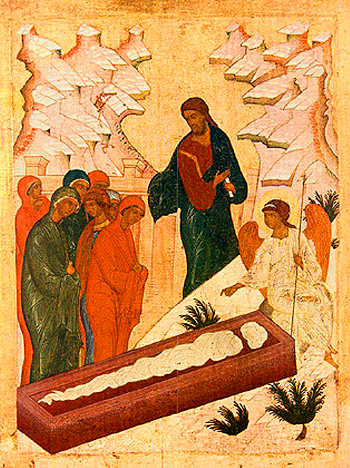
The Myrrh-bearing Women at the Sepulchre
Posted on 04/11/2020 9:30:28 PM PDT by Salvation
KEYWORDS: catholic; easter; jn20; prayer; resurrection;
Please FReepmail me to get on/off the Alleluia Ping List.
From: Acts 10:31-43
Peter’s Address
***********************************************************************
Commentary:
34-43. Peter’s short address is his first to non-Jews. It begins with the central idea that God is impartial: he wants all men to be saved
through the proclamation of the Gospel (vv. 34-36). This is followed by a summary of Jesus’ public life (vv. 37-41) and, finally, the
statement (the first time it appears in Acts) that Jesus Christ has been made Judge of the living and the dead (v. 42). As in all Christian
preaching to Gentiles, proofs from Scripture take a secondary place (v. 43).
34. This verse refers to 1 Samuel 16:7, where the Lord, in connection with the anointing of David as king of Israel, tells the prophet, “Do not look on his appearance or on the height of his stature, because I have rejected him; for the Lord sees not as man sees; man looks on the outward appearance, but the Lord looks on the heart.” When God calls and offers salvation to his elect, he does not judge as men do. With him distinctions regarding social class, race, sex or education do not count.
Here St Peter proclaims that the Old Testament prophecies about the Jews and the Gentiles forming one single nation (Is 2:2-4; Joel 2:28; Amos 9:12; Mich 4:1 ) and Jesus’ words calling everyone to enter his Kingdom (cf. Mt 8:11; Mk 16:15-16; Jn 10:16) should be interpreted literally.
40. Peter’s summary of the Gospel of Jesus (verses 37-41) reaches its climax with his statement that “God raised Him on the third day.” This had become the usual way of referring to our Lord’s resurrection (cf. 1 Corinthians 15:4); see note on Acts 4:10.
42. This verse refers to Christ’s role as Judge: He has been made supreme Judge over all mankind and will deliver His judgment at His
second coming (Parousia). “The Sacred Scriptures inform us that there are two comings of the Son of God: the one when He assumed human flesh for our salvation in the womb of a virgin; the other when He shall come at the end of the world to judge all mankind” (”St. Pius V Catechism”, I, 8, 2).
Christ’s coming as Judge means that men will appear before Him twice, to render an account of their lives—of their thoughts, words, deeds and omissions. The first judgment will take place “when each of us departs this life; for then He is instantly placed before the
judgment-seat of God, where all that he has ever done or spoken or thought during his life shall be subjected to the most rigid scrutiny.
This is called the Particular Judgment. The second occurs when on the same day and in the same place all men shall stand together before the tribunal of their Judge [...], and this is called the General Judgment” (”Ibid.”, I, 8, 3).
From: Colossians 3:1-11
Seek the Things That Are Above
Avoid Sin
***********************************************************************
Commentary:
1-4. The more ethical and exhortatory part of the letter begins at this point. It is a practical application of the teaching given in the
earlier chapters, designed to suit the circumstances that have arisen in the Colossian church.
By His death and resurrection the Son of God frees us from the power of Satan and of death. “By Baptism men are grafted into the paschal mystery of Christ; they die with him, are buried with Him, and rise with Him” (Vatican II, “Sacrosanctum Concilium”, 6). In other words, Christians have been raised to a new kind of life, a supernatural life, whereby they share, even while on earth, in the glorious life of the risen Jesus. This life is at present spiritual and hidden, but when our Lord comes again in glory, it will become manifest and glorious.
Two practical consequences flow from this teaching—the need to seek the “things that are above”, that is, the things of God; and the need to pass unnoticed in one’s everyday work and ordinary life, yet to do everything with a supernatural purpose in mind.
As regards the first of these the Second Vatican Council has said: “In their pilgrimage to the Heavenly city Christians are to seek and relish the things that are above (cf. Colossians 3:1-2): this involves not a lesser, but a greater commitment to working with all men to build a world that is more human” (”Gaudium Et Spes”, 57). Work, family relationships, social involvements—every aspect of human affairs— should be approached in a spirit of faith and done perfectly, out of love: “The true Christian, who acts according to this faith”, Monsignor Escriva comments, “always has his sights set on God. His outlook is supernatural. He works in this world of ours, which he loves passionately; he is involved in all its challenges, but all the while his eyes are fixed on Heaven” (”Friends of God”, 206).
Ordinary life, everyday interests, the desire to be better and to serve others without seeking public recognition of one’s merits—all this
makes for holiness if done for love of God. A simple life “hid with Christ in God” (verse 3) is so important that Jesus Himself chose to
spend the greater part of His life on earth living like an ordinary person: He was the son of a tradesman. “As we meditate on these
truths, we come to understand better the logic of God. We come to realize that the supernatural value of our life does not depend on
accomplishing great undertakings suggested to us by our over-active imagination. Rather it is to be found in the faithful acceptance
of God’s will, in welcoming generously the opportunities for small, daily sacrifice” (St. J. Escriva, “Christ Is Passing By”, 172).
This means that those who try to seek holiness by imitating Jesus in His hidden life will be people full of hope; they will be optimistic
and happy people; and after their death they will share in the glory of the Lord: they will hear Jesus’ praise, “Well done, good and
faithful servant; you have been faithful over a little; I will set you over much; enter into the joy of your Master” (Matthew 25:21).
On the value of the hidden life, see the note on Luke 2:51.
5-17. The Christian, who in Baptism has risen with Christ, should not live for himself but for God. This means that every day he needs to put off his old nature and put on the new.
The “old nature”, the “old man”: one who lets himself be led by disorderly passions (cf. Rom 7:8), who lets his body do evil in the
service of sin (v. 5; cf. Rom 6:12f). With the help of grace the old nature is being more and more broken down, while the new nature is constantly being renewed (cf. 2 Cor 6:16). Impurity and the other vices need to be uprooted so as to make room for goodness and its train of Christian virtues (vv. 12-13), especially charity (v. 14), which are features of the new nature.
Christ’s disciple, who has been made a new person and who lives for the Lord, has a new and more perfect knowledge of God and of the world (v. 10). Thanks to this he see things from a more elevated viewpoint; he has a “supernatural insight”. This enables him to love and understand everyone without distinction of race, nation or social status (v. 11), and to imitate Christ, who has given himself up for all. “The Only-begotten of the Eternal Father vouchsafed to become a son of man, that we might be made conformable to the image of the Son of God and be renewed according to the likeness of him who created us. Therefore let all those who glory in the name of Christians not only look upon our divine Savior as the most sublime and most perfect model of all virtues, but also, by the careful avoidance of sin and the unremitting practice of holiness, so reproduce in their conduct his teaching and life, that when the Lord appears they may be like to him in glory, seeing him as he is (cf. 1 Jn 3:2)” (Pius XII, “Mystici Corporis”, 20).
From: John 20:1-18 (or 1-9)
The Empty Tomb
The Appearance To Mary Magdalene
*********************************************************************************************
Commentary:
1-2. All four Gospels report the first testimonies of the holy women and the disciples regarding Christ’s glorious resurrection, beginning with the fact of the empty tomb (cf. Matthew 28:1-15; Mark 16:1ff; Luke 24:1-12) and then telling of the various appearances of the risen Jesus.
Mary Magdalene was one of the women who provided for our Lord during His journeys (Luke 8:1-3); along with the Virgin Mary she bravely stayed with Him right up to His final moments (John 19:25), and she saw where His body was laid (Luke 23:55). Now, after the obligatory Sabbath rest, she goes to visit the tomb. The Gospel points out that she went “early, when it was still dark”: her love and veneration led her to go without delay, to be with our Lord’s body.
4. The Fourth Gospel makes it clear that, although the women, and specifically Mary Magdalene, were the first to reach the tomb, the Apostles were the first to enter it and see the evidence that Christ had risen (the empty tomb, the linen clothes “lying” and the napkin in a place by itself). Bearing witness to this will be an essential factor in the mission which Christ will entrust to them: “You shall be My witnesses in Jerusalem...and to the end of the earth” (Acts 1:8; cf. Acts 2:32).
John, who reached the tomb first (perhaps because he was the younger), did not go in, out of deference to Peter. This is an indication that Peter was already regarded as leader of the Apostles.
5-7. The words the Evangelist uses to describe what Peter and he saw in the empty tomb convey with vivid realism the impression it made on them, etching on their memory details which at first sight seem irrelevant. The whole scene inside the tomb in some way caused them to intuit that the Lord had risen. Some of the words contained in the account need further explanation, so terse is the translation.
“The linen clothes lying there”: the Greek participle translated as “lying there” seems to indicate that the clothes were flattened, deflated, as if they were emptied when the body of Jesus rose and disappeared—as if it had come out of the clothes and bandages without their being unrolled, passing right through them (just as later He entered the Cenacle when the doors were shut). This would explain the clothes being “fallen”, “flat” “lying”, which is how the Greek literally translates, after Jesus’ body—which had filled them—left them. One can readily understand how this would amaze a witness, how unforgettable the scene would be.
“The napkin...rolled up in a place by itself”: the first point to note is that the napkin, which had been wrapped round the head, was not on top of the clothes, but placed on one side. The second, even more surprising thing is that, like the clothes, it was still rolled up but, unlike the clothes, it still had a certain volume, like a container, possibly due to the stiffness given it by the ointments: this is what the Greek participle, here translated as “rolled”, seems to indicate.
From these details concerning the empty tomb one deduces that Jesus’ body must have risen in a heavenly manner, that is, in a way which transcended the laws of nature. It was not only a matter of the body being reanimated as happened, for example, in the case of Lazarus, who had to be unbound before he could walk (cf. John 11:44).
8-10. As Mary Magdalene had told them, the Lord was not in the tomb; but the two Apostles realized that there was no question of any robbery, which was what she thought had happened, because they saw the special way the clothes and napkin were; they know began to understand what the Master had so often told them about His death and resurrection (cf. Matthew 16:21; Mark 8:31; Luke 9:22; etc....)
The empty tomb and the other facts were perceptible to the senses; but the resurrection, even though it had effects that could be tested by experience, requires faith if it is to be accepted. Christ’s resurrection is a real, historic fact: His body and soul were re-united. But since His was a glorious resurrection unlike Lazarus’, far beyond our capacity in this life to understand what happened, and outside the scope of sense experience, a special gift of God is required—the gift of faith—to know and accept as a certainty this fact which, while it is historical, is also supernatural. Therefore, St. Thomas Aquinas can say that “the individual arguments taken alone are not sufficient proof of Christ’s resurrection, but taken together, in a cumulative way, they manifest it perfectly. Particularly important in this regard are the spiritual proofs (cf. specially Luke 24:25-27), the angelic testimony (cf. Luke 24:4-7) and Christ’s own post-resurrection word confirmed by miracles (cf. John 3:13; Matthew 16:21; 17:22; 20:18)” (St. Thomas Aquinas, “Summa Theologiae”, III, q. 55, a. 6 ad 1).
In addition to Christ’s predictions about His passion, death and resurrection (cf. John 2:19; Matthew 16:21; Mark 9:31; Luke 9:22), the Old Testament also foretells the glorious victory of the Messiah and, in some way, His resurrection (cf. Psalm 16:9; Isaiah 52:13; Hosea 6:2). The Apostles begin to grasp the true meaning of Sacred Scripture after the resurrection, particularly once they receive the Holy Spirit, who fully enlightens their minds to understand the content of the Word of God. It is easy to imagine the surprise and elation they all feel when Peter and John tell them what they have seen in the tomb.
11-18. Mary’s affection and sensitivity lead her to be concerned about what has become of the dead body of Jesus. This woman out of whom seven demons were cast (cf. Luke 8:2) stayed faithful during His passion and even now her love is still ardent: our Lord had freed her from the Evil One and she responded to that grace humbly and generously.
After consoling Mary Magdalene, Jesus gives her a message for the Apostles, whom He tenderly calls His “brethren”. This message implies that He and they have the same Father, though each in an essentially different way: “I am ascending to My Father”—My own Father by nature—”and to your Father”—for He is your Father through the adoption I have won for you and by My death. Jesus, the Good Shepherd, shows His great mercy and understanding by gathering together all His disciples who had abandoned Him during His passion and were now in hiding for fear of the Jews (John 20:19).
Mary Magdalene’s perseverance teaches us that anyone who sincerely keeps searching for Jesus Christ will eventually find Him. Jesus’ gesture in calling His disciples His “brethren” despite their having run away should fill us with love in the midst of our own infidelities.
15. From Jesus’ dialogue with Mary Magdalene, we can see the frame of mind all His disciples must have been in: they were not expecting the resurrection.
17. “Do not hold Me”: the use of the negative imperative in the Greek, reflected in the New Vulgate (”noli me tenere”) indicates that our Lord is telling Mary to release her hold of Him, to let Him go, since she will have another chance to see Him before His ascension into Heaven.
Liturgical Colour: White.
| First reading |
|---|
| Acts 10:34,37-43 © |
| Responsorial Psalm |
|---|
| Psalm 117(118):1-2,16-17,22-23 © |
| Second reading |
|---|
| Colossians 3:1-4 © |
| Sequence |
|---|
| Gospel Acclamation | 1Cor5:7-8 |
|---|
| Gospel | John 20:1-9 © |
|---|
| John | |||
| English: Douay-Rheims | Latin: Vulgata Clementina | Greek NT: Byzantine/Majority Text (2000) | |
| John 20 |
|||
| 1. | AND on the first day of the week, Mary Magdalen cometh early, when it was yet dark, unto the sepulchre; and she saw the stone taken away from the sepulchre. | Una autem sabbati, Maria Magdalene venit mane, cum adhuc tenebræ essent, ad monumentum : et vidit lapidem sublatum a monumento. | τη δε μια των σαββατων μαρια η μαγδαληνη ερχεται πρωι σκοτιας ετι ουσης εις το μνημειον και βλεπει τον λιθον ηρμενον εκ του μνημειου |
| 2. | She ran, therefore, and cometh to Simon Peter, and to the other disciple whom Jesus loved, and saith to them: They have taken away the Lord out of the sepulchre, and we know not where they have laid him. | Cucurrit ergo, et venit ad Simonem Petrum, et ad alium discipulum, quem amabat Jesus, et dicit illis : Tulerunt Dominum de monumento, et nescimus ubi posuerunt eum. | τρεχει ουν και ερχεται προς σιμωνα πετρον και προς τον αλλον μαθητην ον εφιλει ο ιησους και λεγει αυτοις ηραν τον κυριον εκ του μνημειου και ουκ οιδαμεν που εθηκαν αυτον |
| 3. | Peter therefore went out, and that other disciple, and they came to the sepulchre. | Exiit ergo Petrus, et ille alius discipulus, et venerunt ad monumentum. | εξηλθεν ουν ο πετρος και ο αλλος μαθητης και ηρχοντο εις το μνημειον |
| 4. | And they both ran together, and that other disciple did outrun Peter, and came first to the sepulchre. | Currebant autem duo simul, et ille alius discipulus præcucurrit citius Petro, et venit primus ad monumentum. | ετρεχον δε οι δυο ομου και ο αλλος μαθητης προεδραμεν ταχιον του πετρου και ηλθεν πρωτος εις το μνημειον |
| 5. | And when he stooped down, he saw the linen cloths lying; but yet he went not in. | Et cum se inclinasset, vidit posita linteamina : non tamen introivit. | και παρακυψας βλεπει κειμενα τα οθονια ου μεντοι εισηλθεν |
| 6. | Then cometh Simon Peter, following him, and went into the sepulchre, and saw the linen cloths lying, | Venit ergo Simon Petrus sequens eum, et introivit in monumentum, et vidit linteamina posita, | ερχεται ουν σιμων πετρος ακολουθων αυτω και εισηλθεν εις το μνημειον και θεωρει τα οθονια κειμενα |
| 7. | And the napkin that had been about his head, not lying with the linen cloths, but apart, wrapped up into one place. | et sudarium, quod fuerat super caput ejus, non cum linteaminibus positum, sed separatim involutum in unum locum. | και το σουδαριον ο ην επι της κεφαλης αυτου ου μετα των οθονιων κειμενον αλλα χωρις εντετυλιγμενον εις ενα τοπον |
| 8. | Then that other disciple also went in, who came first to the sepulchre: and he saw, and believed. | Tunc ergo introivit et ille discipulus qui venerat primus ad monumentum : et vidit, et credidit : | τοτε ουν εισηλθεν και ο αλλος μαθητης ο ελθων πρωτος εις το μνημειον και ειδεν και επιστευσεν |
| 9. | For as yet they knew not the scripture, that he must rise again from the dead. | nondum enim sciebant Scripturam, quia oportebat eum a mortuis resurgere. | ουδεπω γαρ ηδεισαν την γραφην οτι δει αυτον εκ νεκρων αναστηναι |
1. The first day of the week cometh Mary Magdalene early, when it was yet dark, unto the sepulchre, and seeth the stone taken away from the sepulchre.
2. Then she runneth, and cometh to Simon Peter, and to the other disciple, whom Jesus loved, and saith unto them, They have taken away the Lord out of the sepulchre, and we know not where they have laid him.
3. Peter therefore went forth, and that other disciple, and came to the sepulchre.
4. So they ran both together: and the other disciple did outrun Peter, and came first to the sepulchre.
5. And he stooping down, and looking in, saw the linen clothes lying: yet went he not in.
6. Then cometh Simon Peter following him, and went into the sepulchre, and seeing the linen clothes lie,
7. And the napkin, that was about his head, not lying with the linen clothes, but wrapped together in a place by itself.
8. Then went in also that other disciple, which came first to the sepulchre, and he saw, and believed.
9. For as yet they knew not the Scripture, that he must rise again from the dead.
CHRYSOSTOM. (Hom. lxxxv) The Sabbath being now over, during which it was unlawful to be there, Mary Magdalene could rest no longer, but came very early in the morning, to seek consolation at the grave: The first day of the week cometh Mary Magdalene early, when it was yet dark, unto the sepulchre.
AUGUSTINE. (de Con. Evang. iii. 24) Mary Magdalene, undoubtedly the most fervent in love, of all the women that ministered to our Lord; so that John deservedly mentions her only, and says nothing of the others who were with her, as we know from the other Evangelists.
AUGUSTINE. (Tr. cxx) Una sabbati is the day which Christians call the Lord’s day, after our Lord’s resurrection. Matthew calls it prima sabbati.
BEDE. Una sabbati, i. e. one day after the sabbath.
THEOPHYLACT. Or thus: The Jews called the days of the week sabbath, and the first day, one of the sabbaths, which day is a type of the life to come; for that life will be one day not cut short by any night, since God is the sun there, a sun which never sets. On this day then our Lord rose again, with an incorruptible body, even as we in the life to come shall put on incorruption.
AUGUSTINE. (de Con. Evang. iii. 24.) What Mark says, Very early in the morning, at the rising of the sun (Mark 16:1), does not contradict John’s words, when it was yet dark. At the dawn of day, there are yet remains of darkness, which disappear as the light breaks in. We must not understand Mark’s words, Very early in the morning, at the rising of the sun, ἡλίου ἀνατεέλαντος to mean that the sun was above the horizon, but rather what we ourselves ordinarily mean by the phrase, when we want any thing to be done very early, we say at the rising of the sun, i. e. some time before the sun is risen.
GREGORY. (Hom. in Ev. xxii.) It is well said, When it was yet dark: Mary was seeking the Creator of all things in the tomb, and because, she found Him not, thought He was stolen. Truly it was yet dark when she came to the sepulchre.
And seeth the stone taken away from the sepulchre.
AUGUSTINE. (Con. Evang. iii. 24) Now took place what Matthew only relates, the earthquake, and rolling away of the stone, and fright of the guards.
CHRYSOSTOM. (Hom. lxxxv. 4) Our Lord rose while the stone and seal were still on the sepulchre. But as it was necessary that others should be certified of this, the sepulchre is opened after the resurrection, and so the fact confirmed. This it was which roused Mary. For when she saw the stone taken away, she entered not nor looked in, but ran to the disciples with all the speed of love. But as yet she knew nothing for certain about the resurrection, but thought that His body had been carried off.
GLOSS. And therefore she ran to tell the disciples, that they might seek Him with her, or grieve with her: Then she runneth, and cometh to Simon Peter, and to the other disciple, whom Jesus loved.
AUGUSTINE. (Tr. cxx) This is the way in which he usually mentions himself. Jesus loved all, but him in an especial and familiar way. And saith unto them, They have taken away the Lord out of the sepulchre, and we know not where they have laid Him.
GREGORY. (iii. Mor. ix.) She puts the part for the whole; she had come only to seek for the body of our Lord, and now she laments that our Lord, the whole of Him, is taken away.
AUGUSTINE. (Tr. cxx) Some of the Greek copies have, taken away my Lord, which is more expressive of love, and of the feeling of an handmaiden. But only a few have this reading.
CHRYSOSTOM. (Hom. lxxxv) The Evangelist does not deprive the woman of this praise, nor leaves out from shame, that they had the news first from her. As soon as they hear it, they hasten to the sepulchre.
GREGORY. (xxii. in Evang.) But Peter and John before the others, for they loved most; Peter therefore went forth, and that other disciple, and came to the sepulchre.
THEOPHYLACT. But how came they to the sepulchre, while the soldiers were guarding it? an easy question to answer. After our Lord’s resurrection and the earthquake, and the appearance of the angel at the sepulchre, the guards withdrew, and told the Pharisees what had happened.
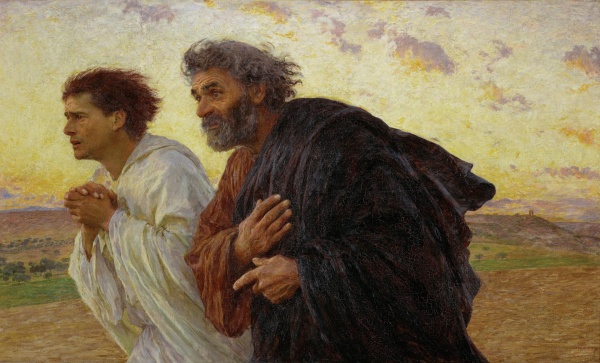
AUGUSTINE. (Tr. cxx) After saying, came to the sepulchre, he goes back and tells us how they came: So they ran both together: and the other disciple did outrun Peter, and came first to the sepulchre; meaning himself, but he always speaks of himself, as if he were speaking of another person.
CHRYSOSTOM. (Hom. lxxxv) On coming he sees the linen clothes set aside: And he slooping down, and looking in, saw the linen clothes lying. But he makes no further search: yet went he not in. Peter on the other hand, being of a more fervid temper, pursued the search, and examined every thing: Then cometh Simon Peter following him, and went into the sepulchre, and seeth the linen clothes lie, and the napkin, that was about His head, not lying with the linen clothes, but wrapped together in a place by itself. Which circumstances were proof of His resurrection. For had they carried Him away, they would not have stripped Him; nor, if any had stolen Him, would they have taken the trouble to wrap up the napkin, and put it in a place by itself, apart from the linen clothes; but would have taken away the body as it was. John mentioned the myrrh first of all, for this reason, i. e. to shew you that He could not have been stolen away. For myrrh would make the linen adhere to the body, and so caused trouble to the thieves, and they would never have been so senseless as to have taken this unnecessary pains about the matter. After Peter however, John entered: Then went in also that other disciple, which came first to the sepulchre, and he saw, and believed.
AUGUSTINE. (Tract. cxxii) i. e. That Jesus had risen again, some think: but what follows contradicts this notion. He saw the sepulchre empty, and believed what the woman had said: For as yet they knew not the Scripture, that He must rise again from the dead. If he did not yet know that He must rise again from the dead, he could not believe that He had risen. They had heard as much indeed from our Lord, and very openly, but they were so accustomed to hear parables from Him, that they took this for a parable, and thought He meant something else.
GREGORY. (Hom. xxii. in Evang.) But this account of the Evangelist1 must not be thought to be without some mystical meaning. By John, the younger of the two, the synagogue; by Peter, the elder, the Gentile Church is represented: for though the synagogue was before the Gentile Church as regards the worship of God, as regards time the Gentile world was before the synagogue. They ran together, because the Gentile world ran side by side with the synagogue from first to last, in respect of purity and community of life, though a purity and community of understanding2 they had not. The synagogue came first to the sepulchre, but entered not: it knew the commandments of the law, and had heard the prophecies of our Lord’s incarnation and death, but would not believe in Him who died. Then cometh Simon Peter, and enteredinto the sepulchre: the Gentile Church both knew Jesus Christ as dead man, and believed in Him as living God. The napkin about our Lord’s head is not found with the linen clothes, i. e. God, the Head of Christ, and the incomprehensible mysteries of the Godhead are removed from our poor knowledge; His power transcends the nature of the creature. And it is found not only apart, but also wrapped together; because of the linen wrapped together, neither beginning nor end is seen; and the height of the Divine nature had neither beginning nor end. And it is into one place: for where there is division, God is not; and they merit His grace, who do not occasion scandal by dividing themselves into sects. But as a napkin is what is used in labouring to wipe the sweat of the brow, by the napkin here we may understand the labour of God: which napkin is found apart, because the suffering of our Redeemer is far removed from ours; inasmuch as He suffered innocently, that which we suffer justly; He submitted Himself to death voluntarily, we by necessity. But after Peter entered, John entered too; for at the end of the world even Judæa shall be gathered in to the true faith.
THEOPHYLACT. Or thus: Peter is practical and prompt, John contemplative and intelligent, and learned in divine things. Now the contemplative man is generally beforehand in knowledge and intelligence, but the practical by his fervour and activity gets the advance of the other’s perception, and sees first into the divine mystery.
Catena Aurea John 20



Pray for Pope Francis.
Catholic Church in Nigeria Appeals to the West: ‘Make Known the Atrocities’
50 Boko Haram Islamic Radicals Killed; 1,000 Hostages, Women and Children, Rescued in Nigeria
Nigeria: In the Face of Ongoing Islamist Attacks, the Faith is Growing
US Promises to Help Nigeria Exterminate Boko Haram
Is This Bishop Right about the Rosary Conquering Boko Haram? [Catholic Caucus]
Why Boko Haram and ISIS Target Women
Report reveals scale of Boko Haram violence inflictef on Nigerian Catholics
Military evacuating girls, women rescued from Boko Haram
Echos of Lepanto Nigerian bishop says rosary will bring down Boko Harm
After vision of Christ, Nigerian bishop says rosary will bring down Boko Haram (Catholic Caucus)
Nigerian Bishop Says Christ Showed Him How to Beat Islamic Terror Group
Disclaimer: Opinions posted on Free Republic are those of the individual posters and do not necessarily represent the opinion of Free Republic or its management. All materials posted herein are protected by copyright law and the exemption for fair use of copyrighted works.