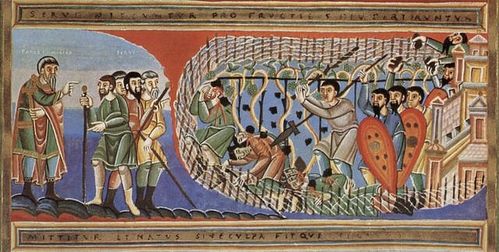
The Parable of the Wicked Husbandmen
Posted on 03/12/2020 11:30:14 PM PDT by Salvation
Israel loved Joseph best of all his sons,
for he was the child of his old age;
and he had made him a long tunic.
When his brothers saw that their father loved him best of all his sons,
they hated him so much that they would not even greet him.
One day, when his brothers had gone
to pasture their father’s flocks at Shechem,
Israel said to Joseph,
“Your brothers, you know, are tending our flocks at Shechem.
Get ready; I will send you to them.”
So Joseph went after his brothers and caught up with them in Dothan.
They noticed him from a distance,
and before he came up to them, they plotted to kill him.
They said to one another: “Here comes that master dreamer!
Come on, let us kill him and throw him into one of the cisterns here;
we could say that a wild beast devoured him.
We shall then see what comes of his dreams.”
When Reuben heard this,
he tried to save him from their hands, saying,
“We must not take his life.
Instead of shedding blood,” he continued,
“just throw him into that cistern there in the desert;
but do not kill him outright.”
His purpose was to rescue him from their hands
and return him to his father.
So when Joseph came up to them,
they stripped him of the long tunic he had on;
then they took him and threw him into the cistern,
which was empty and dry.
They then sat down to their meal.
Looking up, they saw a caravan of Ishmaelites coming from Gilead,
their camels laden with gum, balm and resin
to be taken down to Egypt.
Judah said to his brothers:
“What is to be gained by killing our brother and concealing his blood?
Rather, let us sell him to these Ishmaelites,
instead of doing away with him ourselves.
After all, he is our brother, our own flesh.”
His brothers agreed.
They sold Joseph to the Ishmaelites for twenty pieces of silver.
R. (5a) Remember the marvels the Lord has done.
When the LORD called down a famine on the land
and ruined the crop that sustained them,
He sent a man before them,
Joseph, sold as a slave.
R. Remember the marvels the Lord has done.
They had weighed him down with fetters,
and he was bound with chains,
Till his prediction came to pass
and the word of the LORD proved him true.
R. Remember the marvels the Lord has done.
The king sent and released him,
the ruler of the peoples set him free.
He made him lord of his house
and ruler of all his possessions.
R. Remember the marvels the Lord has done.
God so loved the world that he gave his only-begotten Son;
so that everyone who believes in him might have eternal life.
Jesus said to the chief priests and the elders of the people:
“Hear another parable.
There was a landowner who planted a vineyard,
put a hedge around it,
dug a wine press in it, and built a tower.
Then he leased it to tenants and went on a journey.
When vintage time drew near,
he sent his servants to the tenants to obtain his produce.
But the tenants seized the servants and one they beat,
another they killed, and a third they stoned.
Again he sent other servants, more numerous than the first ones,
but they treated them in the same way.
Finally, he sent his son to them,
thinking, ‘They will respect my son.’
But when the tenants saw the son, they said to one another,
‘This is the heir.
Come, let us kill him and acquire his inheritance.’
They seized him, threw him out of the vineyard, and killed him.
What will the owner of the vineyard do to those tenants when he comes?”
They answered him,
"He will put those wretched men to a wretched death
and lease his vineyard to other tenants
who will give him the produce at the proper times.”
Jesus said to them, "Did you never read in the Scriptures:
The stone that the builders rejected
has become the cornerstone;
by the Lord has this been done,
and it is wonderful in our eyes?
Therefore, I say to you,
the Kingdom of God will be taken away from you
and given to a people that will produce its fruit.”
When the chief priests and the Pharisees heard his parables,
they knew that he was speaking about them.
And although they were attempting to arrest him,
they feared the crowds, for they regarded him as a prophet.
KEYWORDS: catholic; lent; mt21; prayer;
Please FReepmail me to get on/off the Lenten Ping List.
From: Genesis 37:3-4, 12-13a, 17b-28a
Joseph and His Brothers
Joseph is Sold to Egyptians as a Slave
[17b] So Joseph went after his brothers, and found them at Dothan. [18] They saw him afar off, and before he came near to them they conspired against him to kill him. [19] They said to one another, “Here comes this dreamer. [20] Come now, let us kill him and throw him into one of the pits; then we shall say that a wild beast has devoured him, and we shall see what will become of his dreams.” [21] But when Reuben heard it, he delivered him out of their hands, saying, “Let us not take his life.” [22] And Reuben said to them, “Shed no blood; cast him into this pit here in the wilderness, but lay no hand upon him”—that he might rescue him out of their hand, to restore him to his father. [23] So when Joseph came to his brothers, they stripped him of his robe, the long robe with sleeves that he wore; [24] and they took him and cast him into a pit. The pit was empty, there was no water in it.
[25] Then they sat down to eat; and looking up they saw a caravan: of Ishmaelites coming from Gilead, with their camels bearing gum, balm, and myrrh, on their way to carry it down to Egypt. [26] Then Judah said to his brothers, “What profit is it if we slay our brother and conceal his blood? [27] Come, let us sell him to the Ishmaelites, and let not our hand be upon him, for he is our brother, our own flesh.” And his brothers heeded him. [28a] Then Midianite traders passed by; and they drew Joseph up and lifted him out of the pit, and sold him to the Ishmaelites for twenty shekels of silver.
***********************************************************************
Commentary:
37:2-50:26 From here to the end of the book of Genesis, with the exception of chapters 38 and 49, we have the story of Joseph. This concludes the “history of the patriarchs”, leaving them not exactly in the promised land, Canaan, but in Egypt. This sets the scene for the narrative of the great Exodus. The story of Joseph is, thus, the link between patriarchal history and the departure from Egypt, and it therefore constitutes an important stage in the development of salvation history as recorded in the Old Testament.
In the story of Joseph we can see, on the one hand, the testimony borne by ancient accounts about the Israelites going down into Egypt and, on the other, the skill of the narrator who describes the acts of a drama full of emotion, which comes to a happy ending and from which the reader can draw one fundamental lesson: God is guiding everything that happens (even events which seem negative) towards good, towards salvation. “Omnia in bonum” might well be the title of the story of Joseph (cf. 50:20).
The original source of this section may have been quite different from the patriarchal traditions we have seen so far: there is no reference to places of worship, no explanations as to the meaning of names of places and people, no direct divine interventions (except in the case of Jacob in 46:2-4); it assumes that Joseph’s mother is still living (cf. 37:10) and shows Jacob to have a number of daughters (cf. 37:35).
From the information provided in the story of Joseph and from other biblical traditions (cf. for example,Gen 15:16; Ex 12:40-41), it is not possible to say exactly when the Israelites went down into Egypt. The most likely period is when Egypt was under the control of the Hyksos (l’720-l580 BC), invaders who were partly Semitic. The Hyksos had their capital in Avaris, in the Nile delta, and this is where the capital is in the biblical account. The account reminds us of past events and their significance. The whole story of Joseph. as told in the Bible, is very instructive about how God guided the steps of Israel’s ancestors, to work wonders among them, redeeming them from slavery and making them into a people, the chosen people of God. The literary skill with which this last part of the story is told, not only does not take from the historical value of the account: it helps us to grasp the true meaning of all that happened to the “fathers” of Israel, and shows us how the Word of God is able to express itself in language which it knows will hold the reader’s attention.
37:2. “This is the history of ...”: ten times over the course of Genesis the final redactor of the book uses this formal phrase to impose order on its content, dividing it into a number of genealogical sections (cf. “Introduction”, p. 29 above). Here he uses it for the last time, to notify the reader that he has reached the last section, the story of how Jacob-Israel went down into Egypt: one of his sons, Joseph, was sold by his brothers and taken to Egypt (chap. 37); Joseph prospered in that country and became very important (cf. chaps. 39-41); Jacob and his other sons went to Egypt where they met Joseph and, through his good offices, received special treatment from the pharaoh; finally, the patriarch Jacob died in Egypt but was brought back to the land of Canaan to be buried (cf. chaps. 49-50).
37:3-4. The tunic with long sleeves made Joseph took like a prince, in some way foretelling his glorious future. Although Jacob’s preferential love for Joseph is due to human causes, behind it we can see something which occurs throughout the Bible—how some people, gratuitously, enjoy special favor, including special divine favor and love, without this meaning that the love shown to others is diminished. Joseph, the object of Jacob’s special love, thereby becomes a figure of Jesus Christ, the Beloved of the Father (cf. Mt 1:11). The sin of Jacob’s sons, like Cain’s in some way (cfGen 4:5), begins with their reacting against God’s preferential love; it then turns into hatred and envy (cf. vv. 8-Il) and ends up with their getting rid of their brother (cf. v. 20).
37:12-36. This episode deals with the horrible crime of disposing of their brother and the providential events which take Joseph to Egypt. We can see that the narrative is drawing on two sources: one emphasizes the intervention of Judah (v. 26), the other that of Reuben. The true key to what is happening will emerge at the end of the story: “You meant evil against me,” Joseph tells his brothers, “but God meant it for good” (50:20). In the light of the whole narrative we can see the way God’s plan is being put into operation: “Joseph,” comments St Gregoxy the Great, “was sold by his brothers because they did not want to do him honor; but that is exactly what they do, by the very fact of selling him. [...] So too, when one wants to avoid the divine will, then is when it is fulfilled” (”Moralia”, 6, 18, 20).
From: Matthew 21:33-43, 45-46
The Parable of the Wicked Tenants
[42] Jesus said to them, “Have you never read in the scriptures: `The very stone which the builders rejected has become the head of the corner; this was the Lord’s doing, and it is marvellous in our eyes’! [43] Therefore I tell you, the Kingdom of God will be taken away from you and given to a nation producing the fruits of it.”
[45] When the chief priests and the Pharisees heard His parables, they perceived that He was speaking about them. [46] But when they tried to arrest Him, they feared the multitudes, because they held Him to be a prophet.
***********************************************************************
Commentary:
33-46. This very important parable completes the previous one. The parable of the two sons simply identifies the indocility of Israel; that of the wicked tenants focuses on the punishment to come.
Our Lord compares Israel to a choice vineyard, specially fenced, with a watchtower, where a keeper is on the look-out to protect it from thieves and foxes. God has spared no effort to cultivate and embellish His vineyard. The vineyard is in the charge of tenant farmers; the householder is God, and the vineyard, Israel (Isaiah 5:3-5: Jeremiah 2:21; Joel 1:7).
The tenants to whom God has given the care of His people are the priests, scribes and elders. The owner’s absence makes it clear that God really did entrust Israel to its leaders; hence their responsibility and the account He demands of them.
The owner used to send his servants from time to time to collect the fruit; this was the mission of the prophets. The second despatch of servants to claim what is owing to the owner—who meet the same fate as the first—refers to the way God’s prophets were ill-treated by the kings and priests of Israel (Matthew 23:37; Acts 7:42; Hebrews 11:36-38). Finally he sent his son to them, thinking that they would have more respect for him; here we can see the difference between Jesus and the prophets, who were servants, not “the Son”: the parable indicates singular, transcendental sonship, expressing the divinity of Jesus Christ.
The malicious purpose of the tenants in murdering the son and heir to keep the inheritance for themselves is the madness of the leaders in expecting to become undisputed masters of Israel by putting Christ to death (Matthew 12:14; 26:4). Their ambition blinds them to the punishment that awaits them. Then “they cast him out of the vineyard, and killed him”: a reference to Christ’s crucifixion, which took place outside the walls of Jerusalem.
Jesus prophesies the punishment God will inflict on the evildoers: He will put them to death and rent the vineyard to others. This is a very significant prophecy. St. Peter later repeats to the Sanhedrin: “This is the stone which was rejected by you builders, but which has become the head of the corner” (Acts 4:11; 1 Peter 2:4). The stone is Jesus of Nazareth, but the architects of Israel, who build up and rule the people, have chosen not use it in the building. Because of their unfaithfulness the Kingdom of God will be turned over to another people, the Gentiles, who WILL give God the fruit He expects His vineyard to yield (cf. Matthew 3:8-10; Galatians 6:16).
For the building to be well-built, it needs to rest on this stone. Woe to him who trips over it! (cf. Matthew 12:30; Luke 2:34), as first Jews and later the enemies of Christ and His Church will discover through bitter experience (cf. Isaiah 8:14-15).
Christians in all ages should see this parable as exhorting them to build faithfully upon Christ and make sure they do not fall into the sin of this Jewish generation. We should also be filled with hope and a sense of security; for, although the building—the Church—at some times seem to be breaking up, its sound construction, with Christ as its cornerstone, is assured.
Liturgical Colour: Violet.
| First reading |
|---|
| Genesis 37:3-4,12-13,17-28 © |
| Responsorial Psalm |
|---|
| Psalm 104(105):16-21 © |
| Gospel Acclamation | Jn3:16 |
|---|
| Gospel |
|---|
| Matthew 21:33-43,45-46 © |
| Matthew | |||
| English: Douay-Rheims | Latin: Vulgata Clementina | Greek NT: Byzantine/Majority Text (2000) | |
| Matthew 21 |
|||
| 33. | Hear ye another parable. There was a man an householder, who planted a vineyard, and made a hedge round about it, and dug in it a press, and built a tower, and let it out to husbandmen; and went into a strange country. | Aliam parabolam audite : Homo erat paterfamilias, qui plantavit vineam, et sepem circumdedit ei, et fodit in ea torcular, et ædificavit turrim, et locavit eam agricolis, et peregre profectus est. | αλλην παραβολην ακουσατε ανθρωπος [τις] ην οικοδεσποτης οστις εφυτευσεν αμπελωνα και φραγμον αυτω περιεθηκεν και ωρυξεν εν αυτω ληνον και ωκοδομησεν πυργον και εξεδοτο αυτον γεωργοις και απεδημησεν |
| 34. | And when the time of the fruits drew nigh, he sent his servants to the husbandmen that they might receive the fruits thereof. | Cum autem tempus fructuum appropinquasset, misit servos suos ad agricolas, ut acciperent fructus ejus. | οτε δε ηγγισεν ο καιρος των καρπων απεστειλεν τους δουλους αυτου προς τους γεωργους λαβειν τους καρπους αυτου |
| 35. | And the husbandmen laying hands on his servants, beat one, and killed another, and stoned another. | Et agricolæ, apprehensis servis ejus, alium ceciderunt, alium occiderunt, alium vero lapidaverunt. | και λαβοντες οι γεωργοι τους δουλους αυτου ον μεν εδειραν ον δε απεκτειναν ον δε ελιθοβολησαν |
| 36. | Again he sent other servants more than the former; and they did to them in like manner. | Iterum misit alios servos plures prioribus, et fecerunt illis similiter. | παλιν απεστειλεν αλλους δουλους πλειονας των πρωτων και εποιησαν αυτοις ωσαυτως |
| 37. | And last of all he sent to them his son, saying: They will reverence my son. | Novissime autem misit ad eos filium suum, dicens : Verebuntur filium meum. | υστερον δε απεστειλεν προς αυτους τον υιον αυτου λεγων εντραπησονται τον υιον μου |
| 38. | But the husbandmen seeing the son, said among themselves: This is the heir: come, let us kill him, and we shall have his inheritance. | Agricolæ autem videntes filium dixerunt intra se : Hic est hæres, venite, occidamus eum, et habebimus hæreditatem ejus. | οι δε γεωργοι ιδοντες τον υιον ειπον εν εαυτοις ουτος εστιν ο κληρονομος δευτε αποκτεινωμεν αυτον και κατασχωμεν την κληρονομιαν αυτου |
| 39. | And taking him, they cast him forth out of the vineyard, and killed him. | Et apprehensum eum ejecerunt extra vineam, et occiderunt. | και λαβοντες αυτον εξεβαλον εξω του αμπελωνος και απεκτειναν |
| 40. | When therefore the lord of the vineyard shall come, what will he do to those husbandmen? | Cum ergo venerit dominus vineæ, quid faciet agricolis illis ? | οταν ουν ελθη ο κυριος του αμπελωνος τι ποιησει τοις γεωργοις εκεινοις |
| 41. | They say to him: He will bring those evil men to an evil end; and will let out his vineyard to other husbandmen, that shall render him the fruit in due season. | Aiunt illi : Malos male perdet : et vineam suam locabit aliis agricolis, qui reddant ei fructum temporibus suis. | λεγουσιν αυτω κακους κακως απολεσει αυτους και τον αμπελωνα εκδωσεται αλλοις γεωργοις οιτινες αποδωσουσιν αυτω τους καρπους εν τοις καιροις αυτων |
| 42. | Jesus saith to them: Have you never read in the Scriptures: The stone which the builders rejected, the same is become the head of the corner? By the Lord this has been done; and it is wonderful in our eyes. | Dicit illis Jesus : Numquam legistis in Scripturis : Lapidem quem reprobaverunt ædificantes, hic factus est in caput anguli : a Domino factum est istud, et est mirabile in oculis nostris ? | λεγει αυτοις ο ιησους ουδεποτε ανεγνωτε εν ταις γραφαις λιθον ον απεδοκιμασαν οι οικοδομουντες ουτος εγενηθη εις κεφαλην γωνιας παρα κυριου εγενετο αυτη και εστιν θαυμαστη εν οφθαλμοις ημων |
| 43. | Therefore I say to you, that the kingdom of God shall be taken from you, and shall be given to a nation yielding the fruits thereof. | Ideo dico vobis, quia auferetur a vobis regnum Dei, et dabitur genti facienti fructus ejus. | δια τουτο λεγω υμιν οτι αρθησεται αφ υμων η βασιλεια του θεου και δοθησεται εθνει ποιουντι τους καρπους αυτης |
| 44. | And whosoever shall fall on this stone, shall be broken: but on whomsoever it shall fall, it shall grind him to powder. | Et qui ceciderit super lapidem istum, confringetur : super quem vero ceciderit, conteret eum. | και ο πεσων επι τον λιθον τουτον συνθλασθησεται εφ ον δ αν πεση λικμησει αυτον |
| 45. | And when the chief priests and Pharisees had heard his parables, they knew that he spoke of them. | Et cum audissent principes sacerdotum et pharisæi parabolas ejus, cognoverunt quod de ipsis diceret. | και ακουσαντες οι αρχιερεις και οι φαρισαιοι τας παραβολας αυτου εγνωσαν οτι περι αυτων λεγει |
| 46. | And seeking to lay hands on him, they feared the multitudes: because they held him as a prophet. | Et quærentes eum tenere, timuerunt turbas : quoniam sicut prophetam eum habebant. | και ζητουντες αυτον κρατησαι εφοβηθησαν τους οχλους επειδη ως προφητην αυτον ειχον |
Pray for Pope Francis.
Catholic Church in Nigeria Appeals to the West: ‘Make Known the Atrocities’
50 Boko Haram Islamic Radicals Killed; 1,000 Hostages, Women and Children, Rescued in Nigeria
Nigeria: In the Face of Ongoing Islamist Attacks, the Faith is Growing
US Promises to Help Nigeria Exterminate Boko Haram
Is This Bishop Right about the Rosary Conquering Boko Haram? [Catholic Caucus]
Why Boko Haram and ISIS Target Women
Report reveals scale of Boko Haram violence inflictef on Nigerian Catholics
Military evacuating girls, women rescued from Boko Haram
Echos of Lepanto Nigerian bishop says rosary will bring down Boko Harm
After vision of Christ, Nigerian bishop says rosary will bring down Boko Haram (Catholic Caucus)
Nigerian Bishop Says Christ Showed Him How to Beat Islamic Terror Group
We thank you, God our Father, for those who have responded to your call to priestly ministry.
Accept this prayer we offer on their behalf: Fill your priests with the sure knowledge of your love.
Open their hearts to the power and consolation of the Holy Spirit.
Lead them to new depths of union with your Son.
Increase in them profound faith in the Sacraments they celebrate as they nourish, strengthen and heal us.
Lord Jesus Christ, grant that these, your priests, may inspire us to strive for holiness by the power of their example, as men of prayer who ponder your word and follow your will.
O Mary, Mother of Christ and our mother, guard with your maternal care these chosen ones, so dear to the Heart of your Son.
Intercede for our priests, that offering the Sacrifice of your Son, they may be conformed more each day to the image of your Son, our Lord and Savior, Jesus Christ. Amen.
Saint John Vianney, universal patron of priests, pray for us and our priests
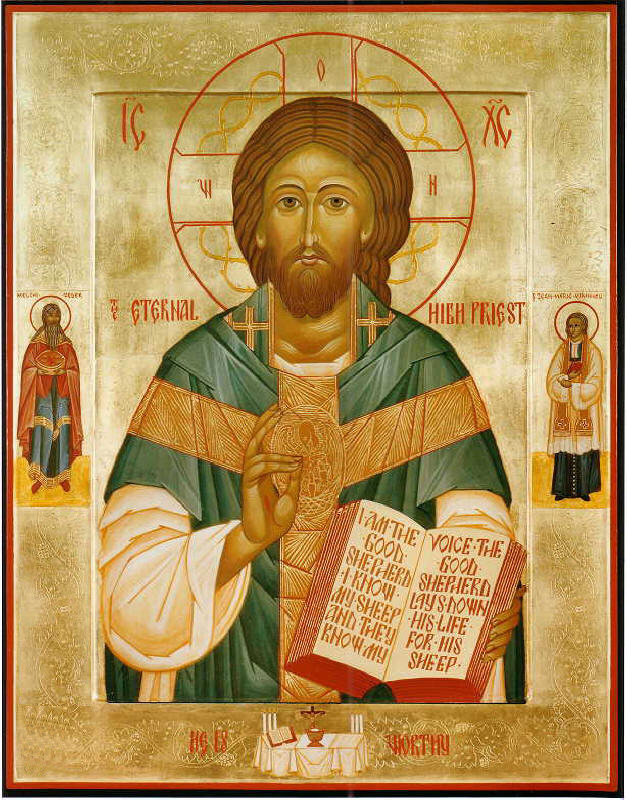
This icon shows Jesus Christ, our eternal high priest.
The gold pelican over His heart represents self-sacrifice.
The border contains an altar and grapevines, representing the Mass, and icons of Melchizedek and St. Jean-Baptiste Vianney.
Melchizedek: king of righteousness (left icon) was priest and king of Jerusalem. He blessed Abraham and has been considered an ideal priest-king.
St. Jean-Baptiste Vianney is the patron saint of parish priests.
Disclaimer: Opinions posted on Free Republic are those of the individual posters and do not necessarily represent the opinion of Free Republic or its management. All materials posted herein are protected by copyright law and the exemption for fair use of copyrighted works.