
Crucifixion
Guido da siena
1270s
Tempera on wood
Pinacoteca Nazionale, Siena
Posted on 03/09/2020 11:14:56 PM PDT by Salvation
Hear the word of the LORD,
princes of Sodom!
Listen to the instruction of our God,
people of Gomorrah!
Wash yourselves clean!
Put away your misdeeds from before my eyes;
cease doing evil; learn to do good.
Make justice your aim: redress the wronged,
hear the orphan’s plea, defend the widow.
Come now, let us set things right,
says the LORD:
Though your sins be like scarlet,
they may become white as snow;
Though they be crimson red,
they may become white as wool.
If you are willing, and obey,
you shall eat the good things of the land;
But if you refuse and resist,
the sword shall consume you:
for the mouth of the LORD has spoken!
R. (23b) To the upright I will show the saving power of God.
“Not for your sacrifices do I rebuke you,
for your burnt offerings are before me always.
I take from your house no bullock,
no goats out of your fold.”
R. To the upright I will show the saving power of God.
“Why do you recite my statutes,
and profess my covenant with your mouth,
Though you hate discipline
and cast my words behind you?”
R. To the upright I will show the saving power of God.
“When you do these things, shall I be deaf to it?
Or do you think that I am like yourself?
I will correct you by drawing them up before your eyes.
He that offers praise as a sacrifice glorifies me;
and to him that goes the right way I will show the salvation of God.”
R. To the upright I will show the saving power of God.
Cast away from you all the crimes you have committed, says the LORD,
and make for yourselves a new heart and a new spirit.
Jesus spoke to the crowds and to his disciples, saying,
“The scribes and the Pharisees
have taken their seat on the chair of Moses.
Therefore, do and observe all things whatsoever they tell you,
but do not follow their example.
For they preach but they do not practice.
They tie up heavy burdens hard to carry
and lay them on people’s shoulders,
but they will not lift a finger to move them.
All their works are performed to be seen.
They widen their phylacteries and lengthen their tassels.
They love places of honor at banquets, seats of honor in synagogues,
greetings in marketplaces, and the salutation ‘Rabbi.’
As for you, do not be called ‘Rabbi.’
You have but one teacher, and you are all brothers.
Call no one on earth your father;
you have but one Father in heaven.
Do not be called ‘Master’;
you have but one master, the Christ.
The greatest among you must be your servant.
Whoever exalts himself will be humbled;
but whoever humbles himself will be exalted.”
KEYWORDS: catholic; lent; mt23; prayer;
Please FReepmail me to get on/off the Lenten Ping List.
From: Isaiah 1:10-20
Religion Without Soul
[12] “When you come to appear before me,
who requires of you
this trampling of my courts?
[13] Bring no more vain offerings;
incense is an abomination to me.
New moon and sabbath and the calling of assemblies –
I cannot endure iniquity and solemn assembly.
[14] Your new moons and your appointed feasts
my soul hates;
[15] When you spread forth your hands,
I will hide my eyes from you;
even though you make many prayers,
I will not listen;
your hands are full of blood.
Call to Conversion
The People Must Decide—Obedience or Rebellion
***********************************************************************
Commentary:
1:2-39:8. The first part of the book of Isaiah is usually described as “First Isaiah”. It includes prophetic passages that have as their background the threat posed by the Assyrians to Judah and Jerusalem during the second half of the eighth century BC. At the start and conclusion of this part, Jerusalem is referred to as a “besieged city” and as “overthrown by aliens” (l:7-8; 36:1ff).
The sacred text links the people of Judah’s distress and uneasiness with the fact that they have distanced themselves from God; they live without reference to him, forgetful of all he has done for them. The future looks bleak, for there is no sign of their heeding the prophet’s call to conversion. However, there is still some cause for hope, for a remnant of Israel has kept faith with God, and from it a new, reformed people will emerge. In various ways a contrast is drawn between those (like King Ahaz: cf. 7:1-17) who clearly do not put their trust in God, relying only on human prudence to deal with the situation, and others (like King Hezekiah: 36:1-38:22) who have recourse to the Lord and make every effort to remedy things; they are confident that God will come to their aid and deliver them from danger.
The first part of the book contains prophetic passages that differ in style and origin. The oldest of them reflect the fear caused by the sheer might of Assyria, which is depicted as a rod or staff wielded by the Lord in his anger (cf. 10:5). All nations in the region felt threatened by Assyria, whose armies reached the very gates of Jerusalem when Sennacherib besieged the city. (That siege marks the end of this part of the book.)
These words of prophecy fall into six sections. The first deals with the threat hanging over Israel and Judah (1:2-12:6); and the second contains oracles to do with foreign nations (13:1-23:18). The third, which in away contains the theological basis of all the teaching found in First Isaiah, and which is known as the “Apocalypse of Isaiah”, deals with the sentence passed on the nations by the Lord (he is supreme, and nothing escapes his justice); still, the light of salvation is always on the horizon (24:1-27:13). Then we hear more about the misfortunes that threaten Jerusalem on account of its sins — and further reason to hope that all is not lost (28:1-33:24). After returning to the theme of divine judgment and rallying the people to hope in salvation, in a section known as the “little Apocalypse” (34:1-35:10), First Isaiah ends with a narrative section dealing with the havoc caused in Judah by Sennacherib’s forces, although, for a while at least, a small remnant is spared — those who take refuge in Jerusalem alongside
Hezekiah the king (36:1-39:8).
1:2-12:6. Isaiah’s ministry as a prophet must have begun in the years prior to the war, when the kingdoms of Syria and Ephraim (Israel), with Egypt’s encouragement, joined forces and took to the field in campaigns aimed at stemming the advance of the Assyrians. The kings of Syria and Israel tried to persuade Ahaz of Judah to join their alliance. Ahaz refused to get involved and, instead, sought to ingratiate himself with Assyria in order to save his country. In 734 BC Assyria overran Syria, most of Israel and the Lebanon, the Philistine coast and the Transjordan, and in the years that followed it consolidated its grip on the region. After the fall of Samaria (722 BC), much of the population of Israel was deported and replaced by foreigners.
The kingdom of Judah was not invaded, but it was forced to pay heavy tribute and became a state dependent on Assyria. At the cost of many concessions, an uneasy peace prevailed. Religious life and the rule of law deteriorated. This was the background to the earliest of the oracles contained in these twelve chapters. The section begins with a general denunciation of the forsaking of the Lord; no specific events are mentioned. It is a time of crisis, with Judah laid waste and Jerusalem under siege (1:2-20); clearly there is need for a call to conversion, to atone for sins and infidelities (1:21-31). After a few verses that strike a note of hope (in time, Jerusalem will be raised on high), there follow oracles that describe how the people have been laid low on account of their pride (2:6-22). However, amid all the uncleanness, a seed of beauty remains, offering hopes of rebirth (3:1-4:6). One could say that the core of the whole section is the “Song of the vineyard” (5:1-7), a lovely allegory about the care that the Lord lavishes on his people, and about their failure to appreciate it.
After this we begin to find references to specific times in what is called the “Book of lmmanuel” (7:1-12:6), which begins with an account of the calling of Isaiah, whom the Lord has commissioned to explain the meaning of what is happening and to show that there are grounds for hope (6:1-13). In line with this, the prophet approaches Ahaz to encourage him to trust in the Lord (7:1-17) in the face of threatened invasion (7:18-25). Assyria is about to close in on Israel and Judah (8:1-22), but there is still hope of deliverance (8:23-9:6). Punishment does await Israel and Judah (9:7-10:4), but Assyria will not escape it either (10:5-19). Meanwhile, the “remnant” of Israel will grow in its appreciation of the Lord and will find peace (10:20-11:9). The section ends with a song of joy and praise to the Lord for saving and renewing his people (11:10-12:6).
1:2-31. The first oracles are couched in the language of a lawsuit (rib). This is a style of writing often found in the prophetical literature of Israel. which shares similar modes of expression with other writings of the ancient Middle East (see the note on Is 1:10-20). However, other people resort to that legal style when they seek to justify the punishment inflicted on a vassal by an aggrieved overlord, whereas when prophetical texts denounce a fault it is in order to evince an immediate change of heart. The Lord takes no pleasure in punishing people; he very much wants to forgive transgressors and reestablish friendship with them.
The passage begins by calling on heaven and earth to see how wickedly the people have acted, and by accusing them of forsaking the Lord (vv. 2-3). It then inveighs against those who have turned away from the Lord and show no inclination to react, even though misfortune has overtaken them (vv. 4-9), and it denounces the hypocrisy of a people that goes through the motions of religious worship without having the right dispositions (vv. 10-15). A call to conversion follows (vv. 16-17). The Lord is ready to argue his point against his people, to reward them if they mend their ways or punish them if they persist in their sins (vv. 18-20). They are in a bad way, such is their sinfulness (vv. 21-23). Their punishment will be very harsh; so they should respond now and be faithful, as they were in earlier times (vv. 24-31).
This oracle brings in all the main theological themes found in the history of the chosen people of the Old Testament — their divine election; God’s offer of a Covenant; the people’s transgression of the Covenant; God’s punishment for their infidelity. Even so, it shows that theirs is a merciful God, ever ready to forgive offences; he never turns his back on those whom he has loved.
1:10-20. These verses, too, in some ways form a literary unit in line with the “lawsuit” (”rib”) style often found in prophetical literature: the charge sheet (vv. 10-15) is set against a list of good works, given here in the form of an exhortation (vv. 16-17), and then comes to the sentence at the end, seen here in the attitude of the judge, who is God (vv. 18-20).
Harsh words (v. 10) are used: the people of Judah are identified with those of Sodom and Gomorrah, the epitome of sin and rejection of God. The transgressions of which they are accused are against acts of worship (vv. 11-15), listed one after the other—sacrifices, incense offerings, festivals, entreaties. The accusation is not against acts of worship in themselves, for these are laid down in the book of Leviticus and therefore are right and proper. What the prophet is inveighing against is religious formalism and the dichotomy between performance and intention, as.can be seen from the verses that follow. What God desires is sincerity of heart, virtue, protection for the weak—in other words, proper treatment of others. In laying down the law here, the Lord shows his readiness to forgive, while still holding out the threat of punishment (vv. 18-20).
Some passages of the section are read in the Liturgy during Lent (Tuesday of the Second Week) to help people check whether they have given God the worship due to him, and as a call to a sincere change of heart. Christian writers have used this passage from Isaiah (and other texts from the Scriptures) to explain that true religion and compassion begin in a person’s heart and then express themselves in actions. For example, one of the apostolic Fathers writes: “Inspired by the Holy Spirit, the ministers of God’s grace will speak of penance. And the Lord of all things himself spoke of penance, and swore an oath: I do not desire the death of the wicked man, but that he should change his ways; and he adds: “Cease to do evil, learn to do good; [...] though your sins are like scarlet, they shall be as white as snow, though they are red like crimson, they shall become like wool.” The Lord desires that all whom he loves would repent, and he affirms it by his all-powerful will. Let us be obedient, then, to his glorious plan, and, by imploring his mercy and kindness, let us return to his goodness and be converted, leaving aside all our vain works, the disputes and jealousies that lead to death” (St Clement of Rome, “Ad Corinthios”, 8, 1-9, 1).
1-17. “Learn to do good”: in order to lead the sort of lives that God wants, we need to be properly schooled. St Basil comments: “Since moral understanding is neither self-evident nor clear to all, we must learn to do good deeds through our study of sound doctrine” (”Enarratio in Isaiam”, 1, 40). As well as calling for sound doctrine, holiness of life requires the practice of virtue, day after day, consistently, in whatever circumstances we find ourselves. The “human virtues are [...] the foundation for the supernatural ones. These in turn provide us with constant encouragement to behave in a noble way. But it is not sufficient merely to want to have these virtues: we must learn bow to practise them. “Discite benefacere” (Is 1:17), learn to do good. We need to make a habit of exercising each virtue, by actually being sincere, truthful, balanced, calm, and patient—for love is proved by deeds and we cannot love God only by word, but ‘with deeds and in truth’ (1 Jn 3:18)” (St Josemaria Escriva, “Friends of God”, 91).
From: Matthew 23:1-12
Vices of the Scribes and Pharisees
***********************************************************************
Commentary:
1-39. Throughout this chapter Jesus severely criticizes the scribes and Pharisees and demonstrates the sorrow and compassion He feels towards the ordinary mass of the people, who have been ill-used, “harassed and helpless, like sheep without a shepherd” (Matthew 9:36). His address may be divided into three parts: in the first (verses 1-12) He identifies their principal vices and corrupt practices; in the second (verses 13-36) He confronts them and speaks His famous “woes”, which in effect are the reverse of the Beatitudes He preached in Chapter 5: no one can enter the Kingdom of Heaven—no one can escape condemnation to the flames—unless he changes his attitude and behavior; in the third part (verses 37-39) He weeps over Jerusalem, so grieved is He by the evils into which the blind pride and hardheartedness of the scribes and Pharisees have misled the people.
2-3. Moses passed on to the people the Law received from God. The scribes, who for the most part sided with the Pharisees, had the function of educating the people in the Law of Moses; that is why they were said to “sit on Moses’ seat”. Our Lord recognized that the scribes and Pharisees did have authority to teach the Law; but He warns the people and His disciples to be sure to distinguish the Law as read out and taught in the synagogues from the practical interpretations of the Law to be seen in their leaders’ lifestyles. Some years later, St. Paul—a Pharisee like his father before him—faced his former colleagues with exactly the same kind of accusations as Jesus makeshere: “You then who teach others, will you not teach yourself? While you preach against stealing, do you steal? You who say that one must not commit adultery, do you commit adultery? You who abhor idols, do you rob temples? You who boast in the law, do you dishonor God by breaking the law? For, as it is written, `The name of God is blasphemed among the Gentiles because of you’” (Romans 2:21-24).
5. “Phylacteries”: belts or bands carrying quotations from sacred Scripture which the Jews used to wear fastened to their arms or foreheads. To mark themselves out as more religiously observant than others, the Pharisees used to wear broader phylacteries. The fringes were light-blue stripes on the hems of cloaks; the Pharisees ostentatiously wore broader fringes.
8-10. Jesus comes to teach the truth; in fact, He is the Truth (John 14:6). As a teacher, therefore, He is absolutely unique and unparalleled. “The whole of Christ’s life was a continual teaching: His silences, His miracles, His gestures, His prayer, His love for people, His special affection for the little and the poor, His acceptance of the total sacrifice on the cross for the redemption of the world, and His resurrection are the actualization of His word and the fulfillment of revelation. Hence for Christians the crucifix is one of the most sublime and popular images of Christ the Teacher.
“These considerations are in line with the great traditions of the Church and they all strengthen our fervor with regard to Christ, the Teacher who reveals God to man and man to himself, the Teacher who saves, sanctifies and guides, who lives, who speaks, rouses, moves, redresses, judges, forgives, and goes with us day by day on the path of history, the Teacher who comes and will come in glory” (John Paul II, “Catechesi Tradendae”, 9).
11. The Pharisees were greedy for honor and recognition: our Lord insists that every form of authority, particularly in the context of religion, should be exercised as a form of service to others; it must not be used to indulge personal vanity or greed. “He who is the greatest among you shall be your servant”.
12. A spirit of pride and ambition is incompatible with being a disciple of Christ. Here our Lord stresses the need for true humility, for anyone who is to follow Him. The verbs “will be humbled”, “will be exalted” have “God” as their active agent. Along the same lines, St. James preaches that “God opposes the proud, but gives grace to the humble” (James 4:6). And in the “Magnificat”, the Blessed Virgin explains that the Lord “has put down the mighty from their thrones, and exalted those of low degree [the humble]” (Luke 1:52).
Liturgical Colour: Violet.
| First reading |
|---|
| Isaiah 1:10,16-20 © |
| Responsorial Psalm |
|---|
| Psalm 49(50):8-9,16-17,21,23 © |
| Gospel Acclamation | Mt4:17 |
|---|
| Or: | Ezk18:31 |
|---|
| Gospel | Matthew 23:1-12 © |
|---|
| Matthew | |||
| English: Douay-Rheims | Latin: Vulgata Clementina | Greek NT: Byzantine/Majority Text (2000) | |
| Matthew 23 |
|||
| 1. | THEN Jesus spoke to the multitudes and to his disciples, | Tunc Jesus locutus est ad turbas, et ad discipulos suos, | τοτε ο ιησους ελαλησεν τοις οχλοις και τοις μαθηταις αυτου |
| 2. | Saying: The scribes and the Pharisees have sitten on the chair of Moses. | dicens : Super cathedram Moysi sederunt scribæ et pharisæi. | λεγων επι της μωσεως καθεδρας εκαθισαν οι γραμματεις και οι φαρισαιοι |
| 3. | All things therefore whatsoever they shall say to you, observe and do: but according to their works do ye not; for they say, and do not. | Omnia ergo quæcumque dixerint vobis, servate, et facite : secundum opera vero eorum nolite facere : dicunt enim, et non faciunt. | παντα ουν οσα εαν ειπωσιν υμιν τηρειν τηρειτε και ποιειτε κατα δε τα εργα αυτων μη ποιειτε λεγουσιν γαρ και ου ποιουσιν |
| 4. | For they bind heavy and insupportable burdens, and lay them on men's shoulders; but with a finger of their own they will not move them. | Alligant enim onera gravia, et importabilia, et imponunt in humeros hominum : digito autem suo nolunt ea movere. | δεσμευουσιν γαρ φορτια βαρεα και δυσβαστακτα και επιτιθεασιν επι τους ωμους των ανθρωπων τω δε δακτυλω αυτων ου θελουσιν κινησαι αυτα |
| 5. | And all their works they do for to be seen of men. For they make their phylacteries broad, and enlarge their fringes. | Omnia vero opera sua faciunt ut videantur ab hominibus : dilatant enim phylacteria sua, et magnificant fimbrias. | παντα δε τα εργα αυτων ποιουσιν προς το θεαθηναι τοις ανθρωποις πλατυνουσιν δε τα φυλακτηρια αυτων και μεγαλυνουσιν τα κρασπεδα των ιματιων αυτων |
| 6. | And they love the first places at feasts, and the first chairs in the synagogues, | Amant autem primos recubitus in cœnis, et primas cathedras in synagogis, | φιλουσιν τε την πρωτοκλισιαν εν τοις δειπνοις και τας πρωτοκαθεδριας εν ταις συναγωγαις |
| 7. | And salutations in the market place, and to be called by men, Rabbi. | et salutationes in foro, et vocari ab hominibus Rabbi. | και τους ασπασμους εν ταις αγοραις και καλεισθαι υπο των ανθρωπων ραββι ραββι |
| 8. | But be not you called Rabbi. For one is your master; and all you are brethren. | Vos autem nolite vocari Rabbi : unus est enim magister vester, omnes autem vos fratres estis. | υμεις δε μη κληθητε ραββι εις γαρ εστιν υμων ο καθηγητης ο χριστος παντες δε υμεις αδελφοι εστε |
| 9. | And call none your father upon earth; for one is your father, who is in heaven. | Et patrem nolite vocare vobis super terram : unus est enim pater vester qui in cælis est. | και πατερα μη καλεσητε υμων επι της γης εις γαρ εστιν ο πατηρ υμων ο εν τοις ουρανοις |
| 10. | Neither be ye called masters; for one is you master, Christ. | Nec vocemini magistri : quia magister vester unus est, Christus. | μηδε κληθητε καθηγηται εις γαρ υμων εστιν ο καθηγητης ο χριστος |
| 11. | He that is the greatest among you shall be your servant. | Qui major est vestrum, erit minister vester. | ο δε μειζων υμων εσται υμων διακονος |
| 12. | And whosoever shall exalt himself shall be humbled: and he that shall humble himself shall be exalted. | Qui autem se exaltaverit, humiliabitur : et qui se humiliaverit, exaltabitur. | οστις δε υψωσει εαυτον ταπεινωθησεται και οστις ταπεινωσει εαυτον υψωθησεται |
Pray for Pope Francis.
Catholic Church in Nigeria Appeals to the West: ‘Make Known the Atrocities’
50 Boko Haram Islamic Radicals Killed; 1,000 Hostages, Women and Children, Rescued in Nigeria
Nigeria: In the Face of Ongoing Islamist Attacks, the Faith is Growing
US Promises to Help Nigeria Exterminate Boko Haram
Is This Bishop Right about the Rosary Conquering Boko Haram? [Catholic Caucus]
Why Boko Haram and ISIS Target Women
Report reveals scale of Boko Haram violence inflictef on Nigerian Catholics
Military evacuating girls, women rescued from Boko Haram
Echos of Lepanto Nigerian bishop says rosary will bring down Boko Harm
After vision of Christ, Nigerian bishop says rosary will bring down Boko Haram (Catholic Caucus)
Nigerian Bishop Says Christ Showed Him How to Beat Islamic Terror Group
We thank you, God our Father, for those who have responded to your call to priestly ministry.
Accept this prayer we offer on their behalf: Fill your priests with the sure knowledge of your love.
Open their hearts to the power and consolation of the Holy Spirit.
Lead them to new depths of union with your Son.
Increase in them profound faith in the Sacraments they celebrate as they nourish, strengthen and heal us.
Lord Jesus Christ, grant that these, your priests, may inspire us to strive for holiness by the power of their example, as men of prayer who ponder your word and follow your will.
O Mary, Mother of Christ and our mother, guard with your maternal care these chosen ones, so dear to the Heart of your Son.
Intercede for our priests, that offering the Sacrifice of your Son, they may be conformed more each day to the image of your Son, our Lord and Savior, Jesus Christ. Amen.
Saint John Vianney, universal patron of priests, pray for us and our priests
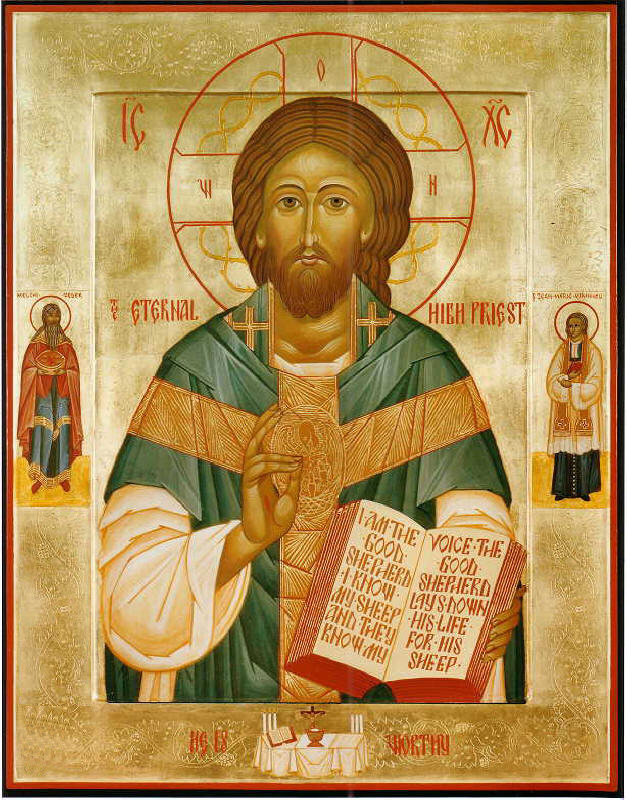
This icon shows Jesus Christ, our eternal high priest.
The gold pelican over His heart represents self-sacrifice.
The border contains an altar and grapevines, representing the Mass, and icons of Melchizedek and St. Jean-Baptiste Vianney.
Melchizedek: king of righteousness (left icon) was priest and king of Jerusalem. He blessed Abraham and has been considered an ideal priest-king.
St. Jean-Baptiste Vianney is the patron saint of parish priests.

1. Sign of the Cross: In the name of the Father, and of the Son, and of the Holy Spirit. Amen.
2. The Apostles Creed: I BELIEVE in God, the Father almighty, Creator of heaven and earth, and in Jesus Christ, His only Son, our Lord, who was conceived by the Holy Spirit, born of the Virgin Mary, suffered under Pontius Pilate, was crucified, died, and was buried. He descended into hell; on the third day he rose again from the dead; he ascended into heaven, and is seated at the right hand of God, the Father Almighty; from there He shall come to judge the living and the dead.
I believe in the Holy Spirit, the holy catholic Church, the communion of saints, the forgiveness of sins, the resurrection of the body, and the life everlasting. Amen.
3. The Lord's Prayer: OUR Father, who art in heaven, hallowed be Thy name. Thy kingdom come. Thy will be done on earth as it is in heaven. Give us this day our daily bread and forgive us our trespasses as we forgive those who trespass against us. And lead us not into temptation, but deliver us from evil. Amen.
4. (3) Hail Mary: HAIL Mary, full of grace, the Lord is with thee. Blessed art thou amongst women and blessed is the fruit of thy womb, Jesus. Holy Mary, Mother of God, pray for us sinners, now, and in the hour of our death. Amen. (Three times)
5. Glory Be: GLORY be to the Father, and to the Son, and to the Holy Spirit. As it was in the beginning, is now, and ever shall be, world without end. Amen.
6. Fatima Prayer: Oh, my Jesus, forgive us our sins, save us from the fires of hell, lead all souls to heaven, especially those in most need of your mercy.
Announce each mystery, then say 1 Our Father, 10 Hail Marys, 1 Glory Be and 1 Fatima prayer. Repeat the process with each mystery.
End with the Hail Holy Queen:
Hail, Holy Queen, Mother of Mercy, our life, our sweetness and our hope! To thee do we cry, poor banished children of Eve! To thee do we send up our sighs, mourning and weeping in this vale of tears! Turn then, most gracious advocate, thine eyes of mercy towards us; and after this, our exile, show unto us the blessed fruit of thy womb, Jesus!
O clement, O loving, O sweet Virgin Mary! Pray for us, O holy Mother of God, that we may be made worthy of the promises of Christ.
Final step -- The Sign of the Cross
The Mysteries of the Rosary By tradition, Catholics meditate on these Mysteries during prayers of the Rosary. The biblical references follow each of the Mysteries below.
The Sorrowful Mysteries
(Tuesdays and Fridays)
1. The Agony in the Garden (Matthew 26:36-46, Luke 22:39-46) [Spiritual fruit - God's will be done]
2. The Scourging at the Pillar (Matthew 27:26, Mark 15:15, John 19:1) [Spiritual fruit - Mortification of the senses]
3. The Crowning with Thorns (Matthew 27:27-30, Mark 15:16-20, John 19:2) [Spiritual fruit - Reign of Christ in our heart]
4. The Carrying of the Cross (Matthew 27:31-32, Mark 15:21, Luke 23:26-32, John 19:17) [Spiritual fruit - Patient bearing of trials]
5. The Crucifixion (Matthew 27:33-56, Mark 15:22-39, Luke 23:33-49, John 19:17-37) [Spiritual fruit - Pardoning of Injuries]

St. Michael the Archangel
~ PRAYER ~
St. Michael, the Archangel, defend us in battle
Be our protection against the wickedness
and snares of the devil;
May God rebuke him, we humbly pray,
and do thou, O Prince of the heavenly host,
by the power of God,
Cast into hell Satan and all the evil spirits
who prowl through the world seeking the ruin of souls.
Amen
+
FOR OUR WORK
Glorious Saint Joseph, pattern of all who are devoted to toil, obtain for me the grace to toil in the spirit of penance, in order thereby to atone for my many sins; to toil conscientiously, putting devotion to duty before my own inclinations; to labor with thankfulness and joy, deeming it an honor to employ and to develop, by my labor, the gifts I have received from Almighty God; to work with order, peace, moderation, and patience, without ever shrinking from weariness and difficulties; to work above all with a pure intention and with detachment from self, having always before my eyes the hour of death and the accounting which I must then render of time ill-spent, of talents unemployed, of good undone, and of my empty pride in success, which is so fatal to the work of God. All for Jesus, all through Mary, all in imitation of thee, 0 Patriarch Joseph! This shall be my motto in life and in death. Amen.
FOR THE INTERCESSION OF SAINT JOSEPH
O Joseph, virgin-father of Jesus, most pure spouse of the Virgin Mary, pray every day for us to the same Jesus, the Son of God, that we, being defended by the power of His grace and striving dutifully in life, may be crowned by Him at the hour of death.
Prayer Source: Prayer Book, The by Reverend John P. O'Connell, M.A., S.T.D. and Jex Martin, M.A., The Catholic Press, Inc., Chicago, Illinois, 1954
St. Joseph
St. Joseph was an ordinary manual laborer although descended from the royal house of David. In the designs of Providence he was destined to become the spouse of the Mother of God. His high privilege is expressed in a single phrase, "Foster-father of Jesus." About him Sacred Scripture has little more to say than that he was a just man-an expression which indicates how faithfully he fulfilled his high trust of protecting and guarding God's greatest treasures upon earth, Jesus and Mary.
The darkest hours of his life may well have been those when he first learned of Mary's pregnancy; but precisely in this time of trial Joseph showed himself great. His suffering, which likewise formed a part of the work of the redemption, was not without great providential import: Joseph was to be, for all times, the trustworthy witness of the Messiah's virgin birth. After this, he modestly retires into the background of holy Scripture.
Of St. Joseph's death the Bible tells us nothing. There are indications, however, that he died before the beginning of Christ's public life. His was the most beautiful death that one could have, in the arms of Jesus and Mary. Humbly and unknown, he passed his years at Nazareth, silent and almost forgotten he remained in the background through centuries of Church history. Only in more recent times has he been accorded greater honor. Liturgical veneration of St. Joseph began in the fifteenth century, fostered by Sts. Brigid of Sweden and Bernadine of Siena. St. Teresa, too, did much to further his cult.
At present there are two major feasts in his honor. On March 19 our veneration is directed to him personally and to his part in the work of redemption, while on May 1 we honor him as the patron of workmen throughout the world and as our guide in the difficult matter of establishing equitable norms regarding obligations and rights in the social order.
Excerpted from The Church's Year of Grace, Pius Parsch.

St. Joseph is invoked as patron for many causes. He is the patron of the Universal Church. He is the patron of the dying because Jesus and Mary were at his death-bed. He is also the patron of fathers, of carpenters, and of social justice. Many religious orders and communities are placed under his patronage.
Patron: Against doubt; against hesitation; Americas; Austria; Diocese of Baton Rouge, Louisiana; California; Belgium; Bohemia; bursars; cabinetmakers; Canada; Carinthia; carpenters; China; Church; confectioners; craftsmen; Croatian people (in 1687 by decree of the Croatian parliament) dying people; emigrants; engineers; expectant mothers; families; fathers; Florence, Italy; happy death; holy death; house hunters; immigrants; interior souls; Korea; laborers; Diocese of La Crosse, Wisconsin; Archdiocese of Louisville, Kentucky; Diocese of Manchester, New Hampshire; Mexico; Diocese of Nashville, Tennessee; New France; New World; Oblates of Saint Joseph; people in doubt; people who fight Communism; Peru; pioneers; pregnant women; protection of the Church; Diocese of San Jose, California; diocese of Sioux Falls, South Dakota; social justice; Styria, Austria; travelers; Turin Italy; Tyrol Austria; unborn children Universal Church; Vatican II; Viet Nam; Diocese of Wheeling-Charleston West Virginia; wheelwrights; workers; working people.
Symbols: Bible; branch; capenter's square; carpenter's tools; chalice; cross; hand tools; infant Jesus; ladder; lamb; lily; monstrance; old man holding a lily and a carpenter's tool such as a square; old man holding the infant Jesus; plane; rod.
Pope Pius X composed this prayer to St. Joseph, patron of working people, that expresses concisely the Christian attitude toward labor. It summarizes also for us the lessons of the Holy Family's work at Nazareth.
Glorious St. Joseph, model of all who devote their lives to labor, obtain for me the grace to work in the spirit of penance in order thereby to atone for my many sins; to work conscientiously, setting devotion to duty in preference to my own whims; to work with thankfulness and joy, deeming it an honor to employ and to develop by my labor the gifts I have received from God; to work with order, peace, moderation, and patience, without ever shrinking from weariness and difficulties; to work above all with a pure intention and with detachment from self, having always before my eyes the hour of death and the accounting which I must then render of time ill spent, of talents wasted, of good omitted, and of vain complacency in success, which is so fatal to the work of God.
All for Jesus, all through Mary, all in imitation of you, O Patriarch Joseph! This shall be my motto in life and in death, Amen.
Litany of Saint Joseph
Lord, have mercy on us.
Christ, have mercy on us.
Lord, have mercy on us.
Christ, hear us.
Christ, graciously hear us.
God, the Father of Heaven, have mercy on us.
God, the Son, Redeemer of the world, have mercy on us.
God, the Holy Ghost, have mercy on us.
Holy Trinity, One God, have mercy on us.
Holy Mary, pray for us.
Holy Joseph, pray for us.
Illustrious Son of David, pray for us.
Light of the Patriarchs, pray for us.
Spouse of the Mother of God, pray for us.
Chaste Guardian of the Virgin, pray for us.
Foster-Father of the Son of God, pray for us.
Faithful Protector of Christ, pray for us.
Head of the Holy Family, pray for us.
Joseph most just, pray for us.
Joseph most chaste, pray for us.
Joseph most prudent, pray for us.
Joseph most courageous, pray for us.
Joseph most obedient, pray for us.
Joseph most faithful, pray for us.
Mirror of patience, pray for us.
Lover of poverty, pray for us.
Model of working men, pray for us.
Ornament of the domestic life, pray for us.
Guardian of virgins, pray for us.
Pillar of the family, pray for us.
Consoler of the miserable, pray for us.
Hope of the sick, pray for us.
Patron of the dying, pray for us.
Terror of demons, pray for us.
Protector of the Holy Church, pray for us.
Lamb of God, who takest away the sins of the world, Spare us, O Lord.
Lamb of God, who takest away the sins of the world, Graciously hear us, O Lord.
Lamb of God, who takest away the sins of the world, Have mercy on us.
V. He hath made him master of His house.
R. And ruler of all His possessions.
Let us pray.
O God, who in Thy ineffable providence didst vouchsafe to choose blessed Joseph to be the Spouse of Thy most holy Mother: grant, we beseech Thee, that we may have him for our intercessor in Heaven, whom on earth we venerate as out most holy Protector. Who livest and reignest world without end. Amen.
Was St. Joseph a tzadik?
St. Joseph: Patron saint of three Popes [Catholic Caucus]
St. Joseph and the Staircase
St. Joseph, Foster Father, Novena [Catholic/Orthodox Caucus]
Patron of a “Happy Death” A Special Role for St. Joseph [Catholic/Orhtodox Caucus]
Lists Every Catholic Should be Familiar With: The 7 Sorrows and 7 Joys of St. Joseph
Catholic Group Blasts Pelosi For Invoking St. Joseph on Pro-Abortion Health Care Bill
THE SEVEN SORROWS AND SEVEN JOYS OF ST. JOSEPH
Joseph, Mary and Jesus: A Model Family
Season of Announcement - Revelation to Joseph
In hard times, don't forget about the humble carpenter Joseph
Saint Joseph: Complete submission to the will of God (Pope Benedict XVI) (Catholic/Orthodox Caucus)
St. Joseph as Head of the Holy Family (Catholic/Orthodox Caucus)
St. Joseph, Patron of a Peaceful Death [Catholic Caucus]
Octave: St. Joseph, A 'Man’s Man', Calling Men to Jesus
St. Teresa de Avila's Devotion to St. Joseph (Catholic Caucus)
Catholic Men's National Day of Prayer, MARCH 15, 2008, The Solemnity of St. Joseph (Catholic Caucus)
The Role and Responsibility of Fatherhood - St. Joseph as Model
St. Joseph - Foster Father of Jesus
Some divine intervention in real estate-[Bury St. Joseph Statues in Ground]
Many Turn To Higher Power For Home Sales
St. Joseph the Worker, Memorial, May 1
Catholic Devotions: St. Joseph the Worker
Nothing Will Be Denied Him (St. Joseph)
The Heart of a Father [St. Joseph]
St. Joseph's DAY
Quemadmodum Deus - Decree Under Blessed Pius IX, Making St. Joseph Patron of the Church
Father & Child (Preaching on St. Joseph)
March 19 - Feast of St. Joseph - Husband of Mary - Intercessor of civil leaders
St. Joseph's Spirit of Silence
St. Joseph's Humility (By St. Francis de Sales)
St. Joseph [Husband of the Blessed Virgin Mary], Solemnity, March 19
St Joseph’s Paternal Love
The Heart of St. Joseph
MORE THAN PATRON OF HOMES, IT'S TIME FOR ST. JOSEPH TO GAIN HIGHEST OF RECOGNITION [Fatherhood]
The Importance of Devotion to St. Joseph
St. Francis de Sales on St. Joseph (Some Excerpts for St. Joseph's Day 2004)
St. Joseph: REDEMPTORIS CUSTOS (Guardian Of The Redeemer)
(Saint) Joseph the Patriarch: A Reflection on the Solemnity of St. Joseph
How I Rediscovered a "Neglected" Saint: Work of Art Inspires Young Man to Rediscover St. Joseph
Novena to Saint Joseph
O Saint Joseph, whose protection is so great, so strong, so prompt before the throne of God, I place in you all my interests and desires.
O Saint Joseph, assist me by your powerful intercession and obtain for me from your Divine Son all spiritual blessings through Jesus Christ, Our Lord; so that having engaged here below your heavenly power, I may offer my thanksgiving and homage to the most loving of Fathers.
O Saint Joseph, I never weary contemplating you and Jesus asleep in your arms; I dare not approach while He reposes near your heart. Press Him in my name and kiss His fine head for me, and ask Him to return the Kiss when I draw my dying breath, Amen.
O Saint Joseph, hear my prayers and obtain my petitions. O Saint Joseph, pray for me. (mention your intention)
St. Joseph Novena
O good father Joseph! I beg you, by all your sufferings, sorrows and joys, to obtain for me what I ask.
(Here name your petition).
Obtain for all those who have asked my prayers, everything that is useful to them in the plan of God. Be near to me in my last moments, that I may eternally sing the praises of Jesus, Mary and Joseph. Amen.
(Our Father, Hail Mary, Glory Be)

St. Padre Pio of Pietrelcina
Disclaimer: Opinions posted on Free Republic are those of the individual posters and do not necessarily represent the opinion of Free Republic or its management. All materials posted herein are protected by copyright law and the exemption for fair use of copyrighted works.