
Temptation of Christ
mosaic
12th century
Basilica di San Marco, Venice
Posted on 02/29/2020 8:37:36 PM PST by Salvation
The LORD God formed man out of the clay of the ground
and blew into his nostrils the breath of life,
and so man became a living being.
Then the LORD God planted a garden in Eden, in the east,
and placed there the man whom he had formed.
Out of the ground the LORD God made various trees grow
that were delightful to look at and good for food,
with the tree of life in the middle of the garden
and the tree of the knowledge of good and evil.
Now the serpent was the most cunning of all the animals
that the LORD God had made.
The serpent asked the woman,
“Did God really tell you not to eat
from any of the trees in the garden?”
The woman answered the serpent:
“We may eat of the fruit of the trees in the garden;
it is only about the fruit of the tree
in the middle of the garden that God said,
‘You shall not eat it or even touch it, lest you die.’”
But the serpent said to the woman:
“You certainly will not die!
No, God knows well that the moment you eat of it
your eyes will be opened and you will be like gods
who know what is good and what is evil.”
The woman saw that the tree was good for food,
pleasing to the eyes, and desirable for gaining wisdom.
So she took some of its fruit and ate it;
and she also gave some to her husband, who was with her,
and he ate it.
Then the eyes of both of them were opened,
and they realized that they were naked;
so they sewed fig leaves together
and made loincloths for themselves.
R. (cf. 3a) Be merciful, O Lord, for we have sinned.
Have mercy on me, O God, in your goodness;
in the greatness of your compassion wipe out my offense.
Thoroughly wash me from my guilt
and of my sin cleanse me.
R. Be merciful, O Lord, for we have sinned.
For I acknowledge my offense,
and my sin is before me always:
“Against you only have I sinned,
and done what is evil in your sight.”
R. Be merciful, O Lord, for we have sinned.
A clean heart create for me, O God,
and a steadfast spirit renew within me.
Cast me not out from your presence,
and your Holy Spirit take not from me.
R. Be merciful, O Lord, for we have sinned.
Give me back the joy of your salvation,
and a willing spirit sustain in me.
O Lord, open my lips,
and my mouth shall proclaim your praise.
R. Be merciful, O Lord, for we have sinned.
Brothers and sisters:
Through one man sin entered the world,
and through sin, death,
and thus death came to all men, inasmuch as all sinned—
for up to the time of the law, sin was in the world,
though sin is not accounted when there is no law.
But death reigned from Adam to Moses,
even over those who did not sin
after the pattern of the trespass of Adam,
who is the type of the one who was to come.
But the gift is not like the transgression.
For if by the transgression of the one, the many died,
how much more did the grace of God
and the gracious gift of the one man Jesus Christ
overflow for the many.
And the gift is not like the result of the one who sinned.
For after one sin there was the judgment that brought condemnation;
but the gift, after many transgressions, brought acquittal.
For if, by the transgression of the one,
death came to reign through that one,
how much more will those who receive the abundance of grace
and of the gift of justification
come to reign in life through the one Jesus Christ.
In conclusion, just as through one transgression
condemnation came upon all,
so, through one righteous act,
acquittal and life came to all.
For just as through the disobedience of the one man
the many were made sinners,
so, through the obedience of the one,
the many will be made righteous.
or
Brothers and sisters:
Through one man sin entered the world,
and through sin, death,
and thus death came to all men, inasmuch as all sinned.
For if, by the transgression of the one,
death came to reign through that one,
how much more will those who receive the abundance of grace
and of the gift of justification
come to reign in life through the one Jesus Christ.
In conclusion, just as through one transgression
condemnation came upon all,
so, through one righteous act,
acquittal and life came to all.
For just as through the disobedience of the one man
the many were made sinners,
so, through the obedience of the one,
the many will be made righteous.
One does not live on bread alone,
but on every word that comes forth from the mouth of God.
At that time Jesus was led by the Spirit into the desert
to be tempted by the devil.
He fasted for forty days and forty nights,
and afterwards he was hungry.
The tempter approached and said to him,
“If you are the Son of God,
command that these stones become loaves of bread.”
He said in reply,
“It is written:
One does not live on bread alone,
but on every word that comes forth
from the mouth of God.”
Then the devil took him to the holy city,
and made him stand on the parapet of the temple,
and said to him, “If you are the Son of God, throw yourself down.
For it is written:
He will command his angels concerning you
and with their hands they will support you,
lest you dash your foot against a stone.”
Jesus answered him,
“Again it is written,
You shall not put the Lord, your God, to the test.”
Then the devil took him up to a very high mountain,
and showed him all the kingdoms of the world in their magnificence,
and he said to him, "All these I shall give to you,
if you will prostrate yourself and worship me.”
At this, Jesus said to him,
“Get away, Satan!
It is written:
The Lord, your God, shall you worship
and him alone shall you serve.”
Then the devil left him and, behold,
angels came and ministered to him.
KEYWORDS: catholic; lent; mt4; prayer;
Please FReepmail me to get on/off the Lenten Ping List.
From: Genesis 2:7-9, 15-25; 3:1-7
The Creation of Adam (Continuation)
Man in Paradise
The Creation of Eve
Temptation and the First Sins
***********************************************************************
Commentary:
2:7. As far as his body is concerned, man belongs to the earth. To affirm this, the sacred writer must have been always conscious of the fact that when a person dies, his/her body will turn into dust, as Genesis 3:19 will in due course tell us. Or it may be that this sort of account (a special one like the literary genre of all these chapters) is based on the similarity between the word “adam”, which means man in general, and “adamah”, which means “reddish soil”; and given that the words look alike, the sacred writer may have drawn the conclusion that there is in fact a connection between the two very things (unsophisticated etymology goes in for this sort of thing). But the fact that man belongs to the earth is not his most characteristic feature: as the author sees it, animals too are made up of the stuff of the earth. What makes man different is the fact that he receives his life from God. Life is depicted here in terms of breathing, because only living animals: breathe. The fact that God infuses life into man in this way means
that although man on account of his corporeal nature is material, his existence as a living being comes directly from God, that is, it is animated by a vital principle—the soul or the spirit—which does not derive from the earth. This principle of life received from God also endows man’s body with its own dignity and puts it on a higher level than that of animals.
God is portrayed as a potter who models man’s body in clay; this means that man is supposed to live in accordance with a source of life that is higher than that deriving from matter The image of God as a potter shows that man (all of him) is in God’s hands just like clay in a potter’s hands; he should not resist or oppose God’s will (cf Is 29:16; Jer 18:6; Rom 9:20-21).
2:8-15. Here we have a scenario in which God and man are friends; there is no such thing as evil or death. The garden is described as being a leafy oasis, with the special feature of having two trees in the center, the tree of life and the tree of the knowledge of good and evil—symbolizing the power to give life, and the ultimate reference-point for man’s moral behavior. Out of the garden flow the four rivers the author is most familiar with; these water the entire earth and make it fertile. What the Bible is teaching here is that man was created to be happy, to enjoy the life and goodness which flow from God. “The Church interpreting the symbolism of biblical language in an authentic way, in the light of the New Testament and Tradition teaches that our first parents, Adam Eve, were constituted in an original ‘state of holiness and justice’ (Council of Trent, “De Peccato Originali”). This grace of original holiness was ‘to share in...divine life’ (”Lumen Gentium”, 2)” (”Catechism the Catholic Church”, 375).
From the outset, man is charged with cultivating the garden—working it, protecting it and making it bear fruit. Here again we can see that work is a commission that God gives man from the start. “From the beginning of creation man has had to work,” St. J. Escriva said. ‘This not something that I have invented. It is enough to turn to the opening pages the Bible. There you can read that, before sin entered the world, and in its wake death, punishment and misery (cf. Rom 5:12). God made Adam from the clay the earth, and created for him and descendants this beautiful world we live in, “ut operaretur et custodiret illum” (Gen 2:15), so that we might cultivate it and look after it” (”Friends of God”, 57). But man needs to recognize God’s mastery over creation and over himself by obeying the commandment God gives him as a kind of covenant, telling him not to eat the forbidden fruit. If man lost the original happiness he was created to enjoy (the writer will later explain), it was because he broke that covenant.
2:16-17. The fact that man had access to the “tree of the knowledge of good and evil” means that God left the way open to the possibility of evil in order to ensure a greater good—the freedom which is man’s endowment. By using his reason and following his conscience, man is able to discern what is good and what is evil; but he himself cannot “make” something good or evil. So, God’s command to our first parents implies that they have a duty to recognize that they are creatures and have a duty to reverence and respect goodness, as reflected in the laws of creation and in the dignity proper to man as a person. Were man to want to decide on good and evil for himself, ignoring the good-ness God impressed on things when he created them, it would mean man wanted to be like God. Man is always being tempted towards absolute moral autonomy—and he gives in to that temptation when he forgets that there exists a God who is the Creator and Lord of all, man included.
“The tree of the knowledge of good and evil,” John Paul II comments, “was to express and constantly remind man of the ‘limit’ impassable for a created being” (”Dominum Et Vivificantem”, 36).
2:18-25. God continues to take care of man, his creature. The sacred writer conveys this by means of a human metaphor, depicting God as a potter who realizes his creation is not yet perfect. The creation of the human being is not yet over: he needs to be able to live in a full and deep union with another of his kind. The animals were also created by God, but they cannot provide complete companionship. So God creates woman, giving her the same body as man. From now on it is possible for the human being to communicate. The creation of woman, therefore, marks the climax of God’s love for the human being he created.
This passage also shows us man’s interiority: he is aware of his own aloneness. Although here loneliness is more a possibility and a fear rather than a real situation, we are being told that it is through awareness of being alone that man can appreciate the benefit of communion with others.
2:19-20. Like man, animals are created out of matter, but they are not said to have received from God the breath of life. Only man is given the breath of life, and this is what makes him essentially different from animals: man has a form of life given him directly by God; that is to say, he is animated by a spiritual principle which enables him to converse with God and to have real communion with other human beings. We call this “soul” or “spirit”. It makes man more akin to God than to animals, even though the human body is made from the earth and belongs to the earth just as an animal’s body does (cf. the notes on 1:26 and 2:7).
“The unity of soul and body is so profound that one has to consider the soul to be the ‘form’ of the body (cf. Council of Vienne, “Fidei Catholicae”): that is, it is because of its spiritual soul that the body made of matter becomes a living, human body; spirit and matter, in man, are not two natures united, but rather their union forms a single nature” (”Catechism of the Catholic Church”, 365).
2:21-22. This sleep is a kind of death; it is as if God suspended the life he gave man, in order to re-shape him so that he can begin to live again in another way—by being two, man and woman, and no longer alone. By describing the creation of woman as coming from one of Adam’s ribs, the sacred writer is saying that, contrary to people’s thinking at the time, man and woman have the same nature and the same dignity, for both have come from the same piece of clay that God shaped and made into a living being. The Bible is also explaining the mutual attraction man and woman have for one another.
2.23 When man—now in the sense of the male human being—recognizes woman as a person who is his equal, someone who has the same nature as himself, he discovers in her the fit “helper” God wanted him to have. Now indeed the creation of the human being is complete, having become “man becomes the image of God not so much in the moment of solitude as in the moment of communion” (John Paul II, General Audience, 4 November 1979).
The first man’s acclaim for the first woman shows the capacity both have to associate intimately in marriage. Man’s attitude to woman as it comes across here is that of husband to wife. “In his wife he sees the fulfillment of God’s intention: ‘It not good that the man should he alone; will make him a helper fit for him,’ and he makes his own the cry of Adam, the first husband: ‘This at last is bone of my bones and flesh of my flesh.’ Authentic conjugal love presupposes and requires that a man have a profound respect for the equal dignity of his wife: ‘You are not her master,’ writes St Ambrose (”Hexaemeron”, 5, 7, 19) ‘but her husband; she was not given to you to be your slave, but your wife [...]. Reciprocate her attentiveness to you and be grateful to her for her love”’ (John Paul II, “Familiaris Consortio”, 25).
2:24. These words are a comment by the sacred writer in which, having told the story of the creation of woman, he depicts the institution of marriage as something established by God at the time when human life began. As John Paul II explains, “this conjugal communion sinks its roots in the natural complementarity that exists between man and woman, and is nurtured through the personal willingness of the spouses to share their entire life-project, what they have and what they are: for this reason such communion is the fruit and the sign of a profoundly human need” (”Farniliaris Consortio”, 19).
By joining in marriage, man and woman form a family. Even the earliest translations of the Bible (Greek and Aramaic), interpreted this passage as meaning “the two will become one flesh”, thereby indicating that marriage as willed by God was monogamous. Jesus also referred to this passage about the origin of man to teach the indissolubility of marriage, drawing the conclusion that “what God has joined together, let no man put asunder” (Mt 19:5 and par.) The Church teaches the same: “The intimate partnership oflife and the love which constitutes the married state has been established by the Creator and endowed by him with its own proper laws: it is rooted in the contract of its partners, that is, in their irrevocable personal consent. It is an institution confirmed by the divine law and receiving its stability, even in the eyes of society, from the human act by which the partners mutually surrender themselves to each other; for the good of the partners, of the children, and of society this sacred bond no longer depends on human decision alone. For God himself is the author of marriage and has endowed it with various benefits and with various ends in view” (Vatican II, “Gaudium Et Spes”, 48,).
2:25. Here we can see how man and his body were totally in harmony, as were man and woman; this harmony will be broken due to the sin the narrative goes on to report.
3:1-24. “The account of the fall in Genesis 3 uses figurative language, but affirms a primeval event, a deed that took place “at the beginning of the history of man”. Revelation gives us the certainty of faith that the whole of human history is marked by the original fault freely committed by our first parents” (”Catechism of the Catholic Church”, 390). The Bible is teaching us here about the origin of evil—of all the evils mankind experiences, and particularly the evil of death. Evil does not come from God (he created man to live a happy life and to be his friend); it comes from sin, that is, from the fact that man broke the divine commandment, thereby destroying the happiness he was created for, and his harmony with God, with himself, and with creation in general. “Man, tempted by the devil, let his trust in his Creator die in his heart and, abusing his freedom, disobeyed God’s command. This is what man’s first sin consisted of. All subsequent sin would be disobedience toward God and lack of trust in his goodness” (”Catechism of the Catholic Church”, 397).
In his description of that original sin and its consequences, the sacred writer uses symbolic language (garden, tree, serpent) in order to convey an important historical and religious truth—that no sooner did he walk the earth than man disobeyed God, and therein lies the cause of evil. We can also see here how every sin happens and what results from it: “The eyes of our soul grow dull. Reason proclaims itself sufficient to understand everything, without the aid of God. This is a subtle temptation, which hides behind the power of our intellect, given by our Father God to man so that he might know and love him freely. Seduced by this temptation, the human mind appoints itself the center of the universe, being thrilled with the prospect that ‘you shall be like gods’ (Gen 3:15). So filled with love for itself, it turns its back on the love of God” ([St] J. Escriva, “Christ Is Passing By”, 6).
3:1. The serpent symbolizes the devil, a personal being who tries to frustrate God’s plans and draw man to perdition. “Behind the disobedient choice of our first parents lurks a seductive voice, opposed to God, which makes them fall into death out of envy (Wis 2:24). Scripture and the Church’s Tradition see in this being a fallen angel, called ‘Satan’ or the ‘devil’. The Church teaches what Satan was at first a good angel, made by God: ‘The devil and the other demons were indeed created naturally good by God, but they became evil by their own doing’ (Fourth Vatican Council)” (”Catechism of the Catholic Church”, 391.).
3:2-5. The devil’s temptation strategy is very realistically described here: he falsifies what God has said, raises suspicions about God’s plans and intentions, and, finally, portrays God as man’s enemy. “The analysis of sin in its original dimension indicates that, through the influence of the ‘father of lies’, “throughout the history of humanity there will be a constant pressure on man to reject God”, even to the point of hating him: ‘Love of self to the point of contempt for God,’ as St Augustine puts it (cf. “De Civitate Dei”, 14, 28). Man will be inclined to see in God primarily a limitation of himself, and not the source of his own freedom and the fullness of good. We see this confirmed in the modern age, when the atheistic ideologies seek “to root out religion” on the grounds that religion causes the radical “’alienation’ of man”, as if man were dispossessed of his own humanity when, accepting the idea of God, he attributes to God what belongs to man, and exclusively to man! Hence a process of thought and historico-sociological practice in which the rejection of God has reached the point of declaring his ‘death’. An absurdity, both in concept and expression!” (John Paul II, “Dominum Et Vivificantem”, 38).
3:6 And so both of them, the man and the woman, disobeyed God’s commandment. Genesis refers not to an apple but to a mysterious fruit: eating it symbolizes Adam and Eve’s sin—one of disobedience.
The sacred writer leads us to the denouement by giving a masterly psychological description of temptation, dialogue with the tempter, doubt about God’s truthfulness, and then yielding to one’s sensual appetites. This sin, Pope John Paul II also commented, “constitutes “the principle and root of all the others”. We find ourselves faced with the original reality of sin in human history and at the same time in the whole of the economy of salvation. [...] This original disobedience presupposes “a rejection”, or at least “a turning away from the truth contained in the Word of God”, who creates the world. [...] ‘Disobedience’ means precisely going beyond that limit, which remains impassable to the will and the freedom of man as a created being. For God the Creator is the one definitive source of the moral order in the world created by him. Man cannot decide by himself what is good and what is evil—cannot ‘know good and evil, like God’. In the created world “God” indeed remains the first and sovereign source “for deciding about good and evil”, through the intimate truth of being, which is the reflection “of the Word”, the eternal son, consubstantial with the Father. To man, created to the image of God, the Holy Spirit gives the gift of “conscience”, so that in this conscience the image may faithfully reflect its model, which is both Wisdom and eternal Law, the source of the moral order in man and in the world. ‘Disobedience’, as the original dimension of sin, means the “rejection of this source”, through man’s claim to become an independent and exclusive source for deciding about good and evil” (”Dominum Et Vivificantem”, 33-36).
3:7-13. This passage begins the description of the effects of the original sin. Man and woman have come to know evil, and it shows, initially, in a most direct way—in their own bodies. The inner harmony described in Genesis 2:25 is broken, and concupiscence rears its head. Their friendship with God is also broken, and they flee from his presence, to avoid their nakedness being seen. As if his Creator could not see them! The harmony between man and woman is also fractured: he puts the blame on her, and she puts it on the serpent. But all three share in the responsibility, and therefore all three are going to pay the penalty.
“The harmony in which they found themselves, thanks to original justice, is now destroyed: the control of the soul’s spiritual faculties over the body is shattered; the union of man and woman becomes subject to tensions (cf. Gen 3:7-16), their relations henceforth marked by lust and domination. Harmony with creation is broken: visible creation has become alien and hostile to man (cf. Gen 3:17, 19). Because of man, creation is now subject ‘to its bondage to decay’ (Rom 8:21). Finally, the consequence explicitly foretold for this disobedience will come true: man will ‘return to the ground’ (Gen 3:19), for out of it he was taken. “Death makes its entrance into human history” (cf. Rom 5:12)” (”Catechism of the Catholic Church”, 400).
From: Romans 5:12-21
Adam’s Original Sin
[15] But the free gift is not like the trespass. For if many died through one man’s trespass, much more have the grace of God and the free gift in the grace of that one man Jesus Christ abounded for many. [16] And the free gift is not like the effect of that one man’s sin. For the judgment following one trespass brought condemnation, but the free gift following many trespasses brings justification. [17] If, because of one man’s trespass, death reigned through that one man, much more will those who receive the abundance of grace and the free gift of righteousness reign in life through the one man Jesus Christ.
[18] Then as one man’s trespass led to condemnation for all men, so one man’s act of righteousness leads to acquittal and life for all men. [19] For as by one man’s disobedience many were made sinners, so by One Man’s obedience many will be made righteous. [20] Law came in, to increase the trespass; but where sin increased, grace abounded all the more, [21] so that, as sin reigned in death, grace also might reign through righteousness to eternal life through Jesus Christ our Lord.
************************************************************************
Commentary:
12-21. Four important teachings are discernible in this passage: 1) Adam’s sin and its consequences, which include, particular death (verses 12-14); 2) the contrast between the effects of Original Sin and those of the Redemption wrought by Christ (verses 15-19); 3) the role of the Law of Moses in relation to sin (especially verses 13, 20), anticipating what is explained more elaborately in Chapter 7; 4) the final victory of the reign of grace (verses 20-21). These teachings are closely connected by one single idea: only Jesus Christ can justify us and bring us to salvation. The Apostle refers to Adam as a “type of the One who was to come”, that is, Jesus, the Messiah, who is the true head of the human race; and he also stresses that Christ, by His obedience and submission to the Father’s will, counters the disobedience and rebellion of Adam, restoring to us—superabundantly—the happiness and eternal life which we lost through the sin of our First Parents.
Here we can see the clash of the two kingdoms—the kingdom of sin and death and the kingdom of righteousness and grace. These two kingdoms were established, the first by Adam and the second by Christ, and spread to all mankind.
Because the superabundance of Christ’s grace is the more important factor, Adam’s sin is referred to in no great detail. St. Paul takes it as something everyone is familiar with. All Christians have read about or been told about the account of the Fall in Genesis (Genesis 3) and they are familiar with many passages in Sacred Scripture which confirm and explain something which is self-evident—that all men are mortal and that the human race is subject to a whole series of afflictions (cf. Sirach 25:33; Wisdom 2:23-24; Psalm 51:7; Job 14:4; Genesis 8:21; etc.)
12-14. This passage can be elaborated on as follows: just as sin entered the world through the action of a single individual man, so righteousness is attained for us by one man—Jesus Christ. Adam, the first man, is a type of the “new Adam”: Adam contained within himself all mankind, his offspring; the “new Adam” is “the first-born of all creation” and “the head of the body, the Church” (Colossians 1:15, 18) because He is the redeeming Word Incarnate. To Adam we are linked by flesh and blood, to Christ by faith and the Sacraments.
When, in His infinite goodness, He raised Adam to share in the divine life, God also decreed that our First Parent would pass on to us his human nature and with it all the various gifts that perfected it and the grace that sanctified it. But Adam committed a sin by breaking God’s commandment and as a result he immediately lost the holiness and righteousness in which he had been installed, and because of this disloyalty he incurred God’s wrath and indignation and, as consequence, death—as God had warned him. By becoming mortal and falling under the power of the devil, Adam “was changed for the worse”, in both body and soul (cf. Council of Trent, “De Peccato Originali”, Canon 1). From then on Adam and his descendants pass on a human nature deprived of supernatural gifts, and men are in a state of enmity with God, which means that they cannot attain eternal beatitude.
The fact of Original Sin is a truth of faith. This has been stated once again solemnly by [Pope] Paul VI: “We believe that in Adam all have sinned. From this it follows that, on account of the original offense committed by him, human nature, which is common to all men, is reduced to that condition in which it must suffer the consequences of that Fall [...]. Consequently, fallen human nature is deprived of the economy of grace which it formerly enjoyed. It is wounded in its natural powers and subjected to the dominion of death which is transmitted to all men. It is in this sense that every man is born in sin. We hold, therefore, in accordance with the Council of Trent, that Original Sin is transmitted along with human nature, “not by imitation but by propagation”, and is, therefore, incurred by each person individually” (”Creed of the People of God”, 16).
Our own experience bears out what divine Revelation tells us: when we examine our conscience we realize that we have this inclination towards evil and we are conscious of being enmeshed in evils which cannot have their source in our holy Creator (cf. Vatican II, “Gaudium Et Spes”, 13). The obvious presence of evil in the world and in ourselves convince us of the profound truth contained in Revelation and moves us to fight against sin.
“So much wretchedness! So many offenses! Mine, yours, those of all mankind....
“Et in peccatis concepit me mater mea!” In sin did my mother conceive me! (Psalm 51:5). I, like all men, came into the world stained with the guilt of our First Parents. And then...my own sins: rebellions, thought about, desired, committed....
“To purify us of this rottenness, Jesus chose to humble Himself and take on the form of a slave (cf. Philippians 2:7), becoming incarnate in the spotless womb of our Lady, His Mother, who is also your Mother and mine. He spent thirty years in obscurity, working like everyone else, at Joseph’s side. He preached. He worked miracles.... And we repaid Him with a cross.
“Do you need more motives for contrition?” ([St] J. Escriva, “The Way of the Cross”, IV, 2).
13-14. Both the commandment imposed by God on Adam, and the Mosaic Law, threatened the transgressor with death; but the same cannot be said of the period between Adam and Moses. In that period also people did sin against the natural law written on every person’s heart (cf. 2:12ff). However, their sins “were not like the transgression of Adam”, because the natural law did not explicitly bind under pain of death. If, nevertheless, they in fact had to die, this proves, the Apostle concludes, that death is due not to personal sins but to Original Sin. It is also proved, the Father of the Church usually add, by the fact that some people die before reaching the use of reason, that is, before they are capable of sinning.
Death is a consequence of Original Sin, because that sin brought with it the loss of the “preternatural” gift of immortality (cf. Genesis 2:17; 3:19). Adam incurred this loss when, through a personal act of his, he broke an explicit, specific command of God. Later, under the Mosaic Law, there were also certain precepts which involved the death penalty if broken (cf., for example, Exodus 21:12ff; Leviticus 24:16). In the period from Adam to Moses there was no law which stated: If you sin, you shall die. However, people in that period were all subject to death, even those who committed no sin “like the transgression of Adam” that is, what is termed “actual sin”.
Therefore, death is due to a sin—Original Sin—which attaches to each man, woman and child, yet which is not an “actual sin”. This Original Sin is the cause of death, and the fact that everyone dies is the proof that everyone is affected by Original Sin. The Second Vatican Council sums up this teaching as follows: “The Church, taught by divine Revelation, declares that God has created man in view of a blessed destiny that lies beyond the limits of his sad state on earth. Moreover, the Christian faith teaches that bodily death, from which man would have been immune had he not sinned (cf. Wisdom 1:13; 2:23-24; Romans 5:21; 6:23; James 1:15), will be overcome when that wholeness which he lost through his own fault will be given once again to him by the almighty and merciful Savior. For God has called man, and still calls him, to cleave with all his being to Him in sharing forever a life that is divine and free from all decay” (”Gaudium Et Spes”, 18).
Matthew 4:1-11
Jesus Fasts and Is Tempted
[5] Then the devil took Him to the holy city, and set Him on the pinnacle of the temple, [6] and said to Him, “If you are the Son of God, throw Yourself down; for it is written, ‘He will give His angels charge of you,’ and ‘On their hands they will bear you up, lest you strike your foot against a stone’” [7] Jesus said to him, “Again it is written, ‘You shall not tempt the Lord your God.’” [8] Again, the devil took Him to a very high mountain, and showed Him all the kingdoms of the world and the glory of them; [9] and he said to Him, “All these I will give You, if You will fall down and worship me.” [10] Then Jesus said to him, “Begone, Satan! for it is written, ‘You shall worship the Lord your God and Him only shall you serve.’”
[11] Then the devil left Him, and behold, angels came and ministered to Him.
***********************************************************************
Commentary (Optional Reading):
1. Jesus, our Savior, allowed Himself to be tempted because He so chose; and He did so out of love for us and to instruct us. However, since He was perfect He could only be tempted externally. Catholic teaching tells us that there are three levels of temptation: 1) suggestion, that is, external temptation, which we can undergo without committing any sin; 2) temptation in which we take a certain delight, whether prolonged or not, even though we do not give clear consent; this level of temptation has now become internal and there is some sinfulness in it; 3) temptation to which we consent; this is always sinful, and since it affects the deepest part of the soul, it is definitely internal. By allowing Himself to be tempted, Jesus wanted to teach us how to fight and conquer our temptations. We will do this by having trust in God and prayer, with the help of God’s grace and by having fortitude.
Jesus’ temptations in the desert have a deep significance in salvation history. All the most important people throughout sacred history were tempted—Adam and Eve, Abraham, Moses, and the Chosen People themselves. Similarly with Jesus. By rejecting the temptations of the devil, our Lord atones for the falls of those who went before Him and those who come after Him. He is an example for us in all the temptations we were subsequently to have, and also for the battles between the Church and the power of the devil. Later Jesus teaches us in the “Our Father” to ask God to help us with His grace not to fall at the time of temptation.
2. Before beginning His work as Messiah, that is, before promulgating the New Law or New Testament, Jesus prepares Himself by prayer and fasting in the desert. Moses acted in the same way before proclaiming, in God’s name, the Old Law on Mount Sinai (Exodus 34:28). Elijah, too, journeyed for forty days in the desert to fulfill the Law (1 Kings 19:5-8).
The Church follows Jesus’ footsteps by prescribing the yearly Lenten fast. We should practice Lent each year with this spirit of piety. “It can be said that Christ introduced the tradition of forty days fast into the Church’s liturgical year, because He Himself ‘fasted forty days and forty nights’ before beginning to teach. By this Lenten fast the Church is in a certain sense called every year to follow her Master and Lord if she wishes to preach His Gospel effectively” ([Pope] John Paul II, “General Audience”, 28 February 1979). In the same way, Jesus’ withdrawal into the desert invites us to prepare ourselves by prayer and penance before any important decision or action.
3. Jesus had fasted forty days and forty nights. Naturally He is very hungry and the devil makes use of this opportunity to tempt Him. Our Lord rejects the temptation and in doing so He uses a phrase from Deuteronomy (8:3). Although He could do this miracle, He prefers to continue to trust His Father since performing the miracle is not part of His plan of salvation. In return for this trust, angels come and minister to Him (Matthew 4:11).
Miracles in the Bible are extraordinary and wonderful deeds done by God to make His words or actions understood. They do not occur as isolated outpourings of God’s power but rather as part of the work of Redemption. What the devil proposes in this temptation would be for Jesus’ benefit only and therefore could not form part of the plan for Redemption. This suggests that the devil, in tempting Him in this way, wanted to check if Jesus is the “Son of God”. For, although he seems to know about the voice from Heaven at Jesus’ baptism, he cannot see how the Son of God could be hungry. By the way He deals with the temptation, Jesus teaches us that when we ask God for things we should not ask in the first place for what we can obtain by our own efforts. Neither should we ask for what is exclusively for our own convenience, but rather for what will help towards our holiness or that of others.
4. Jesus’ reply is an act of trust in God’s fatherly providence. God led Him into the desert to prepare Him for His messianic work, and now He will see to it that Jesus does not die. This point is underlined by the fact that Jesus’ reply evokes Deuteronomy 8:3, where the sons of Israel are reminded how Yahweh fed them miraculously with manna in the desert. Therefore, in contrast to the Israelites who were impatient when faced with hunger in the desert, Jesus trustingly leaves His well-being to His Father’s providence. The words of Deuteronomy 8:3, repeated here by Jesus, associate “bread” and “word” as having both come from the mouth of God: God speaks and gives His Law; God speaks and makes manna appear as food.
Also, manna is commonly used in the New Testament (see, for example, in 6:32-58) and throughout Tradition as a symbol of the Eucharist.
The Second Vatican Council points out another interesting aspect of Jesus’ words when it proposes guidelines for international cooperation in economic matters: “In many instances there exists a pressing need to reassess economic structures, but caution must be exercised with regard to proposed solutions which may be untimely, especially those which offer material advantages while militating against man’s spiritual nature and advancement. For ‘man shall not live by bread alone, but by every word that proceeds from the mouth of God’” (”Gaudium Et Spes”, 86).
5. Tradition suggests that this temptation occurred at the extreme southern corner of the temple wall. At this point, the wall was at its highest, since the ground beneath sloped away steeply to the Cedron River. Looking down from this point one could easily get a feeling of vertigo.
St. Gregory the Great (”In Evangelia Homiliae”, 16) says that if we consider how our Lord allowed Himself to be treated during His passion, it is not surprising that He allowed the devil also to treat Him as he did.
6. “Holy Scripture is good, but heresies arise through its not being understood properly” (St. Augustine, “In Ioann. Evang., 18, 1). Catholics should be on their guard against arguments which, though they claim to be founded on Scripture, are nevertheless untrue. As we can see in this passage of the Gospel, the devil can also set himself up at times as an interpreter of Scripture, quoting it to suit himself. Therefore, any interpretation which is not in line with the teaching contained in the Tradition of the Church should be rejected.
The error proposed by a heresy normally consists in stressing certain passages to the exclusion of others, interpreting them at will, losing sight of the unity that exists in Scripture and the fact that the faith is all of a piece.
7. Jesus rejects the second temptation as He did the first; to do otherwise would have been to tempt God. In rejecting it, He uses a phrase from Deuteronomy (6:16): “You shall not put the Lord your God to the test”. In this way He alludes to the passage in Exodus where the Israelites demand a miracle of Moses. The latter replies, “Why do you put the Lord to the proof?”
To tempt God is the complete opposite of having trust in Him. It means presumptuously putting ourselves in the way of unnecessary danger, expecting God to help us by an exceptional use of His power. We would also tempt Him if, by our unbelief and arrogance, we were to ask Him for signs or proof. The very first lesson from this passage of the Gospel is that if ever a person were to ask or demand extraordinary proofs or signs from God, he would clearly be tempting Him.
8-10. The third temptation is the most pseudo-messianic of the three: Jesus is urged to appropriate to Himself the role of an earthly messianic king of the type so widely expected at the time. Our Lord’s vigorous reply, “Begone, Satan!” is an uncompromising rejection of an earthly messianism—an attempt to reduce His transcendent, God-given mission to a purely human and political use. By His attitude, Jesus, as it were, rectifies and makes amends for the worldly views of the people of Israel. And, for the same reason, it is a warning to the Church, God’s true Israel, to remain faithful to its God-given mission of salvation in the world. The Church’s pastors should be on the alert and not allow themselves to be deceived by this temptation of the devil.
“We should learn from Jesus’ attitude in these trials. During His life on earth He did not even want the glory that belonged to Him. Though He had the right to be treated as God, He took the form of a servant, a slave (cf. Philippians 2:6-7). And so the Christian knows that all the glory is due to God and that he must not make use of the sublimity and greatness of the Gospel to further his own interests or human ambitions.
“We should learn from Jesus. His attitude in rejecting all human glory is in perfect balance with the greatness of His unique mission as the beloved Son of God who takes flesh to save men [...]. And the Christian, who, following Christ, has this attitude of complete adoration of the Father, also experiences our Lord’s loving care: ‘because he cleaves to Me in love, I will deliver him; I will protect him, because he knows My name’ (Psalm 90:14)” ([St] J. Escriva, “Christ Is Passing By”, 62).
11. If we struggle constantly, we will attain victory. And nobody is crowned without having first conquered: “Be faithful unto death, and I will give you the crown of life” (Revelation 2:10). By coming to minister to Jesus after He rejects the temptations, the angels teach us the interior joy given by God to the person who fights energetically against the temptations of the devil. God has given us also powerful defenders against such temptations—our guardian angels, on whose aid we should call.
Readings at Mass
Liturgical Colour: Violet.
| First reading |
|---|
| Genesis 2:7-9,3:1-7 © |
| Responsorial Psalm |
|---|
| Psalm 50(51):3-6,12-14,17 © |
| Second reading | Romans 5:12-19 © |
|---|
| Gospel Acclamation | Mt4:4 |
|---|
| Gospel | Matthew 4:1-11 © |
|---|
| Matthew | |||
| English: Douay-Rheims | Latin: Vulgata Clementina | Greek NT: Byzantine/Majority Text (2000) | |
| Matthew 4 |
|||
| 1. | THEN Jesus was led by the spirit into the desert, to be tempted by the devil. | Tunc Jesus ductus est in desertum a Spiritu, ut tentaretur a diabolo. | τοτε ο ιησους ανηχθη εις την ερημον υπο του πνευματος πειρασθηναι υπο του διαβολου |
| 2. | And when he had fasted forty days and forty nights, afterwards he was hungry. | Et cum jejunasset quadraginta diebus, et quadraginta noctibus, postea esuriit. | και νηστευσας ημερας τεσσαρακοντα και νυκτας τεσσαρακοντα υστερον επεινασεν |
| 3. | And the tempter coming said to him: If thou be the Son of God, command that these stones be made bread. | Et accedens tentator dixit ei : Si Filius Dei es, dic ut lapides isti panes fiant. | και προσελθων αυτω ο πειραζων ειπεν ει υιος ει του θεου ειπε ινα οι λιθοι ουτοι αρτοι γενωνται |
| 4. | Who answered and said: It is written, Not in bread alone doth man live, but in every word that proceedeth from the mouth of God. | Qui respondens dixit : Scriptum est : Non in solo pane vivit homo, sed in omni verbo, quod procedit de ore Dei. | ο δε αποκριθεις ειπεν γεγραπται ουκ επ αρτω μονω ζησεται ανθρωπος αλλ επι παντι ρηματι εκπορευομενω δια στοματος θεου |
| 5. | Then the devil took him up into the holy city, and set him upon the pinnacle of the temple, | Tunc assumpsit eum diabolus in sanctam civitatem, et statuit eum super pinnaculum templi, | τοτε παραλαμβανει αυτον ο διαβολος εις την αγιαν πολιν και ιστησιν αυτον επι το πτερυγιον του ιερου |
| 6. | And said to him: If thou be the Son of God, cast thyself down, for it is written: That he hath given his angels charge over thee, and in their hands shall they bear thee up, lest perhaps thou dash thy foot against a stone. | et dixit ei : Si Filius Dei es, mitte te deorsum. Scriptum est enim : Quia angelis suis mandavit de te, et in manibus tollent te, ne forte offendas ad lapidem pedem tuum. | και λεγει αυτω ει υιος ει του θεου βαλε σεαυτον κατω γεγραπται γαρ οτι τοις αγγελοις αυτου εντελειται περι σου και επι χειρων αρουσιν σε μηποτε προσκοψης προς λιθον τον ποδα σου |
| 7. | Jesus said to him: It is written again: Thou shalt not tempt the Lord thy God. | Ait illi Jesus : Rursum scriptum est : Non tentabis Dominum Deum tuum. | εφη αυτω ο ιησους παλιν γεγραπται ουκ εκπειρασεις κυριον τον θεον σου |
| 8. | Again the devil took him up into a very high mountain, and shewed him all the kingdoms of the world, and the glory of them, | Iterum assumpsit eum diabolus in montem excelsum valde : et ostendit ei omnia regna mundi, et gloriam eorum, | παλιν παραλαμβανει αυτον ο διαβολος εις ορος υψηλον λιαν και δεικνυσιν αυτω πασας τας βασιλειας του κοσμου και την δοξαν αυτων |
| 9. | And said to him: All these will I give thee, if falling down thou wilt adore me. | et dixit ei : Hæc omnia tibi dabo, si cadens adoraveris me. | και λεγει αυτω ταυτα παντα σοι δωσω εαν πεσων προσκυνησης μοι |
| 10. | Then Jesus saith to him: Begone, Satan: for it is written, The Lord thy God shalt thou adore, and him only shalt thou serve. | Tunc dicit ei Jesus : Vade Satana : Scriptum est enim : Dominum Deum tuum adorabis, et illi soli servies. | τοτε λεγει αυτω ο ιησους υπαγε οπισω μου σατανα γεγραπται γαρ κυριον τον θεον σου προσκυνησεις και αυτω μονω λατρευσεις |
| 11. | Then the devil left him; and behold angels came and ministered to him. | Tunc reliquit eum diabolus : et ecce angeli accesserunt, et ministrabant ei. | τοτε αφιησιν αυτον ο διαβολος και ιδου αγγελοι προσηλθον και διηκονουν αυτω |
Pray for Pope Francis.
Catholic Church in Nigeria Appeals to the West: ‘Make Known the Atrocities’
50 Boko Haram Islamic Radicals Killed; 1,000 Hostages, Women and Children, Rescued in Nigeria
Nigeria: In the Face of Ongoing Islamist Attacks, the Faith is Growing
US Promises to Help Nigeria Exterminate Boko Haram
Is This Bishop Right about the Rosary Conquering Boko Haram? [Catholic Caucus]
Why Boko Haram and ISIS Target Women
Report reveals scale of Boko Haram violence inflictef on Nigerian Catholics
Military evacuating girls, women rescued from Boko Haram
Echos of Lepanto Nigerian bishop says rosary will bring down Boko Harm
After vision of Christ, Nigerian bishop says rosary will bring down Boko Haram (Catholic Caucus)
Nigerian Bishop Says Christ Showed Him How to Beat Islamic Terror Group
We thank you, God our Father, for those who have responded to your call to priestly ministry.
Accept this prayer we offer on their behalf: Fill your priests with the sure knowledge of your love.
Open their hearts to the power and consolation of the Holy Spirit.
Lead them to new depths of union with your Son.
Increase in them profound faith in the Sacraments they celebrate as they nourish, strengthen and heal us.
Lord Jesus Christ, grant that these, your priests, may inspire us to strive for holiness by the power of their example, as men of prayer who ponder your word and follow your will.
O Mary, Mother of Christ and our mother, guard with your maternal care these chosen ones, so dear to the Heart of your Son.
Intercede for our priests, that offering the Sacrifice of your Son, they may be conformed more each day to the image of your Son, our Lord and Savior, Jesus Christ. Amen.
Saint John Vianney, universal patron of priests, pray for us and our priests
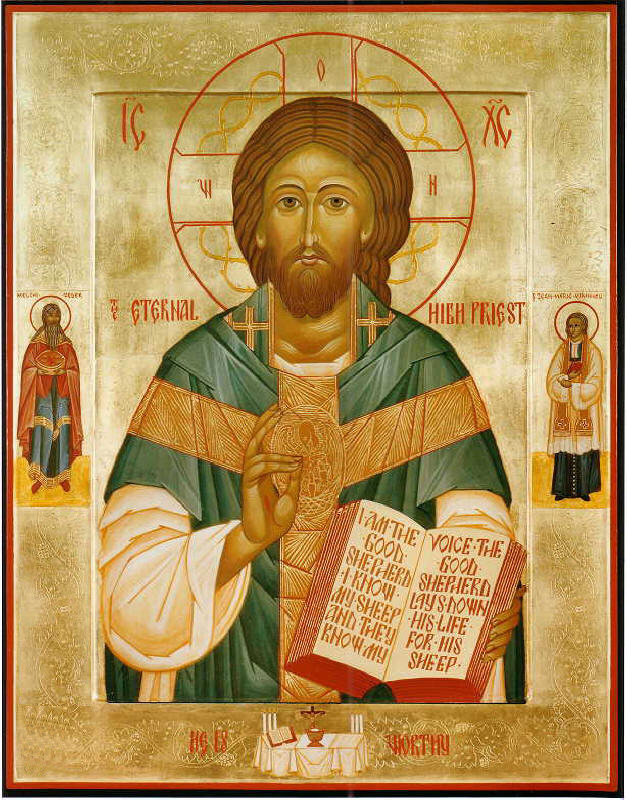
This icon shows Jesus Christ, our eternal high priest.
The gold pelican over His heart represents self-sacrifice.
The border contains an altar and grapevines, representing the Mass, and icons of Melchizedek and St. Jean-Baptiste Vianney.
Melchizedek: king of righteousness (left icon) was priest and king of Jerusalem. He blessed Abraham and has been considered an ideal priest-king.
St. Jean-Baptiste Vianney is the patron saint of parish priests.

1. Sign of the Cross: In the name of the Father, and of the Son, and of the Holy Spirit. Amen.
2. The Apostles Creed: I BELIEVE in God, the Father almighty, Creator of heaven and earth, and in Jesus Christ, His only Son, our Lord, who was conceived by the Holy Spirit, born of the Virgin Mary, suffered under Pontius Pilate, was crucified, died, and was buried. He descended into hell; on the third day he rose again from the dead; he ascended into heaven, and is seated at the right hand of God, the Father Almighty; from there He shall come to judge the living and the dead.
I believe in the Holy Spirit, the holy catholic Church, the communion of saints, the forgiveness of sins, the resurrection of the body, and the life everlasting. Amen.
3. The Lord's Prayer: OUR Father, who art in heaven, hallowed be Thy name. Thy kingdom come. Thy will be done on earth as it is in heaven. Give us this day our daily bread and forgive us our trespasses as we forgive those who trespass against us. And lead us not into temptation, but deliver us from evil. Amen.
4. (3) Hail Mary: HAIL Mary, full of grace, the Lord is with thee. Blessed art thou amongst women and blessed is the fruit of thy womb, Jesus. Holy Mary, Mother of God, pray for us sinners, now, and in the hour of our death. Amen. (Three times)
5. Glory Be: GLORY be to the Father, and to the Son, and to the Holy Spirit. As it was in the beginning, is now, and ever shall be, world without end. Amen.
6. Fatima Prayer: Oh, my Jesus, forgive us our sins, save us from the fires of hell, lead all souls to heaven, especially those in most need of your mercy.
Announce each mystery, then say 1 Our Father, 10 Hail Marys, 1 Glory Be and 1 Fatima prayer. Repeat the process with each mystery.
End with the Hail Holy Queen:
Hail, Holy Queen, Mother of Mercy, our life, our sweetness and our hope! To thee do we cry, poor banished children of Eve! To thee do we send up our sighs, mourning and weeping in this vale of tears! Turn then, most gracious advocate, thine eyes of mercy towards us; and after this, our exile, show unto us the blessed fruit of thy womb, Jesus!
O clement, O loving, O sweet Virgin Mary! Pray for us, O holy Mother of God, that we may be made worthy of the promises of Christ.
Final step -- The Sign of the Cross
The Mysteries of the Rosary By tradition, Catholics meditate on these Mysteries during prayers of the Rosary. The biblical references follow each of the Mysteries below.
The Glorious Mysteries
(Wednesdays and Sundays)
1.The Resurrection (Matthew 28:1-8, Mark 16:1-18, Luke 24:1-12, John 20:1-29) [Spiritual fruit - Faith]
2. The Ascension (Mark 16:19-20, Luke 24:50-53, Acts 1:6-11) [Spiritual fruit - Christian Hope]
3. The Descent of the Holy Spirit (Acts 2:1-13) [Spiritual fruit - Gifts of the Holy Spirit]
4. The Assumption [Spiritual fruit - To Jesus through Mary]
5. The Coronation [Spiritual fruit - Grace of Final Perseverance]
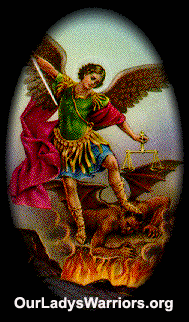
St. Michael the Archangel
~ PRAYER ~
St. Michael, the Archangel, defend us in battle
Be our protection against the wickedness
and snares of the devil;
May God rebuke him, we humbly pray,
and do thou, O Prince of the heavenly host,
by the power of God,
Cast into hell Satan and all the evil spirits
who prowl through the world seeking the ruin of souls.
Amen
+
FOR OUR WORK
Glorious Saint Joseph, pattern of all who are devoted to toil, obtain for me the grace to toil in the spirit of penance, in order thereby to atone for my many sins; to toil conscientiously, putting devotion to duty before my own inclinations; to labor with thankfulness and joy, deeming it an honor to employ and to develop, by my labor, the gifts I have received from Almighty God; to work with order, peace, moderation, and patience, without ever shrinking from weariness and difficulties; to work above all with a pure intention and with detachment from self, having always before my eyes the hour of death and the accounting which I must then render of time ill-spent, of talents unemployed, of good undone, and of my empty pride in success, which is so fatal to the work of God. All for Jesus, all through Mary, all in imitation of thee, 0 Patriarch Joseph! This shall be my motto in life and in death. Amen.
FOR THE INTERCESSION OF SAINT JOSEPH
O Joseph, virgin-father of Jesus, most pure spouse of the Virgin Mary, pray every day for us to the same Jesus, the Son of God, that we, being defended by the power of His grace and striving dutifully in life, may be crowned by Him at the hour of death.
Prayer Source: Prayer Book, The by Reverend John P. O'Connell, M.A., S.T.D. and Jex Martin, M.A., The Catholic Press, Inc., Chicago, Illinois, 1954
St. Joseph
St. Joseph was an ordinary manual laborer although descended from the royal house of David. In the designs of Providence he was destined to become the spouse of the Mother of God. His high privilege is expressed in a single phrase, "Foster-father of Jesus." About him Sacred Scripture has little more to say than that he was a just man-an expression which indicates how faithfully he fulfilled his high trust of protecting and guarding God's greatest treasures upon earth, Jesus and Mary.
The darkest hours of his life may well have been those when he first learned of Mary's pregnancy; but precisely in this time of trial Joseph showed himself great. His suffering, which likewise formed a part of the work of the redemption, was not without great providential import: Joseph was to be, for all times, the trustworthy witness of the Messiah's virgin birth. After this, he modestly retires into the background of holy Scripture.
Of St. Joseph's death the Bible tells us nothing. There are indications, however, that he died before the beginning of Christ's public life. His was the most beautiful death that one could have, in the arms of Jesus and Mary. Humbly and unknown, he passed his years at Nazareth, silent and almost forgotten he remained in the background through centuries of Church history. Only in more recent times has he been accorded greater honor. Liturgical veneration of St. Joseph began in the fifteenth century, fostered by Sts. Brigid of Sweden and Bernadine of Siena. St. Teresa, too, did much to further his cult.
At present there are two major feasts in his honor. On March 19 our veneration is directed to him personally and to his part in the work of redemption, while on May 1 we honor him as the patron of workmen throughout the world and as our guide in the difficult matter of establishing equitable norms regarding obligations and rights in the social order.
Excerpted from The Church's Year of Grace, Pius Parsch.

St. Joseph is invoked as patron for many causes. He is the patron of the Universal Church. He is the patron of the dying because Jesus and Mary were at his death-bed. He is also the patron of fathers, of carpenters, and of social justice. Many religious orders and communities are placed under his patronage.
Patron: Against doubt; against hesitation; Americas; Austria; Diocese of Baton Rouge, Louisiana; California; Belgium; Bohemia; bursars; cabinetmakers; Canada; Carinthia; carpenters; China; Church; confectioners; craftsmen; Croatian people (in 1687 by decree of the Croatian parliament) dying people; emigrants; engineers; expectant mothers; families; fathers; Florence, Italy; happy death; holy death; house hunters; immigrants; interior souls; Korea; laborers; Diocese of La Crosse, Wisconsin; Archdiocese of Louisville, Kentucky; Diocese of Manchester, New Hampshire; Mexico; Diocese of Nashville, Tennessee; New France; New World; Oblates of Saint Joseph; people in doubt; people who fight Communism; Peru; pioneers; pregnant women; protection of the Church; Diocese of San Jose, California; diocese of Sioux Falls, South Dakota; social justice; Styria, Austria; travelers; Turin Italy; Tyrol Austria; unborn children Universal Church; Vatican II; Viet Nam; Diocese of Wheeling-Charleston West Virginia; wheelwrights; workers; working people.
Symbols: Bible; branch; capenter's square; carpenter's tools; chalice; cross; hand tools; infant Jesus; ladder; lamb; lily; monstrance; old man holding a lily and a carpenter's tool such as a square; old man holding the infant Jesus; plane; rod.
Pope Pius X composed this prayer to St. Joseph, patron of working people, that expresses concisely the Christian attitude toward labor. It summarizes also for us the lessons of the Holy Family's work at Nazareth.
Glorious St. Joseph, model of all who devote their lives to labor, obtain for me the grace to work in the spirit of penance in order thereby to atone for my many sins; to work conscientiously, setting devotion to duty in preference to my own whims; to work with thankfulness and joy, deeming it an honor to employ and to develop by my labor the gifts I have received from God; to work with order, peace, moderation, and patience, without ever shrinking from weariness and difficulties; to work above all with a pure intention and with detachment from self, having always before my eyes the hour of death and the accounting which I must then render of time ill spent, of talents wasted, of good omitted, and of vain complacency in success, which is so fatal to the work of God.
All for Jesus, all through Mary, all in imitation of you, O Patriarch Joseph! This shall be my motto in life and in death, Amen.
Litany of Saint Joseph
Lord, have mercy on us.
Christ, have mercy on us.
Lord, have mercy on us.
Christ, hear us.
Christ, graciously hear us.
God, the Father of Heaven, have mercy on us.
God, the Son, Redeemer of the world, have mercy on us.
God, the Holy Ghost, have mercy on us.
Holy Trinity, One God, have mercy on us.
Holy Mary, pray for us.
Holy Joseph, pray for us.
Illustrious Son of David, pray for us.
Light of the Patriarchs, pray for us.
Spouse of the Mother of God, pray for us.
Chaste Guardian of the Virgin, pray for us.
Foster-Father of the Son of God, pray for us.
Faithful Protector of Christ, pray for us.
Head of the Holy Family, pray for us.
Joseph most just, pray for us.
Joseph most chaste, pray for us.
Joseph most prudent, pray for us.
Joseph most courageous, pray for us.
Joseph most obedient, pray for us.
Joseph most faithful, pray for us.
Mirror of patience, pray for us.
Lover of poverty, pray for us.
Model of working men, pray for us.
Ornament of the domestic life, pray for us.
Guardian of virgins, pray for us.
Pillar of the family, pray for us.
Consoler of the miserable, pray for us.
Hope of the sick, pray for us.
Patron of the dying, pray for us.
Terror of demons, pray for us.
Protector of the Holy Church, pray for us.
Lamb of God, who takest away the sins of the world, Spare us, O Lord.
Lamb of God, who takest away the sins of the world, Graciously hear us, O Lord.
Lamb of God, who takest away the sins of the world, Have mercy on us.
V. He hath made him master of His house.
R. And ruler of all His possessions.
Let us pray.
O God, who in Thy ineffable providence didst vouchsafe to choose blessed Joseph to be the Spouse of Thy most holy Mother: grant, we beseech Thee, that we may have him for our intercessor in Heaven, whom on earth we venerate as out most holy Protector. Who livest and reignest world without end. Amen.
Was St. Joseph a tzadik?
St. Joseph: Patron saint of three Popes [Catholic Caucus]
St. Joseph and the Staircase
St. Joseph, Foster Father, Novena [Catholic/Orthodox Caucus]
Patron of a “Happy Death” A Special Role for St. Joseph [Catholic/Orhtodox Caucus]
Lists Every Catholic Should be Familiar With: The 7 Sorrows and 7 Joys of St. Joseph
Catholic Group Blasts Pelosi For Invoking St. Joseph on Pro-Abortion Health Care Bill
THE SEVEN SORROWS AND SEVEN JOYS OF ST. JOSEPH
Joseph, Mary and Jesus: A Model Family
Season of Announcement - Revelation to Joseph
In hard times, don't forget about the humble carpenter Joseph
Saint Joseph: Complete submission to the will of God (Pope Benedict XVI) (Catholic/Orthodox Caucus)
St. Joseph as Head of the Holy Family (Catholic/Orthodox Caucus)
St. Joseph, Patron of a Peaceful Death [Catholic Caucus]
Octave: St. Joseph, A 'Man’s Man', Calling Men to Jesus
St. Teresa de Avila's Devotion to St. Joseph (Catholic Caucus)
Catholic Men's National Day of Prayer, MARCH 15, 2008, The Solemnity of St. Joseph (Catholic Caucus)
The Role and Responsibility of Fatherhood - St. Joseph as Model
St. Joseph - Foster Father of Jesus
Some divine intervention in real estate-[Bury St. Joseph Statues in Ground]
Many Turn To Higher Power For Home Sales
St. Joseph the Worker, Memorial, May 1
Catholic Devotions: St. Joseph the Worker
Nothing Will Be Denied Him (St. Joseph)
The Heart of a Father [St. Joseph]
St. Joseph's DAY
Quemadmodum Deus - Decree Under Blessed Pius IX, Making St. Joseph Patron of the Church
Father & Child (Preaching on St. Joseph)
March 19 - Feast of St. Joseph - Husband of Mary - Intercessor of civil leaders
St. Joseph's Spirit of Silence
St. Joseph's Humility (By St. Francis de Sales)
St. Joseph [Husband of the Blessed Virgin Mary], Solemnity, March 19
St Joseph’s Paternal Love
The Heart of St. Joseph
MORE THAN PATRON OF HOMES, IT'S TIME FOR ST. JOSEPH TO GAIN HIGHEST OF RECOGNITION [Fatherhood]
The Importance of Devotion to St. Joseph
St. Francis de Sales on St. Joseph (Some Excerpts for St. Joseph's Day 2004)
St. Joseph: REDEMPTORIS CUSTOS (Guardian Of The Redeemer)
(Saint) Joseph the Patriarch: A Reflection on the Solemnity of St. Joseph
How I Rediscovered a "Neglected" Saint: Work of Art Inspires Young Man to Rediscover St. Joseph
Novena to Saint Joseph
O Saint Joseph, whose protection is so great, so strong, so prompt before the throne of God, I place in you all my interests and desires.
O Saint Joseph, assist me by your powerful intercession and obtain for me from your Divine Son all spiritual blessings through Jesus Christ, Our Lord; so that having engaged here below your heavenly power, I may offer my thanksgiving and homage to the most loving of Fathers.
O Saint Joseph, I never weary contemplating you and Jesus asleep in your arms; I dare not approach while He reposes near your heart. Press Him in my name and kiss His fine head for me, and ask Him to return the Kiss when I draw my dying breath, Amen.
O Saint Joseph, hear my prayers and obtain my petitions. O Saint Joseph, pray for me. (mention your intention)
St. Joseph Novena
O good father Joseph! I beg you, by all your sufferings, sorrows and joys, to obtain for me what I ask.
(Here name your petition).
Obtain for all those who have asked my prayers, everything that is useful to them in the plan of God. Be near to me in my last moments, that I may eternally sing the praises of Jesus, Mary and Joseph. Amen.
(Our Father, Hail Mary, Glory Be)

Disclaimer: Opinions posted on Free Republic are those of the individual posters and do not necessarily represent the opinion of Free Republic or its management. All materials posted herein are protected by copyright law and the exemption for fair use of copyrighted works.