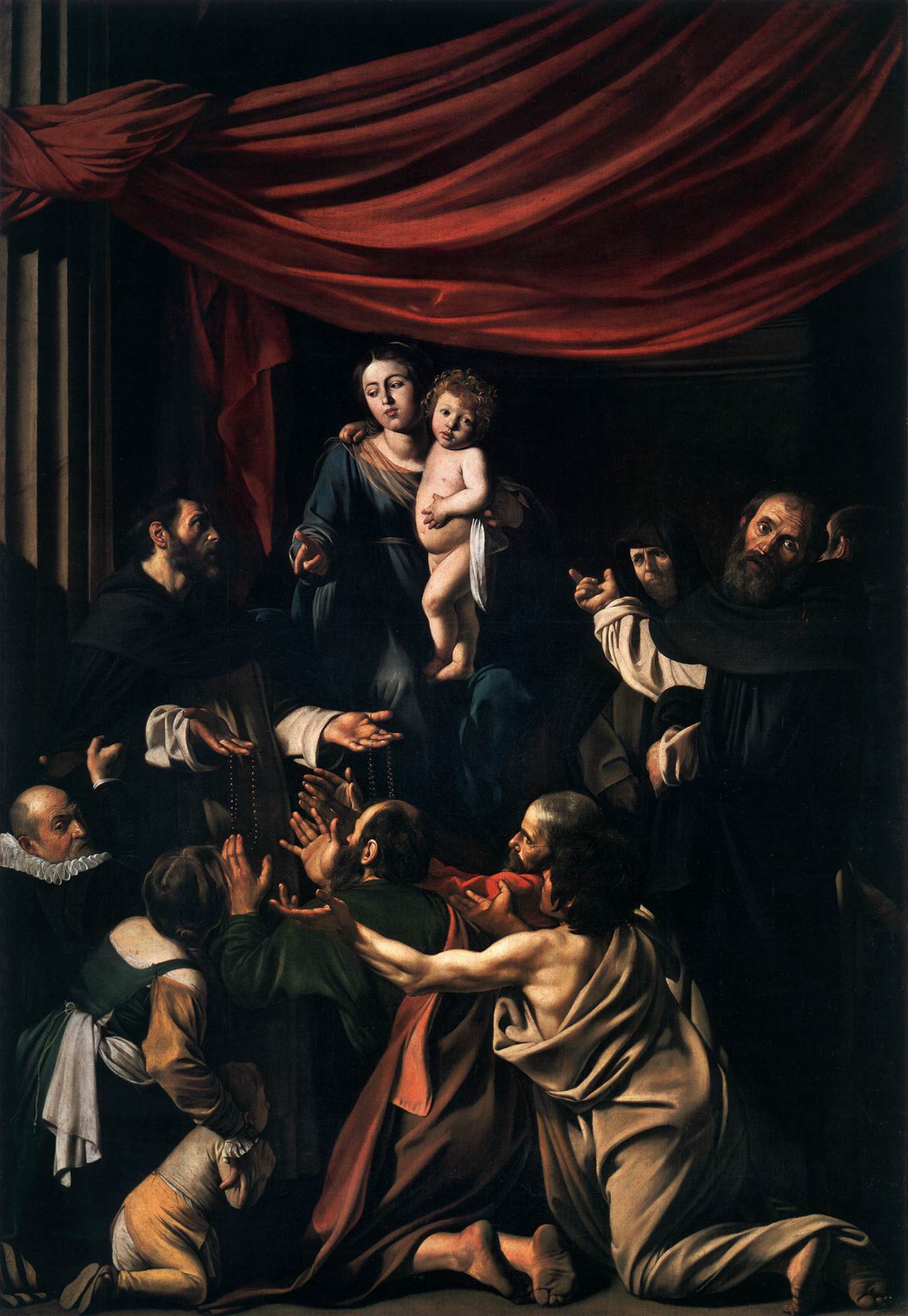
Madonna del Rosario
Caravaggio
1607
Oil on canvas, 364,5 x 249,5 cm
Kunsthistorisches Museum, Vienna
Posted on 02/25/2020 7:58:14 PM PST by Salvation
Even now, says the LORD,
return to me with your whole heart,
with fasting, and weeping, and mourning;
Rend your hearts, not your garments,
and return to the LORD, your God.
For gracious and merciful is he,
slow to anger, rich in kindness,
and relenting in punishment.
Perhaps he will again relent
and leave behind him a blessing,
Offerings and libations
for the LORD, your God.
Blow the trumpet in Zion!
proclaim a fast,
call an assembly;
Gather the people,
notify the congregation;
Assemble the elders,
gather the children
and the infants at the breast;
Let the bridegroom quit his room
and the bride her chamber.
Between the porch and the altar
let the priests, the ministers of the LORD, weep,
And say, “Spare, O LORD, your people,
and make not your heritage a reproach,
with the nations ruling over them!
Why should they say among the peoples,
‘Where is their God?’”
Then the LORD was stirred to concern for his land
and took pity on his people.
R. (see 3a) Be merciful, O Lord, for we have sinned.
Have mercy on me, O God, in your goodness;
in the greatness of your compassion wipe out my offense.
Thoroughly wash me from my guilt
and of my sin cleanse me.
R. Be merciful, O Lord, for we have sinned.
For I acknowledge my offense,
and my sin is before me always:
“Against you only have I sinned,
and done what is evil in your sight.”
R. Be merciful, O Lord, for we have sinned.
A clean heart create for me, O God,
and a steadfast spirit renew within me.
Cast me not out from your presence,
and your Holy Spirit take not from me.
R. Be merciful, O Lord, for we have sinned.
Give me back the joy of your salvation,
and a willing spirit sustain in me.
O Lord, open my lips,
and my mouth shall proclaim your praise.
R. Be merciful, O Lord, for we have sinned.
Brothers and sisters:
We are ambassadors for Christ,
as if God were appealing through us.
We implore you on behalf of Christ,
be reconciled to God.
For our sake he made him to be sin who did not know sin,
so that we might become the righteousness of God in him.
Working together, then,
we appeal to you not to receive the grace of God in vain.
For he says:
In an acceptable time I heard you,
and on the day of salvation I helped you.
Behold, now is a very acceptable time;
behold, now is the day of salvation.
If today you hear his voice,
harden not your hearts.
Jesus said to his disciples:
“Take care not to perform righteous deeds
in order that people may see them;
otherwise, you will have no recompense from your heavenly Father.
When you give alms,
do not blow a trumpet before you,
as the hypocrites do in the synagogues and in the streets
to win the praise of others.
Amen, I say to you,
they have received their reward.
But when you give alms,
do not let your left hand know what your right is doing,
so that your almsgiving may be secret.
And your Father who sees in secret will repay you.
“When you pray,
do not be like the hypocrites,
who love to stand and pray in the synagogues and on street corners
so that others may see them.
Amen, I say to you,
they have received their reward.
But when you pray, go to your inner room,
close the door, and pray to your Father in secret.
And your Father who sees in secret will repay you.
“When you fast,
do not look gloomy like the hypocrites.
They neglect their appearance,
so that they may appear to others to be fasting.
Amen, I say to you, they have received their reward.
But when you fast,
anoint your head and wash your face,
so that you may not appear to be fasting,
except to your Father who is hidden.
And your Father who sees what is hidden will repay you.”
KEYWORDS: catholic; lent; mt6; prayer;
Please FReepmail me to get on/off the Lenten Ping List.
From: Joel 2:12-18
An Urgent Call to Repentance
[15] Blow the trumpet in Zion; sanctify a fast; call a solemn assembly; [16] gather the people. Sanctify the congregation; assemble the elders; gather the children, even nursing infants. Let the bridegroom leave his room, and the bride her chamber.
The Priests Entreat the Lord
[18] Then the LORD became jealous for his land, and had pity on his people.
***********************************************************************
Commentary:
2:12-17. The first part of the book ends with a general exhortation to conversion: there is an oracle of the Lord (“says the Lord”: v. 12), where the prophet makes an appeal on behalf of God; and then he specifically mentions the priests’ duty to do penance and offer prayers. Central to these words of warning is v. 13, which spells out what makes conversion last—God’s compassion and man’s sincere determination. St Jerome comments: “’Return to me with. all your heart’: show your repentance and inner conversion through fasting, mourning and tears. By fasting now, your hunger will be satisfied later; mourning now, one day you will laugh; weeping now, you shall be consoled. The custom of rending one’s garments at times of sorrow or adversity is well-established: the high priest tore his robes to show the gravity of the Savior’s crime; and, according to the Acts of the Apostles, Paul and Barnabas ripped their tunics when they heard blasphemous words being spoken. But I tell you to rend not your garments, but your hearts that are filled with sin. The heart, like wineskins, does not tear of its own accord: it must be deliberately torn. When you have rent your heart in this way, return to the Lord, your God, from whom you have strayed by your sins. Never doubt his forgiveness, for no matter how many and grave your past sins have been, he will pardon you from the abundance of his mercy”(”Commentarii in Ioelem”, 2, 12ff).
2:17. This verse (which the liturgy of the Church uses as a call to penance on Ash Wednesday) acts as a conclusion to the first part of the book: a change of heart, backed up by sincere acts of penance, can cause God to stay his hand and spare his people any more affliction. The words that open the second part of the book (v. 18) tell us of the Lord’s response; from then on, hope is on the horizon: “God does not let himself be outdone in generosity. Be sure that he grants faithfulness to those who give themselves to him” (St Josemaria Escrivá, “The Forge”, 623).
From: 2 Corinthians 5:20-6:2
The Ministry of Reconciliation (Continuation)
St Paul, a True Servant of Christ
***********************************************************************
Commentary:
18-21. The reconciliation of mankind with God—whose friendship we lost through original sin—has been brought about by Christ’s death on the cross. Jesus, who is like men in all things “yet without sinning” (Heb 4:14), bore the sins of men (cf. Is 53:4-12) and offered himself on the cross as an atoning sacrifice for all those sins (cf. 1 Pet 2:22-25), thereby reconciling men to God; through this sacrifice we became the righteousness of God, that is, we are justified, made just in God’s sight (cf. Rom 1:17; 3:24-26 and notes). The Church reminds us of this in the rite of sacramental absolution: “God, the Father of mercies, through the death and resurrection of his son has reconciled the world to himself [...].”
Our Lord entrusted the Apostles with this ministry of reconciliation (v. 18), this “message of reconciliation” (v. 19), to pass it on to all
men: elsewhere in the New Testament it is described as the “message of salvation” (Acts 13:26), the “word of grace” (Acts 14:3; 20:32), the “word of life” ( 1 Jn 1: 1). Thus, the Apostles were our Lord’s ambassadors to men, to whom St Paul addresses a pressing call: “be reconciled to God”, that is, apply to yourselves the reconciliation obtained by Jesus Christ—which is done mainly through the sacraments of Baptism and Penance. “The Lord Jesus instituted in his Church the sacrament of Penance, so that those who have committed sins after Baptism might be reconciled with God, whom they have offended, and with the Church itself whom they have injured” (John Paul II, “Aperite Portas”, 5).
21. “He made him to be sin”: obviously St Paul does not mean that Christ was guilty of sin; he does not say “to be a sinner” but “to be
sin”. “Christ had no sin,” St Augustine says; “he bore sins, but he did not commit them” (”Enarrationes in Psalmos”, 68, 1, 10).
According to the rite of atoning sacrifices (cf. Lev 4:24; 5:9; Num 19:9; Mic 6:7; Ps 40:7) the word “sin”, corresponding to the Hebrew “asam”, refers to the actual act of sacrifice or to the victim being offered. Therefore, this phrase means “he made him a victim for sin” or “a sacrifice for sin”. it should be remembered that in the Old Testament nothing unclean or blemished could be offered to God; the offering of an unblemished animal obtained God’s pardon for the transgression which one wanted to expiate. Since Jesus was the most perfect of victims offered for us, he made full atonement for all sins. In the Letter to the Hebrews, when comparing Christ’s sacrifice with that of the priests of the Old Testament, it is expressly stated that “every priest stands daily at his service, offering repeatedly the same sacrifices, which can never take away sins. But when Christ had offered for all time a single sacrifice for sins, he sat down at the right hand of God, then to wait until his enemies should be made a stool for his feet. For by a single offering he has perfected for all time those who are sanctified” (Heb 10:11-14).
This concentrated sentence also echoes the Isaiah prophecy about the sacrifice of the Servant of Yahweh; Christ, the head of the human race, makes men sharers in the grace and glory he achieved through his sufferings: “upon him was the chastisement that made us whole, and with his stripes we are healed” (Is 53:5).
Jesus Christ, burdened with our sins and offering himself on the cross as a sacrifice for them, brought about the Redemption: the Redemption is the supreme example both of God’s justice—which requires atonement befitting the offense—and of his mercy, that mercy which makes him love the world so much that “he gave his only Son” (Jn 3:16). “In the Passion and Death of Christ—in the fact that the Father did not spare his own Son, but ‘for our sake made him sin’—absolute justice is expressed, for Christ undergoes the Passion and Cross because of the sins of humanity. This constitutes even a ‘superabundance’ of justice, for the sins of man are ‘compensated for’ by the sacrifice of the Man-God. Nevertheless, this justice, which is properly justice ‘to God’s measure’, springs completely from love, from the love of the Father and of the Son, and completely bears fruit in love. Precisely for this reason the divine justice revealed in the Cross of Christ is ‘to God’s measure’, because it springs from love and is accomplished in love, producing fruits of salvation. The divine dimension of redemption is put into effect not only by bringing justice to bear upon sin, but also by restoring to love that creative power in man thanks to which he once more has access to the fullness of life and holiness that come
from God. In this way, redemption involves the revelation of mercy in its fullness” (John Paul II, “Dives In Misericordia”, 7).
1-10. St Paul concludes his long defense of his apostolic ministry (cf. 3:1-6:10) by saying that he has always tried to act as a worthy servant of God. First he calls on the Corinthians to have a sense of responsibility so that the grace of God be not ineffective in them (vv. 1-2), and then he briefly describes the afflictions this ministry has meant for him. Earlier, he touched on this subject (cf. 4:7-12), and he will deal with it again in 11:23-33.
1-2. St Paul exhorts the faithful not to accept the grace of God in vain-which would happen if they did not cultivate the faith and initial
grace they received in Baptism and if they neglected the graces which God continues to send them. This exhortation is valid for all
Christians: “We receive the grace of God in vain”, St Francis de Sales points out, “when we receive it at the gate of our heart, without
allowing it to enter: we receive it without receiving it; we receive it without fruit, since there is no use in feeling the inspiration if one
does not consent unto it. And just as the sick man who has the medicine in his hands, if he takes only part of it, will only partially benefit from it, so too, when God sends a great and mighty inspiration to move us to embrace his love, if we do not avail of it in its entirety, we shall benefit from it only partially” (”Treatise on the Love of God”, book 2, chap. 11).
The Apostle urges them to cultivate the grace they have been given, using a quotation from Isaiah (49:8): the right time has come, the day of salvation. His words recall our Lord’s preaching in the synagogue of Nazareth (cf. Lk 4:16-21).
The “acceptable time” will last until Christ comes in glory at the end of the world (in the life of the individual, it will last until the
hour of his death); until then, every day is “the day of salvation”: “’Ecce none dies salutis’, the day of salvation is here before us. The
call of the good shepherd has reached us: ‘”ego vocavi te nomine too”, I have called you by name’ (Is 43:1). Since love repays love, we must reply: ‘”ecce ego quia vocasti me”, Here I am, for you called me’ (1 Sam 3:5) [...]. I will be converted, I will turn again to the Lord and love him as he wants to be loved” ([St] J. Escriva, “Christ Is Passing By”, 59).
From: Matthew 6:1-18
An Upright Intention in Almsgiving, Prayer and Fasting
[2] “Thus, when you give alms, sound no trumpet before you, as the hypocrites do in the synagogues and in the streets, that they may be praised by men. Truly, I say to you, they have their reward. [3] But when you give alms, do not let your left hand know what your right hand is doing, [4] so that your alms may be in secret; and your Father who sees in secret will reward you.
[5] “And when you pray, you must not be like the hypocrites; for they love to stand and pray in the synagogues and at the street corners, that they may be seen by men. Truly, I say to you, they have their reward. [6] But when you pray, go into your room and shut the door and pray to your Father who is in secret; and your Father who sees in secret will reward you.
[7] “And in praying do not heap up empty phrases as the Gentiles do; for they think that they will be heard for their many words. [8] Do not be like them, for your Father knows what you need before you ask Him. [9] Pray then like this: Our Father who art in Heaven, hallowed be Thy name. [10] Thy kingdom come, Thy will be done, on earth as it is in Heaven. [11] Give us this day our daily bread; [12] And forgive us our debts, as we also have forgiven our debtors; [13] And lead us not into temptation, but deliver us from evil. [14] For if you forgive men their trespasses, your Heavenly Father also will forgive you; [15] but if you do not forgive men their trespasses, neither will your Father forgive your trespasses.”
[16] “And when you fast, do not look dismal, like the hypocrites, for they disfigure their faces that their fasting may be seen by men. Truly, I say to you, they have their reward. [17] But when you fast, anoint your head and wash your face, [18] that your fasting may not be seen by men but by your Father who is in secret; and your Father who
sees in secret will reward you.”
***********************************************************************
Commentary:
1-18. “Piety”, here, means good works (cf. note on Matthew 5:6). Our Lord is indicating the kind of spirit in which we should do acts of personal piety. Almsgiving, fasting and prayer were the basic forms taken by personal piety among the chosen people—which is why Jesus refers to these three subjects. With complete authority He teaches that true piety must be practised with an upright intention, in the presence of God and without any ostentation. Piety practised in this way implies exercising our faith in God who sees us—and also in the safe knowledge that He will reward those who are sincerely devout.
5-6. Following the teaching of Jesus, the Church has always taught us to pray even when we were infants. By saying “you” (singular) our Lord is stating quite unequivocally the need for personal prayer—relating as child to Father, alone with God.
Public prayer, for which Christ’s faithful assemble together, is something necessary and holy; but it should never displace obedience to this clear commandment of our Lord: “When you pray, go into your room and shut the door and pray to your Father”.
The Second Vatican Council reminds us of the teaching and practice of the Church in its liturgy, which is “the summit toward which the activity of the Church is directed; it is also the fount from which all her power flows [...]. The spiritual life, however, is not limited solely to participation in the liturgy. The Christian is indeed called to pray with others, but he must also enter into his bedroom to pray to his Father in secret; furthermore, according to the teaching of the Apostle, he must pray without ceasing (1 Thessalonians 5:17)” (”Sacrosanctum Concilium”, 10 and 12).
A soul who really puts his Christian faith into practice realizes that he needs frequently to get away and pray alone to his Father, God. Jesus, who gives us this teaching about prayer, practised it during His own life on earth: the holy Gospel reports that He often went apart to pray on His own: “At times He spent the whole night in an intimate conversation with His Father. The Apostles were filled with love when they saw Christ pray” ([St] J. Escriva, “Christ Is Passing By”, 119; cf. Matthew 14:23; Mark 1:35; Luke 5:16; etc.). The Apostles followed the Master’s example, and so we see Peter going up to the rooftop of the house to pray in private, and receiving a revelation (cf. Acts 10:9-16). “Our life of prayer should also be based on some moments that are dedicated exclusively to our conversation with God, moments of silent dialogue” (”ibid”, 119).
7-8. Jesus condemns the superstitious notion that long prayers are needed to attract God’s attention. True piety is not so much a matter of the amount of words as of the frequency and the love with which the Christian turns towards God in all the events, great or small, of his day. Vocal prayer is good, and necessary; but the words count only if they express our inner feelings.
9-13. The “Our Father” is, without any doubt, the most commented-on passage in all Sacred Scripture. Numerous great Church writers have left us commentaries full of poetry and wisdom. The early Christians, taught by the precepts of salvation, and following the divine commandment, centered their prayer on this sublime and simple form of words given them by Jesus. And the last Christians, too, will raise their hearts to say the “Our Father” for the last time when they are on the point of being taken to Heaven. In the meantime, from childhood to death, the “Our Father” is a prayer which fills us with hope and consolation. Jesus fully realized how helpful this prayer would be to us. We are grateful to Him for giving it to us, to the Apostles for passing it on to us and, in the case of most Christians, to our mothers for teaching it to us in our infancy. So important is the Lord’s Prayer that from apostolic times it has been used, along with the Creed, the Ten Commandments and the Sacraments, as the basis of Christian catechesis. Catechumens were introduced to the life of prayer by the “Our Father”, and our catechisms today use it for that purpose.
St. Augustine says that the Lord’s Prayer is so perfect that it sums up in a few words everything man needs to ask God for (cf. “Sermon”, 56). It is usually seen as being made up of an invocation and seven petitions—three to do with praise of God and four with the needs of men.
9. It is a source of great consolation to be able to call God “our Father”; Jesus, the Son of God, teaches men to invoke God as Father because we are indeed His children, and should feel towards Him in that way.
“The Lord [...] is not a tyrannical master or a rigid and implacable judge; He is our Father. He speaks to us about our lack of generosity, our sins, our mistakes; but He also does so in order to free us from them, to promise us His friendship and His love [...]. A child of God treats the Lord as his Father. He is not obsequious and servile, he is not merely formal and well-mannered; he is completely sincere and trusting” ([St] J. Escriva, “Christ Is Passing By”, 64).
“Hallowed by Thy name”: in the Bible a person’s “name” means the same as the person himself. Here the name of God means God Himself. Why pray that His name be hallowed, sanctified? We do not mean sanctification in the human sense—leaving evil behind and drawing closer to God—for God is Holiness Itself. God, rather, is sanctified when His holiness is acknowledged and honored by His creatures—which is what this first petition of the “Our Father” means (cf. “St. Pius Catechism”, IV, 10).
10. “Thy Kingdom come”: this brings up again the central idea of the Gospel of Jesus Christ—the coming of the Kingdom. The Kingdom of God is so identical with the life and work of Jesus Christ that the Gospel is referred to now as the Gospel of Jesus Christ, now as the Gospel of the Kingdom (Matthew 9:35). On the notion of the Kingdom of God see the commentary on Matthew 3:2 and 4:17. The coming of the Kingdom of God is the realization of God’s plan of salvation in the world. The Kingdom establishes itself in the first place in the core of man’s being, raising him up to share in God’s own inner life. This elevation has, as it were, two stages—the first, in this life, where it is brought about by grace; the second, definitive stage in eternal life, where man’s elevation to the supernatural level is fully completed. We for our part need to respond to God spontaneously, lovingly and trustingly.
“Thy will be done”: this third petition expresses two desires. The first is that man identify humbly and unconditionally with God’s will—abandonment in the arms of his Father God. The second that the will of God be fulfilled, that man cooperate with it in full freedom. For example, God’s will is to be found in the moral aspect of the divine law—but this law is not forced on man. One of the signs of the coming of the Kingdom is man’s loving fulfillment of God’s will. The second part of the petition, “on earth as it is in Heaven”, means that, just as the angels and saints in Heaven are fully at one with God’s will, so—we desire—should the same thing obtain on earth.
Our effort to do God’s will proves that we are sincere when we say the words, “Thy will be done.” For our Lord says, “Not every one who says to Me, `Lord, Lord’ shall enter the Kingdom of Heaven, but he who does the will of My Father who is in Heaven.” (Matthew 7:21). “Anyone, then, who sincerely repeats this petition, `Fiat voluntas tua’, must, at least in intention, have done this already” (St. Teresa of Avila, “Way of Perfection”, chapter 36).
11. In making this fourth petition, we are thinking primarily of our needs in this present life. The importance of this petition is that it declares that the material things we need in our lives are good and lawful. It gives a deep religious dimension to the support of life: what Christ’s disciple obtains through his own work is also something for which he should implore God—and he should receive it gratefully as a gift from God. God is our support in life: by asking God to support him and by realizing that it is God who is providing this support, the Christian avoids being worried about material needs. Jesus does not want us to pray for wealth or to be attached to material things, but to seek and make sober use of what meets our needs. Hence, in Matthew as well as in Luke (Luke 11:2), there is reference to having enough food for every day. This fourth petition, then, has to do with moderate use of food and material things—far from the extremes of opulence and misery, as God already taught in the Old Testament “Give me neither poverty nor riches; feed me with the food which is needful for me, lest I be full, and deny Thee, and say, `Who is the Lord?’ or lest I be poor, and steal, and profane the name of my God” (Proverbs 30:8).
The Fathers of the Church interpreted the bread asked for here not only as material food but also as referring to the Blessed Eucharist, without which our spirit cannot stay alive.
According to the “St. Pius V Catechism” (cf. IV, 13, 21) the Eucharist is called our daily bread because it is offered daily to God in the Holy Mass and because we should worthily receive it, every day if possible, as St. Ambrose advises: “If the bread is daily, why do you take it only once a year [...]? Receive daily what is of benefit to you daily! So live that you may deserve to receive it daily!” (”De Sacramentis”, V, 4).
12. “Debts”: clearly, here, in the sense of sin. In the Aramaic of Jesus’ time the same word was used for offense and debt. In this fifth petition, then, we admit that we are debtors because we have offended God. The Old Testament is full of references to man’s sinful condition. Even the “righteous” are sinners. Recognizing our sins is the first step in every conversion to God. It is not a question of recognizing that we have sinned in the past but of confessing our present sinful condition. Awareness of our sinfulness makes us realize our religious need to have recourse to the only One who can cure it. Hence the advantage of praying insistently, using the Lord’s Prayer to obtain God’s forgiveness time and again.
The second part of this petition is a serious call to forgive our fellow-men, for we cannot dare to ask God to forgive us if we are not ready to forgive others. The Christian needs to realize what this prayer implies: unwillingness to forgive others means that one is condemning oneself (see the notes on Matthew 5:23-24 and 18:21:21-35).
13. “And lead us not into temptation”: “We do not ask to be totally exempt from temptation, for human life is one continuous temptation (cf. Job 7:1). What, then, do we pray for in this petition? We pray that the divine assistance may not forsake us, lest having been deceived, or worsted, we should yield to temptation; and that the grace of God may be at hand to succor us when our strength fails, to refresh and invigorate us in our trials” (”St. Pius V Catechism”, IV, 15, 14).
In this petition of the “Our Father” we recognize that our human efforts alone do not take us very far in trying to cope with temptation, and that we need to have humble recourse to God, to get the strength we need. For, “God is strong enough to free you from everything and can do you more good than all the devils can do you harm. All that God decrees is that you confide in Him, that you draw near Him, that you trust Him and distrust yourself, and so be helped; and with this help you will defeat whatever hell brings against you. Never lose hold of this firm hope [...] even if the demons are legion and all kinds of severe temptations harass you. Lean upon Him, because if the Lord is not your support and your strength, then you will fall and you will be afraid of everything” (St. John of Avila, “Sermons, 9, First Sunday of Lent”).
“But deliver us from evil”: in this petition, which, in a way, sums up the previous petitions, we ask the Lord to free us from everything our enemy does to bring us down; we cannot be free of him unless God Himself free us, in response to our prayers.
This sentence can also be translated as “Deliver us from the Evil One”, that is to say, the devil, who is in the last analysis the author of all evils to which we are prone.
In making this request we can be sure that our prayer will be heard because Jesus Christ, when He was on the point of leaving this world, prayed to the Father for the salvation of all men: “I do not pray that Thou shouldst take them out of the world, but that Thou shouldst keep them from the evil one” (John 17:15).
14-15. In verses 14 and 15 St. Matthew gives us a sort of commentary of our Lord on the fifth petition of the “Our Father”.
A God who forgives is a wonderful God. But if God, who is thrice-holy, has mercy on the sinner, how much more ought we to forgive others—we sinners, who know from our own experience the wretchedness of sin. No one on earth is perfect. Just as God loves us, even though we have defects, and forgives us, we should love others, even though they have defects, and forgive them. If we wait to love people who have no defects, we shall never love anyone. If we wait until others mend their ways or apologize, we will scarcely ever forgive them. But then we ourselves will never be forgiven. “All right: that person has behaved badly towards you. But, haven’t you behaved worse towards God?” ([St] J. Escriva, “The Way”, 686).
Thus, forgiving those who have offended us makes us like our Father, God: “In loving our enemies there shines forth in us some likeness to God our Father, who, by the death of His Son, ransomed from everlasting perdition and reconciled to Himself the human race, which before was most unfriendly and hostile to Him” (”St. Pius V Catechism”, IV, 14, 19).
16-18. Starting from the traditional practice of fasting, our Lord tells us the spirit in which we should exercise mortification of our senses: we should do so without ostentation, avoiding praise, discreetly; that way Jesus’ words will not apply to us: “they have their reward”; it would have been a very bad deal. “The world admires only spectacular sacrifice, because it does not realize the value of sacrifice that is hidden and silent” ([St] J. Escriva, “The Way”, 185).
Liturgical Colour: Violet.
| First reading | Joel 2:12-18 © |
|---|
| Responsorial Psalm |
|---|
| Psalm 50(51):3-6,12-14,17 © |
| Second reading |
|---|
| 2 Corinthians 5:20-6:2 © |
| Gospel Acclamation | Ps50:12,14 |
|---|
| Or: | cf.Ps94:8 |
|---|
| Gospel |
|---|
| Matthew 6:1-6,16-18 © |
| Matthew | |||
| English: Douay-Rheims | Latin: Vulgata Clementina | Greek NT: Byzantine/Majority Text (2000) | |
| Matthew 6 |
|||
| 1. | TAKE heed that you do not your justice before men, to be seen by them: otherwise you shall not have a reward of your Father who is in heaven. | Attendite ne justitiam vestram faciatis coram hominibus, ut videamini ab eis : alioquin mercedem non habebitis apud Patrem vestrum qui in cælis est. | προσεχετε την ελεημοσυνην υμων μη ποιειν εμπροσθεν των ανθρωπων προς το θεαθηναι αυτοις ει δε μηγε μισθον ουκ εχετε παρα τω πατρι υμων τω εν τοις ουρανοις |
| 2. | Therefore when thou dost an almsdeed, sound not a trumpet before thee, as the hypocrites do in the synagogues and in the streets, that they may be honoured by men. Amen I say to you, they have received their reward. | Cum ergo facis eleemosynam, noli tuba canere ante te, sicut hypocritæ faciunt in synagogis, et in vicis, ut honorificentur ab hominibus. Amen dico vobis, receperunt mercedem suam. | οταν ουν ποιης ελεημοσυνην μη σαλπισης εμπροσθεν σου ωσπερ οι υποκριται ποιουσιν εν ταις συναγωγαις και εν ταις ρυμαις οπως δοξασθωσιν υπο των ανθρωπων αμην λεγω υμιν απεχουσιν τον μισθον αυτων |
| 3. | But when thou dost alms, let not thy left hand know what thy right hand doth. | Te autem faciente eleemosynam, nesciat sinistra tua quid faciat dextera tua : | σου δε ποιουντος ελεημοσυνην μη γνωτω η αριστερα σου τι ποιει η δεξια σου |
| 4. | That thy alms may be in secret, and thy Father who seeth in secret will repay thee. | ut sit eleemosyna tua in abscondito, et Pater tuus, qui videt in abscondito, reddet tibi. | οπως η σου η ελεημοσυνη εν τω κρυπτω και ο πατηρ σου ο βλεπων εν τω κρυπτω αυτος αποδωσει σοι εν τω φανερω |
| 5. | And when ye pray, you shall not be as the hypocrites, that love to stand and pray in the synagogues and corners of the streets, that they may be seen by men: Amen I say to you, they have received their reward. | Et cum oratis, non eritis sicut hypocritæ qui amant in synagogis et in angulis platearum stantes orare, ut videantur ab hominibus : amen dico vobis, receperunt mercedem suam. | και οταν προσευχη ουκ εση ωσπερ οι υποκριται οτι φιλουσιν εν ταις συναγωγαις και εν ταις γωνιαις των πλατειων εστωτες προσευχεσθαι οπως αν φανωσιν τοις ανθρωποις αμην λεγω υμιν οτι απεχουσιν τον μισθον αυτων |
| 6. | But thou when thou shalt pray, enter into thy chamber, and having shut the door, pray to thy Father in secret: and thy Father who seeth in secret will repay thee. | Tu autem cum oraveris, intra in cubiculum tuum, et clauso ostio, ora Patrem tuum in abscondito : et Pater tuus, qui videt in abscondito, reddet tibi. | συ δε οταν προσευχη εισελθε εις το ταμιειον σου και κλεισας την θυραν σου προσευξαι τω πατρι σου τω εν τω κρυπτω και ο πατηρ σου ο βλεπων εν τω κρυπτω αποδωσει σοι εν τω φανερω |
| [...] | |||
| 16. | And when you fast, be not as the hypocrites, sad. For they disfigure their faces, that they may appear unto men to fast. Amen I say to you, they have received their reward. | Cum autem jejunatis, nolite fieri sicut hypocritæ, tristes. Exterminant enim facies suas, ut appareant hominibus jejunantes. Amen dico vobis, quia receperunt mercedem suam. | οταν δε νηστευητε μη γινεσθε ωσπερ οι υποκριται σκυθρωποι αφανιζουσιν γαρ τα προσωπα αυτων οπως φανωσιν τοις ανθρωποις νηστευοντες αμην λεγω υμιν οτι απεχουσιν τον μισθον αυτων |
| 17. | But thou, when thou fastest anoint thy head, and wash thy face; | Tu autem, cum jejunas, unge caput tuum, et faciem tuam lava, | συ δε νηστευων αλειψαι σου την κεφαλην και το προσωπον σου νιψαι |
| 18. | That thou appear not to men to fast, but to thy Father who is in secret: and thy Father who seeth in secret, will repay thee. | ne videaris hominibus jejunans, sed Patri tuo, qui est in abscondito : et Pater tuus, qui videt in abscondito, reddet tibi. | οπως μη φανης τοις ανθρωποις νηστευων αλλα τω πατρι σου τω εν τω κρυπτω και ο πατηρ σου ο βλεπων εν τω κρυπτω αποδωσει σοι |
Pray for Pope Francis.
Catholic Church in Nigeria Appeals to the West: ‘Make Known the Atrocities’
50 Boko Haram Islamic Radicals Killed; 1,000 Hostages, Women and Children, Rescued in Nigeria
Nigeria: In the Face of Ongoing Islamist Attacks, the Faith is Growing
US Promises to Help Nigeria Exterminate Boko Haram
Is This Bishop Right about the Rosary Conquering Boko Haram? [Catholic Caucus]
Why Boko Haram and ISIS Target Women
Report reveals scale of Boko Haram violence inflictef on Nigerian Catholics
Military evacuating girls, women rescued from Boko Haram
Echos of Lepanto Nigerian bishop says rosary will bring down Boko Harm
After vision of Christ, Nigerian bishop says rosary will bring down Boko Haram (Catholic Caucus)
Nigerian Bishop Says Christ Showed Him How to Beat Islamic Terror Group
We thank you, God our Father, for those who have responded to your call to priestly ministry.
Accept this prayer we offer on their behalf: Fill your priests with the sure knowledge of your love.
Open their hearts to the power and consolation of the Holy Spirit.
Lead them to new depths of union with your Son.
Increase in them profound faith in the Sacraments they celebrate as they nourish, strengthen and heal us.
Lord Jesus Christ, grant that these, your priests, may inspire us to strive for holiness by the power of their example, as men of prayer who ponder your word and follow your will.
O Mary, Mother of Christ and our mother, guard with your maternal care these chosen ones, so dear to the Heart of your Son.
Intercede for our priests, that offering the Sacrifice of your Son, they may be conformed more each day to the image of your Son, our Lord and Savior, Jesus Christ. Amen.
Saint John Vianney, universal patron of priests, pray for us and our priests
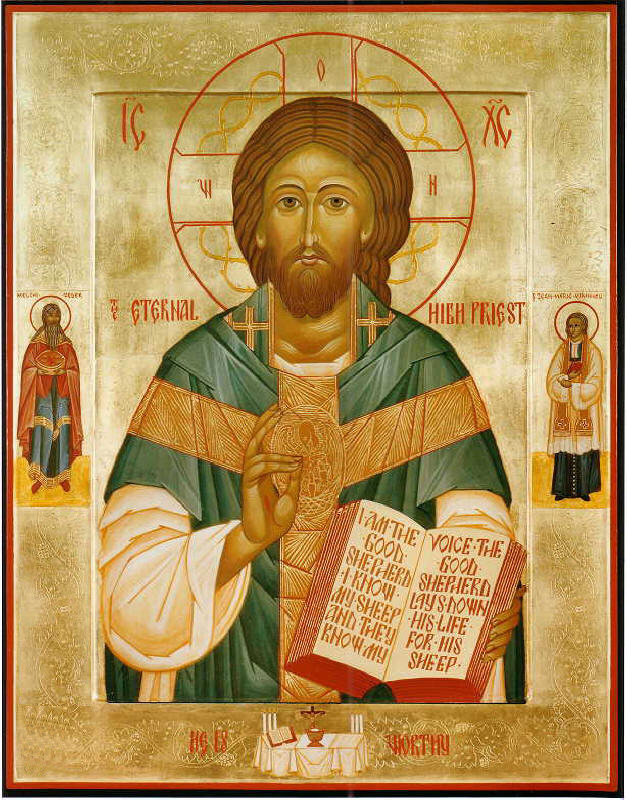
This icon shows Jesus Christ, our eternal high priest.
The gold pelican over His heart represents self-sacrifice.
The border contains an altar and grapevines, representing the Mass, and icons of Melchizedek and St. Jean-Baptiste Vianney.
Melchizedek: king of righteousness (left icon) was priest and king of Jerusalem. He blessed Abraham and has been considered an ideal priest-king.
St. Jean-Baptiste Vianney is the patron saint of parish priests.

1. Sign of the Cross: In the name of the Father, and of the Son, and of the Holy Spirit. Amen.
2. The Apostles Creed: I BELIEVE in God, the Father almighty, Creator of heaven and earth, and in Jesus Christ, His only Son, our Lord, who was conceived by the Holy Spirit, born of the Virgin Mary, suffered under Pontius Pilate, was crucified, died, and was buried. He descended into hell; on the third day he rose again from the dead; he ascended into heaven, and is seated at the right hand of God, the Father Almighty; from there He shall come to judge the living and the dead.
I believe in the Holy Spirit, the holy catholic Church, the communion of saints, the forgiveness of sins, the resurrection of the body, and the life everlasting. Amen.
3. The Lord's Prayer: OUR Father, who art in heaven, hallowed be Thy name. Thy kingdom come. Thy will be done on earth as it is in heaven. Give us this day our daily bread and forgive us our trespasses as we forgive those who trespass against us. And lead us not into temptation, but deliver us from evil. Amen.
4. (3) Hail Mary: HAIL Mary, full of grace, the Lord is with thee. Blessed art thou amongst women and blessed is the fruit of thy womb, Jesus. Holy Mary, Mother of God, pray for us sinners, now, and in the hour of our death. Amen. (Three times)
5. Glory Be: GLORY be to the Father, and to the Son, and to the Holy Spirit. As it was in the beginning, is now, and ever shall be, world without end. Amen.
6. Fatima Prayer: Oh, my Jesus, forgive us our sins, save us from the fires of hell, lead all souls to heaven, especially those in most need of your mercy.
Announce each mystery, then say 1 Our Father, 10 Hail Marys, 1 Glory Be and 1 Fatima prayer. Repeat the process with each mystery.
End with the Hail Holy Queen:
Hail, Holy Queen, Mother of Mercy, our life, our sweetness and our hope! To thee do we cry, poor banished children of Eve! To thee do we send up our sighs, mourning and weeping in this vale of tears! Turn then, most gracious advocate, thine eyes of mercy towards us; and after this, our exile, show unto us the blessed fruit of thy womb, Jesus!
O clement, O loving, O sweet Virgin Mary! Pray for us, O holy Mother of God, that we may be made worthy of the promises of Christ.
Final step -- The Sign of the Cross
The Mysteries of the Rosary By tradition, Catholics meditate on these Mysteries during prayers of the Rosary. The biblical references follow each of the Mysteries below.
The Glorious Mysteries
(Wednesdays and Sundays)
1.The Resurrection (Matthew 28:1-8, Mark 16:1-18, Luke 24:1-12, John 20:1-29) [Spiritual fruit - Faith]
2. The Ascension (Mark 16:19-20, Luke 24:50-53, Acts 1:6-11) [Spiritual fruit - Christian Hope]
3. The Descent of the Holy Spirit (Acts 2:1-13) [Spiritual fruit - Gifts of the Holy Spirit]
4. The Assumption [Spiritual fruit - To Jesus through Mary]
5. The Coronation [Spiritual fruit - Grace of Final Perseverance]
Pray a Rosary each day for our nation.
1. Sign of the Cross: In the name of the Father, and of the Son, and of the Holy Spirit. Amen.
2. The Apostles Creed: I BELIEVE in God, the Father almighty, Creator of heaven and earth, and in Jesus Christ, His only Son, our Lord, who was conceived by the Holy Spirit, born of the Virgin Mary, suffered under Pontius Pilate, was crucified, died, and was buried. He descended into hell; on the third day he rose again from the dead; he ascended into heaven, and is seated at the right hand of God, the Father Almighty; from there He shall come to judge the living and the dead.
I believe in the Holy Spirit, the holy catholic Church, the communion of saints, the forgiveness of sins, the resurrection of the body, and the life everlasting. Amen.
3. The Lord's Prayer: OUR Father, who art in heaven, hallowed be Thy name. Thy kingdom come. Thy will be done on earth as it is in heaven. Give us this day our daily bread and forgive us our trespasses as we forgive those who trespass against us. And lead us not into temptation, but deliver us from evil. Amen.
4. (3) Hail Mary: HAIL Mary, full of grace, the Lord is with thee. Blessed art thou amongst women and blessed is the fruit of thy womb, Jesus. Holy Mary, Mother of God, pray for us sinners, now, and in the hour of our death. Amen. (Three times)
5. Glory Be: GLORY be to the Father, and to the Son, and to the Holy Spirit. As it was in the beginning, is now, and ever shall be, world without end. Amen.
6. Fatima Prayer: Oh, my Jesus, forgive us our sins, save us from the fires of hell, lead all souls to heaven, especially those in most need of your mercy.
Announce each mystery, then say 1 Our Father, 10 Hail Marys, 1 Glory Be and 1 Fatima prayer. Repeat the process with each mystery.
End with the Hail Holy Queen:
Hail, Holy Queen, Mother of Mercy, our life, our sweetness and our hope! To thee do we cry, poor banished children of Eve! To thee do we send up our sighs, mourning and weeping in this vale of tears! Turn then, most gracious advocate, thine eyes of mercy towards us; and after this, our exile, show unto us the blessed fruit of thy womb, Jesus!
O clement, O loving, O sweet Virgin Mary! Pray for us, O holy Mother of God, that we may be made worthy of the promises of Christ.
Final step -- The Sign of the Cross
The Mysteries of the Rosary By tradition, Catholics meditate on these Mysteries during prayers of the Rosary. The biblical references follow each of the Mysteries below.
The Sorrowful Mysteries
(Tuesdays and Fridays)
1. The Agony in the Garden (Matthew 26:36-46, Luke 22:39-46) [Spiritual fruit - God's will be done]
2. The Scourging at the Pillar (Matthew 27:26, Mark 15:15, John 19:1) [Spiritual fruit - Mortification of the senses]
3. The Crowning with Thorns (Matthew 27:27-30, Mark 15:16-20, John 19:2) [Spiritual fruit - Reign of Christ in our heart]
4. The Carrying of the Cross (Matthew 27:31-32, Mark 15:21, Luke 23:26-32, John 19:17) [Spiritual fruit - Patient bearing of trials]
5. The Crucifixion (Matthew 27:33-56, Mark 15:22-39, Luke 23:33-49, John 19:17-37) [Spiritual fruit - Pardoning of Injuries]

St. Michael the Archangel
~ PRAYER ~
St. Michael, the Archangel, defend us in battle
Be our protection against the wickedness
and snares of the devil;
May God rebuke him, we humbly pray,
and do thou, O Prince of the heavenly host,
by the power of God,
Cast into hell Satan and all the evil spirits
who prowl through the world seeking the ruin of souls.
Amen
+
Disclaimer: Opinions posted on Free Republic are those of the individual posters and do not necessarily represent the opinion of Free Republic or its management. All materials posted herein are protected by copyright law and the exemption for fair use of copyrighted works.