Skip to comments.
Catholic Caucus: Daily Mass Readings, 02-23-20, Seventh Sunday in Ordinary Time
USCCB.org/RNAB ^
| 02-23-20
| Revised New American Bible
Posted on 02/22/2020 9:02:06 PM PST by Salvation
February 23 2020
Seventh Sunday in Ordinary Time
The LORD said to Moses,
“Speak to the whole Israelite community and tell them:
Be holy, for I, the LORD, your God, am holy.
“You shall not bear hatred for your brother or sister in your heart.
Though you may have to reprove your fellow citizen,
do not incur sin because of him.
Take no revenge and cherish no grudge against any of your people.
You shall love your neighbor as yourself.
I am the LORD.”
R. (8a) The Lord is kind and merciful.
Bless the LORD, O my soul;
and all my being, bless his holy name.
Bless the LORD, O my soul,
and forget not all his benefits.
R. The Lord is kind and merciful.
He pardons all your iniquities,
heals all your ills.
He redeems your life from destruction,
crowns you with kindness and compassion.
R. The Lord is kind and merciful.
Merciful and gracious is the LORD,
slow to anger and abounding in kindness.
Not according to our sins does he deal with us,
nor does he requite us according to our crimes.
R. The Lord is kind and merciful.
As far as the east is from the west,
so far has he put our transgressions from us.
As a father has compassion on his children,
so the LORD has compassion on those who fear him.
R. The Lord is kind and merciful.
Brothers and sisters:
Do you not know that you are the temple of God,
and that the Spirit of God dwells in you?
If anyone destroys God’s temple, God will destroy that person;
for the temple of God, which you are, is holy.
Let no one deceive himself.
If any one among you considers himself wise in this age,
let him become a fool, so as to become wise.
For the wisdom of this world is foolishness in the eyes of God,
for it is written:
God catches the wise in their own ruses,
and again:
The Lord knows the thoughts of the wise,
that they are vain.
So let no one boast about human beings, for everything belongs to you,
Paul or Apollos or Cephas,
or the world or life or death,
or the present or the future:
all belong to you, and you to Christ, and Christ to God.
R. Alleluia, alleluia.
Whoever keeps the word of Christ,
the love of God is truly perfected in him.
R. Alleluia, alleluia.
Jesus said to his disciples:
“You have heard that it was said,
An eye for an eye and a tooth for a tooth.
But I say to you, offer no resistance to one who is evil.
When someone strikes you on your right cheek,
turn the other one as well.
If anyone wants to go to law with you over your tunic,
hand over your cloak as well.
Should anyone press you into service for one mile,
go for two miles.
Give to the one who asks of you,
and do not turn your back on one who wants to borrow.
“You have heard that it was said,
You shall love your neighbor and hate your enemy.
But I say to you, love your enemies
and pray for those who persecute you,
that you may be children of your heavenly Father,
for he makes his sun rise on the bad and the good,
and causes rain to fall on the just and the unjust.
For if you love those who love you, what recompense will you have?
Do not the tax collectors do the same?
And if you greet your brothers only,
what is unusual about that?
Do not the pagans do the same?
So be perfect, just as your heavenly Father is perfect.”
TOPICS: Catholic; General Discusssion; Prayer; Worship
KEYWORDS: catholic; mt5; ordinarytime; prayer
Navigation: use the links below to view more comments.
first 1-20, 21-24 next last
For your reading, reflection, faith-sharing, comments, questions, discussion.
1
posted on
02/22/2020 9:02:06 PM PST
by
Salvation
To: All
KEYWORDS: catholic; mt5; ordinarytime; prayer;
2
posted on
02/22/2020 9:03:22 PM PST
by
Salvation
("With God all things are possible." Matthew 19:26)
To: nickcarraway; NYer; ELS; Pyro7480; livius; ArrogantBustard; Catholicguy; RobbyS; marshmallow; ...
Alleluia PingPlease FReepmail me to get on/off the Alleluia Ping List.
3
posted on
02/22/2020 9:04:06 PM PST
by
Salvation
("With God all things are possible." Matthew 19:26)
To: All
From: Leviticus 19:1-2; 11-18
Moral and Religious Duties
[1] And the Lord said to Moses, [2] “Say to all the congregation of the people of Israel, You shall be holy; for I the Lord am holy.
[11] “You shall not steal, nor deal falsely, nor lie to one another. [12] And you shall not swear by my name falsely, and so profane the name of your God: I am the Lord.
[13] “You shall not oppress your neighbor or rob him. The wages of a hired servant shall not remain with you all night until the morning. [14] You shall not curse the deaf or put a stumbling block before the blind, but you shall fear your God: I am the Lord.
[15] “You shall do no injustice in judgment; you shall not be partial to the poor or defer to the great, but in righteousness shall you judge your neighbor. [16] You shall not go up and down as a slanderer among your people, and you shall not stand forth against the life of your neighbor: I am the Lord.
[17] “You shall not hate your brother in your heart, but you shall reason with your neighbor, lest you bear sin because of him. [18] You shall not take vengeance or bear grudge against the sons of your own people, but you shall love your neighbor as yourself: I am the Lord.”
***********************************************************************
Commentary:
19:1-37. The holiness asked of the Israelites is much more than merely ritual holiness. As in 20:26, the exhortation, made to them is based on the highest possible reason—the fact that the Lord is holy. The injunction to honor parents, as also the obligation to keep the sabbath and the prohibition on idolatry, are commandments of the Decalogue already spelled out in Exodus 20:3-4, 12; 21:15, 17. The rules about peace offerings were covered in Leviticus 7:11-15, and the rules to protect the weaker members of society are repeated on a number of occasions (cf. 23:22; Deut 24:19:22).
Verse 2 (”You shall be holy, for I the Lord your God am holy”: cf. also 20:26) and v. 18 (”you shall love your neighbor as yourself: I am the Lord”: cf. also 19:33-34) sum up the entire ethic of Leviticus and indeed of the whole Law of God. Jesus himself says this, as reported in Matthew 22:34-40 (parallel texts in Mk 12:28-31 and Luke 10:25-28): “When the Pharisees heard that he had silenced the Sadducees, they came together. And one of them, a lawyer, asked him a question, to test him. ‘Teacher, which is the great commandment in the law?’ And he said to him, ‘You shall love the Lord your God with all your heart, and with all your soul, and with all your mind. This is the great and first commandment. And a second is like it, You shall love your neighbor as yourself. On these two commandments depend all the law and the prophets’ “ (Mt 22:34-40).
19:1-8. Our Lord refers to the criteria about perjury in his Sermon on the Mount, in which he rejects the prevalent abuse of swearing by holy things such as heaven, earth or the holy city for no good reason (cf. Mt 5:33-37). Jesus’ teaching on this point is that all one need do is simply tell the truth, without any oath to back up one’s words. St James reminds Christians of that same teaching (cf. Jas 5:12).
The blind and the deaf (v. 14) are to be respected out of fear of the Lord: any harm done them he regards as done to himself.
Fraternal correction is a practice which Jesus will put on a higher plane (cf. Mt 18:15f). He does the same for love of neighbor. For one thing, one’s neighbor is not just members of the Jewish people or sojourners in Judea: for Christ everyone we meet is our neighbor, irrespective of his religion or race. And it is not just a matter of loving others as oneself, but of loving them as Christ loved us (cf. Jn 15:12).
19:13. The social teaching of the Church, which is part of moral theology and is based on Revelation and on reason enlightened by faith; is summed up on the subject of the just wage by the “Catechism of the Catholic Church”: “A just wage is the legitimate fruit of work. To refuse or withhold it can be a grave injustice (cf, Lev 19:13; Deut 24:14-15; Jas 5:4). In determining fair pay both the needs and the contributions of each person must be taken into account. ‘Remuneration for work should guarantee man the opportunity to provide a dignified livelihood for himself and his family on the material, social, cultural and spiritual level, taking into account the role and the productivity of each, the state of the business, and the common good’ (”Gaudium Et Spes”, 67). Agreement between the parties is not sufficient to justify morally the amount to be received in wages” (no. 2434).
19:15. “Justice is the moral virtue that consists in the constant and firm will to give their due to God and neighbor. Justice toward God is called the ‘virtue of religion’. Justice toward men disposes one to respect the rights of each and to establish in human relationships the harmony that promotes equity with regard to persons and to the common good. The just man, often mentioned in the Sacred Scriptures, is distinguished by habitual right thinking and the uprightness of his conduct toward his neighbor. ‘You shall not be partial to the poor or defer to the great, but in righteousness shall you judge you neighbor’ (Lev 19:15)” (”Catechism of the Catholic Church”, 1807).
4
posted on
02/22/2020 9:07:51 PM PST
by
Salvation
("With God all things are possible." Matthew 19:26)
To: All
From: 1 Corinthians 3:18-23
Apostolic Ministry (Continuation)
[18] Let no one deceive himself. If any one among you thinks that he is wise in this age, let him become a fool that he may become wise. [19] For the wisdom of this world is folly with God. For it is written, “He catches the wise in their craftiness,” [20] and again, “The Lord knows that the thoughts of the wise are futile.” [21] So let no one boast of men. For all things are yours, [22] whether Paul or Apollos or Cephas or the world or life or death or the present or the future, all are yours; [23] and you are Christ’s; and Christ is God’s.
***********************************************************************
Commentary:
18-20. As an application of his teaching about true wisdom, St Paul shows Christians that the worst kind of foolishness is that of thinking one is wise when one in fact is not. He uses two biblical quotations (Job 5:13; Ps 94:11 ) as a gloss to prove that an exclusively human approach is always doomed to failure.
Christians, therefore, are wiser the more they identify their desires with the plan God has for each; that is, the more supernatural their
outlook on life is: “We must learn to acquire the divine measure of things, never losing our supernatural outlook, and realizing that Jesus makes use also of our weaknesses to reveal his glory. So, whenever your conscience feels the stirrings of self-love, of weariness, of discouragement, or the weight of your passions, you must react immediately and listen to the Master, without letting the sad truth
about our lives frighten us, because as long as we live our personal failings will always be with us” ([St] J. Escriva, “Friends of God”, 194).
21-23. One consequence of the defective wisdom which St Paul spoke about in the preceding verses is the Corinthians’ desire to seize on one particular teacher. They have forgotten that all ministers are there to serve the faithful (v. 5). In fact, the Apostle tells them, it
is not only the teachers that are theirs: “all things are yours.” This clearly emphasizes the great dignity involved in being a Christian: by being an adoptive son of God, a brother of Jesus Christ, the Christian has a share in Christ’s lordship over the universe (cf. 1 Cor
15:24-28), and is the master of all creation (cf. 2 Cor 6:10), through which he should move with a certain proprietorial feeling, called as he is to live in the freedom of the glory of the sons of God (cf. Rom 8:21), a freedom which God has won for him (cf. Gal 4:31). Human factions and dissensions of the type that have arisen among the Corinthians show that they have forgotten all this and therefore their sense of vocation has become impoverished. The Christian belongs to Christ alone: he has only one master, Christ. “Mine are the heavens and mine is the earth”, St John of the Cross explains; “mine are the people, the righteous are mine and the Mother of God, and all things are mine; and God himself is mine and for me, for Christ is mine and all for me. What, then, do you ask for and seek, my soul? All this is yours, and it is all for you. Do not despise yourself, do not despise the crumbs that fall from your Father’s table” (”A Prayer of the Soul Enkindled by Love”).
The Apostle’s words also remind us of the love and respect that man should have for created things, which God has entrusted to him (cf. Vatican II, “Gaudium Et Spes”, 37). “The world is not evil,” Monsignor Escriva reminds us “for it has come from God’s hands; it is his creation; Yahweh looked upon it and saw that it was good (cf. Gen 1:7ff). We ourselves, mankind, make it evil and ugly with our sins and infidelities [...] our age needs to give back to matter and to the most trivial occurrences and situations their noble and original meaning. It needs to restore them to the service of the Kingdom of God, to spiritualize them, turning them into a means and an opportunity for a continuous meeting with Jesus Christ [...]. It is understandable that the Apostle should write: ‘all things are yours, you are Christ’s and Christ is God’s (1 Cor 3:22-23). We have here an ascending movement which the Holy Spirit, infused in our hearts, wants to call forth from this world, upwards from the earth to the glory of the Lord” (”Conversations”, 114-115).
5
posted on
02/22/2020 9:10:49 PM PST
by
Salvation
("With God all things are possible." Matthew 19:26)
To: All
From: Matthew 5:38-42
Jesus and His Teaching, the Fulfillment of the Law (Continuation)
(Jesus said to His disciples,) [38] “You have heard that it was said, `An eye for an eye and a tooth for a tooth.’ [39] But I say to you, Do not resist one who is evil. But if any one strikes you on the right cheek, turn to him the other also; [40] and if any one would sue you and take your coat, let him have your cloak as well; [41] and if any one forces you to go one mile, go with him two miles. [42] Give to him who begs from you, and do not refuse him who would borrow from you.”
***********************************************************************
Commentary:
38-42. Among the Semites, from whom the Israelites stemmed, the law of vengeance ruled. It led to interminable strife, and countless crimes. In the early centuries of the chosen people, the law of retaliation was recognized as an ethical advance, socially and legally: no punishment could exceed the crime, and any punitive retaliation was outlawed. In this way, the honor of the clans and families was satisfied, and endless feuds avoided.
As far as New Testament morality is concerned, Jesus establishes a definitive advance: a sense of forgiveness and absence of pride play an essential role. Every legal framework for combating evil in the world, every reasonable defense of personal rights, should be based on this morality. The three last verses refer to mutual charity among the children of the Kingdom, a charity which presupposes and deeply imbues justice.
***********************************************************************
From: Matthew 5:43-48
Jesus and His Teaching, the Fulfillment of the Law (Continuation)
(Jesus said to His disciples,) [43] “You have heard that it was said, `You shall love your neighbor and hate your enemy.’ [44] But I say to you, Love your enemies and pray for those who persecute you. [45] So that you may be sons of your Father who is in Heaven; for He makes His sun rise on the evil and on the good, and sends rain on the just and on the unjust. [46] For if you love those who love you, what reward have you? Do not even the tax collectors do the same? [47] And if you salute only your brethren, what more are you doing than others? Do not even the Gentiles do the same? [48] You, therefore, must be perfect, as your Heavenly Father is perfect.”
***********************************************************************
Commentary:
43. The first part of this verse—”You shall love your neighbor”—is to be found in Leviticus 19:18. The second part—”hate your enemy”—is not to be found in the Law of Moses. However, Jesus’ words refer to a widespread rabbinical interpretation which understood “neighbors” as meaning “Israelites”. Our Lord corrects this misinterpretation of the Law: for Him everyone is our neighbor (cf. the parable of the Good Samaritan in Luke 10:25-37).
43-47. This passage sums up the teaching which precedes it. Our Lord goes so far as to say that a Christian has no personal enemies. His only enemy is evil as such—sin—but not the sinner. Jesus Himself puts this into practice with those who crucified Him, and He continues to act in the same way towards sinners who rebel against Him and despise Him. Consequently, the saints have always followed His example—like St. Stephen, the first martyr, who prayed for those who were putting him to death. This is the apex of Christian perfection—to love, and pray for, even those who persecute us and calumniate us. It is the distinguishing mark of the children of God.
46. “Tax collectors”: the Roman empire had no officials of its own for the collection of taxes: in each country it used local people for this purpose. These were free to engage agents (hence we find reference to “chief tax collectors”: cf. Luke 19:2). The global amount of tax for each region was specified by the Roman authorities; the tax collectors levied more than this amount, keeping the surplus for themselves: this led them to act rather arbitrarily, which was why the people hated them. In the case of the Jews, insult was added to injury by the fact that the chosen people were being exploited by Gentiles.
48. Verse 48 is, in a sense, a summary of the teaching in this entire chapter, including the Beatitudes. Strictly speaking, it is quite impossible for a created being to be as perfect as God. What our Lord means here is that God’s own perfection should be the model which every faithful Christian tries to follow, even though he realizes that there is an infinite distance between himself and his Creator. However, this does not reduce the force of this commandment; it sheds more light on it. It is a difficult commandment to live up to, but along with this we must take account of the enormous help grace gives us to go so far as to tend towards divine perfection. Certainly, perfection which we should imitate does not refer to the power and wisdom of God, which are totally beyond our scope; here the context seems to refer primarily to love and mercy. Along the same lines, St. Luke quotes these words of our Lord: “Be merciful, even as your Father is merciful” (Luke 6:36; cf. note on Luke 6:20-49).
Clearly, the “universal call to holiness” is not a recommendation but a commandment of Jesus Christ.
“Your duty is to sanctify yourself. Yes, even you. Who thinks that this task is only for priests and religious? To everyone, without exception, our Lord said: `Be ye perfect, as My Heavenly Father is perfect’” ([St] J. Escriva, “The Way”, 291). This teaching is sanctioned by chapter 5 of Vatican II’s Constitution “Lumen Gentium”, where it says (40): “The Lord Jesus, divine teacher and model of all perfection, preached holiness of life (of which He is the author and maker) to each and every one of His disciples without distinction: `You, therefore, must be perfect, as your Heavenly Father is perfect’ [...]. It is therefore quite clear that all Christians in any state or walk of life are called to the fullness of Christian life and to the perfection of love, and by this holiness a more human manner of life is fostered also in earthly society.”
6
posted on
02/22/2020 9:13:05 PM PST
by
Salvation
("With God all things are possible." Matthew 19:26)
To: All
Scripture readings from the Jerusalem Bible by Darton, Longman & Todd
Readings at Mass
Liturgical Colour: Green.
| First reading |
| Leviticus 19:1-2,17-18 © |
You must love your neighbour as yourself
The Lord spoke to Moses; he said: ‘Speak to the whole community of the sons of Israel and say to them:
‘“Be holy, for I, the Lord your God, am holy.
‘“You must not bear hatred for your brother in your heart. You must openly tell him, your neighbour, of his offence; this way you will not take a sin upon yourself. You must not exact vengeance, nor must you bear a grudge against the children of your people. You must love your neighbour as yourself. I am the Lord.”’
| Responsorial Psalm |
| Psalm 102(103):1-4,8,10,12-13 © |
The Lord is compassion and love.
My soul, give thanks to the Lord
all my being, bless his holy name.
My soul, give thanks to the Lord
and never forget all his blessings.
The Lord is compassion and love.
It is he who forgives all your guilt,
who heals every one of your ills,
who redeems your life from the grave,
who crowns you with love and compassion.
The Lord is compassion and love.
The Lord is compassion and love,
slow to anger and rich in mercy.
He does not treat us according to our sins
nor repay us according to our faults.
The Lord is compassion and love.
As far as the east is from the west
so far does he remove our sins.
As a father has compassion on his sons,
the Lord has pity on those who fear him.
The Lord is compassion and love.
| Second reading |
| 1 Corinthians 3:16-23 © |
You belong to Christ and Christ belongs to God
Didn’t you realise that you were God’s temple and that the Spirit of God was living among you? If anybody should destroy the temple of God, God will destroy him, because the temple of God is sacred; and you are that temple.
Make no mistake about it: if any one of you thinks of himself as wise, in the ordinary sense of the word, then he must learn to be a fool before he really can be wise. Why? Because the wisdom of this world is foolishness to God. As scripture says: The Lord knows wise men’s thoughts: he knows how useless they are; or again: God is not convinced by the arguments of the wise. So there is nothing to boast about in anything human: Paul, Apollos, Cephas, the world, life and death, the present and the future, are all your servants; but you belong to Christ and Christ belongs to God.
| Gospel Acclamation |
Jn14:23 |
Alleluia, alleluia!
If anyone loves me he will keep my word,
and my Father will love him,
and we shall come to him.
Alleluia!
Alleluia, alleluia!
Whenever anyone obeys what Christ has said,
God’s love comes to perfection in him.
Alleluia!
Love your enemies
Jesus said to his disciples: ‘You have learnt how it was said: Eye for eye and tooth for tooth. But I say this to you: offer the wicked man no resistance. On the contrary, if anyone hits you on the right cheek, offer him the other as well; if a man takes you to law and would have your tunic, let him have your cloak as well. And if anyone orders you to go one mile, go two miles with him. Give to anyone who asks, and if anyone wants to borrow, do not turn away.
‘You have learnt how it was said: You must love your neighbour and hate your enemy. But I say this to you: love your enemies and pray for those who persecute you; in this way you will be sons of your Father in heaven, for he causes his sun to rise on bad men as well as good, and his rain to fall on honest and dishonest men alike. For if you love those who love you, what right have you to claim any credit? Even the tax collectors do as much, do they not? And if you save your greetings for your brothers, are you doing anything exceptional? Even the pagans do as much, do they not? You must therefore be perfect just as your heavenly Father is perfect.’
7
posted on
02/22/2020 9:15:46 PM PST
by
Salvation
("With God all things are possible." Matthew 19:26)
To: Salvation
| Matthew |
| |
English: Douay-Rheims |
Latin: Vulgata Clementina |
Greek NT: Byzantine/Majority Text (2000) |
| |
Matthew 5
|
| 38. |
You have heard that it hath been said, An eye for an eye, and a tooth for a tooth. |
Audistis quia dictum est : Oculum pro oculo, et dentem pro dente. |
ηκουσατε οτι ερρεθη οφθαλμον αντι οφθαλμου και οδοντα αντι οδοντος |
| 39. |
But I say to you not to resist evil: but if one strike thee on thy right cheek, turn to him also the other: |
Ego autem dico vobis, non resistere malo : sed si quis te percusserit in dexteram maxillam tuam, præbe illi et alteram : |
εγω δε λεγω υμιν μη αντιστηναι τω πονηρω αλλ οστις σε ραπισει επι την δεξιαν [σου] σιαγονα στρεψον αυτω και την αλλην |
| 40. |
And if a man will contend with thee in judgment, and take away thy coat, let go thy cloak also unto him. |
et ei, qui vult tecum judicio contendere, et tunicam tuam tollere, dimitte ei et pallium : |
και τω θελοντι σοι κριθηναι και τον χιτωνα σου λαβειν αφες αυτω και το ιματιον |
| 41. |
And whosoever will force thee one mile, go with him other two, |
et quicumque te angariaverit mille passus, vade cum illo et alia duo. |
και οστις σε αγγαρευσει μιλιον εν υπαγε μετ αυτου δυο |
| 42. |
Give to him that asketh of thee and from him that would borrow of thee turn not away. |
Qui petit a te, da ei : et volenti mutuari a te, ne avertaris. |
τω αιτουντι σε διδου και τον θελοντα απο σου δανεισασθαι μη αποστραφης |
| 43. |
You have heard that it hath been said, Thou shalt love thy neighbor, and hate thy enemy. |
Audistis quia dictum est : Diliges proximum tuum, et odio habebis inimicum tuum. |
ηκουσατε οτι ερρεθη αγαπησεις τον πλησιον σου και μισησεις τον εχθρον σου |
| 44. |
But I say to you, Love your enemies: do good to them that hate you: and pray for them that persecute and calumniate you: |
Ego autem dico vobis : Diligite inimicos vestros, benefacite his qui oderunt vos, et orate pro persequentibus et calumniantibus vos : |
εγω δε λεγω υμιν αγαπατε τους εχθρους υμων ευλογειτε τους καταρωμενους υμας καλως ποιειτε τοις μισουσιν υμας και προσευχεσθε υπερ των επηρεαζοντων υμας και διωκοντων υμας |
| 45. |
That you may be the children of your Father who is in heaven, who maketh his sun to rise upon the good, and bad, and raineth upon the just and the unjust. |
ut sitis filii Patris vestri, qui in cælis est : qui solem suum oriri facit super bonos et malos : et pluit super justos et injustos. |
οπως γενησθε υιοι του πατρος υμων του εν [τοις] ουρανοις οτι τον ηλιον αυτου ανατελλει επι πονηρους και αγαθους και βρεχει επι δικαιους και αδικους |
| 46. |
For if you love them that love you, what reward shall you have? do not even the publicans this? |
Si enim diligitis eos qui vos diligunt, quam mercedem habebitis ? nonne et publicani hoc faciunt ? |
εαν γαρ αγαπησητε τους αγαπωντας υμας τινα μισθον εχετε ουχι και οι τελωναι το αυτο ποιουσιν |
| 47. |
And if you salute your brethren only, what do you more? do not also the heathens this? |
Et si salutaveritis fratres vestros tantum, quid amplius facitis ? nonne et ethnici hoc faciunt ? |
και εαν ασπασησθε τους φιλους υμων μονον τι περισσον ποιειτε ουχι και οι τελωναι ουτως ποιουσιν |
| 48. |
Be you therefore perfect, as also your heavenly Father is perfect. |
Estote ergo vos perfecti, sicut et Pater vester cælestis perfectus est. |
εσεσθε ουν υμεις τελειοι ωσπερ ο πατηρ υμων ο εν τοις ουρανοις τελειος εστιν |
8
posted on
02/23/2020 8:24:11 AM PST
by
annalex
(fear them not)
To: annalex
38. You have heard that it has been said, An eye for an eye, and a tooth for a tooth;
39. But I say to you, That you resist not evil; but whosoever shall smite you on your right cheek, turn to him the other also.
40. And if any man will sue you at the law, and take away your coat, let him have your cloak also.
41. And whosoever shall compel you to go a mile, go with him twain.
42. Give to him that asks you, and from him that would borrow of you turn not away.
GLOSS. The Lord having taught that we are not to offer injury to our neighbor or irreverence to the Lord, now proceeds to show the Christian should demean himself to those that injure him.
AUG. This law, Eye for eye, tooth for tooth, was enacted to repress the flames of mutual hate, and to be a check on their undisciplined spirits. For who when he would take revenge, was ever content to return just so much harm as he had received? Do we not see men who have suffered some trifling hurt, straightway plot murder, thirst for blood, and hardly find evil enough that they can do to their enemies for the satisfying of their rage? To this immeasured and cruel fury the Law puts bounds when it enacts a lex talionis; that is, that whatever wrong or hurt any man has done to another, he should suffer just the same in return. This is not to encourage but to check rage; for it does not rekindle what was extinguished, but hinders the flames already kindled from further spread. It enacts a just retaliation, properly due to him who has suffered the wrong. But that mercy forgives any debt, does not make it unjust that payment had been sought. Since then he sins who seeks an unmeasured vengeance, but he does not sin who desires only a just one; he is therefore further from sin who seeks no retribution at all. I might state it yet thus: It was said to them of old time, You shall not take unequal retaliation; But I say to you, You shall not retaliate; this is a completion of the Law, if in these words something is added to the Law which was wanting to it; yea, rather that which the Law sought to do, namely, to put an end to unequal revenge, is more safely secured when there is no revenge at all.
PSEUDO-CHRYS. For without this command, the commands of the Law could not stand. For if according to the Law we begin all of us to render evil for evil, we shall all become evil, since they do hurt abound. But if according to Christ we resist not evil, though they that are evil be not amended, yet they that are good remain good.
JEROME; Thus our Lord by doing away all retaliation, cuts off the beginnings of sin. So the Law corrects faults, the Gospel removes their occasions.
GLOSS. Or it may be said that the Lord said this, adding somewhat to the righteousness of the old Law.
AUG. For the righteousness of the Pharisees is a less righteousness, not to transgress the measure of equal retribution; and this is the beginning of peace; but perfect peace is to refuse all such retribution. Between that first manner then, which was not according to the Law, to wit, that a greater evil should be returned for a less, and this which the Lord enjoins to make His disciples perfect, to wit, that no evil should be returned for evil, a middle place is held by this, that an equal evil should be returned, which was thus the passage from extremist discord to extremist peace. Whoso then first does evil to another departs furthest from righteousness; and who does not first do any wrong, but when wronged repays with a heavier wrong, has departed somewhat from extreme injustice; he who repays only what he has received, gives up yet something more, for it were but strict right that he whom is the first aggressor should receive a greater hurt than he inflicted. This righteousness thus partly begun, He perfects, who is come to fulfill the Law. The two steps that intervene He leaves to be understood; for there is who does not repay so much, but less; and there is yet above him, he who repays not at all; yet this seems too little to the Lord, if you be not also ready to suffer wrong. Therefore He says not, Render not evil for evil, but, Resist not against evil, not only repay not what is offered to you, but do not resist that it should not be done to you. For thus accordingly He explains that saying, If any man smite you on your right cheek, offer to him the left also. Which as being a high part of mercy is known to those who serve such as they love much; from whom, being morose, or insane, they endure many things, and if it be for their health they offer themselves to endure more. The Lord then, the Physician of souls, teaches His disciples to endure with patience the sicknesses of those for whose spiritual health they should provide. For all wickedness comes of a sickness of the mind; nothing is more innocent than he who is sound and of perfect health in virtue.
ID. The things which are done by the Saints in the New Testament profit for examples of understanding those Scriptures which are modeled into the form of precepts. Thus we read in Luke; Whoso smites you on the one cheek, turn to him the other also (Luke 6:29). Now there is no example of patience more perfect than that of the Lord; yet He, when he was smitten, said not, 'Behold the other cheek,' but, If I have spoken amiss, accuse me wherein it is amiss; but if well, why do you smite me (John 18:23)? hereby showing us that that turning of the other cheek should be in the heart.
ID. For the Lord was ready not only to be smitten on the other cheek for the salvation of men, but to be crucified with His whole body. It may be asked, What does the right cheek expressly signify? As the face is that whereby any man is known, to be smitten on the face is according to the Apostle to be condemned and despised. But as But as we cannot say, 'right face,' and 'left face,' and yet we have a name twofold, one before God, and one before the world, it is distributed as it were into the right cheek, and left cheek, that whoever of Christ's disciples is despised for that he is a Christian, may be ready to be yet more despised for any of this world's honors that he may have. All things wherein we suffer any wrong are divided into two kinds, of which one is what cannot be restored, the other what may be restored. In that kind which cannot be restored, we are wont to seek the solace of revenge. For what does it boot if when smitten you smite again, is the hurt done to your body thereby repaid to you? But the mind swollen with rage seeks such assuagements.
PSEUDO-CHRYS. Or has your return blow at all restrained him from striking you again? It has rather roused him to another blow. For anger is not checked by meeting anger, but is only more irritated.
AUG. Whence the Lord judges that others' weakness should rather be born with compassion, than that our own should be soothed by others' pain. For that retribution which tends to correction is not here forbidden, for such is indeed a part of mercy; nor does such intention hinder that he, who seeks to correct another, is not at the same time ready himself to take more at his hands. But it is required that he should inflict the punishment to whom the power is given by the course of things, and with such a mind as the father has to a child in correcting him whom it is impossible he should hate. And holy men have punished some sins with death, in order that a wholesome fear might be struck into the living, and so that not his death, but the likelihood of increase of his sin had he lived, was the hurt of the criminal. Thus Elias punished many with death, and when the disciples would take example from him, they were rebuked by the Lord, who did not censure this example of the Prophet, but their ignorant use of it, seeing them to desire the punishment not for correction's sake, but angry hate. But after He had inculcated love of their neighbor and had given them the Holy Spirit, there wanted not instances of such vengeance, as Ananias and his wife who fell down dead at the words of Peter, and the Apostle Paul delivered some to Satan for the destruction of the flesh. Yet do some, with a kind of blind opposition, rage against the temporal punishments of the Old Testament, not knowing with what mind they were inflicted.
ID. But who that is of sober mind would say to kings, "It is nothing of your concern who will live religiously, or who profanely"? It cannot even be said to them, that it is not their concern who will live chastely, or who unchastely. It is indeed better that men should be led to serve God by right teaching than by penalties; yet has it benefited many, as experience has approved to us, to be first coerced by pain and fear, that they might be taught after, or to be made to conform in deed to what they had learned in words. The better men indeed are led of love, but the more part of men are wrought on by fear. Let them learn in the case of the Apostle Paul, how Christ first constrained, and after taught him.
ID.Therefore in this kind of injuries which are wont to rouse vengeance Christians will observe such a mean, that hate shall not be caused by the injuries they may receive, and yet wholesome correction be not foregone by Him who has right of either counsel or power.
JEROME; Mystically interpreted, when we are smitten on the right cheek, He said not, offer to him the left, but the other; for the righteous has not a left. That is, if a heretic has smitten us in disputation, and would wound us in a right hand doctrine, let him be met with another testimony from Scripture.
AUG. The other kind of injuries are those in which full restitution can be made, of which there are two kinds: one relates to money, the other to work; of the first of these it is He speaks when He continues, Whoever will sue you for your coat, let him have your cloak likewise. As by the cheek are denoted such injuries of the wicked as admit of no restitution but revenge, so by this similitude of the garments is denoted such injury as admits restitution. And this, as the former, is rightly taken of preparation of the heart, not of the show of the outward action. And what is commanded respecting our garments, is to be observed in all things that by any right we call our own in worldly property. For if the command be expressed in these necessary articles of life, how much more does it hold in the case of superfluities and luxuries? And when He says, He who will sue you, He clearly intends to include everything for which it is possible that we should be sued. It may be made a question whether it is to be understood of slaves, for a Christian ought not to possess his slave on the same footing as his horse; though it might be that the horse was worth the more money. And if your slave have a milder master in you than he would have in him who seeks to take him from you, I do not know that he ought to be given up as lightly as your coat.
PSEUDO-CHRYS. For it were an unworthy thing that a believer should stand in his cause before an unbelieving judge. Or if one who is a believer, though (as he must be) a worldly man, though he should have reverenced you for the worthiness of the faith, sues you because the cause is a necessary one, you will lose the worthiness of Christ for the business of the world. Further, every lawsuit irritates the heart and excites bad thoughts; for when you see dishonesty or bribery employed against you, you hasten to support your own cause by like means, though originally, you might have intended nothing of the sort.
AUG. The Lord here forbids his disciples to have lawsuits with others for worldly property. Yet as the Apostle allows such kind of causes to be decided between brethren, and before arbiters who are brethren, but utterly disallows them without the Church, it is manifest what is conceded to infirmity as pardonable.
GREG. There are, who are so far to be endured, as they rob us of our worldly goods; but there are whom we ought to hinder, and that without breaking the law of charity, not only that we may not be robbed of what is ours, but lest they by robbing others destroy themselves. We ought to fear much more for the men who rob us, than to be eager to save the inanimate things they take from us. When peace with our neighbor is banished the heart on the matter of worldly possessions, it is plain that our estate is more loved than our neighbor.
AUG. The third kind of wrongs, which is in the matter of labor, consists of both such as admit restitution, and such as do not - or with or without revenge - for he who forcibly presses a man's service, and makes him give his aid against his will, can either be punished for his crime, or return the labor. In this kind of wrongs then, the Lord teaches that the Christian mind is most patient, and prepared to endure yet more than is offered; If a man constrain you to go with him a mile, go with him yet another two. This likewise is meant not so much of actual service with your feet , as of readiness of mind.
CHRYS.The word here used signifies to drag unjustly, without cause, and with insult.
AUG. Let us suppose it therefore said, Go with him other two, that the number three might be completed; by which number perfection is signified; that whoever does this might remember that he is fulfilling perfect righteousness. For which reason he conveys this precept under three examples, and in this third example, he adds a twofold measure to the one single measure, that the threefold number may be complete. Or we may so consider as though in enforcing this duty, He had begun with what was easiest to bear, and had advanced gradually. For finest He commanded that when the right cheek was smitten we should turn the other also; therein showing ourselves ready to endure another wrong less than that you have already received. Secondly, to him that would take your coat, He bids you part with your cloak (or garment, as some copies read), which is either just as great a loss, or perhaps a little greater). In the third, He doubles the additional wrong which He would have us ready to endure. And seeing it is a small thing not to hurt unless you further show kindness, He adds, To him that asks of you, give.
PSEUDO-CHRYS.Because wealth is not ours but God's, God would have us stewards of His wealth. and not lords.
JEROME; If we understand this only of alms, it cannot stand with the estate of the most part of men who are poor; even the rich if they have been always giving, will not be able to continue always to give.
AUG. Therefore, He says not, 'Give all things to him that asks, but, Give to every one that asks; that you should only give what you can give honestly and rightly. For what if one ask for money to employ in oppressing the innocent man? What if he ask your consent to unclean sin? We must give then only what will hurt neither ourselves or others, as far as man can judge; and when you have refused an inadmissible request, that you may not send away empty him that asked, show the righteousness of your refusal; and such correction of the unlawful petitioner will often be a better gift than the granting of his suit.
ID. For with more benefit is food taken from the hunger, if certainty of provision causes him to neglect righteousness, than that food should be supplied to him that he may consent to a deed of violence and wrong.
JEROME; But it may be understood of the wealth of doctrine: wealth which never fails but the more of it is given away, the more it abounds.
AUG. That He commands, And from him that would borrow of you, turn not away, must be referred to the mind; for God loves a cheerful giver (2 Cor 9:7). And everyone that receives indeed borrows, though it is not he that shall pay, but God who restores to the merciful many fold. Or, if you like to understand by borrowing, only taking with promise to repay, we must understand the Lord's command as embracing both these kinds of affording aid; whether we give outright, or lend to receive again. And of this last kind of showing mercy it is well-said, Turn not away, that is, do not be therefore backward to lend, as though, because man shall repay you, therefore God shall not; for what you do by God's command cannot be without fruit.
PSEUDO-CHRYS. Christ bids us lend but not on usury; for he who gives on such terms does not bestow his own, but takes of another; he looses from one chain to bind with many, and gives not for God's righteousness sake, but for his own gain. For money taken on usury is like the bite of an asp; as the asp's poison secretly consumes the limbs, so usury turns all our possessions into debt.
AUG. Some object that this command of Christ is altogether inconsistent with civil life in Commonwealths; who, say they, would suffer, when he could hinder it, the pillage of his estate by an enemy; or would not repay the evil suffered by a plundered province of Rome on the plunderers according to the rights of war? But these precepts of patience are to be observed in readiness of the heart, and that mercy, not to return evil for evil, must be always fulfilled by the will. Yet must we often use a merciful sharpness in dealing with the headstrong. And in this way, if the earthly commonwealth will keep the Christian commandments, even war will not be waged without good charities, to the establishing among the vanquished peaceful harmony of godliness and righteousness. For that victory is beneficial to him from whom it snatches license to sin; since nothing is more unfortunate for sinners, than the good fortune of their sins, which nourishes an impunity that brings punishment after it, and an evil will is strengthened, as it were some internal enemy.
43. You have heard that it has been said, You shall love your neighbor, and hate your enemy.
44. But I say to you, Love your enemies, bless them that curse you, do good to them that hate you, and pray for them which despitefully use you and persecute you;
45. That you may be the children of your Father which is in heaven; for He makes His sun to rise on the evil and on the good, and sends rain on the just and on the unjust.
46. For if you love them which love you, what reward have you? Do not even the Publicans do the same?
47. And if you salute your brethren only, what do you do more than others? Do not even the Publicans do so?
48. Be you therefore perfect, even as your Father which is in Heaven is perfect.
GLOSS. The Lord has taught above that we must not resist one who offers any injury, but must be ready even to suffer more; He now further requires us to show to them that do us wrong both love and its effects. And as the things that have gone before pertain to the completion of the righteousness of the Law, in like manner this last precept is to be referred to the completion of the law of love, which, according to the Apostle, is the fulfilling of the Law.
AUG. That by the command, You shall love your neighbor, all mankind were intended, the Lord showed in the parable of the man who was left half dead, which teaches us that our neighbor is every one who may happen at any time to stand in need of our offices of mercy; and this who does not see must be denied to none, when the Lord says, Do good to them that hate you.
ID. That there were degrees in the righteousness of the Pharisees which was under the old Law is seen herein, that many hated even those by whom they were loved. He therefore who loves his neighbor, has ascended one degree, though as yet he hates his enemy; which is expressed in that, and shall hate your enemy, which is not to be understood as a command to the justified, but a concession to the weak.
ID. I ask the Manichaeans why they would have this peculiar to the Mosaic Law, that was said by them of old time, you shall hate your enemy? Has not Paul said of certain men that they were hateful to God? We must inquire then how we may understand that, after the example of God, to whom the Apostle here affirms some men to be hateful, our enemies are to be hated; and again after the same pattern of Him who makes His sun to rise on the evil and the good, our enemies are to be loved. Here then is the rule by which we may at once hate our enemy for the evil's sake that is in him, that is, his iniquity, and love him for the good's sake that is in him, that is, his rational part. This then, thus uttered by them of old, being heard, but not understood, hurried men on to the hatred of man, when they should have hated nothing but vice. Such the Lord corrects as He proceeds, saying, I say to you, Love your enemies. He who had just declared that He came not to subvert the Law, but to fulfill it, by bidding us love our enemies, brought us to the understanding of how we may at once hate the same man for his sins whom we love for his human nature.
GLOSS. But it should be known that in the whole body of the Law it is nowhere written, You shall hate your enemy. But it is to be referred to the tradition of the Scribes, who thought good to add this to the Law, because the Lord bade the children of Israel pursue their enemies, and destroy Amalek from under Heaven.
PSEUDO-CHRYS. As that, You shall not lust, was not spoken to the flesh, but to the spirit, so in this the flesh indeed is not able to love its enemy, but the spirit is able; for the love and hate of the flesh is in the sense, but of the spirit is in the understanding. If then we feel hate to one who has wronged us, and yet will not to act upon that feeling, know that our flesh hates our enemy, but our soul loves him.
GREG. Love to an enemy is then observed when we are not sorrowful at his success, or rejoice in his fall. We hate him whom we wish not to he bettered, and pursue with ill wishes the prosperity of the man in whose fall we rejoice. Yet it may often happen that without any sacrifice of charity, the fall of an enemy may gladden us, and again his exaltation make us sorrowful without any suspicion of envy; when, namely, by his fall any deserving man is raised up, or by his success any undeservedly depressed. But herein a strict measure of discernment must be observed, lest in following out our own hates, we hide it from ourselves under the specious pretense of another's benefit. We should balance how much we owe to the fall of the sinner, how much to the justice of the Judge. For when the Almighty has struck any hardened sinner, we must at once magnify His justice as Judge, and feel with the other's suffering who perishes.
GLOSS. They who stand against the Church oppose her in three ways: with hate, with words, and with bodily tortures. The Church on the other hand loves them, as it is here, Love your enemies; does good to them, as it is, Do good to them that hate you; and prays for them, as it is, Pray for them that persecute you and accuse you falsely.
JEROME; Many measuring the commandments of God by their own weakness, not by the strength of the saints, hold these commands for impossible, and say that it is virtue enough not to hate our enemies; but to love them is a command beyond human nature to obey. But it must be understood that Christ enjoins not impossibilities but perfection. Such was the temper of David towards Saul and Absalom; the Martyr Stephen also prayed for his enemies while they stoned him, and Paul wished himself anathema for the sake of his persecutors. Jesus both taught and did the same, saying, Father, forgive them, for they know not what they do.
AUG. These indeed are examples of the perfect sons of God; yet to this should every believer aim, and seek by prayer to God, and struggles with himself to raise his human spirit to this temper. Yet this so great blessing is not given to all those multitudes which we believe are heard when they pray, Forgive us our debts, as we forgive our debtors.
ID. Here arises a question, that this commandment of the Lord, by which He bids us pray for our enemies, seems opposed by many other parts of Scripture. In the Prophets are found many imprecations upon enemies; such as that in the 109th Psalm, Let his children be orphans (Ps 109:9). But it should be known, that the Prophets are wont to foretell things to come in the form of prayer or wish. This has more weight as a difficulty that John says, There is a sin to death, I say not that he shall pray for it (1 John 5:16); plainly showing that there are some brethren for whom he does not bid us pray; for what went before was, If any know his brother sin a sin, &c. Yet the Lord bids us pray for our persecutors. This question can only be resolved, if we admit that there are some sins in brethren more grievous than the sin of persecution in our enemies. For thus Stephen prays for those that stoned him, because they had not yet believed on Christ; but the Apostle Paul does not pray for Alexander though he was a brother, but had sinned by attacking the brotherhood through jealousy. But for whom you pray not, you do not therein pray against him. What must we say then of those against whom we know that the saints have prayed, and that not that they should be corrected (for that would be rather to have prayed for them), but for their eternal damnation; not as that prayer of the Prophet against the Lord's betrayer, for that is a prophecy of the future, not an imprecation of punishment; but as when we read in the Apocalypse the Martyrs' prayer that they may be avenged. But we ought not to let this affect us. For who may dare to affirm that they prayed against those persons themselves, and not against the kingdom of sin? For that would be both a just and a merciful avenging of the Martyrs, to overthrow that kingdom of sin, under the continuance of which they endured all those evils. And it is overthrown by correction of some, and damnation of such as abide in sin. Does not Paul seem to you to have avenged Stephen on his on his own body, as he speaks, I chastise my body, and bring it into subjection.
PSEUDO-AUG. And the souls of them that are slain cry out to be avenged; as the blood of Abel cried out of the ground not with a voice, but in spirit. As the work is said to laud tine workman, when he delights himself in the view thereof; for the saints are not so impatient as to urge what they know will come to pass at the appointed time.
CHRYS. Note through what steps we have now ascended here, and how he has set us on the very pinnacle of virtue. The first step is not to begin to do wrong to any; the second, that in avenging a wrong done to us we be content with retaliating equal; the third, to return nothing of what we have suffered; the fourth, to offer one's self to the endurance of evil; the fifth, to be ready to suffer even more evil than the oppressor desires to inflict; the sixth, not to hate him of whom we suffer such things; the seventh, to love him; the eighth, to do him good; the ninth, to pray for him. And because the command is great, the reward proposed is also great, namely, to be made like to God, You shall be the sons of your Father which is in heaven.
JEROME; For whoever keeps the commandments of God is thereby made the son of God; he then of whom he here speaks is not by nature his son, but by his own will.
AUG. After that rule we must here understand of which John speaks, He gave them power to be made the sons of God. One is His Son by nature; we are made sons by the power which we have received; that is, so far as we fulfill those things that we are commanded. So He says not, Do these things because you are sons, but, do these things that you may become sons. In calling us to this then, He calls us to His likeness, for He says, He makes His sun to rise on the righteous and the unrighteous. By the sun we may understand not this visible, but that of which it is said, To you that fear the name of the Lord, the Sun of righteousness shall arise (Mal 4:2); and by the rain, the water of the doctrine of truth; for Christ was seen, and was preached to good as well as bad.
HILARY; Or, the sun and rain have reference to the baptism with water and Spirit.
AUG. Or we may take it of this visible sun, and of the rain by which the fruits are nourished, as the wicked mourn in the book of Wisdom, The Sun has not risen for us (Wisdom 5:6). And of the rain it is said, I will command the clouds that they rain not on it (Is 5:6). But whether it be this or that, it is of the great goodness of God, which is set forth for our imitation. He says not, 'the sun,' but His sun, that is, the sun which Himself has made, that hence we may be admonished with how great liberality we ought to supply those things that we have not created, but received as a boon from Him.
ID.But as we laud Him for his gifts, let us also consider how He chastises those whom He loves. For not everyone who spares is a friend, nor everyone who chastises an enemy; it is better to love with severity than to use lenity wherewith to deceive.
PSEUDO-CHRYS. He was careful to say, On the righteous and the unrighteous, and not 'on the unrighteous as on the righteous'; for God gives all good gifts not for men's sake, but for the saints' sake, as likewise chastisements for the sake of sinners. In bestowing His good gifts, He does not separate the sinners from the righteous that they should not despair; so in His infliction not the righteous from sinners that they should be made proud; and that the more, since the wicket are not profited by the good things they receive, but turn them to their hurt by their evil lives; nor are the good hurt by evil things, but rather profit to increase of righteousness.
AUG. For the good man is not puffed up by worldly goods, nor broken by worldly calamity. But the bad man is punished in temporal losses, because he is corrupted by temporal gains. Or for another reason he would have good and evil common to both sorts of men, that good things might not be sought with vehement desire, when they were enjoyed even by the wicked; nor the evil things shamefully avoided, when even the righteous are afflicted by them.
GLOSS.To love one that loves us is of nature, but to love our enemy of charity. If you love them who love you, what reward have you? to wit, in heaven. None truly, for of each it is said, You have received your reward. But these things we ought to do, and not leave the other undone.
RABAN.If then sinners be led by nature to show kindness to those that love them, with how much greater show of affection ought you not to embrace those that do not love you? For it follows, Do not even the publicans do so? The publicans are those who collect the public imposts; or perhaps those who pursue the public business or the gain of this world.
GLOSS. But if you only pray for them that are your kinsfolk, what more has your benevolence than that of the unbelieving? Salutation is a kind of prayer.
RABAN. Ethnici, that is, the Gentiles, for the Greek word is translated 'gens' in Latin; those, that is, who abide such as they were born, to wit, under sin.
REMIG. Because the utmost perfection of love cannot go beyond the love of enemies, therefore as soon as the Lord has bid us love our enemies, He proceeds, Be you then perfect, as your Father which is in heaven is perfect. He indeed is perfect, as being omnipotent - man, as being aided by the Omnipotent. For the word ' as' is used in Scripture, sometimes for identity, and equality, as in that, As I was with Moses, so will I be with you (Joshua 1:5); sometimes to express likeness only as here.
PSEUDO-CHRYS.For as our sons after the flesh resemble their fathers in some part of their bodily shape, so do spiritual sons resemble their father God, in holiness.
Catena Aurea Matthew 5
9
posted on
02/23/2020 8:25:59 AM PST
by
annalex
(fear them not)
To: annalex
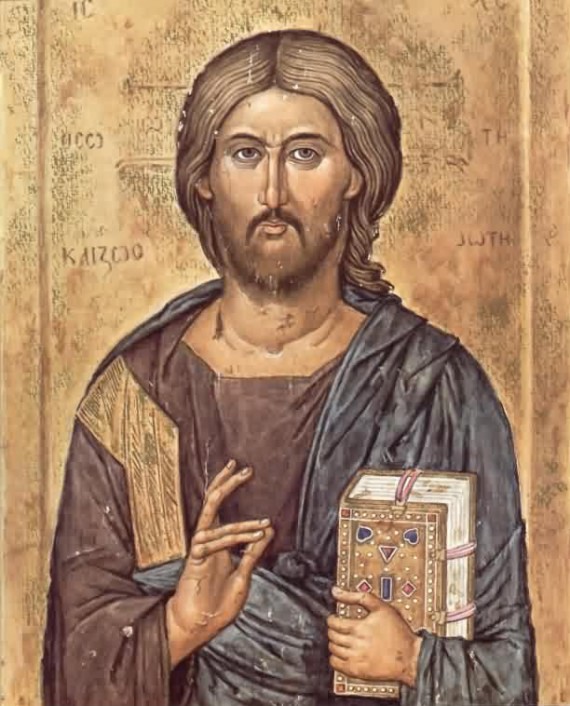
Pantocrator, Christ Savior and Life Giver
Metropolitan Jovan Zograf, Iconographer
1384
Church of the Monastery of the Holy Transfiguration, Zrze - Prilep
10
posted on
02/23/2020 8:26:45 AM PST
by
annalex
(fear them not)
To: All
11
posted on
02/23/2020 6:51:35 PM PST
by
Salvation
("With God all things are possible." Matthew 19:26)
To: All
12
posted on
02/23/2020 6:51:59 PM PST
by
Salvation
("With God all things are possible." Matthew 19:26)
To: All
13
posted on
02/23/2020 6:52:25 PM PST
by
Salvation
("With God all things are possible." Matthew 19:26)
To: All
14
posted on
02/23/2020 6:52:50 PM PST
by
Salvation
("With God all things are possible." Matthew 19:26)
To: All
15
posted on
02/23/2020 6:53:16 PM PST
by
Salvation
("With God all things are possible." Matthew 19:26)
To: All
16
posted on
02/23/2020 6:53:47 PM PST
by
Salvation
("With God all things are possible." Matthew 19:26)
To: All
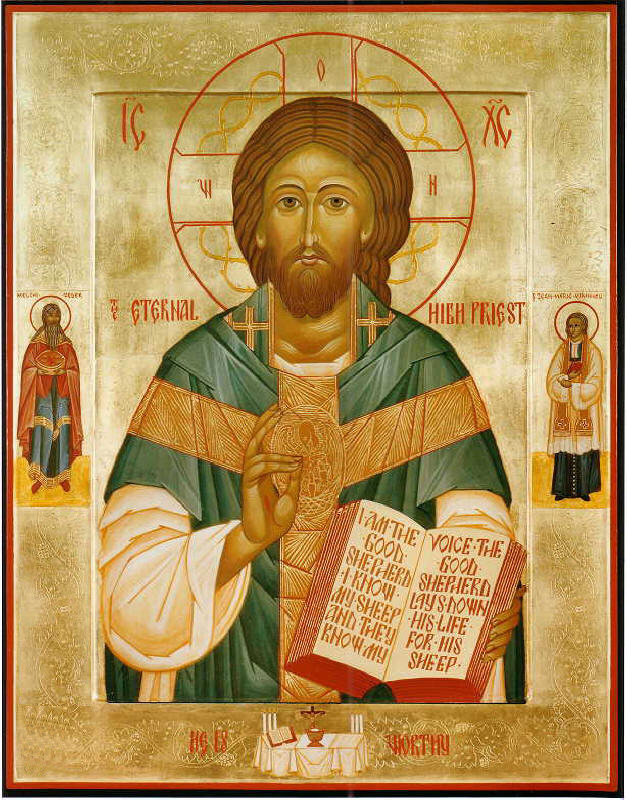
Jesus, High Priest
We thank you, God our Father, for those who have responded to your call to priestly ministry.
Accept this prayer we offer on their behalf: Fill your priests with the sure knowledge of your love.
Open their hearts to the power and consolation of the Holy Spirit.
Lead them to new depths of union with your Son.
Increase in them profound faith in the Sacraments they celebrate as they nourish, strengthen and heal us.
Lord Jesus Christ, grant that these, your priests, may inspire us to strive for holiness by the power of their example, as men of prayer who ponder your word and follow your will.
O Mary, Mother of Christ and our mother, guard with your maternal care these chosen ones, so dear to the Heart of your Son.
Intercede for our priests, that offering the Sacrifice of your Son, they may be conformed more each day to the image of your Son, our Lord and Savior, Jesus Christ. Amen.
Saint John Vianney, universal patron of priests, pray for us and our priests
This icon shows Jesus Christ, our eternal high priest.
The gold pelican over His heart represents self-sacrifice.
The border contains an altar and grapevines, representing the Mass, and icons of Melchizedek and St. Jean-Baptiste Vianney.
Melchizedek: king of righteousness (left icon) was priest and king of Jerusalem. He blessed Abraham and has been considered an ideal priest-king.
St. Jean-Baptiste Vianney is the patron saint of parish priests.
17
posted on
02/23/2020 8:46:18 PM PST
by
Salvation
("With God all things are possible." Matthew 19:26)
To: All
Pray a Rosary each day for our nation.
1. Sign of the Cross: In the name of the Father, and of the Son, and of the Holy Spirit. Amen.
2. The Apostles Creed: I BELIEVE in God, the Father almighty, Creator of heaven and earth, and in Jesus Christ, His only Son, our Lord, who was conceived by the Holy Spirit, born of the Virgin Mary, suffered under Pontius Pilate, was crucified, died, and was buried. He descended into hell; on the third day he rose again from the dead; he ascended into heaven, and is seated at the right hand of God, the Father Almighty; from there He shall come to judge the living and the dead.
I believe in the Holy Spirit, the holy catholic Church, the communion of saints, the forgiveness of sins, the resurrection of the body, and the life everlasting. Amen.
3. The Lord's Prayer: OUR Father, who art in heaven, hallowed be Thy name. Thy kingdom come. Thy will be done on earth as it is in heaven. Give us this day our daily bread and forgive us our trespasses as we forgive those who trespass against us. And lead us not into temptation, but deliver us from evil. Amen.
4. (3) Hail Mary: HAIL Mary, full of grace, the Lord is with thee. Blessed art thou amongst women and blessed is the fruit of thy womb, Jesus. Holy Mary, Mother of God, pray for us sinners, now, and in the hour of our death. Amen. (Three times)
5. Glory Be: GLORY be to the Father, and to the Son, and to the Holy Spirit. As it was in the beginning, is now, and ever shall be, world without end. Amen.
6. Fatima Prayer: Oh, my Jesus, forgive us our sins, save us from the fires of hell, lead all souls to heaven, especially those in most need of your mercy.
Announce each mystery, then say 1 Our Father, 10 Hail Marys, 1 Glory Be and 1 Fatima prayer. Repeat the process with each mystery.
End with the Hail Holy Queen:
Hail, Holy Queen, Mother of Mercy, our life, our sweetness and our hope! To thee do we cry, poor banished children of Eve! To thee do we send up our sighs, mourning and weeping in this vale of tears! Turn then, most gracious advocate, thine eyes of mercy towards us; and after this, our exile, show unto us the blessed fruit of thy womb, Jesus!
O clement, O loving, O sweet Virgin Mary! Pray for us, O holy Mother of God, that we may be made worthy of the promises of Christ.
Final step -- The Sign of the Cross
The Mysteries of the Rosary By tradition, Catholics meditate on these Mysteries during prayers of the Rosary. The biblical references follow each of the Mysteries below.
The Glorious Mysteries
(Wednesdays and Sundays)
1.The Resurrection (Matthew 28:1-8, Mark 16:1-18, Luke 24:1-12, John 20:1-29) [Spiritual fruit - Faith]
2. The Ascension (Mark 16:19-20, Luke 24:50-53, Acts 1:6-11) [Spiritual fruit - Christian Hope]
3. The Descent of the Holy Spirit (Acts 2:1-13) [Spiritual fruit - Gifts of the Holy Spirit]
4. The Assumption [Spiritual fruit - To Jesus through Mary]
5. The Coronation [Spiritual fruit - Grace of Final Perseverance]
18
posted on
02/23/2020 8:46:53 PM PST
by
Salvation
("With God all things are possible." Matthew 19:26)
To: All

St. Michael the Archangel
~ PRAYER ~
St. Michael, the Archangel, defend us in battle
Be our protection against the wickedness
and snares of the devil;
May God rebuke him, we humbly pray,
and do thou, O Prince of the heavenly host,
by the power of God,
Cast into hell Satan and all the evil spirits
who prowl through the world seeking the ruin of souls.
Amen
+
19
posted on
02/23/2020 8:48:20 PM PST
by
Salvation
("With God all things are possible." Matthew 19:26)
To: All

February Devotion: The Holy Family
Since the 16th century Catholic piety has assigned entire months to special devotions. The month of February has been primarily asociated with the Holy Family, probably due to the feast of Our Lord's presentation at the temple, celebrated on February 2. At the very outset of Christ's work on earth, God showed the world a family in which, as Pope Leo XIII teaches, "all men might behold a perfect model of domestic life, and of all virtue and holiness." The harmony, unity, and holiness which characterized this holy Family make it the model for all Christian families.
INVOCATION
Jesus, Mary, and Joseph most kind, Bless us now and in death's agony.
FOR THE PROTECTION OF THE HOLY FAMILY
Grant unto us, Lord Jesus, ever to follow the example of Thy holy Family, that in the hour of our death Thy glorious Virgin Mother together with blessed Joseph may come to meet us and we may be worthily received by Thee into everlasting dwellings: who livest and reignest world without end. Amen.
Roman Missal
CONSECRATION TO THE HOLY FAMILY
O Jesus, our most loving Redeemer, who having come to enlighten the world with Thy teaching and example, didst will to pass the greater part of Thy life in humility and subjection to Mary and Joseph in the poor home of Nazareth, thus sanctifying the Family that was to be an example for all Christian families, graciously receive our family as it dedicates and consecrates itself to Thee this day. Do Thou defend us, guard us and establish amongst us Thy holy fear, true peace, and concord in Christian love: in order that, by conforming ourselves to the divine pattern of Thy family, we may be able, all of us without exception, to attain to eternal happiness.
Mary, dear Mother of Jesus and Mother of us, by thy kindly intercession make this our humble offering acceptable in the sight of Jesus, and obtain for us His graces and blessings.
O Saint Joseph, most holy guardian of Jesus and Mary, assist us by thy prayers in all our spiritual and temporal necessities; that so we may be enabled to praise our divine Savior Jesus, together with Mary and thee, for all eternity.
Our Father, Hail Mary and Glory be, three times.
IN HONOR OF THE HOLY FAMILY
O God, heavenly Father, it was part of Thine eternal decree that Thine only-begotten Son, Jesus Christ, the Savior of the human race, should form a holy family with Mary, His blessed mother, and His foster father, Saint Joseph. In Nazareth home life was sanctified, and a perfect example was given to every Christian family. Grant, we beseech Thee, that we may fully comprehend and faithfully imitate the virtues of the Holy Family so that we may be united with them one day in their heavenly glory. Through the same Christ our Lord. Amen.
Prayer Source: Prayer Book, The by Reverend John P. O'Connell, M.A., S.T.D. and Jex Martin, M.A., The Catholic Press, Inc., Chicago, Illinois, 1954
Holy Family Chaplet
Jesus, Mary, and Joseph, I give you my heart.
Jesus, Mary, and Joseph, be with me in my last hour.
Jesus, Mary, and Joseph, may I breathe forth my soul
in peace with you.
Blessed be Jesus Christ, true God and true man.
Blessed be the great Mother of God, Mary most holy.
Blessed be St. Joseph, her most chaste spouse. Amen.
Say 3 Our Father's, 3 Hail Mary's, and 3 Glory be's.
PRAYER TO
THE HOLY FAMILY
===================================================================== ================
GOD our Heavenly Father, You call all peoples to be united as one family in worshipping You as the one and true God. You willed that Your Son become man, giving Him a virgin mother and a foster father to form the Holy Family of Nazareth.
WE pray: may the Holy Family of Jesus, Mary and Joseph, image and model of every human family unit walk in the spirit of Nazareth and grow in the understanding of its particular mission in society and the Church. May our families be living cells of love, faithfulness and unity, thus reflecting God's covenant with humanity and Christ's redeeming love for His Church.
JESUS, Mary and Joseph protect our families from all evil; keep us, who are away from home, one in love with our dear ones.
Parent's Prayer
-
Jesus, Son of God, Son of Man, and Son of Mary, I thank you for the gift of life you have entrusted to my care. Help me be a parent both tender and wise, both loving and forgiving.
- Mary, Holy Mother of our Lord and Savior Jesus Christ, and our Motherly Queen of Heaven, nourish our family with your heavenly grace. Help us to remain faithful to The Most Holy Trinity, in all our sorrows and joys.
- Joseph, Earthly father to our Lord God, guardian and spouse of Mary, keep our family safe from harm. Help us in all times of discouragement or anxiety.
- Holy Family of Nazareth, help our family to walk in your footsteps. May we be peace-loving and peace-giving.
Amen.
Imitating the Holy Family: Four Traits that Make It Possible
[Catholic Caucus] On the Holy Family [Angelus]
Biblical Teachings on Marriage and Family. A Homily for the Feast of the Holy Family
Feast of the Holy Family of Jesus, Mary, and Joseph
Recovering God's Plan for Marriage and Family: A Sermon on the Feast of the Holy Family
"Why were you looking for me?" (On the Feast of The Holy Family)
U.S. Postal Service Issues Holy Family Forever Stamp
On Prayer in the Life of the Holy Family
The Holy Family - held together by Love through all their problems [Ecumenical]
Feast of the Holy Family: The Christian Family is a Domestic Church
Chesterton on "The Human Family and the Holy Family"
Joseph, Mary and Jesus: A Model Family
ADVICE TO PARENTS by Saint Alphonsus Liguori (1696-1787)
The Holy Family
St. Joseph as Head of the Holy Family (Catholic/Orthodox Caucus)
Feast of the Holy Family
Feast of the Holy Family (Dom Guéranger OSB)
The Feast of the Holy Family
The Holy Family vs. The Holy Innocents: A Christmas season reflection [Catholic Caucus]
Vatican creche to place Holy Family in Joseph's carpentry workshop
The Redemption and Protection of the Family [Feast of the Holy Family]
Study Backs Tradition of Loreto House - Stones in Altar Match Those in Nazareth, It Says
Unraveling Jesus' mystery years in Egypt
Gaudi's Church of the Holy Family to be ready for worship in 2008
Imitating the Holy Family; Four Traits that Make It Possible
Lots of Graphics: Post your favorite image of the St. Mary and Child, the Holy Family...
20
posted on
02/23/2020 8:48:59 PM PST
by
Salvation
("With God all things are possible." Matthew 19:26)
Navigation: use the links below to view more comments.
first 1-20, 21-24 next last
Disclaimer:
Opinions posted on Free Republic are those of the individual
posters and do not necessarily represent the opinion of Free Republic or its
management. All materials posted herein are protected by copyright law and the
exemption for fair use of copyrighted works.
FreeRepublic.com is powered by software copyright 2000-2008 John Robinson
