
The Crucifixion with the Two Thieves
Master of the Pietà
Mid 14th century, Siena
Posted on 11/23/2019 8:56:15 PM PST by Salvation
KEYWORDS: catholic; jesuschrist; lk23; ordinarytime; prayer;
Please FReepmail me to get on/off the Alleluia Ping List.
From: 2 Samuel 5:1-3
David is Anointed King of Israel at Hebron
*********************************************************************************************
Commentary:
5:1-5. David’s consecration as king of Israel is told quite simply but the account
emphasizes details of primary importance in salvation history: the tribes of the
North and the South are all brothers: “we are your flesh and bone” (v. 1); the ima-
ges of the shepherd (v. 2), David’s original profession, conveys the notion of a ru-
ler and king who governs not for his own advantage but for the welfare of his sub-
jects; David’s covenant with the leaders (v. 3) is in line with the general doctrine
of covenant which is the basis of God’s relations with his people, and of those
between Israelite and Israelite; the figures given for David’s reigns (seven as king
of Judah, forty as king of Judah and Israel) are symbols of plenitude. Even in the
New Testament the numbers seven and forty have the same connotation (cf. Mt
4:2; 18:22; Rev 1:11; Acts 4:22; etc.). Hebron, the place where David was also
anointed king of Judah, was the main city of the South; within it was the cave of
Mach-pelah (cf. Gen 25:9) and close to it was the sacred oak of Mamre. How-
ever, it was replaced by Jerusalem perhaps to show that a new kingdom warran-
ted a new royal base.
David is a figure of Jesus Christ on many counts, but they all derive from the fact
that he is king: Jesus Christ, too will be acclaimed King of Israel. “But what did
it mean for the Lord to be acclaimed the King of Israel? What did it mean to the
King of all ages to be recognized as the king of men? Christ did not become the
King of Israel in order to demand tributes or to raise armies and make war against
the enemies [of Israel]; he became the King of Israel to reign over souls, to give
counsel that leads to eternal life, to bring those who were filled with faith, hope
and Love to the Kingdom of heaven” (St Augustine, “In loannis Evangelium”, 51,
4).
The liturgy of the Church uses this passage from the book of Samuel for the so-
lemnity of Our Lord Jesus Christ, Universal King, together with the passage a-
bout the crucifixion (Lk 23:35-43). Jesus won his kingdom through his obedience,
which has its climax in death on the cross, bringing about the definitive salvation
of all mankind.
*********************************************************************************************
Source: “The Navarre Bible: Text and Commentaries”. Biblical text from the
Revised Standard Version and New Vulgate. Commentaries by members of
the Faculty of Theology, University of Navarre, Spain.
Published by Four Courts Press, Kill Lane, Blackrock, Co. Dublin, Ireland, and
by Scepter Publishers in the United States.
From: Colossians 1:12-20
Prayer for Advancement in Holiness; Exhortation to Gratitude (Continuation)
Hymn in Praise of Christ as Head of All Creation
*********************************************************************************************
Commentary:
12-14. “The dominion of darkness”: the condition of enslavement to the devil of a
person in the state of sin. As is frequent in Sacred Scripture (cf. Is 58:10; Jn 12:
35; 1 Jn 1:5; 2:8; 2 Cor 6:14; Rom 13:11-14; Eph 5:7-13), the simile of movement
from darkness to light is used to refer to “redemption” or the change from a condi-
tion of sin to one of righteousness and friendship with God, which is effected by
infusion of sanctifying grace (cf. St Thomas, “Commentary on Col, ad loc.”).
“Light: this is a symbol of the risen Christ and also of the abundance of graces
which he won for mankind in his Easter Mystery. It also describes the whole en-
semble of supernatural benefits which grace brings with it — goodness, righteous-
ness (or holiness) and truth (cf. Eph 5:9), which lead to the glory of heaven (cf. 2
Cor 4:6). Hence the “rite of light”, so richly a symbol of supernatural realities,
which has formed part of baptismal liturgy since the first centuries.
The struggle between light and the power of darkness is referred to in many pas-
sages of Sacred Scripture (cf. Jn 1:5, 9-11). Darkness means both evil and the
power of the Evil One. Before the redemption took place, all men — as a conse-
quence of original sin and their personal sins — were slaves to sin; this slavery
darkened their minds and made it difficult for them to know God, who is the true
light. Christ our Lord, by carrying out the redemption and obtaining forgiveness
for our sins (cf. v. 14), rescued us from the kingdom of darkness from the tyran-
ny of the Evil One, and brought us into the kingdom of light, the kingdom of truth
and justice, of love and of peace (cf. “Preface for the Solemnity of Christ the
King”), enabling us to enjoy “the glorious freedom of the children of God” (Rom
8:21).
“His beloved Son”: the Hebrew expression “Son of his love”, which is paralleled
in the Greek, is one of the ways Jesus Christ is referred to in the New Testament
(cf. Mt 12:6; Lk 20:13). A variation, “my Son, the Beloved”, is spoken by the voice
from heaven, that is, by the Father, at Jesus’ baptism (cf. Mt 3:17; Mk 1:11; Lk 3:
22) and at the Transfiguration (cf. Mt 17:5; Mk 9:7; Lk 9:35).
By speaking in this way St Paul, like St John, is underlining the fact that “God is
love” (1 Jn 4:8). God’s love for us was made manifest by his sending his only Son
into the world so that we might live through him (cf. 1 Jn 4:9). By dying on the
Cross he won life for us; by redeeming us with his blood he obtained forgiveness
for our sins (cf. Col 1:14; Eph 2:4ff): “He revealed to us that God is love, and he
gave us the ‘new commandment’ of love (Jn 13:34), at the same time communica-
ting to us the certainty that the path of love is open for all people, so that the ef-
fort to establish universal brotherhood is not a vain one (cf. “Gaudium Et Spes”,
38). By conquering through his death on the Cross evil and the power of sin, by
his loving obedience he brought salvation to all” (John Paul II, “Reconciliatio Et
Paenitentia”, 10).
On the meaning of “redemption” and “forgiveness of sins”, see the note on Eph
1:7-8.
12. We Christians should be grateful to God for his great mercy in deigning to
free us from the power of the devil, forgiving our sins and making us worthy to
“share in the inheritance of the saints”. We have benefited in so many ways: “In
addition to the gift itself, he also gives us the power we need so receive it [...].
God has not only honored us by making us share in the inheritance, but has
made us worthy to possess it. And so we receive a double honor from God —
firstly, the position itself; and secondly, the capacity to measure up to it” (Chry-
sostom, “Hom. on Col, ad loc.”).
Our sharing in “the inheritance of the saints” enables us to draw on the treasury
of spiritual goods which the Church is continually applying to its members — pra-
yers, sacrifices and all kinds of meritorious actions, which benefit every Christian.
This “inheritance of the saints” — in which we begin to share in this present life —
will be found in its full and permanent form by those who attain everlasting joy.
The grace of conversion originates in God’s loving kindness. “Prior to God’s gift of
grace, although not every man might be sinful there is nothing that he does or can
do which would merit forgiveness or the grace of God. You must realize”, St John
of Avila says, “that it is God who has brought you out of darkness into his wonder-
ful light [...]. And what caused him to do so was not your past merits or any ser-
vice you have rendered him, but his kindness alone and the merits of our only me-
diator, Jesus Christ our Lord” (”Audi, Filia”, 65).
15-20. Now we come to a very beautiful hymn in praise of Christ’s sublime dignity
as God and as man. This was a truth deserving emphasis in view of the danger to
the faith which the false apostles’ teaching represented (cf. note on vv. 7-8). How-
ever, quite apart from the particular situation in Colossae, the sublime teaching
contained in this canticle holds good for all times; it is one of the most important
Christological texts in St Paul’s writings.
The real protagonist of this passage is the Son of God made man, whose two na-
tures, divine and human, are always linked in the divine person of the Word. How-
ever, at some points St Paul stresses his divinity (vv. 16, 17, 18b and 19) and at
others his humanity (vv. 15, 18a, 18c and 20). The underlying theme of the hymn
is Christ’s total pre-eminence over all creation.
We can distinguish two stanzas in the hymn. In the first (vv. 15-17) Christ’s domi-
nion is stated to embrace the entire cosmos, stemming as it does from his action
as Creator: “in him all things were created” (v. 16). This same statement is made
in the prologue to the fourth Gospel (cf. Jn 1:3), and it is implied in the Book of
Genesis, which tells us that creation was effected by God’s word (cf. Gen 1:3, 6,
9, etc.). Since Christ is the Word of God, he is above all things, and therefore St
Paul stresses that all angels — irrespective of their hierarchy or order — come un-
der his sway.
Christ’s pre-eminence over natural creation is followed by his primacy in the eco-
nomy of supernatural salvation, a second creation worked by God through grace.
The second stanza (vv. 18-20) refers to this further primacy of Christ: by his death
on the cross, Christ has restored peace and has reconciled all things — the world
and mankind — to God. Jews and Gentiles both are called to form part of one bo-
dy, the Church, of which Christ is the head; and all the celestial powers are sub-
ject to his authority.
This passage is, then, a sublime canticle celebrating Christ, the head by virtue
of his surpassing excellence and his salvific action. “The Son of God and of the
Blessed Virgin”, Pius XII teaches, “must be called the head of the Church for the
special reason of his preeminence. For the head holds the highest place. But
none holds a higher place than Christ as God for he is the Word of the Eternal
Father and is therefore justly called ‘the first-born of all creation’. None holds a
higher place than Christ as man, for he, born of the immaculate Virgin, is the
true and natural Son of God, and by reason of his miraculous and glorious resur-
rection by which he triumphed over death he is ‘the first-born from the dead’. And
none stands higher than he who, being the ‘one mediator between God and man’
(1 Tim 2:5), admirably unites earth with heaven; who, exalted on the Cross as
on his throne of mercy, has drawn all things to himself” (”Mystici Corporis”, 15).
15. By the unaided use of reason man can work out that God exists, but he
could never, on his own, have grasped the essence of God: in this sense God is
said to be invisible (cf. St Thomas, “Commentary on Col, ad loc.”). This is why it
is said in St John’s Gospel that “no one has ever seen God” (Jn 1:18).
In Sacred Scripture we are told that man was created “in the image of God” (Gen
1:26). However, only the second person of the Blessed Trinity, the Son, is the
perfect image and likeness of the Father. “The image [likeness] of a thing may
be found in something else in two ways; in one way it is found in something of
the same specific nature — as the image of the king is found in his son; in another
way it is found in something of a different nature, as the king’s image on the coin.
In the first sense the Son is the image of the Father; in the second sense man is
called the image of God; and therefore in order to express the imperfect character
of the divine image in man, man is not simply called ‘the image’ but is referred to
as being ‘according to the image’, whereby is expressed a certain movement or
tendency to perfection. But it cannot be said that the Son of God is ‘according to
the image’, because he is the perfect image of the Father” (”Summa Theologiae”,
I, q. 35, a. 2 ad 3). And so, “for something to be truly an image, it has to proceed
from another as similar to it in species, or at least in some aspect of the species”
(”Summa Theologiae”, I, q. 35, a. 1, c.) To say that the Son is “image of the invisi-
ble God” means that the Father and the Son are one-in-substance — that is, both
possess the same divine nature — with the nuance that the Son proceeds from
the Father. It also conveys the fact that they are two distinct persons, for no one
is the image of himself.
The supreme revelation of God is that effected by the Son of God through his In-
carnation. He is the only one who can say, “He who has seen me has seen the
Father” (Jn 14:9). His sacred humanity, therefore, reflects the perfections of God,
which he possesses by virtue of the hypostatic union — the union of divine nature
and human nature which occurs in his person, which is divine. The second Per-
son of the Trinity restored man to his original dignity. The image of God, imper-
fect though it be, which there is in every man and woman, was blurred by Adam’s
sin; but it was restored in Christ: God’s true self-image takes on a nature the
same as ours, and thanks to the redemption wrought by his death, we obtain
forgiveness of sins (v. 14).
Jesus Christ is the “first-born of all creation” by virtue of the hypostatic union. He
is, of course, prior to all creation, for he proceeds eternally from the Father by ge-
neration. This the Church has always believed, and it proclaims it in the Creed:
“born of the Father before time began ..., begotten, not made, of one being [con-
substantial] with the Father” (”Nicene-Constantinopolitan Creed”).
In Jewish culture, the first-born was first in honor and in law. When the Apostle
calls Jesus “the first-born of all creation”, he is referring to the fact that Christ has
pre-eminence and headship over all created things, because not only does he pre-
date them but they were all created “through him” and “for him” (v. 16).
16-17. Jesus Christ is God; this is why he has pre-eminence over all created
things. The relationships between Christ and creation are spelled out by three pre-
positions. “In him all things were created”: in Christ: he is their source, their cen-
ter and their model or exemplary cause. “All things were created through him and
for him”: through him, in other words, God the Father, through God the Son, cre-
ates all things; and for him, because he is the last end, the purpose or goal of
everything.
St Paul goes on to say that “in him all things hold together”; “the Son of God has
not only created everything: he conserves everything in being; thus, if his sove-
reign will were to cease to operate for even an instant, everything would return in-
to the nothingness from which he drew everything that exists” (Chrysostom,
“Hom. on Col, ad loc.”).
All created things, then, continue in existence because they share, albeit in a li-
mited way, in Christ’s infinite fullness of existence or perfection. His dominion ex-
tends not only over celestial things but also over all material things, however in-
significant they may seem: it embraces everything in heaven and in the physical
universe.
The sacred text also points to Christ’s supremacy over invisible creation, that is,
over the angels and celestial hierarchies (cf. Heb 1:5). If St Paul stresses this
fact, it is to expose the errors of those who were depicting Jesus as a creature
intermediary between corporeal beings and spiritual created beings, and, there-
fore, lower than the angels.
18. “He is the head of the body, the church”: this image shows the relationship
of Christ with the Church, to which he sends his grace in abundance, bearing life
to all its members. ‘The head,” St Augustine says, “is our very Savior, who suf-
fered under Pontius Pilate and now, after rising from the dead, is seated at the
right hand of the Father. And his body is the Church [...] For the whole Church,
made up of the assembly of the faithful — for all the faithful are Christ’s mem-
bers — has Christ, as its head, who rules his body from on high” (”Enarrationes
in Psalmos”, 56, 1).
St Paul unequivocally teaches that the Church is a body. “Now if the Church is
a body it must be something one and undivided, according to the statement of St
Paul: ‘We, though many, are one body in Christ’ (Rom 12:5). And not only must
it be one and undivided, it must also be something concrete and visible, as our
Predecessor of happy memory, Leo XIII, says in his Encyclical “Satis Cognitum”:
‘By the very fact of being a body the Church is visible.’ It is therefore an aberra-
tion from divine truth to represent the Church as something intangible and invisi-
ble, as a mere ‘pneumatic’ entity joining together by an invisible link a number
of communities of Christians in spite of their difference in faith.
“But a body requires a number of members so connected that they help one ano-
ther. And, in fact, as in our mortal organism when one member suffers the others
suffer with it, and the healthy members come to the assistance of those who are
ailing, so in the Church individual members do not live only for themselves but
also help one another, alleviating their suffering and helping to build up the entire
body” (Pius XII, “Mystici Corporis”, 7).
“He is the beginning, the first-born from the dead”: this can be said because he
was the first man to rise from the dead, never again to die (cf. 1 Cor 15:20; Rev
1:5), and also because thanks to him it enabled men to experience resurrection
in glory (cf. 1 Cor 15:22; Rom 8:11), because they are justified through him (cf.
Rom 4:25).
So, just as the previous verses looked to Christ’s pre-eminent role in creations
the hymn now focuses on his primacy in a new creation — the rebirth of mankind,
and all creation in its train, in the supernatural order of grace and glory. Christ
rose from the dead to enable us also to walk in newness of life (cf. Rom 6:4).
Therefore, in every way Jesus Christ is “pre-eminent.”
19. The word “pleroma” translated here as “fullness”, has two meanings in Greek:
one, an active meaning, describes something that “fills” or “completes”; for exam-
ple, a ship’s full load can be referred to as its pleroma. The other meaning is pas-
sive, “that which is filled” or “that which is complete”, so that a ship can be said
to be “pleroma” when it is fully loaded. In this passage St Paul is using the word
in both senses: Christ is the fullness (passive sense) of the Godhead (cf. Col 2:9),
because he is full of all the perfections of the divine essence; and he is the full-
ness (active sense), because he fills the Church and all creation.
St John Chrysostom suggests that “the word ‘fullness’ is to be taken to mean the
divinity of Jesus Christ [...]. This term has been chosen the better to show that
the very essence of the godhead resides in Jesus Christ” (”Hom. on Col, ad loc.”).
Since Christ possesses the divine nature, he also possesses the fullness of the
supernatural gifts, for himself and for all mankind. Hence St Thomas’ comment
that pleroma “reveals the dignity of the head in so far as it has the fullness of all
grace” (”Commentary on Col”, ad loc.). In this sense, Christ is the fullness of the
Church, for as its head he vivifies his body with all kinds of unmerited gifts. Final-
ly, the entire created universe can be termed the “fullness” (”pleroma”) of Christ,
because everything that exists in heaven and on earth has been created and is
maintained in existence by him (cf. vv. 16-17); they are ever-present to him and
are ruled by him (cf. Is 6:3; Ps 139:8; Wis 1:7; etc.). Thus, the world, which was
created good (cf. Gen 1:31) tends towards its fulfillment insofar as it clearly re-
flects the imprint God gave it at the start of creation.
20. Since Christ is pre-eminent over all creation, the Father chose to reconcile
all things to himself through him. Sin had cut man off from God, rupturing the per-
fect order which originally reigned in the created world. By shedding his blood on
the cross, Christ obtained peace for us; nothing in the universe falls outside the
scope of his peace-giving influence. He who in the beginning created all things in
heaven and on earth has reestablished peace throughout creation.
This reconciliation of all things, ushered in by Christ, is fostered by the Holy
Spirit who enables the Church to continue the process of reconciliation. However,
we will not attain the fullness of this reconciliation until we reach heaven, when
the entire created universe, along with mankind, will be perfectly renewed in
Christ (cf. “Lumen Gentium”, 48).
“The history of salvation — the salvation of the whole of humanity, as well as of
every human being of whatever period—is the wonderful history of a reconciliation;
the reconciliation whereby God, as Father, in the Blood and the Cross of his Son
made man, reconciles the world to himself and thus brings into being a new fa-
mily of those who have been reconciled.
“Reconciliation becomes necessary because there has been the break of sin
from which derive all the other forms of break within man and about him. Recon-
ciliation therefore, in order to be complete, necessarily requires liberation from
sin, which is to be rejected in its deepest roots. Thus a close internal link unites
“conversion” and “reconciliation”. It is impossible to split these two realities or to
speak of one and say nothing of the other (John Paul II, “Reconciliatio Et Paeni-
tentia”, 13).
Jesus Christ also counts on the cooperation of every individual Christian to apply
his work of redemption and peace to all creation. The founder of Opus Dei says,
in this connection: “We must love the world and work and all human things. For
the world is good. Adam’s sin destroyed the divine balance of creation; but God
the Father sent his only Son to reestablish peace, so that we his children by
adoption, might free creation from disorder and reconcile all things to God”
(”Christ Is Passing By”, 112).
*********************************************************************************************
Source: “The Navarre Bible: Text and Commentaries”. Biblical text from the
Revised Standard Version and New Vulgate. Commentaries by members of
the Faculty of Theology, University of Navarre, Spain.
Published by Four Courts Press, Kill Lane, Blackrock, Co. Dublin, Ireland, and
by Scepter Publishers in the United States.
From: Luke 23:35-43
The Crucified Christ is Mocked
The Good Thief
*********************************************************************************************
Commentary:
35. The Roman governor’s soldiers join the Jewish people and their leaders in mo-
cking Jesus; thus, everyone — Jews and Gentiles — contributed to making Christ’s
passion even more bitter. But we should not forget that we too make a mockery
of our Lord every time we fall into sin or fail to respond sufficiently to grace. This
is why St. Paul says that those who sin “crucify the Son of God on their own ac-
count and hold Him up to contempt” (Hebrews 6:6).
39-43. The episode of the two thieves invites us to admire the designs of divine
providence, of grace and human freedom. Both thieves are in the same position
— in the presence of the Eternal High Priest as He offers Himself in sacrifice for
them for all mankind. One of them hardens his heart, despairs and blasphemes,
while the other repents, prays with confidence to Christ and is promised imme-
diate salvation. “The Lord,” St. Ambrose comments, “always grants more than
one asks: the thief only asked Him to remember Him, but the Lord says to him,
‘Truly, I say to you, today, you will be with Me in Paradise.’ Life consists in dwel-
ling with Jesus Christ, and where Jesus Christ is there is His Kingdom” (”Expo-
sitio Evangelii Sec. Lucam, in loc.). “It is one thing for man to judge someone he
does not know; another, for God, who can see into a person’s conscience.
Among men, confession is followed by punishment; whereas confession to God
is followed by salvation” (St. John Chrysostom, “De Cruce Et Latrone”).
While we make our way through life, we all sin, but we can all repent also. God
is always waiting for us with His arms wide open, ready to forgive us. Therefore,
no one should despair: everyone should try to have a strong hope in God’s mercy.
But no one may presume that he will be saved, for none of us can be absolutely
certain of our final perseverance (cf. Council of Trent, “De Justificatione”, Canon
16). This relative uncertainty is a spur God gives us to be ever vigilant; this vigi-
lance in turns helps us progress in the work of our sanctification as Christians.
42. “Many times have I repeated that verse of the eucharistic hymn: “Peto quod
petivit latro poenitens,” and it always fills me with emotion: to ask like the peni-
tent did! He recognized that he himself deserved that awful punishment.... And
with a word he stole Christ’s heart and ‘opened up for himself’ the gates of Hea-
ven” (St. J. Escriva, “The Way of the Cross”, XII, 4).
43. In responding to the good thief, Jesus reveals that He is God, for He has po-
wer over man’s eternal destiny; and He also shows that He is infinitely merciful
and does not reject the soul who sincerely repents. Similarly by these words
Jesus reveals to us a basic truth of faith: “We believe in eternal life. We believe
that the souls of all who die in the grace of Christ — whether they must still make
expiation in the fire of Purgatory, or whether from the moment they leave their bo-
dies they are received by Jesus Christ into Paradise like the good thief — go to
form the People of God which succeeds death, death which will be totally de-
stroyed on the day of the Resurrection when these souls are reunited with their
bodies” (Paul VI, “Creed of the People of God”, 28).
*********************************************************************************************
Source: “The Navarre Bible: Text and Commentaries”. Biblical text from the
Revised Standard Version and New Vulgate. Commentaries by members of
the Faculty of Theology, University of Navarre, Spain.
Published by Four Courts Press, Kill Lane, Blackrock, Co. Dublin, Ireland, and
by Scepter Publishers in the United States.
Liturgical Colour: White.
| First reading | 2 Samuel 5:1-3 © |
|---|
| Responsorial Psalm |
|---|
| Psalm 121(122):1-5 © |
| Second reading |
|---|
| Colossians 1:12-20 © |
| Gospel Acclamation | Mk11:10 |
|---|
| Gospel | Luke 23:35-43 © |
|---|
| Luke | |||
| English: Douay-Rheims | Latin: Vulgata Clementina | Greek NT: Byzantine/Majority Text (2000) | |
| Luke 23 |
|||
| 35. | And the people stood beholding, and the rulers with them derided him, saying: He saved others; let him save himself, if he be Christ, the elect of God. | Et stabat populus spectans, et deridebant eum principes cum eis, dicentes : Alios salvos fecit, se salvum faciat, si hic est Christus Dei electus. | και ειστηκει ο λαος θεωρων εξεμυκτηριζον δε και οι αρχοντες συν αυτοις λεγοντες αλλους εσωσεν σωσατω εαυτον ει ουτος εστιν ο χριστος ο του θεου εκλεκτος |
| 36. | And the soldiers also mocked him, coming to him, and offering him vinegar, | Illudebant autem ei et milites accedentes, et acetum offerentes ei, | ενεπαιζον δε αυτω και οι στρατιωται προσερχομενοι και οξος προσφεροντες αυτω |
| 37. | And saying: If thou be the king of the Jews, save thyself. | et dicentes : Si tu es rex Judæorum, salvum te fac. | και λεγοντες ει συ ει ο βασιλευς των ιουδαιων σωσον σεαυτον |
| 38. | And there was also a superscription written over him in letters of Greek, and Latin, and Hebrew: THIS IS THE KING OF THE JEWS. | Erat autem et superscriptio scripta super eum litteris græcis, et latinis, et hebraicis : Hic est rex Judæorum. | ην δε και επιγραφη γεγραμμενη επ αυτω γραμμασιν ελληνικοις και ρωμαικοις και εβραικοις ουτος εστιν ο βασιλευς των ιουδαιων |
| 39. | And one of those robbers who were hanged, blasphemed him, saying: If thou be Christ, save thyself and us. | Unus autem de his, qui pendebant, latronibus, blasphemabat eum, dicens : Si tu es Christus, salvum fac temetipsum et nos. | εις δε των κρεμασθεντων κακουργων εβλασφημει αυτον λεγων ει συ ει ο χριστος σωσον σεαυτον και ημας |
| 40. | But the other answering, rebuked him, saying: Neither dost thou fear God, seeing thou art condemned under the same condemnation? | Respondens autem alter increpabat eum, dicens : Neque tu times Deum, quod in eadem damnatione es. | αποκριθεις δε ο ετερος επετιμα αυτω λεγων ουδε φοβη συ τον θεον οτι εν τω αυτω κριματι ει |
| 41. | And we indeed justly, for we receive the due reward of our deeds; but this man hath done no evil. | Et nos quidem juste, nam digna factis recipimus : hic vero nihil mali gessit. | και ημεις μεν δικαιως αξια γαρ ων επραξαμεν απολαμβανομεν ουτος δε ουδεν ατοπον επραξεν |
| 42. | And he said to Jesus: Lord, remember me when thou shalt come into thy kingdom. | Et dicebat ad Jesum : Domine, memento mei cum veneris in regnum tuum. | και ελεγεν τω ιησου μνησθητι μου κυριε οταν ελθης εν τη βασιλεια σου |
| 43. | And Jesus said to him: Amen I say to thee, this day thou shalt be with me in paradise. | Et dixit illi Jesus : Amen dico tibi : Hodie mecum eris in paradiso. | και ειπεν αυτω ο ιησους αμην λεγω σοι σημερον μετ εμου εση εν τω παραδεισω |
Pray for Pope Francis.
50 Boko Haram Islamic Radicals Killed; 1,000 Hostages, Women and Children, Rescued in Nigeria
Nigeria: In the Face of Ongoing Islamist Attacks, the Faith is Growing
US Promises to Help Nigeria Exterminate Boko Haram
Is This Bishop Right about the Rosary Conquering Boko Haram? [Catholic Caucus]
Why Boko Haram and ISIS Target Women
Report reveals scale of Boko Haram violence inflictef on Nigerian Catholics
Military evacuating girls, women rescued from Boko Haram
Echos of Lepanto Nigerian bishop says rosary will bring down Boko Harm
After vision of Christ, Nigerian bishop says rosary will bring down Boko Haram (Catholic Caucus)
Nigerian Bishop Says Christ Showed Him How to Beat Islamic Terror Group
We thank you, God our Father, for those who have responded to your call to priestly ministry.
Accept this prayer we offer on their behalf: Fill your priests with the sure knowledge of your love.
Open their hearts to the power and consolation of the Holy Spirit.
Lead them to new depths of union with your Son.
Increase in them profound faith in the Sacraments they celebrate as they nourish, strengthen and heal us.
Lord Jesus Christ, grant that these, your priests, may inspire us to strive for holiness by the power of their example, as men of prayer who ponder your word and follow your will.
O Mary, Mother of Christ and our mother, guard with your maternal care these chosen ones, so dear to the Heart of your Son.
Intercede for our priests, that offering the Sacrifice of your Son, they may be conformed more each day to the image of your Son, our Lord and Savior, Jesus Christ. Amen.
Saint John Vianney, universal patron of priests, pray for us and our priests
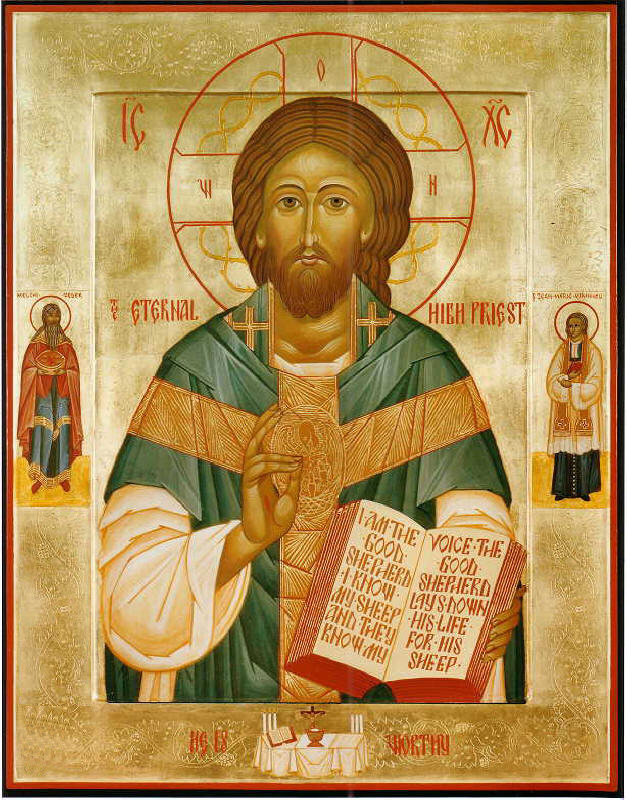
This icon shows Jesus Christ, our eternal high priest.
The gold pelican over His heart represents self-sacrifice.
The border contains an altar and grapevines, representing the Mass, and icons of Melchizedek and St. Jean-Baptiste Vianney.
Melchizedek: king of righteousness (left icon) was priest and king of Jerusalem. He blessed Abraham and has been considered an ideal priest-king.
St. Jean-Baptiste Vianney is the patron saint of parish priests.

1. Sign of the Cross: In the name of the Father, and of the Son, and of the Holy Spirit. Amen.
2. The Apostles Creed: I BELIEVE in God, the Father almighty, Creator of heaven and earth, and in Jesus Christ, His only Son, our Lord, who was conceived by the Holy Spirit, born of the Virgin Mary, suffered under Pontius Pilate, was crucified, died, and was buried. He descended into hell; on the third day he rose again from the dead; he ascended into heaven, and is seated at the right hand of God, the Father Almighty; from there He shall come to judge the living and the dead.
I believe in the Holy Spirit, the holy catholic Church, the communion of saints, the forgiveness of sins, the resurrection of the body, and the life everlasting. Amen.
3. The Lord's Prayer: OUR Father, who art in heaven, hallowed be Thy name. Thy kingdom come. Thy will be done on earth as it is in heaven. Give us this day our daily bread and forgive us our trespasses as we forgive those who trespass against us. And lead us not into temptation, but deliver us from evil. Amen.
4. (3) Hail Mary: HAIL Mary, full of grace, the Lord is with thee. Blessed art thou amongst women and blessed is the fruit of thy womb, Jesus. Holy Mary, Mother of God, pray for us sinners, now, and in the hour of our death. Amen. (Three times)
5. Glory Be: GLORY be to the Father, and to the Son, and to the Holy Spirit. As it was in the beginning, is now, and ever shall be, world without end. Amen.
6. Fatima Prayer: Oh, my Jesus, forgive us our sins, save us from the fires of hell, lead all souls to heaven, especially those in most need of your mercy.
Announce each mystery, then say 1 Our Father, 10 Hail Marys, 1 Glory Be and 1 Fatima prayer. Repeat the process with each mystery.
End with the Hail Holy Queen:
Hail, Holy Queen, Mother of Mercy, our life, our sweetness and our hope! To thee do we cry, poor banished children of Eve! To thee do we send up our sighs, mourning and weeping in this vale of tears! Turn then, most gracious advocate, thine eyes of mercy towards us; and after this, our exile, show unto us the blessed fruit of thy womb, Jesus!
O clement, O loving, O sweet Virgin Mary! Pray for us, O holy Mother of God, that we may be made worthy of the promises of Christ.
Final step -- The Sign of the Cross
The Mysteries of the Rosary By tradition, Catholics meditate on these Mysteries during prayers of the Rosary. The biblical references follow each of the Mysteries below.
The Glorious Mysteries
(Wednesdays and Sundays)
1.The Resurrection (Matthew 28:1-8, Mark 16:1-18, Luke 24:1-12, John 20:1-29) [Spiritual fruit - Faith]
2. The Ascension (Mark 16:19-20, Luke 24:50-53, Acts 1:6-11) [Spiritual fruit - Christian Hope]
3. The Descent of the Holy Spirit (Acts 2:1-13) [Spiritual fruit - Gifts of the Holy Spirit]
4. The Assumption [Spiritual fruit - To Jesus through Mary]
5. The Coronation [Spiritual fruit - Grace of Final Perseverance]
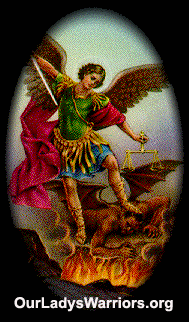
St. Michael the Archangel
~ PRAYER ~
St. Michael, the Archangel, defend us in battle
Be our protection against the wickedness
and snares of the devil;
May God rebuke him, we humbly pray,
and do thou, O Prince of the heavenly host,
by the power of God,
Cast into hell Satan and all the evil spirits
who prowl through the world seeking the ruin of souls.
Amen
+
Disclaimer: Opinions posted on Free Republic are those of the individual posters and do not necessarily represent the opinion of Free Republic or its management. All materials posted herein are protected by copyright law and the exemption for fair use of copyrighted works.