
The Last Judgment
Attribution unknown, Russian
Posted on 10/22/2019 8:04:01 PM PDT by Salvation
KEYWORDS: catholic; lk12; ordinarytime; prayer; saints;
Please FReepmail me to get on/off the Alleluia Ping List.
From: Romans 6:12-18
Liberation from Sin
[15] What then? Are we to sin because we are not under law but under grace?
By no means! [16] Do you not know that if you yield yourselves to any one as
obedient slaves, you are slaves of the one whom you obey, either of sin, which
leads to death, or of obedience, which leads to righteousness? [17] But thanks
be to God, that you who were once slaves of sin have become obedient from the
heart to the standard of teaching to which you were committed, [18] and, having
been set free from sin, have become slaves of righteousness.
*********************************************************************************************
Commentary:
12-13. Our body, while forming one substance with our soul, is also an instru-
ment (like a pen in the hand of a writer) which can be used either to do works of
justice and piety or to enter into combat against the spirit. True, it is a “mortal bo-
dy”, but, St John Chrysostom comments, “It is not in any sense an evil thing, be-
cause it can be a weapon of holiness and righteousness [...]. Our body stands
between vice and virtue. It is a weapon we can freely put to one use or the other.
The soldier who fights to defend his country uses the same weapons as the cri-
minal who makes an attempt on the life of his fellow citizens [...]. And so the bo-
dy can be an instrument of good or evil depending on what the soul chooses: it
is not naturally disposed to either course” (”Hom. on Rom”, 11).
*********************************************************************************************
Source: “The Navarre Bible: Text and Commentaries”. Biblical text from the
Revised Standard Version and New Vulgate. Commentaries by members of
the Faculty of Theology, University of Navarre, Spain.
Published by Four Courts Press, Kill Lane, Blackrock, Co. Dublin, Ireland, and
by Scepter Publishers in the United States.
From: Luke 12:39-48
The Need for Vigilance and the Parable of the Steward (Continuation)
[41] Peter said, “Lord are you telling this parable for us or for all?” [42] And the
Lord said, “Who then is the faithful and wise steward, whom his master will set o-
ver his household, to give them their portion of food at the proper time? [43] Bles-
sed is that servant whom his master when he comes will find so doing. [44] Truly
I tell you, he will set him over all his possessions. [45] But if that servant says to
himself, ‘My master is delayed in coming,’ and begins to beat the menservants
and the maidservants, and to eat and drink and get drunk, [46] the master of that
servant will come on a day when he does not expect him and at an hour he does
not know, and will punish him, and put him with the unfaithful. [47] And that ser-
vant who knew his master’s will, but did not make ready or act according to his
will, shall receive a severe beating. [48] But he who did not know, and did what
deserved a beating, shall receive a light beating. Everyone to whom much is gi-
ven, of him much will be required; and of him to whom men commit much they
will demand the more.”
*********************************************************************************************
Commentary:
40. God has chosen to hide from us the time of our death and the time when the
world will come to an end. Immediately after death everyone undergoes the Parti-
cular Judgment: “just as it is appointed for men to die once, and after that comes
judgment...” (Hebrews 9:27). The end of the world is when the General Judgment
will take place.
41-48. After our Lord’s exhortation to vigilance, St. Peter asks a question (verse
41), the answer to which is the key to understanding this parable. On the one
hand, Jesus emphasizes that we simply do not know exactly when God is going
to ask us to render an account of our life; on the other — answering Peter’s ques-
tion — our Lord explains that His teaching is addressed to every individual. God
will ask everyone to render an account of his doings: everyone has a mission to
fulfill in this life and he has to account for it before the judgment seat of God and
be judged on what he has produced, be it much or little.
“Since we know neither the day nor the hour, we should follow the advice of the
Lord and watch constantly so that, when the single course of our earthly life is
completed (cf. Hebrews 9:27), we may merit to enter with Him into the marriage
feast and be numbered among the blessed (cf. Matthew 25:31-46) and not, like
the wicked and slothful servants (cf. Matthew 25:26), be ordered to depart into
the eternal fire (cf. Matthew 25:41)” (Vatican II, “Lumen Gentium”, 48).
*********************************************************************************************
Source: “The Navarre Bible: Text and Commentaries”. Biblical text from the
Revised Standard Version and New Vulgate. Commentaries by members of
the Faculty of Theology, University of Navarre, Spain.
Published by Four Courts Press, Kill Lane, Blackrock, Co. Dublin, Ireland, and
by Scepter Publishers in the United States.
Liturgical Colour: Green.
| First reading | Romans 6:12-18 © |
|---|
| Make every part of your body a weapon fighting on the side of God |
|---|
| Responsorial Psalm | Psalm 123(124) © |
|---|
| Gospel Acclamation | Jn10:27 |
|---|
| Or: | Mt24:42,44 |
|---|
| Gospel | Luke 12:39-48 © |
|---|
| The Son of Man is coming at an hour you do not expect |
|---|
That servant who knew his master’s will but did not make preparations nor act in accord with his will shall be beaten severely;
and the servant who was ignorant of his master’s will but acted in a way deserving of a severe beating shall be beaten only lightly.
Much will be required of the person entrusted with much, and still more will be demanded of the person entrusted with more.”
**************************************
And many are the rewards of those who follow His Will.. His Love is very great.
| Luke | |||
| English: Douay-Rheims | Latin: Vulgata Clementina | Greek NT: Byzantine/Majority Text (2000) | |
| Luke 12 |
|||
| 39. | But this know ye, that if the householder did know at what hour the thief would come, he would surely watch, and would not suffer his house to be broken open. | Hoc autem scitote, quoniam si sciret paterfamilias, qua hora fur veniret, vigilaret utique, et non sineret perfodi domum suam. | τουτο δε γινωσκετε οτι ει ηδει ο οικοδεσποτης ποια ωρα ο κλεπτης ερχεται εγρηγορησεν αν και ουκ αν αφηκεν διορυγηναι τον οικον αυτου |
| 40. | Be you then also ready: for at what hour you think not, the Son of man will come. | Et vos estote parati : quia qua hora non putatis, Filius hominis veniet. | και υμεις ουν γινεσθε ετοιμοι οτι η ωρα ου δοκειτε ο υιος του ανθρωπου ερχεται |
| 41. | And Peter said to him: Lord, dost thou speak this parable to us, or likewise to all? | Ait autem et Petrus : Domine, ad nos dicis hanc parabolam, an et ad omnes ? | ειπεν δε αυτω ο πετρος κυριε προς ημας την παραβολην ταυτην λεγεις η και προς παντας |
| 42. | And the Lord said: Who (thinkest thou) is the faithful and wise steward, whom his lord setteth over his family, to give them their measure of wheat in due season? | Dixit autem Dominus : Quis, putas, est fidelis dispensator, et prudens, quem constituit dominus supra familiam suam, ut det illis in tempore tritici mensuram ? | ειπεν δε ο κυριος τις αρα εστιν ο πιστος οικονομος και φρονιμος ον καταστησει ο κυριος επι της θεραπειας αυτου του διδοναι εν καιρω το σιτομετριον |
| 43. | Blessed is that servant, whom when his lord shall come, he shall find so doing. | Beatus ille servus quem, cum venerit dominus, invenerit ita facientem. | μακαριος ο δουλος εκεινος ον ελθων ο κυριος αυτου ευρησει ποιουντα ουτως |
| 44. | Verily I say to you, he will set him over all that he possesseth. | Vere dico vobis, quoniam supra omnia quæ possidet, constituet illum. | αληθως λεγω υμιν οτι επι πασιν τοις υπαρχουσιν αυτου καταστησει αυτον |
| 45. | But if that servant shall say in his heart: My lord is long a coming; and shall begin to strike the menservants and maidservants, and to eat and to drink and be drunk: | Quod si dixerit servus ille in corde suo : Moram facit dominus meus venire : et cœperit percutere servos, et ancillas, et edere, et bibere, et inebriari : | εαν δε ειπη ο δουλος εκεινος εν τη καρδια αυτου χρονιζει ο κυριος μου ερχεσθαι και αρξηται τυπτειν τους παιδας και τας παιδισκας εσθιειν τε και πινειν και μεθυσκεσθαι |
| 46. | The lord of that servant will come in the day that he hopeth not, and at the hour that he knoweth not, and shall separate him, and shall appoint him his portion with unbelievers. | veniet dominus servi illius in die qua non sperat, et hora qua nescit, et dividet eum, partemque ejus cum infidelibus ponet. | ηξει ο κυριος του δουλου εκεινου εν ημερα η ου προσδοκα και εν ωρα η ου γινωσκει και διχοτομησει αυτον και το μερος αυτου μετα των απιστων θησει |
| 47. | And that servant who knew the will of his lord, and prepared not himself, and did not according to his will, shall be beaten with many stripes. | Ille autem servus qui cognovit voluntatem domini sui, et non præparavit, et non facit secundum voluntatem ejus, vapulabit multis : | εκεινος δε ο δουλος ο γνους το θελημα του κυριου εαυτου και μη ετοιμασας μηδε ποιησας προς το θελημα αυτου δαρησεται πολλας |
| 48. | But he that knew not, and did things worthy of stripes, shall be beaten with few stripes. And unto whomsoever much is given, of him much shall be required: and to whom they have committed much, of him they will demand the more. | qui autem non cognovit, et fecit digna plagis, vapulabit paucis. Omni autem cui multum datum est, multum quæretur ab eo : et cui commendaverunt multum, plus petent ab eo. | ο δε μη γνους ποιησας δε αξια πληγων δαρησεται ολιγας παντι δε ω εδοθη πολυ πολυ ζητηθησεται παρ αυτου και ω παρεθεντο πολυ περισσοτερον αιτησουσιν αυτον |
It has been said the Christian saints are the world’s greatest optimists. Not blind to the existence and consequences of evil, they base their confidence on the power of Christ’s redemption. The power of conversion through Christ extends not only to sinful people but also to calamitous events.
Imagine being born in the 14th century. One-third of the population and nearly 40 percent of the clergy were wiped out by the bubonic plague. The Western Schism split the Church with two or three claimants to the Holy See at one time. England and France were at war. The city-states of Italy were constantly in conflict. No wonder that gloom dominated the spirit of the culture and the times.
John Capistrano was born in 1386. His education was thorough. His talents and success were great. When he was 26 he was made governor of Perugia. Imprisoned after a battle against the Malatestas, he resolved to change his way of life completely. At the age of 30 he entered the Franciscan novitiate and was ordained a priest four years later.
John’s preaching attracted great throngs at a time of religious apathy and confusion. He and 12 Franciscan brethren were received in the countries of central Europe as angels of God. They were instrumental in reviving a dying faith and devotion.
The Franciscan Order itself was in turmoil over the interpretation and observance of the Rule of St. Francis. Through John’s tireless efforts and his expertise in law, the heretical Fraticelli were suppressed and the “Spirituals” were freed from interference in their stricter observance.
John of Capistrano helped bring about a brief reunion with the Greek and Armenian Churches.
When the Turks captured Constantinople in 1453, John was commissioned to preach a crusade for the defense of Europe. Gaining little response in Bavaria and Austria, he decided to concentrate his efforts in Hungary. He led the army to Belgrade. Under the great General John Hunyadi, they gained an overwhelming victory, and the siege of Belgrade was lifted. Worn out by his superhuman efforts, Capistrano was an easy prey to an infection after the battle. He died on October 23, 1456.
John Hofer, a biographer of John Capistrano, recalls a Brussels organization named after the saint. Seeking to solve life problems in a fully Christian spirit, its motto was: “Initiative, Organization, Activity.” These three words characterized John’s life. He was not one to sit around. His deep Christian optimism drove him to battle problems at all levels with the confidence engendered by a deep faith in Christ.
Judges

Pray for Pope Francis.
50 Boko Haram Islamic Radicals Killed; 1,000 Hostages, Women and Children, Rescued in Nigeria
Nigeria: In the Face of Ongoing Islamist Attacks, the Faith is Growing
US Promises to Help Nigeria Exterminate Boko Haram
Is This Bishop Right about the Rosary Conquering Boko Haram? [Catholic Caucus]
Why Boko Haram and ISIS Target Women
Report reveals scale of Boko Haram violence inflictef on Nigerian Catholics
Military evacuating girls, women rescued from Boko Haram
Echos of Lepanto Nigerian bishop says rosary will bring down Boko Harm
After vision of Christ, Nigerian bishop says rosary will bring down Boko Haram (Catholic Caucus)
Nigerian Bishop Says Christ Showed Him How to Beat Islamic Terror Group
We thank you, God our Father, for those who have responded to your call to priestly ministry.
Accept this prayer we offer on their behalf: Fill your priests with the sure knowledge of your love.
Open their hearts to the power and consolation of the Holy Spirit.
Lead them to new depths of union with your Son.
Increase in them profound faith in the Sacraments they celebrate as they nourish, strengthen and heal us.
Lord Jesus Christ, grant that these, your priests, may inspire us to strive for holiness by the power of their example, as men of prayer who ponder your word and follow your will.
O Mary, Mother of Christ and our mother, guard with your maternal care these chosen ones, so dear to the Heart of your Son.
Intercede for our priests, that offering the Sacrifice of your Son, they may be conformed more each day to the image of your Son, our Lord and Savior, Jesus Christ. Amen.
Saint John Vianney, universal patron of priests, pray for us and our priests
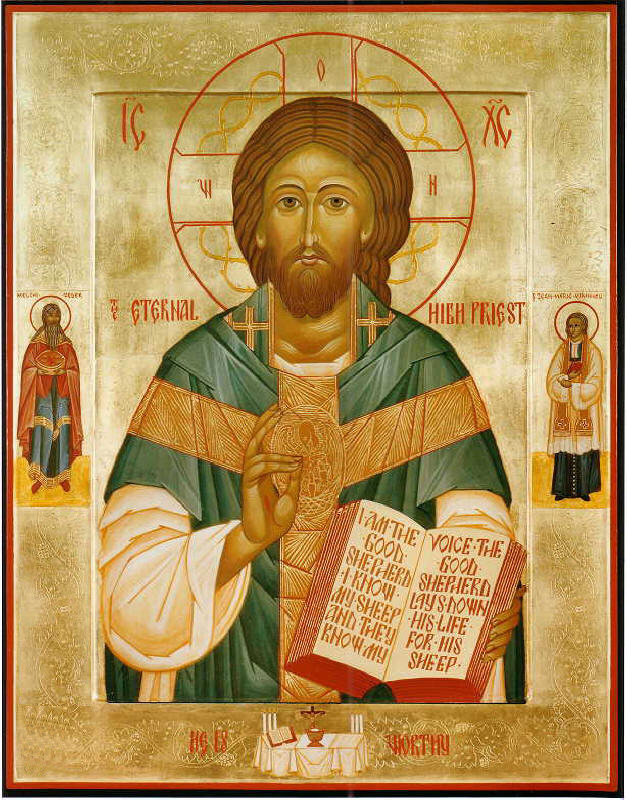
This icon shows Jesus Christ, our eternal high priest.
The gold pelican over His heart represents self-sacrifice.
The border contains an altar and grapevines, representing the Mass, and icons of Melchizedek and St. Jean-Baptiste Vianney.
Melchizedek: king of righteousness (left icon) was priest and king of Jerusalem. He blessed Abraham and has been considered an ideal priest-king.
St. Jean-Baptiste Vianney is the patron saint of parish priests.
Disclaimer: Opinions posted on Free Republic are those of the individual posters and do not necessarily represent the opinion of Free Republic or its management. All materials posted herein are protected by copyright law and the exemption for fair use of copyrighted works.