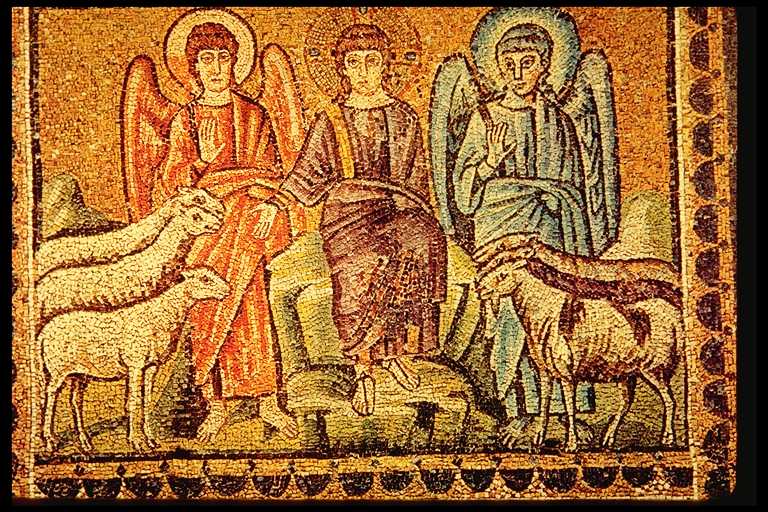
Christ separates the sheep from the goats
early 6th-century
the Church of Appolinare Nuovo
Ravenna
Posted on 09/12/2019 11:13:13 PM PDT by Salvation
KEYWORDS: catholic; lk6; ordinarytime; prayer; saints;
Please FReepmail me to get on/off the Alleluia Ping List.
From: 1 Timothy 1:1-2, 12-14
Greeting
[2] To Timothy, my true child in the faith: Grace, mercy, and peace from God the
Father and Christ Jesus our Lord.
Paul Recalls His Own Conversion
*********************************************************************************************
Commentary:
12-13. This clearly autobiographical passage, which shows the Apostle’s humi-
lity (cf., e.g., 1 Cor 15:9-10), is evidence of the letter’s Pauline authorship: it is
difficult to believe that a later disciple would have dared to call St Paul a “blas-
phemer”, “persecutor” or “insulter” or made him describe himself as “the fore-
most of sinners”.
St Paul’s conversion is an example of a miracle of grace; only by the mercy of
God could he have been changed and become the Apostle of the Gentiles and
such a faithful minister of the Gospel. This change which grace worked in Paul
can also help all who approach the Church to have great confidence in God’s
mercy and forgiveness; like a good father, God is always ready to receive the
repentant sinner.
The sacred text shows quite clearly that the initiative lies with God when it
comes to calling people to Church office. The call to the priesthood is a grace
from God; it is God who makes the choice and then he gives the person he has
chosen the strength to fulfill his office worthily. In this connection Bishop Alvaro
del Portillo has written: “Christian priesthood is not, then, in the line of ethical
relationships among men nor on the level of a merely human attempt to ap-
proach God: it is a gift from God and it is irreversibly located on the vertical line
of the search for man by his Creator and Sanctifier and on the sacramental line
of the gratuitous opening up to man of God’s intimate life. In other words, Chris-
tian priesthood is essentially (this is the only possible way it can be understood)
an eminently sacred mission, both in its origin (Christ) and in its content (the di-
vine mystery) and by the very manner in which it is conferred—a sacrament”
(”On Priesthood”, pp. 59f).
14. “In Christ Jesus”: this expression is being used with a special technical
meaning: it refers to the position of the new man who, after the “washing of re-
generation and renewal in the Holy Spirit” (Titus 3:5) which takes place at Bap-
tism, is now united to Christ, made a Christian. At Baptism the mercy of God
not only justifies the sinner but causes him to share profoundly in God’s own life
by means of grace, faith and love. These three gifts are a sign that the Christian
has truly been built into the body of Christ (cf. 2 Tim 1:13).
*********************************************************************************************
Source: “The Navarre Bible: Text and Commentaries”. Biblical text from the
Revised Standard Version and New Vulgate. Commentaries by members of
the Faculty of Theology, University of Navarre, Spain.
Published by Four Courts Press, Kill Lane, Blackrock, Co. Dublin, Ireland, and
by Scepter Publishers in the United States.
Memorial: St John Chrysostom, Bishop and Doctor
From: Luke 6:39-42
Integrity
*********************************************************************************************
Commentary:
[None for Luke 6:39-42. Below is a commentary on a similar theme from Matthew
7:1-5:]
1. Jesus is condemning any rash judgments we make maliciously or carelessly
about our brothers’ behavior or feelings or motives. “Think badly and you will not
be far wrong” is completely at odds with Jesus’ teaching.
In speaking of Christian charity St. Paul lists its main features: “Love is patient
and kind [...]. Love bears all things, believes all things, hopes all things, endures
all things” (1 Corinthians 13:4, 5, 7). Therefore, “Never think badly of anyone, not
even if the words or conduct of the person in question give you good grounds for
doing so” (St. J. Escriva, “The Way”, 442).
“Let us be slow to judge. Each one sees things from his own point of view, as his
mind, with all its limitations, tells him, and through eyes that are often dimmed
and clouded by passion” (”ibid”., 451).
1-2. As elsewhere, the verbs in the passive voice (”you will be judged”, “the mea-
sure you will be given”) have God as their subject, even though He is not explicit-
ly mentioned: “Do not judge others, that you be not judged by God”. Clearly the
judgment referred to here is always a condemnatory judgment; therefore, if we do
not want to be condemned by God, we should never condemn our neighbor. “God
measures out according as we measure out and forgives as we forgive, and comes
to our rescue with the same tenderness as He sees us having towards others”
(Fray Luis de Leon, “Exposicion Del Libro De Job”, chapter 29).
3-5. A person whose sight is distorted sees things as deformed, even though in
fact they are not deformed. St. Augustine gives this advice: “Try to acquire those
virtues which you think your brothers lack, and you will no longer see their defects,
because you will not have them yourselves” (”Enarrationes In Psalmos”, 30, 2, 7).
In this connection, the saying, “A thief thinks that everyone else is a thief” is in
line with this teaching of Jesus.
Besides: “To criticize, to destroy, is not difficult; any unskilled laborer knows how
to drive his pick into the noble and finely-hewn stone of a cathedral. To construct
that is what requires the skill of a master” (St. J. Escriva, “The Way”, 456).
*********************************************************************************************
Source: “The Navarre Bible: Text and Commentaries”. Biblical text from the
Revised Standard Version and New Vulgate. Commentaries by members of
the Faculty of Theology, University of Navarre, Spain.
Published by Four Courts Press, Kill Lane, Blackrock, Co. Dublin, Ireland, and
by Scepter Publishers in the United States. We encourage readers to purchase
The Navarre Bible for personal study. See Scepter Publishers for details.
Please pray for this ministry and support it through PayPal here. For other
options (check, money order, etc.) please contact the Listowner directly.
“Ignorance of Scripture is ignorance of Christ.” — St Jerome
*********************************************************************************************
Ad Majorem Dei Gloriam (To the Greater Glory of God)
For: Friday, September 11, 2015
23rd Week in Ordinary Time
From: Luke 6:39-42
Integrity
*********************************************************************************************
Commentary:
[None for Luke 6:39-42. Below is a commentary on a similar theme from Matthew
7:1-5:]
1. Jesus is condemning any rash judgments we make maliciously or carelessly
about our brothers’ behavior or feelings or motives. “Think badly and you will not
be far wrong” is completely at odds with Jesus’ teaching.
In speaking of Christian charity St. Paul lists its main features: “Love is patient
and kind [...]. Love bears all things, believes all things, hopes all things, endures
all things” (1 Corinthians 13:4, 5, 7). Therefore, “Never think badly of anyone, not
even if the words or conduct of the person in question give you good grounds for
doing so” (St. J. Escriva, “The Way”, 442).
“Let us be slow to judge. Each one sees things from his own point of view, as his
mind, with all its limitations, tells him, and through eyes that are often dimmed
and clouded by passion” (”ibid”., 451).
1-2. As elsewhere, the verbs in the passive voice (”you will be judged”, “the mea-
sure you will be given”) have God as their subject, even though He is not explicit-
ly mentioned: “Do not judge others, that you be not judged by God”. Clearly the
judgment referred to here is always a condemnatory judgment; therefore, if we do
not want to be condemned by God, we should never condemn our neighbor. “God
measures out according as we measure out and forgives as we forgive, and comes
to our rescue with the same tenderness as He sees us having towards others”
(Fray Luis de Leon, “Exposicion Del Libro De Job”, chapter 29).
3-5. A person whose sight is distorted sees things as deformed, even though in
fact they are not deformed. St. Augustine gives this advice: “Try to acquire those
virtues which you think your brothers lack, and you will no longer see their defects,
because you will not have them yourselves” (”Enarrationes In Psalmos”, 30, 2, 7).
In this connection, the saying, “A thief thinks that everyone else is a thief” is in
line with this teaching of Jesus.
Besides: “To criticize, to destroy, is not difficult; any unskilled laborer knows how
to drive his pick into the noble and finely-hewn stone of a cathedral. To construct
that is what requires the skill of a master” (St. J. Escriva, “The Way”, 456).
*********************************************************************************************
Source: “The Navarre Bible: Text and Commentaries”. Biblical text from the
Revised Standard Version and New Vulgate. Commentaries by members of
the Faculty of Theology, University of Navarre, Spain.
Published by Four Courts Press, Kill Lane, Blackrock, Co. Dublin, Ireland, and
by Scepter Publishers in the United States.
Liturgical Colour: White.
These are the readings for the feria
| First reading |
|---|
| 1 Timothy 1:1-2,12-14 © |
| I used to be a blasphemer, but the mercy of God was shown me |
|---|
| Responsorial Psalm |
|---|
| Psalm 15(16):1-2,5,7-8,11 © |
| Gospel Acclamation | Ps147:12,15 |
|---|
| Or: | Jn17:17 |
|---|
| Gospel | Luke 6:39-42 © |
|---|
| Can the blind lead the blind? |
|---|
These are the readings for the memorial
| First reading |
|---|
| Ephesians 4:1-7,11-13 © |
| We are all to come to unity, fully mature in the knowledge of the Son of God |
|---|
| Responsorial Psalm |
|---|
| Psalm 39(40):2,4,7-11 © |
| Gospel Acclamation |
|---|
| Gospel |
|---|
| Mark 4:1-10,13-20 © |
| The parable of the sower |
|---|
| Luke | |||
| English: Douay-Rheims | Latin: Vulgata Clementina | Greek NT: Byzantine/Majority Text (2000) | |
| Luke 6 |
|||
| 39. | And he spoke also to them a similitude: Can the blind lead the blind? do they not both fall into the ditch? | Dicebat autem illis et similitudinem : Numquid potest cæcus cæcum ducere ? nonne ambo in foveam cadunt ? | ειπεν δε παραβολην αυτοις μητι δυναται τυφλος τυφλον οδηγειν ουχι αμφοτεροι εις βοθυνον πεσουνται |
| 40. | The disciple is not above his master: but every one shall be perfect, if he be as his master. | Non est discipulus super magistrum : perfectus autem omnis erit, si sit sicut magister ejus. | ουκ εστιν μαθητης υπερ τον διδασκαλον αυτου κατηρτισμενος δε πας εσται ως ο διδασκαλος αυτου |
| 41. | And why seest thou the mote in thy brother's eye: but the beam that is in thy own eye thou considerest not? | Quid autem vides festucam in oculo fratris tui, trabem autem, quæ in oculo tuo est, non consideras ? | τι δε βλεπεις το καρφος το εν τω οφθαλμω του αδελφου σου την δε δοκον την εν τω ιδιω οφθαλμω ου κατανοεις |
| 42. | Or how canst thou say to thy brother: Brother, let me pull the mote out of thy eye, when thou thyself seest not the beam in thy own eye? Hypocrite, cast first the beam out of thy own eye; and then shalt thou see clearly to take out the mote from thy brother's eye. | aut quomodo potes dicere fratri tuo : Frater, sine ejiciam festucam de oculo tuo : ipse in oculo tuo trabem non videns ? Hypocrita, ejice primum trabem de oculo tuo : et tunc perspicies ut educas festucam de oculo fratris tui. | η πως δυνασαι λεγειν τω αδελφω σου αδελφε αφες εκβαλω το καρφος το εν τω οφθαλμω σου αυτος την εν τω οφθαλμω σου δοκον ου βλεπων υποκριτα εκβαλε πρωτον την δοκον εκ του οφθαλμου σου και τοτε διαβλεψεις εκβαλειν το καρφος το εν τω οφθαλμω του αδελφου σου |
The ambiguity and intrigue surrounding John, the great preacher (his name means “golden-mouthed”) from Antioch, are characteristic of the life of any great man in a capital city. Brought to Constantinople after a dozen years of priestly service in Syria, John found himself the reluctant victim of an imperial ruse to make him bishop in the greatest city of the empire. Ascetic, unimposing but dignified, and troubled by stomach ailments from his desert days as a monk, John became a bishop under the cloud of imperial politics.
If his body was weak, his tongue was powerful. The content of his sermons, his exegesis of Scripture, were never without a point. Sometimes the point stung the high and mighty. Some sermons lasted up to two hours.
His lifestyle at the imperial court was not appreciated by many courtiers. He offered a modest table to episcopal sycophants hanging around for imperial and ecclesiastical favors. John deplored the court protocol that accorded him precedence before the highest state officials. He would not be a kept man.
His zeal led him to decisive action. Bishops who bribed their way into office were deposed. Many of his sermons called for concrete steps to share wealth with the poor. The rich did not appreciate hearing from John that private property existed because of Adam’s fall from grace any more than married men liked to hear that they were bound to marital fidelity just as much as their wives were. When it came to justice and charity, John acknowledged no double standards.
Aloof, energetic, outspoken, especially when he became excited in the pulpit, John was a sure target for criticism and personal trouble. He was accused of gorging himself secretly on rich wines and fine foods. His faithfulness as spiritual director to the rich widow, Olympia, provoked much gossip attempting to prove him a hypocrite where wealth and chastity were concerned. His actions taken against unworthy bishops in Asia Minor were viewed by other ecclesiastics as a greedy, uncanonical extension of his authority.
Theophilus, archbishop of Alexandria, and Empress Eudoxia were determined to discredit John. Theophilus feared the growth in importance of the Bishop of Constantinople and took occasion to charge John with fostering heresy. Theophilus and other angered bishops were supported by Eudoxia. The empress resented his sermons contrasting gospel values with the excesses of imperial court life. Whether intended or not, sermons mentioning the lurid Jezebel and impious Herodias were associated with the empress, who finally did manage to have John exiled. He died in exile in 407.
John Chrysostom’s preaching, by word and example, exemplifies the role of the prophet to comfort the afflicted and to afflict the comfortable. For his honesty and courage, he paid the price of a turbulent ministry as bishop, personal vilification, and exile.
Orators
Preachers
Speakers

Pray for Pope Francis.
50 Boko Haram Islamic Radicals Killed; 1,000 Hostages, Women and Children, Rescued in Nigeria
Nigeria: In the Face of Ongoing Islamist Attacks, the Faith is Growing
US Promises to Help Nigeria Exterminate Boko Haram
Is This Bishop Right about the Rosary Conquering Boko Haram? [Catholic Caucus]
Why Boko Haram and ISIS Target Women
Report reveals scale of Boko Haram violence inflictef on Nigerian Catholics
Military evacuating girls, women rescued from Boko Haram
Echos of Lepanto Nigerian bishop says rosary will bring down Boko Harm
After vision of Christ, Nigerian bishop says rosary will bring down Boko Haram (Catholic Caucus)
Nigerian Bishop Says Christ Showed Him How to Beat Islamic Terror Group
We thank you, God our Father, for those who have responded to your call to priestly ministry.
Accept this prayer we offer on their behalf: Fill your priests with the sure knowledge of your love.
Open their hearts to the power and consolation of the Holy Spirit.
Lead them to new depths of union with your Son.
Increase in them profound faith in the Sacraments they celebrate as they nourish, strengthen and heal us.
Lord Jesus Christ, grant that these, your priests, may inspire us to strive for holiness by the power of their example, as men of prayer who ponder your word and follow your will.
O Mary, Mother of Christ and our mother, guard with your maternal care these chosen ones, so dear to the Heart of your Son.
Intercede for our priests, that offering the Sacrifice of your Son, they may be conformed more each day to the image of your Son, our Lord and Savior, Jesus Christ. Amen.
Saint John Vianney, universal patron of priests, pray for us and our priests
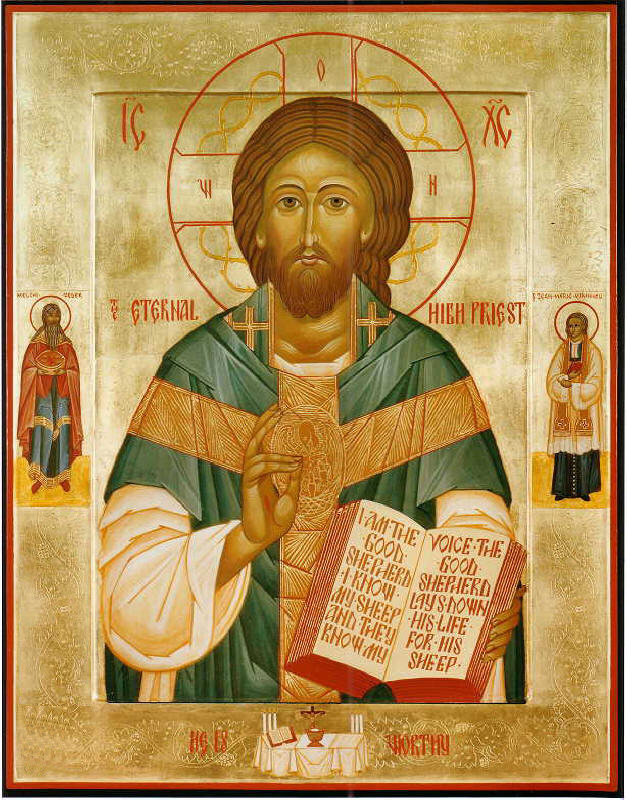
This icon shows Jesus Christ, our eternal high priest.
The gold pelican over His heart represents self-sacrifice.
The border contains an altar and grapevines, representing the Mass, and icons of Melchizedek and St. Jean-Baptiste Vianney.
Melchizedek: king of righteousness (left icon) was priest and king of Jerusalem. He blessed Abraham and has been considered an ideal priest-king.
St. Jean-Baptiste Vianney is the patron saint of parish priests.

1. Sign of the Cross: In the name of the Father, and of the Son, and of the Holy Spirit. Amen.
2. The Apostles Creed: I BELIEVE in God, the Father almighty, Creator of heaven and earth, and in Jesus Christ, His only Son, our Lord, who was conceived by the Holy Spirit, born of the Virgin Mary, suffered under Pontius Pilate, was crucified, died, and was buried. He descended into hell; on the third day he rose again from the dead; he ascended into heaven, and is seated at the right hand of God, the Father Almighty; from there He shall come to judge the living and the dead.
I believe in the Holy Spirit, the holy catholic Church, the communion of saints, the forgiveness of sins, the resurrection of the body, and the life everlasting. Amen.
3. The Lord's Prayer: OUR Father, who art in heaven, hallowed be Thy name. Thy kingdom come. Thy will be done on earth as it is in heaven. Give us this day our daily bread and forgive us our trespasses as we forgive those who trespass against us. And lead us not into temptation, but deliver us from evil. Amen.
4. (3) Hail Mary: HAIL Mary, full of grace, the Lord is with thee. Blessed art thou amongst women and blessed is the fruit of thy womb, Jesus. Holy Mary, Mother of God, pray for us sinners, now, and in the hour of our death. Amen. (Three times)
5. Glory Be: GLORY be to the Father, and to the Son, and to the Holy Spirit. As it was in the beginning, is now, and ever shall be, world without end. Amen.
6. Fatima Prayer: Oh, my Jesus, forgive us our sins, save us from the fires of hell, lead all souls to heaven, especially those in most need of your mercy.
Announce each mystery, then say 1 Our Father, 10 Hail Marys, 1 Glory Be and 1 Fatima prayer. Repeat the process with each mystery.
End with the Hail Holy Queen:
Hail, Holy Queen, Mother of Mercy, our life, our sweetness and our hope! To thee do we cry, poor banished children of Eve! To thee do we send up our sighs, mourning and weeping in this vale of tears! Turn then, most gracious advocate, thine eyes of mercy towards us; and after this, our exile, show unto us the blessed fruit of thy womb, Jesus!
O clement, O loving, O sweet Virgin Mary! Pray for us, O holy Mother of God, that we may be made worthy of the promises of Christ.
Final step -- The Sign of the Cross
The Mysteries of the Rosary By tradition, Catholics meditate on these Mysteries during prayers of the Rosary. The biblical references follow each of the Mysteries below.
The Sorrowful Mysteries
(Tuesdays and Fridays)
1. The Agony in the Garden (Matthew 26:36-46, Luke 22:39-46) [Spiritual fruit - God's will be done]
2. The Scourging at the Pillar (Matthew 27:26, Mark 15:15, John 19:1) [Spiritual fruit - Mortification of the senses]
3. The Crowning with Thorns (Matthew 27:27-30, Mark 15:16-20, John 19:2) [Spiritual fruit - Reign of Christ in our heart]
4. The Carrying of the Cross (Matthew 27:31-32, Mark 15:21, Luke 23:26-32, John 19:17) [Spiritual fruit - Patient bearing of trials]
5. The Crucifixion (Matthew 27:33-56, Mark 15:22-39, Luke 23:33-49, John 19:17-37) [Spiritual fruit - Pardoning of Injuries]

St. Michael the Archangel
~ PRAYER ~
St. Michael, the Archangel, defend us in battle
Be our protection against the wickedness
and snares of the devil;
May God rebuke him, we humbly pray,
and do thou, O Prince of the heavenly host,
by the power of God,
Cast into hell Satan and all the evil spirits
who prowl through the world seeking the ruin of souls.
Amen
+
Disclaimer: Opinions posted on Free Republic are those of the individual posters and do not necessarily represent the opinion of Free Republic or its management. All materials posted herein are protected by copyright law and the exemption for fair use of copyrighted works.