Skip to comments.
India: Christians warn against law raising punishments for 'forced' religious conversions
Christian post ^
| 8 August 2019
| Samuel Smith
Posted on 09/09/2019 1:58:21 AM PDT by Cronos
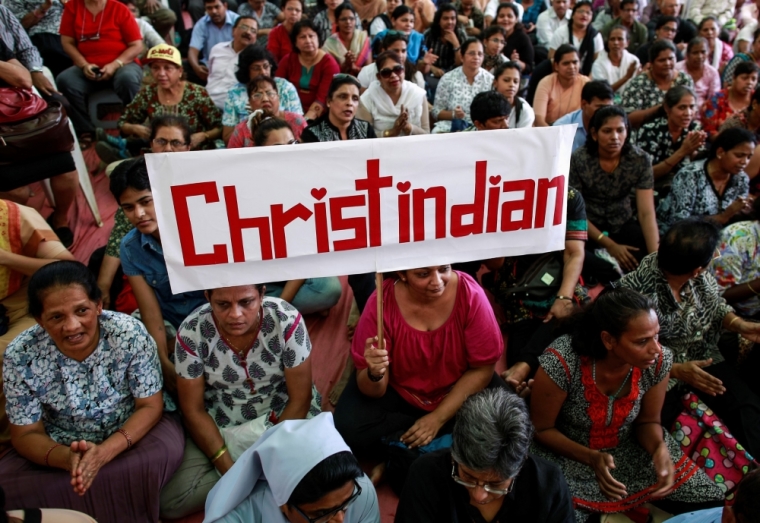 A protester holds a placard during a rally by hundreds of Christians against recent attacks on churches nationwide, in Mumbai, February 9, 2015. Five churches in the Indian capital New Delhi have reported incidents of arson, vandalism and burglary. The latest was reported last week when an individual stole ceremonial items. | (Photo: Reuters/Danish Siddiqui)
A state in India has passed a new law broadening the definition of illegal conversion and creating stiffer penalties for those accused of forced conversion. Critics fear the update to the so-called religious freedom law will be used by Hindus to further harass Christians.
The Freedom of Religion Act 2019 was unanimously approved in a voice vote by the legislature in the northern Indian state of Himachal Pradesh on Aug 30. The state Legislature is led by the Hindu nationalist Bharatiya Janata Party, according to The Hindu.
The bill raises the maximum punishment for violating the forced religious conversion law from three years in prison to seven. It replaces the state’s Freedom of Religion Act of 2006, which banned religious conversion as a result of force or inducement.
The new law extends the definition of forced religious conversion to include conversion that takes place as a result of misrepresentation, force, undue influence, coercion, inducement, marriage, or other fraudulent means.
Himachal Pradesh is one of seven states in India that have forced religious conversion laws. Critics say these laws are often abused by Hindu radicals to persecute Christians and other religious minorities.
Across the country, examples of abuse of the law have been seen in the arrests of Christians escorting children to summer camps and the arrests of Christian pastors during worship services.
"The previous 2006 law provided for a maximum of [three] years in prison for those who broke the rules,” Sajan K George, president of the Global Council of Indian Christians, told the Catholic news agency Asia News. “The new law contains some terms that were absent in the past, such as coercion, misrepresentation, marriage, excessive influence. Section 5 of the law declares marriage to be null and void if was done for the sole purpose of conversion."
George warned that "anti-conversion laws discriminate against religious minorities” and are used as a “tool to harass vulnerable Christians.”
“They can plant seeds of sectarian suspicion among communities that have lived together in a peaceful manner and can be used against the weakest in society, in particular Dalits, women and children,” George stressed.
Under the new law, those found guilty of conversion by force, deception or marriage can be sentenced to between one to five years in prison. But if those who were converted are Dalits (the lowest caste), or women and children, the maximum punishment increases to seven years in prison.
The new law also requires people seeking to convert religions and the priest doing the converting to notify the district magistrate one month before the conversion takes place.
The Hindu reports that Chief Minister of Himachal Pradesh Jai Ram Thakur argued that the new law is needed because of the rise of religious conversions in the state.
International Christian Concern, a nonprofit organization based in the U.S. that monitors Christian persecution worldwide, reports that Hindu radicals often use the “conspiracy” of mass religious conversions to pass laws that limit religious freedom. Christians are often accused of fraudulently converting Hindus.
“However, according to India’s own population data, the conspiracy of mass conversions to Christianity does not hold up,” an ICC report from Monday reads. “In 1951, the first census after independence, Christians made up only 2.3 percent of India’s overall population. According to the 2011 census, the most recent census data available, Christians still only make up 2.3 percent of the population.”
The ICC is also warning that anti-conversion laws are “widely abused” in the states where they are enacted — Odisha, Madhya Pradesh, Arunachal Pradesh, Chhattisgarh, Gujarat, Himachal Pradesh, Jharkhand, and Uttrakhand — as nationalists accused Christian leaders and evangelists of forcible conversion to justify harassment or assault.
“Local police often overlook this harassment due to the false accusation of forced conversions,” ICC notes.
India ranks as the 10th worst country in the world when it comes to Christian persecution, according to Open Doors USA’s World Watch List. Since the BJP came to national power in 2014, Hindu nationalist attacks against Christians and Muslims have increased.
Several cases have been reported over the last few years of Christians arrested after being accused of forcible conversion.
In May 2017, at least 11 chaperones transporting 70 children to a Christian camp were arrested in Madhya Pradesh after they were accused by Hindu radicals of forcible conversion.
Last September, in Uttar Pradesh, it was reported that at least 10 pastors were arrested after authorities stormed church services across the state after Hindu radicals made accusations of forced conversions.
Follow Samuel Smith on Twitter: @IamSamSmith
or Facebook: SamuelSmithCP
TOPICS: Catholic; Current Events; General Discusssion
KEYWORDS:
The Hindu groups accuse Christians of deceiving people and converting them.
These accusations have only started in the past 25 years as many Evangelical - some like Benny Hinn etc. have come into the country.
I haven't read or heard of any forced conversions, but many hindus point out the Miracle sessions like Hinns etc. as "proof"
By some reports as much as 10% of India - 130 million people are newly converted Christians, bringing the number of christians up to 12.5%
1
posted on
09/09/2019 1:58:21 AM PDT
by
Cronos
To: Cronos
“I haven’t read or heard of any forced conversions...”
Here’s an excerpt:
Goa inquisition
The Portuguese practised religious persecution in Goa, India in the 16th and 17th centuries. The natives of Goa, most of them Hindus, were subjected to severe torture and oppression by the zealous Portuguese rulers and missionaries, and forcibly converted to Christianity.[34][35][36][37][38][39]
In 1567, the campaign to destroy temples in Bardez met with success, with 300 Hindu temples destroyed. Prohibition was laid from December 4, 1567 on rituals of Hindu marriages, sacred thread wearing and cremation. All persons above 15 years of age were compelled to listen to Christian preaching, failing which they were punished. In 1583, Hindu temples at Assolna and Cuncolim were destroyed by the Portuguese army. “The fathers of the Church forbade the Hindus under terrible penalties the use of their own sacred books, and prevented them from all exercise of their religion. They destroyed their temples, and so harassed and interfered with the people that they abandoned the city in large numbers, refusing to remain any longer in a place where they had no liberty, and were liable to imprisonment, torture and death if they worshiped after their own fashion the gods of their fathers”, wrote Filippo Sassetti, who was in India from 1578 to 1588. An order was issued in June 1684 for suppressing the Konkani language and making it compulsory to speak Portuguese, on pain of severe penalties. All non-Christian cultural symbols and books written in local languages were also ordered to be destroyed.[40]
https://en.wikipedia.org/wiki/Forced_conversion#India_2
2
posted on
09/09/2019 2:49:07 AM PDT
by
Jyotishi
(Seeking the truth, a fact at a time.)
To: Jyotishi
1. you’re talking of something from the 16th and 17th centuries. This is a law about “forced conversions” of today, in the 21st century - no forced conversions to Christianity happen in today’s india and none have happened in independent India
2. They didn’t manage to destroy the konkani language nor the hindu customs -
2.1. Hindus survived in Goa and were the majority at the time of reunification with India
2.2. The Catholic Managaloreans - grandchildren of Hindu brahmin converts, moved to Mangalore, 300km south, under Hindu lords and retained both their Konkani language and many Hindu cultural aspects
3
posted on
09/09/2019 2:55:19 AM PDT
by
Cronos
(Re-elect President Trump 2020!)
To: Cronos
Laws about forced conversions can be a minefield that the lawyer class loves, if there is too many terms that are used for “forced” that leave too much to interpretation.
Such laws should within the same law consider it criminal to stop, or attempt to stop, or take any action against any voluntary religious conversion. I think such actions are carried out more often or at least just as often as forced conversions.
There is too much culture in nations like India in such laws. They are about protecting group identity more than about protecting the free conscience of the individual. They as much as anything else seek to “protect” the offspring of people from converting from the religion of their parents. Their identity is tied up in the tribe, clan, village and so forth and it is often tied up with religion. To many, leaving the religion of parents is like leaving your whole identity behind. There is so much importance placed on it, there is so much angst about it. That angst leads to extreme concern, anger and violence, from those who oppose a conversion.
4
posted on
09/09/2019 7:49:33 AM PDT
by
Wuli
To: Wuli
Look what do you want to believe in )
some myriad of pagan gods ?
Or the one true savior of humanity ? your choice
5
posted on
09/09/2019 8:59:24 AM PDT
by
Truthoverpower
(The guvmint you get is the Trump winning express !)
To: Truthoverpower
Your point is?
I am for freedom of Conscience and believe as far as secular law goes that is the best legal framework for Christianity. While separation of church and state in that limited sense does not legally promote Christianity, neither was/is it intended to suppress it either. That to me makes a legal environment most healthy for Christians.
So what is your argument about my comments????
6
posted on
09/09/2019 9:12:58 AM PDT
by
Wuli
Disclaimer:
Opinions posted on Free Republic are those of the individual
posters and do not necessarily represent the opinion of Free Republic or its
management. All materials posted herein are protected by copyright law and the
exemption for fair use of copyrighted works.
FreeRepublic.com is powered by software copyright 2000-2008 John Robinson